Jeju Island has no passenger railway or subway. Most travelers use public buses, taxis, rental cars, or a combination of the three. A rental car offers the most flexibility for rural attractions, while buses are inexpensive and practical if you organize each day around one area. Taxis work well for airport transfers, short gaps between bus routes, and groups sharing the fare.
Fares, schedules, and transport rules in this guide were verified on June 9, 2026. Check again shortly before traveling because routes and operating times can change.
At a glance
| Option | Works best for | Main limitation |
|---|---|---|
| Public bus | Budget travel, solo travelers, major towns and attractions | Rural services may be infrequent and require transfers |
| Taxi | Airport transfers, short trips, small groups | Long cross-island journeys become expensive |
| Rental car | Rural sightseeing, families, tight itineraries | License requirements, parking, and insurance need advance attention |
| Hired taxi tour | Travelers who do not drive but want a flexible day | Costs more than public transport and normally requires advance booking |
| Bicycle | Experienced cyclists following coastal routes | Wind, hills, weather, and traffic make it unsuitable as casual transport |
A useful compromise is to stay near a transport hub, use buses for straightforward journeys, and take taxis only where the final connection is inconvenient.
Understanding Jeju's geography
Jeju is larger and more spread out than its resort-island image may suggest. Jeju City and the airport are on the north coast, while Seogwipo is on the south coast. Hallasan, the island's central mountain, limits direct east-west travel through the middle.
Attractions that look close on a map may be separated by volcanic terrain, indirect roads, or infrequent bus connections. Do not plan a day by drawing a simple circle around the island. Group stops geographically instead:
- North: Jeju City, Dongmun Market, Iho Tewoo and nearby coastal districts
- East: Hamdeok, Gimnyeong, Woljeongri, Seongsan and Seopjikoji
- South: Seogwipo, Jungmun, waterfalls and the southern coast
- West: Aewol, Hallim, Hyeopjae, Andeok and southwest attractions
- Central highlands: Hallasan trail entrances, forests and oreum volcanic cones
Even with a car, trying to visit the far east, far west, and Seogwipo in one day usually means spending too much time on the road.
Getting around Jeju by bus
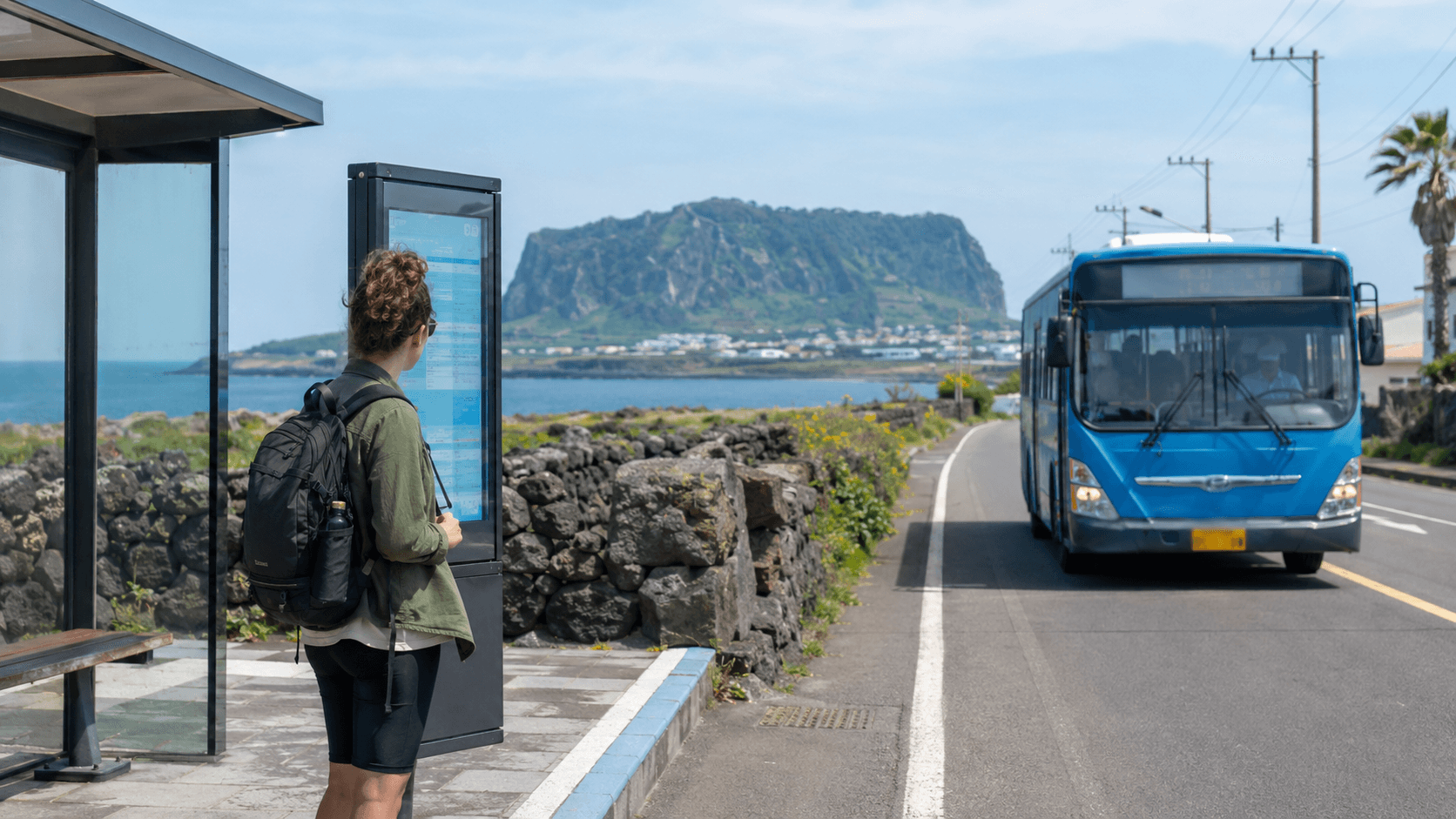
Jeju's bus network reaches both cities, coastal towns, rural villages, and numerous visitor attractions. It is the cheapest way to travel, but successful bus travel depends on checking the exact stop, direction, and final departure time.
The official Jeju Bus Information System provides route searches, stop information, timetables, and real-time vehicle locations. For English journey planning, Naver Map and KakaoMap are generally more useful in Korea than relying exclusively on international map services. Search with the attraction's Korean name or street address when an English name produces several results.
Bus fares and payment
The following adult fares were confirmed through the official Jeju bus fare information on June 9, 2026:
| Bus type | Transportation card | Cash |
|---|---|---|
| Regular trunk, branch, and tourist-loop buses | KRW 1,150 | KRW 1,200 |
| Express bus, first 20 km | KRW 2,000 | KRW 3,000 |
| Express bus, maximum adult fare | KRW 3,000 | KRW 3,000 |
Express-bus card fares increase with distance after the first 20 km. The current adult airport-limousine ranges are KRW 1,300-5,500 for bus 600 and KRW 1,300-5,000 for buses 800 and 800-1, depending on the section traveled.
Use a rechargeable transportation card such as T-money. Cards are sold and topped up at convenience stores. According to the Korea Tourism Organization's transportation payment guide, transportation-card purchases and top-ups at convenience stores generally require cash; a foreign-issued bank card cannot be used directly as a tap-to-pay bus card.
Tap the reader when boarding and when leaving. The exit tap calculates distance-based express fares and activates transfer discounts. Jeju permits up to two discounted transfers when the next eligible bus is boarded within 40 minutes of the exit tap. The same route is excluded.
If more than one person is using one card, tell the driver the number of passengers before tapping. Separate cards are simpler when travelers may split up or transfer independently.
How to plan a bus journey
- Find the attraction's exact map entry, including its Korean name if possible.
- Check both the outbound and return journey before leaving your accommodation.
- Note the stop number and direction, not only the stop name. Stops on opposite sides of a road may have similar names.
- Allow at least 10-15 minutes for a rural transfer. A missed connection can create a much longer delay.
- Check the day's official notices in the Jeju Bus Information System for diversions or timetable adjustments.
- Save a screenshot of the final return service in case mobile reception or app data becomes unreliable.
Published times are not guarantees. Congestion, roadworks, festivals, and severe weather can delay services. At small rural stops, stand where the driver can see you and signal clearly as the bus approaches.
Airport buses
Jeju International Airport has bus stops directly outside the terminal. Confirm your stop number on the airport signs because city, express, and limousine services use different boarding positions.
Bus 600 links the airport with Jungmun and Seogwipo through major hotel and resort areas. As verified on June 9, 2026, the airport's official transport page listed departures from the airport between 06:00 and 22:40, with intervals of approximately 16-40 minutes. Its airport stop is in front of Gate 5. Recheck the timetable for your arrival date, particularly after a late flight.
If you are carrying a large suitcase, airport limousine services are usually easier than local buses with several transfers. For an early departure, confirm the first bus before booking accommodation far from the airport.
Tourist-loop buses
Tourist-loop routes are designed to connect clusters of attractions in Jeju's rural areas. The principal routes are 810, based around Daecheon Transit Center in the east, and 820, based around Donggwang Transit Center in the west.
The official fare and timetable page listed one-day tourist-loop passes at KRW 3,000 for adults, KRW 2,000 for teenagers, and KRW 1,000 for children on June 9, 2026. Passes are issued at the offices inside Daecheon and Donggwang transit centers.
These buses are useful only when their stops match your itinerary. Confirm the direction of the loop and the last departure from each attraction rather than assuming frequent hop-on, hop-off service.
Taking taxis in Jeju
Taxis are easy to find at the airport and in the central parts of Jeju City and Seogwipo. Availability becomes less predictable near beaches, trail entrances, and rural attractions, especially in the evening.
You can use a taxi rank, ask your accommodation to call one, or use a ride-hailing app. The Korea Tourism Organization currently identifies services including k.ride and Uber Taxi for international visitors. App coverage and driver availability still vary by location.
Current taxi fares
The official Jeju taxi fare table showed these standard medium-taxi rates on June 9, 2026:
- Base fare: KRW 4,300 for the first 2 km
- Distance charge after 2 km: KRW 100 per 126 metres
- Low-speed time charge: KRW 100 per 31 seconds below 15 km/h
- Long-distance surcharge: applies after 20 km to small and medium taxis
- Late-night surcharge: 20% from 23:00 to 04:00
- Call fee: up to KRW 1,000 per dispatched ride where the registered call system applies
The meter, traffic, route, and surcharges determine the final amount. The airport publishes approximate standard-taxi estimates of KRW 9,000 to Jeju City Hall, KRW 25,000 to Aewol, KRW 35,000 to Jungmun, and KRW 45,000 to Seongsan. These are estimates rather than fixed fares; see the official airport taxi page.
Most taxis accept cards, but carrying some KRW is sensible. Show the destination's Korean address on your phone. For a rural destination, save the return plan before getting out and ask the attraction or restaurant whether staff can call a taxi later.
Hired taxi tours
A taxi hired for several hours can be practical for three or four travelers who do not want to drive. Jeju's official Global Taxi service connects visitors with drivers offering supported foreign languages. Use the Jeju Global Taxi information and reservation site to check current rates, operating rules, and availability.
Before confirming, establish in writing:
- Total hours and price
- Included distance
- Overtime and long-distance charges
- Parking and admission costs
- Pickup and final drop-off points
- Luggage capacity
- Cancellation and weather policies
Treat the driver as transport support, not automatically as a licensed tour guide, unless that service is explicitly included.
Renting a car
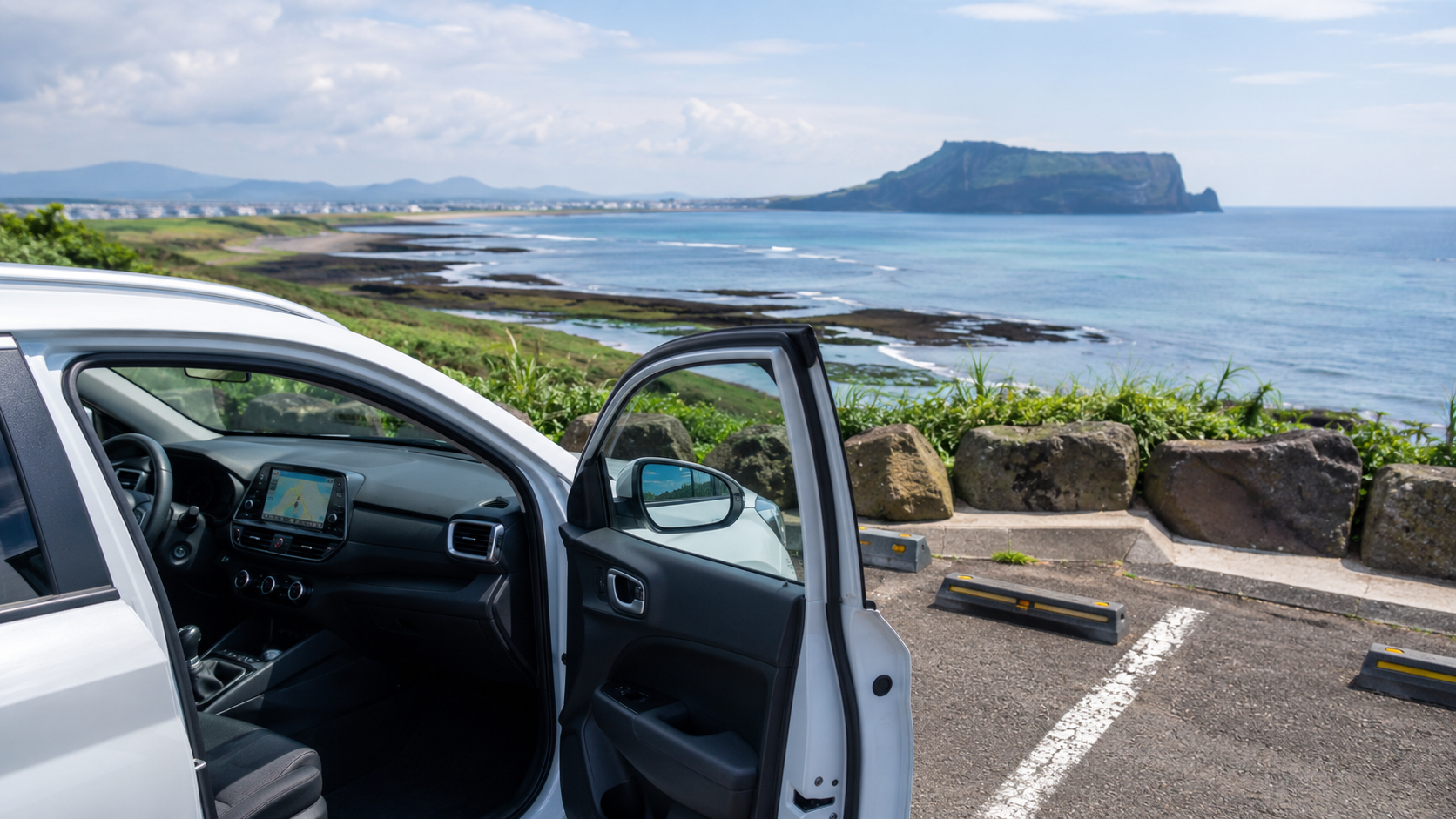
A rental car is the most flexible option for waterfalls, oreum, beaches, cafés, and rural attractions spread across several districts. It is particularly useful for families or groups sharing costs.
Foreign visitors must confirm that their license documents are valid in South Korea. Requirements depend on where the license was issued and the applicable international agreement. Rental companies commonly require a passport, the original domestic license, and a valid International Driving Permit, with matching names. Do not rely on a digital image or unofficial translation.
The Korea Tourism Organization notes that rentals are unavailable to travelers whose countries are not covered by the relevant International Driving Permit arrangements. Confirm eligibility with the rental company and the Korea Road Traffic Authority before paying a non-refundable rate. This is a legal eligibility issue, so use the official authority rather than travel-forum advice.
Collecting a rental car at the airport
Rental vehicles are generally collected from off-terminal facilities. The Jeju International Airport rental-car guide directs arriving passengers toward Gates 3 and 5, across the road to the Rental Car House, where company shuttle buses depart. Confirm your provider's shuttle bay and final pickup time in advance.
Allow extra time when returning the car. You must refuel or recharge as required, complete the inspection, and take a shuttle back to the terminal. During busy periods, returning the vehicle two to three hours before a domestic flight is more realistic than treating the rental office as part of the terminal.
What to check in the rental contract
- Which drivers are registered
- Minimum driver age and license-history requirements
- Collision-damage waiver and deductible
- Coverage for tires, wheels, glass, mirrors, and underbody damage
- Fuel or battery-return rules
- Cancellation fees caused by flight or weather disruption
- After-hours assistance
- Whether the vehicle can be taken on a ferry to a smaller island
Photograph the car, wheels, fuel level, and existing damage before leaving. Enter destinations while parked; Jeju's narrow village roads and sudden roadside entrances require attention.
Cycling and walking
Jeju has established coastal cycling routes, but cycling should be treated as an activity rather than an easy substitute for island-wide transport. Strong winds, rain, summer heat, hills, and vehicle traffic can make distances harder than expected. Check bicycle-return conditions carefully because some rental businesses require return to the original shop.
Walking works within compact areas such as central Jeju City, Seogwipo's market district, and individual coastal neighborhoods. It is not practical between widely separated attractions. Rural roads may lack continuous sidewalks or lighting, so avoid planning long roadside walks after dark.
Accessibility and traveling with luggage
Low-floor buses operate on parts of the network, but a particular departure should not be assumed to be wheelchair-accessible. Rural stops may also have uneven approaches or limited shelter. Contact the transport operator or the Jeju Tourist Information Center at 064-740-6000 to confirm a specific journey. Visit Jeju maintains an official traveling with disabilities information page.
Traveling by local bus with a large suitcase is possible but inconvenient during busy periods and transfers. Airport limousine buses, direct taxis, or an accommodation near a main bus corridor reduce the difficulty. Confirm that a taxi or hired vehicle can hold wheelchairs, strollers, or several large bags before booking.
Common transport mistakes
- Planning attractions by straight-line distance instead of actual travel time
- Checking the outbound bus but not the final return service
- Forgetting to tap the transportation card when leaving a bus
- Assuming a foreign credit card can be tapped directly on the bus reader
- Booking a rental car before confirming license eligibility
- Underestimating rental-car shuttle and return time at the airport
- Expecting taxis to wait near isolated trails or rural beaches
- Scheduling Hallasan and a distant coastal attraction on the same tightly timed day
- Relying on one map app without checking the exact Korean destination
What to check before you go
- Download Naver Map or KakaoMap and save accommodation addresses in Korean.
- Check current routes and notices through the Jeju Bus Information System.
- Buy and load a T-money card with KRW cash if using buses.
- Save the final bus time back to your accommodation.
- Confirm airport transport if arriving after 22:00 or departing early.
- Verify driving eligibility, insurance, and the rental shuttle location before booking a car.
- Check weather alerts for Hallasan, coastal roads, and ferry-dependent plans.
- Carry a charged phone, portable battery, and some Korean won.
- For accessibility needs, confirm the exact vehicle and stop rather than relying on a general route description.
Choose one side of Jeju for each sightseeing day, then compare the complete door-to-door journey by bus, taxi, and car. That single planning step usually makes the difference between a workable itinerary and a day dominated by transfers.