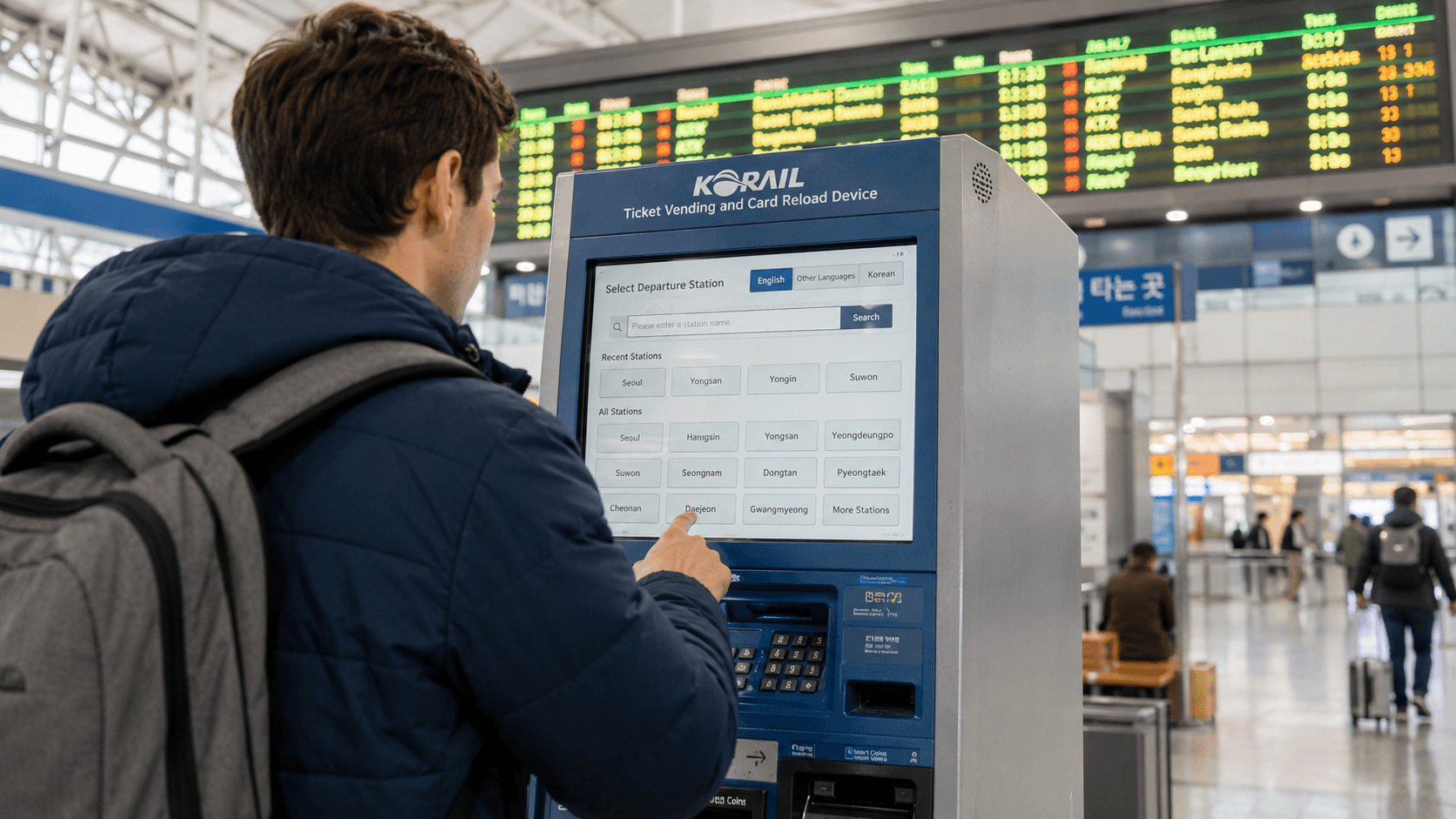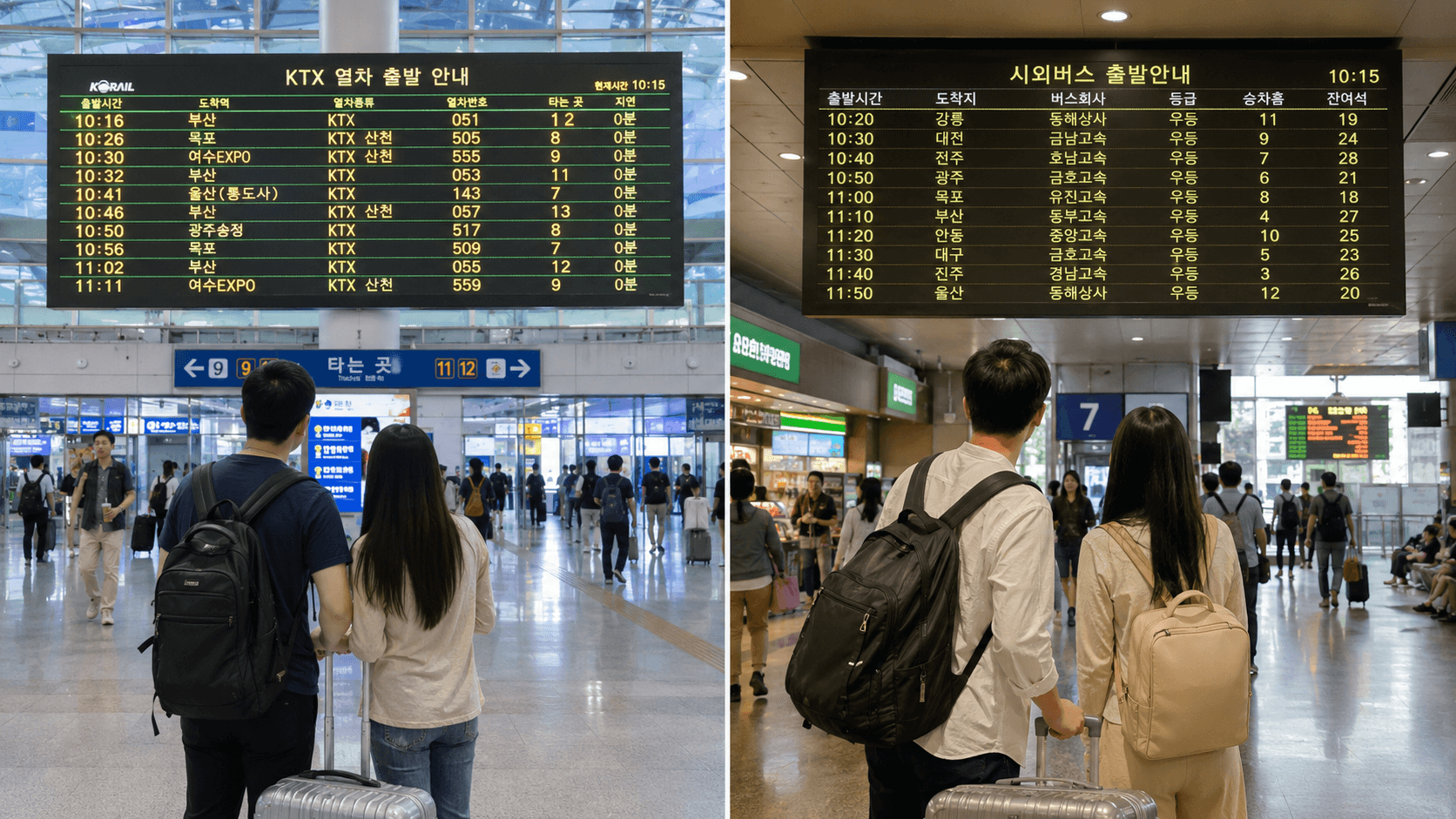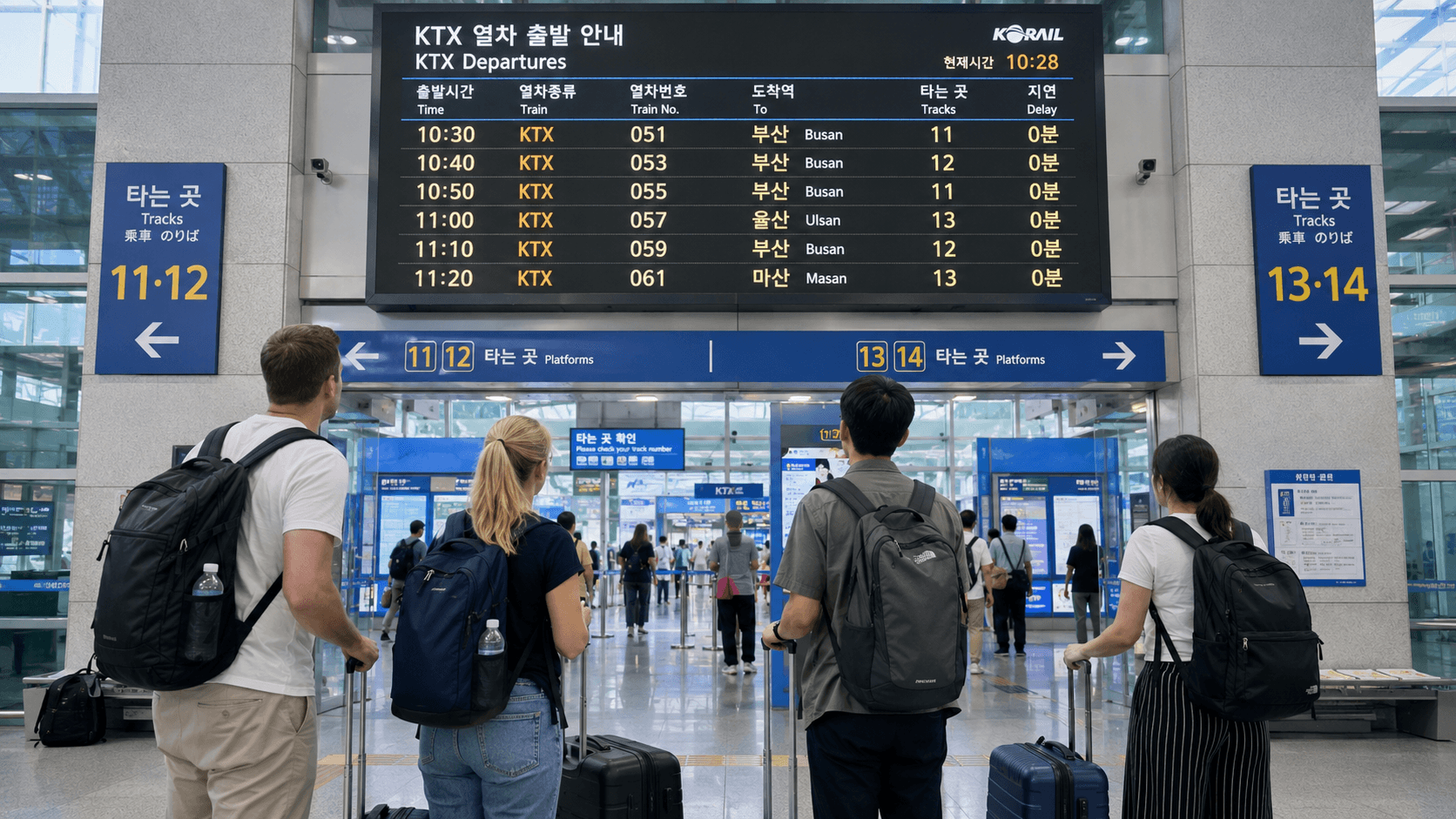
For most travelers, the easiest way to travel from Seoul to Busan is the KTX high-speed train from Seoul Station to Busan Station. The journey usually takes about 2 hours 15 minutes to 3 hours, and both stations have convenient public transport connections. SRT trains from Suseo are a useful alternative if you are staying in southeastern Seoul.
Fares, schedules, booking rules, and airport information in this guide were checked on June 9, 2026. Always confirm the live timetable and final price before payment, particularly around Korean public holidays.
Quick answer
| Option | Typical travel time | Typical one-way cost | Best for |
|---|---|---|---|
| KTX from Seoul Station | About 2 hr 15 min–3 hr | Standard adult fare commonly KRW 59,800 | Most visitors and city-center travel |
| SRT from Suseo Station | About 2 hr 20 min–3 hr | Usually about KRW 52,500–52,600 | Travelers staying in Gangnam or southeastern Seoul |
| Express bus | About 4–5.5 hr, sometimes longer | Varies by seat class and departure | Lower-cost travel or sold-out trains |
| Flight from Gimpo | About 1 hr in the air; usually 3.5–5 hr door to door | Dynamic airline pricing | Travelers already near Gimpo Airport |
| Car | About 4.5–6+ hr | Rental, fuel, tolls, and parking | Groups making stops outside major cities |
Best default choice: Take the KTX from Seoul Station to Busan Station.
Choose SRT instead: If Suseo Station is substantially easier to reach from your accommodation.
Avoid choosing a flight based only on flight time: Transfers, security, boarding, and travel from Gimhae Airport can remove most of the time advantage.
Option 1: KTX from Seoul Station to Busan Station
KTX is generally the most practical option because it connects central Seoul with central Busan without airport procedures or highway traffic. Most services use the Gyeongbu high-speed line and terminate at Busan Station.
The standard adult fare commonly shown for Seoul–Busan KTX travel is KRW 59,800, although the amount can differ for first class, discounted products, indirect services, or trains using different stopping patterns. This fare and the timetable should be confirmed through the official KORAIL booking service or KorailTalk app before purchase.
Where to board
Most travelers should select:
- Departure: Seoul (서울)
- Arrival: Busan (부산)
- Train type: KTX
Seoul Station is served by Seoul Subway Lines 1 and 4, the Airport Railroad, and the Gyeongui–Jungang Line. The railway concourse is large, so allow at least 15–20 minutes to find the correct platform after entering the station.
Do not accidentally select another station simply because it contains the word Seoul. Some KTX services also use Yongsan, Cheongnyangni, or other metropolitan-area stations, but Seoul Station is the normal starting point for the fastest Gyeongbu-line services to Busan.
Where you arrive
Busan Station is in Dong-gu, close to the port and connected to Busan Metro Line 1. It is convenient for Nampo-dong, Jagalchi Market, Seomyeon, and transfers to other parts of the city.
Approximate onward travel patterns are:
- Nampo or Jagalchi: Direct on Metro Line 1
- Seomyeon: Direct on Metro Line 1
- Gwangalli: Metro Line 1, then transfer to Line 2 at Seomyeon
- Haeundae: Metro Line 1, then transfer to Line 2 at Seomyeon
Busan Station is not beside Haeundae Beach. Allow roughly an hour for the cross-city transfer, depending on your exact destination and waiting time.
How to book a KTX ticket
- Open the official KORAIL website or KorailTalk app.
- Set the departure station to Seoul and the arrival station to Busan.
- Enter your date, preferred departure time, and passenger count.
- Filter for KTX if slower trains also appear.
- Compare arrival times, not only departure times; some trains make more stops.
- Choose a seat and complete payment.
- Keep the mobile or printed ticket available during the journey.
KORAIL tickets are usually released from 07:00 one month before departure, according to the official Korea Tourism Organization train guide. Special booking procedures may replace the normal sales window during Seollal, Chuseok, or other peak periods.
Luggage on the KTX
Small bags can usually go on the overhead shelf. Larger suitcases should be placed in designated luggage areas where available or in a space that does not block doors and aisles.
Large luggage areas can fill quickly. Arrive early if you have a full-size suitcase, and keep valuables, passports, medication, and electronics at your seat. Avoid leaving luggage in a vestibule where it could obstruct movement.
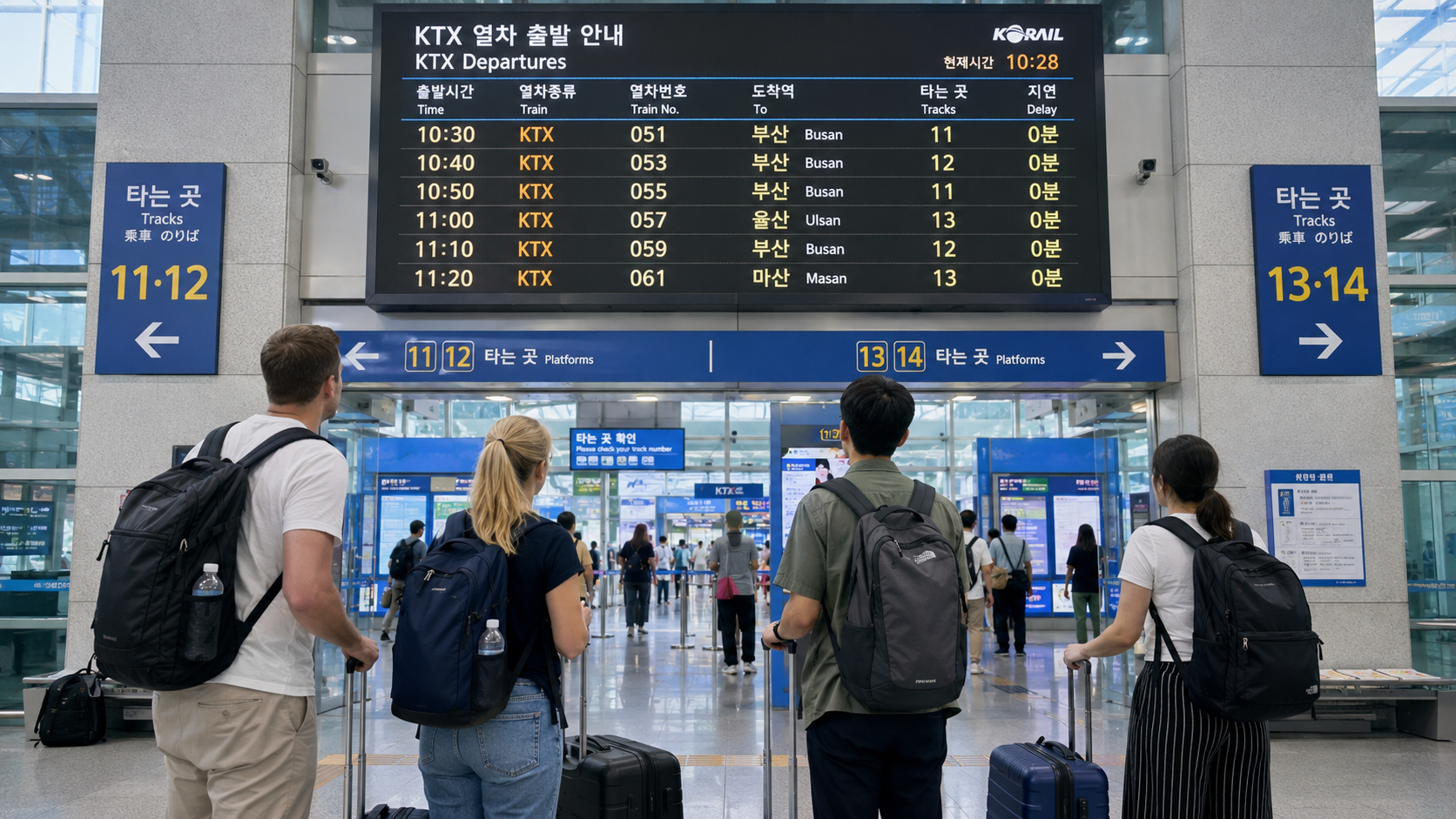
Option 2: SRT from Suseo Station
SRT is another high-speed service using the Gyeongbu high-speed corridor. It departs from Suseo Station (수서역) in southeastern Seoul rather than Seoul Station.
The trip to Busan normally takes approximately 2 hours 20 minutes to 3 hours. Official SR materials have listed the base Suseo–Busan fare at about KRW 52,500–52,600, with the precise amount depending on the service and applicable discount. Check the final fare through the official SRT reservation website.
SRT is especially useful if you are staying near Gangnam, Jamsil, Songpa, or a convenient connection to Suseo. It may not save money or time if you must cross Seoul from areas such as Hongdae, Myeong-dong, or Seoul Station.
Reaching Suseo Station
Suseo connects with Seoul Subway Line 3, the Suin–Bundang Line, and GTX-A. Follow signs specifically for the SRT platforms after arriving. The conventional subway and high-speed railway areas are connected but not identical.
Booking rules
According to SR’s official ticket guide, regular SRT tickets are sold from 07:00 one month before departure. Website sales normally close 20 minutes before departure, while app sales remain available closer to departure, subject to seat availability and current system rules.
SRT tickets can sell out on Friday evenings, Sunday afternoons, and holiday weekends. Book when your travel date enters the sales window if your schedule is fixed.
Option 3: Express bus from Seoul to Busan
Express buses are comfortable and can be useful when high-speed trains are sold out. The standard route normally runs from Seoul Express Bus Terminal, often shown as Seoul Gyeongbu, to Busan Central Bus Terminal in Nopo.
The scheduled journey is generally around four hours, but congestion can extend it to five hours or considerably longer. Buses normally make a rest stop at a highway service area.
Current fares depend on whether you select economy, excellent or premium seating, as well as the specific departure. A reliable fixed fare could not be confirmed from the public booking results on June 9, 2026, so check the live price on the official KOBUS express-bus website before booking.
The important location detail
Busan Central Bus Terminal is at Nopo Station, at the northern end of Busan Metro Line 1. It is not near Busan Station, Nampo-dong, Gwangalli, or Haeundae.
This makes the bus less convenient than the KTX for most tourists. After arriving at Nopo, allow substantial extra time for the metro journey into central or coastal Busan.
The Busan Metropolitan City transportation guide confirms that the central terminal serves express routes from Seoul and connects with Nopo Station.
Booking and boarding
- Search from Seoul Gyeongbu to Busan on KOBUS.
- Check the destination terminal carefully.
- Select the seat class and departure time.
- Arrive at least 20 minutes early to locate the correct boarding gate.
- Place large suitcases in the luggage compartment beneath the bus.
- Keep your ticket or QR code ready when boarding.
Foreign-issued card support can vary by platform. The Korea Tourism Organization’s international visitor transportation guide states that foreign-issued cards are accepted at express and intercity bus ticket machines and counters. Buying at the terminal is therefore a practical fallback if online payment fails.
Option 4: Flying from Gimpo to Gimhae
Domestic flights operate between Gimpo International Airport (GMP) in Seoul and Gimhae International Airport (PUS) in Busan. The flight itself takes about one hour, but the complete trip is rarely faster than KTX for travelers moving between the two city centers.
You must include:
- Travel from your accommodation to Gimpo Airport
- Check-in and baggage-drop time
- Security screening
- Boarding time
- The flight
- Baggage collection
- Travel from Gimhae Airport into Busan
The Gimpo Airport flight schedule warns that airline schedules may be adjusted. Airfares and baggage allowances are dynamic, so compare the total price directly with the airline before booking.
Getting to Gimpo Airport
Gimpo Airport is served by Subway Lines 5 and 9, the Airport Railroad, the Seohae Line, and the Gimpo Goldline. The official airport transport page provides the current network information.
Use the Domestic Terminal, not the International Terminal. KAC notes that domestic check-in and baggage acceptance commonly close around 30 minutes before departure, but individual airline deadlines control. Arriving at least 60–90 minutes before departure is a sensible practical allowance.
Carry your passport or another identification document accepted by the airline for domestic travel.
From Gimhae Airport into Busan
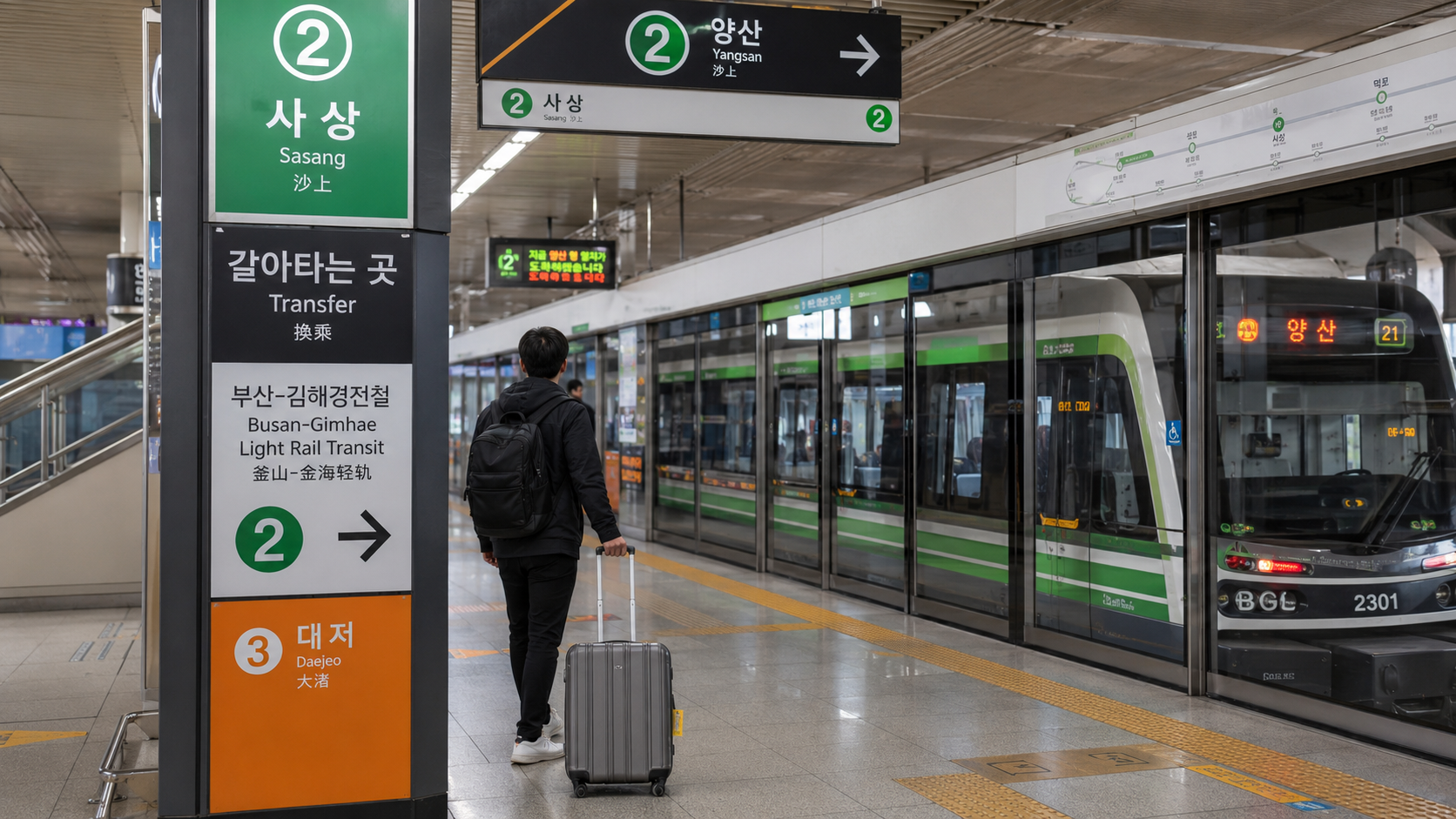
The Busan–Gimhae Light Rail connects the airport with:
- Sasang, where you can transfer to Busan Metro Line 2
- Daejeo, where you can transfer to Busan Metro Line 3
The official Gimhae Airport public-transport page confirms these transfer points.
Flying may make sense if you are staying near Gimpo Airport, find a low fare with suitable baggage, or need to connect with another flight. It is usually less convenient for a straightforward Seoul-center to Busan-center journey.
Option 5: Driving or renting a car
Driving is useful when Busan is part of a longer road trip through smaller cities or rural destinations. It is rarely the easiest option for a direct city-to-city transfer.
The Korea Expressway Corporation’s Road Plus traffic forecasts commonly place the tollgate-to-tollgate journey at more than four hours under ordinary conditions. Travel from central Seoul, rest breaks, congestion, and entering Busan can increase the total to 5–6 hours or more. Holiday traffic can be substantially worse.
Costs include the rental fee, insurance, fuel, expressway tolls, and parking. Use the official expressway toll lookup for your actual entrance, exit, and vehicle class.
International visitors should confirm driving eligibility with the rental company. Requirements commonly include a passport, an accepted International Driving Permit, the original domestic licence, and a payment card in the driver’s name. Requirements vary, so do not rely on a general guide as legal confirmation.
Which option should you choose?
Choose KTX when:
- You are staying in central or western Seoul.
- Your Busan accommodation is near Busan Station, Nampo, Seomyeon, or a metro connection.
- You have luggage and want the fewest transfers.
- You want the most predictable total journey time.
Choose SRT when:
- You are staying in Gangnam, Songpa, or southeastern Seoul.
- Suseo Station is easier to reach than Seoul Station.
- A suitable SRT departure is cheaper or has seats when KTX is sold out.
Choose the bus when:
- Train tickets are unavailable.
- You prefer premium bus seating.
- You are not concerned about traffic delays or arriving at Nopo.
Choose a flight when:
- You are already near Gimpo Airport.
- The airfare, baggage allowance, and schedule are favorable.
- Your final destination has a convenient connection from Gimhae Airport.
Choose a car when:
- You are traveling as a group.
- You plan to stop outside Seoul and Busan.
- Your Busan accommodation includes parking.
Common mistakes to avoid
- Confusing Busan Station with Busan Central Bus Terminal: The railway station is central; the bus terminal is at Nopo in northern Busan.
- Booking from the wrong Seoul station: KTX usually leaves from Seoul Station, while SRT primarily uses Suseo.
- Searching for Incheon Airport flights: Domestic Seoul–Busan flights normally use Gimpo Airport.
- Underestimating the trip to Haeundae: Haeundae is across the city from Busan Station and Gimhae Airport.
- Waiting until the weekend to book: Friday evening and Sunday return services often sell quickly.
- Using an unofficial ticket reseller without checking conditions: Changes and refunds may be harder than with the operator.
- Leaving too little transfer time: Seoul Station, Suseo, and the airports require time for walking and orientation.
What to check before you go
- Confirm the exact departure station and destination terminal.
- Recheck your departure time on the operator’s official app or website.
- Review cancellation and change fees before payment.
- Book early for Fridays, Sundays, public holidays, Seollal, and Chuseok.
- Check whether your payment card supports Korean online transactions.
- Confirm baggage limits if flying.
- Allow extra time if carrying large luggage or requesting mobility assistance.
- Download your ticket or take a screenshot that remains available without mobile data.
- Check the last metro or bus connection if arriving late in Busan.
- Save your Busan accommodation name and address in Korean for taxis or navigation apps.
FAQ
Can I take a day trip from Seoul to Busan?
It is possible by KTX, but you will spend at least four and a half to six hours on trains, plus local transportation. A day trip works for one compact area, but staying overnight gives you much more usable time.
Do I need to print my train ticket?
A valid mobile ticket is normally sufficient. Keep the screen accessible and make sure the ticket shows the correct passenger, train, date, carriage, and seat information.
Is there a night train from Seoul to Busan?
Do not assume that an overnight sleeper service is available. Search the official KORAIL timetable for your date. Late high-speed services may arrive around midnight, when onward public transport is limited.
Is KTX cheaper than flying?
Not always. Promotional airfares can be lower, but airline baggage charges and airport transfers affect the total cost. Compare the complete door-to-door price rather than the headline fare.
Can I use a Tmoney card for KTX or SRT?
No. KTX and SRT require separate reserved tickets. A Tmoney transportation card remains useful for the subway or city bus before and after the intercity journey.
Sources
- KORAIL official ticket and timetable service
- SRT official reservation service
- SR ticket purchase and refund guide
- KOBUS official express-bus booking service
- Busan Metropolitan City transportation guide
- Gimpo International Airport official website
- Gimhae International Airport official website
- Korea Tourism Organization train guide
- Korea Expressway Corporation toll lookup
For a straightforward first trip, search Seoul to Busan on KORAIL as soon as your date enters the booking window, then choose the fastest departure that fits your hotel check-in time.