Yes. Public transportation in South Korea is generally very good, particularly in Seoul, Busan, Daegu, Daejeon, Gwangju, and other large urban areas. Subways and buses cover most city districts, while KTX high-speed trains and intercity buses connect destinations across the country.
The main qualifications are that rural services can be infrequent, transfers in large stations may involve long walks, and payment is not always as foreign-card-friendly as visitors expect. A rechargeable Korean transportation card and a local navigation app make the system much easier to use.
Fares, payment rules, and service information in this guide were verified on June 9, 2026.
Quick answer
| Question | Practical answer |
|---|---|
| Is a car necessary in Seoul? | No. Public transportation is usually more practical. |
| Can one card be used around Korea? | A standard Tmoney or EZL transportation card works on most urban buses and subways nationwide. |
| Can I tap a foreign credit card at subway gates? | Generally no. Buy a Korean transportation card or a single-use ticket. |
| Is public transportation inexpensive? | Yes by international big-city standards. Seoul subway rides start at KRW 1,550 with a transportation card. |
| Is it easy without Korean? | Usually, especially with Naver Map. Major stations have English signs and announcements, but local bus stops can be harder to navigate. |
| Does transportation run all night? | Usually not. Some cities operate limited night buses, but ordinary subway and bus services stop around late evening or after midnight depending on the route. |
| Is public transportation good outside cities? | It varies. Intercity connections are strong, but local transport near rural attractions may be limited. |
Where Korea's public transportation works especially well
Seoul and the capital region
Seoul has an extensive network of subways, city buses, village buses, and regional services extending into Incheon and Gyeonggi Province. For most visitors, the subway is the easiest way to cover long urban distances, while buses fill gaps between stations.
The network is integrated for fare purposes. When using a transportation card, transfers between eligible buses and subways are calculated according to the integrated fare rules rather than charging an entirely separate base fare for every ride. To receive the correct transfer calculation, tap the card when entering and leaving the subway and when boarding and getting off a bus.
According to the Seoul Metropolitan Government's current fare information, the adult subway base fare has been KRW 1,550 by transportation card since June 28, 2025. The single-use adult ticket is KRW 1,650, and distance charges apply beyond the base range. These amounts were verified on June 9, 2026.
A standard adult Seoul trunk or branch bus fare is KRW 1,500 by card. Express-style red buses and late-night Owl Buses cost more. Current categories, transfer conditions, and fares are listed on the city's official Seoul bus guide.
The system is efficient, but the map can be deceptive: changing lines at a large station may involve several escalators and a substantial walk. A route with one short bus connection may be easier than a subway-only route with multiple transfers.
Other major cities
Busan, Daegu, Daejeon, and Gwangju have their own subway or urban rail networks supported by city buses. These systems are smaller than Seoul's and are normally easier to understand. Standard nationwide transportation cards are accepted in most cases.
Busan's geography means that a destination that looks nearby on a map may be separated by a hill, harbor, or long coastal road. The subway is useful for major corridors, but beaches, hillside neighborhoods, and some coastal sights often require a bus connection.
Cities without extensive subway networks rely more heavily on buses. Real-time route information is often available in navigation apps, although English stop names and rural arrival predictions are not always consistent.
Travel between cities
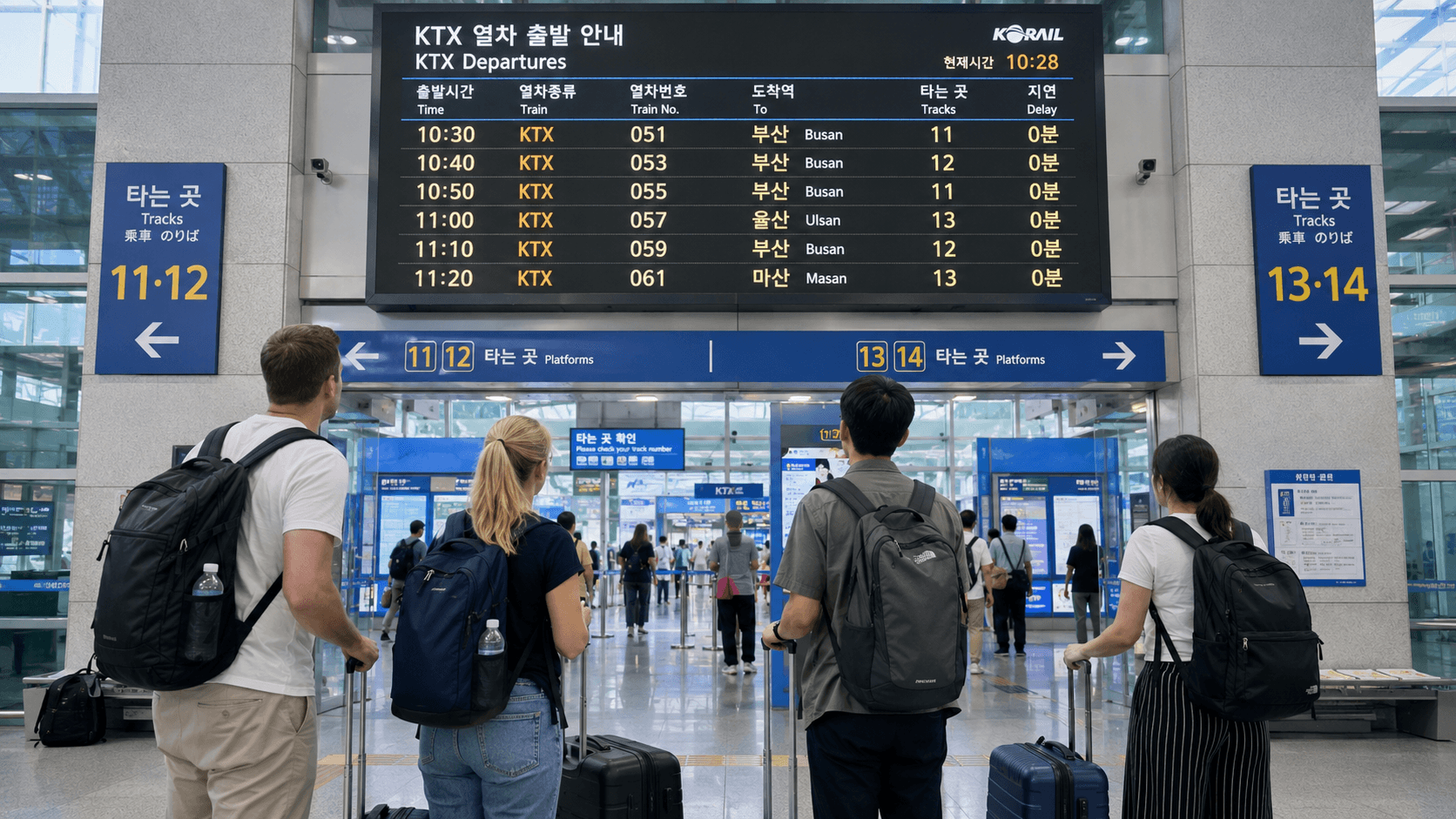
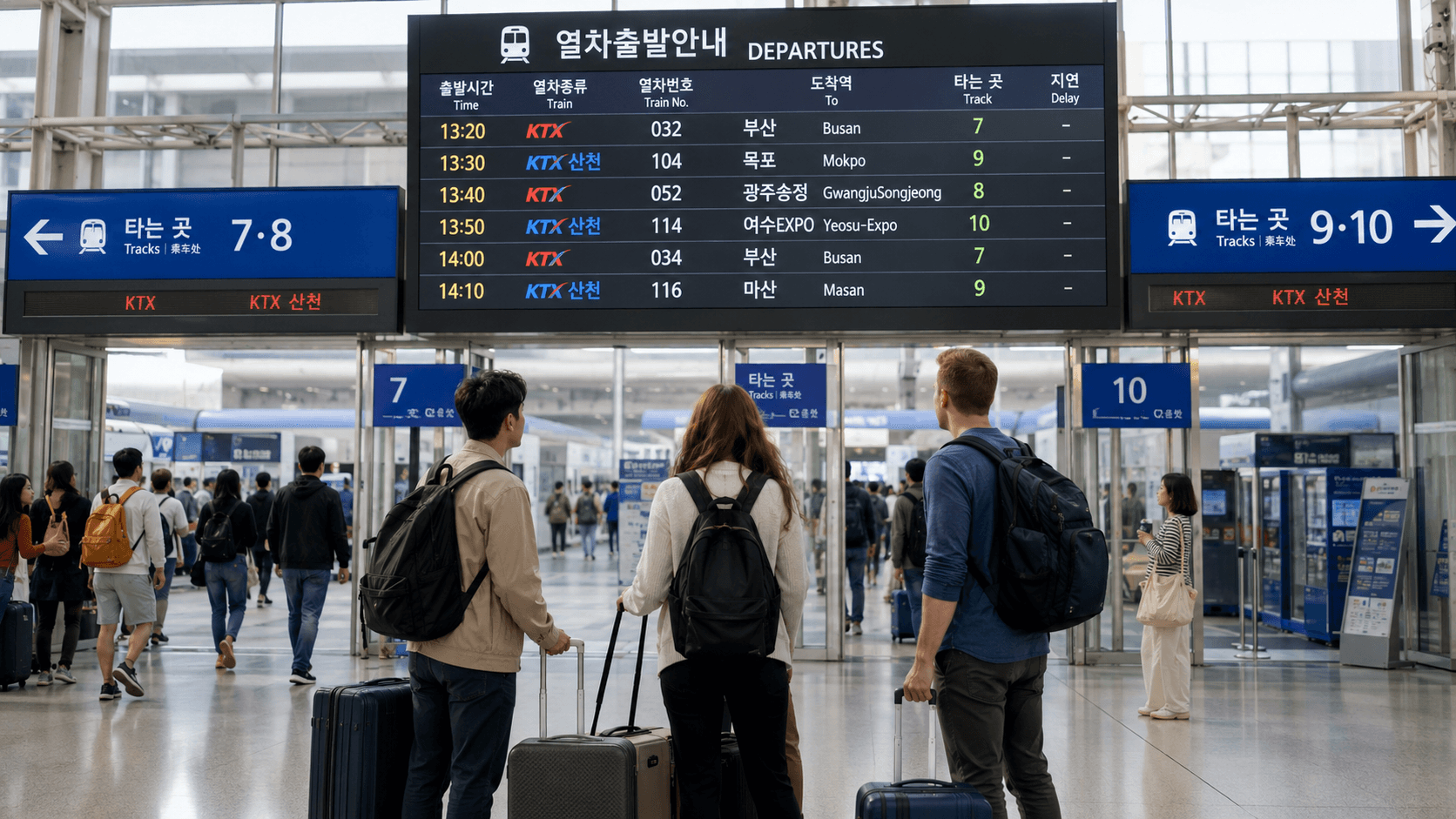
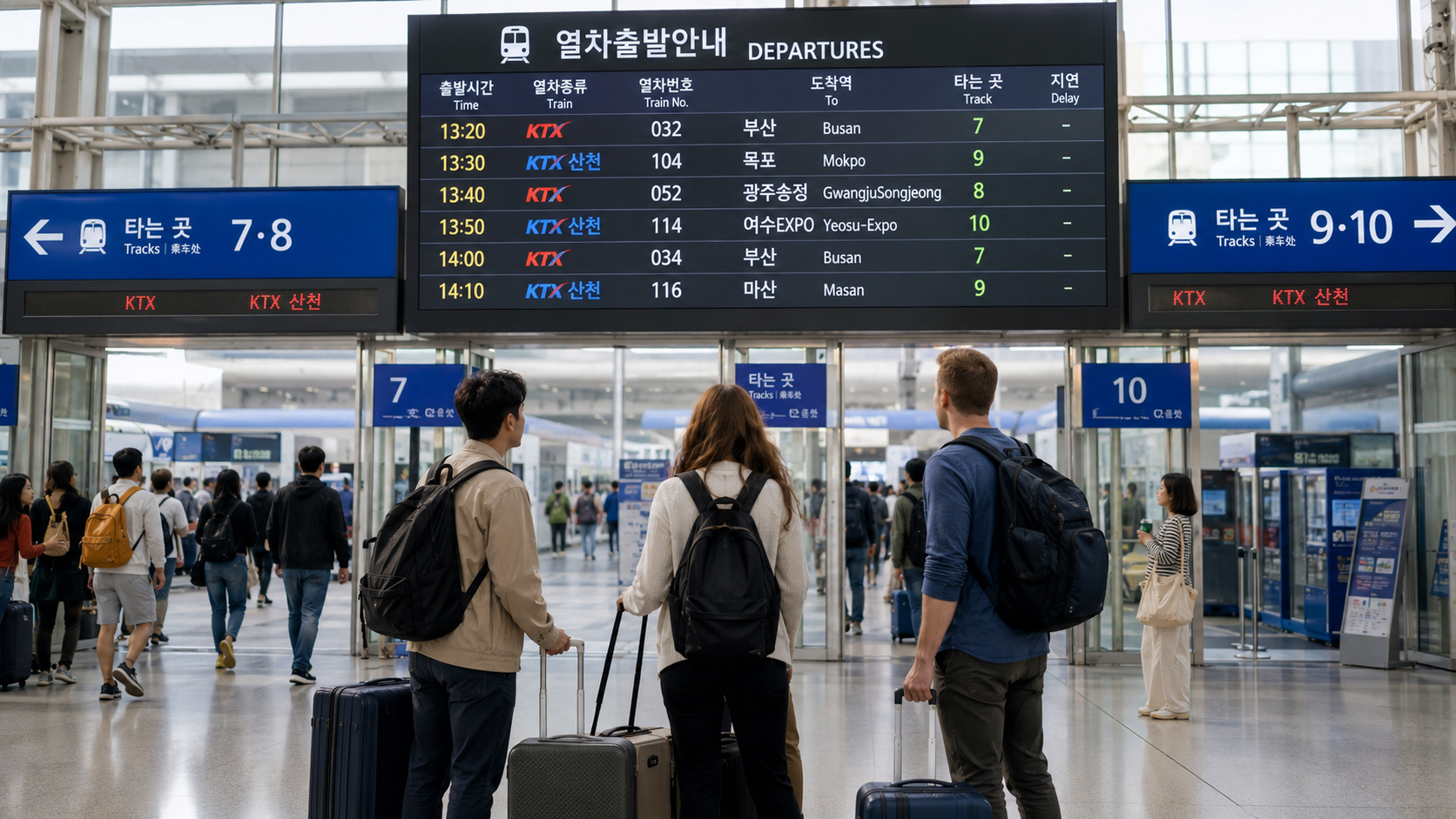
Korea's intercity network is one of the strongest parts of its transportation system. KTX high-speed trains connect Seoul with cities including Busan, Daegu, Daejeon, Gyeongju via Singyeongju Station, Gwangju, Mokpo, Gangneung, and Yeosu. Slower conventional trains serve additional towns.
Express and intercity buses complement the railway network and often reach places without a convenient train station. Some cities have more than one bus terminal, so confirm the terminal name rather than searching only for the city.
Train tickets and long-distance bus tickets are separate from ordinary subway and city-bus fares. Do not assume that tapping a Tmoney card will secure a reserved KTX or express-bus seat.
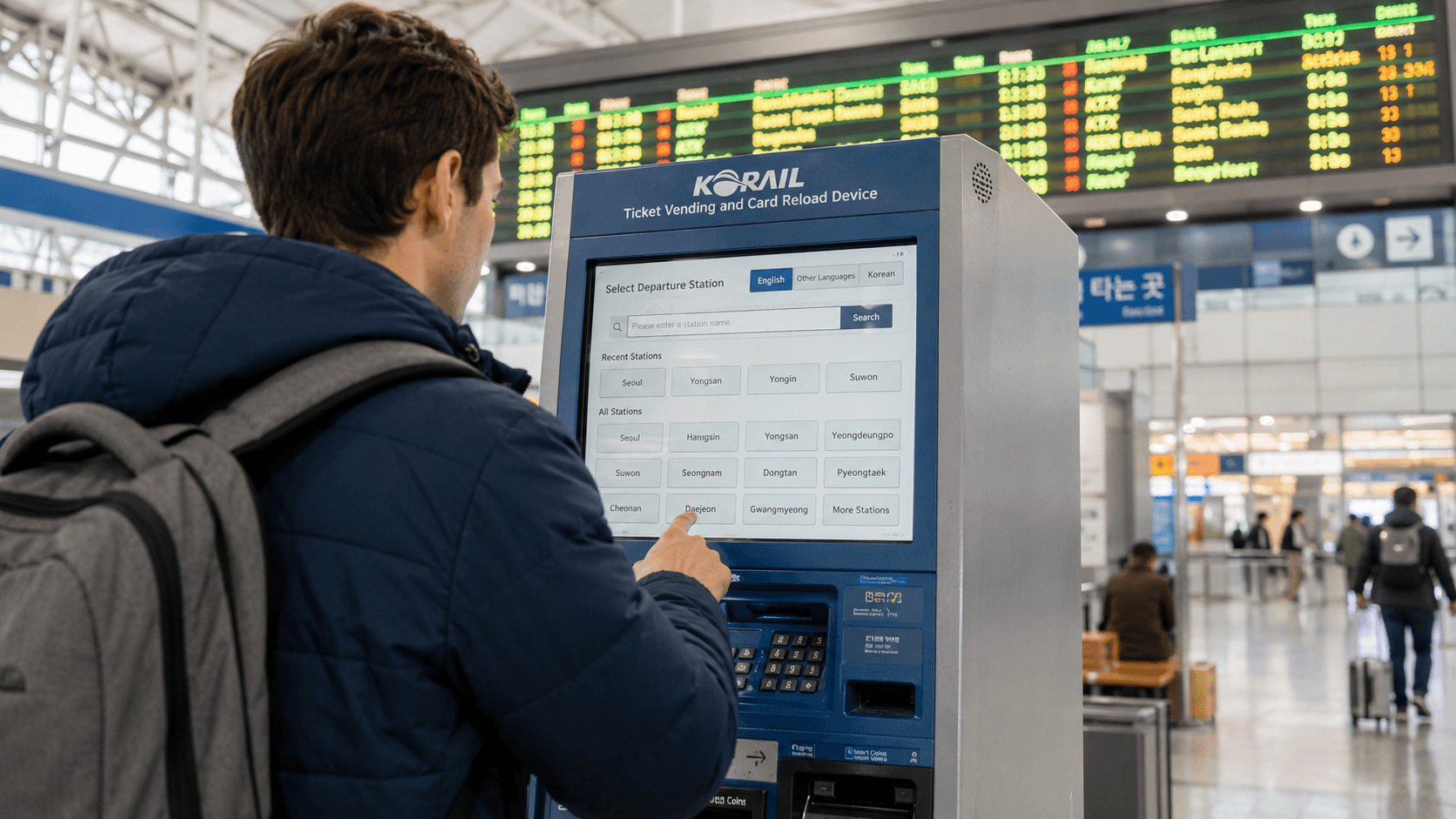
KTX tickets can be booked through the official KORAIL website. The Korea Tourism Organization also reports that the multilingual KORAIL service supports seat selection and that tickets can be purchased at station counters. Popular Friday-evening, Sunday-evening, and holiday-period trains can sell out, so advance reservations are sensible.
How to pay for subways and city buses
Buy a rechargeable transportation card
For most visitors, the simplest choice is a standard Tmoney or EZL card. These are prepaid transportation cards rather than travel passes. You buy the card, add a cash balance, and pay according to each journey.
The Korea Tourism Organization's transportation-card guide states that Tmoney and EZL cards can be purchased and recharged at convenience stores nationwide. A general Tmoney card typically costs KRW 3,000 to KRW 5,000 before adding travel credit. The card price itself is normally separate from its stored balance.
A standard card is usually the most flexible option because it can be used across multiple cities. It is suitable for travelers moving between Seoul, Busan, Jeju, and other destinations, although acceptance on Jeju applies to city buses rather than every private or specialized service.
Carry Korean won for recharging
This is one of the most important details for international visitors. The Korea Tourism Organization's May 2026 transportation and payment guide says that foreign-issued credit cards are not accepted for ordinary Tmoney purchases or top-ups and identifies these transactions as cash only.
Some newer machines on Seoul Subway Lines 1 to 8 accept foreign-issued cards for single-use tickets and short-term Climate Card products. That does not mean every transportation-card machine nationwide accepts an overseas card.
A practical starting amount is KRW 20,000 to KRW 30,000 for several days of ordinary city travel. Add smaller amounts later instead of leaving a large unused balance.
Tap correctly
On the subway, tap at the gate when entering and again when leaving. On buses, tap once when boarding and once immediately before getting off.
Forgetting to tap off a bus can cause the system to charge an additional fare or prevent the correct transfer discount from being applied. In Seoul, an eligible transfer normally must begin within 30 minutes, extended to 60 minutes during the designated late-evening and early-morning period. The same bus route does not count as a free transfer back onto itself.
Do not place several contactless cards against the reader together. Remove the transportation card from a wallet containing bank cards to avoid a multiple-card error.
Should you buy a pass instead?
Seoul's Climate Card provides unlimited use within a defined service area for a selected period. Short-term options from one to seven days are available, but coverage is not identical to the entire Seoul metropolitan transit network.
The official Climate Card coverage guide excludes the Sinbundang Line, airport buses, intercity buses, and subway sections outside its designated area. Seoul-licensed buses can be covered even when traveling outside Seoul, but subway exit rules are more restrictive. Check every planned suburban journey before relying on the pass.
For a visitor making only two or three rides per day, an ordinary pay-as-you-go card may cost less and requires less attention to coverage boundaries. The Climate Card becomes more attractive for frequent rides concentrated inside Seoul.
International travelers planning extensive rail travel can also investigate KORAIL PASS products. In January 2026, KORAIL introduced KORAIL PASS+, which combines eligible rail-pass travel with a reloadable local transportation function for an additional fee. Pass value depends heavily on the exact trains and travel dates, so compare the pass price with individual tickets before buying.
Route-planning apps you should install
Use Naver Map or KakaoMap rather than depending entirely on Google Maps for Korean public transportation. Naver Map supports public-transit route suggestions, estimated journey times, stop information, and real-time arrivals on many services. Its interface is available in English as well as several other languages.
The Korea Tourism Organization's official apps and resources guide recommends Naver Map for walking, driving, cycling, and public-transport directions. Search results can still be easier to find using a Korean place name, so copy the Hangul name from an attraction's official listing when an English search fails.
Before boarding a bus, check all of the following:
- The route number
- The direction of travel
- The name of the destination stop
- The number of stops remaining
- Whether the bus is a standard city bus, regional bus, or airport service
At large bus stops, several routes may use the same platform. A correct route number traveling in the wrong direction is a common mistake.
Airport transportation
Incheon International Airport is connected to Seoul by the Airport Railroad, known as AREX, as well as airport limousine buses and taxis.
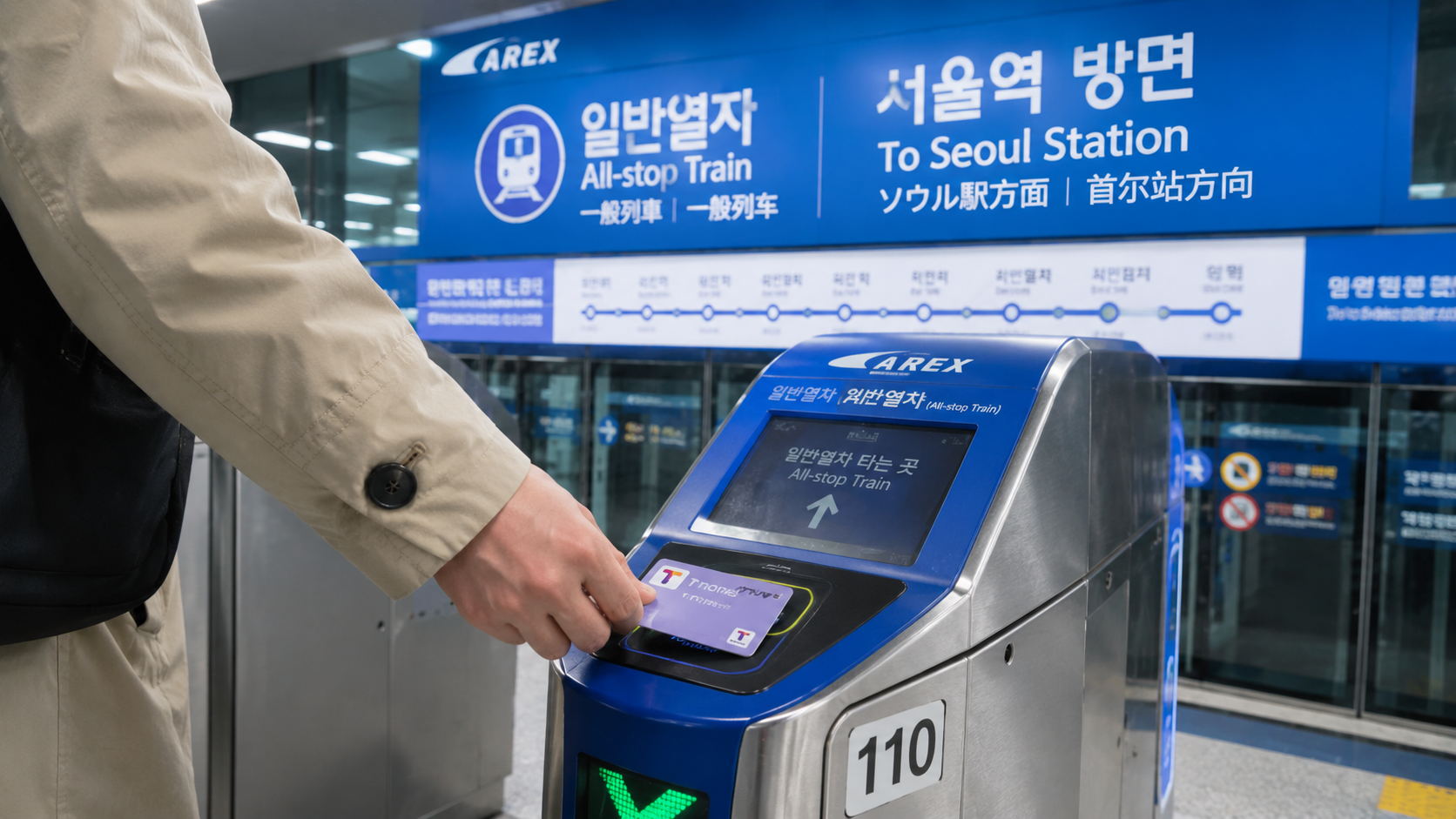
AREX operates two different services. The all-stop train functions like an urban railway and accepts an ordinary transportation card. The Express Train has reserved seating and a separate ticket. Do not follow signs for the Express Train if you intend to tap in with Tmoney.
As verified on June 9, 2026, the official AREX all-stop fare table lists transportation-card fares of KRW 4,750 from Incheon Airport Terminal 1 to Seoul Station and KRW 5,350 from Terminal 2 to Seoul Station. A single-use ticket costs KRW 100 more, plus a refundable KRW 500 deposit. Check the official table again before travel because fares can change.
Airport buses can be more convenient when a hotel is far from an AREX or subway station, particularly with large luggage. However, journey times are affected by road traffic, and not every airport bus accepts an ordinary transportation card or foreign card in the same way. Confirm the route, boarding point, fare, and last departure through the airport or bus operator.
The limitations visitors should expect
Rural areas and remote attractions
Public transportation is much less comprehensive in rural counties, mountain regions, and around isolated beaches or temples. A bus may operate only a few times per day, and the return service may finish earlier than expected.
Do not interpret a route appearing in an app as proof that it runs frequently. Open the route details and check individual departure times in both directions. For remote destinations, compare the bus schedule with a taxi or rental-car plan before leaving the nearest city.
Late-night travel
Korea does not have a nationwide all-night subway system. Last-train times differ by station, line, destination, weekday, and direction. A departure shown near midnight may terminate before reaching the end of the line.
Seoul operates limited Owl Bus routes overnight, but they do not replace the daytime network. Check the final connection in Naver Map and the relevant operator's information on the day of travel. Allow extra time for station transfers rather than aiming for the last possible train.
Rush hour and luggage
Seoul subway trains and major commuter buses can be extremely crowded during weekday commuting periods, particularly around 7:30-9:00 and 17:30-19:30. These are practical ranges, not fixed operator schedules.
Travel outside peak periods when carrying a suitcase. Elevators may be located far from the most direct exit, and some older station layouts require lengthy detours. Use the station map or ask staff for the elevator marked 엘리베이터.
Accessibility
Major stations commonly provide elevators, accessible gates, and tactile paving, but the complete journey may still involve long corridors, crowded platforms, or street-level obstacles. Low-floor buses operate on many routes, but availability is not guaranteed for every departure.
Travelers who require step-free access should check the station and vehicle information supplied by the local operator. Build additional transfer time into the route and avoid treating a general accessibility symbol as confirmation that every entrance is step-free.
Is renting a car better?
A car is usually unnecessary in Seoul and can add parking, congestion, and navigation problems. Public transportation is also sufficient for standard trips between major cities.
A rental car becomes more useful for countryside itineraries, remote coastal areas, national-park surroundings, and trips involving several small attractions in one day. Jeju is the clearest example: buses cover the island, but reaching multiple rural sights efficiently can require long waits and indirect routes.
The practical compromise is often to use trains or express buses between cities and rent a car only for the rural portion of the itinerary.
Common mistakes to avoid
- Relying only on Google Maps instead of installing Naver Map or KakaoMap
- Expecting to tap a foreign contactless bank card directly on every bus or subway gate
- Arriving without Korean cash for a transportation-card top-up
- Forgetting to tap off when leaving a bus
- Assuming the Climate Card covers every train in the Seoul metropolitan region
- Confusing the AREX all-stop train with the separately ticketed Express Train
- Booking a train to a station far outside the city center without checking the onward connection
- Searching only by city name when several bus terminals serve the same area
- Planning a rural return journey without checking the final bus
- Waiting until a holiday weekend to reserve KTX seats
What to check before you go
- Install Naver Map and download any language or offline information you need.
- Save your accommodation's Korean name, Hangul address, and nearest station exit.
- Carry at least KRW 20,000 in cash for card purchase and recharging.
- Buy a standard Tmoney or EZL card unless a pass clearly fits your itinerary.
- Reserve KTX or express-bus seats for busy dates.
- Check the exact last train or bus for evening journeys.
- Confirm both outward and return schedules for rural destinations.
- Check elevator locations in advance if you have heavy luggage or mobility requirements.
- Verify airport transport against your flight terminal and arrival time.
- Recheck fares, operating hours, and pass coverage on official websites shortly before travel.
FAQ
Can tourists use Korean public transportation without speaking Korean?
Yes. Subways in major cities use numbered lines, color coding, and English station names. English announcements are common on urban rail. Buses require more attention, but a navigation app can show the route and remaining stops.
Can two people share one Tmoney card?
Separate cards are strongly recommended. Although a bus driver may sometimes process multiple passengers on one card when asked in advance, this complicates transfers and cannot be used normally at individual subway gates.
Can I use my phone instead of a physical card?
Mobile transportation-card support depends on the phone, operating system, payment service, and account configuration. Compatibility is not reliable enough to assume that every international visitor can use it immediately. A physical prepaid card remains the simplest fallback.
Are taxis part of the public transportation system?
Taxis are widely available but are not a substitute for the integrated subway-and-bus fare network. Many taxis accept foreign-issued cards, according to the Korea Tourism Organization's May 2026 payment guide, but carrying another payment method is prudent.
What should I do if I am lost?
Show station staff the Korean name of your destination or call the Korea Travel Hotline at 1330. The hotline provides travel assistance in multiple languages. For immediate route problems, station staff or a staffed information desk will usually be faster.
The practical next step
Build your first route in Naver Map before arriving, note the Korean name of your destination, and plan to buy a rechargeable transportation card with Korean won. That preparation is enough for most visitors to use Korea's urban transport confidently from their first day.
Sources
- Korea Tourism Organization: International Visitors' Use of Public Transportation and Booking/Payment Services, May 2026
- Korea Tourism Organization: Transportation Cards
- Seoul Metropolitan Government: Subway Fares and Transportation Modes
- Seoul Metropolitan Government: Bus Routes, Fares, and Transfer Rules
- Seoul Metropolitan Government: Climate Card Coverage
- AREX: Official All-Stop Train Fare Information
- Korea Tourism Organization: Helpful Apps and Resources
- KORAIL Official Website