For most first-time visitors to South Korea, a hotel is the simpler choice. Hotels usually offer staffed reception, luggage storage, predictable cleaning, and easier help when something goes wrong. Airbnb may offer more space, a kitchen, or a washing machine, making it attractive for families, groups, and longer stays. However, quality, access instructions, and building rules vary considerably between individual listings.
The right choice depends less on the nightly headline price and more on your group size, arrival time, luggage, length of stay, and tolerance for self-service.
Information and platform policies in this guide were checked on June 11, 2026. Always review the terms shown for your specific reservation before paying.
At a glance
| Priority | Usually the better choice | Why |
|---|---|---|
| First trip to Korea | Hotel | Reception and predictable service reduce arrival problems |
| One- or two-night stay | Hotel | Cleaning fees and self-check-in effort can reduce Airbnb's value |
| Late-night arrival | Hotel with 24-hour reception | Easier if your flight or airport transport is delayed |
| Family or group | Airbnb or serviced residence | More beds, living space, and possible kitchen facilities |
| Stay of one week or longer | Airbnb or residence hotel | Washing machine and cooking facilities become more useful |
| Daily housekeeping | Hotel | Usually included, although frequency may vary by rate or property |
| Luggage storage | Hotel | Common before check-in and after check-out |
| Cooking meals | Airbnb or serviced residence | Many hotels do not provide a usable kitchen |
| Reliable accessibility information | Major hotel | More likely to document lifts, entrances, and accessible rooms |
| Local residential setting | Airbnb | More listings in residential streets, but less on-site assistance |
The main difference in Korea
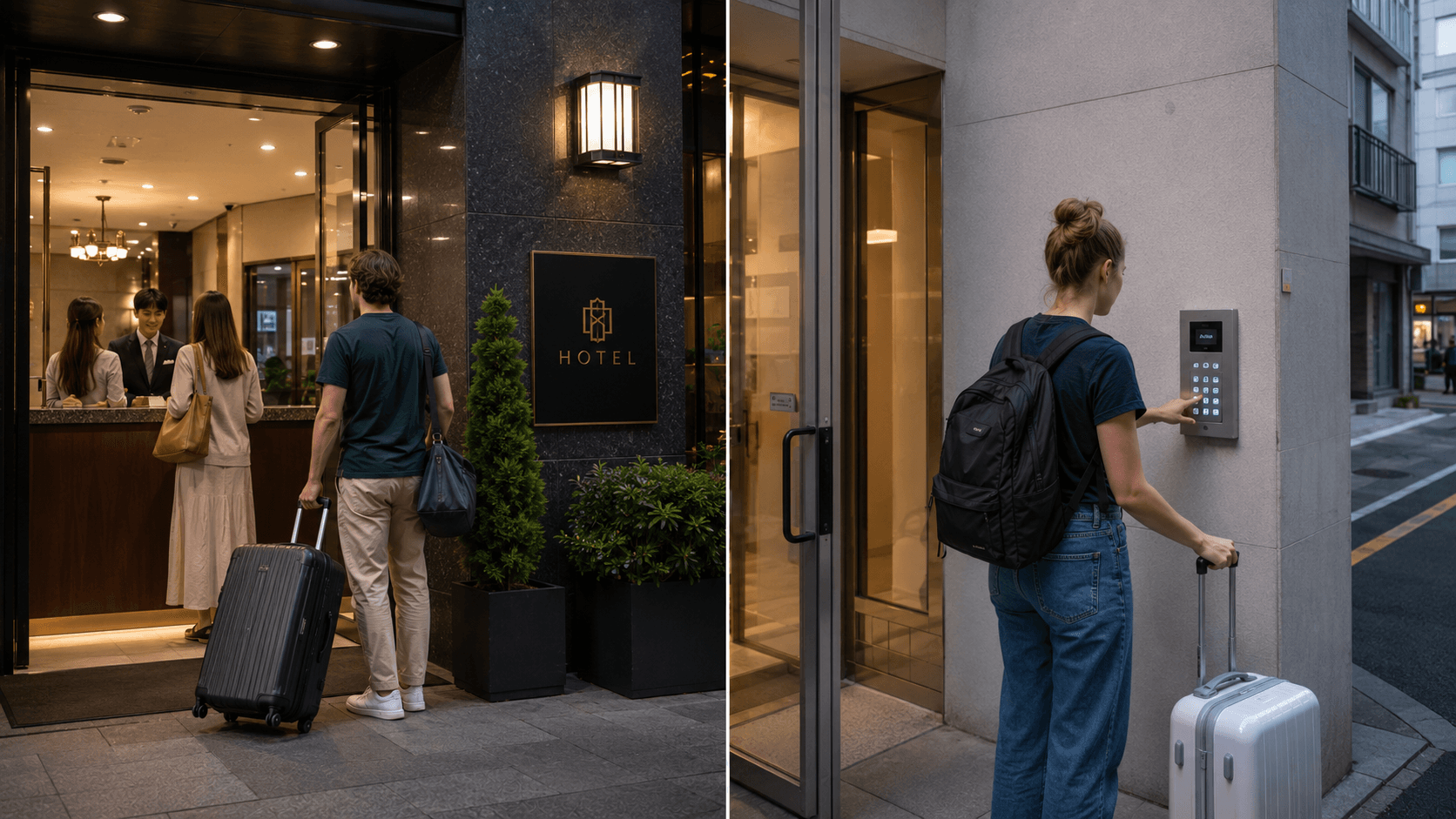
A hotel provides accommodation as an organized hospitality business. Even a modest Korean business hotel normally has a front desk, a clearly marked entrance, and staff responsible for the building or rooms.
Airbnb is a booking platform containing several kinds of accommodation. A result may be a private apartment, a room in the host's home, a guesthouse, a serviced residence, or even a conventional hotel. Airbnb's Terms of Service state that the platform itself does not own, control, or manage individual listings. The practical experience therefore depends heavily on the host and property.
Do not assume that every Airbnb in Korea is a spacious private apartment. Check whether the listing says:
- Entire place, private room, or shared room
- Number of actual bedrooms rather than number of beds
- Private or shared bathroom
- Host present or absent
- Lift access
- Kitchen access and permitted cooking
- Washing machine and drying method
- Exact maximum occupancy
Price: compare the total, not the nightly rate
There is no reliable rule that Airbnb is always cheaper than a hotel in Korea. Prices change by city, neighborhood, weekday, season, event dates, and booking lead time. Seoul during a major concert or holiday can behave very differently from an ordinary weekday in Daegu or Daejeon.
For a fair comparison, enter the same dates and number of guests on both platforms and compare the amount payable for the complete stay.
Costs to include
For an Airbnb, check:
- Nightly accommodation charge
- Cleaning fee
- Airbnb service fee, if charged to the guest
- Taxes shown at checkout
- Extra-guest charges
- Currency-conversion costs from your card issuer
- Any permitted fees clearly disclosed before booking
Airbnb's service-fee explanation says the guest service fee, where the split-fee structure applies, appears in the price breakdown before booking. It also notes that fee structures vary and that cross-currency bookings may affect the fee. These rules were verified on June 11, 2026.
For a hotel, check:
- Room rate for the complete stay
- Taxes and service charges
- Breakfast
- Extra-bed or additional-guest fees
- Parking
- Laundry
- Early check-in or late check-out
A hotel may look more expensive per night but include daily cleaning, reception, toiletries, luggage storage, and immediate maintenance support. An Airbnb may offer better value for four people sharing one property, while two travelers may find that two hotel beds cost less after all fees are included.
A useful comparison method
Divide the final payable amount by both the number of nights and the number of guests. Then add any predictable costs, such as breakfast, laundry, or transport from a less convenient location.
Do not compare an Airbnb in a distant residential district with a hotel beside your main subway station without accounting for travel time. Saving KRW 20,000 per night may not feel worthwhile if everyone makes two extra transfers with luggage.
Location matters more than the district name
A listing described as being in Hongdae, Gangnam, Myeongdong, or Haeundae may not be next to the station or central visitor area associated with that name. Airbnb generally limits the exact address shown before booking for privacy and security reasons, so inspect the map carefully and ask the host for realistic walking information if necessary.
In Korea, a short distance on a map can still involve:
- A steep hill
- Long station corridors
- An exit without a lift
- Pedestrian overpasses or major intersections
- Narrow alleys that are difficult for taxis
- Several flights of stairs inside an older building
Ask for the nearest subway station and exit number, walking time with luggage, and whether the route is step-free. Korean station exits are numbered, so “five minutes from Exit 3” is more useful than “near the station.”
Hotels are generally easier for taxi drivers to identify because they have a business name and marked entrance. For any accommodation, keep the address in Hangul as well as English. Korean map applications may recognize the Korean address more reliably.
Check-in and late arrival
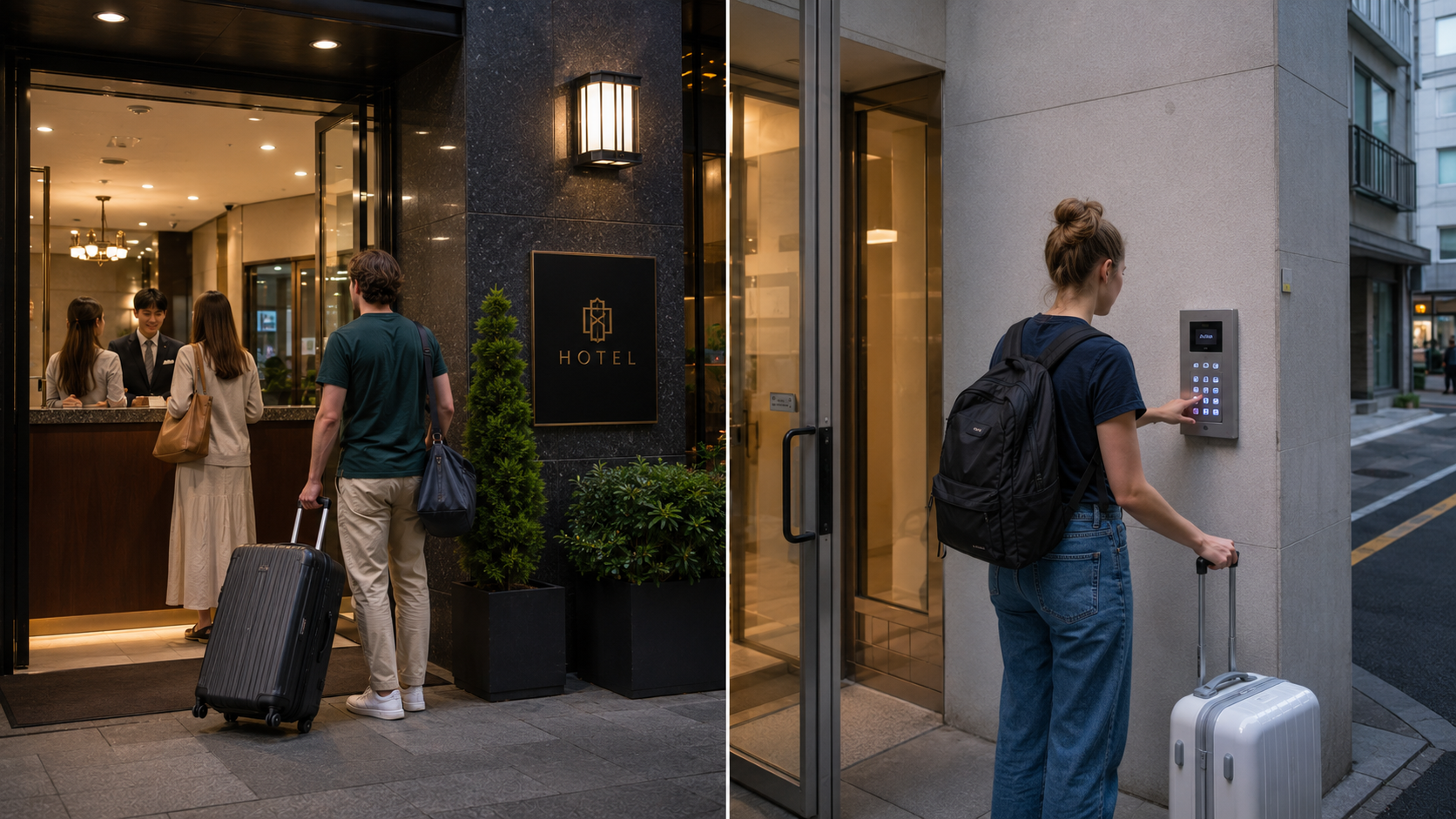
Hotels
Hotels normally provide a check-in desk, but reception is not automatically open 24 hours. Small hotels, guesthouses, and pensions may close the desk at night. Confirm the reception hours and late-arrival procedure directly with the property.
A hotel is usually the safer choice after a late international flight because staff can resolve room-access problems. It may also be easier to leave luggage if you arrive before check-in.
Airbnb
Airbnb check-in may involve a door code, lockbox, building intercom, or meeting the host. Instructions are sometimes released shortly before arrival. Read them before leaving the airport and save an offline copy in case your mobile data is not working.
Confirm these points in advance:
- Can you enter without the host being present?
- Does the building entrance have a separate code?
- Which floor and unit are you using?
- Is there a lift large enough for your luggage?
- Who can help if the code fails after midnight?
- Is the address written in Korean for a taxi driver?
Avoid a listing if the host asks you to misrepresent why you are in the building, hide from security staff, or claim to be a personal acquaintance. Platform availability alone should not be treated as proof that an accommodation complies with every applicable Korean registration and building rule. Ask the host to identify the property's accommodation or tourism-business registration where relevant, and contact the local district office or the Korea Tourism Organization if you need authoritative confirmation.
Space, beds, and bathrooms
Airbnb often wins on floor area, but photographs can make compact Korean homes look larger. Review the stated floor area when available and confirm that dining tables or sofas do not need to be converted into beds every night.
Korean bedding descriptions may include a floor mattress or yo (요), a traditional-style sleeping pad placed on the floor. This is not equivalent to a Western bed and may be uncomfortable for travelers with joint or mobility problems.
Bathrooms also require attention. Some Korean apartments and small guesthouses have a wet-room layout in which the shower is not separated from the toilet and sink. Hotels are more likely to have a partitioned shower, but this is not guaranteed in budget properties.
Check photographs and reviews for:
- Bed dimensions
- Number of fixed beds
- Floor bedding
- Shower separation
- Hot-water reliability
- Towels and towel size
- Storage space
- Blackout curtains
- Heating and air conditioning
Korean homes commonly use ondol (온돌), underfloor heating. Controls may be labelled only in Korean. Ask the host for translated instructions rather than repeatedly pressing boiler controls, which can also affect the hot water.
Kitchens, laundry, and longer stays
A kitchen is one of Airbnb's strongest advantages, particularly for families, dietary needs, or stays longer than a week. However, “kitchen” can mean anything from a microwave and kettle to a full cooking area.
Confirm whether the property provides:
- Refrigerator and freezer space
- Microwave
- Hob or induction cooker
- Pans, knives, and dishes
- Rice cooker
- Drinking-water filter or bottled water
- Permission for normal cooking
Washing machines are common in residential listings, but tumble dryers are less predictable. Clothes may need to dry on a rack indoors. Check whether detergent is supplied and whether the machine controls have English labels or translated instructions.
Hotels usually provide paid laundry or an external laundry service. Some business hotels and residence hotels have coin-operated machines, making them a useful middle ground between a standard hotel and Airbnb.
Cleaning and household rules
Hotel housekeeping is normally more predictable, although some properties clean only on request or on selected days. Confirm the policy for longer stays.
Airbnb cleaning arrangements vary. A cleaning fee generally covers turnover between guests; it does not necessarily provide cleaning during your stay. You may still be expected to wash dishes, collect rubbish, and leave the property reasonably tidy.
Waste disposal in Korea can be complicated because ordinary rubbish, food waste, and recyclable materials are separated. Buildings may use designated bags, collection rooms, or restricted disposal times. Follow the host's written instructions and ask questions if they are unclear. Do not leave bags in a corridor or beside a public bin.
Residential buildings also tend to enforce quiet hours. Sound carries easily through some apartment walls, and hallways are shared with permanent residents. A private apartment is not automatically suitable for parties or late-night group gatherings.
Service, problems, and cancellations
Hotels provide direct on-site assistance for issues such as a broken air conditioner, missing towels, or a room-key failure. They may be able to move you to another room immediately, subject to availability.
With Airbnb, contact usually begins through the host. Keep important communication in Airbnb's messaging system so that there is a record. If the accommodation is inaccessible, unsafe, unclean, or significantly different from the listing, document the issue with photographs or video and report it promptly.
Under Airbnb's Rebooking and Refund Policy for Homes, guests generally need to report a reservation issue within 72 hours after discovering it. Assistance or refunds depend on the circumstances, evidence, availability, and comparable pricing. This policy was verified on June 11, 2026.
Cancellation terms are not uniform. Airbnb listings can use different policies, while hotels may sell both flexible and non-refundable rates. Airbnb's home cancellation policy page says that the applicable policy is based on the listing and reservation details; monthly stays of 28 nights or more have separate long-term rules. Check the exact refund deadline in Korea Standard Time before payment.
Accessibility and traveling with children
Travelers requiring step-free access should generally favor a hotel that confirms accessible facilities in writing. An Airbnb marked as having a lift may still have steps at the building entrance, a raised bathroom threshold, a narrow lift, or a shower without grab rails.
Ask for specific measurements and photographs rather than relying on “wheelchair friendly” or a general accessibility symbol.
Families should check window locks, balcony access, floor heating, kitchen safety, and whether a cot or high chair is genuinely available. Children count toward occupancy limits unless the booking terms explicitly state otherwise. Enter the correct number and ages of all guests before comparing prices.
A useful middle option: residence hotels
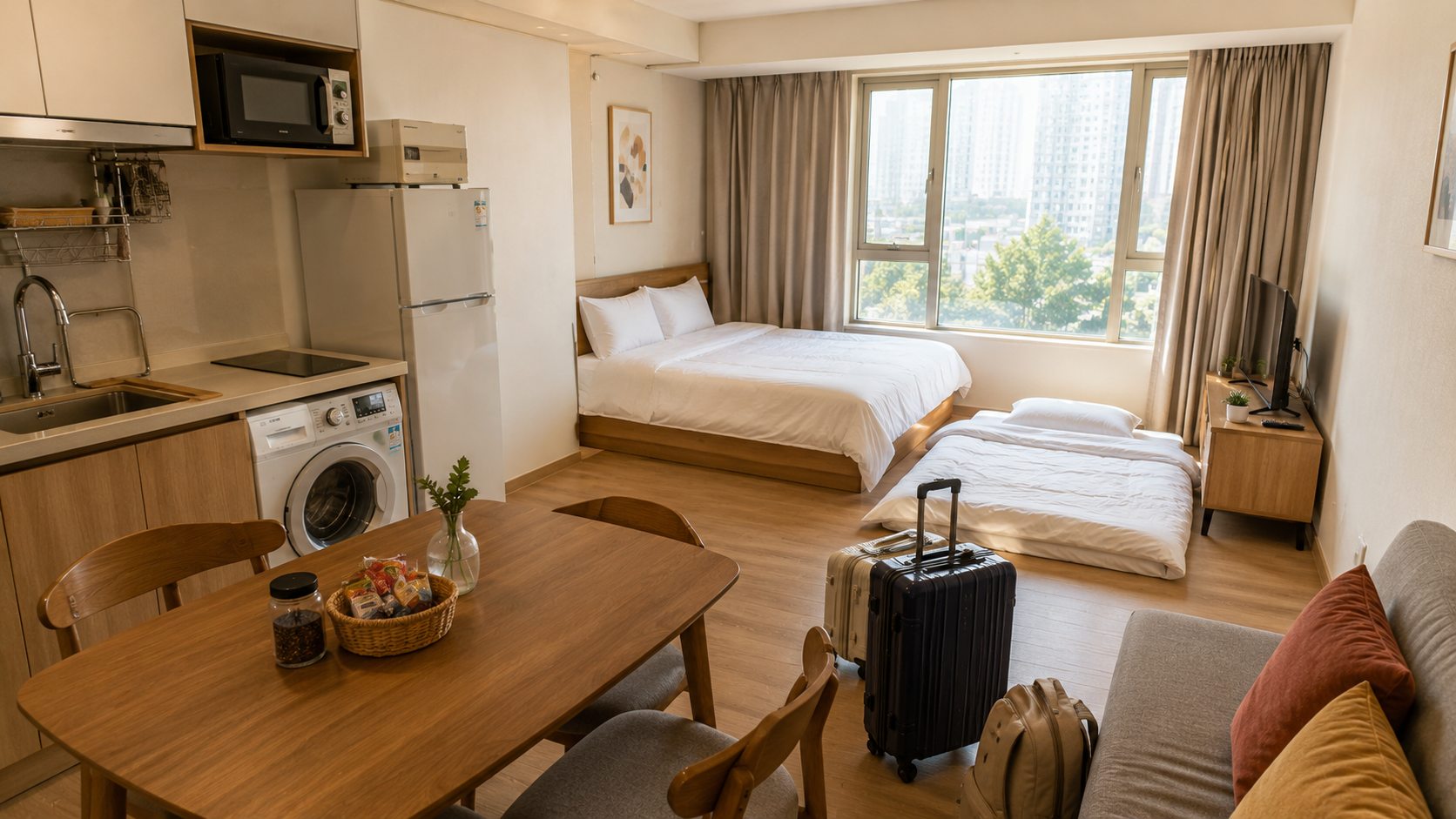
A serviced residence or residence hotel can combine apartment-style facilities with hotel operations. These properties may provide a kitchenette, washing machine, larger refrigerator, and separate living area while retaining reception and luggage support.
This category is worth checking when you want to cook or stay for several weeks but do not want to depend on an individual host. Confirm the cleaning frequency, kitchen equipment, and whether the washing machine is inside the room or shared.
What to check before you book
For either type
- Final price in KRW for all guests and nights
- Exact cancellation deadline and refund amount
- Distance from the correct station exit
- Stairs, lift, and luggage access
- Check-in deadline or self-check-in method
- Heating and air-conditioning availability
- Bed type and dimensions
- Bathroom layout
- Recent reviews mentioning noise, cleanliness, and location
- Korean-language address and emergency contact
Additional checks for Airbnb
- Entire place, private room, or shared room
- Host response record and recent review pattern
- Accommodation registration details where applicable
- Building entrance and room-access instructions
- Kitchen and laundry equipment
- Waste-separation instructions
- Cleaning expectations
- On-call help for access or maintenance failures
- Any request to conceal the nature of your stay
Additional checks for hotels
- Reception and late-arrival hours
- Luggage-storage policy
- Housekeeping frequency
- Breakfast price and hours
- Extra-bed availability
- Laundry facilities
- Accessible-room specifications
- Whether the rate is prepaid or payable at the property
FAQ
Is Airbnb legal in South Korea?
Short-term accommodation in Korea is subject to national and local registration, safety, building, and business rules that depend on the property type and location. A guest should not try to make a legal determination from the listing title alone. Ask the host for the relevant registration information and seek confirmation from the local district office when necessary. This guide does not provide legal advice.
Is Airbnb cheaper than a hotel in Seoul?
Sometimes, particularly for groups sharing a larger property or travelers who use the kitchen and laundry. For solo travelers and couples, business hotels can be similarly priced or cheaper once Airbnb cleaning and service fees are included. Compare final checkout totals for identical dates.
Do Korean hotels accept foreign credit cards?
Many do, especially properties serving international travelers, but acceptance is not universal and online payment may be processed by a separate booking platform. Confirm the accepted cards and whether payment is collected online or at check-in. Carry a backup payment method.
Can a hotel store luggage after check-out?
Many staffed hotels offer same-day storage, but it is a property service rather than a universal entitlement. Ask before booking if storage is important. Airbnb hosts may not be able to hold luggage between guests.
Which is better for a first trip to Korea?
A centrally located hotel with a staffed front desk is usually the lowest-friction option. Choose Airbnb when its extra space or facilities provide a clear advantage and you are comfortable following detailed self-check-in and household instructions.
What to check before you go
Three to five days before arrival, reconfirm the address, check-in time, guest count, and access procedure. Download the booking details, save the Korean address, and take screenshots of any door-code instructions that will be available at arrival.
If you need tourism assistance or help communicating about an accommodation problem, the Korea Tourism Organization lists the 1330 Korea Travel Helpline. Service channels and supported languages can change, so check the official page before relying on it.
Your next step is to shortlist one hotel and one Airbnb in the same neighborhood, enter the full guest count and dates, and compare the final KRW price against the checklist above. The better booking is the one that still works when you include arrival logistics, luggage, cleaning, and support—not simply the one with the lower nightly figure.