Seoul is well connected to historic cities, coastal districts, mountains, and the border region, making a day trip practical without renting a car. Suwon is the easiest all-round choice, Gangneung is the strongest option for the coast, and a guided DMZ tour suits travelers interested in modern Korean history.
Operational information and prices in this guide were checked on June 10, 2026. Train times, admission fees, tours, and access restrictions can change, so confirm them on the linked official websites before departure.
At a glance
| Destination | Good for | Typical one-way journey | Planning level |
|---|---|---|---|
| Suwon | Joseon history and walking | About 30–70 minutes | Easy |
| Incheon | Port history, food, and modern architecture | About 1–1.5 hours | Easy |
| Paju and the DMZ | Korean War and division history | About 1–2 hours | Advance planning required |
| Nami Island and Gapyeong | Riverside scenery and seasonal color | About 1.5–2 hours | Moderate |
| Gangneung | Beaches, coffee, and the east coast | About 2 hours by KTX | Moderate |
| Korean Folk Village, Yongin | Traditional architecture and performances | About 1.5–2 hours | Moderate |
Journey times are approximate and depend on your starting point in Seoul, transfers, and waiting time. Check the actual route on the morning of travel.
1. Suwon: the easiest historical day trip
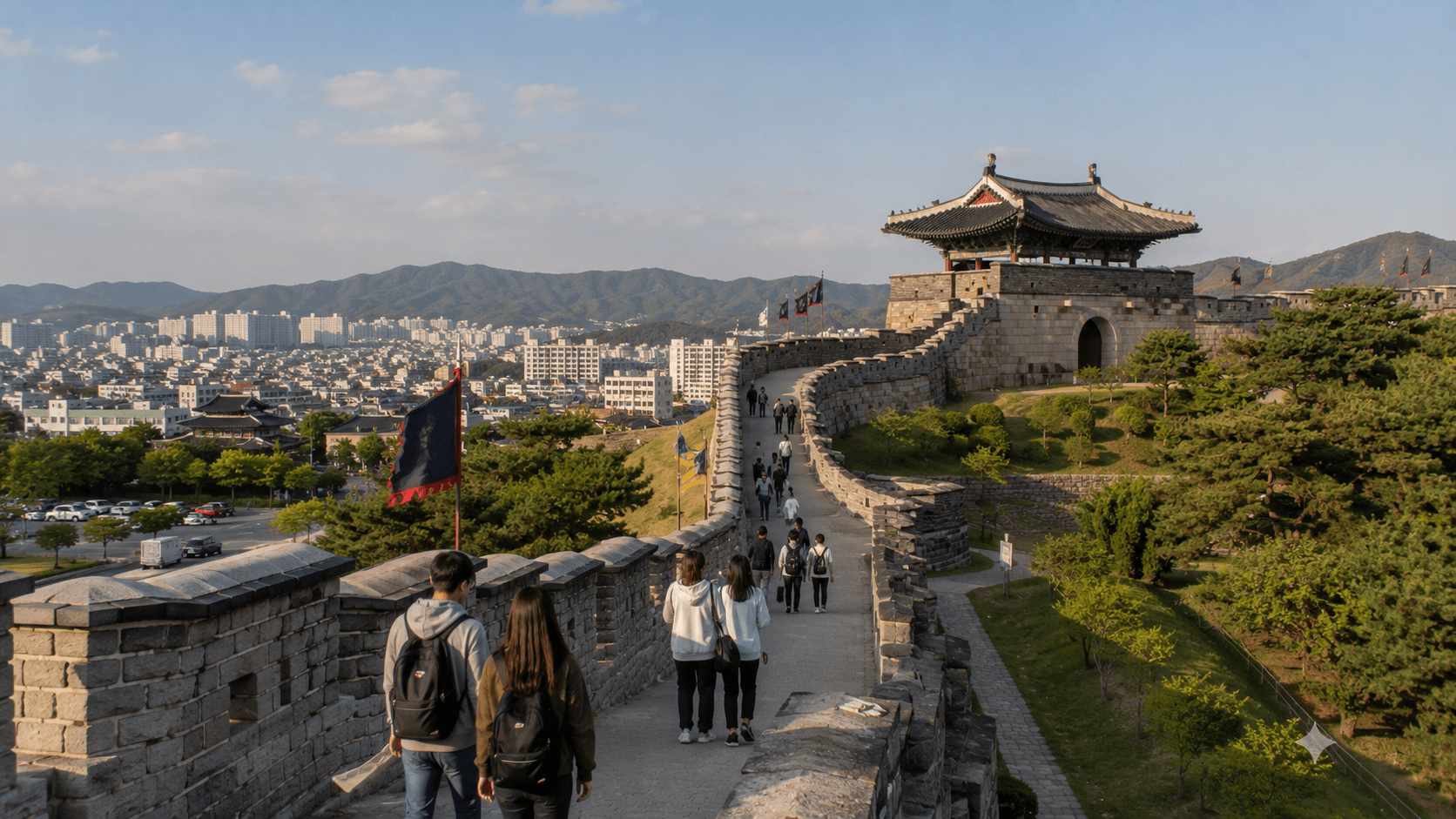
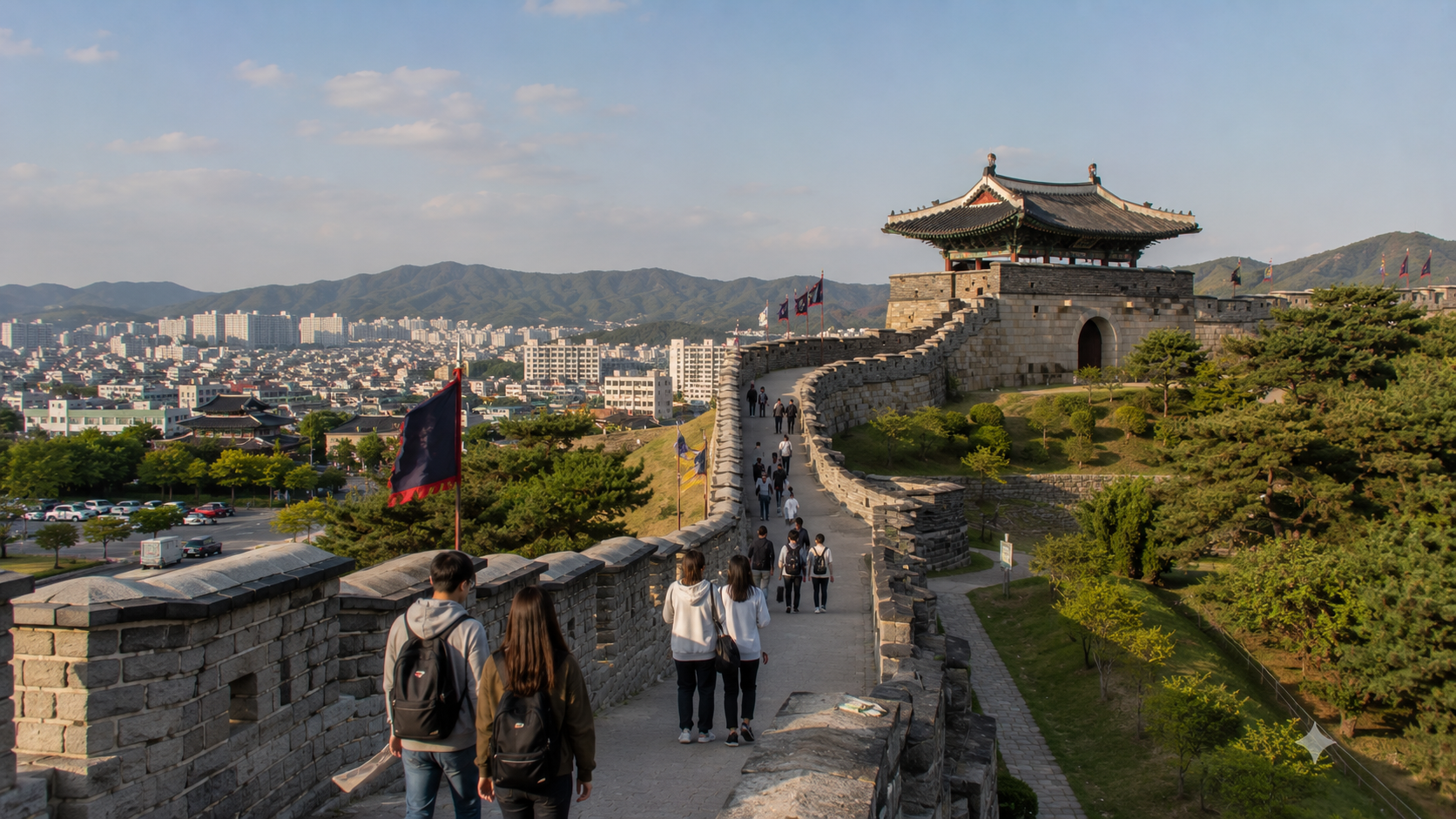
Suwon is the most straightforward choice for first-time visitors who want to leave Seoul without committing to a long journey. Its main attraction is Hwaseong Fortress (수원 화성), a late-18th-century defensive complex built under King Jeongjo and recognized as a UNESCO World Heritage Site.
The fortress wall passes gates, observation towers, command posts, and sections overlooking the modern city. Inside the walls, Hwaseong Haenggung (화성행궁) served as a temporary royal palace when the king visited Suwon.
Suggested itinerary
- Travel from Seoul to Suwon Station by regular rail, metro, or a faster intercity service.
- Take a local bus or taxi to Paldalmun Gate or Hwaseong Haenggung.
- Visit the palace before walking part of the fortress wall.
- Continue toward Seojangdae Command Post for elevated city views.
- Finish around Haenggung-dong, where restored streets contain restaurants and cafés.
You do not need to walk the entire wall. Some western sections climb Paldalsan and include steep stairs, so a shorter palace-to-Janganmun route is more suitable for travelers with limited time or mobility.
As verified on June 10, 2026, the open fortress itself is free and accessible throughout the year. Hwaseong Haenggung normally operates from 09:00 to 18:00, with final admission one hour before closing. The listed adult admission is KRW 2,000. Seasonal evening opening is scheduled on selected Fridays, weekends, and public holidays from May 1 to November 1, 2026, but dates can change. Confirm the latest details through the Suwon Cultural Foundation visitor information.
Practical tip: Suwon Station is not directly beside the fortress. Allow roughly 20–30 minutes for the final local bus or taxi journey, especially during peak traffic.
2. Incheon: port history and modern Korea in one day
Incheon works well for travelers who prefer neighborhoods, food, and waterfront scenery to a single major monument. The city is part of the Seoul metropolitan transport network, so you can reach it with an ordinary transit card and do not normally need an advance reservation.
For a coherent day, choose either historic central Incheon or modern Songdo as your main focus. Trying to cover Chinatown, Wolmido, and Songdo in a few hours creates unnecessary travel across a large city.
Historic Incheon route
Begin at Incheon Station, immediately outside Chinatown. Walk through the neighborhood, Jayu Park, and the former international settlement area near the old port. Small museums explain the period after Incheon Port opened to foreign trade in the late 19th century.
Chinatown is associated with Korean-style jajangmyeon, noodles served with a dark fermented-bean sauce. Restaurant prices and queues vary, and the busiest streets become crowded at lunchtime on weekends.
From Chinatown, continue to Wolmido for a waterfront walk. The boardwalk is free, while amusement rides, museums, and cruises charge separately.
Songdo alternative
Songdo offers a contrasting landscape of high-rise architecture, broad pedestrian spaces, and a park built around a seawater canal. Central Park Station on Incheon Metro Line 1 is the most convenient arrival point.
The park itself is suitable for walking and picnics. Boat services and rentals are weather-dependent and have separate operating schedules, so check locally rather than treating them as guaranteed parts of the itinerary. Use the Incheon Tourism Organization for current city attraction information.
Practical tip: Seoul subway and metropolitan rail journeys can involve long standing periods. Avoid weekday commuter hours, particularly approximately 07:30–09:30 and 17:00–19:30.
3. Paju and the DMZ: a structured history trip
A visit to the Demilitarized Zone, or DMZ, is fundamentally different from an ordinary sightseeing excursion. The DMZ is a controlled buffer zone established after the 1953 Korean Armistice Agreement. Access to locations such as the Third Infiltration Tunnel and Dora Observatory depends on military and local authority approval.
For most international visitors, an organized tour from Seoul is the practical option. A standard itinerary may include Imjingak, the Third Tunnel, and an observatory, but no specific stop should be considered guaranteed. Security conditions, military exercises, weather, and administrative decisions can change the route with little notice.
Before booking
- Confirm exactly which sites are included, rather than relying only on the words “DMZ tour.”
- Check whether hotel pickup is included or whether you must meet at a central station.
- Carry the original passport used for the reservation. A photograph or photocopy may not satisfy identity checks.
- Ask whether tunnel access involves a steep walk. The Third Tunnel can be physically demanding and may not suit visitors with heart, respiratory, knee, or mobility problems.
- Treat Joint Security Area or Panmunjom access as separate from a general DMZ tour. Do not assume it is included or operating.
Current access could not be confirmed as a fixed daily service valid for every date after June 10, 2026. Book only through a provider that confirms the day’s approved itinerary and cancellation policy. The Paju City government website is the relevant local authority source for notices, although not all updates are consistently available in English.
Imjingak Peace Park, south of the controlled zone, is easier to visit independently and contains memorials, observation areas, and exhibits related to national division. It is a reasonable alternative when restricted DMZ sites are unavailable.
Common mistake: A South Korean DMZ tour does not cross into North Korea. Visitors remain on the South Korean side of the border.
4. Nami Island and Gapyeong: scenery with transfer planning
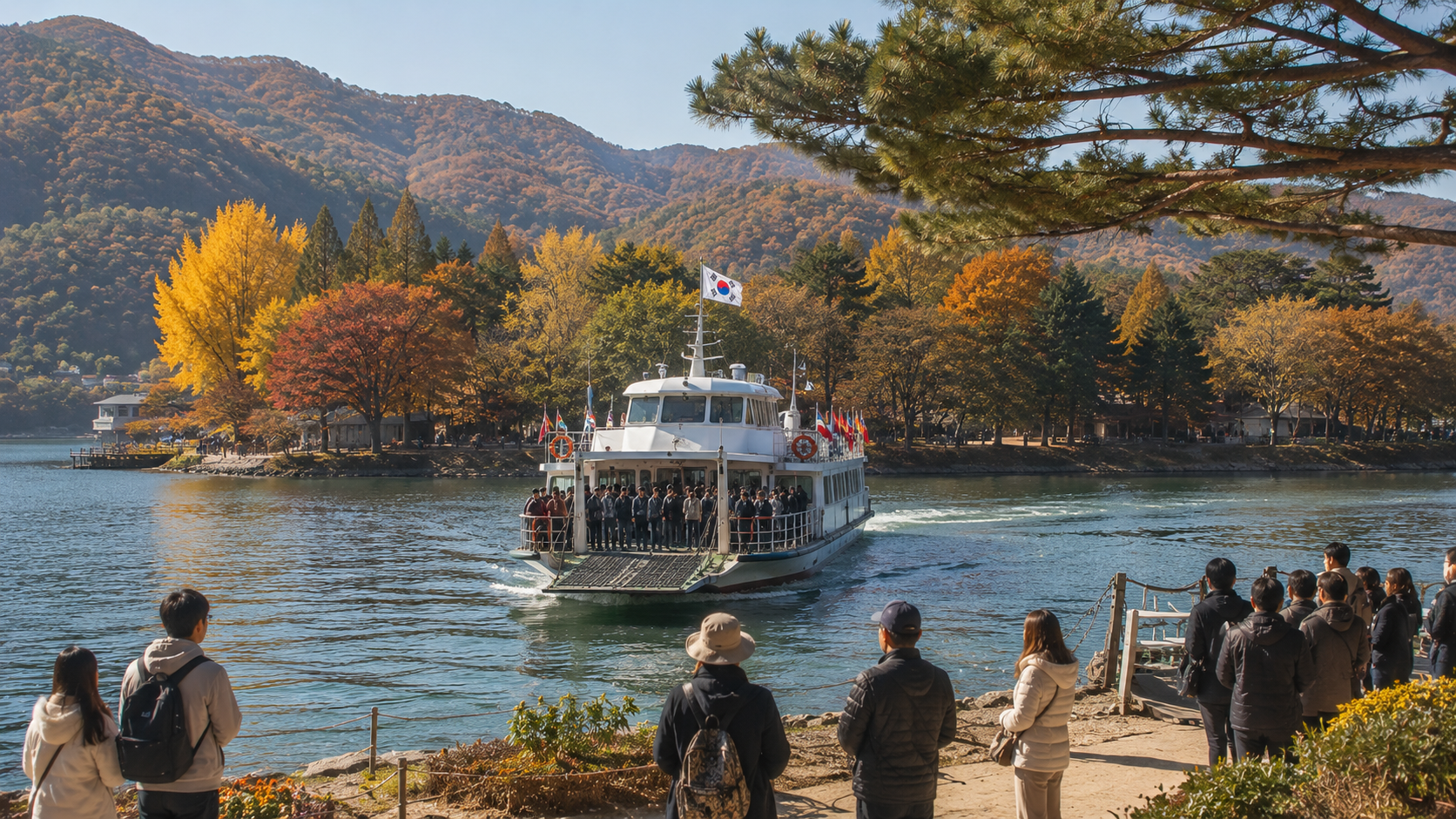
Nami Island, or Namiseom (남이섬), is a landscaped river island near Gapyeong known for tree-lined paths and seasonal scenery. It is commercially operated and can become extremely busy during spring blossoms, autumn foliage, weekends, and public holidays.
The usual independent route is a train from Seoul to Gapyeong Station, followed by a local bus or taxi to the wharf. Admission is normally sold as a package including the short ferry crossing. Because ticket prices, ferry intervals, and closing times can change, check the official Nami Island website immediately before traveling.
Is Nami Island worth combining with another attraction?
It can be combined with the Garden of Morning Calm or another Gapyeong attraction, but only if you start early and confirm local transport. Attractions that look close on a map may require slow bus connections. A packaged shuttle or tour can reduce transfer uncertainty, while independent travel provides more flexibility.
A relaxed plan is to visit Nami Island alone, have lunch near the wharf or on the island, and return before the evening rush. Travelers who dislike crowds may prefer a weekday morning outside peak blossom and foliage periods.
Accessibility: The main island paths are generally level, but ferry boarding conditions and distances between facilities should be checked directly if you use a wheelchair or have limited mobility.
5. Gangneung: the most practical east-coast escape
Gangneung is a long day, but high-speed rail makes it realistic for travelers who want to see Korea’s east coast without staying overnight. KTX trains run from Seoul-area stations to Gangneung, with the journey generally taking around two hours depending on the service.
Reserve both directions in advance for Fridays, weekends, holidays, and summer beach season. Use the official Korail website or KorailTalk app to confirm the exact June 2026 timetable and fare for your departure station. Ticket prices vary by train and route, so they should be checked for the specific service rather than estimated from an old fare table.
A workable one-day route
- Take a morning KTX to Gangneung Station.
- Use a city bus or taxi to Gyeongpo Lake and Gyeongpo Beach.
- Walk part of the lakeside or coastline rather than attempting the entire area.
- Continue to Anmok Coffee Street for sea views and cafés.
- Return to Gangneung Station with at least 30 minutes of extra time before your train.
Gangneung’s attractions are spread out. Local buses are economical but can be infrequent compared with Seoul, while taxis save substantial time when shared by two or more travelers.
Swimming conditions, lifeguard periods, beach facilities, and coastal trail closures are seasonal. Check the Gangneung City English website for local notices. Outside the official swimming season, treat the beach primarily as a walking destination.
Budget note: This is usually the most expensive independent trip in this guide because it combines reserved intercity rail with local transport and meals. Buying an early outbound train and a late return does not necessarily leave a full day once transfers are included.
6. Korean Folk Village in Yongin: traditional buildings and performances
The Korean Folk Village in Yongin is a practical choice for families and visitors who want traditional architecture presented in one accessible site. The grounds contain reconstructed or relocated buildings representing different regions and social classes, alongside scheduled performances and demonstrations.
This is an open-air attraction rather than an untouched historical village. Its value lies in showing building layouts, household tools, workshops, and performance traditions in a compact setting.
Public transport usually involves a train or metro journey followed by a local bus. Direct or seasonal transport arrangements may change, so check the Korean Folk Village’s official English website for current admission, opening hours, performance schedules, and directions.
Allow at least four hours inside. Rain, heat, and winter cold matter because much of the site is outdoors. Some paths are uneven, and performance times may change due to weather.
Practical tip: Check the daily performance board immediately after entering. Planning your walking route around two or three priority performances is more efficient than repeatedly crossing the grounds.
How to choose the right trip
Choose Suwon for the simplest combination of history, low cost, and flexible transport. Choose Incheon when you want food and neighborhood exploration without a reserved ticket. Choose the DMZ for modern history, provided you accept security-related changes and book a confirmed tour.
Choose Nami Island for landscaped nature and seasonal photographs. Choose Gangneung when seeing the sea is the priority and you are comfortable with a long day. Choose the Korean Folk Village for an organized introduction to traditional buildings and performances.
What to check before you go
- Confirm the final return train, bus, or tour drop-off time.
- Reserve KTX and limited-capacity tours in advance.
- Check whether your destination closes on Mondays or public holidays.
- Carry a charged Korean transit card for metropolitan trains and buses.
- Keep a physical payment card or cash backup. Foreign cards do not work at every small ticket machine or restaurant.
- Download a Korean map app because international map services may provide limited navigation in South Korea.
- Check rain, heat, snow, air-quality, and coastal wind forecasts.
- Allow extra time for station transfers and finding the correct platform.
- Carry your original passport for DMZ tours and any reservation made under a passport name.
- Verify accessibility directly with the attraction when step-free access is essential.
Frequently asked questions
Can I use a T-money card for these trips?
T-money and similar transit cards work on most metropolitan subways and local buses, including routes to Suwon and Incheon. They do not replace a reserved KTX ticket or an attraction admission ticket.
Is renting a car necessary?
No. Every destination in this guide can be reached by public transport or an organized tour. A car may help with rural combinations around Gapyeong, but parking, traffic, and Korean-language navigation can offset the benefit for first-time visitors.
Which day trip is cheapest?
Suwon or Incheon will usually cost the least because both are connected to the metropolitan rail system and have substantial areas that can be explored free of charge. The final total depends on your starting point, meals, and paid attractions.
Which trip needs the earliest start?
Gangneung, the DMZ, and multi-attraction Gapyeong itineraries benefit most from an early departure. Suwon and Incheon remain workable with a later start because transport is more frequent and flexible.
Sources
- Korail official English website
- UNESCO listing for Hwaseong Fortress
- Suwon Cultural Foundation visitor information
- Incheon Tourism Organization
- Paju City government
- Nami Island official website
- Gangneung City English website
- Korean Folk Village official English website
Start by choosing one priority—history, coast, nature, or border history—then check the official timetable and booking page for your exact travel date before building the rest of the day.