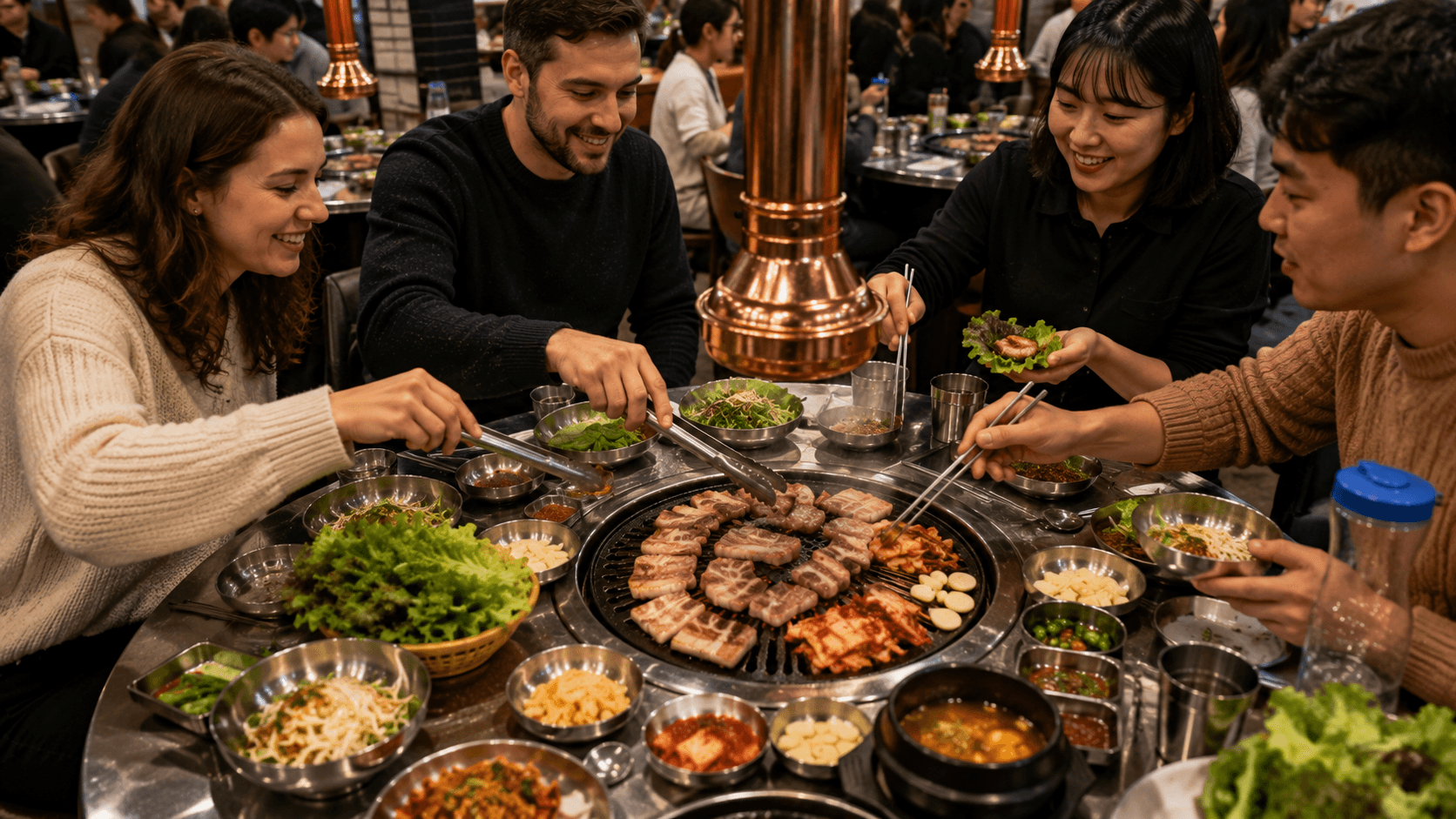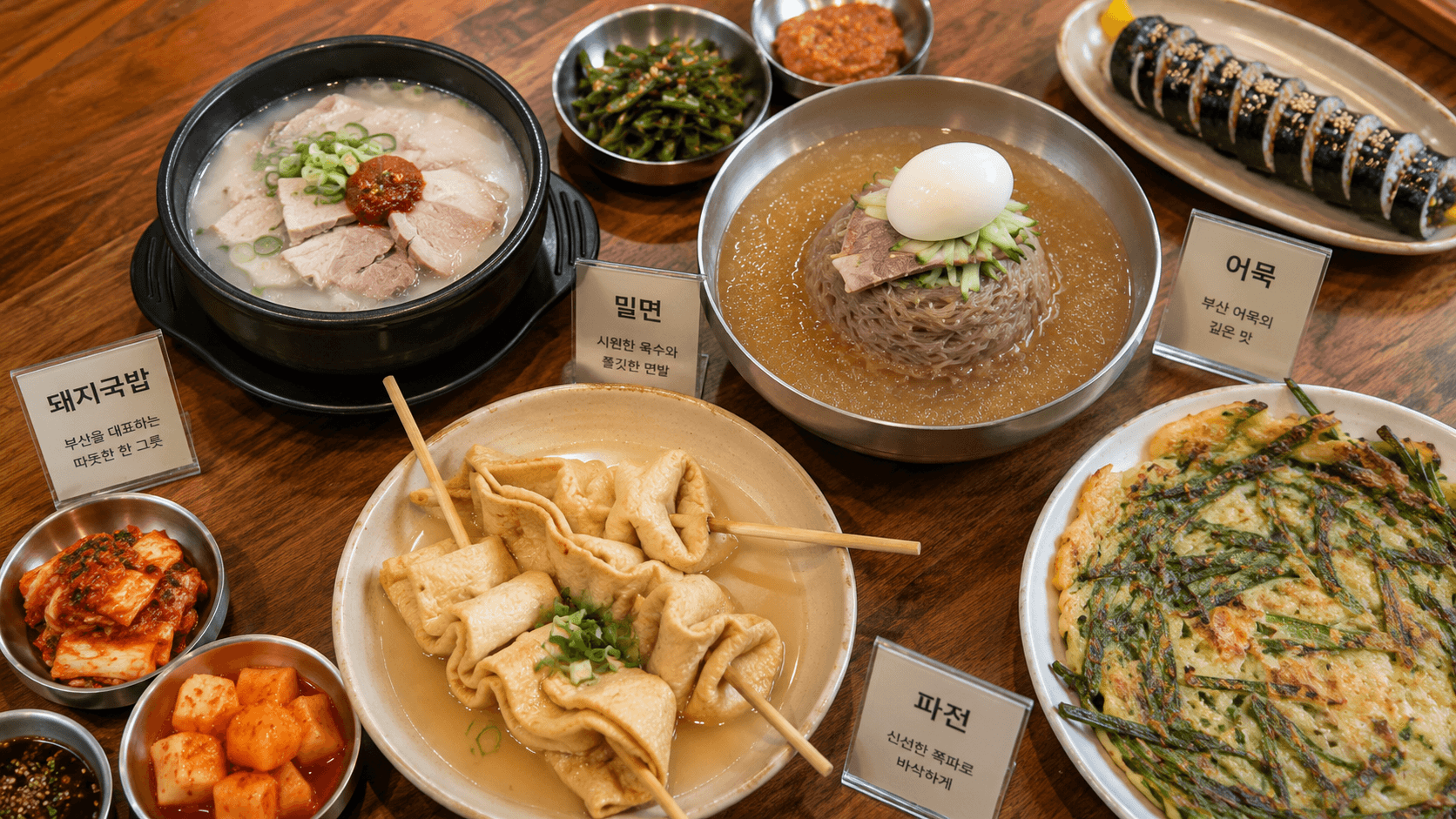
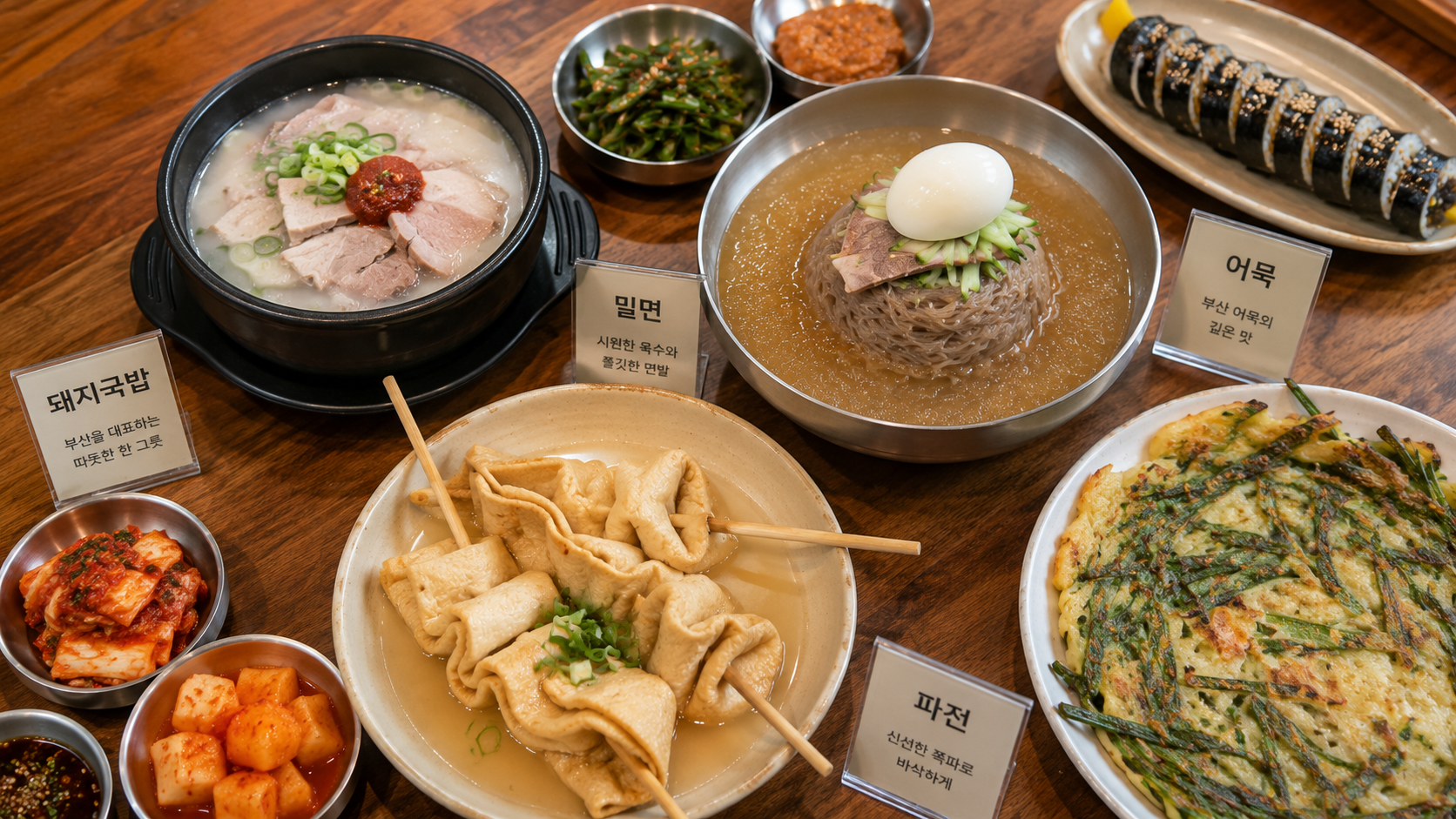
Busan's food is shaped by its port, fishing industry, traditional markets, and history as a refuge during the Korean War. Start with dwaeji-gukbap, milmyeon, fresh seafood, and eomuk, then add market snacks such as ssiat hotteok if you have time. You do not need to visit a famous restaurant for every dish: neighborhood shops often specialize in just one or two foods.
Information on market hours and current restaurant listings was verified on June 11, 2026. Individual menus, prices, closing days, and last orders can change, so check the restaurant or market listing again on the day you visit.
At a glance
| What to eat | Korean name | What it is | Good for |
|---|---|---|---|
| Pork and rice soup | 돼지국밥 | Pork, broth, and rice served together or separately | A filling breakfast or lunch |
| Busan wheat noodles | 밀면 | Chilled wheat noodles in broth or spicy sauce | A light meal, especially in warm weather |
| Sliced raw fish | 회 | Fresh fish sliced for wrapping with vegetables and condiments | A shared seafood dinner |
| Busan fish cake | 부산어묵 | Seasoned fish paste steamed or fried in different shapes | A snack or quick meal |
| Spicy octopus stir-fry | 낙지볶음 | Octopus cooked in a red chili-based sauce | Diners who enjoy spicy food |
| Dongnae green-onion pancake | 동래파전 | A thick savory pancake with green onions and seafood | Sharing with drinks |
| Sea eel | 꼼장어 | Hagfish, commonly grilled with salt or spicy seasoning | An adventurous evening meal |
| Seed-filled hotteok | 씨앗호떡 | Fried sweet pancake filled with sugar and chopped seeds | Dessert while exploring Nampo-dong |
The Busan dishes to prioritize
1. Dwaeji-gukbap: pork and rice soup
Dwaeji-gukbap (돼지국밥) is one of the city's most recognizable everyday meals. A bowl usually contains sliced pork in a pale, savory broth. Depending on the restaurant, the rice arrives inside the soup or in a separate bowl.
The broth may taste deliberately mild when it reaches the table. Season it gradually using the available salt, chopped green onions, fermented shrimp called saeujeot (새우젓), or spicy seasoning paste. Adding everything immediately can make the soup excessively salty.
Useful menu variations include:
- Dwaeji-gukbap: pork soup with rice
- Sundae-gukbap: soup containing Korean blood sausage
- Seokkeo-gukbap: a mixture that may include pork, offal, and blood sausage
- Ttarogukbap: soup and rice served separately
- Suyuk-baekban: boiled pork with rice, soup, and side dishes, generally intended as a larger meal
Ask what is included if you do not eat offal. Even a bowl labeled pork soup may contain intestines at restaurants that specialize in mixed cuts. The official Visit Busan Michelin Guide listings include several current dwaeji-gukbap options, but inclusion is not a guarantee that a restaurant will suit every budget or dietary requirement.
2. Milmyeon: Busan's cold wheat noodles
Milmyeon (밀면) consists of chewy wheat-based noodles served either in chilled broth or mixed with a spicy sauce. It developed as a Busan regional dish associated with the city's Korean War refugee history and the adaptation of northern-style cold noodles to locally available ingredients.
Choose between two main versions:
- Mul-milmyeon (물밀면): noodles in cold broth, often with ice
- Bibim-milmyeon (비빔밀면): noodles mixed with a sweet, sour, and spicy red sauce
The noodles can be unusually long and elastic. Scissors are often provided so that you can cut them before eating. Add vinegar or mustard only after tasting the broth because the seasoning cannot be reversed.
Milmyeon restaurants commonly sell steamed dumplings or thinly sliced boiled pork as side dishes. Ordering one side to share works well when the noodles alone seem too light.
3. Hoe and cooked seafood
Hoe (회) is the general Korean term used for sliced raw fish. In Busan, it is commonly eaten with garlic, chili, ssamjang dipping paste, and leafy vegetables. Diners wrap a piece of fish with the condiments rather than soaking every piece in sauce.
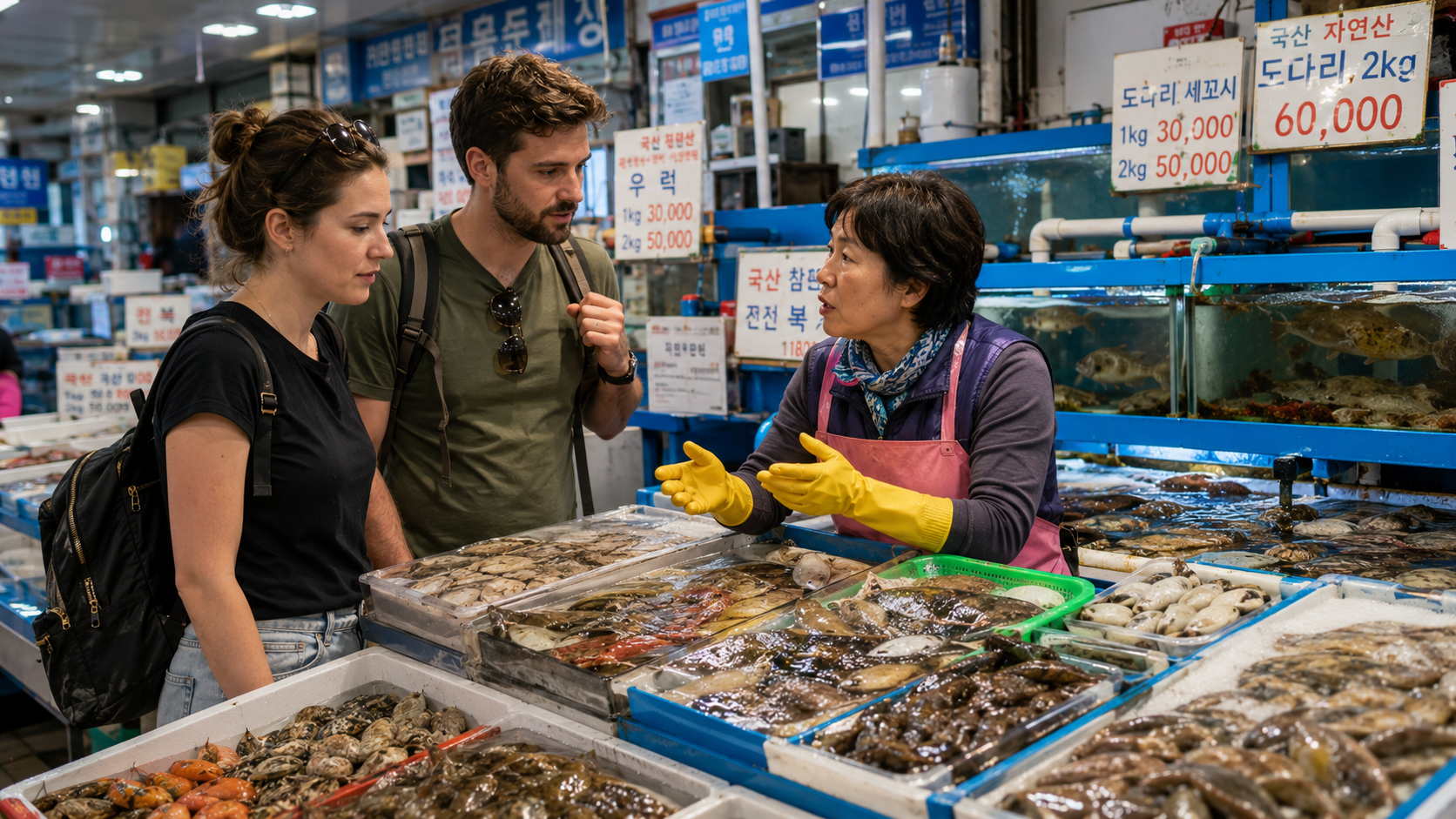
At a seafood market, clarify the complete cost before agreeing to a fish. The amount quoted for seafood may not include preparation, table use, side dishes, or a final spicy fish stew. Ask these questions:
- Is the quoted amount the total price?
- Does it include slicing and preparation?
- Is there a separate table or restaurant charge?
- Is spicy fish stew included?
- Is the portion suitable for your group size?
Do not assume that raw fish is the only worthwhile option. Grilled fish, shellfish, spicy fish stew, eel, and seafood soups are easier choices for diners who prefer cooked food.
Jagalchi Market has indoor and outdoor seafood sellers as well as places serving raw fish, grilled fish, and spicy stew. As verified on June 11, 2026, Visit Busan lists general market hours as 05:00-22:00, with closure on the first, third, and fifth Tuesdays. Store hours and service fees differ, so arriving well before closing is safer than planning a late dinner.
4. Busan eomuk: fish cake
Eomuk (어묵), sometimes translated as fish cake, is made from processed fish paste combined with other ingredients and formed into sheets, bars, balls, or filled products. Busan's port and seafood-processing history have made it particularly associated with the city.
At street stalls, flat fish cakes are often kept in hot broth and served on skewers. The broth may be offered in a paper cup. Dedicated shops sell packaged varieties suitable for eating immediately or carrying home, although chilled products need appropriate storage.
Fish cake is not normally vegetarian. It can also contain wheat, egg, shellfish, or other allergens depending on the recipe. Request ingredient information from the manufacturer when allergies are involved rather than relying on appearance.
5. Nakji-bokkeum: spicy octopus stir-fry
Nakji-bokkeum (낙지볶음) is chopped octopus cooked with vegetables in a red chili-based sauce. Busan versions are often served in a shallow pan or pot, sometimes with noodles, glass noodles, or shrimp added.
The dish can be genuinely hot, and asking for less spice may only reduce rather than remove the chili paste. Rice helps balance the sauce. Some restaurants finish the meal by frying rice in the remaining seasoning, but this may require an additional order.
Check whether the menu says nakji-bokkeum, nakgopsae (낙곱새), or another combination. Nakgopsae contains octopus, beef intestines, and shrimp; it is not simply octopus with seafood.
6. Dongnae-pajeon: a substantial local pancake
Dongnae-pajeon (동래파전) is a regional green-onion pancake associated with Busan's Dongnae area. It is generally thicker and softer than a crisp, thin jeon, with long green onions and seafood held together by batter and egg.
It is usually a shared dish rather than a complete individual meal. Pairing it with makgeolli, a cloudy rice-based alcoholic drink, is common, but alcohol is optional. Since seafood and egg are integral to many versions, confirm ingredients before ordering if you have dietary restrictions.
7. Ggomjangeo: grilled sea eel
Ggomjangeo (꼼장어), commonly called sea eel on English menus, is technically hagfish. It has a firm, chewy texture and is normally grilled with salt or a spicy red seasoning. Restaurants may cook it at the table with onions and other vegetables.
This is a stronger-flavored and more textural experience than grilled freshwater eel. Order a smaller portion to share if nobody in your group has tried it. Confirm the minimum order because barbecue-style restaurants frequently require two portions or a dish sized for at least two diners.
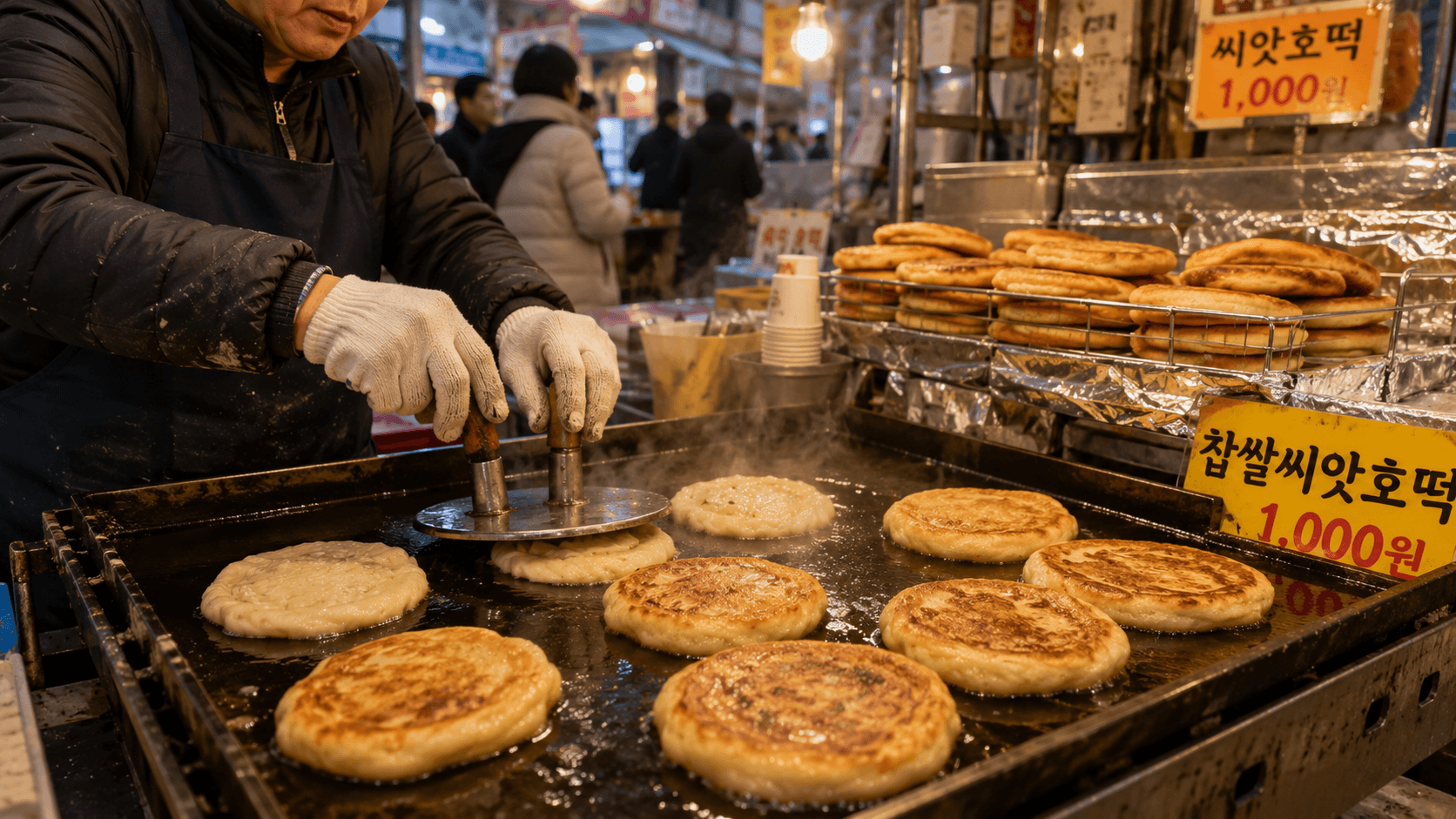
8. Ssiat hotteok: the Nampo-dong sweet snack
Ssiat hotteok (씨앗호떡) is a Busan variation of hotteok, a fried filled pancake. After cooking, the vendor cuts it open and adds a mixture of chopped seeds, nuts, and sugar.
It is closely associated with the Nampo-dong market area. Eat it carefully: the sugar filling and cooking oil can remain extremely hot. People with nut, seed, wheat, or cross-contact concerns should not assume that different stall utensils or cooking surfaces are separated.
Other foods worth recognizing
Grilled clams and shellfish
Coastal restaurant areas serve shellfish cooked over a tabletop grill. Menus and set composition can vary with season and supply. Ask whether the listed price is per person, per plate, or for a fixed set, and confirm whether additional shellfish will be added automatically.
Gijang seaweed soup
Gijang, in eastern Busan, is associated with seaweed and seafood. Miyeok-guk (미역국) is seaweed soup, traditionally eaten in Korea on birthdays but available throughout the year. Restaurants may prepare it with beef, clams, fish, or other seafood, so it is not automatically vegetarian.
Dae-gutang
Dae-gutang (대구탕) is cod soup, generally made with pieces of fish, radish, and green onions in a clear or lightly seasoned broth. It can be a useful alternative when you want a hot seafood meal without a heavy red sauce. Fish bones may remain in the bowl.
Where to eat by neighborhood
Nampo-dong, Jagalchi, and Bupyeong
Choose this area for seafood and concentrated market snacking. Jagalchi is the main seafood stop, while nearby Bupyeong Kkangtong Market is better suited to fish cake, tteokbokki, fried foods, and other casual snacks.
As verified on June 11, 2026, the official Bupyeong Kkangtong Night Market guide lists night-market hours as 19:30-midnight daily, except traditional holidays. The stalls occupy narrow aisles; keep to the right and avoid blocking the walking lane while deciding what to order.
Seomyeon
Seomyeon is convenient for groups who want choices within a compact nightlife district. Look for pork soup, barbecue, nakgopsae, casual pubs, and late meals. It is practical rather than specifically seafood-focused.
Haeundae
Haeundae has seafood restaurants, cod soup, barbecue, hotel dining, and a broad selection of international food. Restaurants near the beachfront can be busy on weekends and holidays. Check whether reservations are accepted and whether a minimum order applies before joining a queue.
Gwangalli and Millak
This area combines seafood dining with views toward Gwangandaegyo Bridge. Some restaurants sell atmosphere as much as food, so inspect the menu and seating rules before committing. Window tables may involve waiting or reservation requirements.
Dongnae
Visit Dongnae when Dongnae-pajeon is a priority. Because the pancake is designed for sharing, this stop works better for two or more diners than for a solo snack.
How ordering usually works
Check the minimum order
Barbecue, grilled shellfish, eel, and large seafood dishes may require two portions or a set intended for multiple people. Solo diners should look for gukbap, noodles, soups, rice dishes, or restaurants displaying one-person meals.
Use the call button
Many Korean restaurant tables have a call button marked 벨 or 호출. Press it once when you are ready to order or need assistance. At smaller establishments, calling out politely may be normal if there is no button.
Expect shared side dishes
Banchan (반찬) are small side dishes placed in the center of the table. Basic refills are often available, but this is not universal. Ask before assuming that a particular item is complimentary or refillable.
Check the payment counter
At many casual restaurants, you pay at the front counter after eating rather than requesting the bill at the table. Cards are widely used in established restaurants, but carrying some KRW is sensible for small market stalls. Payment acceptance can differ by vendor.
Dietary restrictions and allergies
Vegetarian and vegan visitors should be cautious with apparently meat-free soups, noodles, pancakes, kimchi, and side dishes. Anchovy stock, fish sauce, shrimp paste, meat broth, egg, or seafood may not be visually obvious.
Useful phrases include:
- I have an allergy: 알레르기가 있어요. (Allereugiga isseoyo.)
- Does this contain peanuts? 땅콩 들어가요? (Ttangkong deureogayo?)
- Does this contain seafood? 해산물 들어가요? (Haesanmul deureogayo?)
- I do not eat meat: 고기를 먹지 않아요. (Gogireul meokji anayo.)
These phrases begin a conversation but do not guarantee protection from cross-contact. Show a translated allergy card listing the exact ingredients and severity. When the consequences could be serious, choose a business that can clearly confirm its ingredients and preparation process.
What to check before you go
- Confirm the restaurant's current hours, break time, last order, and closing day.
- Check whether reservations are required or accepted.
- Look for a minimum order, especially for barbecue and seafood sets.
- Ask for the total seafood price before preparation begins.
- Carry some KRW for market stalls even if you normally pay by card.
- Confirm ingredients when avoiding pork, seafood, alcohol, egg, or allergens.
- Allow extra time on weekends and public holidays.
- Do not plan around an old social-media menu; prices and dishes can change.
- Recheck Jagalchi's Tuesday closure pattern and night-market operations on your actual travel date.
For a first Busan food day, have milmyeon or pork soup for lunch, explore Jagalchi in the afternoon, and continue to Bupyeong Kkangtong Market after 19:30 for fish cake and a sweet snack. This keeps the route compact and gives you both a proper local meal and a market experience.