Busan does not have one ideal neighborhood for every visitor. Choose Haeundae for a classic beach holiday, Gwangalli for sea views and evenings out, Seomyeon for convenient transport, or Nampo for markets and older central Busan. Songjeong, Centum City, and the Busan Station area work better for more specific itineraries.
Busan is geographically spread out, so your accommodation choice can substantially affect how much time you spend in transit. Before booking, identify the three or four places you most want to visit and check their locations against the official Busan Metro map.
At a glance
| Area | Most suitable for | Main advantage | Main drawback |
|---|---|---|---|
| Haeundae | First-time beach visitors, families, resort stays | Beach access and extensive visitor facilities | Far from Nampo and western attractions |
| Gwangalli | Couples, friends, nightlife, bridge views | Lively waterfront after dark | Beachfront rooms can be noisy |
| Seomyeon | Short trips, public transport, shopping | Transfer between Metro Lines 1 and 2 | No beach or coastal atmosphere |
| Nampo and Jagalchi | Markets, food, history, western Busan | Walkable access to major central attractions | Longer journey to eastern beaches |
| Songjeong | Surfing, quieter coastal stays | More relaxed beach environment | Less convenient for citywide sightseeing |
| Centum City | Events, shopping, business travel | Convenient for BEXCO and major retail facilities | Less neighborhood atmosphere at night |
| Busan Station | Rail connections and one-night stays | Immediate KTX access | Not the most convenient base for beaches |
Haeundae: best for a full beach holiday
Haeundae (해운대) is the straightforward choice if the beach is the main purpose of your trip. The neighborhood has a broad range of hotels, restaurants, cafés, convenience stores, and visitor-oriented services. Haeundae Station is on Metro Line 2, while the beachfront is generally reached on foot from the station area.
The district is also convenient for Dongbaekseom, the Marine City waterfront, and attractions farther east. The official metro map shows Haeundae, Dongbaek, BEXCO, Centum City, and other eastern districts along Line 2. This makes Haeundae a practical base for an itinerary concentrated on coastal Busan rather than the entire city.
Stay here if you want
- A hotel within walking distance of a major beach
- A large selection of conventional hotels and family rooms
- Restaurants and cafés that remain active into the evening
- Easy access to eastern Busan
- A resort-style visit with limited daily commuting
Think twice if you want
Nampo, Jagalchi Market, Gamcheon Culture Village, and other western attractions are on the opposite side of the city. Reaching them normally requires a substantial cross-city journey and at least one metro transfer. Haeundae can also become crowded during summer weekends, festivals, and major events.
When comparing hotels, check the actual walking route rather than relying on the word “Haeundae” in the property name. Accommodation near Jangsan or other parts of Haeundae District may not be close to the sand.
Gwangalli: best for waterfront evenings and bridge views
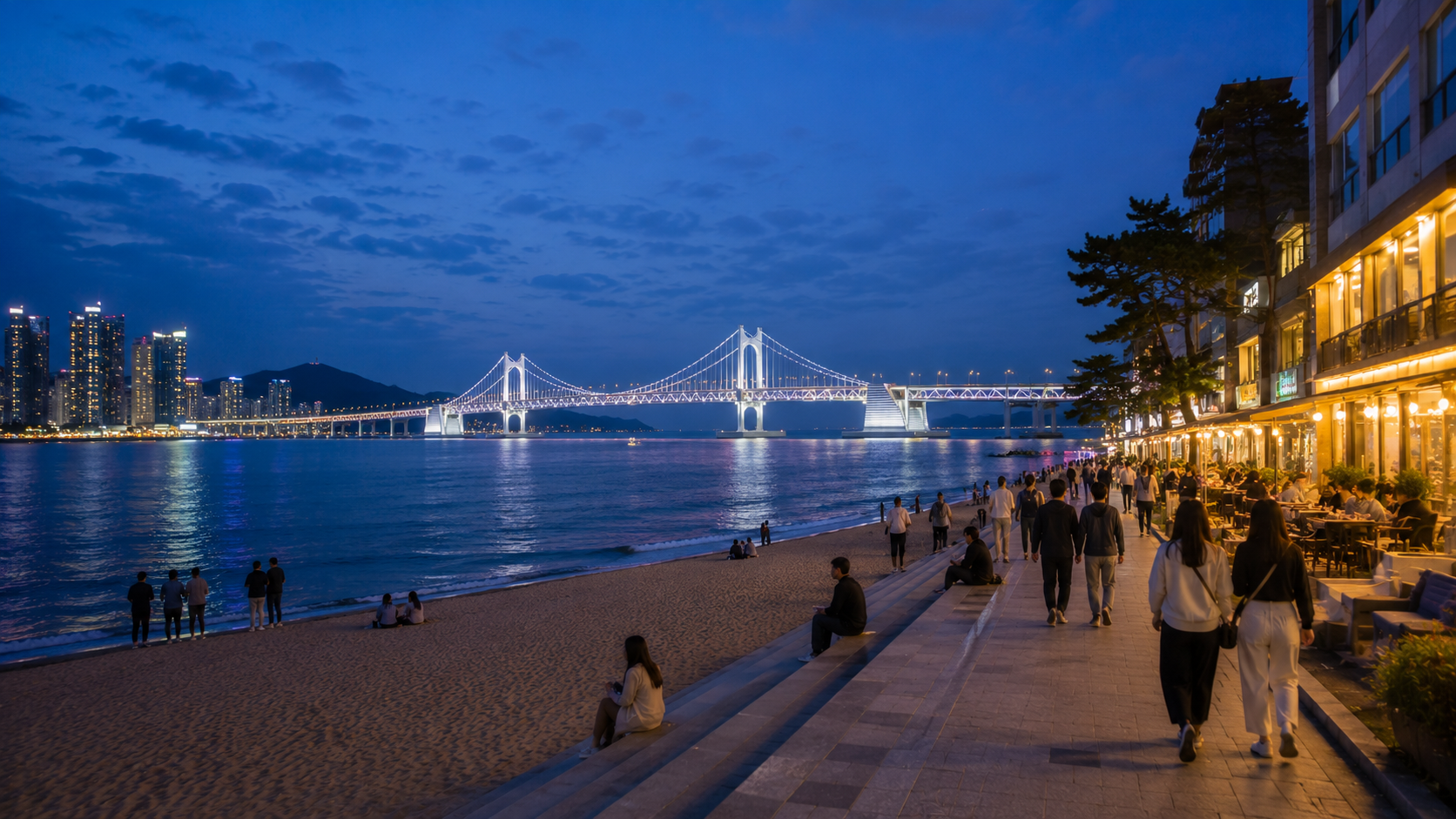
Gwangalli (광안리) suits visitors who want an urban beach neighborhood with an active evening scene. Its defining feature is the view across the water to Gwangandaegyo Bridge, commonly called Gwangan Bridge. The seafront contains cafés, restaurants, bars, and accommodation facing the bay.
According to Visit Busan’s Gwangalli guide, the beach is open throughout the year and can be reached by walking from Gwangan Station on Metro Line 2. The tourism authority lists ramps and an accessible bathroom at the beach, although travelers with mobility requirements should confirm the route and hotel entrance directly.
Stay here if you want
- A coastal view that remains interesting after sunset
- Restaurants and cafés close to your hotel
- A social atmosphere suitable for couples or groups of friends
- Line 2 access to Haeundae, Centum City, and Seomyeon
Practical booking advice
Properties advertised as being in Gwangalli may be several streets inland. For an unobstructed bridge view, inspect the room category and recent guest photographs rather than assuming every “ocean-view” room faces the bridge.
Noise is another consideration. Rooms directly above busy beachfront streets, restaurants, or bars may remain noisy late into the evening. Travelers who want the view but need quieter nights should consider accommodation one or two blocks inland.
Seomyeon: best for transport and a balanced first visit
Seomyeon (서면) is often the most practical base for travelers who want to explore both eastern and western Busan. Seomyeon Station connects Metro Lines 1 and 2. Line 1 serves Busan Station, Nampo, and Jagalchi, while Line 2 runs toward Gwangan, Centum City, and Haeundae. These connections can be confirmed on the official metro network map.
The neighborhood itself is a dense commercial district with department stores, underground shopping areas, restaurants, cafés, and nightlife. Jeonpo, immediately southeast of central Seomyeon, offers smaller cafés and restaurants around Jeonpo Station.
Stay here if you want
- A central transport interchange rather than a coastal setting
- A practical base for a two- or three-day sightseeing trip
- Restaurants and shopping close to the hotel
- Easier airport access than the eastern beaches
- More flexibility when plans cover both sides of Busan
Seomyeon is functional rather than scenic. Main roads and nightlife streets can be busy, and station exits are spread over a large area. Check which exit is closest to the hotel and whether the route includes stairs, especially when carrying luggage.
As verified on June 11, 2026, Gimhae International Airport’s official transport page listed a limousine bus to Seomyeon and Bujeon for KRW 6,000, payable only by credit card. It listed departures from the airport between 07:20 and 21:30, approximately every 70 minutes. The airport warns that fares and schedules may change, so check the Gimhae Airport public transportation page shortly before travel.
Nampo and Jagalchi: best for markets and older central Busan
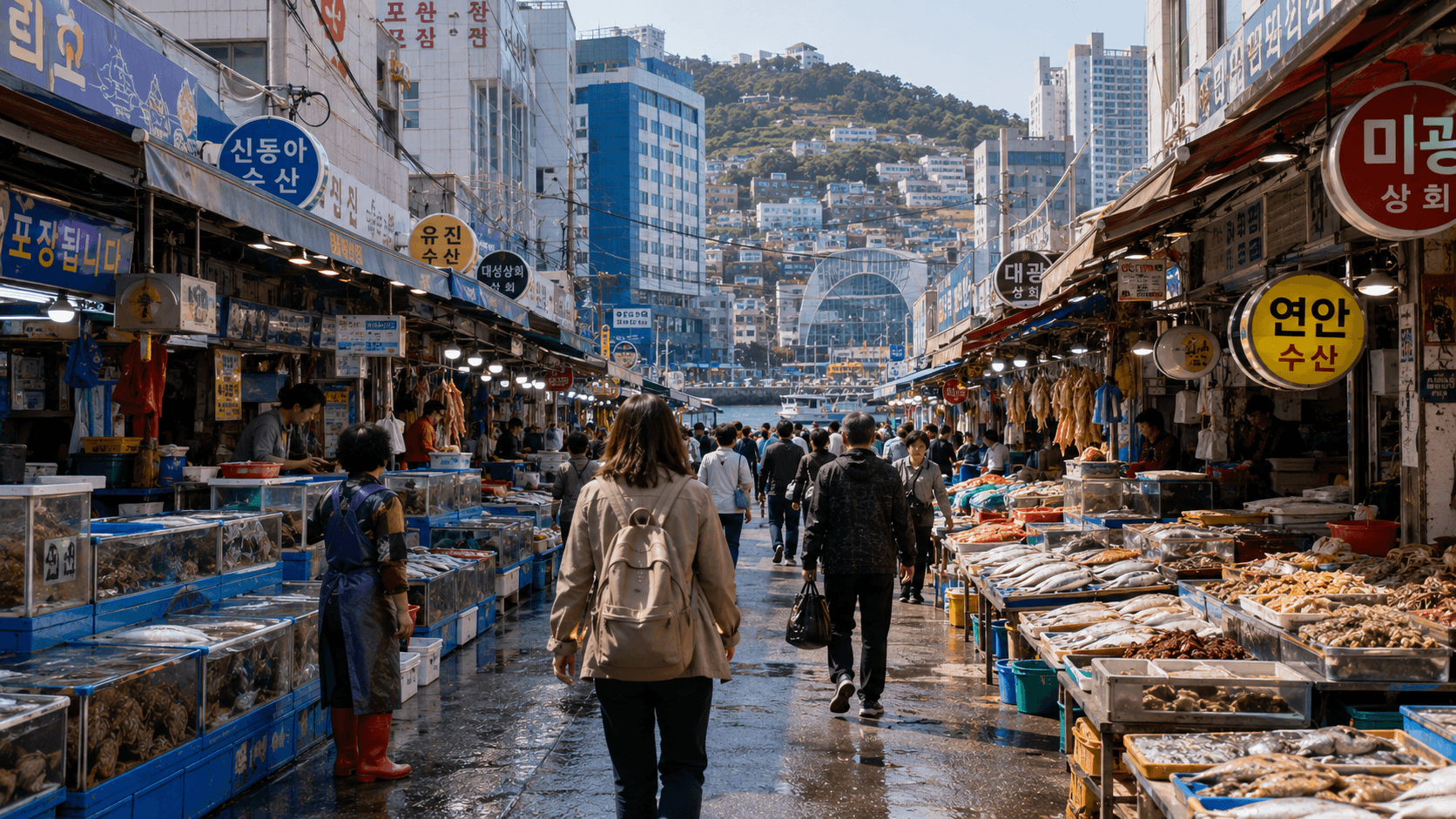
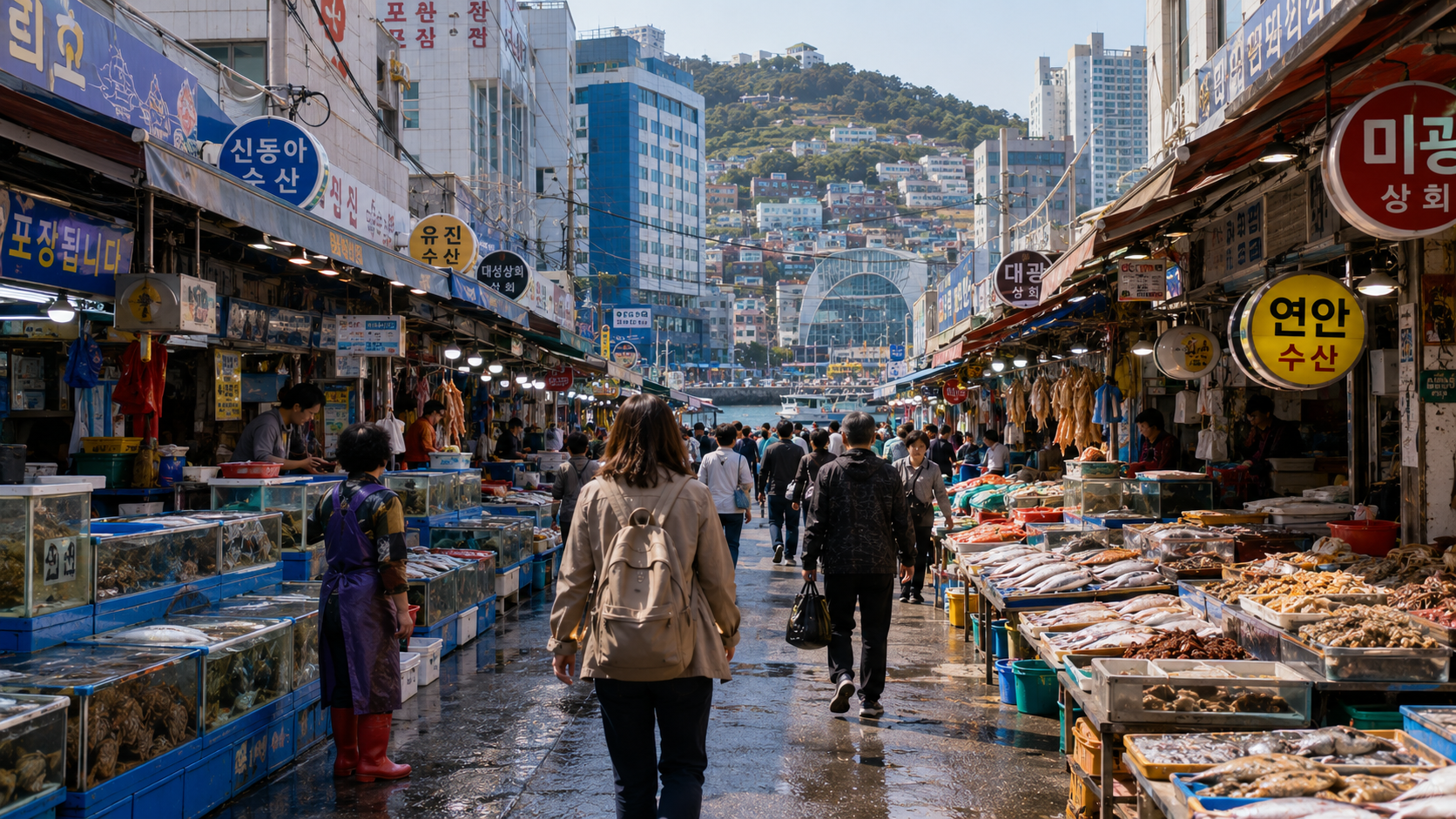
Nampo (남포), Jagalchi (자갈치), and the adjoining market districts are strong choices for travelers interested in food, shopping, harbor scenery, and Busan’s older urban center. Nampo and Jagalchi stations are consecutive stops on Metro Line 1.
From this area, you can walk between Jagalchi Market, BIFF Square, Gukje Market, Bupyeong Kkangtong Market, and Yongdusan Park. Gamcheon Culture Village is not within comfortable walking distance, but it is on the western side of the city and is generally easier to reach from here than from Haeundae.
Visit Busan’s official Gamcheon guide directs visitors to transfer from Toseong Station on Line 1 to a local bus. It also notes that Gamcheon remains a residential area, so visitors should keep noise down and avoid entering private property.
Stay here if you want
- Traditional markets and seafood restaurants nearby
- A compact, walkable sightseeing area
- Convenient access to Gamcheon, Songdo, and Yeongdo
- A neighborhood that feels distinct from Busan’s modern beach districts
- Direct Line 1 access to Busan Station
Limitations
The journey to Haeundae or Songjeong is comparatively long. Some market streets become quiet after businesses close, while other blocks remain active around restaurants and late-night venues. Inspect the immediate hotel location rather than judging the entire area by the nearest station.
Nampo is also hilly once you move away from the waterfront. Travelers with wheelchairs, strollers, or heavy luggage should check gradients and accessible station exits before booking.
Songjeong: best for surfing and a quieter coast
Songjeong (송정) lies east of Haeundae and offers a more relaxed beach setting. It is a reasonable choice for surfing, slower mornings, and travelers who do not need to return to central Busan every day.
Songjeong Station is on the Donghae Line rather than the numbered Busan Metro lines. This line also serves Bujeon, BEXCO, Sinhaeundae, Osiria, and Gijang, as shown on the official metro network map. Confirm the walking distance between your accommodation and the station because parts of the beachfront are not immediately beside the rail stop.
Stay here for a coastal retreat or an itinerary focused on eastern Busan. Do not choose it merely because the room rate is lower than Haeundae: repeated journeys to Seomyeon, Nampo, or Busan Station can offset the savings in time and convenience.
Centum City: best for BEXCO and indoor facilities
Centum City is suitable for business travelers, conference attendees, shoppers, and visitors attending an event at BEXCO. Both Centum City and BEXCO stations are on Metro Line 2, while BEXCO also connects with the Donghae Line.
The district is modern and convenient, with large commercial buildings and straightforward transport connections. It is less suitable for travelers seeking a traditional neighborhood or a hotel directly on the beach. Gwangalli and Haeundae provide stronger evening atmosphere while remaining relatively close.
Before booking for a convention, verify whether the event is at BEXCO Exhibition Center 1, Exhibition Center 2, or another venue. A property described as being near BEXCO may still require a longer walk than expected.
Busan Station: best for rail connections and short stopovers
The area around Busan Station works well when arriving late by KTX, leaving early, or spending only one night in the city. Busan Station is on Metro Line 1, giving direct access to Nampo, Jagalchi, and Seomyeon.
It is less convenient for a beach-focused stay because Haeundae and Gwangalli require travel across the city. For a longer holiday, staying beside the station only to simplify arrival and departure usually creates unnecessary daily commuting.
Choose a hotel on a well-lit main route if arriving late. Also distinguish carefully between Busan Station, the main KTX terminal, and similarly named stations or properties elsewhere in the metropolitan area.
How to choose your area step by step
- Mark your priority attractions. Group Haeundae, Gwangalli, and Centum City as eastern Busan; group Nampo, Jagalchi, Gamcheon, Songdo, and Yeongdo as central or western Busan.
- Check the nearest station. A hotel that is technically near a station may still involve a steep or inconvenient walk.
- Count transfers, not just distance. Direct access to the correct metro line is often more useful than a geographically central location.
- Inspect the room category. “Ocean view,” “partial ocean view,” and “city view” are materially different products.
- Read recent noise comments. This is especially important in Gwangalli, Haeundae, and central Seomyeon.
- Confirm luggage access. Check for elevators at the hotel and relevant station exit. The Busan Transportation Corporation maintains an official elevator information service.
- Check cancellation conditions. Summer weekends, festivals, concerts, and conventions can affect availability and prices throughout nearby districts.
Transport costs to consider
As verified on June 11, 2026, the Busan Transportation Corporation fare guide listed adult metro fares of KRW 1,600 for Section 1 and KRW 1,800 for Section 2 when using a transit card or mobile ticket. Adult single-use QR tickets were KRW 1,700 and KRW 1,900 respectively.
The same official page listed mobile-app passes at KRW 6,000 for one day and KRW 13,000 for three days for adults. These passes do not cover buses, the Donghae Line, or the Busan-Gimhae Light Rail Transit. Fares and pass conditions can change, so verify them again before relying on a pass for your itinerary.
For airport travel, the official Gimhae Airport page listed the Haeundae and Gijang limousine bus at KRW 9,500, credit card only, on June 11, 2026. The listed airport departures ran from 07:10 to 21:40, but not every service continued to Gijang. Travelers arriving outside the operating period should plan to use the light rail and metro, a city bus, or a taxi.
What to check before you go
- Confirm the property’s nearest station and exit.
- Check the walking route for slopes, stairs, and major road crossings.
- Verify check-in hours if arriving on a late flight or train.
- Ask whether luggage storage is available before check-in or after checkout.
- Confirm that the reserved room, not merely the hotel building, has the advertised view.
- Review recent comments about street, bar, construction, or railway noise.
- Check whether breakfast, parking, and extra-person fees are included.
- Recheck airport buses and final metro services shortly before travel.
- During summer or major events, reserve early but retain flexible cancellation where possible.
FAQ
Is Haeundae or Seomyeon better for a first visit?
Choose Haeundae when the beach and eastern coast are your priorities. Choose Seomyeon when you want to divide your time between beaches, markets, and attractions across the city. For a short general sightseeing trip, Seomyeon usually reduces the number of difficult cross-city journeys.
Is Gwangalli better than Haeundae?
Neither is universally better. Gwangalli has direct bridge views and a strong evening atmosphere. Haeundae has a larger visitor district and is better positioned for attractions farther east. Compare specific hotels, room views, noise levels, and station access.
Should I change hotels during a Busan trip?
For stays of four nights or more, splitting the trip between Nampo and Haeundae or Gwangalli can reduce repeated cross-city travel. For two or three nights, changing hotels usually consumes more time than it saves; Seomyeon is the simpler compromise.
Where should families stay?
Haeundae is convenient for beach access and has a broad range of conventional hotels. Families prioritizing efficient transport may prefer Seomyeon. In either area, verify room occupancy limits, bed configuration, laundry access, elevator availability, and the walking route from the station.
Where should I stay without a car?
Seomyeon, Nampo, Haeundae, and Gwangalli are all workable without a car when the accommodation is near a station. Seomyeon offers the most flexible metro connections. Avoid choosing an isolated hillside property solely for its view unless you are comfortable using buses or taxis.
Once you have selected an area, compare the hotel’s exact address with your planned attractions on the official metro map. In Busan, choosing the correct station and walking route is usually more important than choosing a particular hotel brand.
Sources
- Visit Busan official travel guide
- Visit Busan guide to Gwangalli Beach
- Visit Busan guide to Gamcheon Culture Village
- Busan Transportation Corporation metro map
- Busan Transportation Corporation fare guide
- Gimhae International Airport public transportation guide
- Busan Metropolitan City beach information