Andong is one of South Korea’s strongest destinations for traditional architecture, Confucian heritage, and living folk culture. For a first visit, prioritize Hahoe Folk Village, one of the two UNESCO-listed Confucian academies, and central Andong around Wolyeonggyo Bridge and the Old Market. Stay at least one night: the major sights are spread across a large rural area, and trying to cover them on a day trip can mean spending more time in transit than at the attractions.
At a glance
| Place | Main reason to visit | Suggested time | Practical note |
|---|---|---|---|
| Hahoe Folk Village | Historic houses and village landscape | 3–4 hours | Make this your priority on a first visit |
| Buyongdae Cliff | Panoramic view over Hahoe | 1–2 hours | Access can be inconvenient without a car |
| Byeongsan Seowon | Architecture framed by mountains and river | 1–1.5 hours | Combine with Hahoe when transport allows |
| Dosan Seowon | Yi Hwang and Korean Confucian history | 1.5–2 hours | Located well north of central Andong |
| Bongjeongsa Temple | Historic Buddhist wooden architecture | 1.5–2 hours | Quiet mountain setting; dress respectfully |
| Wolyeonggyo Bridge | Riverside walk and evening views | 1–2 hours | Particularly suitable after sunset |
| Andong Old Market | Jjimdak and everyday city atmosphere | 1–2 hours | Several dishes are designed for sharing |
The selections below are based on cultural significance, distinctiveness, and usefulness to a first-time itinerary rather than a claim that every traveler will rank them in the same order.
1. Hahoe Folk Village
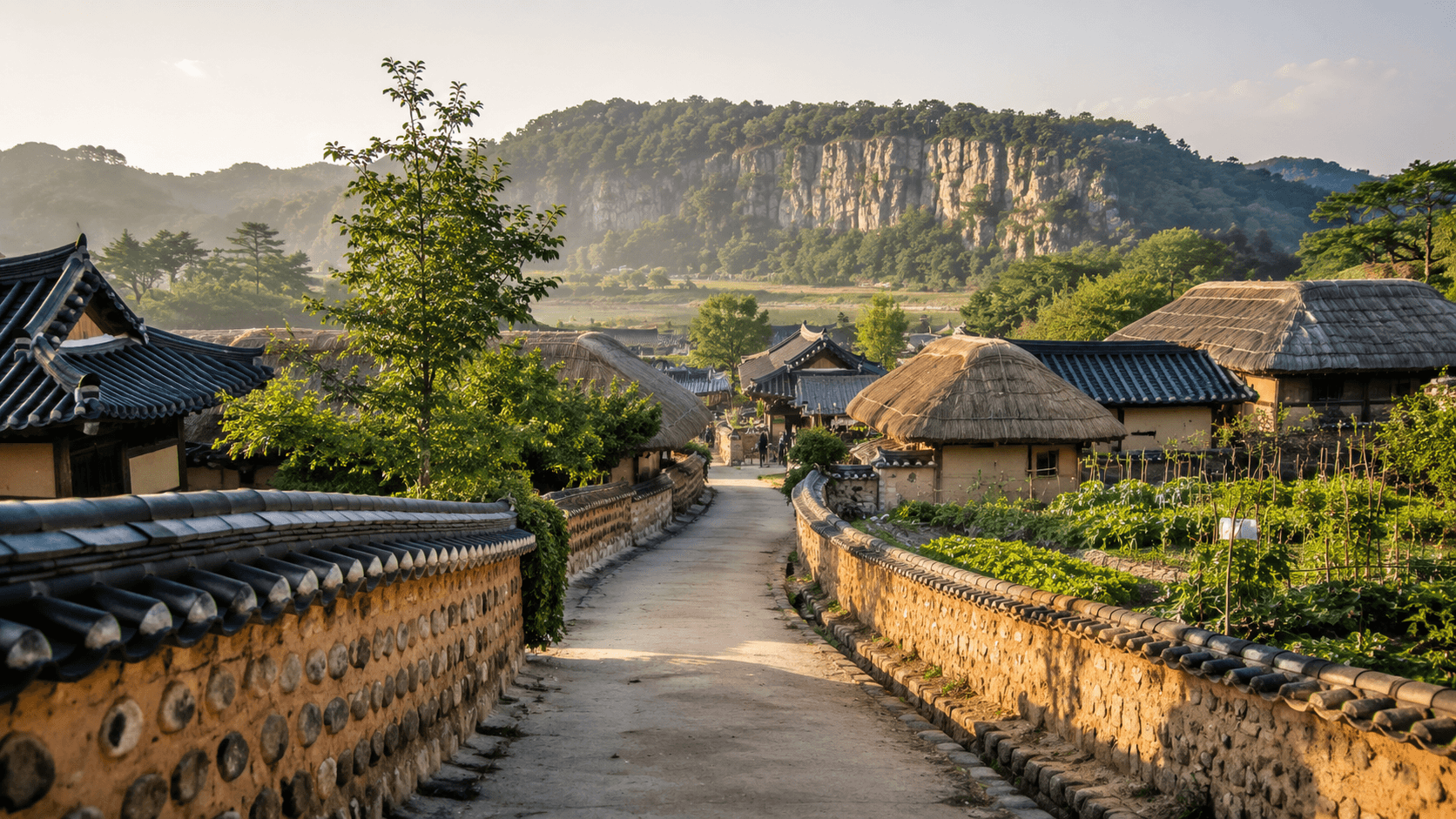
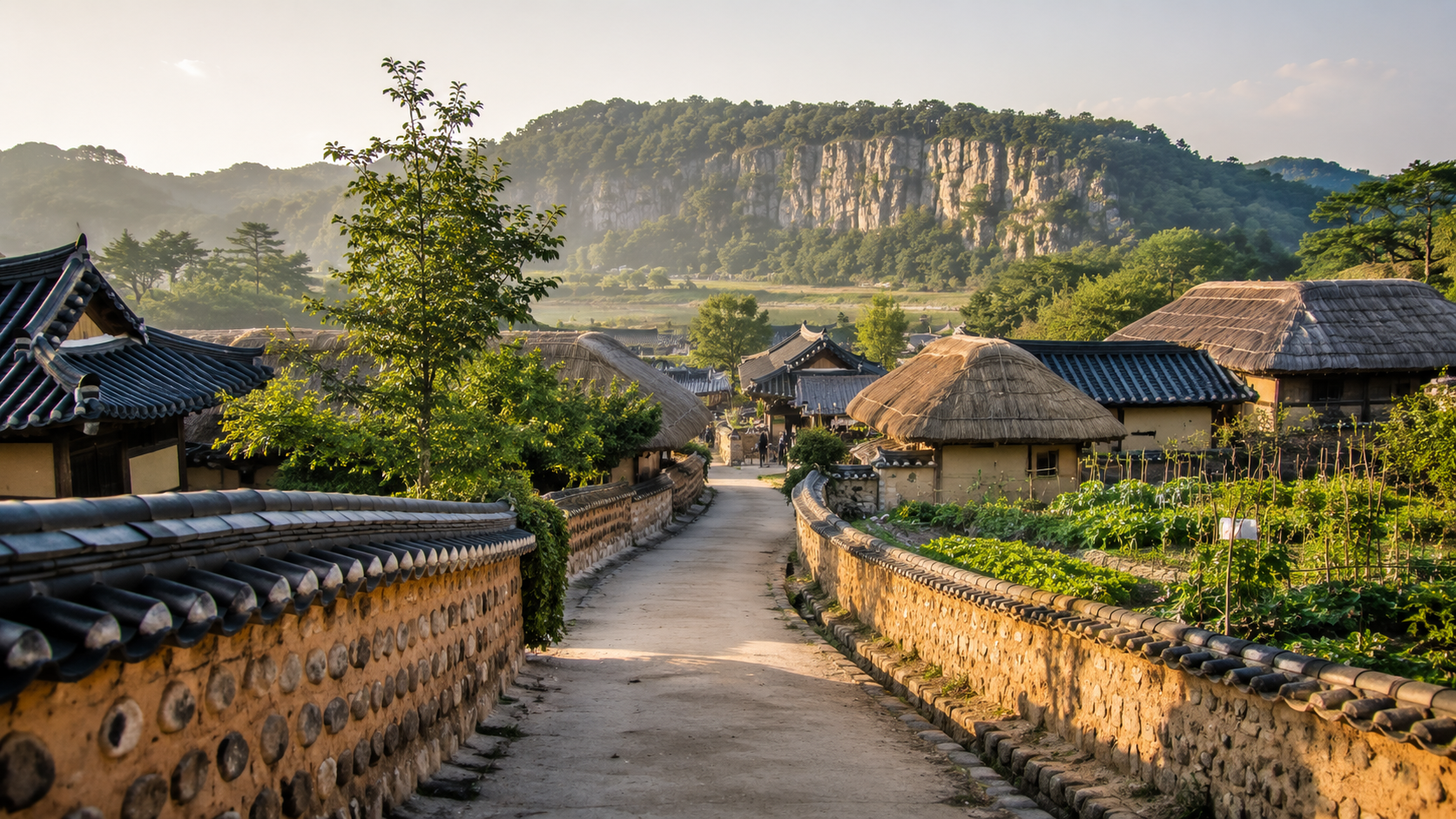
Hahoe Folk Village (안동 하회마을, Andong Hahoe Maeul) is the essential Andong attraction. The Nakdonggang River curves around a settlement of tiled-roof residences, thatched houses, lanes, old trees, pavilions, and agricultural land. It remains a residential community, not simply an outdoor museum.
UNESCO lists Hahoe together with Yangdong near Gyeongju as the Historic Villages of Korea. UNESCO describes them as representative clan villages whose buildings and landscape reflect the aristocratic Confucian culture of the Joseon dynasty.
Allow enough time to walk beyond the busiest central lanes. Look for the contrast between substantial tiled houses associated with elite families and smaller thatched homes historically occupied by commoners. Some buildings are private residences or can only be viewed from outside; an open gate is not automatically an invitation to enter.
Traditional Hahoe mask-dance performances are an important part of the village’s appeal, but performance dates and times can change. Check the official Hahoe Village website shortly before visiting rather than building an itinerary around an unverified timetable.
Practical considerations
The visitor facilities and main parking area are outside the historic settlement. Expect some walking even if a local shuttle operates between the entrance area and the village. Wear shoes suitable for packed-earth lanes and uneven ground.
Admission fees, opening hours, shuttle arrangements, and performance schedules were checked on June 11, 2026. A dependable, complete set of current details was not available in English from the official pages accessible during verification, so exact figures are omitted here. Confirm them through the official village site or an Andong tourist information center before departure.
2. Buyongdae Cliff
Buyongdae (부용대) provides the classic elevated view of Hahoe’s roofs, fields, river bend, and surrounding hills. It is the place that makes the village’s geography immediately understandable.
The viewpoint is across the river from the main village entrance. Seasonal boats, walking routes, road access, and local restrictions can change, particularly after heavy rain or during maintenance. Do not assume that you can cross directly from the village. Ask at the Hahoe information desk about same-day access.
The climb is relatively short but includes uneven and potentially slippery sections. Take water, avoid smooth-soled shoes, and do not approach exposed edges for photographs. Travelers with limited mobility can still appreciate the village from ground level without treating Buyongdae as mandatory.
3. Byeongsan Seowon
Byeongsan Seowon (병산서원) is a seowon, or private Confucian academy from the Joseon period. Its most memorable feature is the relationship between architecture and landscape: the long, open Mandaeru pavilion frames the fields, river, and mountain beyond.
Byeongsan and Dosan are among the nine academies included in UNESCO’s Seowon, Korean Neo-Confucian Academies, inscribed in 2019. UNESCO identifies education, commemoration of scholars, and interaction with nature as central functions expressed through seowon design.
Byeongsan is near Hahoe geographically, but the rural road connection and limited public transport can make the combination less straightforward than it looks on a map. A taxi or hired car is usually the most efficient option. If using a taxi, arrange the return in advance because finding another vehicle at the site may be difficult.
Treat the academy as a heritage and ceremonial space. Keep voices low, do not sit on thresholds, and obey signs restricting access to shrines or wooden buildings.
4. Dosan Seowon
Dosan Seowon (도산서원) is closely associated with Yi Hwang, commonly known by his pen name Toegye, one of Korea’s most influential Confucian scholars. The complex developed around the place where he studied and taught; his disciples later established the academy in his memory.
This is the better choice for visitors who want historical explanation and a clearer connection to a major Korean thinker. The compact study buildings, raised library structures, courtyards, and surrounding water-and-mountain landscape show how scholarship and nature were intended to reinforce each other. The Andong City overview of its principal attractions provides a concise official introduction.
Dosan Seowon is north of central Andong and should normally be treated as a half-day excursion. Public buses may be infrequent, especially outside peak visitor periods. Check the outbound and return trips separately; the last practical return may be much earlier than expected.
If you have time for only one seowon, choose Byeongsan for architectural composition and easier pairing with Hahoe, or Dosan for Yi Hwang’s story and a more focused introduction to Confucian scholarship.
5. Bongjeongsa Temple
Bongjeongsa (봉정사) offers a quieter counterpart to Andong’s Confucian sites. It is one of seven temples included in UNESCO’s Sansa, Buddhist Mountain Monasteries in Korea, inscribed in 2018. These monasteries continue to function as religious communities rather than surviving only as monuments.
The temple is particularly important for its historic wooden architecture. Geungnakjeon Hall is recognized as one of Korea’s oldest surviving wooden buildings, while the arrangement of halls and courtyards rewards slow observation. The complex is smaller and less visually monumental than some famous temples near Seoul or Busan, but that intimacy is part of its value.
Visitors should avoid interrupting ceremonies, photographing people at prayer without permission, or entering areas marked for monastic use. Shoulders and knees should be reasonably covered. Food and drinks belong outside worship halls.
Bongjeongsa’s mountain location makes it another place where return transport requires planning. Temple-stay programs may be offered, but availability, language support, prices, and participation rules must be confirmed through the temple or the official Templestay system rather than assumed.
6. Wolyeonggyo Bridge and the riverside
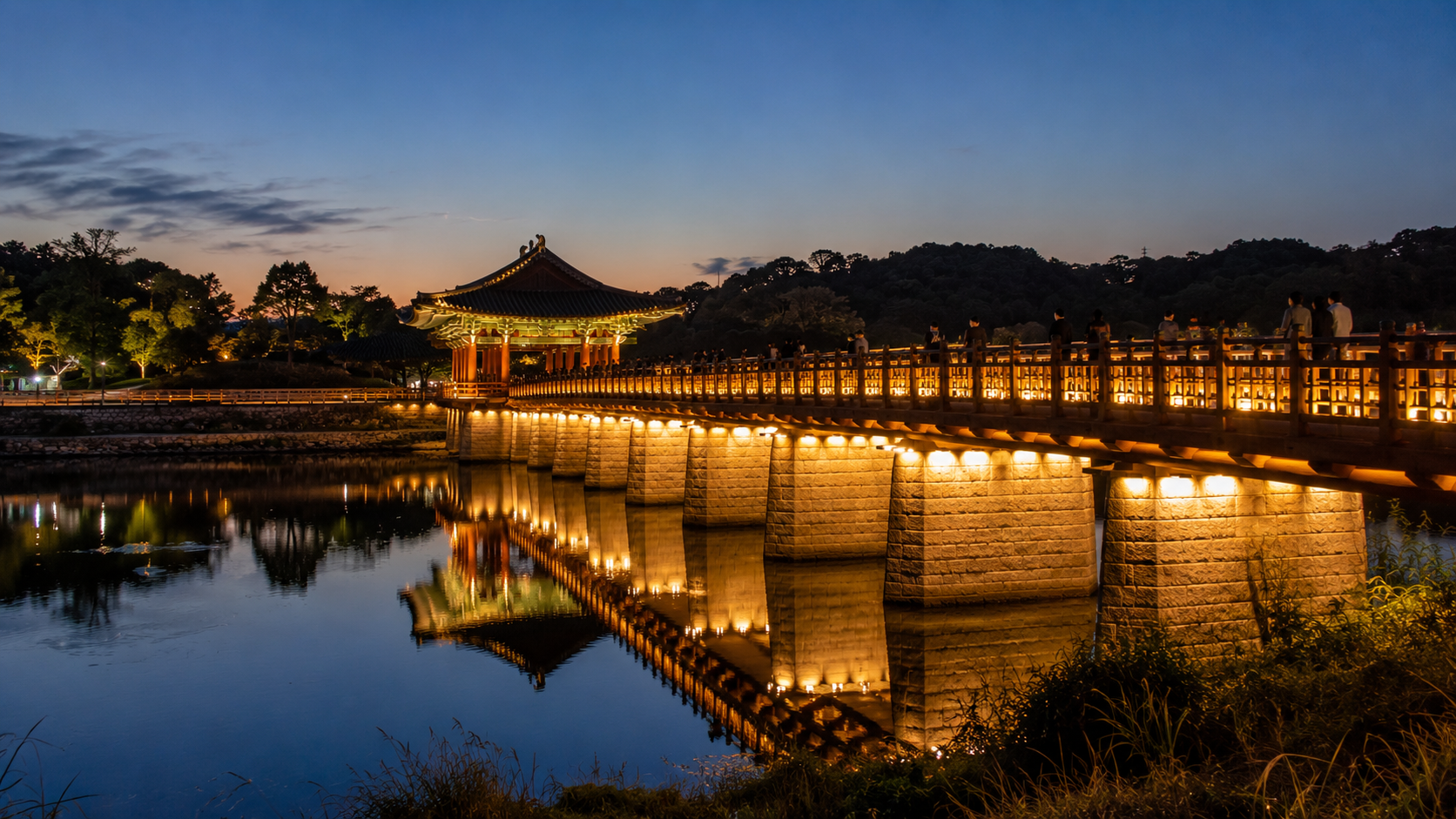
Wolyeonggyo (월영교), usually translated as Wolyeonggyo Bridge or Moonlight Bridge, is the easiest major sight to fit into a central Andong itinerary. The wooden pedestrian bridge crosses the reservoir area of the Nakdonggang River and includes a pavilion near its center. Andong City describes it as 387 meters long in its official attractions guide.
Visit around dusk if possible. The bridge and nearby paths are less dependent on museum-style opening hours, and evening lighting creates a pleasant contrast with a day spent at historic sites. However, lighting times, fountain operation, boat services, and temporary closures are weather- and season-dependent. These operating details could not be reliably confirmed for every date as of June 11, 2026.
The riverside is generally easier than the rural heritage sites for families and slower walkers, although bridge approaches and connected paths may still involve slopes. Check local signs for step-free routes.
7. Andong Old Market and Jjimdak Alley
Andong Old Market (안동구시장, Andong Gusijang) gives the trip an everyday urban finish. Its best-known section is Jjimdak Alley, where restaurants serve Andong jjimdak: chicken braised with soy sauce, vegetables, chilies, and glass noodles.
A standard portion is often intended for more than one person. Solo diners should ask whether a small portion or single-person menu is available before sitting down. Specify your preferred spice level, but understand that the soy-based sauce may still contain chili. Check the price on the menu before ordering and ask whether rice is included or separate.
The market is also useful for trying salted mackerel, local noodles, and heotjesabap, a rice meal based on foods associated with ancestral rites. Andong City provides official introductions to local markets and regional foods.
Individual stalls and restaurants set their own closing days and hours. Market-wide hours published on older English pages should not be treated as guarantees for a particular business.
How many days do you need?
One day
Choose Hahoe Folk Village as the main excursion. Return to central Andong for dinner at the Old Market and an evening walk at Wolyeonggyo Bridge. This is the most balanced plan for first-time visitors.
Two days
Use the first day for Hahoe and, if transport is arranged, Byeongsan Seowon. On the second day, choose either Dosan Seowon or Bongjeongsa, then finish with central Andong.
Three days
A third day allows you to visit both Dosan and Bongjeongsa without rushing, add museums or smaller heritage sites, or spend a night in traditional accommodation. Confirm check-in procedures and bathroom arrangements before booking a hanok stay; traditional atmosphere does not always mean traditional sleeping and washing facilities are compulsory, but standards vary considerably.
Getting to and around Andong
Andong Station and Andong Bus Terminal are beside each other, west of the city center. Rail passengers should search services through KORAIL, while intercity bus options can be checked through BusTago. Departure points, fares, journey times, and seat availability vary by date, so verify the exact trip rather than relying on a typical duration quoted in a blog.
Andong’s main difficulty is local transport. Hahoe, Dosan, Bongjeongsa, and other rural attractions lie in different directions, and buses may run at long intervals.
Practical options include:
- Use Naver Map or KakaoMap for Korean public-transport routing; overseas map services may have limited Korean navigation data.
- Check the return bus before leaving the city, not after reaching the attraction.
- Show the destination name in Hangul to the driver.
- Carry a transport card and some KRW cash in case a rural service or small business cannot handle your preferred payment method.
- Use taxis selectively for difficult connections, especially Hahoe–Byeongsan or the return from an isolated site.
- Ask your accommodation or a tourist information center to write down a taxi destination and arrange a pickup when necessary.
Public transport schedules and fares are time-sensitive. They were reviewed on June 11, 2026, but no single official English source provided a sufficiently complete, date-specific local network timetable for publication here.
Common planning mistakes
- Treating Andong as a compact walking destination. The central district is manageable, but the headline heritage sites are rural and widely separated.
- Scheduling several distant attractions around a single bus timetable without checking return services.
- Assuming every part of Hahoe is open to visitors. It is a living village with private homes.
- Arriving at a temple or academy immediately before closing. Entry to buildings may finish earlier than access to the surrounding grounds.
- Expecting every restaurant to serve a solo portion of jjimdak.
- Visiting Hahoe only for photographs and allowing less than an hour. The village’s lanes, houses, river setting, and interpretation deserve substantially longer.
What to check before you go
- Current KORAIL or intercity bus availability for both directions
- Local bus departure and return times for each rural attraction
- Admission fees and final entry times on the day of travel
- Hahoe mask-dance performance dates and any festival-related restrictions
- Weather warnings, river conditions, or trail closures affecting Buyongdae
- Temple ceremonies or restricted areas at Bongjeongsa
- Whether your accommodation can store luggage before check-in or after checkout
- Taxi availability and estimated fare for any rural connection
- Accessibility needs, particularly for unpaved lanes, steps, and mountain paths
For current on-the-ground help, use the guidebook and information-center links on the Andong City tourist information page. Your most useful next step is to choose Hahoe plus one secondary heritage site, then build the rest of the trip around confirmed transport rather than distance alone.
Sources
- Andong City: Tourist Attractions
- Andong City: Tourist Information
- UNESCO: Historic Villages of Korea—Hahoe and Yangdong
- UNESCO: Seowon, Korean Neo-Confucian Academies
- UNESCO: Sansa, Buddhist Mountain Monasteries in Korea
- KORAIL English booking portal
- BusTago intercity bus reservation portal
Time-sensitive visitor and transport information verified on June 11, 2026.