Gyeongju is most rewarding when you treat it as several connected historical districts rather than a checklist of isolated monuments. First-time visitors should concentrate on the walkable downtown heritage area, then add Bulguksa Temple and Seokguram Grotto on a second day. Mount Namsan, Yangdong Village, and the coast are better choices for travelers with extra time or a particular interest in hiking, traditional architecture, or seaside history.
The selections below are based on historical importance, visitor experience, and practical accessibility. Gyeongju was the capital of Silla, a kingdom that lasted from 57 BCE to 935 CE, and its surviving monuments form several UNESCO World Heritage properties.
At a glance
| Place | Main reason to visit | Suggested time | Location |
|---|---|---|---|
| Daereungwon | Royal tomb mounds and an accessible tomb interior | 1–1.5 hours | Downtown |
| Cheomseongdae and Wolseong | Easy historical walk through the former royal district | 1–2 hours | Downtown |
| Gyeongju National Museum | Essential context and original Silla objects | 2–3 hours | Downtown |
| Donggung Palace and Wolji Pond | Reflections and illuminated evening scenery | 1 hour | Downtown |
| Woljeonggyo Bridge and Gyochon | Riverside walk and reconstructed Silla bridge | 1–2 hours | Downtown |
| Bulguksa Temple | Major Silla Buddhist architecture | 1.5–2 hours | Eastern Gyeongju |
| Seokguram Grotto | Monumental Buddhist sculpture | 1–1.5 hours | Mount Toham |
| Mount Namsan | Hiking among Buddhist remains | Half or full day | Southern Gyeongju |
| Yangdong Village | Joseon-period clan village and rural architecture | 2–3 hours | Northern Gyeongju |
| Hwangnidan-gil | Restaurants, cafés, shops, and evening activity | 1–2 hours | Downtown |
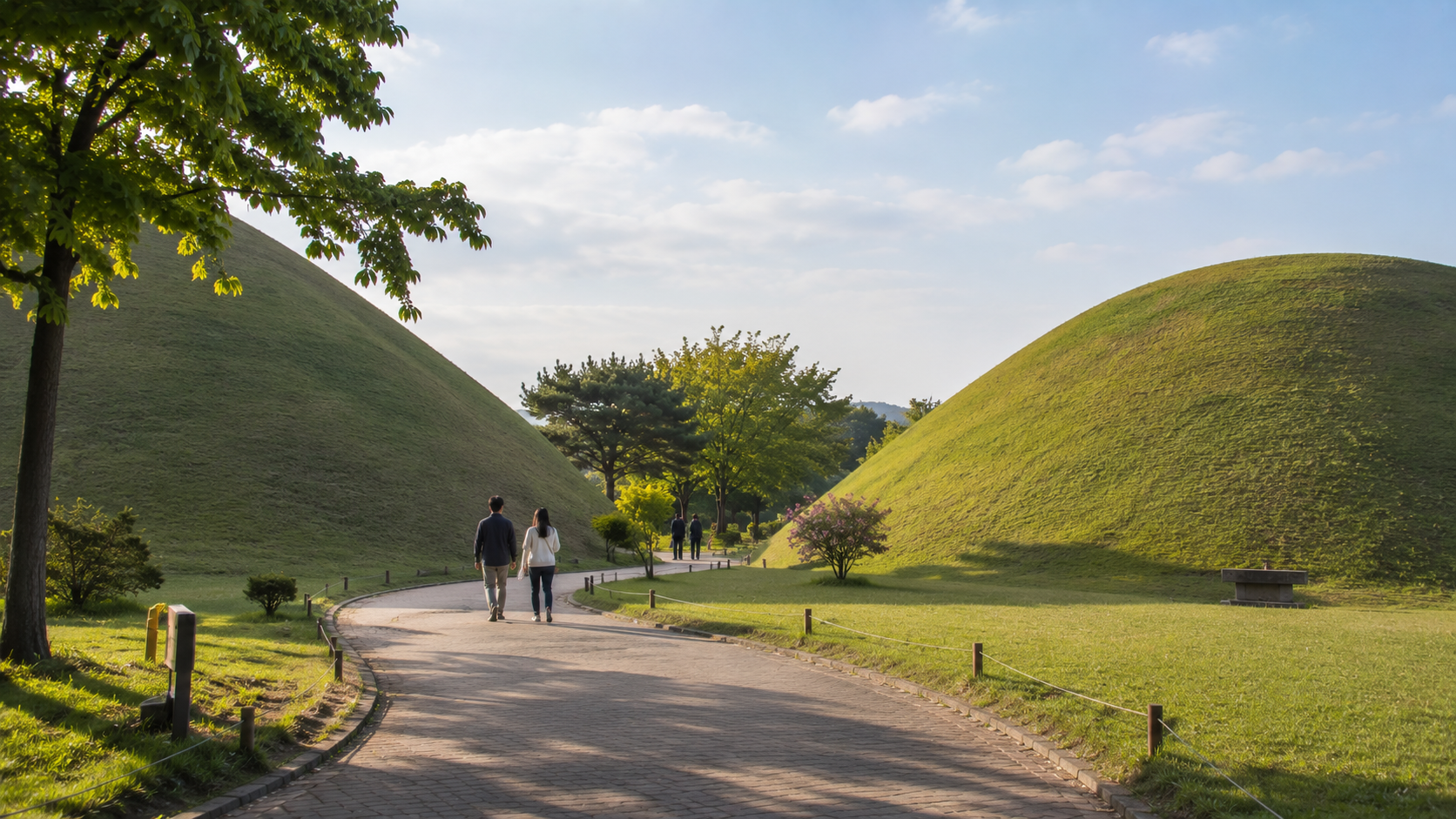
1. Daereungwon Ancient Tomb Complex
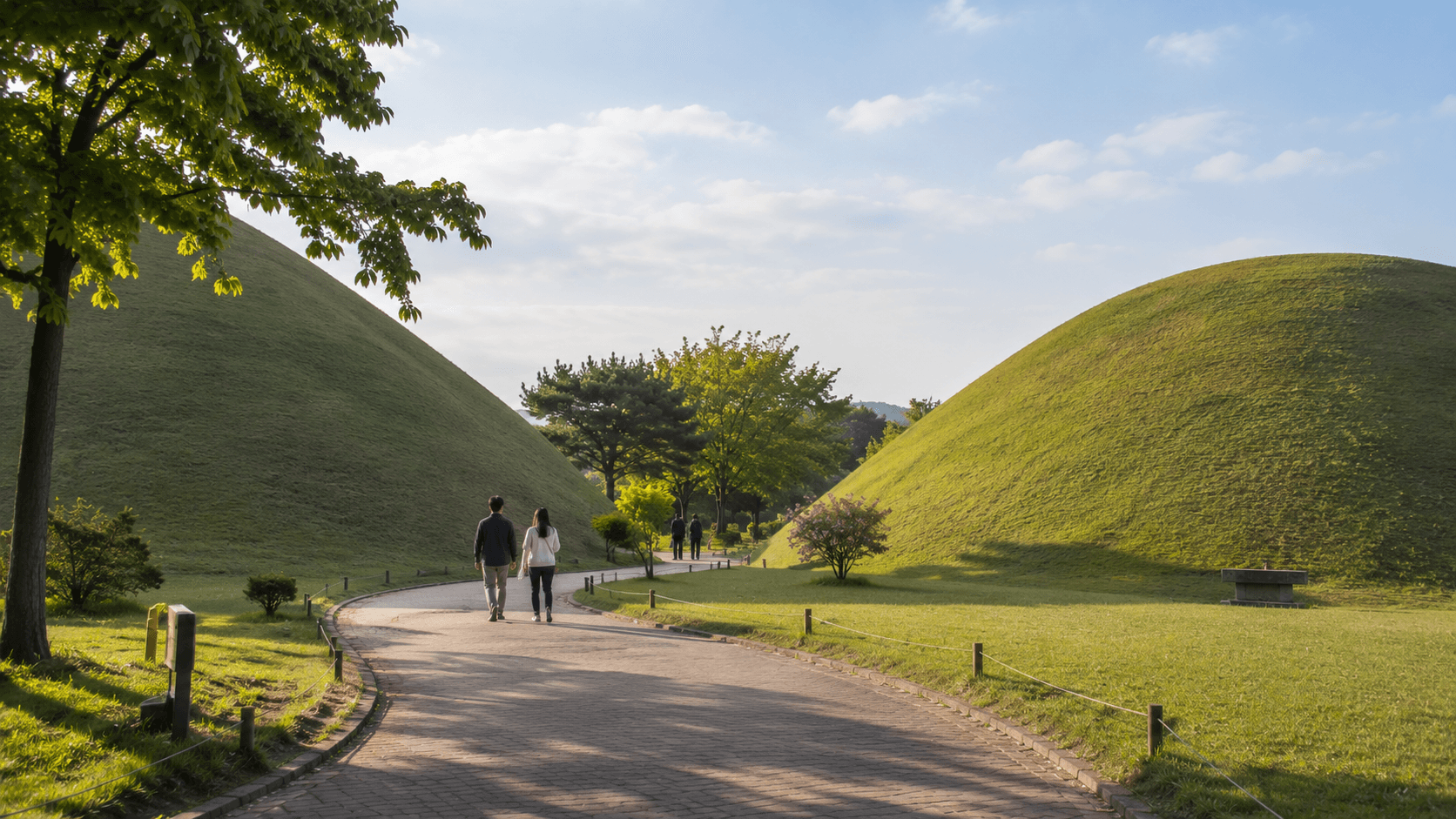
Daereungwon (대릉원) is the clearest introduction to Gyeongju's royal landscape. Its large, grass-covered mounds contain tombs associated with Silla royalty and elites. Unlike a conventional cemetery, it feels like a spacious park, although visitors must remain on the designated paths and respect barriers around the mounds.
The main reason to enter is Cheonmachong (천마총), or the Tomb of the Heavenly Horse. Its reconstructed interior demonstrates how a Silla stone-and-wood burial chamber was assembled beneath layers of rock and earth. Replicas and displays also help explain why gold crowns, jewelry, weapons, and horse equipment survived inside these difficult-to-rob tombs.
UNESCO includes the royal tomb groups within the Tumuli Park Belt of the Gyeongju Historic Areas. As verified on June 11, 2026, Gyeongju City's official admission page lists general entry to Daereungwon as free, while Cheonmachong costs KRW 3,000 for adults, KRW 2,000 for teenagers, and KRW 1,000 for children. Conditions can change, so check the linked page before visiting.
Practical tip: Visit early in the morning for quieter paths. Hwangnidan-gil is immediately west of the complex, making the two easy to combine.
2. Cheomseongdae, Gyerim, and Wolseong
These neighboring sites are better experienced as one continuous walk. Cheomseongdae (첨성대) is a compact stone tower traditionally understood as an astronomical observatory from the Silla period. Its importance is easier to appreciate as part of the former capital rather than as a stand-alone photo stop.
Continue through Gyerim (계림), a small woodland connected with Silla foundation legends, toward Wolseong (월성), the crescent-shaped site of the royal palace. Much of Wolseong survives as archaeological terrain rather than reconstructed architecture. That can initially look understated, but the open landscape helps reveal the scale and position of the former palace district.
UNESCO identifies Cheomseongdae, Gyerim, Wolseong, and Donggung Palace and Wolji Pond as components of the World Heritage-listed Wolseong Belt. Gyeongju City's downtown route confirms that the principal central attractions lie within a roughly three-kilometer area suitable for walking or cycling.
Practical tip: The route has long exposed sections. Carry water and sun protection in summer, and expect cold wind in winter. Cheomseongdae is illuminated after dark, but the surrounding archaeological landscape is easier to understand in daylight.
3. Gyeongju National Museum
Do not leave the museum until the end of the trip. Visiting it before or between the outdoor sites makes the tombs, palace remains, and temples much more intelligible.
The museum's collections include objects from Silla tombs, Buddhist sculpture, architectural material, and finds from Wolji Pond. The outdoor exhibition area contains stone monuments and the Divine Bell of King Seongdeok. The Wolji Gallery is particularly useful before visiting Donggung Palace and Wolji because it displays objects recovered from the palace pond.
As verified on June 11, 2026, the Gyeongju National Museum lists regular hours of 10:00 to 18:00, with Saturday opening extended to 20:00 from March through October. It closes on January 1, Seollal, and Chuseok. General admission is free, although special exhibitions may have separate conditions. The museum's Korean-language notices state that the Children's Museum is temporarily closed through October 31, 2026, so families should confirm its status before visiting.
Accessibility: This is one of the more manageable major attractions for visitors who need level routes, indoor seating, toilets, and protection from extreme weather. Contact the museum directly for current wheelchair or assistance arrangements.
4. Donggung Palace and Wolji Pond
Donggung Palace and Wolji Pond (동궁과 월지) is Gyeongju's principal evening attraction. The surviving and reconstructed pavilions stand around a Silla royal pond, where illuminated buildings are reflected in the water after sunset.
The site was formerly widely known as Anapji, and that older name still appears on signs, maps, and older travel material. Excavations recovered thousands of objects connected with life in the royal compound; selected finds can be seen in the museum's Wolji Gallery.
As verified on June 11, 2026, the Gyeongju City admission schedule lists admission at KRW 3,000 for adults, KRW 2,000 for teenagers, and KRW 1,000 for children. The city warns that visitors arriving close to final admission may have difficulty entering because of evening crowds.
Practical tip: Arrive before sunset rather than after full darkness. You will see the site change from an archaeological landscape into an illuminated night scene and avoid joining the largest late-evening influx.
5. Woljeonggyo Bridge and Gyochon Traditional Village
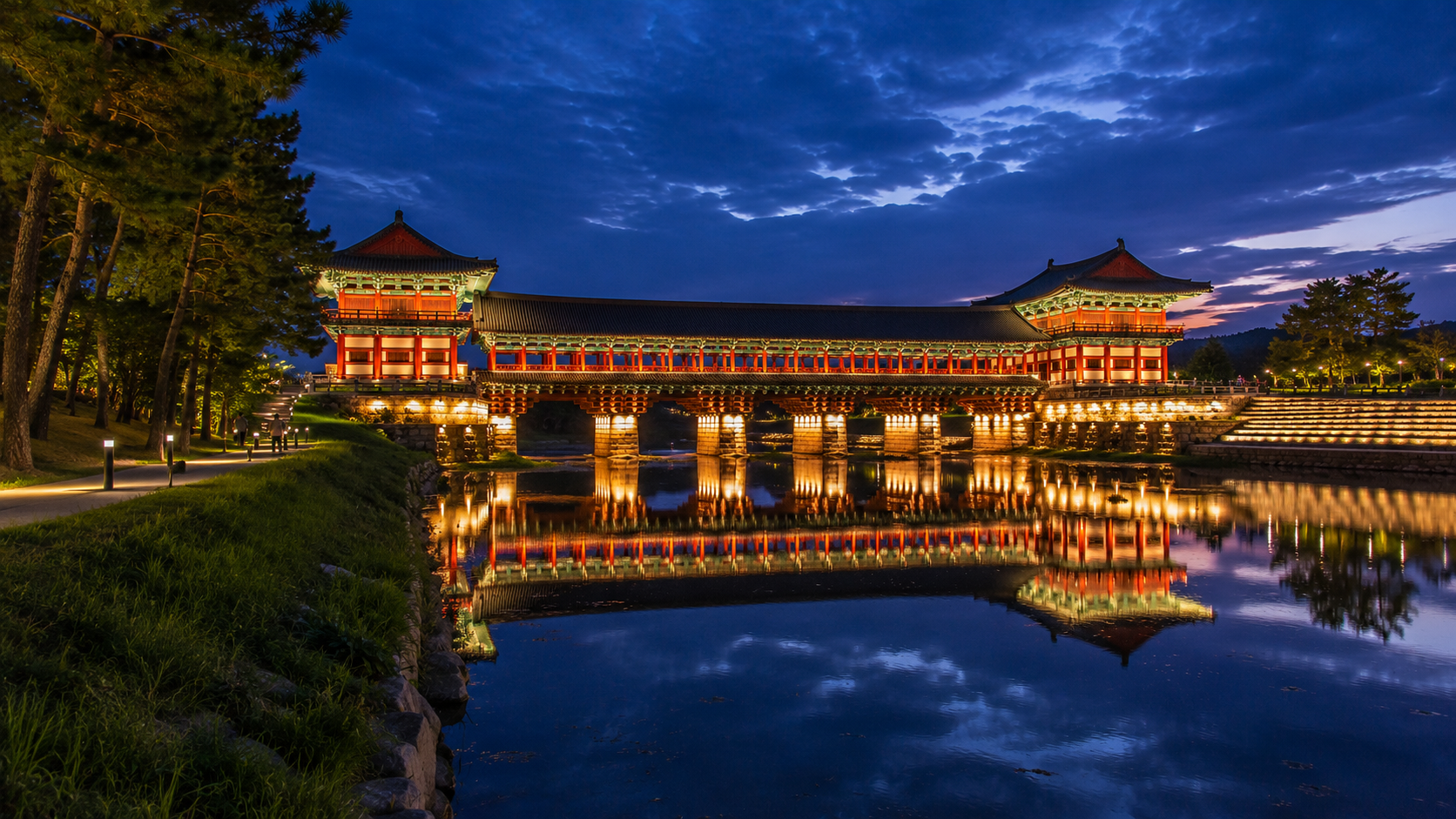
Woljeonggyo (월정교) is a modern reconstruction of a covered bridge recorded during the Unified Silla period. Its scale, painted woodwork, and gatehouses make it visually impressive, particularly when illuminated across the Namcheon Stream.
The bridge is next to Gyochon Traditional Village, where hanok-style buildings, courtyards, workshops, and food businesses occupy an area associated with the Gyeongju Choi family. Gyochon is smaller and more commercial than a preserved residential village such as Yangdong, but it works well as part of a central walking route.
Cross the bridge, walk along the stream, and continue toward Gyerim or Cheomseongdae. The official Gyeongju downtown guide lists Woljeonggyo as a free attraction, but opening access and gatehouse hours should be reconfirmed locally because the English page may not reflect temporary changes.
Practical tip: The exterior view from the riverbank is often more memorable than the bridge interior. For photographs, visit shortly after sunset while some color remains in the sky.
6. Bulguksa Temple
Bulguksa (불국사) is the most important temple stop for a first visit. Its stone terraces, stairways, bridges, courtyards, and two contrasting pagodas represent the architectural and religious ambitions of eighth-century Silla.
Look for Dabotap, the elaborate Pagoda of Bountiful Treasures, and the more restrained Seokgatap. The celebrated stone stairways are historical structures and are viewed rather than used as ordinary entrances.
Together with Seokguram, Bulguksa was inscribed on the UNESCO World Heritage List in 1995. UNESCO describes the two sites as a religious architectural complex of exceptional significance and explains the temple's arrangement as a representation of the land of Buddha. See the UNESCO Bulguksa and Seokguram listing for historical context.
Bulguksa remains an active Buddhist temple. Dress and speak respectfully, do not interrupt worship, and follow photography restrictions inside halls. Gyeongju City advises that temple hours and admission arrangements can change; verify them through the official Gyeongju admission information or the temple before departure.
7. Seokguram Grotto
Seokguram (석굴암) is an artificial granite grotto on Mount Toham containing a monumental seated Buddha surrounded by carved figures. The sculpture is viewed through protective glass because humidity and temperature changes threaten the stone interior. Visitors should therefore expect a controlled, relatively brief viewing experience rather than a cave they can explore.
The site requires more effort than Bulguksa. From the entrance area, a forest path leads to the grotto, and reaching the mountain site by public transport may involve waiting or a transfer. Combining both places in one half-day is possible, but allow extra time if bus intervals are inconvenient.
Practical tip: Visit Seokguram first if you are relying on buses or want cooler walking conditions, then descend to Bulguksa. In fog or heavy rain, the mountain setting and distant views may be limited, although the grotto itself remains the main attraction.
8. Mount Namsan
Mount Namsan (남산) is the strongest choice for travelers who want hiking and archaeology together. UNESCO records a remarkable concentration of former temple sites, stone statues, pagodas, reliefs, tombs, and other monuments across the Namsan section of the Gyeongju Historic Areas.
This is not one attraction with a single entrance. It is a broad mountain landscape with several trailheads and routes of different lengths. Samneung is a commonly used starting area, but the appropriate route depends on weather, fitness, daylight, and which carvings or temple remains you want to see.
Wear proper walking shoes and download an offline map. Some monuments are beside established paths, while others require steeper climbs. Do not touch rock carvings or leave the marked route to obtain a photograph. In hot, wet, icy, or windy conditions, choose a shorter course or substitute the national museum.
9. Yangdong Folk Village
Yangdong Village (양동마을) introduces a later period of Korean history. Unlike Gyeongju's Silla monuments, Yangdong is a Joseon-period clan village containing timber-framed houses, study halls, pavilions, and thatched-roof buildings arranged within a rural landscape.
UNESCO lists Yangdong with Andong's Hahoe as representative historic clan villages shaped by Confucian social organization and their surrounding mountains, waterways, and fields. Read the UNESCO Historic Villages of Korea listing before visiting if you want to understand why the arrangement of buildings matters.
As verified on June 11, 2026, Gyeongju City lists individual admission at KRW 4,000 for adults, KRW 2,000 for teenagers, and KRW 1,500 for children. Yangdong is a living heritage area, not an open-air film set. Stay out of private courtyards, keep noise low, and do not photograph residents at close range without permission.
Practical tip: Public transport is less frequent than in central Gyeongju. Check the return journey before entering the village, especially late in the afternoon.
10. Hwangnidan-gil
Hwangnidan-gil (황리단길) is the practical place to eat, take a break, and experience contemporary Gyeongju between historical visits. The district occupies streets west of Daereungwon and contains cafés, restaurants, small shops, photo studios, and hanok-style accommodation.
It is worth visiting for convenience and atmosphere, not because every business is traditional or historically significant. Popular restaurants may use waiting-list systems, and some small businesses close irregularly. Keep a second dining option in mind rather than building an itinerary around one social-media-famous venue.
The main street can become congested on weekends. Quieter side lanes are often easier for walking, but remember that the district also contains homes and accommodation.
How to organize your visit
One-day route
- Start at Daereungwon and Cheonmachong.
- Walk through Cheomseongdae, Gyerim, and Wolseong.
- Visit Gyeongju National Museum during the hottest or coldest part of the day.
- Continue to Woljeonggyo and Gyochon.
- Eat near Hwangnidan-gil.
- Finish at Donggung Palace and Wolji Pond after sunset.
This route is ambitious but geographically coherent. It involves substantial walking, so remove either the museum or Gyochon if you prefer a slower pace.
Two-day route
Use the downtown plan for day one. On day two, visit Seokguram and Bulguksa. Add Bomun Lake only if you want a relaxed resort-area walk, or replace the temple pair with Mount Namsan if hiking is your priority.
Three days or more
Add Yangdong Village, a longer Namsan hike, or an east-coast trip to the underwater tomb area associated with King Munmu. Coastal locations are spread out, so they work better with careful bus planning, a taxi budget, or a rental car.
Getting around
Central Gyeongju is unusually walkable for a Korean heritage destination. Daereungwon, Hwangnidan-gil, Cheomseongdae, Gyerim, Wolseong, Woljeonggyo, Donggung and Wolji, and the national museum can be connected on foot, although the complete circuit is tiring.
Bulguksa, Seokguram, Yangdong, and the coast require buses, taxis, or a car. The city promotes Bus No. 10 as a route serving several major attractions, but routes and intervals may change. Check a Korean navigation app on the day and confirm the final return service instead of relying on an old timetable. The official Gyeongju tourism site provides transport guidance and tourist information-center contacts.
When arriving by high-speed rail, note that Gyeongju Station is west of the historic center. Allow time for the onward local bus or taxi. Reserve intercity trains through Korail and verify the station name carefully when booking.
What to check before you go
- Confirm opening hours, final admission, and temporary closures on official sites the day before travel.
- Check sunset time if visiting Donggung and Wolji or Woljeonggyo at night.
- Look up the last practical bus back from Seokguram, Yangdong, or the coast.
- Carry a transport card, but keep another payment method because small businesses and ticketing arrangements vary.
- Wear shoes suitable for uneven stone, packed-earth paths, and long distances.
- Bring water and sun protection from late spring through early autumn.
- Avoid scheduling Mount Namsan during heavy rain, extreme heat, snow, or icy conditions.
- Ask about step-free routes at staffed entrances if accessibility is important; historic terrain and mountain paths can present significant barriers.
- Treat Bulguksa as an active religious site and Yangdong as a residential community.
Frequently asked questions
Is one day enough for Gyeongju?
One day is enough for the central tomb, palace, museum, and night-view district. It is not enough to cover downtown, Bulguksa, Seokguram, and outlying villages comfortably. Two days is the more practical first visit.
Where should first-time visitors stay?
The downtown area near Daereungwon or the bus terminals is convenient for walking, restaurants, and evening sights. Bomun is better suited to travelers prioritizing larger hotels, resort facilities, or a quieter lakeside setting, but it requires more transport to reach the downtown heritage district.
Is Gyeongju manageable without a car?
Yes, particularly for a one- or two-day itinerary centered on downtown and Bulguksa. A car becomes more useful for Yangdong, multiple Namsan trailheads, and coastal sites. Bus frequency outside the center can be limited, so build extra time into the schedule.
Which place should be visited at night?
Choose Donggung Palace and Wolji Pond if you have time for only one paid evening attraction. Add Woljeonggyo and Cheomseongdae for a longer night walk. Visit archaeological sites such as Wolseong in daylight first if historical interpretation matters to you.
Sources
- Gyeongju City official tourism guide
- Gyeongju City official admission information
- Gyeongju National Museum
- UNESCO: Gyeongju Historic Areas
- UNESCO: Seokguram Grotto and Bulguksa Temple
- UNESCO: Historic Villages of Korea, Hahoe and Yangdong
Start by marking the downtown heritage circuit on your map, then reserve a separate half-day for Bulguksa and Seokguram rather than trying to cross the city repeatedly.