Daejeon is a strong choice for travelers who prefer science museums, urban parks, easy hikes, contemporary art, and local food to crowded landmark sightseeing. First-time visitors should concentrate on the Expo and Hanbat Arboretum area, then choose either central Daejeon or one of the city's outer forests for the second half of the day.
Information on admission, opening hours, and temporary closures was checked on June 11, 2026. Reconfirm details on the linked official websites before traveling, especially for museums and seasonal facilities.
At a glance
| Place | Best for | Suggested time | Main consideration |
|---|---|---|---|
| Hanbat Arboretum | Gardens and relaxed walks | 1.5–3 hours | East and West Gardens close on different weekdays |
| Expo Science Park and Expo Bridge | Evening views and Expo history | 1–2 hours | Individual facilities may have separate schedules |
| National Science Museum | Families and science enthusiasts | 2–4 hours | Some experiences require reservations or extra tickets |
| Lee Ungno Museum | Modern Korean art | 1–1.5 hours | Check exhibition-change dates |
| Yuseong Hot Spring Foot Bath | A short, inexpensive break | 30–60 minutes | Bring a small towel |
| Jangtaesan Recreational Forest | Metasequoia forest scenery | 2–4 hours | Much easier by car or taxi |
| Gyejoksan Red Clay Trail | Walking and light hiking | 2–4 hours | Barefoot walking is optional |
| Daejeon Station and old downtown | Markets, shopping, and food | 2–3 hours | Expect queues at famous bakeries |
| Daecheong Lake | Scenic driving and quiet walks | Half day | Public transport is limited |
1. Hanbat Arboretum
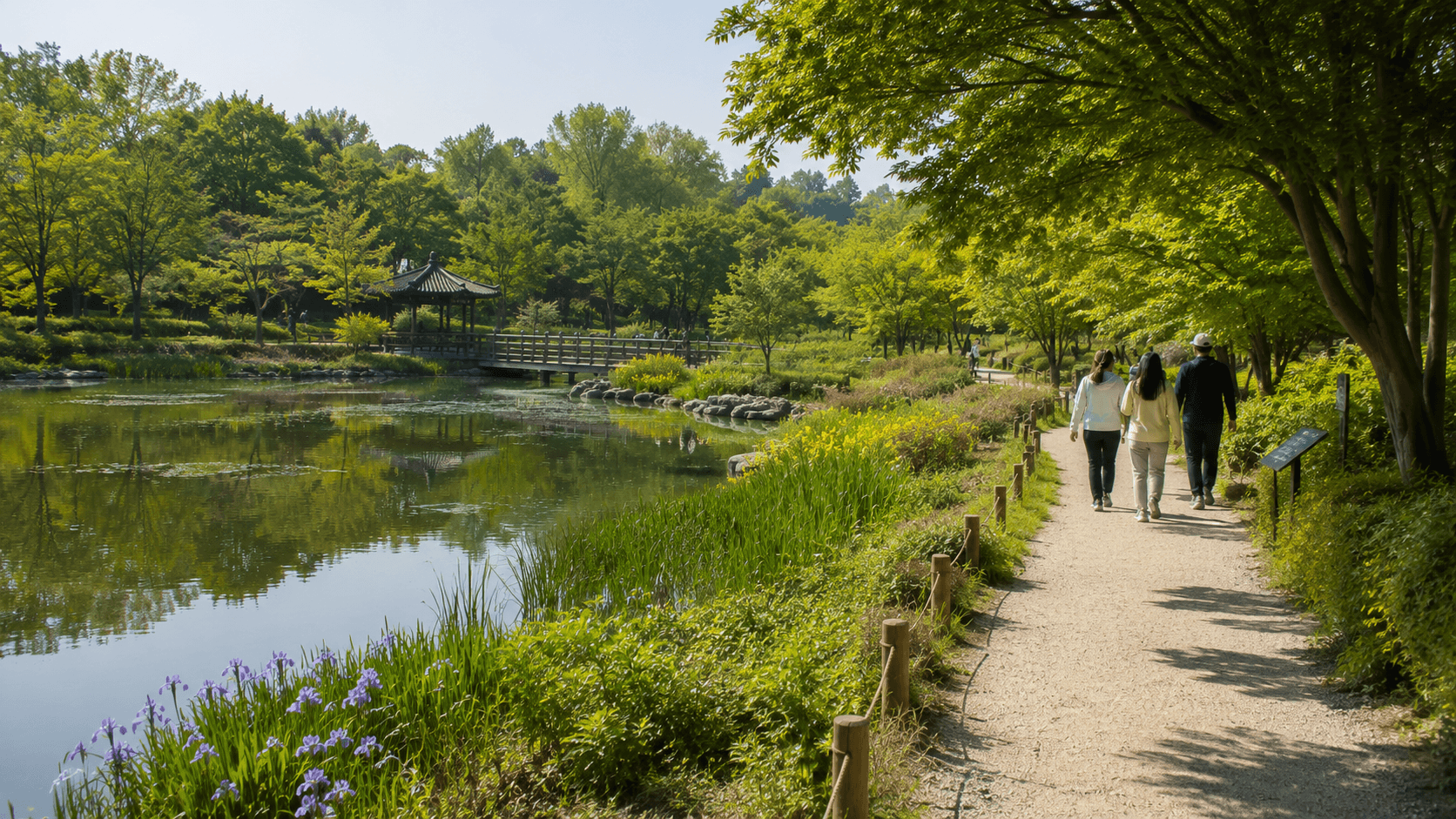
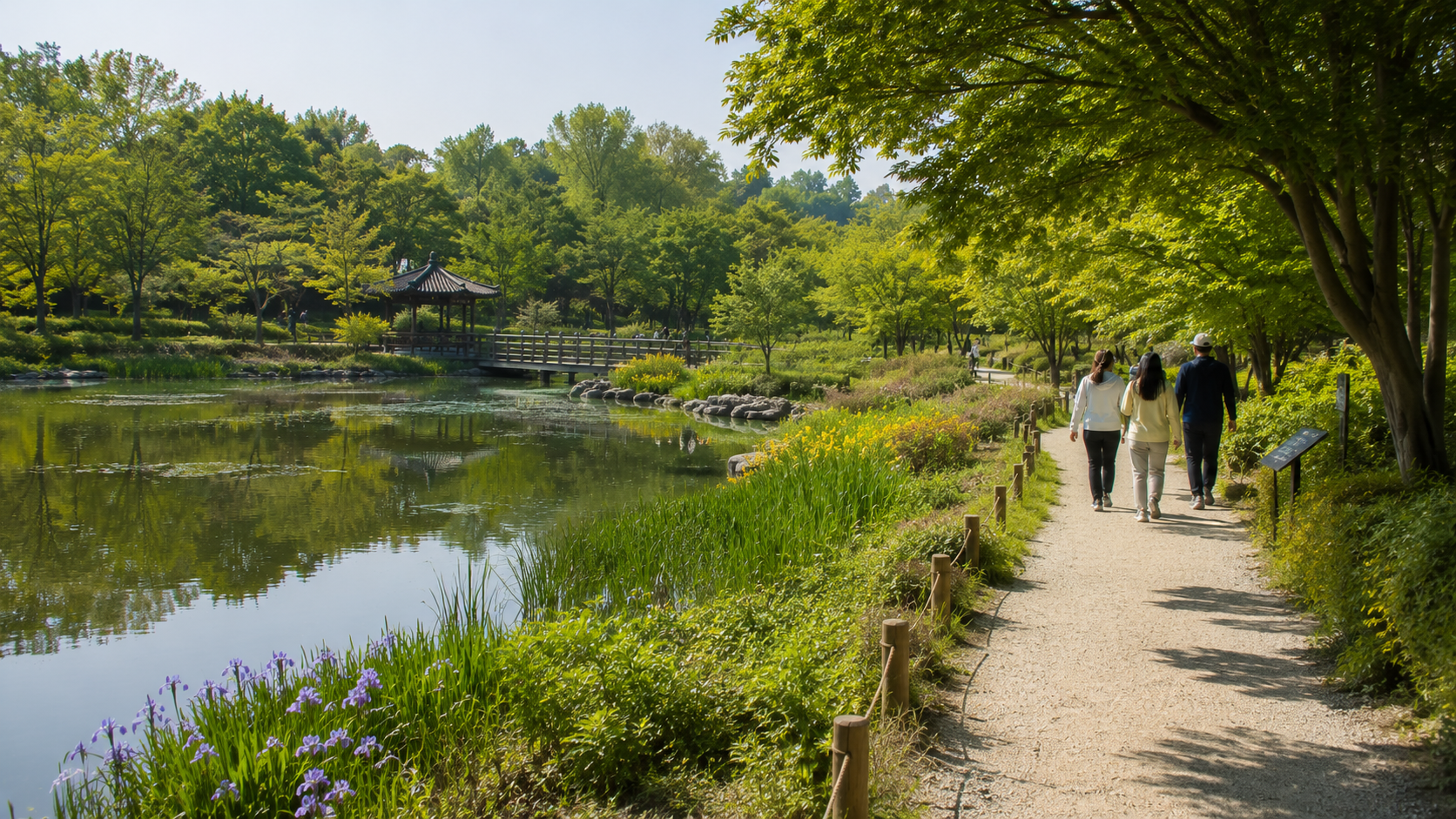
Hanbat Arboretum (한밭수목원) is the most convenient introduction to Daejeon's combination of greenery, science, and culture. The municipal arboretum occupies a large central site between the Government Complex area and the former Expo grounds. Its themed gardens include native plants, woodland paths, ponds, wildflowers, magnolias, shrubs, and a tropical greenhouse.
The grounds are divided into an East Garden, a West Garden, and the Tropical Plant Garden. This matters because they do not all close on the same day. According to the official visitor information, verified June 11, 2026, admission is free. From April through October, the outdoor gardens are open from 05:00 to 21:00, with last entry at 20:00. From November through March, they open from 07:00 to 19:00, with last entry at 18:00. The East Garden and tropical greenhouse normally close on Mondays; the West Garden closes on Tuesdays. A garden opens normally when its closure day falls on a public holiday.
Allow at least 90 minutes for one garden. Add more time if you want to visit both sides, take photographs, or combine the arboretum with a museum. Bicycles, motorcycles, kickboards, and inline skates cannot be brought into the gardens.
Practical tip: The arboretum is near the Daejeon Museum of Art, Lee Ungno Museum, Daejeon Arts Center, and Expo Bridge. Grouping these places together avoids unnecessary cross-city travel.
2. Expo Science Park and Expo Bridge
Daejeon hosted Expo 1993, and the Expo district remains one of the city's most recognizable areas. Hanbit Tower, Expo Bridge, public plazas, riverside paths, and newer science and commercial buildings now share the former exposition zone.
Visit in the late afternoon, walk along the Gapcheon Stream, and stay until the bridge and surrounding buildings are illuminated. The area works better as a combined walk than as a conventional theme park: several original Expo structures have disappeared or changed function, so visitors expecting a fully preserved exposition site may be disappointed.
The district is also useful as a meal or rest stop. Daejeon Convention Center, the Shinsegae Art & Science complex, Hanbat Arboretum, and the National Science Museum are nearby. Check the official Daejeon tourism portal for facility notices and city events before visiting.
3. National Science Museum
The National Science Museum (국립중앙과학관) reflects Daejeon's role as one of South Korea's principal research and technology centers. It is particularly suitable for families, exchange students, and travelers interested in natural history, astronomy, engineering, or Korean scientific development.
The museum complex includes indoor galleries and outdoor exhibits, but not every attraction follows the same admission or reservation system. Planetarium programs, children's facilities, special exhibitions, and hands-on sessions may use timed entry or separate tickets. English information is not equally extensive in every gallery, although the major displays remain visually accessible.
Plan two to four hours. On weekends and during school holidays, reserve any bookable experience before arriving. Because operating schedules can change by exhibition, consult the museum's official website rather than relying on an old blog post.
4. Lee Ungno Museum
The Lee Ungno Museum introduces the work of Lee Ungno, a major Korean modern artist whose career connected Korean ink traditions with European abstraction. The building itself, designed around ideas associated with the artist's work and landscape, is a reason to visit.
The museum stands beside Hanbat Arboretum and close to the Daejeon Museum of Art, making it easy to include in a cultural half day. According to the official visitor guide, verified June 11, 2026, regular hours are 10:00–19:00 from March through October and 10:00–18:00 from November through February. Last entry is 30 minutes before closing. It normally closes on Mondays, January 1, Seollal, and Chuseok; when Monday is a public holiday, closure moves to the following day.
Standard listed admission is KRW 500 for the permanent collection and KRW 1,000 for special exhibitions, although individual exhibitions may set different prices. The museum website listed an exhibition-installation period from June 8 to June 22, 2026, so anyone visiting during those dates should confirm which galleries are accessible.
5. Yuseong Hot Spring Foot Bath
Yuseong (유성) is Daejeon's traditional hot-spring district. The easiest way to experience it is the outdoor foot-bath area rather than booking a full spa visit. The Yuseong District government states that the public foot baths use natural hot-spring water and are free to use.
The foot baths are near Yuseong Spa Station on Daejeon Metro Line 1, making this one of the simplest short stops in the city. Remove your shoes and socks, rinse your feet where instructed, and avoid putting food or belongings beside the water. Bring a small towel, although nearby shops may sell basic supplies.
The district government describes the facility as operating year-round, but cleaning, maintenance, severe weather, or local events can interrupt access. Check posted notices when you arrive. Travelers with circulatory conditions, reduced heat sensitivity, or other medical concerns should seek appropriate medical guidance before using hot water facilities.
6. Jangtaesan Recreational Forest
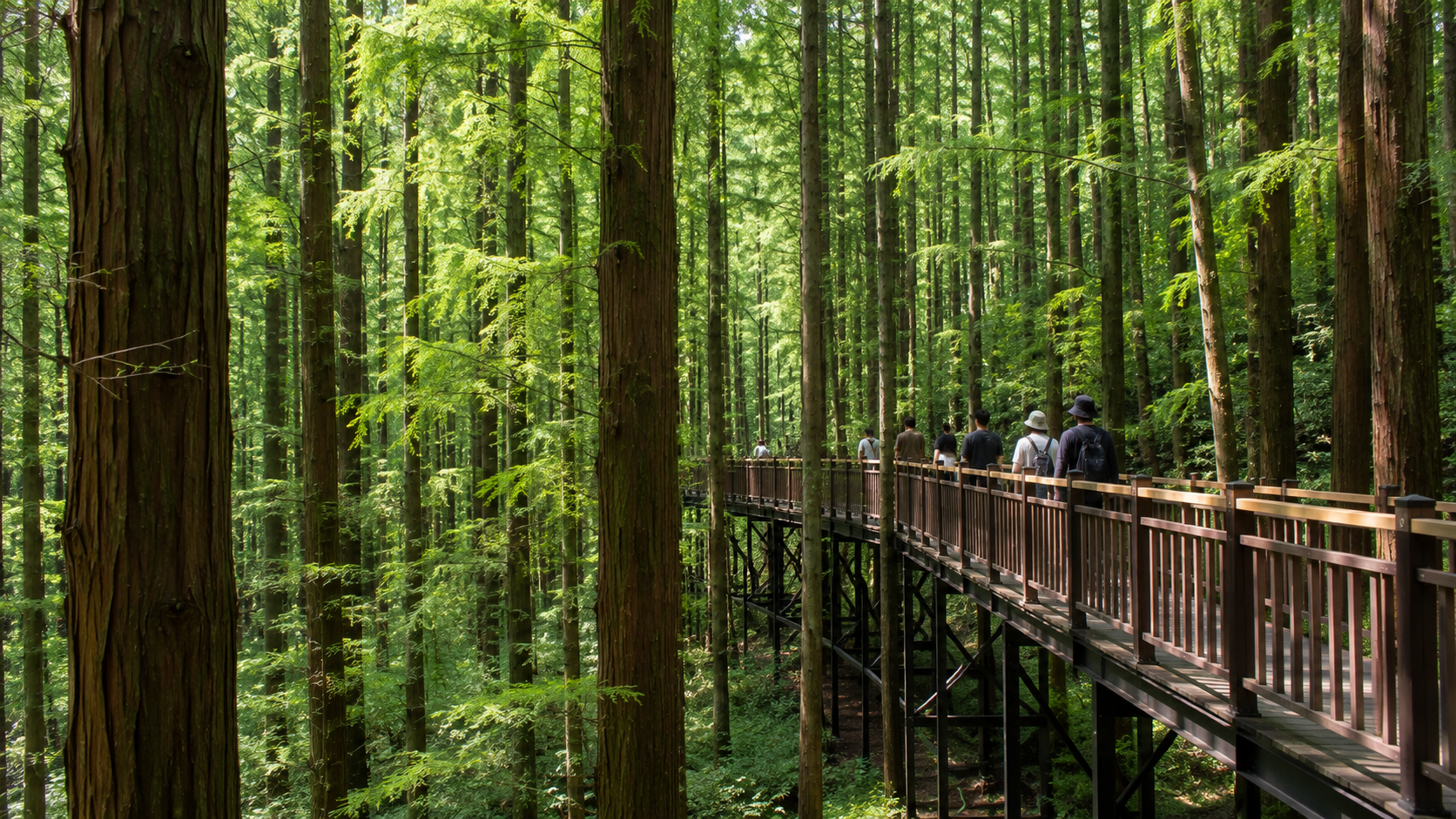
Jangtaesan Recreational Forest (장태산자연휴양림) is known for tall metasequoia trees that create one of Daejeon's most distinctive forest landscapes. Elevated walkways, forest paths, and viewpoints make it appealing even to visitors who do not want a demanding mountain hike.
The forest is especially attractive when new leaves appear in spring and when the foliage changes in autumn. Weekends during peak foliage can be busy, and parking may take time. Early morning is the most practical period for quieter paths and softer light.
Jangtaesan lies well outside the central subway corridor. A car or taxi substantially reduces travel time, while bus journeys may involve infrequent services and additional walking. Search for 장태산자연휴양림 in a Korean map application and check the Daejeon tourism portal for current access notices. Accommodation and organized programs, when available, may require advance reservations; ordinary forest walking should not be confused with a lodging booking.
7. Gyejoksan Red Clay Trail
Gyejoksan Mountain (계족산) is associated with a long red-clay trail where visitors may walk barefoot. The softer surface and woodland setting distinguish it from a conventional rocky Korean hiking route, but shoes are entirely acceptable. Do not feel obliged to walk barefoot if the ground is cold, wet, crowded, or uncomfortable.
Take water, a small towel, and a separate bag for damp items. Use designated washing points rather than cleaning muddy feet in drinking-water facilities. The broader mountain area also contains regular forest roads and routes toward Gyejoksanseong Fortress, so check the length and elevation of your chosen course before starting.
Public transportation reaches the general area, but the final approach and return service can be inconvenient. Confirm the last practical bus in a live Korean navigation app, particularly on Sundays and public holidays. After heavy rain, choose another attraction because trail conditions may deteriorate.
8. Daejeon Station, Jungang Market, and the old downtown
The streets west of Daejeon Station offer a more urban experience than the Expo district. Jungang Market (중앙시장), Eunhaeng-dong, the Jungangno underground shopping area, and nearby food streets can be explored on foot. This is a useful final stop before taking an evening train.
Jungang Market is a working traditional market rather than a curated tourist attraction. Carry a transit card and some KRW cash because payment practices vary among small stalls. Ask before photographing vendors or merchandise at close range.
The neighborhood is also home to the main branch of Sungsimdang, usually written Seongsimdang in revised romanization. The local bakery is known for items including fried soboro bread and chive bread. Queues can be substantial at popular times, so the station branch may be more convenient if you only want a takeaway purchase. Check official branch information rather than relying on map listings, as entrances and sales arrangements can change.
9. Daecheong Lake
Daecheong Lake (대청호) is a reservoir northeast of central Daejeon, surrounded by winding roads, wooded slopes, observation points, and waterside walking areas. It is a suitable choice for travelers with a car who want a quiet half day away from the commercial center.
There is no single entrance that represents the entire lake. Choose a specific destination before leaving, such as a lakeside ecological park, walking course, café area, or the vicinity of Daecheong Dam. Attempting to navigate simply to Daecheong Lake can put you on the wrong side of a large reservoir.
Public transportation is possible to selected points but is not ideal for spontaneous exploration. Mobile reception and taxi availability can also be less predictable on quieter stretches. Avoid stopping on narrow roads for photographs and observe all restrictions near water-management facilities.
How to plan your visit
One-day route without a car
- Start at the National Science Museum.
- Walk or take a short bus or taxi ride to Hanbat Arboretum.
- Visit Lee Ungno Museum if its exhibitions are open.
- Cross toward Expo Bridge around sunset.
- Finish at Yuseong Foot Bath or travel to Daejeon Station and the old downtown for dinner.
One-day route with a car
- Visit Jangtaesan Recreational Forest early.
- Return to central Daejeon for Hanbat Arboretum and a nearby museum.
- Walk around Expo Bridge after dark.
Choose Gyejoksan or Daecheong Lake instead of Jangtaesan if either better matches your interests. Combining all three outer nature areas in one day would leave little time to enjoy them.
Getting around Daejeon
Daejeon has one metro line, supplemented by an extensive bus network. The metro is useful for Daejeon Station, Jungangno, City Hall, Government Complex Daejeon, and Yuseong Spa, but several major nature attractions require buses, taxis, or a car.
A rechargeable Korean transportation card can be used on ordinary urban public transport. For real-time routing, Korean navigation services generally provide more complete local bus information than international map platforms. Check the final return bus before beginning an outlying hike.
Travelers arriving by rail should distinguish Daejeon Station from Seodaejeon Station. Daejeon Station is the more convenient arrival point for the old downtown and most Gyeongbu-line high-speed services. Confirm the station printed on your ticket through the official Korail website.
Accessibility and luggage
Hanbat Arboretum, Expo Bridge, and the major museums have broad paved areas, but long distances may still be tiring. Forest paths at Jangtaesan and Gyejoksan can include slopes, uneven ground, and weather-related obstacles. Contact the relevant facility for current wheelchair routes, lift availability, or mobility assistance.
Large luggage is best left in station lockers or at your accommodation. Storage capacity cannot be guaranteed, particularly on weekends. Do not take wheeled suitcases to forest attractions.
What to check before you go
- Confirm museum exhibition dates and closure days.
- Check whether the East or West side of Hanbat Arboretum is closed.
- Look at the weather and air-quality forecast before hiking.
- Save attraction names in Hangul for taxi drivers and map searches.
- Check the last return bus from Jangtaesan, Gyejoksan, or Daecheong Lake.
- Carry water and suitable shoes for forest routes.
- Bring a towel for the Yuseong foot bath.
- Reserve science programs or forest accommodation separately when required.
- Verify whether public-holiday schedules affect transport or museums.
Frequently asked questions
Is Daejeon worth visiting as a day trip from Seoul?
Yes, particularly for science museums, gardens, contemporary art, or a relaxed city break. A day trip is practical by high-speed train, but an overnight stay is better if you want to visit an outer forest or Daecheong Lake.
Which area is best for a first visit?
The Hanbat Arboretum and Expo district offers the easiest concentration of attractions. It combines gardens, museums, riverside walking, restaurants, and evening views without requiring a car.
When is the best season to visit Daejeon?
Spring and autumn generally provide the most comfortable conditions for gardens and hiking. Summer can be hot, humid, and rainy, while winter brings cold temperatures and possible ice on shaded paths. Indoor science and art museums remain useful alternatives in poor weather.
Do international visitors need a car?
Not for the central attractions. A car becomes valuable for Jangtaesan Recreational Forest and Daecheong Lake, especially when time is limited. Gyejoksan can be reached by public transport, but careful return planning is necessary.
Start by choosing one central cluster and one nature or food area. That produces a more realistic Daejeon itinerary than trying to cross the city repeatedly in a single day.
Sources
- Daejeon Metropolitan City Hanbat Arboretum
- Official Hanbat Arboretum visitor information
- National Science Museum
- Lee Ungno Museum English website
- Lee Ungno Museum visitor information
- Yuseong District hot-spring and recreation guide
- Daejeon official tourism portal
- Korail English website
- Sungsimdang official website