Suwon is best known for Hwaseong Fortress, but the city offers enough history, food, museums and green space for a full day or an overnight trip. First-time visitors should concentrate on the fortress, Hwaseong Haenggung Palace and Haenggung-dong before adding a market, museum or park.
The operating hours and admission prices below were verified on June 11, 2026. Recheck official notices before traveling, particularly for evening openings, performances and holiday closures.
At a glance
| Place | Best for | Suggested time | Admission |
|---|---|---|---|
| Hwaseong Fortress | History, walking and city views | 2–4 hours | Free |
| Hwaseong Haenggung Palace | Royal history and architecture | 1–1.5 hours | KRW 2,000 for adults |
| Banghwasuryujeong and Hwahongmun | Photography and sunset | 30–60 minutes | Free |
| Haenggung-dong | Cafes, workshops and neighborhood streets | 1–2 hours | Free to explore |
| Paldalmun markets and Chicken Street | Local food and traditional shopping | 1–2 hours | Free to explore |
| Suwon Hwaseong Museum | Historical context and rainy days | 1 hour | Check the current museum notice |
| Gwanggyo Lake Park | Walking, running and evening scenery | 1–3 hours | Free |
| Irwol Arboretum | Gardens, families and quieter afternoons | 1.5–2.5 hours | KRW 4,000 for adults |
| Haewoojae | An unusual family-friendly museum | 1 hour | Free |
1. Walk around Hwaseong Fortress
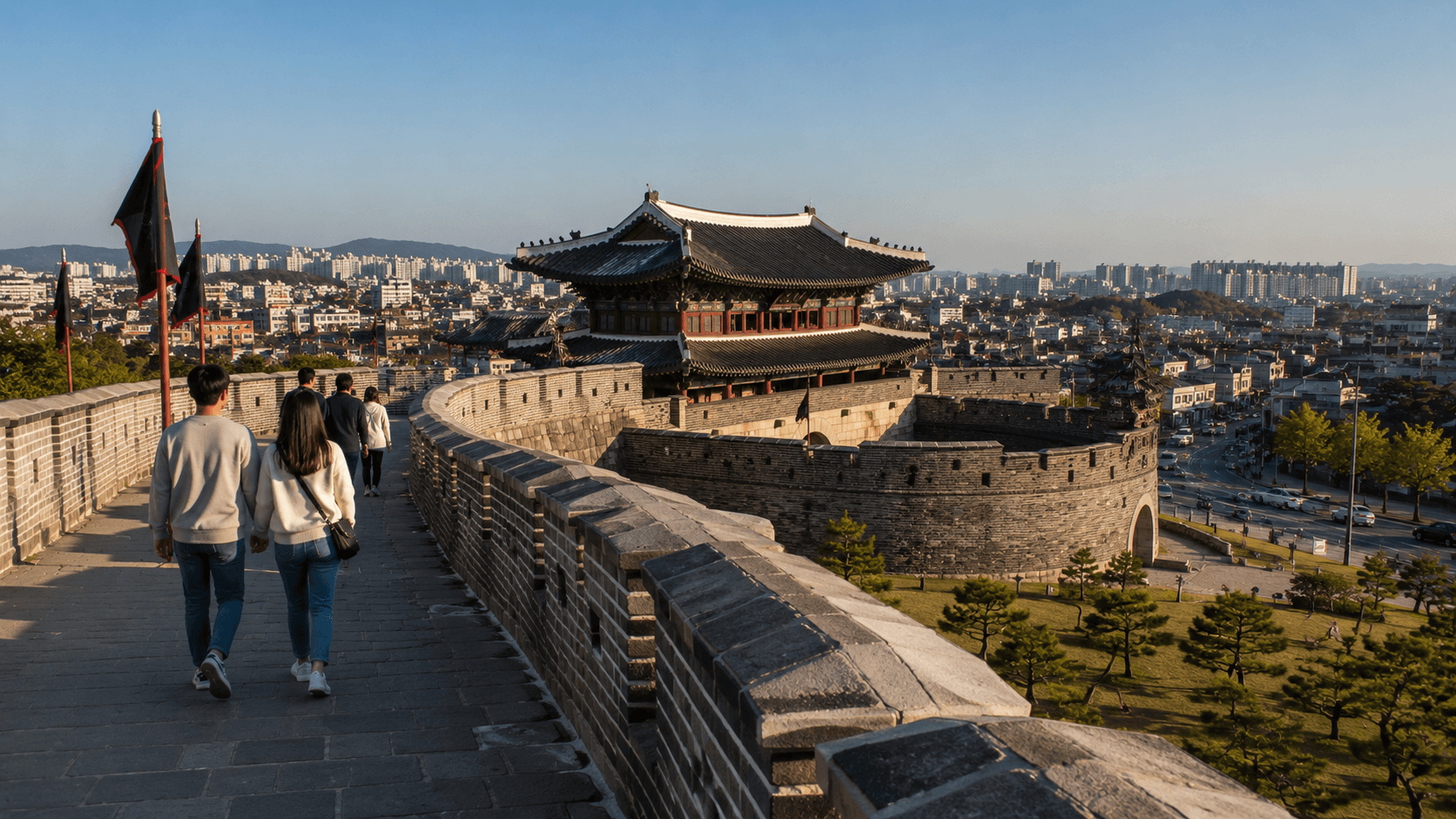
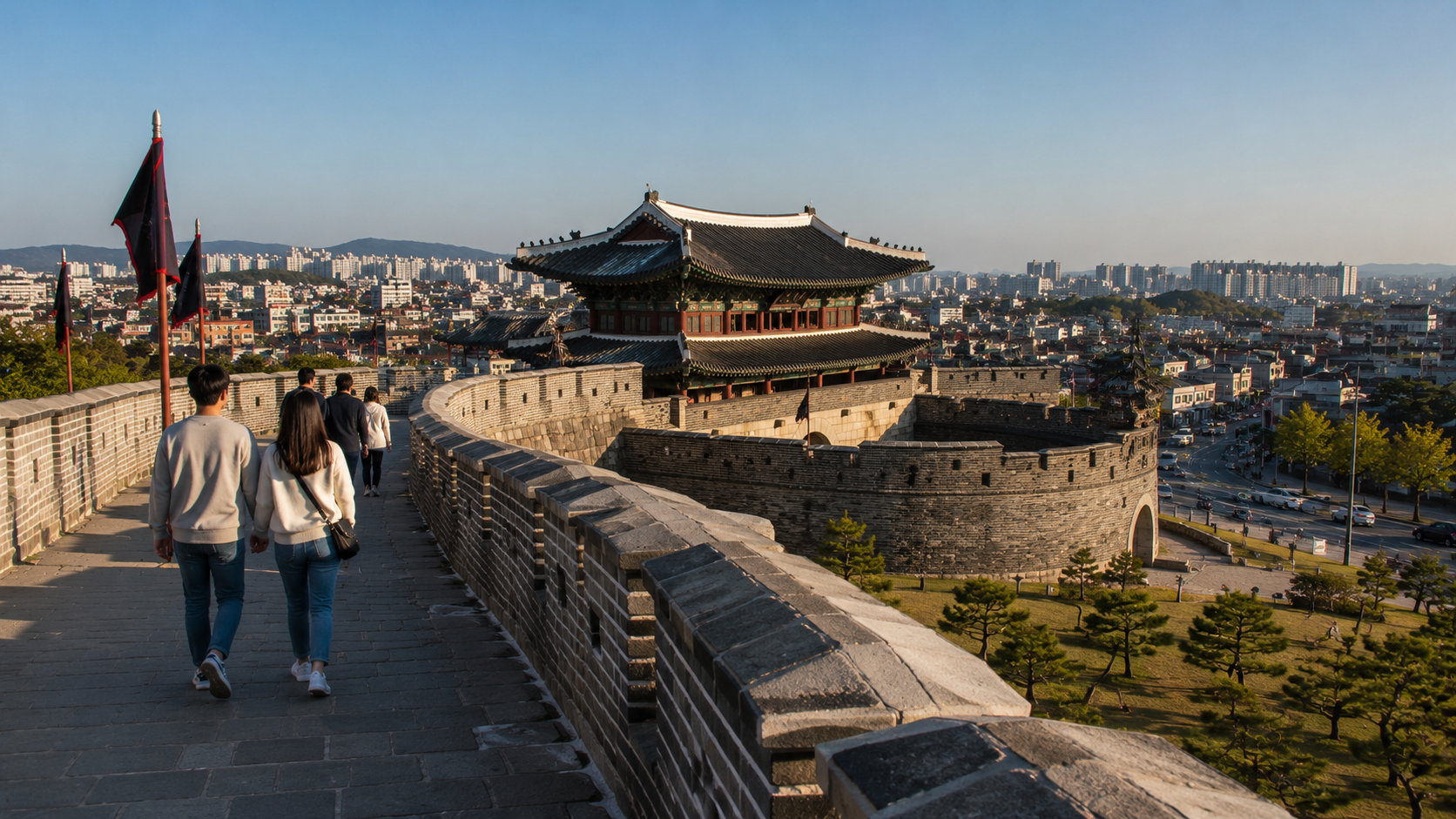
Hwaseong Fortress (수원화성) is Suwon’s essential attraction. Built in the late 18th century under King Jeongjo, it combines stone walls, brick defenses, command posts, gates and floodgates. UNESCO records the wall as 5.74 kilometers long and inscribed the site on the World Heritage List in 1997. Its design incorporated defensive, administrative and commercial functions rather than serving only as a military barrier. Read the historical overview on the UNESCO World Heritage Centre’s Hwaseong Fortress page.
A complete circuit is possible, but it involves several hours of walking and a noticeable climb over Paldalsan, the hill on the western side. Most day-trippers will have a better visit by choosing one of these sections:
- Janganmun to Hwahongmun: A relatively approachable stretch connecting the impressive north gate with the stream.
- Hwahongmun to Changnyongmun: Good for waterside views, defensive structures and access to Yeonmudae.
- Paldalmun to Seojangdae: The steepest popular section, rewarded with broad city views from the western command post.
- Hwaseomun to Janganmun: A pleasant wall walk beside Jangan Park.
The fortress is an open site that remains accessible at night, and general admission is free, according to the Suwon Cultural Foundation visitor information. Individual buildings or sections can occasionally be restricted for maintenance.
Wear shoes with grip. Parts of the route contain steep stone steps, uneven surfaces and exposed slopes. Travelers using wheelchairs or strollers should explore the flatter areas around Hwaseong Haenggung, Janganmun, Hwahongmun and Yeonmudae instead of attempting the entire wall.
2. Visit Hwaseong Haenggung Palace
Hwaseong Haenggung (화성행궁) was a temporary royal palace used when King Jeongjo visited Suwon. Its courtyards, halls and gates make the political purpose of the fortress easier to understand, so it is worth entering rather than seeing only the exterior plaza.
As verified on June 11, 2026, the palace is normally open from 09:00 to 18:00 throughout the year, with final admission one hour before closing. Adult admission is KRW 2,000; reduced rates apply to eligible military personnel, teenagers and children. The official three-site combination ticket, covering the palace, Suwon Hwaseong Museum and Suwon Museum, costs KRW 4,000 for an adult.
The Suwon Cultural Foundation admission page also lists a 2026 night opening from May 1 through November 1 on Fridays, Saturdays, Sundays and public holidays. Night hours are 18:00–21:30, with final entry at 21:00. The foundation warns that the period can change, so check again before making a special evening trip.
Wheelchairs and strollers are available in limited numbers at the palace. Some thresholds and historic surfaces may still require assistance.
3. See Hwahongmun and Banghwasuryujeong
Hwahongmun (화홍문) is the northern floodgate where Suwoncheon Stream passes through the fortress. Immediately above it, Banghwasuryujeong Pavilion (방화수류정), also called Dongbukgangnu, overlooks Yongyeon Pond.
This compact area is one of the easiest places to appreciate how the fortress follows Suwon’s terrain. Water, walls, a pavilion and the surrounding neighborhood appear together within a short walk. Visit around sunset for softer light, then continue toward Janganmun or follow the stream south.
The paths beside the water are easier than the hill sections, although access to the pavilion itself includes steps. After heavy rain, follow barriers and local safety notices near the stream.
4. Explore Haenggung-dong
Haenggung-dong (행궁동) refers to the neighborhoods around the palace and inside the fortress walls. Restored buildings, small workshops, restaurants, independent shops and cafes now sit beside older residential streets.
The most useful way to explore is without a rigid checklist. Begin at Hwaseong Haenggung Plaza, walk through the streets east or north of the palace, and reconnect with the wall near Janganmun or Hwahongmun. The area is particularly convenient for lunch or an afternoon break between historical sites.
Individual businesses set their own hours, and some close one day each week. Cafes can become busy on weekends. Do not treat the residential alleys as a staged photo set: keep voices down, avoid blocking entrances and respect signs asking visitors not to enter private property.
5. Eat around the Paldalmun markets and Suwon Chicken Street
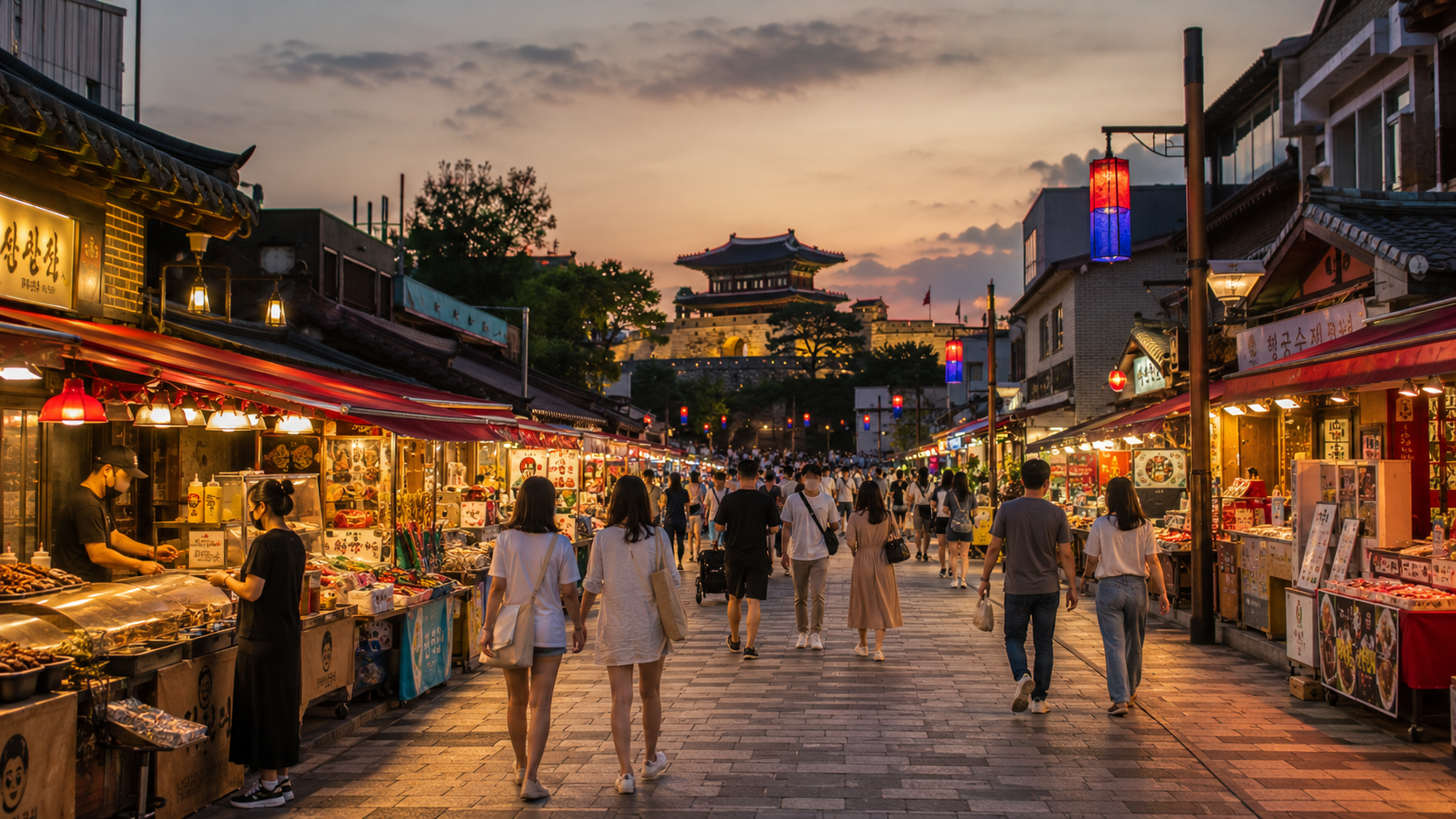
Several traditional markets cluster near Paldalmun, the fortress’s south gate. They include Paldalmun Market, Motgol Market, Yeongdong Market, Jidong Market and Minarigwang Market, all identified in the official Suwon tourism market listings.
The area is useful for seeing everyday market trade rather than only souvenir shopping. Depending on the market and time of day, visitors may find produce, prepared foods, clothing, household goods and snacks. Carrying some cash is sensible, although many established vendors accept Korean cards or mobile payments.
Nearby Suwon Chicken Street is known for whole fried chicken served in an old-fashioned Korean style. Portions are often intended for sharing, and popular restaurants can have queues at dinner or on weekends. Prices, menus and opening hours vary by restaurant, so check the individual business on Naver Map or KakaoMap on the day of your visit.
Paldalmun stands in the center of a busy traffic roundabout. Photograph it from the pavement and use designated crossings rather than attempting to approach the gate through the road.
6. Understand the fortress at Suwon Hwaseong Museum
Suwon Hwaseong Museum (수원화성박물관) explains the fortress’s construction, design and cultural setting through models and related objects. It is especially useful before a wall walk if you want historical context, or afterward if you have questions about the structures you saw.
The museum is near the eastern side of the historic district at 21 Changnyong-daero. According to the official Suwon museum portal, it normally opens from 09:00 to 18:00, with admission ending at 17:00, and closes on Mondays and on additional dates designated by the city. Temporary exhibition dates and children’s programs should be checked separately.
The museum can also provide shelter during rain, summer heat or poor air-quality conditions. Allow about an hour for the permanent displays.
7. Walk around Gwanggyo Lake Park
Gwanggyo Lake Park (광교호수공원) presents a completely different side of Suwon. Developed around Woncheon and Sindae reservoirs, it has broad waterside paths and landscaped public spaces surrounded by the modern Gwanggyo district.
Choose this stop if you want a long walk, an evening run, a picnic or open space after the compact streets around the fortress. The Suwon tourism park guide gives the main address as 102 Gwanggyohosu-gongwon-ro, Yeongtong-gu.
The park is extensive, so set a specific destination in your navigation app rather than entering only the park name. Public transport access depends on which side of the lakes you plan to visit. Restaurants, shopping areas and toilets are easier to find around developed entrances than on quieter stretches of the path.
8. Visit Irwol Arboretum
Irwol Arboretum (일월수목원) is a flat, city-operated botanical garden beside Irwol Reservoir. Its combination of outdoor gardens and an exhibition greenhouse makes it a practical choice for families, plant enthusiasts and travelers who want a quieter half-day.
As verified on June 11, 2026, opening hours are 09:30–17:30, with ticket sales ending at 17:00. The arboretum normally closes on Mondays; when Monday is a public holiday or part of a holiday period, the closure moves to the following day. Adult admission is KRW 4,000, with lower prices for teenagers and children. See the official Irwol Arboretum visitor page and admission table.
The official directions list local bus connections from Sungkyunkwan University Station and Hwaseo Station. Because bus routes can change, confirm the live route in a Korean navigation app before departure.
9. See Suwon’s most unusual museum at Haewoojae
Haewoojae (해우재), commonly introduced in English as Mr. Toilet House, is a museum and cultural park devoted to sanitation and toilet culture. The subject is unusual, but the exhibits also cover public hygiene and the historical development of toilets. The outdoor sculptures and children’s experience center make it most suitable for families or travelers interested in unconventional museums.
The official Suwon tourism listing for Haewoojae states that admission is free. Hours are 10:00–18:00 from March through October and 10:00–17:00 from November through February. It closes on Mondays, or the following day when Monday is a public holiday, as well as January 1 and the Seollal and Chuseok holiday periods. These details were verified on June 11, 2026.
Haewoojae is north of central Suwon and does not combine naturally with the fortress on foot. Use a bus or taxi and allow extra travel time.
How to plan your time
One-day first visit
- Start at Janganmun and walk to Hwahongmun and Banghwasuryujeong.
- Continue through Haenggung-dong to Hwaseong Haenggung Palace.
- Have lunch near the palace or Paldalmun.
- Visit Suwon Hwaseong Museum or climb to Seojangdae.
- Finish at the traditional markets or Chicken Street.
Slower overnight visit
Use the first day for the fortress district, palace and markets. On the second day, choose Gwanggyo Lake Park, Irwol Arboretum or Haewoojae according to your interests. These outer attractions are spread across the city, so trying to visit all three in one morning is inefficient.
Getting to and around Suwon
Suwon Station is the city’s main transport hub. From Seoul, journey time varies significantly by service and starting point, so compare a metropolitan subway route with reserved Korail trains rather than assuming the first option shown is fastest. Check current intercity train schedules and fares through the official Korail booking site.
The fortress district is not directly beside Suwon Station. Local buses and taxis connect the station with Paldalmun, Hwaseong Haenggung and Janganmun. Traffic can be slow around Paldalmun on weekends.
For local navigation, Naver Map and KakaoMap generally provide more useful Korean bus information than international map services. Search attractions using both their English names and Hangul names. A rechargeable transport card can be used on metropolitan subways and local buses.
What to check before you go
- Check the Suwon Cultural Foundation visitor page for palace hours, night openings, trolley operations and temporary restrictions.
- Confirm Monday and public-holiday closures for museums and arboretums.
- Look at the weather before committing to a full fortress circuit; shade is limited on exposed sections.
- Check air-quality conditions, particularly if you plan a long wall or lakeside walk.
- Carry water and wear supportive footwear for Paldalsan and the stone stairways.
- Reserve extra time for local buses, especially when transferring from Suwon Station.
- Check individual restaurant and cafe hours on the day of travel.
- Ask at an information center about accessible routes if stairs or steep slopes are a concern. The Suwon Station tourist information center is near Exit 4 and, according to the Suwon Cultural Foundation, provides English, Chinese and Japanese interpretation from 09:00 to 18:00.
Start by choosing the section of Hwaseong Fortress that matches your walking ability. Once that route is fixed, add the palace, a nearby meal and no more than one outlying attraction.
Sources
- UNESCO World Heritage Centre: Hwaseong Fortress
- Suwon Cultural Foundation: Visitor information, admission and facilities
- Official Suwon tourism portal
- Suwon tourism guide to parks and natural attractions
- Official Suwon museum portal
- Official Irwol Arboretum website
- Suwon tourism information for Haewoojae
- Korail English booking site