The best way to exchange money in Korea is usually to avoid exchanging your entire budget at once. Bring a card with low foreign-transaction and ATM fees, obtain enough Korean won for transport and small purchases, and compare the final amount of KRW offered before exchanging additional cash. Airport counters are convenient for arrival money, while bank branches and authorized city exchange offices may offer more competitive rates.
Information on exchange locations, operating hours, card acceptance, and customs rules was verified on June 9, 2026. Exchange rates change throughout the day, so no specific rate quoted in advance can remain reliable.
Quick answer
| Situation | Practical choice |
|---|---|
| Arriving without Korean won | Exchange a small amount at the airport or use an international-card ATM |
| Paying for hotels, restaurants, and shopping | Use a low-fee international credit or debit card |
| Exchanging USD, EUR, JPY, or another major currency | Compare an authorized city exchange office with a bank's cash rate |
| Withdrawing cash | Use an ATM displaying an international network supported by your card |
| Asked to pay in your home currency | Decline the conversion and choose KRW |
| Visiting markets, small businesses, or regional areas | Carry a cash reserve in smaller notes |
| Bringing more than USD 10,000 or its equivalent | Declare it to Korea Customs on arrival |
A sensible starting amount for a short visit is approximately ₩100,000 to ₩200,000 in cash, adjusted for your itinerary. This is a practical suggestion rather than an official requirement. Travelers who expect to use traditional markets, older ticket machines, small restaurants, or cash-funded transport cards may need more.
Understanding Korean won
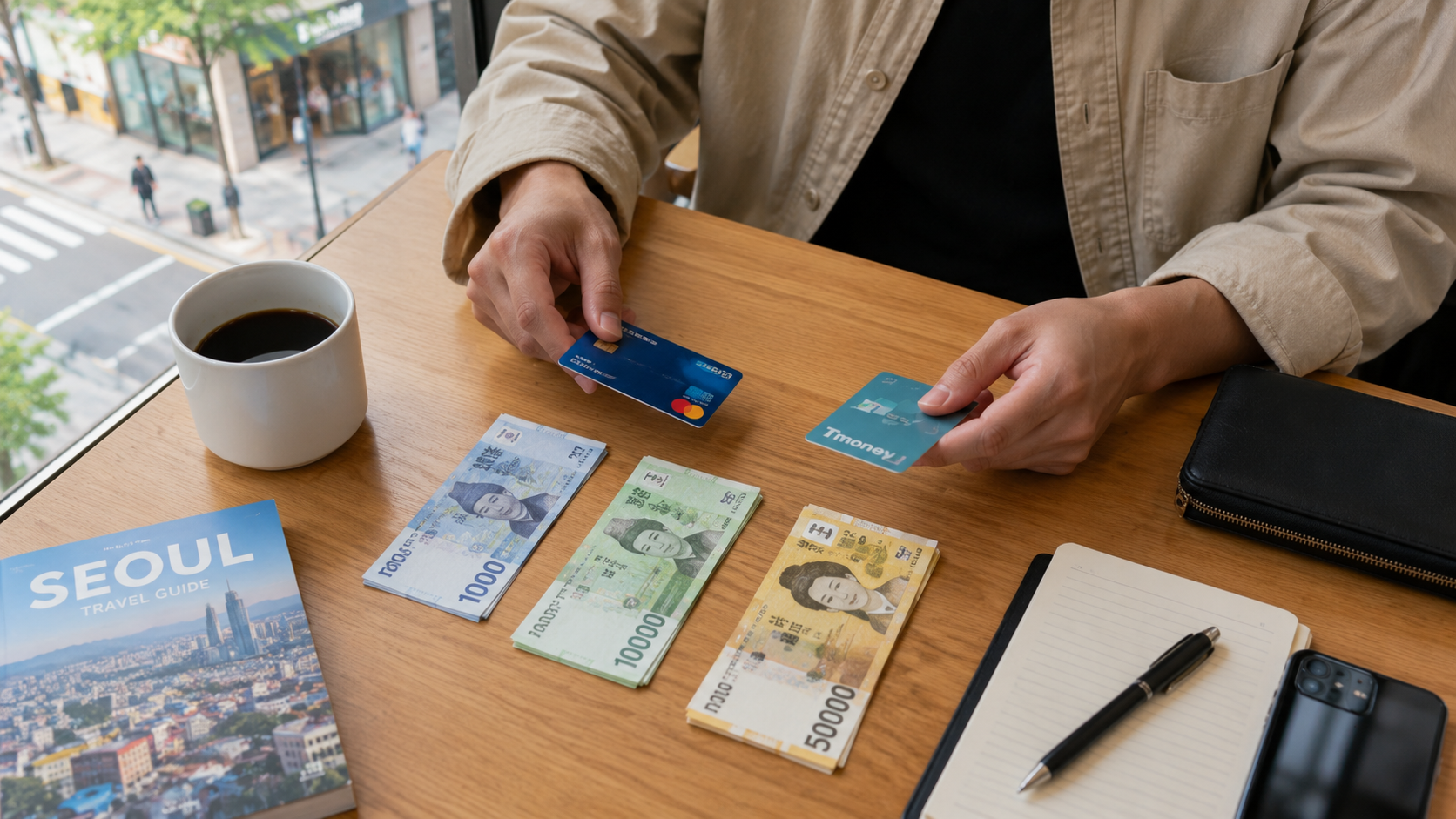
South Korea's currency is the Korean won, written as KRW or with the symbol ₩. The Bank of Korea lists current banknotes in denominations of ₩1,000, ₩5,000, ₩10,000, and ₩50,000. Common coins are ₩10, ₩50, ₩100, and ₩500.
When reading prices, remember that the comma separates thousands. A price written as ₩15,000 means fifteen thousand won, not fifteen won.
Cashiers may be reluctant to accept a ₩50,000 note for a very small transaction, particularly early in the day. Ask for some ₩1,000 and ₩10,000 notes when exchanging money, or break a large note at a supermarket or convenience store after making a reasonable purchase.
The most cost-effective strategy for most travelers
1. Check your card's fees before departure
Ask your card issuer about four separate charges:
- Foreign-transaction fees on purchases
- International ATM withdrawal fees
- Currency-conversion markups
- Fees charged by the ATM owner in Korea
A card advertising favorable exchange rates may still charge a fixed withdrawal fee. That makes frequent small withdrawals expensive. If your card has a fixed fee, fewer and larger withdrawals may cost less, provided you are comfortable carrying the cash.
Also confirm that international transactions and overseas ATM withdrawals are enabled. Keep a second card from a different network or issuer in a separate place in case the first card is declined or retained by an ATM.
2. Bring a modest arrival reserve
Arriving with some won can simplify the first hour of the trip, but it is not essential at Incheon International Airport. The airport has bank-operated exchange counters and ATMs in both terminals.
If your home bank offers a reasonable advance-order rate, obtaining approximately ₩50,000 to ₩100,000 before departure can be convenient. Otherwise, exchange or withdraw only enough at the airport for your first day, then compare options in your destination.
3. Use cards for ordinary purchases
According to the Seoul Metropolitan Government's currency guidance, international credit cards are accepted at most stores, restaurants, hotels, and tourist attractions. Visa and Mastercard generally have the broadest usefulness, although acceptance ultimately depends on the merchant and card issuer.
A physical card is worth carrying even if you normally use a mobile wallet. Some terminals may not accept your particular phone-based payment service, and staff may ask you to insert the card or use its chip.
4. Keep cash for exceptions
Korea is highly card-oriented, but cash remains useful for:
- Traditional markets and very small businesses
- Adding value to some transport cards or using older ticket machines
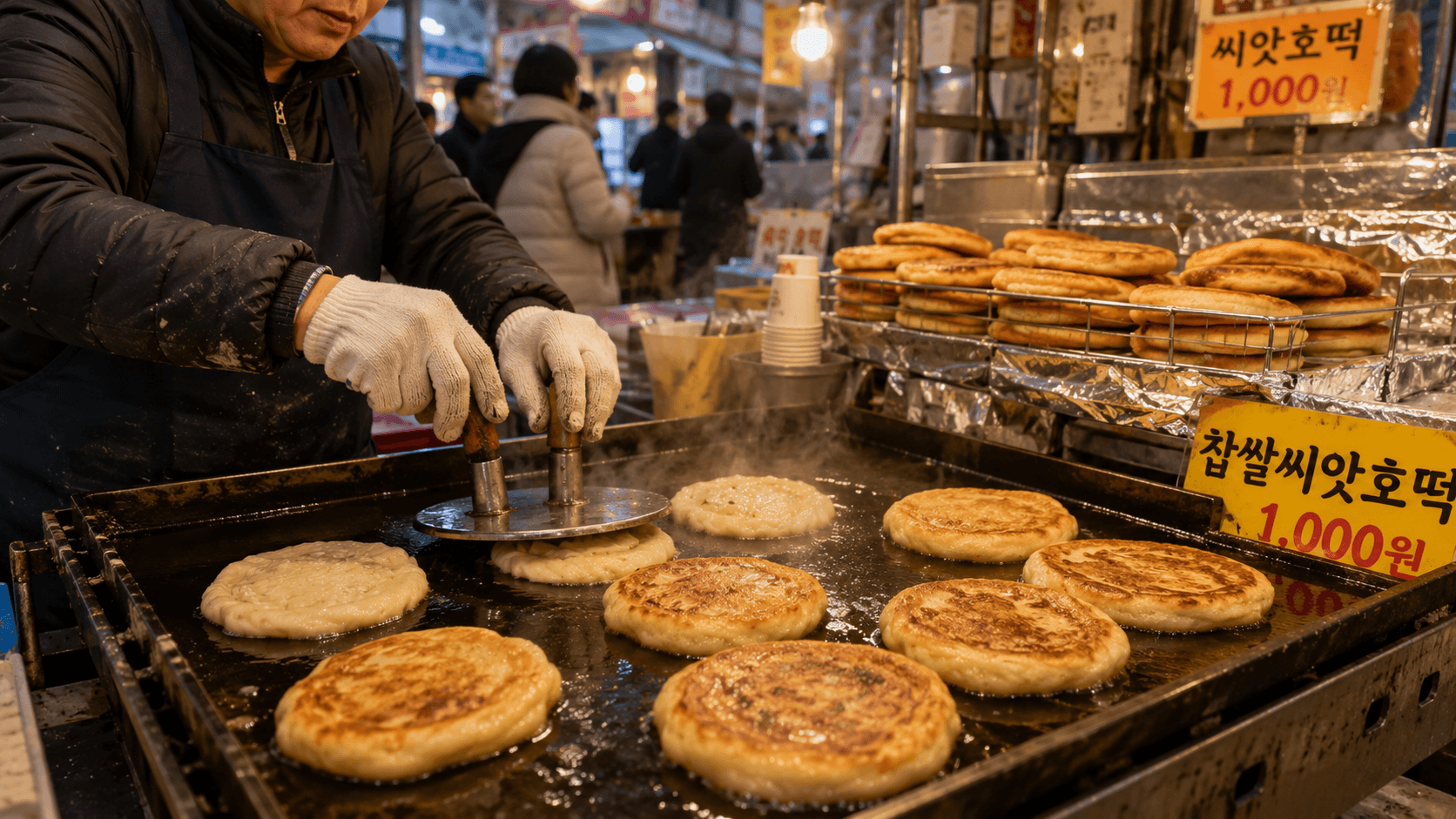
- Street-food stalls
- Coin lockers, vending machines, and self-service facilities with limited payment support
- Emergency transport or payment when a foreign card is declined
- Smaller establishments outside major tourist districts
Do not rely on a single payment method, particularly if you are traveling beyond Seoul, Busan, or other large cities.
Where to exchange cash in Korea
Incheon International Airport
Incheon Airport is the easiest place to obtain won immediately after landing. As verified on June 9, 2026, its official facility directory lists exchange services operated by KB Kookmin Bank, Hana Bank, and Woori Bank. Selected counters operate 24 hours, while others have limited schedules such as 06:00-22:00 or standard bank hours.
Counter locations and hours can change. Search the airport directory by terminal and select the finance or insurance category shortly before departure.
Airport exchange is convenient, but convenience does not guarantee the strongest rate. Exchange only your immediate requirement unless the displayed offer is competitive. Use an official bank counter or authorized service; Incheon Airport specifically advises travelers to avoid unauthorized exchange.
Bank branches
Banks provide regulated exchange services and clear transaction records. A passport or residence card may be required. Seoul's official guidance states that ordinary bank branches generally operate from 09:00 to 16:00 on weekdays, but individual branches and holiday schedules vary.
Not every branch handles every foreign currency. USD, JPY, EUR, and CNY are more widely supported than less frequently traded currencies. Contact the branch in advance if you have another currency or a large amount.
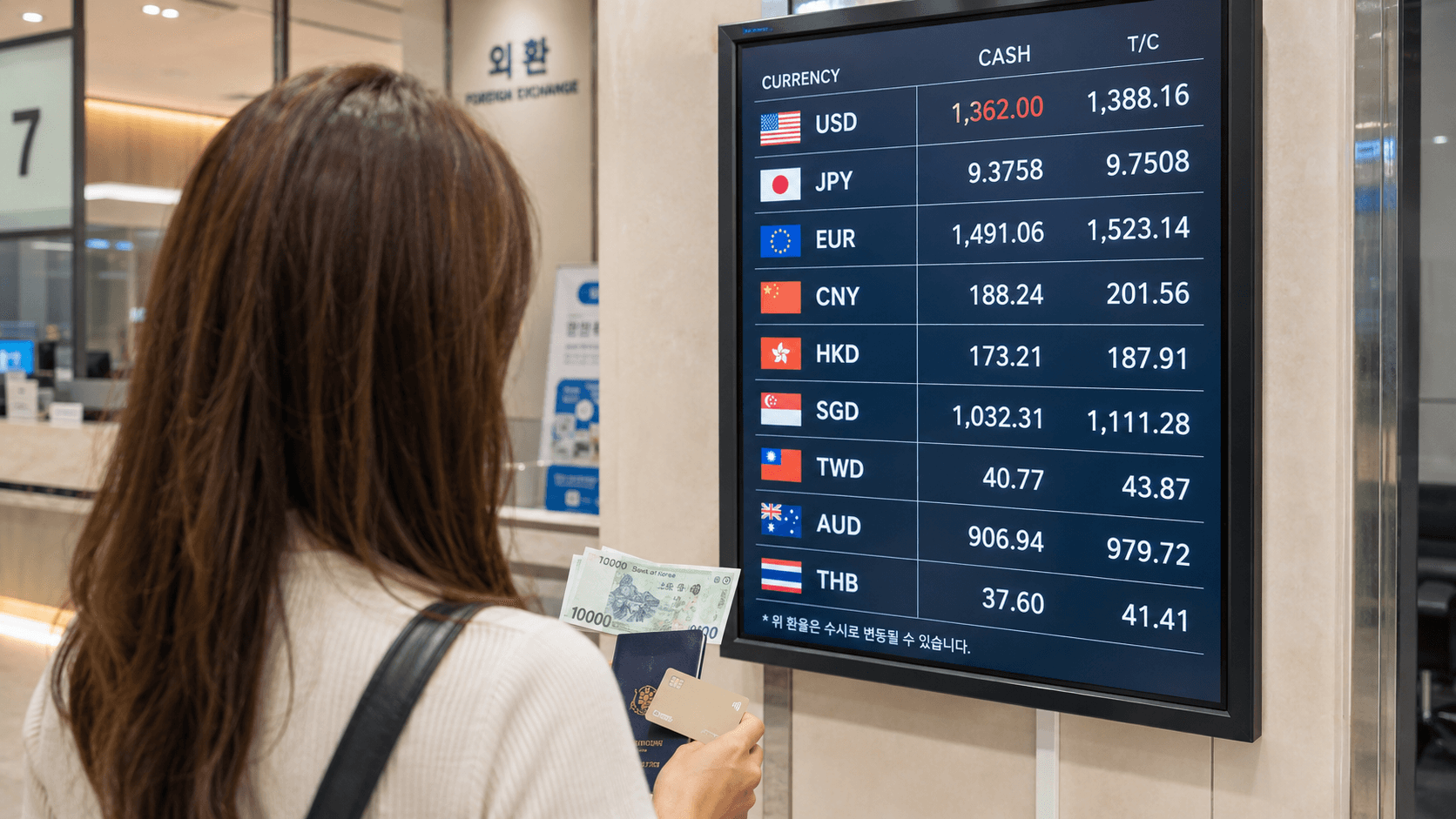
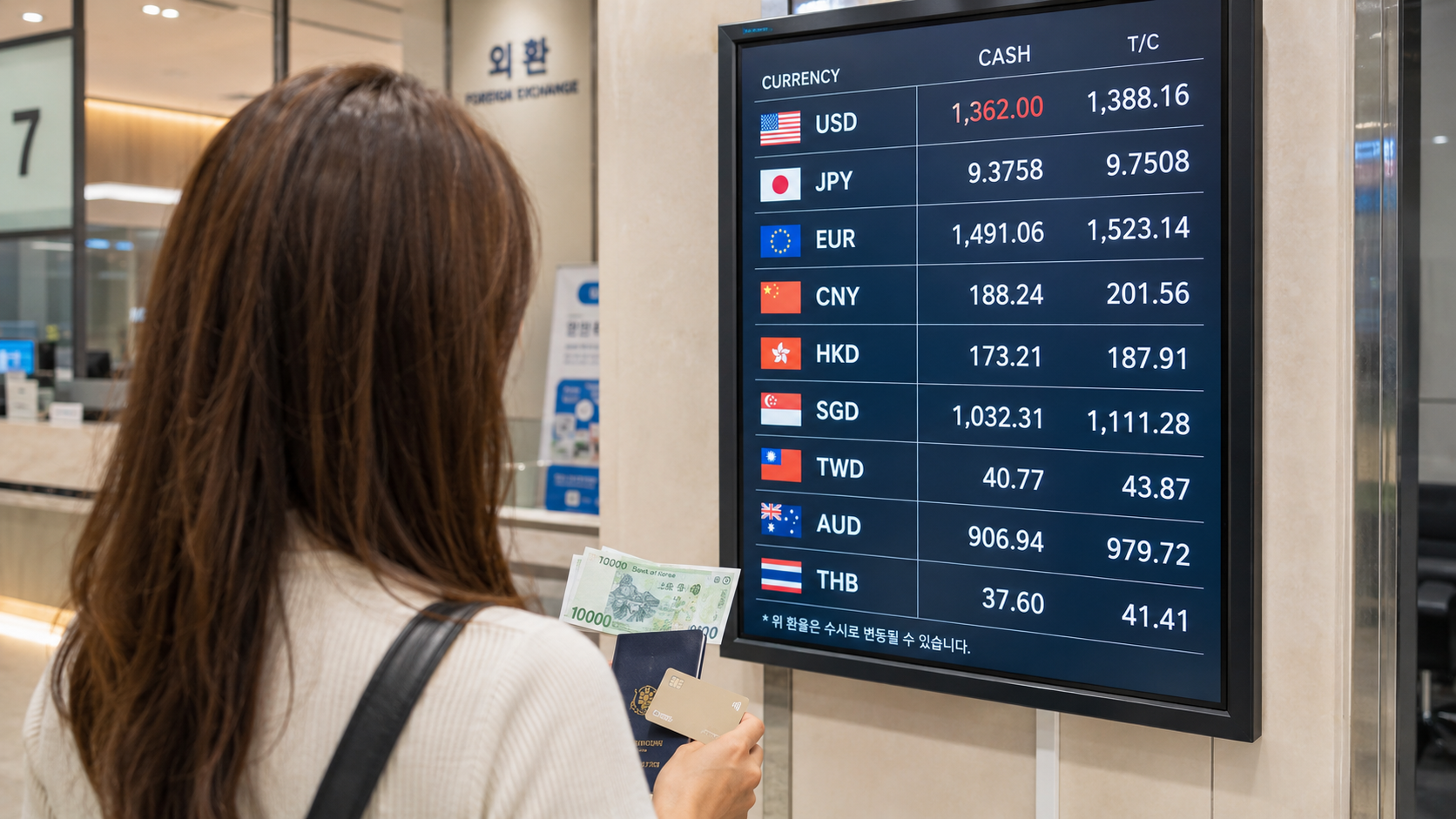
Banks publish different rates for cash, remittances, and other transactions. When selling foreign banknotes for won, look at the relevant cash rate rather than the headline market or remittance rate. For example, Woori Bank's official exchange-rate page separates cash rates from its basic and remittance rates.
Authorized private exchange offices
Private exchange offices are common in heavily visited districts, including central Seoul. They can offer competitive rates for major currencies, but rates, supported currencies, and opening hours differ by business.
Use a clearly established exchange office and check the calculation before handing over cash. Ask one direct question: “How many won will I receive for this amount, after all fees?” Compare that final figure rather than relying only on signs saying “no commission.” A service can advertise no separate commission while building its margin into the exchange rate.
Count the money at the counter and keep the receipt. Seoul's official guidance says travelers should present a passport or residence card when exchanging currency, so carry identification even if a particular office does not request it immediately.
How to use an ATM in Korea
An ATM can be the simplest option when your debit card offers a favorable international rate. Look for an ATM showing a network supported by your card and an international or “Global ATM” option. Bank branches, airports, major stations, and convenience stores are the most practical places to look.
The transaction can involve several costs:
- The Korean ATM operator's fee
- Your bank's overseas withdrawal fee
- Your bank's foreign-transaction or conversion fee
- Dynamic currency conversion, if accepted
The screen should show the local operator's fee before you confirm. Your own bank's charges may appear only later on your account.
Withdraw in Korean won. If the ATM offers to calculate and charge a guaranteed amount in your home currency, that is dynamic currency conversion, commonly shortened to DCC. Visa's official DCC guidance explains that the offered home-currency amount includes an exchange rate and may include additional fees or markup. Visa says customers must be allowed to accept or decline the conversion.
In most cases, selecting KRW lets your card network and issuer perform the conversion under their normal terms. Check your card agreement because the lower-cost choice ultimately depends on its fee structure.
If an ATM rejects your card:
- Try a bank-operated ATM rather than repeatedly using the same machine
- Check that overseas cash withdrawals are enabled
- Confirm that you are using the correct account type and PIN
- Try a smaller amount in case the machine has a transaction limit
- Contact your issuer if the card is blocked
Do not make repeated unsuccessful attempts if you are uncertain about the PIN, as the card may be locked or retained.
The currency choice at shops and hotels
A terminal may ask whether you want to pay in KRW or your home currency. Choose KRW unless you have compared the displayed conversion and deliberately prefer the merchant's offer.
Paying in dollars, euros, pounds, or another home currency does not avoid conversion. It transfers the conversion to the merchant's DCC provider, whose rate can include a markup. Check the terminal before entering your PIN or signing, and inspect the receipt for the currency symbol.
A useful phrase is:
“Korean won, please.”
한국 원화로 결제해 주세요. (Hanguk wonhwaro gyeoljehae juseyo.)
If the receipt shows your home currency without your agreement, ask the merchant to cancel and process the payment again in KRW before leaving.
Should you bring USD to exchange in Korea?
Bringing USD can make sense if you already hold clean, recent US banknotes and your home currency is difficult to exchange in Korea. It does not automatically save money. Converting your home currency into USD and then USD into KRW creates two exchange transactions and potentially two margins.
For widely traded currencies such as USD, EUR, JPY, or CNY, direct cash exchange is generally easier to find. For other currencies, verify availability with a Korean bank or exchange service before relying on cash.
Damaged, heavily marked, or older foreign notes may be refused or valued differently. Bring notes in good condition and avoid carrying more cash than necessary.
How much cash should you carry?
There is no universal amount. Use your itinerary rather than a fixed daily formula.
For a mostly urban trip with card-paid accommodation and meals, ₩100,000 to ₩200,000 may be a reasonable reserve. Increase it if you plan to visit traditional markets, rural destinations, festivals, small guesthouses, or places where transport-card top-ups require cash. This range is practical editorial guidance, not an official recommendation.
Separate the reserve between your wallet and secure luggage or a hotel safe. Avoid displaying or counting a large bundle in public.
Declaring large amounts of money
The Korea Customs Service states that travelers entering Korea with more than USD 10,000 or its equivalent in total must declare it to Customs. The calculation includes foreign currency, Korean won notes, and applicable checks.
Travelers must mark the relevant item on the traveler declaration, state the amount, submit it to Customs, and receive a certificate of foreign-currency declaration. Korea Customs warns that this certificate cannot be issued after entry procedures have been completed. Penalties may apply for failing to declare.
Rules for taking money out of Korea depend on residency, the amount, its source, and whether it was declared on arrival. Anyone carrying a large amount should review the current Korea Customs instructions or contact Customs directly. This guide is not legal or financial advice.
Common money-exchange mistakes
Exchanging the entire budget at the airport
The airport solves an immediate need, but exchanging everything there removes your ability to compare rates later. Start with a smaller amount unless you have confirmed that the airport offer is competitive.
Comparing only the headline rate
The mid-market rate shown by financial websites is a reference, not necessarily the cash rate available to a traveler. Compare the actual KRW you will receive after the exchange spread and any fees.
Accepting home-currency conversion automatically
Choose KRW at card terminals and ATMs unless you have consciously compared the DCC offer. A familiar currency display is not evidence of a lower cost.
Depending on one card
Issuer fraud controls, network problems, damaged chips, or incompatible terminals can interrupt a trip. Carry a second card and some cash separately.
Leaving with too much won
Spend remaining coins and small notes before departure, or exchange larger notes at an authorized counter. Converting won back into another currency creates another exchange spread, and coins are generally inconvenient to exchange.
Keep your original exchange receipt if possible. It can help document the source of the won, particularly when exchanging a substantial remaining amount.
What to check before you go
- Confirm your card's foreign-transaction and overseas ATM fees.
- Enable international use and record the issuer's overseas contact number.
- Check whether your card uses a four-digit or longer PIN accepted by overseas ATMs.
- Carry at least two payment methods in separate places.
- Check current airport counter locations and hours if arriving late at night.
- Confirm that an exchange office accepts your particular currency.
- Bring your passport when exchanging cash.
- Use clean, undamaged foreign banknotes.
- Choose KRW at ATMs and payment terminals.
- Declare amounts above the Korea Customs threshold.
- Check rates on the day of the transaction rather than relying on an old travel article.
FAQ
Is it better to exchange money before arriving in Korea?
Exchanging a small arrival reserve can be convenient, but compare your home bank's cash rate with Korean options. For the full trip budget, a low-fee card combined with selective ATM withdrawals or city exchange is often more flexible.
Can I travel in Korea without cash?
You can complete many urban transactions by card, but a fully cashless plan is unnecessarily fragile. Keep a modest reserve for small merchants, transport-related payments, machines, and card failures.
Do Korean taxis accept foreign cards?
Many taxis accept cards, but successful payment depends on the card, terminal, and network connection. Carry enough cash or another payment method for the fare, especially for late-night or regional travel.
Are traveler’s checks useful?
Seoul's official currency page notes that traveler’s checks can be exchanged at some banks or exchange offices but are rarely used in Korea. Cards and cash are generally more practical, and travelers should confirm acceptance before bringing checks.
Where can I find today's exchange rate?
Use an official Korean bank's current cash-rate page and compare the column applying to foreign banknotes being sold for won. Do not confuse it with the remittance rate or basic reference rate. The amount offered at a specific airport or private counter can still differ.
Sources
- Bank of Korea: Currency in Circulation
- Korea Customs Service: Declaration of Foreign Currency
- Incheon International Airport: Finance and Currency Exchange Facilities
- Seoul Metropolitan Government: Currency Exchange
- Woori Bank: Foreign Exchange Rates
- Visa: Dynamic Currency Conversion Explained
Before leaving for Korea, check your card fees and compare the current cash rate from an official Korean bank. That single comparison will tell you whether to rely mainly on your card, an ATM, or a cash exchange counter.