Cherry blossom season in South Korea generally moves north from Jeju and the southern coast toward Seoul and the colder inland and mountain regions. For trip planning, late March through mid-April is the most useful overall window, but the exact timing changes every year. Warm weather can bring flowering forward, while rain and strong wind can quickly shorten peak viewing.
Information in this guide was verified on June 11, 2026. The 2026 blossom season has ended, so travelers planning a future spring trip should treat the dates below as planning ranges, not a forecast.
Quick answer
- Best general travel window: The last week of March through the second week of April.
- Southern Korea: Usually earlier, often from late March.
- Seoul and central Korea: Commonly around late March to early or mid-April.
- Northern and higher-altitude areas: Often later, extending into mid-April or beyond.
- How long peak blossoms last: Often only several days at one location, depending on temperature, rain, and wind.
- Best strategy: Stay flexible and check current blossom photographs and local weather immediately before traveling.
Korea's cherry blossom season is not a single nationwide event. Trees in Jeju, Busan, Jinhae, Gyeongju, Seoul, and Gangwon Province do not normally reach full bloom at the same time.
Understanding bloom dates
Korean forecasts and news reports commonly distinguish between first flowering and full bloom. First flowering means that blossoms have begun to open on an observed tree. It does not mean that an entire park or street is already covered in flowers.
Full bloom generally follows several days later, but the interval depends on the weather. A warm spell can accelerate the process. Cold conditions can slow it, and heavy spring rain can remove petals from trees that have already peaked.
The Korea Meteorological Administration, known as KMA or Gisangcheong (기상청), operates a spring flower observation page with dated photographs from selected locations. This is more useful close to your trip than a forecast published weeks earlier. The page is primarily in Korean, but browser translation can help.
For short-range rain, wind, temperature, and air-quality planning, use the KMA English weather service. Check the forecast again the evening before a blossom-viewing day.
Typical regional progression
The following periods are broad planning ranges based on Korea's usual south-to-north spring pattern. They are not confirmed dates for any future year.
| Area | Practical planning range | Examples |
|---|---|---|
| Jeju Island | Late March to early April | Jeju City, Jeonnong-ro, Hallim area |
| Southern coast | Late March to early April | Busan, Jinhae, Hadong |
| Southeastern inland | Late March to early April | Gyeongju, Daegu |
| Central Korea | Late March to mid-April | Daejeon, Cheongju, Suwon |
| Seoul and Incheon | Early to mid-April, with annual variation | Yeouido, Seokchon Lake, Seoul Forest |
| Gangwon and colder highlands | Mid-April or later | Chuncheon and higher-elevation areas |
Do not build an expensive trip around one predicted day. A better approach is to reserve several nights in a well-connected city and keep two or three possible viewing locations available.
Where to see cherry blossoms
Seoul: easiest for first-time visitors
Seoul has numerous blossom areas connected by subway, making it the simplest choice if flowers are only one part of your trip.
Yeouiseo-ro and the National Assembly area
The road behind the National Assembly in Yeouido is one of Seoul's most recognized blossom routes. During major spring events, nearby roads may be closed or pedestrian access may be controlled. National Assembly Station and Yeouinaru Station can become extremely busy.
Visit early on a weekday if possible. Yeouinaru Station is convenient for the Han River, but National Assembly Station may provide more direct access to the main tree-lined road depending on temporary closures.
Seokchon Lake
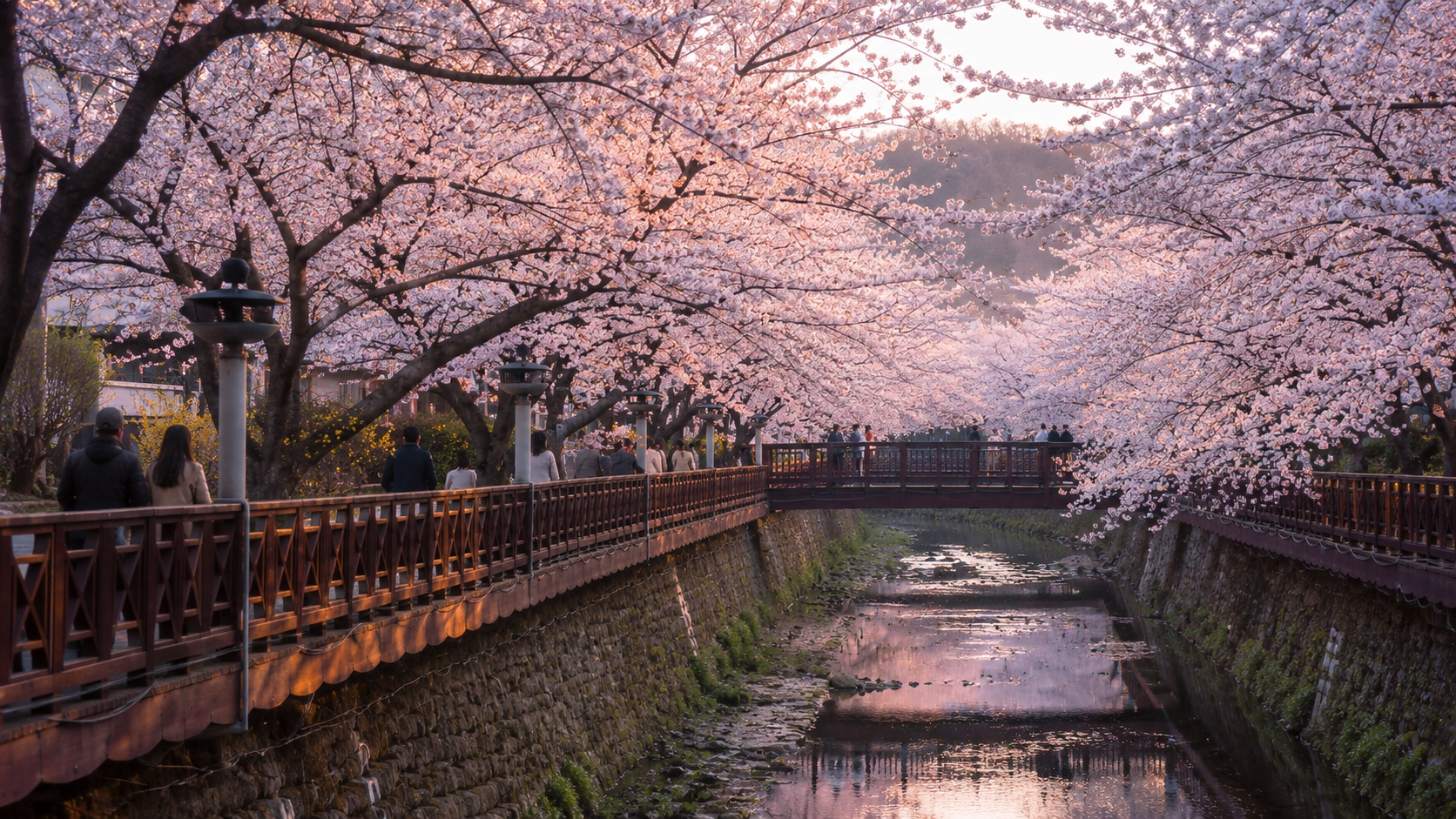
The walking path around Seokchon Lake combines blossoms with views of Lotte World Tower and the amusement park. Jamsil Station is the main subway access point. The path is relatively straightforward, but crowd density can make a complete circuit slow during peak weekends.
Seoul Forest
Seoul Forest offers lawns, paths, and several types of spring flowers rather than one continuous tunnel of cherry trees. It is a practical choice for travelers who want more space or want to combine blossom viewing with cafés in nearby Seongsu-dong.
Royal palaces and urban parks
Several palaces and parks contain flowering trees, but visitors should not expect every historic site to have large cherry-tree avenues. Palace opening days, admission rules, and special evening programs can change, so confirm them through the relevant palace or official Seoul city information before visiting.

Jinhae: Korea's largest blossom-focused destination
Jinhae-gu, now part of Changwon, is closely associated with the Jinhae Gunhangje (진해군항제), or Jinhae Naval Port Festival. Its major viewing areas include Yeojwacheon Stream and the former Gyeonghwa Station railway area.
Jinhae provides a more concentrated blossom experience than Seoul, but it also requires more planning. The district does not have regular KTX high-speed rail service. Travelers generally reach the Changwon area by train or use intercity buses, followed by local transport into Jinhae. Festival traffic can significantly increase travel times.
Gyeonghwa Station is no longer a normal passenger station, so do not search for a direct passenger train to the blossom site. During the festival period, temporary transport and traffic arrangements may operate. Confirm current details through the Changwon city website and official festival announcements.
If visiting as a day trip from Busan, leave early and avoid scheduling a fixed evening connection immediately afterward. Bus queues and road congestion can make the return unpredictable.
Gyeongju: blossoms with historic sites
Gyeongju works well for travelers who want spring scenery without making blossoms the only purpose of the trip. Common routes include the Bomun Lake area and roads or paths near central historic attractions.
The city's Silla-era tombs, observatory, museums, and temples provide alternatives if the blossoms are early, late, or damaged by rain. This makes Gyeongju a lower-risk choice than a trip focused entirely on one blossom street.
Singyeongju Station has been renamed Gyeongju Station and is located outside the historic center. Allow time for a city bus or taxi after arriving by high-speed train. Confirm train times and availability through Korail's official booking website.
Busan: coastal neighborhoods and city parks
Busan normally blooms earlier than Seoul, although conditions vary by neighborhood and elevation. Popular possibilities include Dalmaji-gil near Haeundae, Samnak Ecological Park, and roads around Oncheoncheon Stream.
Busan's blossom sites are spread across a large city. Check the Korean map location carefully before leaving; two attractions that appear to be in central Busan can require a long subway or bus journey between them.
Jeju Island: an early start to the season
Jeju is generally among the earliest major blossom destinations in South Korea. Jeju's large-flowered native king cherry trees are often promoted locally as wangbeotkkot (왕벚꽃).
Jeonnong-ro in Jeju City is a well-known urban viewing street. Festival dates and road controls vary annually. Renting a car can help with island travel, but parking near popular blossom streets may be difficult. Public buses or taxis are often more practical for central Jeju City locations.
Do not assume that blossoms will be open everywhere on the island simultaneously. Coastal areas, Jeju City, Seogwipo, and roads at higher elevations can have different conditions.
Quieter alternatives
Visitors who want fewer crowds should look beyond nationally advertised festivals. University campuses, apartment neighborhoods, riverside cycling paths, reservoirs, and smaller municipal parks often have substantial plantings.
Useful Korean search terms include:
- 벚꽃 명소: cherry blossom attraction or viewing spot
- 벚꽃 개화현황: current cherry blossom flowering status
- 벚꽃 만개: cherry blossoms in full bloom
- 봄꽃축제: spring flower festival
- 교통통제: traffic control or road closure
Search these terms with the city or district name in a Korean map application. Recent dated photographs are usually more useful than old travel articles.
How to plan around uncertain timing
Book a window, not a single blossom day
For a Seoul-based trip, three to five nights give you a better chance of finding good conditions than a one-night stop. Keep one clear-weather morning uncommitted until the short-range forecast is available.
If blossoms appear earlier than expected, consider moving north or to a higher elevation. If they are late, southern cities may already have finished, so focus on Seoul, the central region, or Gangwon Province.
Use refundable reservations where practical
Flexible accommodation is valuable during spring because reliable blossom information becomes available relatively close to flowering. Check cancellation deadlines carefully; a listing marked refundable may still become non-refundable several days before arrival.
Transport tickets can sell quickly around major festivals and weekends. Use official booking platforms, and verify the station name as well as the city. Gyeongju Station, Changwon Jungang Station, Changwon Station, and Masan Station serve different locations.
Check three things before leaving
- Look for current, dated photographs from the exact park or street.
- Check the KMA forecast for rain and wind, not temperature alone.
- Check the city or district website for closures, festival programs, and temporary transport.
A forecast saying that Seoul is in full bloom does not guarantee identical conditions at every park. Sun exposure, tree variety, elevation, and local temperature all matter.
Crowds, timing, and photography
Peak weekend afternoons are the busiest periods at famous locations. For easier walking and clearer photographs, arrive shortly after sunrise or before the commuter rush. Some illuminated sites can also be pleasant after dinner, but expect crowded paths and strong artificial lighting.
Use designated paths and avoid shaking branches or climbing onto walls. At lakes and streams, do not stop suddenly in the middle of narrow walking routes to take photographs. Move to the side and keep bicycle lanes clear.
A phone camera usually handles pale blossoms better if you reduce exposure slightly. Overcast weather can produce softer detail, while bright midday sun may make white petals appear featureless.
What to wear and bring
Spring weather in Korea can change substantially between morning and afternoon. Coastal cities may feel windy, while Seoul can be cold after sunset even following a mild day.
Bring:
- A light jacket or packable insulated layer
- Comfortable shoes for long walks and standing in crowds
- A compact umbrella or waterproof outer layer
- Water and a small waste bag, especially in parks with limited bins
- A charged phone and portable battery
- A transit card for local buses and subways
- A mask if you are sensitive to pollen, fine dust, or Asian dust
Check official air-quality information through AirKorea on the day of your visit. Cherry blossom season overlaps with periods when fine dust or Asian dust may affect visibility and outdoor comfort.
Accessibility and traveling with luggage
Major urban parks are generally easier to navigate than hillside temples or mountain roads, but temporary festival stalls and dense crowds can reduce the usable width of paths. Seokchon Lake and parts of Yeouido are mostly level, while Jinhae viewing routes may involve bridges, steps, or crowded roadside sections.
Travel with the smallest possible bag. Large suitcases are difficult to manage on festival shuttle buses and packed local transport. Use station lockers or accommodation luggage storage before visiting a blossom area, but remember that lockers at major stations may fill early.
Travelers using wheelchairs or strollers should check the precise entrance and route rather than relying only on the attraction's general accessibility description. Construction and temporary event barriers can change circulation each year.
Common mistakes
- Treating forecast dates as guaranteed: Long-range blossom predictions can shift.
- Confusing first flowering with full bloom: A city may be reported as blooming while most trees still look sparse.
- Visiting only at midday on a weekend: This usually means the largest crowds and harshest light.
- Booking Jinhae without checking transport: Jinhae is not directly served by regular high-speed trains.
- Following an old festival schedule: Dates, road closures, and programs change annually.
- Ignoring rain and wind: A storm near peak bloom can shorten the viewing period dramatically.
- Assuming every pink tree is a cherry tree: Plum, apricot, peach, and other spring flowers may bloom at similar times.
What to check before you go
- Confirm the latest blossom photographs for the exact location.
- Check the KMA short-range forecast for rain, wind, and temperature.
- Check AirKorea for fine-dust conditions.
- Confirm festival dates through the relevant city or district government.
- Check road closures and the last practical bus or train connection.
- Reserve intercity transport early for peak weekends.
- Verify whether evening lighting operates on your chosen date.
- Carry a backup destination in case the trees are early, late, or damaged by weather.
Your next practical step is to choose one flexible regional base, such as Seoul, Busan, or Gyeongju, and begin checking official bloom photographs approximately one to two weeks before departure.
Sources
- Korea Meteorological Administration spring flower observations
- Korea Meteorological Administration English weather service
- VISITKOREA official travel information
- Changwon Special City official website
- Seoul Metropolitan Government English website
- Korail official booking website
- AirKorea official air-quality service