South Korea uses the Korean won (KRW), shown as ₩. International cards are widely accepted, but visitors should still carry some won for transport-card top-ups, traditional markets, small businesses, and situations where a foreign card does not work. A practical approach is to arrive with at least one internationally enabled card, obtain a modest amount of cash at the airport, and compare rates before exchanging larger amounts.
Information on exchange locations, operating hours, and declaration rules was verified on June 9, 2026. Exchange rates change throughout the day, so this guide does not quote a fixed rate.
Quick answer
- Currency: Korean won, abbreviated KRW and written ₩.
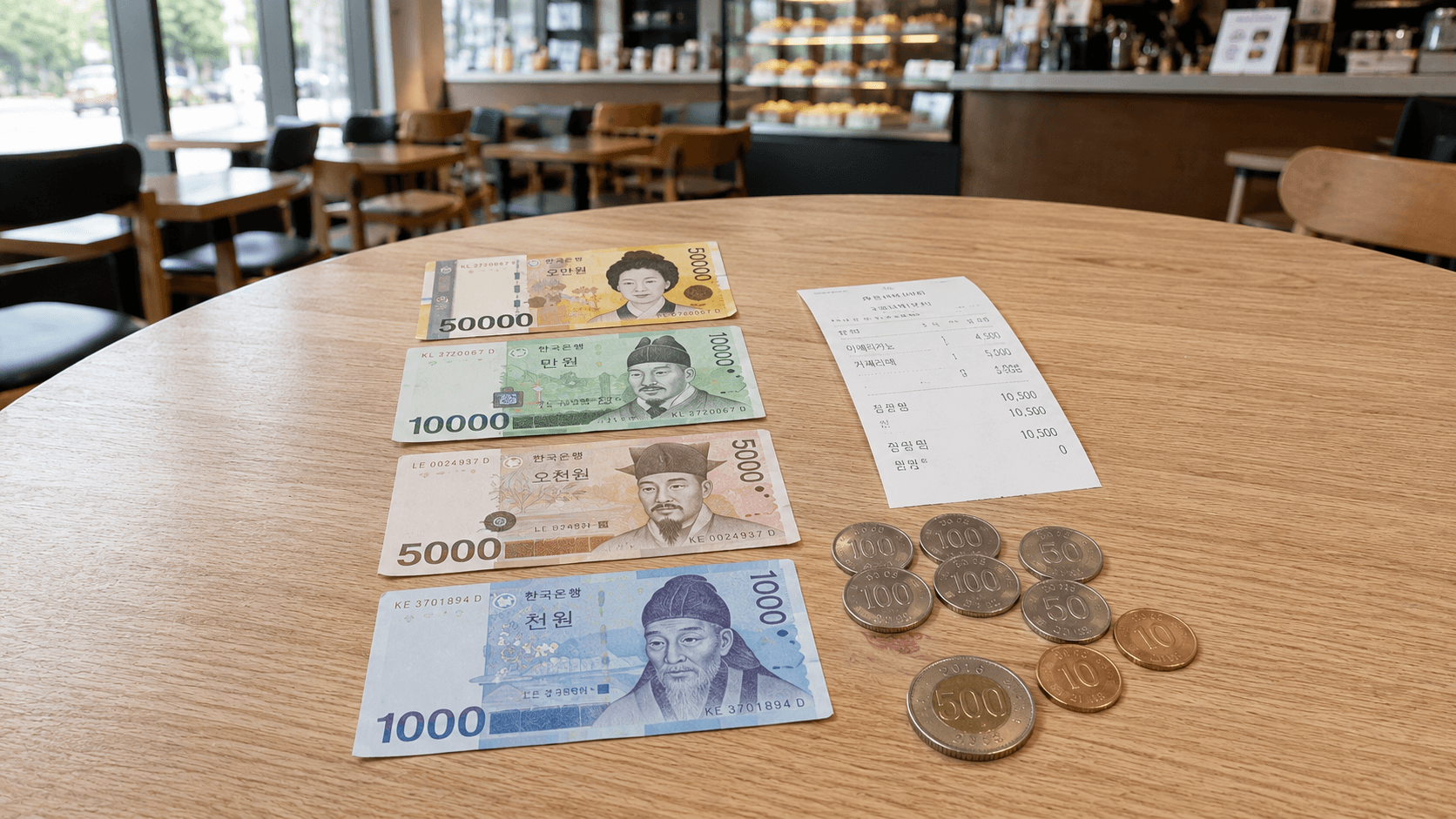
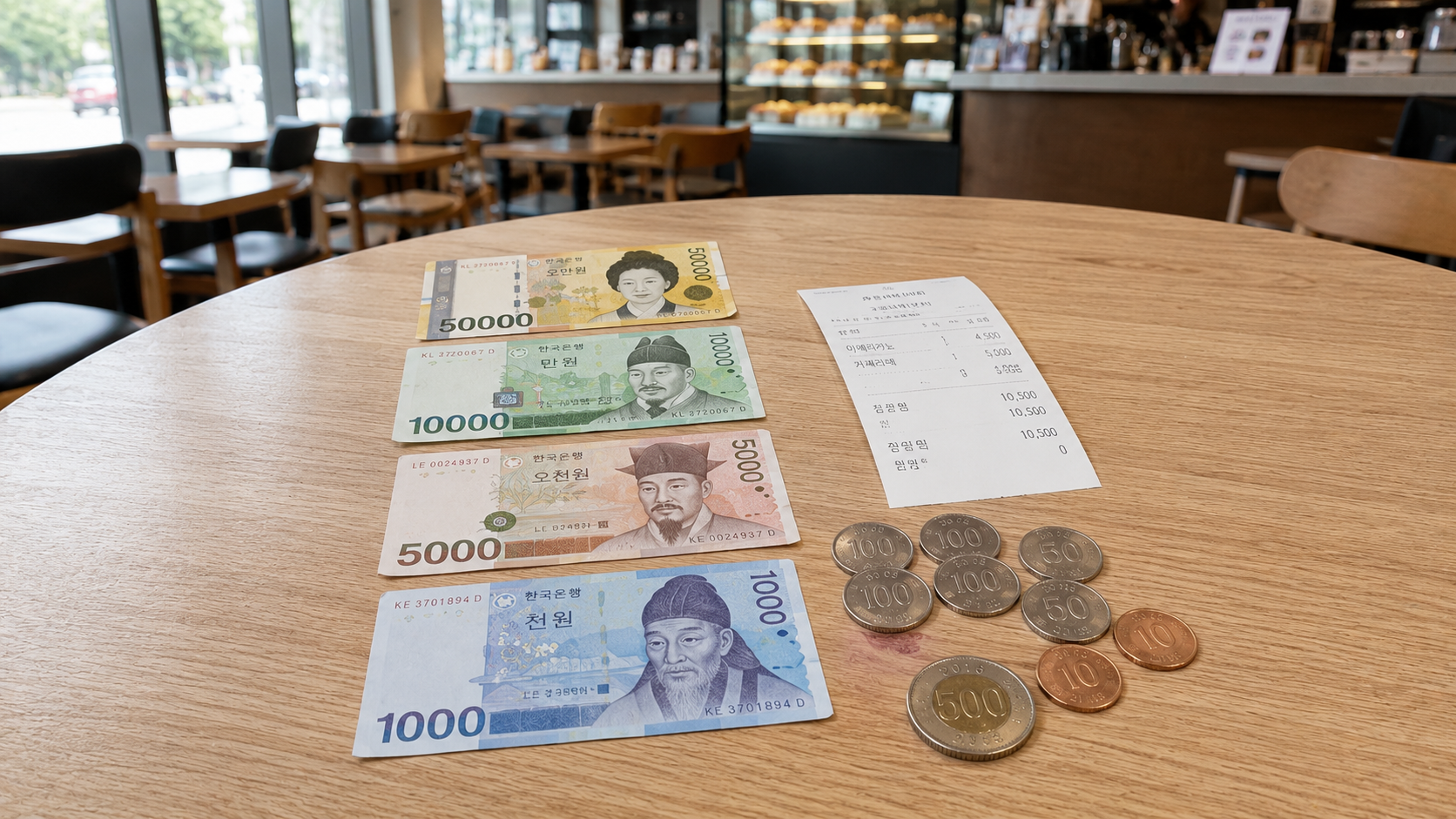
- Banknotes: ₩1,000, ₩5,000, ₩10,000, and ₩50,000.
- Coins: ₩10, ₩50, ₩100, and ₩500.
- Where to exchange: Airport bank counters, ordinary bank branches, and authorized private exchange offices.
- What to bring: Your passport; a Korean residence card may also be accepted for residents.
- Cards: Widely accepted, but acceptance of any particular foreign card is not guaranteed.
- ATMs: Use a machine displaying your card network, check all displayed fees, and withdraw in KRW.
- Cash declaration: Amounts exceeding the equivalent of USD 10,000 in total must be declared when entering Korea.
Understanding Korean won
Korean prices are normally written without decimal places. A café drink might be ₩5,000, while a restaurant bill might be ₩25,000. On signs and payment terminals, you may see ₩, KRW, or the Korean word won (원).
The Korea Tourism Organization’s currency guide confirms the four banknote and four coin denominations currently in ordinary circulation. The ₩10 and ₩50 coins exist but are less useful for most travelers than ₩100 and ₩500 coins.
Do not mistake a ₩50,000 note for a ₩5,000 note. Both contain the number 5, but their colors, size, and number of zeros differ. Count the zeros before handing over cash.
Where to exchange money in Korea
Airport exchange counters
Airport counters are the simplest option immediately after arrival. They are useful when you need won for transportation, food, or a transport card before reaching your accommodation.
Incheon International Airport has bank branches and exchange counters operated by KB Kookmin Bank, Hana Bank, and Woori Bank. According to the airport’s current facilities directory, some counters operate 24 hours, while others generally operate from 06:00 to 22:00. Locations and hours differ between Terminal 1, Terminal 2, the public areas, and the secure areas.
Examples verified on June 9, 2026 include:
| Terminal | Example location | Listed hours |
|---|---|---|
| Incheon Terminal 1 | KB exchange counter near Arrival Hall B, 1F | 24 hours |
| Incheon Terminal 1 | Woori exchange counter near Exit 6, 1F | 24 hours |
| Incheon Terminal 2 | Woori exchange counter near Exit 7, 1F | 24 hours |
| Incheon Terminal 2 | Hana exchange counter near Exit 10, 1F | 06:00–22:00 |
These are examples, not a complete list. Search the airport directory for “currency exchange” shortly before your flight because individual counters can change hours or location.
Airport exchange rates may be less favorable than rates available elsewhere. Rather than exchanging your entire budget automatically, consider exchanging only enough for your first day and comparing the amount offered at another authorized provider later. This is a practical suggestion, not a guarantee that a city counter will always be cheaper.
At Gimpo International Airport, exchange facilities are more limited. The Korea Tourism Organization’s airport banking guide, last updated August 21, 2025, lists a Shinhan Bank branch operating from 09:00 to 16:00 on weekdays and closed on weekends and public holidays. Because this page may not reflect same-day changes, check the official Gimpo Airport website before relying on it.
Bank branches
Banks are a dependable choice for established procedures and clearly displayed rates. The Korea Tourism Organization states that Korean banks are generally open from 09:00 to 16:00 on weekdays, although hours vary by institution and branch.
Bring your passport. Seoul Metropolitan Government’s currency exchange information states that customers must present a passport or residence card when exchanging currency.
Not every branch handles every currency. USD, JPY, EUR, and CNY are generally easier to exchange than less commonly traded currencies, but availability must be confirmed with the individual bank. Old, damaged, marked, or heavily worn foreign notes may be refused.
Authorized private exchange offices
Authorized exchange offices are common in visitor districts such as Myeong-dong, Namdaemun, Dongdaemun, and Itaewon in Seoul. Other major cities also have exchange offices near transport hubs and shopping areas.
Private offices can offer convenient hours and competitive rates, but compare the final amount rather than relying on signs saying “no commission.” A provider can incorporate its margin into the exchange rate even when no separate fee is listed.
Use an established, authorized counter and obtain a receipt. Incheon Airport specifically warns travelers to use authorized exchange services or bank counters rather than unofficial operators.
Hotels and department stores
Some hotels and large commercial facilities may exchange major currencies, but the service is not universal. Rates, eligible currencies, transaction limits, and operating hours vary. Ask for the exact amount of KRW you will receive before completing the transaction.
How to compare exchange rates
The rate shown in a news report or currency-converter app is usually a market reference rate. It is not necessarily the cash rate that a bank or exchange office will give you.
When converting foreign cash into won, look for the rate under which the institution buys foreign currency. Korean bank rate tables may label this as “cash buying,” “foreign currency buying,” or similar wording. The reverse rate applies when you use won to purchase foreign currency.
For a meaningful comparison:
- Ask how many won you will receive for a specific amount, such as USD 100.
- Confirm whether commission or service fees will be deducted.
- Compare the final KRW amount at two or more providers.
- Count the cash before leaving the counter.
- Keep the receipt, especially if you may convert unused won later.
Official bank tables show that cash-buying and cash-selling rates differ from the basic rate. For example, the KB Kookmin Bank exchange-rate table separates its basic, remittance, and cash rates. Use the live table only as a reference because rates can update repeatedly during a business day.
Using international cards
Visa, Mastercard, American Express, and other international cards are accepted at many Korean hotels, shops, restaurants, and tourist sites, according to the Korea Tourism Organization. Acceptance still depends on the merchant, terminal, card issuer, and fraud controls.
Before departure:
- Confirm that overseas purchases and cash withdrawals are enabled.
- Check your issuer’s foreign-transaction and ATM fees.
- Carry a second card from a different network or issuer.
- Know how to contact your issuer if a transaction is blocked.
- Use a physical card if a foreign mobile wallet is not accepted.
Korean payment terminals may request a signature, PIN, or no additional verification. A declined transaction does not necessarily mean the merchant refuses foreign cards; the issuer may have blocked it. Try your backup card or pay in cash rather than repeatedly submitting the same transaction.
Always check the transaction currency
A shop or ATM may offer to convert the payment into your home currency. This is called dynamic currency conversion, or DCC. The displayed home-currency amount may feel convenient, but it includes the provider’s conversion rate and potentially an additional markup.
Visa’s official DCC guidance says merchants and ATMs should show the local and cardholder-currency amounts, the conversion rate, and applicable fees, while allowing the cardholder to accept or decline conversion.
For most travelers, the practical default is to select KRW, Korean won, or continue without conversion. Your card issuer will then perform the conversion under its own terms. Compare your issuer’s fees before travel because choosing KRW does not eliminate a foreign-transaction fee charged by your bank.
Withdrawing won from an ATM
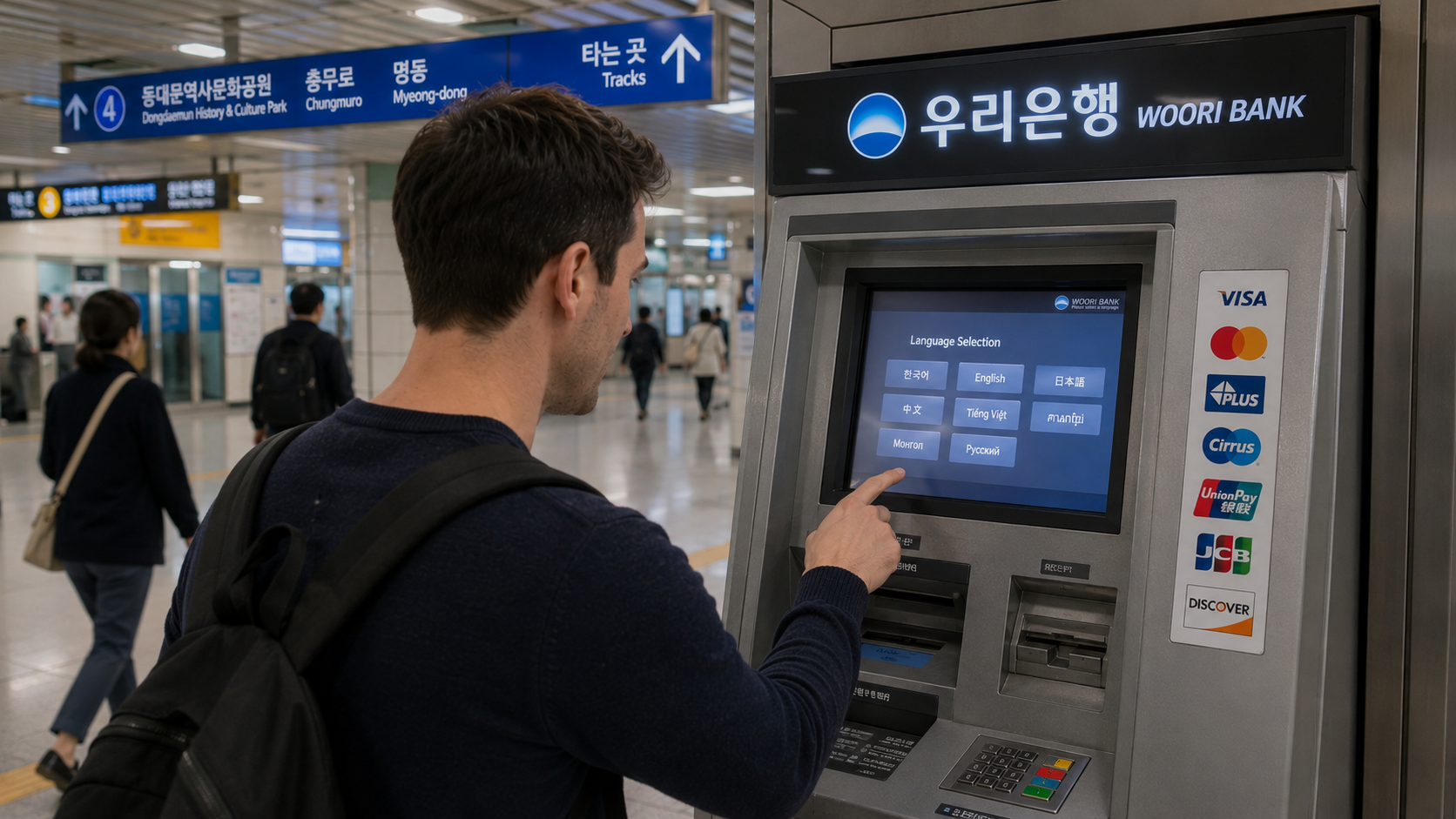
ATMs are available at airports, banks, convenience stores, subway stations, and shopping areas. However, not every machine accepts every foreign card.
Use this process:
- Look for your network logo, such as Visa, Plus, Mastercard, Cirrus, or UnionPay.
- Select the foreign-card or international-card option if one appears.
- Choose withdrawal and enter the amount in KRW.
- Review the Korean ATM fee shown on screen.
- Decline home-currency conversion if you prefer your issuer to convert the transaction.
- Take your card, cash, and receipt before leaving.
A withdrawal can involve separate charges from the Korean ATM operator and your home bank. Your issuer may also treat the transaction as a cash advance if you use a credit card. Check these costs before relying on frequent small withdrawals.
Withdrawal limits differ by ATM, Korean operator, card issuer, and account. If a large withdrawal fails, try a smaller amount, but avoid making repeated attempts without checking whether each transaction carries a fixed fee.
How much cash should you carry?
There is no single correct amount. Card-focused travelers may need only a modest cash reserve, while visitors using traditional markets, rural buses, small guesthouses, or cash-only services may need more.
A reasonable method is to carry enough cash for one day of essential expenses and keep a separate emergency amount. Avoid carrying your entire travel budget in one wallet. This is practical risk-management advice, not an official requirement.
Remember that some transport-card purchases or top-ups may require Korean cash or a Korean-issued card, depending on the card and machine. Check the current rules for your chosen transport card rather than assuming that an overseas card will work.
Bringing large amounts of cash into Korea
The Korea Customs Service states that travelers entering Korea with foreign currency, Korean won notes, or checks exceeding the equivalent of USD 10,000 in total must declare them to Customs. Amounts not exceeding USD 10,000 do not require a foreign-currency declaration.
The threshold concerns the combined value, not USD notes alone. Travelers who must declare should mark the relevant item on the traveler declaration and submit it to a Customs officer. Keep the certificate issued by Customs; it may be needed to explain the source of funds or take remaining money out of Korea.
Rules for carrying money out of Korea depend on residency, the source of the funds, and the type of transaction. Do not rely on a general travel article for a large transfer, salary withdrawal, property payment, or business transaction. Contact Korea Customs Service or a licensed foreign-exchange bank for guidance applying to your circumstances.
Common mistakes to avoid
- Exchanging everything at the first counter: Obtain enough for immediate needs, then compare final KRW amounts.
- Comparing only the advertised rate: Ask about fees and the exact amount you will receive.
- Choosing home-currency billing automatically: Read the DCC screen and select KRW when that matches your preferred conversion method.
- Bringing damaged notes: Banks and exchange offices may reject old, torn, written-on, or heavily worn currency.
- Arriving without identification: Carry your passport when exchanging cash.
- Depending on one card: Issuer security controls or terminal compatibility can cause unexpected declines.
- Using an unofficial exchanger: Use authorized counters or bank branches and request a receipt.
- Forgetting departure timing: Bank branches commonly close on weekends and public holidays, although selected airport counters remain open.
What to check before you go
- Ask your bank about overseas purchase, ATM, cash-advance, and foreign-transaction fees.
- Enable international transactions and confirm your contact details.
- Check the live KRW reference rate and at least one Korean bank’s cash-buying rate.
- Inspect foreign notes for tears, writing, stains, or outdated designs.
- Confirm your arrival terminal and current airport-counter hours.
- Carry a backup payment card separately from your main wallet.
- Declare cash and monetary instruments exceeding the equivalent of USD 10,000 when entering Korea.
- Keep exchange and ATM receipts until you have reviewed the transactions.
For your arrival, check the live Incheon Airport facilities directory, note a counter in your terminal, and obtain only the amount of won you expect to need before reaching your accommodation.
Sources
- Korea Tourism Organization: Korean Currency and Exchange Information
- Korea Tourism Organization: Foreign Exchange Banks in Airports
- Incheon International Airport: Convenience and Public Facilities
- Korea Customs Service: Declaration of Foreign Currency
- Seoul Metropolitan Government: Currency Exchange
- Visa: Dynamic Currency Conversion Explained