You can travel around South Korea mainly using credit or debit cards, especially in cities. Cards are accepted at most hotels, restaurants, cafés, convenience stores, attractions, and larger shops. However, Korea is not completely cashless: keep some Korean won (KRW) for transportation cards, small vendors, traditional markets, and situations in which a foreign card does not work.
Payment and transportation information in this guide was verified on June 9, 2026.
Quick answer
| Question | Practical answer |
|---|---|
| Can I rely mainly on cards? | Yes, particularly in Seoul, Busan, and other cities. |
| How much cash should I carry? | KRW 50,000-100,000 is a reasonable starting amount for most short visits. This is a practical suggestion, not an official requirement. |
| Do foreign Visa and Mastercard cards work? | They are widely accepted, but no individual card is guaranteed to work everywhere. |
| Do I need cash for public transportation? | Often yes. Standard Tmoney cards generally require cash for purchase and top-up, although Seoul now has limited foreign-card options for specific tickets and passes. |
| Can I withdraw won after arrival? | Yes, but use an ATM that displays an international card network supported by your card. Fees and withdrawal limits vary. |
| Should I bring foreign banknotes? | They can be exchanged, but withdrawing KRW or exchanging a modest amount is usually more practical than carrying a large sum. |
Cards are accepted in most everyday businesses
The Seoul Metropolitan Government's currency guide states that credit cards can be used in most stores, restaurants, hotels, and tourist destinations nationwide, including for small payments. Visa, Mastercard, and American Express are among the networks commonly accepted.
For most visitors, that means you can normally use a card for:
- Hotels and guesthouses that accept card payments
- Department stores, shopping malls, and chain retailers
- Convenience stores
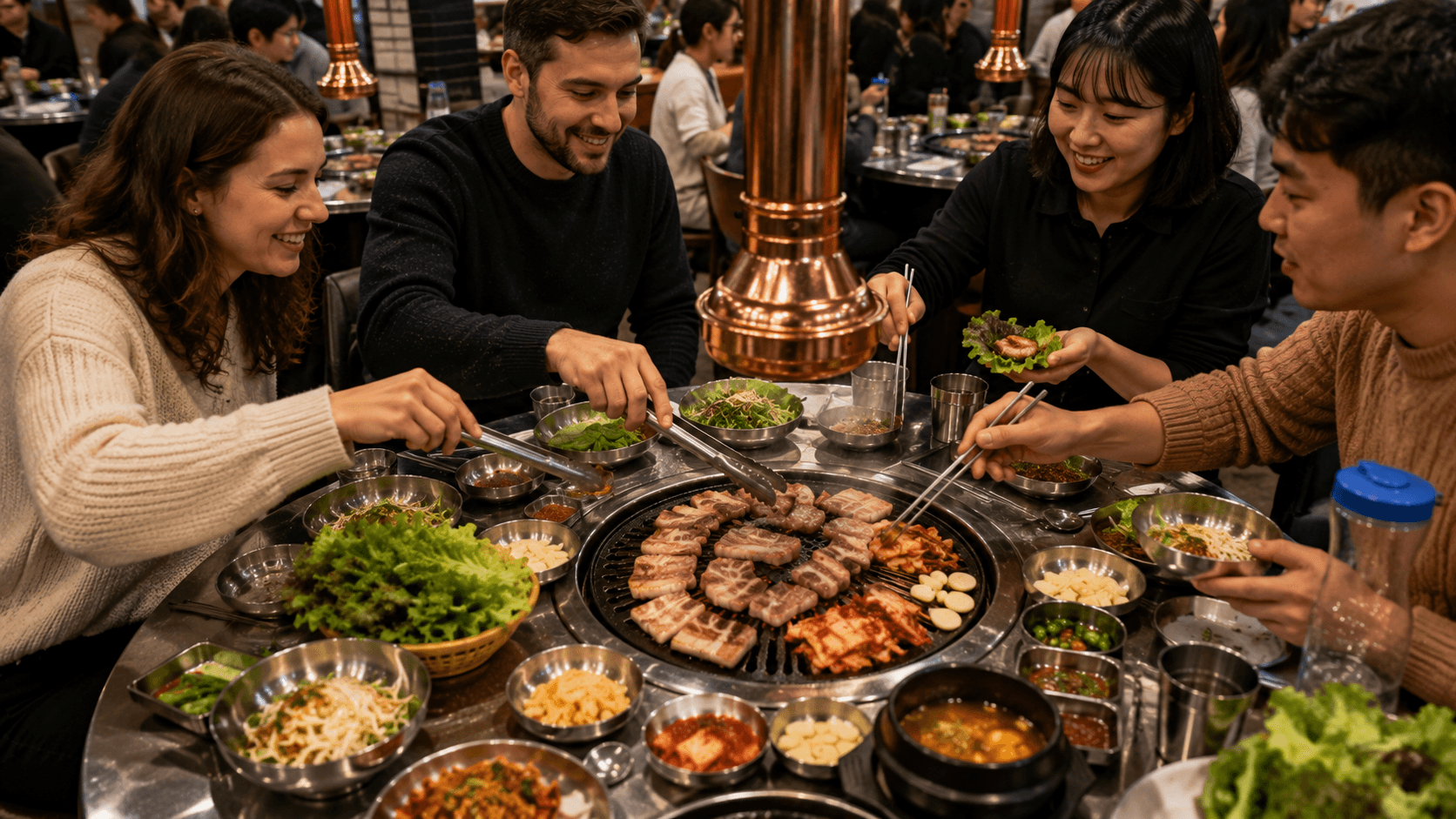
- Restaurants, cafés, and bakeries
- Museums and major visitor attractions
- Pharmacies and supermarkets
- Taxis with functioning card terminals
- KTX and other major train tickets
- Express and intercity bus tickets purchased at supported machines or counters
The Korea Tourism Organization's transportation payment guide, current in May 2026, confirms foreign-issued card acceptance for services including major railway tickets, many express and intercity bus ticket machines, taxis, and car-rental payments.
Nevertheless, bring at least two payment cards if possible. A card may be declined because of your bank's security controls, an unsupported network, a temporary communications problem, or a merchant terminal that handles foreign cards poorly. Store the backup separately from your main wallet.
Chip, PIN, signature, and contactless payment
Physical cards with an activated chip are the safest option. Some terminals support contactless cards and mobile wallets, but availability is not uniform enough for a visitor to depend exclusively on tapping a phone or watch.
You may occasionally be asked to sign a receipt. A terminal can also request a PIN, particularly at an unattended machine. Confirm your PIN and overseas-use settings before departure, and tell your bank that you will be traveling if it recommends doing so.
Where cash is still useful
Cash acceptance varies by individual business, so there is no complete official list of cash-only locations. In practice, Korean won is worth carrying for the following situations.
Standard transportation cards
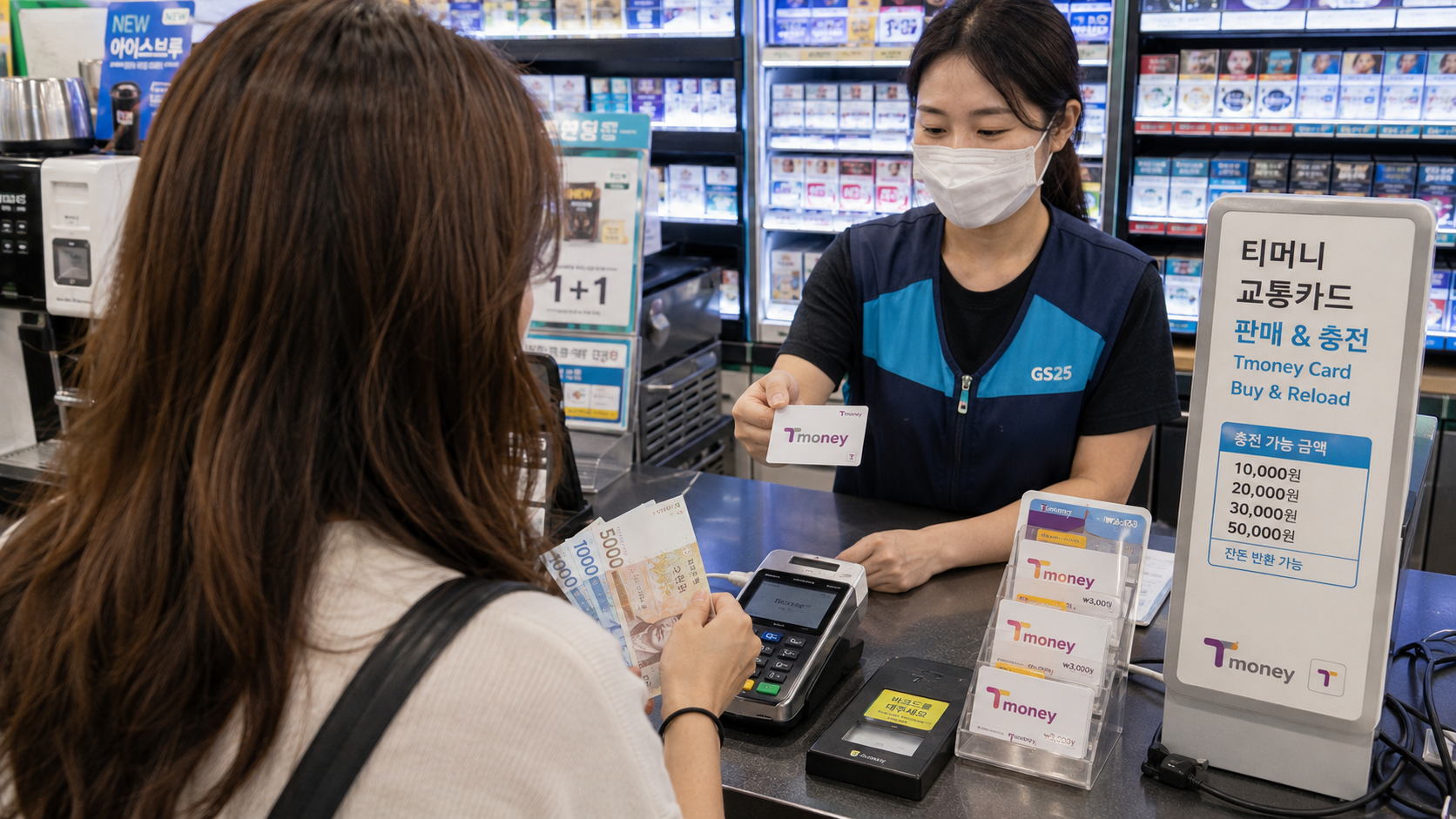
A prepaid transportation card such as Tmoney or EZL is the usual way to pay for local buses and subways. You tap when entering and, where required, again when leaving. Using a transportation card also allows the system to calculate eligible transfer discounts.
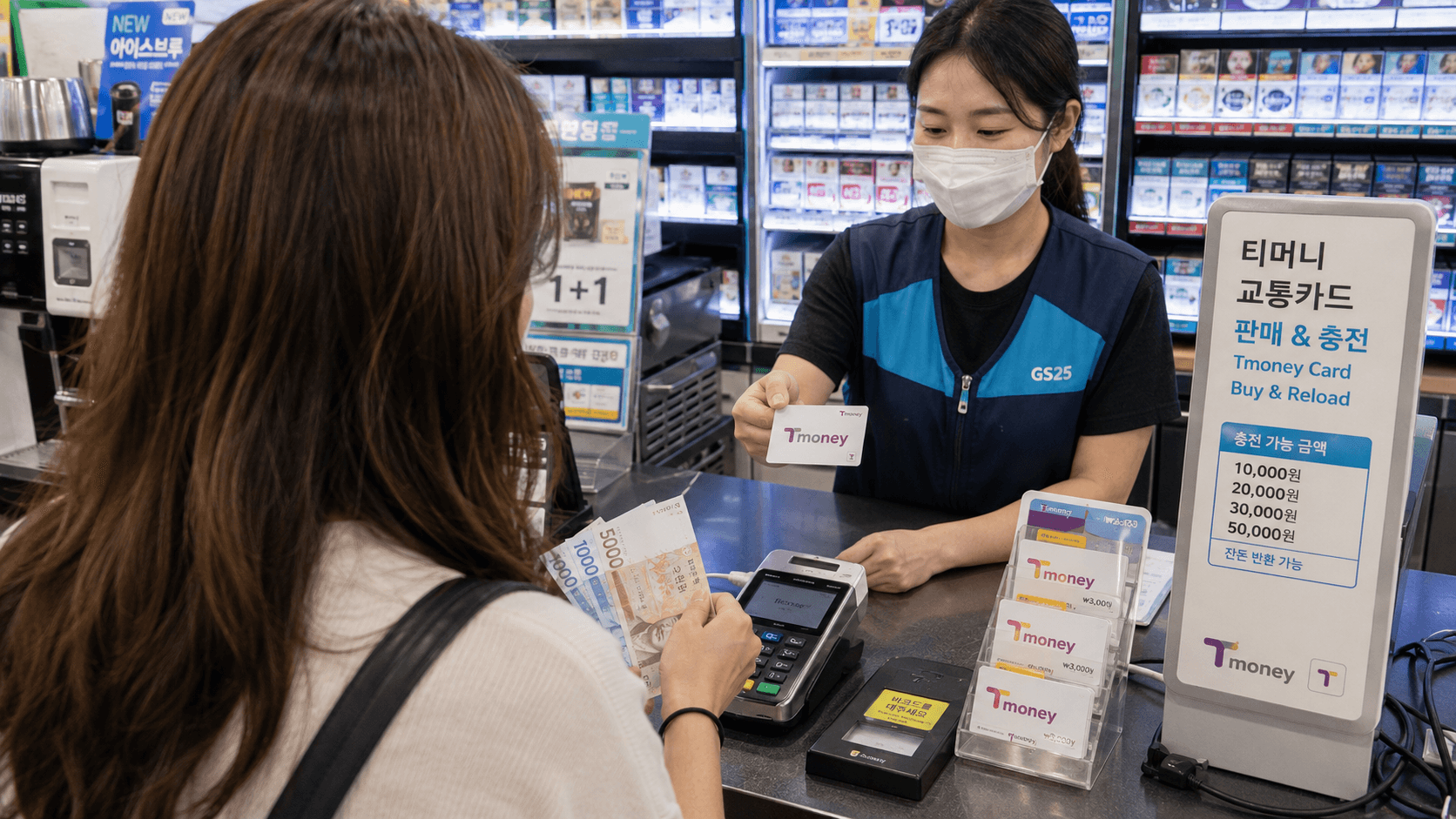
The Korea Tourism Organization says Tmoney and EZL cards are sold and recharged at convenience stores nationwide. However, its May 2026 transportation guide specifically lists standard Tmoney purchase and top-up as cash-only and says foreign-issued credit cards are not accepted for these transactions.
A practical arrival plan is therefore:
- Obtain some Korean won at the airport or from a compatible ATM.
- Buy a Tmoney card at a convenience store displaying the Tmoney logo.
- Pay separately for the card and the balance you want to load.
- Keep a few KRW 1,000 or KRW 5,000 notes for later top-ups.
- Do not load a large amount unless you expect to use it.
General Tmoney cards commonly cost approximately KRW 3,000-5,000 before adding any travel balance, according to VisitKorea. Card designs and retail prices vary, so check the price at the point of sale.
Traditional markets and small vendors
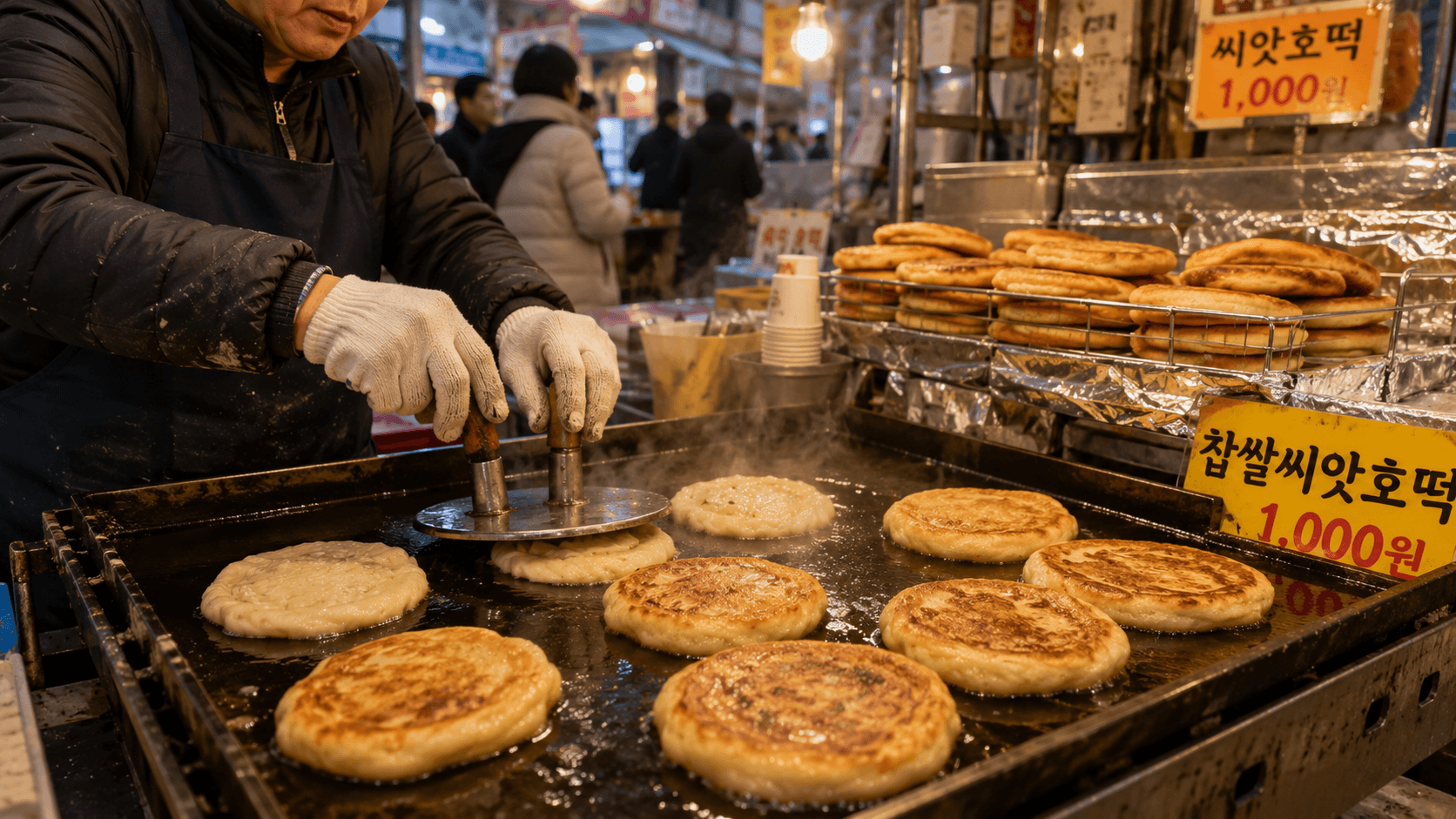
Established shops in major traditional markets often accept cards, but a small food stall, temporary booth, rural vendor, or independently operated business may prefer cash or use a payment setup intended mainly for Korean customers. Ask before ordering if you have no cash available.
Useful Korean phrases include:
- 카드 돼요? (Kadeu dwaeyo?) — Can I pay by card?
- 현금만 돼요? (Hyeongeumman dwaeyo?) — Is it cash only?
Do not assume that every traditional market is cash-only. Card acceptance can differ from one stall to the next.
Small purchases and unexpected situations
Korean businesses generally do not impose a formal minimum purchase amount for normal card payments, and paying for a low-cost item by card is common. Cash is still helpful when:
- A card terminal or network is temporarily unavailable
- Your overseas card is unexpectedly declined
- You need to split a bill with companions
- You need to top up a standard transit card
- You encounter a coin-operated locker or older machine
- A small local business requests cash
Seoul's new foreign-card transit options
Visitors should not confuse Seoul's newer ticket machines with universal contactless payment across Korea.
Starting March 17, 2026, Seoul introduced 440 new vending machines at 273 subway stations on Lines 1-8. According to the Seoul Metropolitan Government announcement, these machines accept internationally issued Visa and Mastercard credit or debit cards for:
- Seoul subway single-journey tickets
- Physical Climate Card purchases
- Climate Card short-term passes valid for 1, 2, 3, 5, or 7 days
An average service fee of approximately 3.7% applies when an internationally issued card is used through this system. This fee and the supported transactions were verified on June 9, 2026.
This development does not mean you can tap an ordinary overseas bank card directly at every subway gate or bus reader. The Korea Tourism Organization's May 2026 guide says foreign cards are not accepted for direct tap payment on ordinary subway and bus readers. Use a regular transportation card, an eligible pass, or a single-use ticket instead.
The foreign-card machines are also specific to participating stations in Seoul. Do not assume that equivalent machines are available in Busan, Daegu, Daejeon, Gwangju, Jeju, or smaller cities.
How much cash should you carry?
There is no official amount that every traveler needs. A practical starting point is KRW 50,000-100,000 per person, supplemented by cards. This should cover several transit-card top-ups, inexpensive food, and a backup payment without requiring you to carry a large sum.
Consider carrying more when:
- You will spend time in rural areas or on islands
- Your itinerary includes markets and small local businesses
- You are traveling with children and paying for several transit cards
- You expect to use buses frequently outside major city centers
- Your bank charges high fees for repeated ATM withdrawals
Carry less when your accommodation and major transport have already been paid for and you will remain in central urban areas.
Use smaller notes when possible. Korea issues KRW 1,000, KRW 5,000, KRW 10,000, and KRW 50,000 banknotes, as well as KRW 10, KRW 50, KRW 100, and KRW 500 coins. A KRW 50,000 note can be inconvenient for a very small cash purchase.
Getting Korean won
Withdrawing money from an ATM
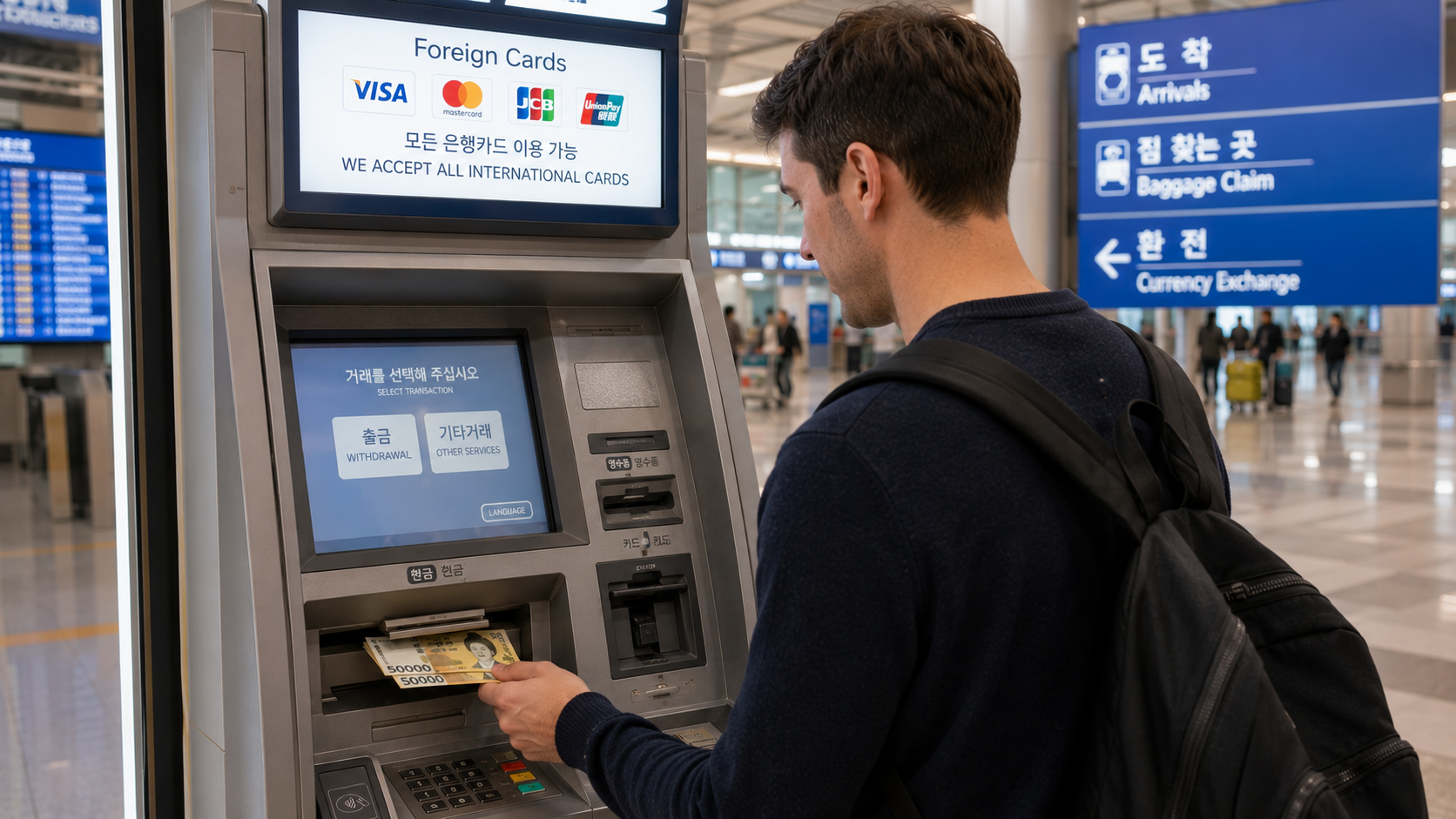
ATMs are common at airports, banks, convenience stores, subway stations, and shopping areas. Before inserting your card, look for the logo of a network supported by your bank or card. An ATM may offer English or another language, but language support and foreign-card compatibility vary by machine.
Your total cost can include:
- A fee charged by the Korean ATM operator
- A foreign withdrawal fee charged by your bank
- A currency-conversion charge
- An exchange-rate margin
The machine should display its local fee before you confirm. Your home bank's charges may appear only on your account statement. Check your bank's overseas cash-withdrawal rules, daily limit, and emergency contact number before traveling.
When offered a choice between conversion into your home currency and processing the transaction in Korean won, compare the displayed terms carefully. Do not approve a conversion without reading the exchange rate and fee.
Exchanging foreign currency
Foreign currency can be exchanged at airport exchange counters, downtown banks, and authorized private exchange offices. The Seoul currency guide says customers must present a passport or residence card when exchanging money. Hours and available currencies depend on the individual counter, so verify them directly before making a special trip.
Airport counters are convenient for obtaining arrival cash, although convenience does not guarantee the most favorable exchange rate. One practical approach is to exchange or withdraw only enough for immediate transportation and then compare options later if you need a larger amount.
Avoid relying on traveler’s checks. Seoul's official guide notes that they are rarely used in Korea.
Payment mistakes to avoid
Depending on one foreign card
Even a widely accepted card can fail. Carry a second card from another account or network and keep it separately.
Assuming your bank card works as a transit card
Foreign-issued bank cards cannot generally be tapped directly on standard Korean bus and subway readers as of June 9, 2026. Seoul's new foreign-card vending machines sell specific tickets and passes; they do not create nationwide open-loop transit acceptance.
Arriving with no way to buy a transit card
If you plan to use a standard Tmoney card immediately, obtain Korean cash first. Do not assume that the convenience store can charge the card using your overseas credit card.
Loading too much onto a prepaid card
Refund rules depend on the card, balance, and refund location. VisitKorea notes that higher Tmoney balances may require processing at a designated Tmoney location. Load manageable amounts instead of treating a transit card like a bank account.
Carrying only large notes
Keep some smaller notes for market stalls, top-ups, and low-cost purchases. Break a large note at a convenience store when making a genuine purchase rather than asking a small vendor to provide all your change.
Bringing a large amount of cash into Korea
Most travelers will never approach the declaration threshold. However, the Korea Customs Service states that travelers entering Korea with foreign currency, Korean won notes, or checks totaling more than USD 10,000 or its equivalent must declare it to Customs. The rule applies to the combined value, not each currency separately.
Customs requirements can have legal and financial consequences. If you may exceed the threshold, confirm the current procedure directly with Korea Customs Service before traveling rather than relying solely on a general travel guide.
What to check before you go
- Enable overseas purchases and ATM withdrawals on your cards.
- Confirm your card PIN and daily withdrawal limit.
- Check your bank's foreign transaction and cash-withdrawal fees.
- Bring two payment cards, preferably from separate accounts.
- Keep your bank's international contact number somewhere outside your wallet.
- Plan to obtain KRW before buying or topping up a standard Tmoney card.
- Store cards and cash in separate places.
- Download transaction alerts if your bank provides them.
- Check the latest transportation payment rules for each city on your route.
- Declare cash and equivalent payment instruments when required by Korea Customs.
FAQ
Can I visit Korea without carrying any cash?
It may be possible for a carefully planned stay in central Seoul, particularly if you use foreign-card ticket machines and avoid cash-only services. It is not the most reliable approach. A small cash reserve reduces problems with transit-card top-ups, small vendors, and declined transactions.
Are foreign debit cards accepted in Korea?
They can work when they carry a supported international network logo and overseas use is enabled. Acceptance and fees depend on your issuing bank and the Korean terminal or ATM. A debit card linked only to a domestic network in your home country may not work.
Can I use Apple Pay or another mobile wallet everywhere?
No. Some businesses and transit-related machines accept mobile payments, but support varies by wallet, device, card issuer, and terminal. Carry a physical payment card and do not rely exclusively on your phone.
Can I pay taxis by card?
Many taxis accept foreign-issued credit cards, and the Korea Tourism Organization's May 2026 guide lists foreign-card payment as available through taxi card readers. Keep cash or another payment method available in case a terminal or card fails. Confirm the meter is running and request a receipt if you need one.
Should I exchange money before arriving?
You do not need to obtain your entire travel budget in advance. Having a small amount of KRW on arrival can be convenient, but airports also have exchange counters and ATMs. Compare your home exchange rate, card fees, and Korean ATM charges rather than assuming one method is always cheaper.
Your most practical next step is to check the overseas-use settings and fees for two cards, then plan to obtain approximately KRW 50,000-100,000 for transportation and backup expenses after arrival.
Sources
- Korea Tourism Organization: International Visitors' Use of Public Transportation and Booking/Payment Services
- Korea Tourism Organization: Transportation Cards
- Seoul Metropolitan Government: Currency Exchange and Payment Methods
- Seoul Metropolitan Government: International Cards for Climate Cards and Single-Journey Tickets
- Korea Customs Service: Declaration of Foreign Currency