Dongdaemun is one of Seoul's largest shopping districts, combining fabric markets, small fashion stalls, conventional retail stores, wholesale buildings and Dongdaemun Design Plaza (DDP). It is not a single market with one entrance or one set of opening hours. Before going, decide whether you want accessible retail shopping, specialist textiles and craft supplies, or the late-night wholesale atmosphere.
Information that may change, including operating hours, transport arrangements and tax-refund procedures, was checked on June 11, 2026. Individual shops and market buildings set their own schedules, so confirm your priority destination on the day of your visit.
At a glance
| Question | Practical answer |
|---|---|
| Best station for malls and DDP | Dongdaemun History & Culture Park Station, served by Lines 2, 4 and 5 |
| Best station for Dongdaemun Shopping Complex | Dongdaemun Station, served by Lines 1 and 4 |
| Best time for ordinary retail shopping | Late morning through evening, after confirming the building's hours |
| Best time to see wholesale activity | Late evening or overnight on an operating day |
| Main products | Clothing, shoes, accessories, fabric, sewing supplies, craft materials and bedding |
| Payment | Cards are common in formal stores, but cash or Korean bank transfers may be preferred by some small vendors |
| Bargaining | Possible at some independent stalls, but not automatic and generally inappropriate in fixed-price stores |
| Main warning | Wholesale buildings may restrict single-item purchases, fitting and returns |
Understanding the Dongdaemun shopping area
The name Dongdaemun, meaning "Great East Gate," is used for both the historic gate area and the surrounding commercial district. The shopping zone extends across multiple blocks on both sides of major roads, with pedestrian underpasses and subway entrances connecting some sections.
For visitors, it helps to divide the district into three broad zones:
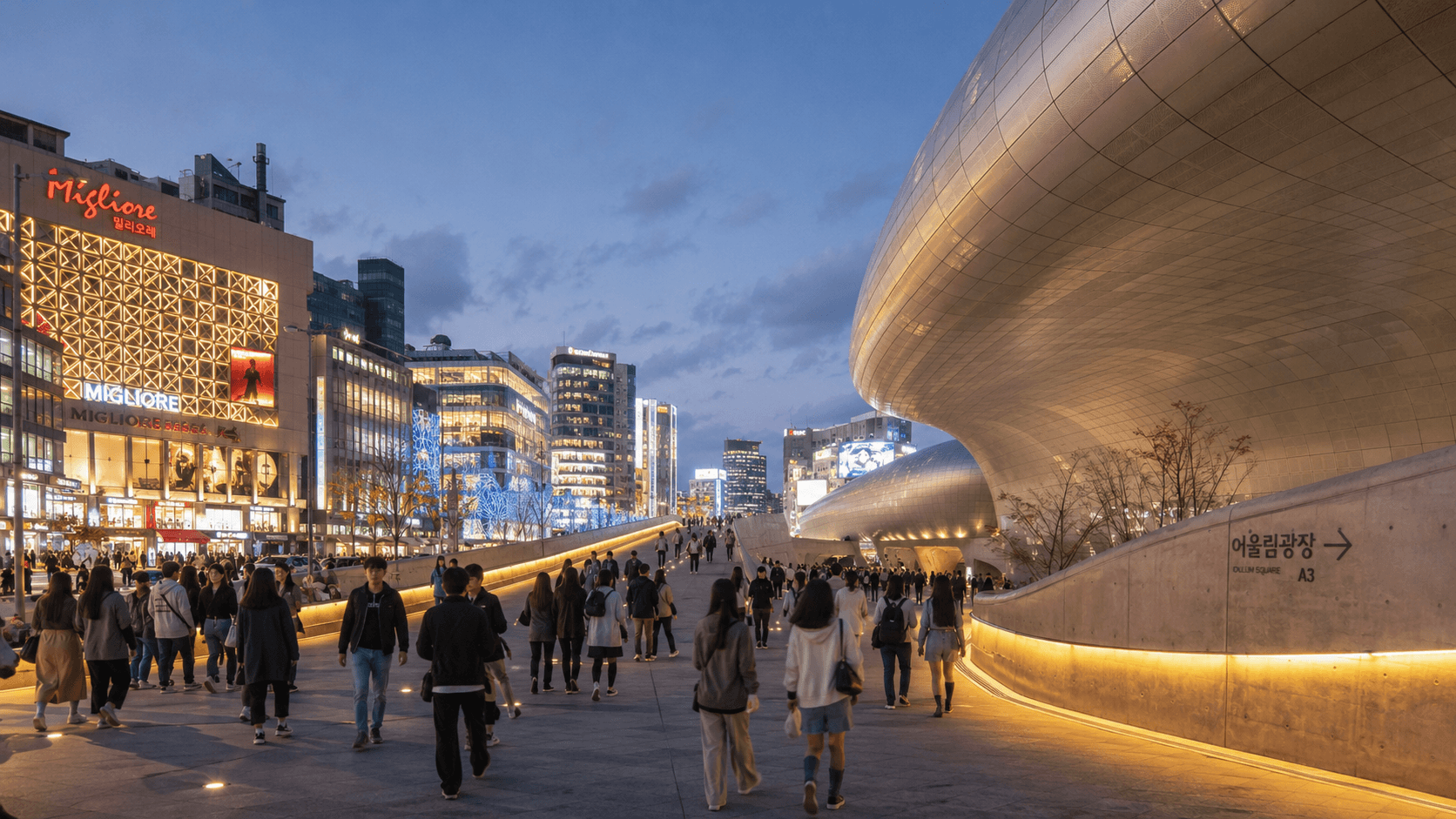
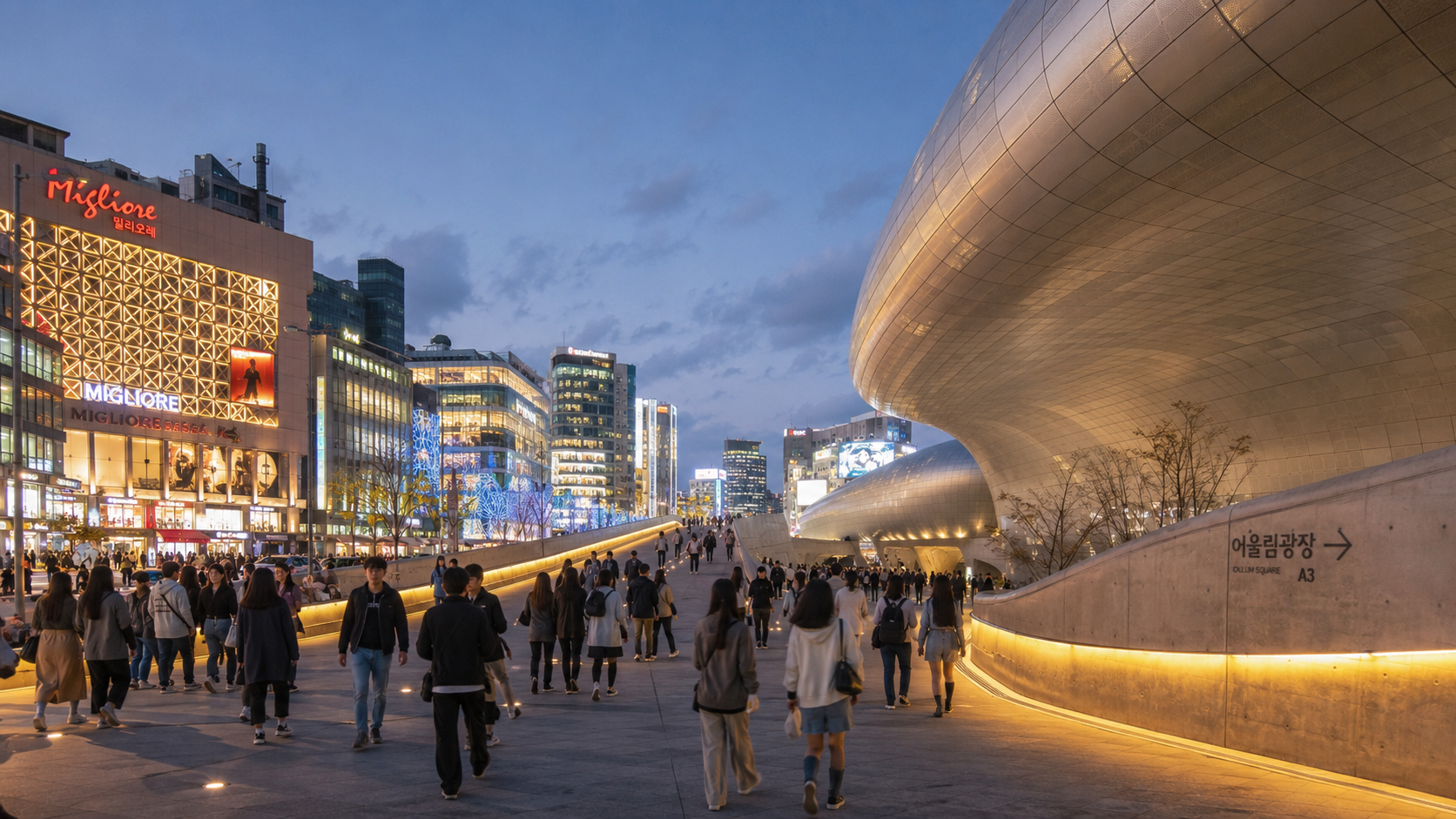
- DDP and the retail-mall area: The easiest starting point for first-time visitors, with recognizable shopping buildings, restaurants and the curved architecture of Dongdaemun Design Plaza.
- The wholesale fashion area: Multi-floor buildings containing compact showrooms that primarily serve professional buyers. Activity commonly begins later than in ordinary retail stores.
- Dongdaemun Shopping Complex and nearby specialist markets: The main area for fabric, sewing notions, craft supplies, accessories and related materials.
The boundaries are informal. A building may contain both retail and wholesale sellers, while individual shops can follow different rules from their neighbors.
Where to shop
Dongdaemun Shopping Complex for fabric and craft materials
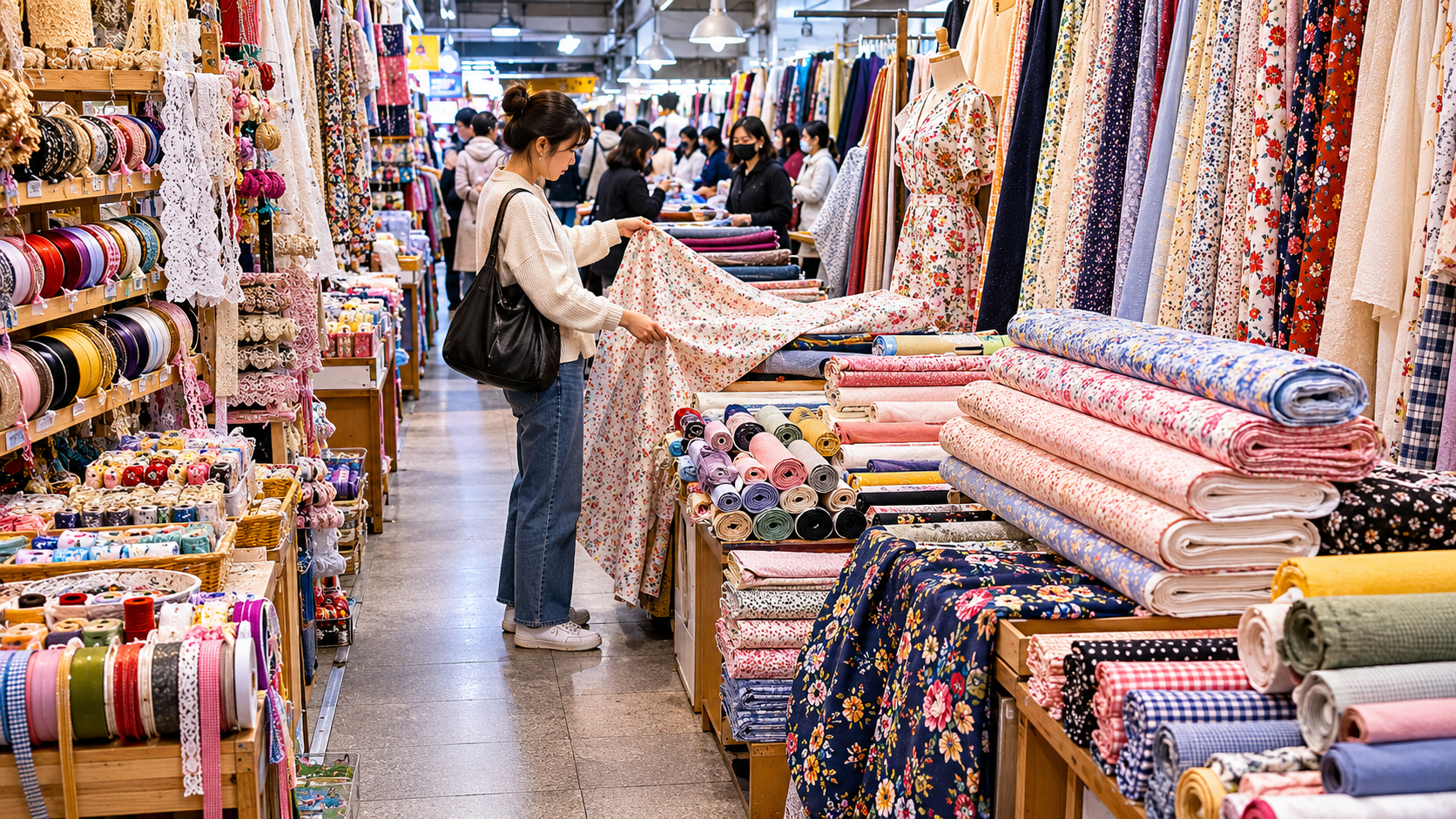
Dongdaemun Shopping Complex (동대문종합시장) is the most useful destination for fabric, ribbons, buttons, beads, lace, sewing notions, accessories and craft materials. Some sections also sell bedding, hanbok materials and ready-made goods.
This is a working specialist market, so the experience differs from browsing a department store. Shops can be small, aisles can be crowded, and products are frequently organized by material rather than by finished project. Bring a photograph, color reference, sample or written measurement if you need something specific.
Ask before touching rolls of fabric or opening packaged materials. When buying fabric, confirm the unit of sale, width, minimum quantity and whether cutting is included. Returns on cut fabric or opened craft materials are unlikely unless the seller clearly agrees otherwise.
Building and section schedules differ and may change around Sundays, public holidays and summer breaks. Check the official Dongdaemun Shopping Complex website before making a special trip.
Retail malls for straightforward shopping
The blocks around DDP contain modern outlets, fashion malls and smaller retail buildings. These are generally easier for visitors who want one or two ready-to-wear items rather than wholesale quantities.
Expect a mixture of conventional stores and individually operated stalls. Larger branded shops are more likely to display fixed prices, accept international cards and have formal exchange policies. Small independent stalls may offer limited fitting facilities and may treat discounted purchases as final sales.
Mall tenants and operating hours change more frequently than travel guides can reliably track. Search the exact building name in Naver Map or Kakao Map on the day you visit, then compare the result with the building's official website or social-media notice. Do not assume that an old list of famous Dongdaemun malls is still current.
Wholesale fashion buildings
The wholesale side of Dongdaemun supplies boutiques and online retailers. Buildings may specialize in women's fashion, menswear, shoes, bags or accessories, with hundreds of small showrooms spread over multiple floors.
These markets are visually interesting, but they are not designed primarily for casual tourism. A seller may require multiple pieces, sell only to registered buyers, decline retail purchases or quote a different retail price. Samples displayed at the front may not be available for immediate purchase.
Before choosing an item, ask:
- "Retail purchase?" or 소매 돼요? (somae dwaeyo?)
- "Can I buy one?" or 한 개 살 수 있어요? (han gae sal su isseoyo?)
- "Can I try it on?" or 입어 봐도 돼요? (ibeo bwado dwaeyo?)
- "Can I pay by card?" or 카드 돼요? (kadeu dwaeyo?)
A refusal usually reflects the seller's business model, not poor service. Move on rather than pressuring the vendor.
Dongdaemun Design Plaza
Dongdaemun Design Plaza is a cultural and exhibition complex operated by the Seoul Design Foundation. DDP itself is not a general clothing market, but it provides a convenient landmark, meeting point and break between shopping areas.
Exhibitions, shops and event spaces have separate admission rules and operating hours. Consult the official DDP website for the current program instead of assuming the entire complex follows one schedule.
The surrounding Dongdaemun History & Culture Park also contains preserved historical remains. It is useful for a quieter walk when the shopping buildings feel crowded.
When should you visit?
For first-time shoppers
Visit in the late morning or afternoon. Public transport is fully operating, navigation is easier, and retail-oriented stores are more likely to be open. Start at Dongdaemun Shopping Complex if you need materials, or at DDP if you want ready-made fashion and general browsing.
For the night-shopping atmosphere
Go after dinner on a confirmed operating night. Wholesale activity traditionally runs late, but the exact opening pattern varies by building, floor, season and holiday. Some markets close for part or all of the weekend, while others maintain different daytime and nighttime sessions.
There is no reliable districtwide closing time. As verified on June 11, 2026, official sources do not provide one consolidated live schedule covering every Dongdaemun market. Check each named building separately before traveling across Seoul.
Days to approach cautiously
Sunday is often a poor choice for specialist and wholesale shopping because closures are common. Public holidays, Lunar New Year (Seollal) and Chuseok can also bring extended breaks. Summer vacation notices may be posted only in Korean at entrances or on official social-media accounts.
A practical shopping route
Two-hour daytime route
- Arrive at Dongdaemun Station and enter Dongdaemun Shopping Complex.
- Browse only the relevant floor or product section; the complex is too large to cover efficiently without a target.
- Walk toward Heunginjimun, the historic gate commonly called Dongdaemun.
- Continue to DDP and finish in one retail building near Dongdaemun History & Culture Park Station.
Evening retail and wholesale route
- Arrive at Dongdaemun History & Culture Park Station before dinner.
- Walk around DDP while there is still daylight.
- Shop in a retail-oriented mall first, while returns, information counters and staffed services are easier to access.
- Eat before entering the wholesale area; browsing several multi-floor buildings takes longer than expected.
- Visit one or two wholesale buildings selected in advance.
- Check your route home before the subway's final services.
Prices, payment and bargaining
Dongdaemun does not have a single price level. A basic accessory at a small stall, a locally designed garment and an imported branded product may be sold in neighboring buildings at very different prices.
Price labels are more common in formal retail stores than in wholesale showrooms. If no price is shown, ask 얼마예요? (eolmayeyo?, "How much is it?"). Confirm whether the quote is for one piece or a wholesale bundle.
International Visa and Mastercard cards are widely accepted in larger Korean retail businesses, but acceptance is not universal. Some independent vendors prefer cash or domestic bank transfer. Ask before committing to a purchase, especially if the product needs to be packaged or altered.
Bargaining is not a requirement. In an independent stall without displayed prices, it is reasonable to ask politely whether there is a discount for buying several items or paying cash. Do not bargain in branded shops, department-store-style outlets or businesses using fixed price labels.
Always request a receipt. It gives you the clearest record of the shop, price and transaction if a problem arises.
Clothing sizes, fitting and returns
Korean clothing labels may use numbers such as 44, 55, 66 and 77, but sizing is not standardized enough to convert reliably from US or European sizes. Free-size or one-size clothing is also common and does not mean that the garment will fit everyone.
For important purchases:
- Compare the garment with your measurements rather than relying on the label.
- Carry a flexible tape measure.
- Check sleeve length, shoulder width, waist and total length.
- Inspect seams, zippers, buttons and fabric before paying.
- Ask whether fitting is allowed; many small stalls have no changing room.
- Confirm the exchange deadline and whether sale items are excluded.
Wholesale purchases, cut fabric, accessories and heavily discounted goods may be final sale. Get the seller's agreement before paying if an exchange is essential.
Tax refunds for international visitors
Tax refunds are available only through participating tax-refund businesses and only when the traveler and purchase meet the legal conditions. A handwritten receipt from an ordinary stall is not automatically enough.
Ask for tax-refund processing at the time of purchase and present your passport if required. Keep the sales certificate, goods and passport available for departure procedures. According to the Korea Customs Service tax-refund guidance, eligible goods must be taken out of Korea within three months of purchase and may need to be shown unused and unopened. Airport kiosks or customs staff can request inspection.
Rules and thresholds can change. Check the official Customs guidance again before departure rather than relying solely on information printed by a shop.
Getting there and returning late
Use Dongdaemun Station for the historic gate and Dongdaemun Shopping Complex. Use Dongdaemun History & Culture Park Station for DDP and many of the fashion buildings. The latter station is served by Lines 2, 4 and 5, making it the more flexible transfer point for much of Seoul.
A T-money or other accepted transport card is more convenient than buying separate tickets. The Seoul Metropolitan Government public-transport guide explains transport cards, subway tickets and route-planning tools. It notes that subway single-journey tickets require a refundable KRW 500 deposit and cost KRW 100 more than the corresponding transport-card fare; these details were verified on June 11, 2026.
Do not assume that shopping until midnight guarantees a subway home. Final train times depend on the line, direction, station and day. Check Naver Map, Kakao Map or the operator's live station information before entering another building. Seoul has late-night buses, but routes may require a walk and are less intuitive for first-time visitors. A taxi may be the simplest fallback, although demand can be high at night.
Luggage and accessibility
Dongdaemun requires considerable walking. Some older market buildings have narrow aisles, crowded elevators, raised thresholds or limited seating. DDP and modern retail buildings generally provide easier circulation, but accessibility varies within the wider district.
Travel with a small bag rather than a large suitcase. Subway lockers exist at many stations, but size and availability are not guaranteed. The Seoul city transport website maintains information on subway storage and accessibility facilities. Travelers who need step-free access should check elevator locations before choosing an exit; the nearest numbered exit is not always the accessible one.
Common mistakes
- Treating Dongdaemun as one market: Save the exact Korean and English name of each building you intend to visit.
- Following an old mall list: Tenants, names and operating patterns change. Verify them on the day.
- Expecting wholesale prices for one item: Wholesale pricing usually depends on quantity or buyer status.
- Assuming every shop accepts foreign cards: Carry a modest amount of KRW and confirm payment first.
- Buying without checking the return policy: Small-market sales may be exchange-only or final.
- Arriving late without planning transport: Check the last practical route home before shopping.
- Visiting specialist markets on Sunday: Confirm that the specific building and floor will open.
What to check before you go
- Save the destination's Korean name and street location in Naver Map or Kakao Map.
- Confirm the building's opening day and hours through an official source.
- Check holiday or summer-closure notices.
- Decide whether you need retail purchases, wholesale goods or fabric supplies.
- Bring measurements, reference photographs and a tape measure when relevant.
- Carry a payment card plus some KRW for small vendors.
- Check the exchange or refund policy before paying.
- Photograph or keep every receipt.
- Review the final subway or bus options before beginning a late-night visit.
- Recheck airport tax-refund procedures if making an eligible purchase.
For help while traveling, the Korea Travel Hotline can be reached at 1330 within Korea or +82-2-1330 from abroad, as listed by the Seoul Metropolitan Government. Begin by selecting one named market or mall, confirming its current schedule, and building your route around that destination rather than trying to cover the entire district.