Duty-free shopping in Korea can mean two different things: buying untaxed goods through a licensed duty-free retailer, or buying taxed goods at an ordinary participating store and claiming a tourist tax refund. The procedures are not interchangeable. Duty-free purchases often require departure details and may be collected at the airport, while tax-refund purchases normally leave the store with you and may require export confirmation.
The rules and airport information below were verified on June 11, 2026. Store inventories, order deadlines, counter locations, and operating hours can change, so confirm them with the retailer and departure airport before traveling.
Quick answer
| Shopping method | When you receive the goods | What you normally need | Main concern |
|---|---|---|---|
| Airport departure duty-free | After security and immigration | Passport and boarding pass | Time, stock, liquids, and destination customs limits |
| Downtown duty-free | Usually at an airport or port collection counter | Passport and confirmed international departure details | Correct terminal and collection deadline |
| Online duty-free | At the designated departure collection counter | Passport, boarding pass, and order details | Order cutoff and terminal changes |
| Arrival duty-free | After landing but before Korean customs | Passport and arrival flight details | Purchases count toward Korea's entry allowance |
| Tourist tax-refund store | Immediately at the shop | Passport and qualifying visitor status | Keeping receipts, goods, and refund documents |
The most important distinction is that a product being sold duty-free in Korea does not automatically exempt it from tax when you enter your next country. Check the import allowance of your destination and any transit country, especially for alcohol, tobacco, perfume, food, and high-value goods.
What duty-free means in Korea
A duty-free shop, or myeonsejeom (면세점), sells goods without certain Korean taxes and duties because the goods are intended to leave the country. Licensed stores operate at international airports, in city shopping districts, and online.
International visitors may encounter four main formats:
- Departure-area shops after airport security and immigration
- Downtown stores in Seoul, Busan, Jeju, and other locations
- Online duty-free stores linked to a departing international journey
- Arrival duty-free stores before customs at participating airports
Duty-free prices are not automatically lower than every Korean retail price. Compare the final amount after store discounts, membership offers, exchange-rate conversion, card fees, and any tax-refund option available at an ordinary retailer. A Korean brand on promotion at a regular department store may occasionally cost less than the duty-free version.
What to prepare
For airport shopping, carry your passport and boarding pass. For downtown or online duty-free orders, expect to provide your passport details and confirmed international departure information, including the date, flight or vessel number, and departure point.
Enter these details exactly as shown on your documents. A name, passport number, terminal, or departure-date error can prevent collection. Update the retailer immediately if your passport, flight, airport, or terminal changes.
Travelers leaving on domestic flights cannot use the international departure collection process. A flight from Seoul to Jeju, for example, is domestic even though Jeju has duty-free arrangements governed by separate rules. Do not assume that procedures for an international departure from Incheon apply to domestic Jeju travel.
Shopping at the airport
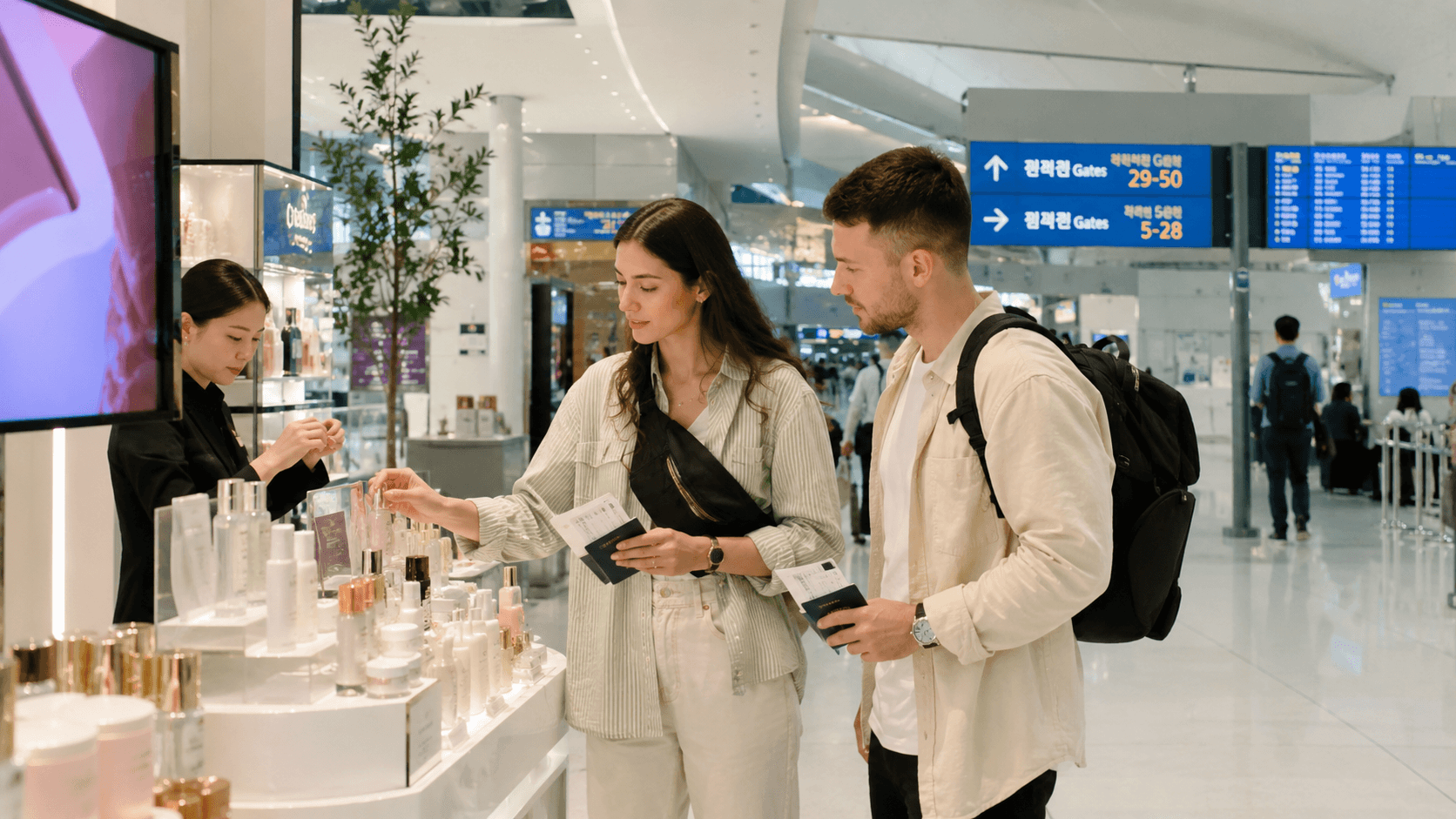
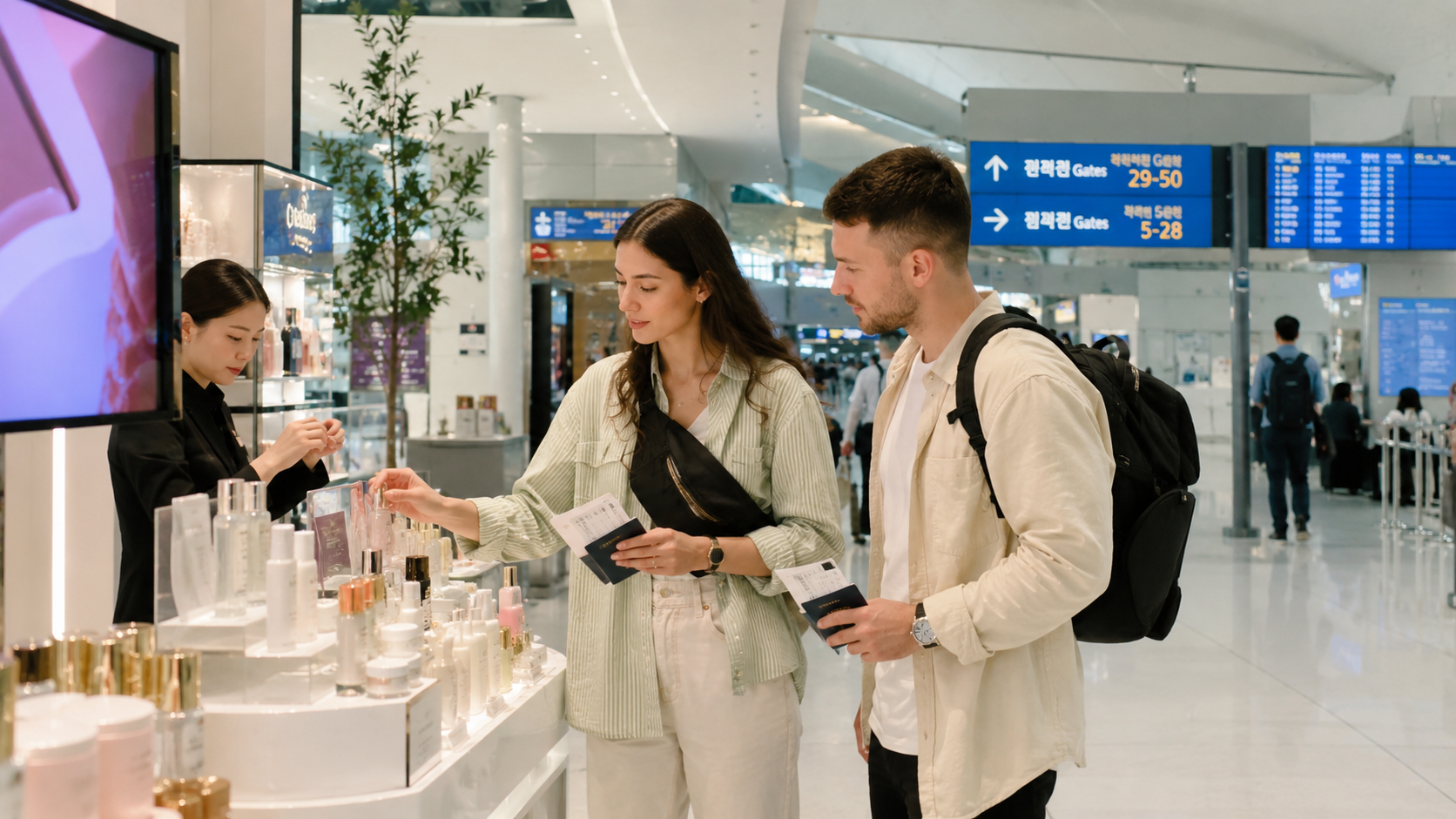
Airport departure shops are the simplest option because you buy and receive the product inside the secure international departure area. Incheon International Airport maintains a searchable official duty-free shopping directory with terminal, location, contact, and operating-hour information.
Hours vary by shop. Incheon's directory showed a mixture of 24-hour outlets and stores with limited schedules when checked on June 11, 2026. Do not assume that every cosmetics, fashion, liquor, or tobacco counter remains open for an early-morning or late-night flight.
Practical airport-shopping sequence
- Check in and confirm your departure gate and terminal.
- Pass security screening and departure immigration.
- Find the store using the airport directory or information screens.
- Show your passport and boarding pass when requested.
- Keep the receipt and any sealed packaging until you finish your journey.
- Confirm whether liquids will remain acceptable during a transfer.
Allow time to walk to your gate. Incheon Airport is large, and a shop near one end of a terminal may be a considerable distance from your departure gate.
Downtown and online duty-free shopping
Downtown duty-free stores allow you to browse before departure, while online stores are useful for comparing products and reserving stock. In both cases, goods intended for export are generally transferred to a designated collection counter at your international departure point rather than handed over for use in Korea.
The retailer should provide the collection location and eligible pickup time. These details vary by operator, airport, terminal, route, and product. Order cutoffs also vary, so no single deadline applies to every purchase.
How to collect an order
- Confirm the terminal directly with your airline before leaving for the airport.
- Check in and obtain your boarding pass.
- Complete security screening and departure immigration unless the retailer instructs otherwise.
- Follow signs for “Duty-Free Pick-up” or “Duty-Free Goods Delivery.”
- Present your passport, boarding pass, and order or exchange voucher.
- Check your name, product, quantity, and packaging before leaving the counter.
Collection counters may serve several retailers. During busy departure periods, queues can form even when the shopping itself was completed online. Arrive early enough to resolve an incorrect terminal, missing item, or document mismatch without risking your flight.
Do not put an uncollected duty-free order in checked baggage: you normally receive it only after baggage check-in. Consider your cabin-baggage allowance before ordering bulky cosmetics sets, bottles, or multiple shopping bags.
Arrival duty-free shopping
Korea also has duty-free shops in the arrivals area before customs. These can be convenient because you carry the purchase only after landing rather than throughout your trip.
According to the Korea Customs Service arrival duty-free guidance, purchases at arrival shops are combined with goods bought abroad and at other duty-free stores when Korean customs calculates your entry allowance. The arrival-shop purchase limit for general goods is officially stated as US$800, with liquor and perfume treated under their separate allowances. This information was verified on June 11, 2026.
Arrival duty-free is therefore not a way to add another US$800 to your Korean customs allowance. If you already bought expensive goods overseas or at your departure airport, calculate the combined value before shopping on arrival.
Korea's customs allowance when entering
The current Korea Customs Service passenger guide listed the following allowances on June 11, 2026:
- General goods with a total taxable value of up to US$800
- Liquor totaling up to 2 liters and up to US$400 in value
- 200 cigarettes, or the separately specified allowance for eligible e-cigarette or liquid-nicotine products
- Up to 100 milliliters of perfume
The liquor, tobacco, and perfume allowances are separate from the general US$800 allowance. Travelers under 19, based on year of birth under the stated Korean customs rule, do not receive the liquor or tobacco exemption.
Agricultural, livestock, fishery, plant, food, and animal products have additional quantity, value, quarantine, and declaration requirements. A product may need inspection even when it is inexpensive. Check with the relevant Korean customs or quarantine authority rather than relying on a retailer's advice.
If you exceed an allowance, declare the goods. Korea Customs states that eligible voluntary declarations receive a reduction from the standard customs duty, while failure to declare can result in additional tax. These are Korean entry rules; your destination country will apply its own rules when you leave Korea with purchases.
Duty-free shopping versus tourist tax refunds
Korean signs can make this distinction confusing because “Duty Free,” “Tax Free,” and “Tax Refund” may appear in English.
Licensed duty-free purchase
The tax is removed as part of the duty-free sale. The purchase is linked to an international journey, and goods bought downtown or online are usually collected when departing. You do not separately claim Korean VAT at an airport refund counter for the same sale.
Tourist tax-refund purchase
You buy from an ordinary participating retailer. Depending on the store and transaction, the tax may be refunded immediately or processed through a refund operator. Look for a tax-refund logo and ask before paying whether the purchase qualifies.
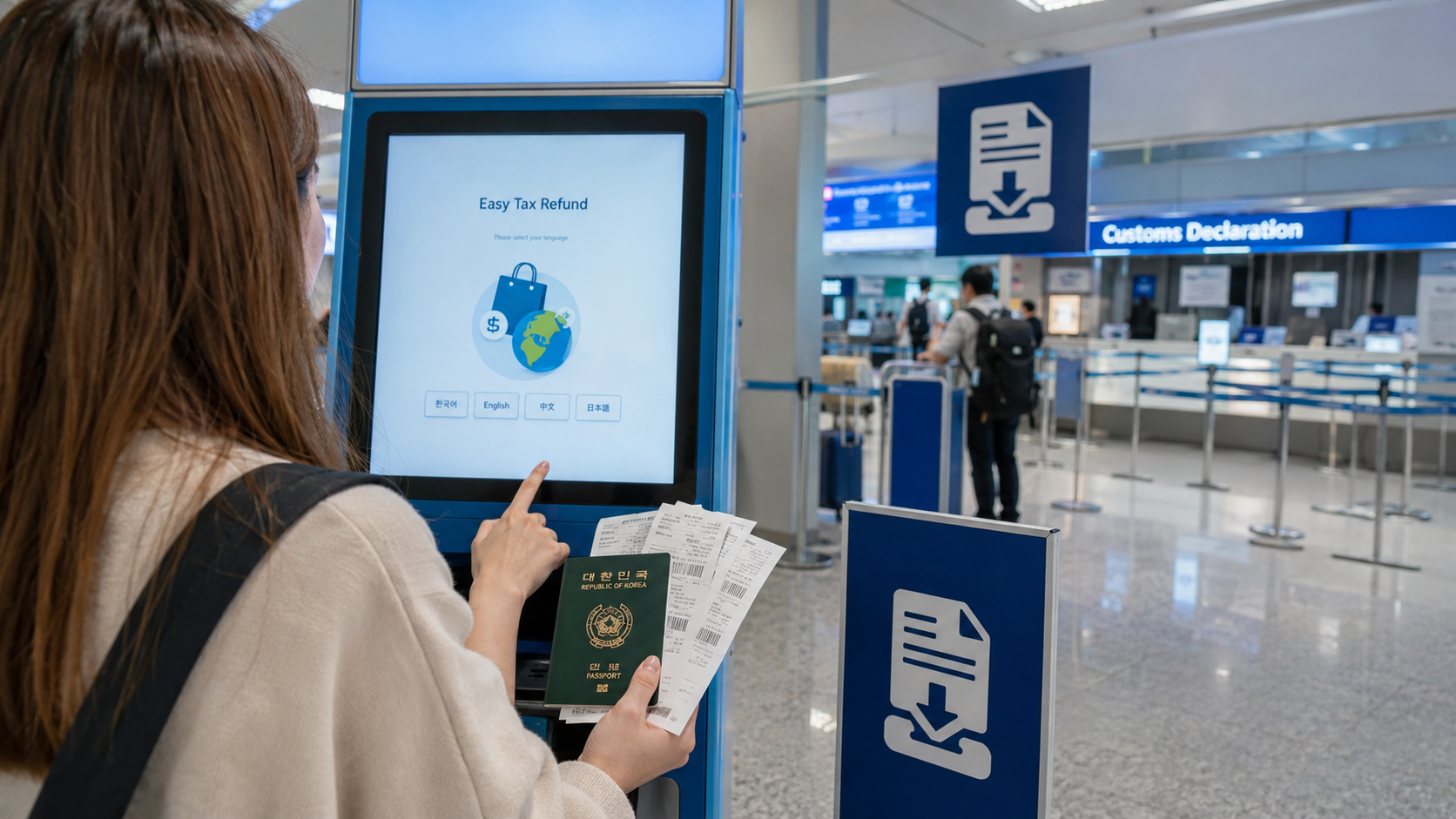
At Incheon Airport, the official domestic tax-refund guide states that eligible purchases must exceed KRW 15,000 and that shoppers should request the receipt and refund documents using their passport. This threshold and procedure were verified on June 11, 2026.
The Korea Customs Service says eligible goods must leave Korea within three months of purchase. For export confirmation, officials may request your passport, sales documentation, and the purchased goods in unopened and unused condition. Eligibility depends on residence or visitor status and the transaction, so confirm it with the participating retailer or refund operator before buying.
How to complete an airport tax refund
The precise route depends on whether the goods are in your cabin baggage or checked baggage.
Goods carried onto the aircraft
- Obtain your boarding pass.
- Keep the goods, passport, receipts, and refund documents accessible.
- Use the tax-refund kiosk before departure immigration where instructed.
- If selected for inspection, present the unused goods and documents to customs.
- After immigration, complete the refund at the designated counter or kiosk if it was not issued earlier.
Goods placed in checked baggage
Tell airline staff before your bag disappears onto the conveyor. Incheon's official instructions say to have the bag tagged, reclaim it for any required customs procedure, and then place the cleared bag on the designated oversized-baggage conveyor near customs.
Do not pack passports, receipts, refund forms, or payment cards inside checked luggage. Arrive earlier than usual if you have several claims or expensive items.
At Incheon, staffed refund-counter hours and locations differ by terminal. The official page listed a Terminal 1 counter operating from 07:00 to 22:00 and a Terminal 2 counter from 07:00 to 21:30 when verified on June 11, 2026. Kiosks may offer additional options, but confirm the current service for your refund operator and departure time.
Liquids, transfers, and cabin baggage
Duty-free cosmetics, perfume, alcohol, and other liquids purchased after security may be packaged in a sealed security bag with the receipt. Keep the bag sealed until reaching your final destination.
A sealed bag does not guarantee acceptance at every connecting airport. Transfer-security policies depend on the country, airport, itinerary, packaging, and time since purchase. Ask the retailer about your route and check the official rules of each transfer airport. This is particularly important if you must collect baggage, enter the transit country, or pass through security again.
Also check your airline's cabin-baggage limits. Duty-free bags are not universally excluded from the number, dimensions, or weight of permitted carry-on items.
Common mistakes to avoid
- Confusing an ordinary tax-refund store with a licensed duty-free store
- Entering the wrong passport number, terminal, or departure date online
- Going to the airport named in the order without checking for an airline terminal change
- Arriving too late to collect an order before boarding closes
- Packing tax-refund goods before completing a possible customs inspection
- Opening or using refund-eligible goods before export confirmation
- Assuming duty-free bags never count toward cabin-baggage limits
- Buying liquids without checking transfer-security rules
- Forgetting that destination-country customs rules still apply
- Assuming every airport shop operates 24 hours
What to check before you go
- Confirm your airport, terminal, flight number, and departure date.
- Read the retailer's latest order cutoff, cancellation, and collection rules.
- Take the passport used for the purchase.
- Save the order voucher offline or print it if the retailer recommends doing so.
- Keep receipts and refund documents together in your cabin bag.
- Leave tax-refund goods unused and accessible for inspection.
- Check the retailer's and collection counter's operating hours.
- Review airline cabin-baggage rules, particularly for bulky purchases.
- Check liquid restrictions at every transfer airport.
- Review the customs allowance of your final destination.
- Declare goods when required; ask customs when uncertain.
Your next step should be to compare the ordinary retail price, tax-refund price, and duty-free final price for the exact product, then confirm the collection procedure against your booked flight. This avoids choosing a nominal discount that creates an impractical airport pickup or an unexpected customs charge.
Sources
- Korea Customs Service: Customs Clearance Guide for Passengers
- Korea Customs Service: On-arrival Duty-Free Shops
- Korea Customs Service: Tax Refund
- Incheon International Airport: Duty-Free Shopping Directory
- Incheon International Airport: Domestic Tax Refund Procedure
- Incheon International Airport: Security Screening