You can travel around South Korea without speaking fluent Korean, but a small set of polite phrases makes everyday situations much easier. Start with 안녕하세요 for hello, 감사합니다 for thank you, and 주세요 when asking for something. Keep the Korean text available on your phone because showing Hangul is often more reliable than relying on pronunciation alone.
Quick answer: 10 phrases worth learning first
| English | Korean | Approximate pronunciation |
|---|---|---|
| Hello | 안녕하세요 | an-nyeong-ha-se-yo |
| Thank you | 감사합니다 | gam-sa-ham-ni-da |
| Excuse me / I am sorry | 죄송합니다 | joe-song-ham-ni-da |
| Please give me this | 이거 주세요 | i-geo ju-se-yo |
| Where is the restroom? | 화장실이 어디예요? | hwa-jang-sil-i eo-di-ye-yo? |
| How much is it? | 얼마예요? | eol-ma-ye-yo? |
| Do you speak English? | 영어 하실 수 있어요? | yeong-eo ha-sil su i-sseo-yo? |
| I do not speak Korean well | 한국어 잘 못해요 | han-gu-geo jal mo-tae-yo |
| Please help me | 도와주세요 | do-wa-ju-se-yo |
| It is okay | 괜찮아요 | gwaen-cha-na-yo |
The pronunciation spellings in this guide are practical approximations for English speakers, not exact representations of Korean sounds. Korea's official Romanization system is based on standard Korean pronunciation, but Romanized text cannot reproduce every sound accurately. The National Institute of Korean Language's Romanization guide explains the official system.
How to sound polite without learning Korean grammar
Most phrases below use polite language suitable for speaking to hotel staff, restaurant workers, drivers, shop employees, and strangers.
Use 주세요 when requesting something
주세요 (ju-se-yo) means approximately please give me or please do this for me. Put the item or action before it:
- 물 주세요 (mul ju-se-yo): Water, please.
- 메뉴판 주세요 (me-nyu-pan ju-se-yo): A menu, please.
- 도와주세요 (do-wa-ju-se-yo): Please help me.
- 천천히 말씀해 주세요 (cheon-cheon-hi mal-sseum-hae ju-se-yo): Please speak slowly.
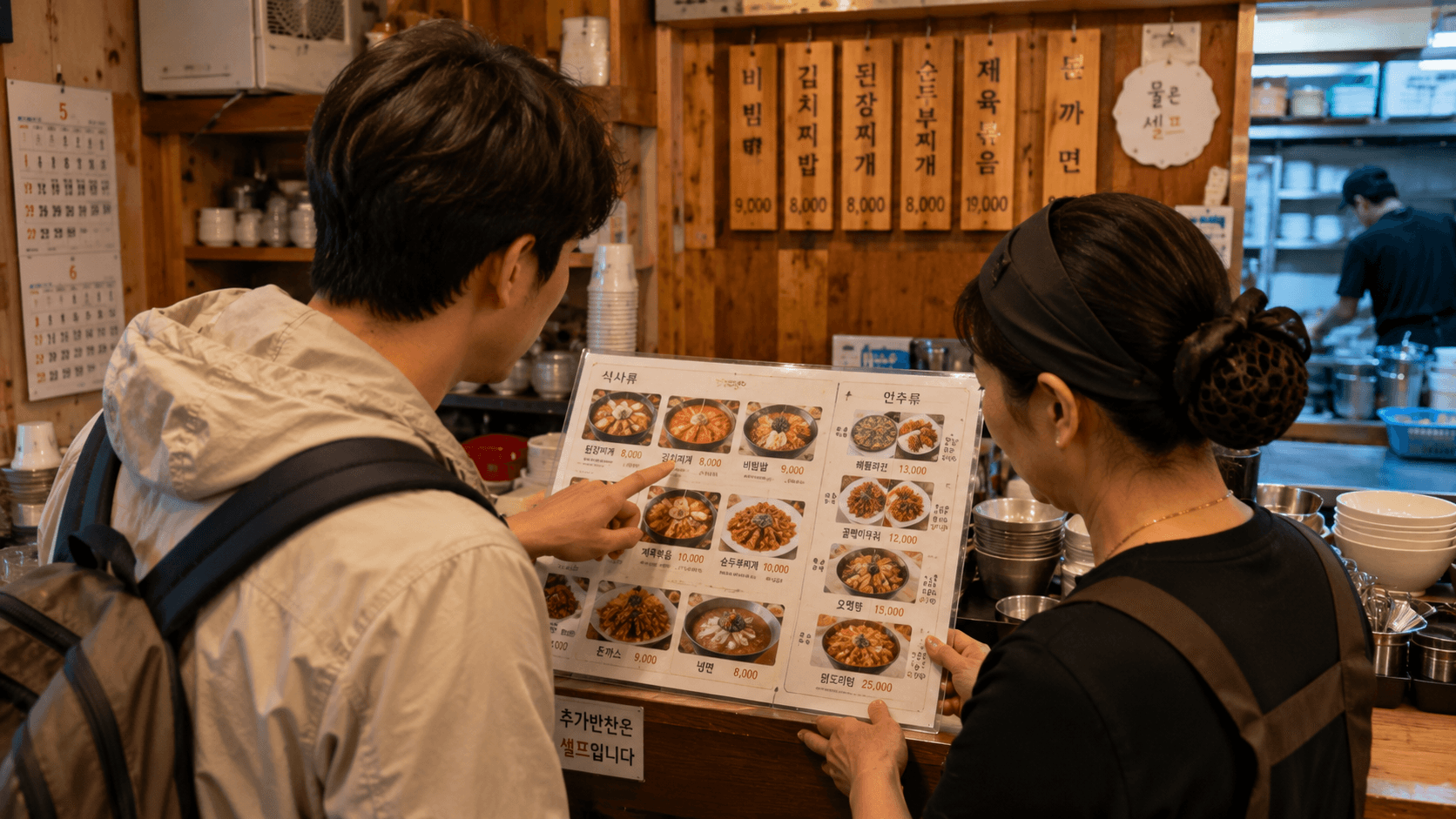
Pointing at a menu or product and saying 이거 주세요 (i-geo ju-se-yo), meaning this one, please, is one of the most useful strategies for a short trip.
Listen for the 요 ending
Many everyday polite expressions end in 요 (yo), including 안녕하세요, 괜찮아요, and 얼마예요? Using these forms is generally more appropriate with strangers than using short informal forms learned from television or social media.
Avoid addressing strangers as 당신
Dictionaries may translate 당신 (dangsin) as you, but it is not a universal substitute for English you. Korean commonly omits the subject or uses a person's title or role. Face the person, make the request politely, and leave you out of the sentence. The Seoul Metropolitan Government's etiquette guide also advises travelers to avoid directly addressing other people as you.
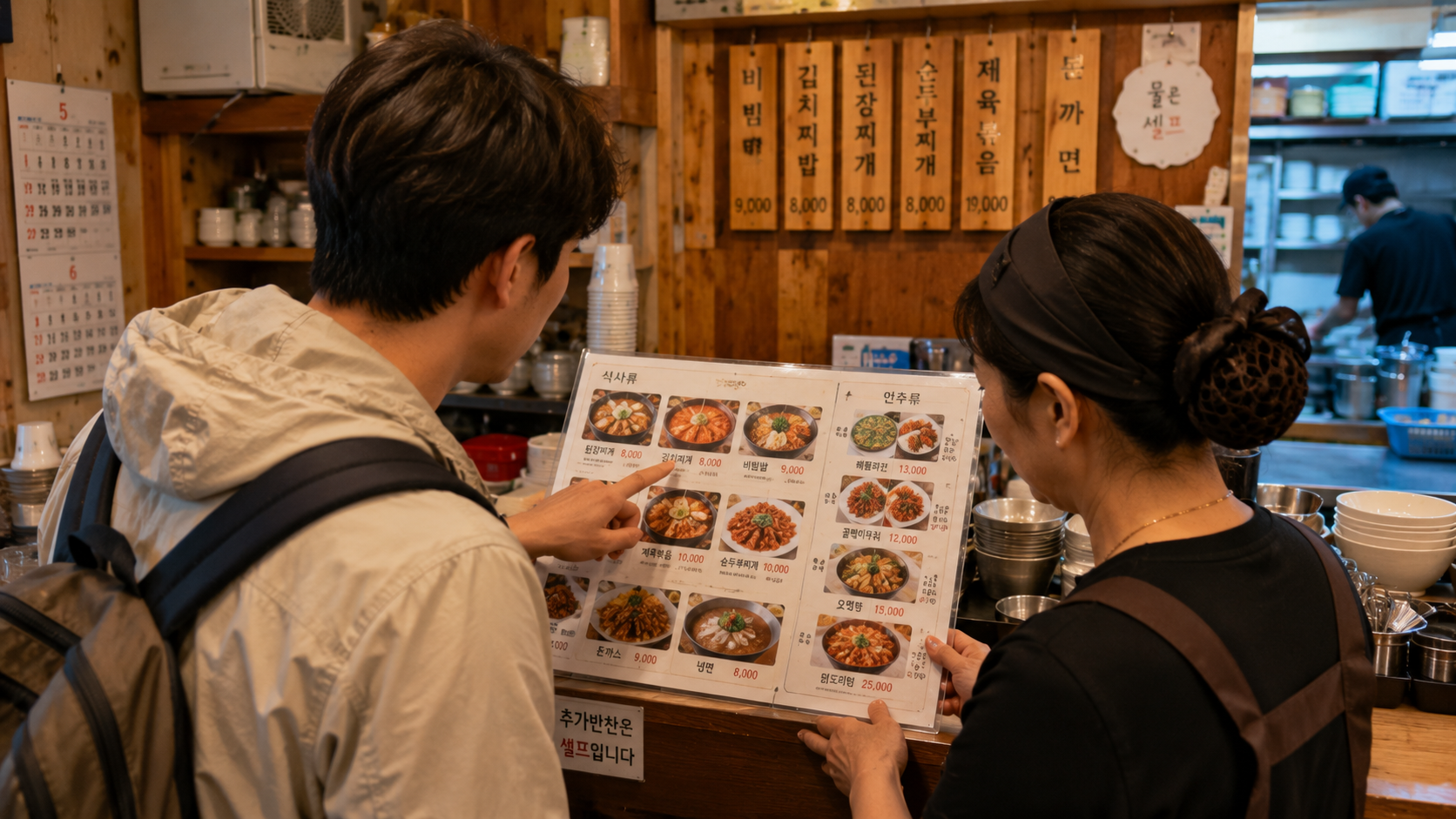
Greetings and basic courtesy
| Situation | Korean | Approximate pronunciation |
|---|---|---|
| Hello | 안녕하세요 | an-nyeong-ha-se-yo |
| Thank you | 감사합니다 | gam-sa-ham-ni-da |
| I am sorry | 죄송합니다 | joe-song-ham-ni-da |
| Excuse me | 실례합니다 | sil-lye-ham-ni-da |
| Yes | 네 | ne |
| No | 아니요 | a-ni-yo |
| It is okay / I am okay | 괜찮아요 | gwaen-cha-na-yo |
| Nice to meet you | 반갑습니다 | ban-gap-seum-ni-da |
| Goodbye, to someone leaving | 안녕히 가세요 | an-nyeong-hi ga-se-yo |
| Goodbye, to someone staying | 안녕히 계세요 | an-nyeong-hi gye-se-yo |
죄송합니다 works both as an apology and as a polite way to get someone's attention. In a busy restaurant, however, 저기요 (jeo-gi-yo) is a common way to call a staff member. It is roughly equivalent to excuse me over here and should be spoken politely rather than shouted aggressively.
When communication becomes difficult
| English | Korean | Approximate pronunciation |
|---|---|---|
| Do you speak English? | 영어 하실 수 있어요? | yeong-eo ha-sil su i-sseo-yo? |
| I do not speak Korean well | 한국어 잘 못해요 | han-gu-geo jal mo-tae-yo |
| Please speak slowly | 천천히 말씀해 주세요 | cheon-cheon-hi mal-sseum-hae ju-se-yo |
| Please say it again | 다시 말씀해 주세요 | da-si mal-sseum-hae ju-se-yo |
| Please write it down | 적어 주세요 | jeo-geo ju-se-yo |
| Please show me | 보여 주세요 | bo-yeo ju-se-yo |
| I do not understand | 이해 못 했어요 | i-hae mot hae-sseo-yo |
| What does this mean? | 이게 무슨 뜻이에요? | i-ge mu-seun tteu-si-e-yo? |
Instead of repeating a place name louder, show its Korean name and full address. This is particularly useful for destinations with similar English spellings or multiple branches.
Asking for directions
Insert the place name before 어디예요? to ask where it is. For example, 서울역이 어디예요? means Where is Seoul Station?
| English | Korean | Approximate pronunciation |
|---|---|---|
| Where is ___? | ___ 어디예요? | ___ eo-di-ye-yo? |
| How do I get to ___? | ___ 어떻게 가요? | ___ eo-tteo-ke ga-yo? |
| Where is the subway station? | 지하철역이 어디예요? | ji-ha-cheol-lyeog-i eo-di-ye-yo? |
| Where is the bus stop? | 버스 정류장이 어디예요? | beo-seu jeong-nyu-jang-i eo-di-ye-yo? |
| Where is the restroom? | 화장실이 어디예요? | hwa-jang-sil-i eo-di-ye-yo? |
| Which exit is it? | 몇 번 출구예요? | myeot beon chul-gu-ye-yo? |
| Is it far? | 멀어요? | meo-reo-yo? |
| I am lost | 길을 잃었어요 | gi-reul i-reo-sseo-yo |
Korean subway stations often have several exits spread across a large area. Asking for the exit number can therefore be more useful than asking only for the station.
Taxis, buses, and trains
In a taxi
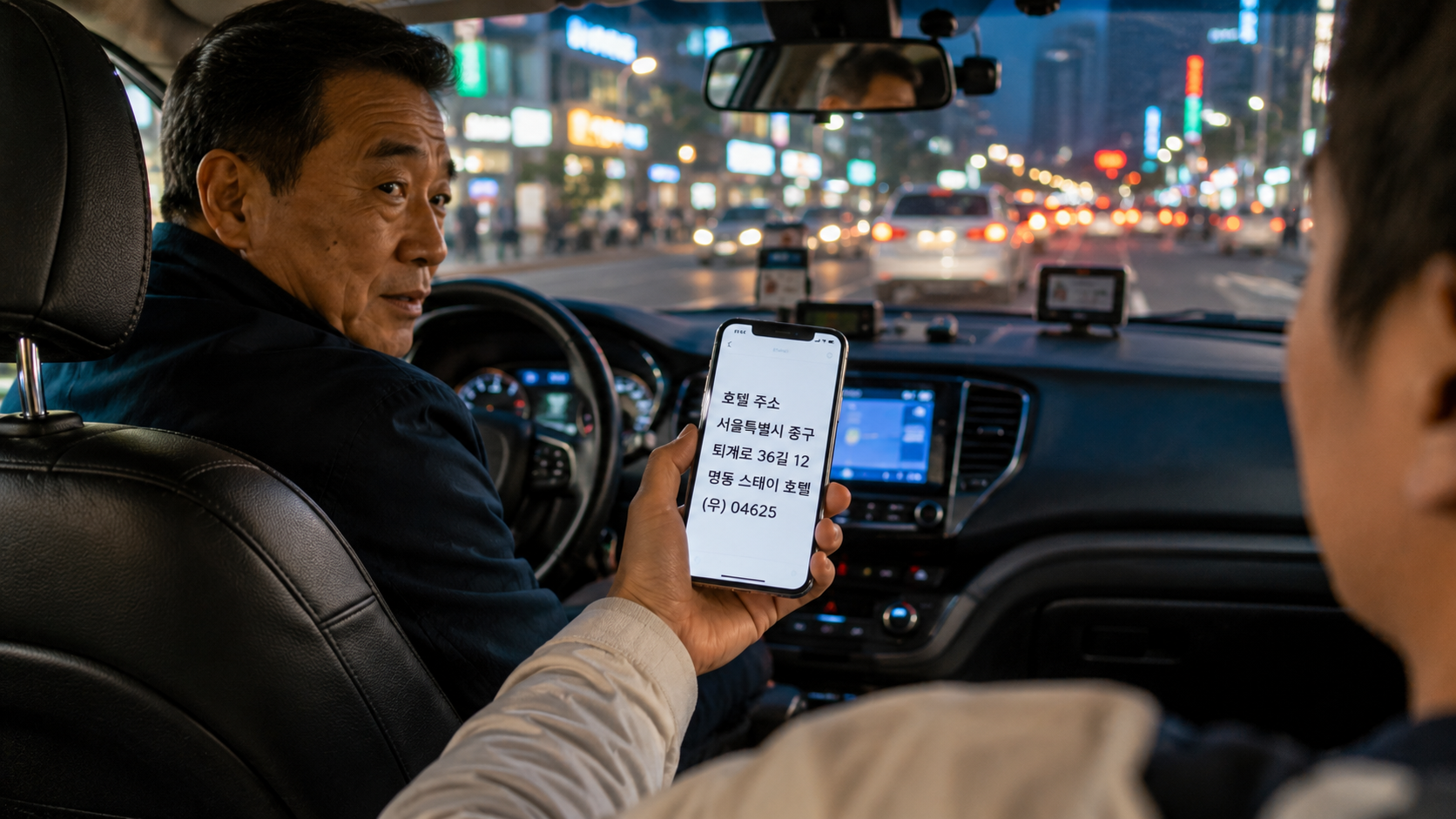
Have the destination open in Hangul before entering. A business name alone may be ambiguous, so include a street address or map pin.
- 이 주소로 가 주세요 (i ju-so-ro ga ju-se-yo): Please take me to this address.
- 여기에서 세워 주세요 (yeo-gi-e-seo se-wo ju-se-yo): Please stop here.
- 얼마나 걸려요? (eol-ma-na geol-lyeo-yo?): How long does it take?
- 카드 돼요? (ka-deu dwae-yo?): Can I pay by card?
- 영수증 주세요 (yeong-su-jeung ju-se-yo): A receipt, please.
On public transport
- 이 버스가 홍대에 가요? (i beo-seu-ga Hongdae-e ga-yo?): Does this bus go to Hongdae?
- 어디에서 내려요? (eo-di-e-seo nae-ryeo-yo?): Where do I get off?
- 서울역에서 내려야 해요? (Seoul-lyeo-ge-seo nae-ryeo-ya hae-yo?): Should I get off at Seoul Station?
- 교통카드 어디서 충전해요? (gyo-tong-ka-deu eo-di-seo chung-jeon-hae-yo?): Where can I top up my transport card?
- 표 한 장 주세요 (pyo han jang ju-se-yo): One ticket, please.
Replace the destination in these examples as needed. Showing the written destination remains the most reliable option if your pronunciation is not understood.
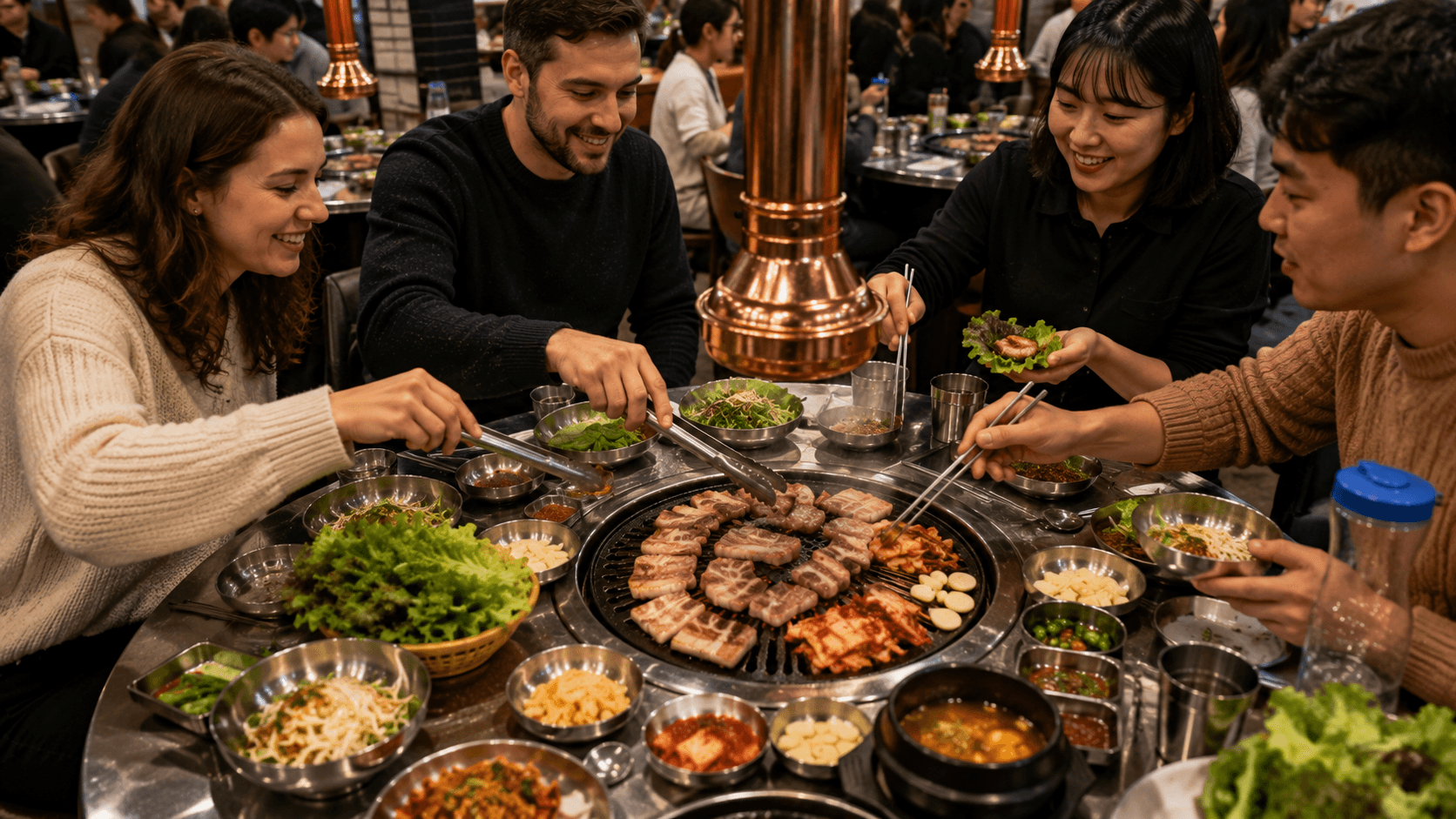
Restaurants and cafés
Getting a table and ordering
| English | Korean | Approximate pronunciation |
|---|---|---|
| One person | 한 명이에요 | han myeong-i-e-yo |
| Two people | 두 명이에요 | du myeong-i-e-yo |
| A menu, please | 메뉴판 주세요 | me-nyu-pan ju-se-yo |
| This one, please | 이거 주세요 | i-geo ju-se-yo |
| What do you recommend? | 추천해 주세요 | chu-cheon-hae ju-se-yo |
| Water, please | 물 주세요 | mul ju-se-yo |
| One more, please | 하나 더 주세요 | ha-na deo ju-se-yo |
| The bill, please | 계산해 주세요 | gye-san-hae ju-se-yo |
| Please pack this to go | 포장해 주세요 | po-jang-hae ju-se-yo |
At many casual restaurants, payment is handled at the front counter rather than at the table. If 계산해 주세요 does not bring the bill, take the table number or order slip to the counter.
Spice levels and dietary needs
- 안 매운 음식 있어요? (an mae-un eum-sik i-sseo-yo?): Do you have food that is not spicy?
- 덜 맵게 해 주세요 (deol maep-ge hae ju-se-yo): Please make it less spicy.
- 고기 안 들어간 음식 있어요? (go-gi an deu-reo-gan eum-sik i-sseo-yo?): Do you have food without meat?
- 땅콩 알레르기가 있어요 (ttang-kong al-le-reu-gi-ga i-sseo-yo): I have a peanut allergy.
- 이거 못 먹어요 (i-geo mot meo-geo-yo): I cannot eat this.
- 계란 들어가요? (gye-ran deu-reo-ga-yo?): Does it contain egg?
- 우유 들어가요? (u-yu deu-reo-ga-yo?): Does it contain milk?
Do not rely on 채식 (chae-sik, vegetarian food) alone if you have strict dietary requirements. A dish without visible meat may still contain meat broth, seafood, fish sauce, or another animal-derived ingredient. Show a translated card listing every ingredient you must avoid. For a serious allergy, confirm ingredients directly with staff and use your own medical guidance rather than treating these phrases as a guarantee of safety.
Shopping and payments
| English | Korean | Approximate pronunciation |
|---|---|---|
| How much is it? | 얼마예요? | eol-ma-ye-yo? |
| Can I pay by card? | 카드 돼요? | ka-deu dwae-yo? |
| Do you have another size? | 다른 사이즈 있어요? | da-reun sa-i-jeu i-sseo-yo? |
| Can I try this on? | 입어 봐도 돼요? | i-beo bwa-do dwae-yo? |
| Do you have another color? | 다른 색 있어요? | da-reun saek i-sseo-yo? |
| A bag, please | 봉투 주세요 | bong-tu ju-se-yo |
| A receipt, please | 영수증 주세요 | yeong-su-jeung ju-se-yo |
| Is an exchange possible? | 교환 가능해요? | gyo-hwan ga-neung-hae-yo? |
| Is a refund possible? | 환불 가능해요? | hwan-bul ga-neung-hae-yo? |
Ask about exchanges or refunds before paying, particularly for discounted goods, cosmetics, opened products, and small independent shops. Store policies differ, so the phrase is a question rather than an assertion that a refund is available.
Hotels and accommodation
- 예약했어요 (ye-yak-hae-sseo-yo): I have a reservation.
- 제 이름은 ___예요 (je i-reu-meun ___ye-yo): My name is ___.
- 체크인하고 싶어요 (che-keu-in-ha-go si-peo-yo): I would like to check in.
- 짐을 맡길 수 있어요? (ji-meul mat-gil su i-sseo-yo?): Can I leave my luggage?
- 와이파이 비밀번호가 뭐예요? (wa-i-pa-i bi-mil-beon-ho-ga mwo-ye-yo?): What is the Wi-Fi password?
- 수건 더 주세요 (su-geon deo ju-se-yo): More towels, please.
- 방에 문제가 있어요 (bang-e mun-je-ga i-sseo-yo): There is a problem with the room.
- 에어컨이 안 돼요 (e-eo-keon-i an dwae-yo): The air conditioner is not working.
- 체크아웃이 몇 시예요? (che-keu-a-u-si myeot si-ye-yo?): What time is checkout?
Keep your booking confirmation available in both English and Korean when possible. The property's Korean name and telephone number can help a driver or local information desk identify it.
Emergencies and urgent help
The following information was verified on June 9, 2026. In an immediate emergency, call 112 for police or 119 for fire and ambulance services. The Korea Tourism Organization advises callers who do not speak Korean to say English please or Interpreter please so the operator can arrange interpretation. See its official emergency guidance for international visitors.
| English | Korean | Approximate pronunciation |
|---|---|---|
| Please help me | 도와주세요 | do-wa-ju-se-yo |
| Please call the police | 경찰 불러 주세요 | gyeong-chal bul-leo ju-se-yo |
| Please call an ambulance | 구급차 불러 주세요 | gu-geup-cha bul-leo ju-se-yo |
| I am sick / It hurts | 아파요 | a-pa-yo |
| Where is the hospital? | 병원이 어디예요? | byeong-won-i eo-di-ye-yo? |
| Where is the pharmacy? | 약국이 어디예요? | yak-gu-gi eo-di-ye-yo? |
| I lost my passport | 여권을 잃어버렸어요 | yeo-gwo-neul i-reo-beo-ryeo-sseo-yo |
| I need an interpreter | 통역이 필요해요 | tong-yeo-gi pi-ryo-hae-yo |
| Please get an interpreter | 통역 부탁드립니다 | tong-yeok bu-tak-deu-rim-ni-da |
For non-emergency tourism information or interpretation assistance, the Korea Tourism Organization operates the 1330 Korea Travel Helpline by telephone and real-time chat. Its official page lists 1330 within Korea and +82-2-1330 from overseas. Service details were verified on June 9, 2026; check the official 1330 helpline page before relying on current language availability or contact methods.
When requesting emergency help, communicate your location first. Show a nearby building name, station exit, road sign, hotel address, or smartphone map pin.
A simple phrase-building method
You do not need to memorize every sentence. Combine a noun with one of these short patterns:
- ___ 주세요: Please give me ___ or please do ___.
- ___ 어디예요?: Where is ___?
- ___ 있어요?: Do you have ___? / Is there ___?
- ___ 돼요?: Is ___ possible? / Does ___ work?
- ___ 안 돼요: ___ does not work or is not possible.
Examples:
- 와이파이 있어요?: Is there Wi-Fi?
- 화장실 어디예요?: Where is the restroom?
- 카드 돼요?: Is card payment possible?
- 와이파이 안 돼요: The Wi-Fi is not working.
Common mistakes to avoid
Depending entirely on Romanization
Romanization is useful as a prompt, but English speakers may interpret the letters differently. Save the Hangul text so the other person can read it.
Using informal language from entertainment
Short forms such as 고마워 for thanks are informal. Use 감사합니다 with strangers and service staff unless you understand the relationship and speech level.
Giving only an English place name
Some businesses have similar names, several branches, or no commonly recognized English name. Show the Hangul name, full street address, and map location.
Treating a dietary phrase as confirmation
Staff may interpret no meat differently from a traveler with a strict vegetarian diet or allergy. Name the specific ingredients and explain whether broth, seafood, eggs, or dairy must also be excluded.
Saying yes when you mean no
네 means yes or acknowledgment, while 아니요 means no. If a question is confusing, use 이해 못 했어요 and ask the person to repeat or write it down.
What to check before you go
- Save your accommodation's name, address, and telephone number in Hangul.
- Screenshot the Korean names of major destinations in case mobile data is unavailable.
- Keep 112, 119, and the current 1330 helpline details accessible.
- Prepare a Korean-language allergy or medical information card if necessary.
- Save phrases for your specific trip, such as luggage storage, wheelchair access, prayer facilities, or dietary restrictions.
- Practice saying 안녕하세요, 감사합니다, 죄송합니다, and 이거 주세요 aloud.
- Confirm changing helpline services and emergency guidance through official sources shortly before departure.
Your most useful next step is to create a phone note containing the 10 quick phrases, your hotel address in Hangul, and any essential dietary or medical statement. Make it available offline and place emergency numbers at the top.
Sources
- National Institute of Korean Language: Romanization of Korean
- Seoul Metropolitan Government: Etiquette and basic Korean phrases
- Korea Tourism Organization: 1330 Travel Helpline and Complaint Center
- Korea Tourism Organization: Disaster safety services for international visitors
- Korea Tourism Organization: Emergency situations