South Korea is straightforward to explore once you understand four essentials: confirm your entry documents, arrange mobile data, obtain a rechargeable transport card, and use a Korea-focused navigation app. Seoul is an easy starting point, but allow enough time for regional cities rather than treating every destination as a day trip.
Quick answer
For a smooth first visit:
- Check visa and Korea Electronic Travel Authorization (K-ETA) requirements for your passport.
- Submit the free e-Arrival Card if required.
- Install Naver Map or KakaoMap before departure.
- Arrange roaming, a SIM, or an eSIM with voice service if possible.
- Carry a payment card plus a modest amount of Korean won.
- Buy a Tmoney or EZL transport card after arrival.
- Stay at least four full days in Seoul; add two or more nights for each regional destination.
- Save 112 for police, 119 for fire or ambulance, and 1330 for tourist assistance.
Entry rules, fares, and service details below were verified on June 9, 2026. Check them again shortly before traveling.
Before booking: visa, K-ETA, and arrival documents
Check the rule for your passport
Korean entry conditions depend on nationality, trip purpose, and intended length of stay. Do not assume that advice written for US, Canadian, British, European, or Australian travelers applies to another passport.
Use the official Korea Visa Portal's Visa Navigator to determine whether you need a visa. For individual cases, contact the Korean embassy or consulate responsible for your place of residence. Immigration decisions remain the authority of the Korean government.
Understand the 2026 K-ETA exemption
K-ETA is an electronic authorization for eligible visa-free visitors. However, the Ministry of Justice has extended the temporary exemption for the countries and regions already covered by that exemption through December 31, 2026, Korea Standard Time. This does not mean every traveler is exempt.
Check your status using the official K-ETA website. The site should identify the exemption when it scans an eligible passport. Travelers who are exempt may still apply voluntarily, partly because holders of a valid K-ETA do not need to submit an arrival card. As verified on June 9, 2026, the official application fee is KRW 10,000, and assessment generally takes up to 72 hours.
Use only the government website or official K-ETA app. Third-party sites may charge substantially more and cannot guarantee faster approval.
Submit the e-Arrival Card if required
In principle, foreign arrivals who are not exempt must submit an entry declaration. Exemptions include registered foreign residents, travelers holding a valid K-ETA, and certain crew members.
The free official e-Arrival Card can be submitted from three days before arrival, based on Korea Standard Time. You will need passport details, flight information, your accommodation address, contact details, occupation, and purpose of entry. It remains valid for 72 hours after submission.
A March 2026 Ministry of Justice warning confirmed the existence of imitation sites. The official service does not request payment information. Save your hotel's Korean address before beginning the form.
When to visit Korea
Korea has four distinct seasons, and conditions can change quickly.
- March to May: Generally mild, but early March can still feel wintry. Spring blossoms are weather-dependent, and popular locations become crowded.
- June to August: Hot and humid. Heavy rain is possible during the summer rainy period, while heat and tropical storms can disrupt plans later in the season.
- September to November: Often comfortable for walking, although early autumn can remain warm and storms are still possible.
- December to February: Cold and dry in much of the country. Seoul frequently falls below freezing, while southern coastal cities are usually milder.
Pack for the actual forecast rather than the season's reputation. The Korea Meteorological Administration's Weather Nuri service provides official forecasts and warnings.
Avoid building an inflexible itinerary around cherry blossoms or autumn foliage. Their timing varies by location and yearly weather.
How long to spend and where to go
A first trip works better when it combines one major city with one regional destination.
| Trip length | Realistic plan |
|---|---|
| 4-5 days | Seoul, with an optional nearby day trip |
| 7 days | Seoul plus Busan, Gyeongju, Jeonju, or another regional base |
| 10 days | Seoul plus two regional areas |
| 14 days | Seoul, several mainland destinations, and possibly Jeju |
Do not underestimate transfer time. Checking out, reaching a station, waiting, traveling, and checking in can consume half a day even when the train journey itself is short.
For Seoul, neighborhoods around Jongno, Euljiro, Myeong-dong, Hongdae, or major subway interchanges are practical for sightseeing. Check the walking route from the station, not merely the straight-line distance. A hotel 300 meters from an exit may still involve stairs, hills, or a long underground passage.
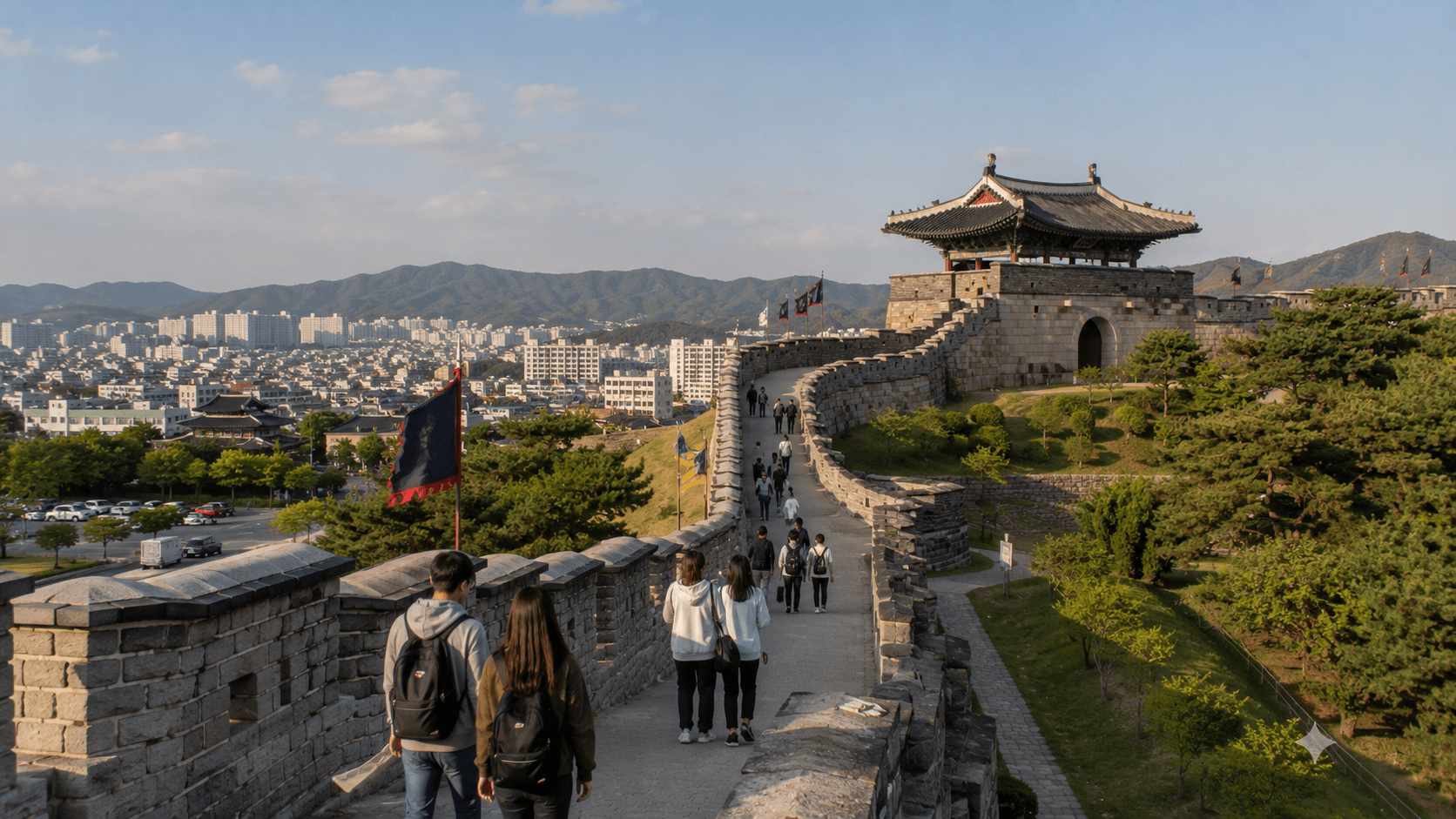
Busan usually deserves at least two nights. Gyeongju is easier with one or two nights than as a rushed return trip from Seoul. Jeju requires a flight or ferry and should be treated as a separate part of the itinerary.
Getting from Incheon Airport to Seoul
First confirm whether your flight uses Incheon Airport Terminal 1 or Terminal 2. The terminals are separate, although airport transport serves both.
AREX all-stop train
The Airport Railroad all-stop service is usually practical for Hongik University, Gongdeok, or connections into the Seoul subway network. It accepts compatible transport cards and has space for luggage, although it can become busy.
AREX Express
The reserved-seat AREX Express runs directly between Incheon Airport and Seoul Station. As verified on June 9, 2026, the official standard adult fare displayed by Airport Railroad is KRW 13,000. It is convenient for travelers staying near Seoul Station or transferring to KTX, but it does not stop at Hongdae.
Airport limousine bus
Airport buses may be easier with large luggage when they stop close to your hotel. Travel time is less predictable because of traffic. Confirm the current stop, fare, ticket counter, and last departure through the Incheon International Airport transport guide on your travel date.
Taxi
Use the designated airport taxi rank. Ignore unsolicited transportation offers inside the terminal. Show the driver your destination in Hangul, including the full street address and telephone number. Tolls can be added to the metered fare.
If you land late, check the last train and bus before departure. Do not assume services operate all night.
Public transport: buy a card and tap correctly
Tmoney and EZL are rechargeable prepaid cards accepted on most urban buses and subway systems. According to the Korea Tourism Organization's transport-card guide, they can be purchased and recharged at convenience stores and used at participating merchants.
Keep some cash because not every recharge point accepts an overseas card. Add only what you expect to use; refund procedures and fees vary.
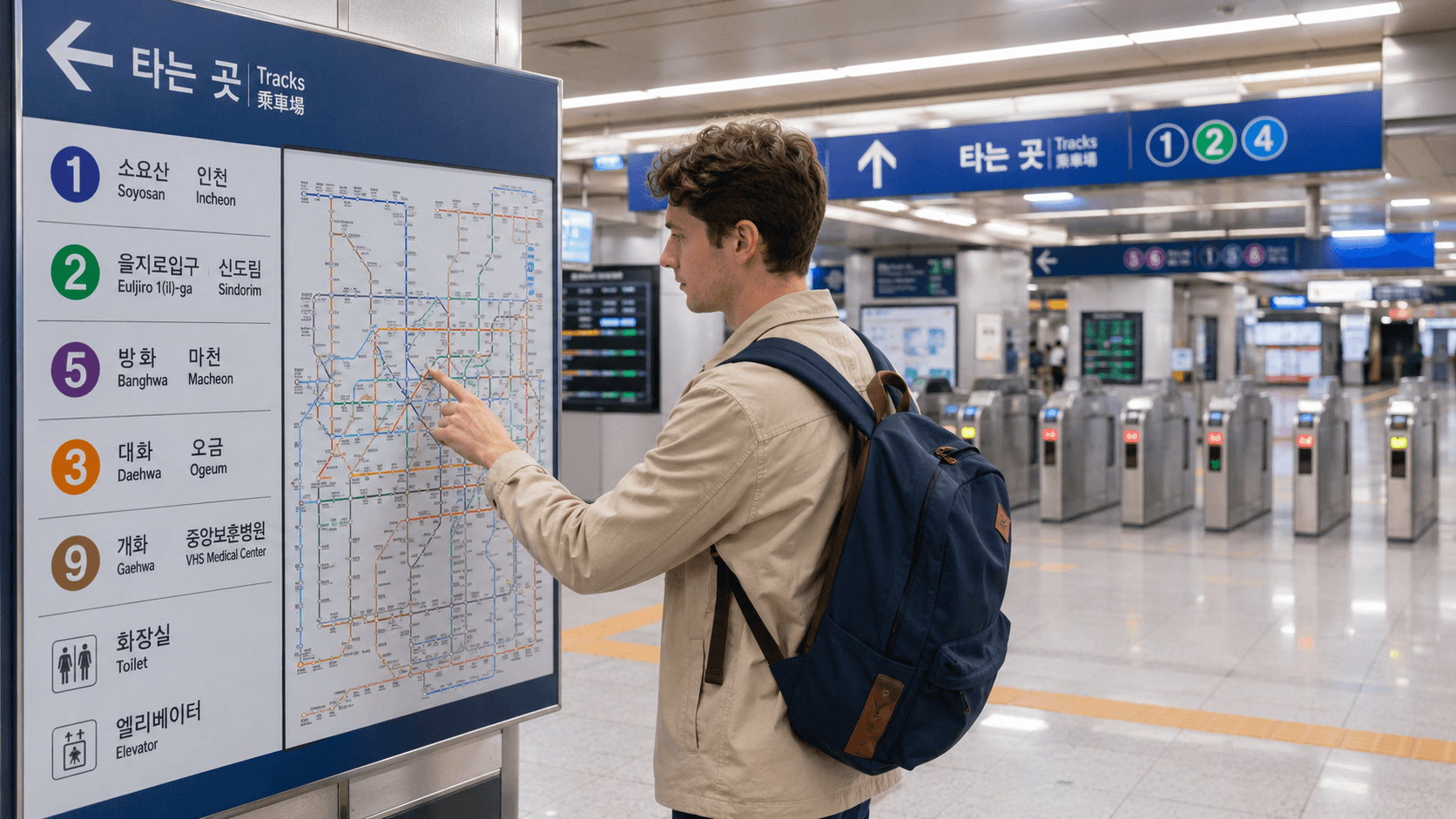
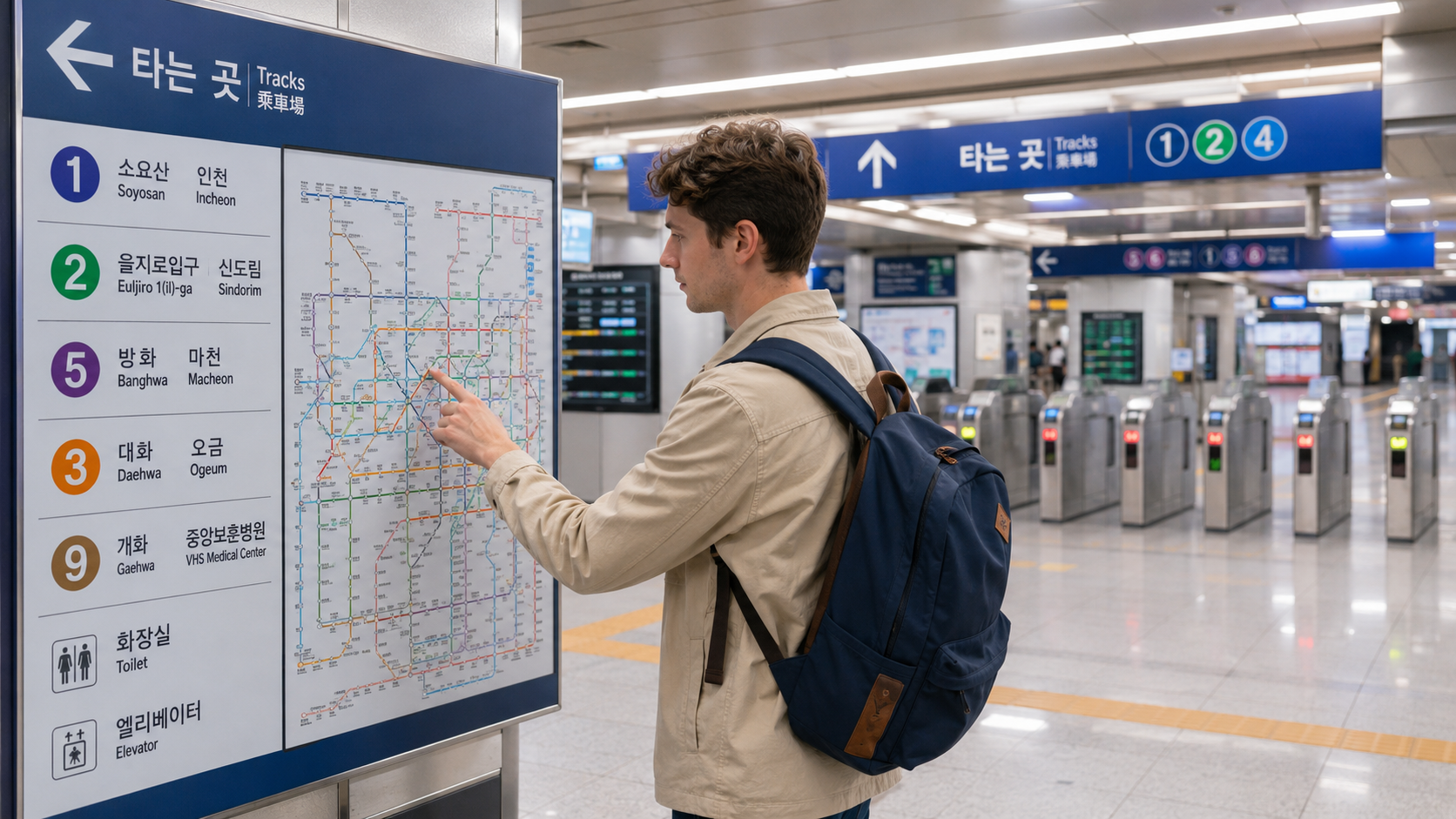
Subway basics
- Find the line number, station name, and direction of travel.
- Tap the card at the entry gate.
- Follow signs for the correct platform and transfer station.
- Tap again when leaving.
In Seoul, the adult subway base fare paid by transport card is KRW 1,550, verified on June 9, 2026 through the Seoul Metropolitan Government fare table. Distance surcharges can apply. A single-use ticket costs more and requires a refundable KRW 500 deposit.
Bus basics
Enter through the front door unless signs indicate otherwise, tap your card, and tap again before leaving. Tapping out is important for distance calculations and transfer discounts. Press the stop button early and be ready near the door.
Public transport becomes limited late at night. Check the final service for your exact route rather than relying on a station's general closing time.
Trains and travel between cities
KTX high-speed trains connect Seoul with cities including Busan, Daegu, Gyeongju's Singyeongju Station, Gangneung, Jeonju, and Gwangju. Reserve through an official KORAIL channel and verify the departure station carefully: Seoul, Yongsan, Cheongnyangni, and Suseo are different terminals, and SRT trains use a separate system.
Popular departures can sell out during weekends, public holidays, and the Seollal and Chuseok holiday periods. Book important journeys in advance through KORAIL's official booking service or its official app. Avoid similarly named unofficial booking sites unless you understand their additional fees and conditions.
Large suitcases may need to go in racks near the carriage entrance. Keep valuables with you, and arrive early enough to locate the platform and carriage.
Mobile data, maps, and useful apps
Reliable mobile data is more useful than a large stack of printed directions. Korea's major airports have carrier roaming counters offering SIM cards and other connectivity products; the Korea Tourism Organization communications guide confirms services at Incheon, Gimpo, Gimhae, and Jeju airports.
Compare roaming, physical SIM, and eSIM options before travel. Check whether your phone is unlocked and whether the plan includes a Korean telephone number. A local number can help with restaurant queues, delivery services, and reservations, although some services still require identity verification unavailable to short-term visitors.
Install these before departure:
- Naver Map or KakaoMap: For local place searches, public transport, and walking directions.
- Papago: For Korean-English text, voice, and image translation.
- Your airline and accommodation apps: Keep offline copies of bookings.
- KORAIL or the relevant official transport app: For regional journeys.
Save important destinations in both English and Hangul. Searching the Korean name often produces better results.
Money and payments
The local currency is the Korean won, written as KRW or ₩. International cards are widely accepted at hotels, department stores, restaurants, cafés, and convenience stores, but occasional foreign-card failures occur.
Carry:
- At least one physical Visa or Mastercard from a major issuer.
- A backup card stored separately.
- A modest amount of KRW for transport-card recharging, markets, lockers, and small businesses.
Choose KRW if a payment terminal or ATM offers dynamic currency conversion into your home currency. Your bank's foreign transaction and cash-withdrawal fees still apply, so review them before departure.
Foreign visitors may qualify for a tax refund at participating stores. As verified on June 9, 2026, the minimum eligible purchase shown in the Korea Tourism Organization tax-refund guide is KRW 15,000. Look for a Tax Refund or Tax Free sign, present your passport when requested, and retain the goods and documentation until departure procedures are complete.
Electricity, luggage, and accessibility
Korea uses 220 volts at 60 hertz with two round-pin sockets. Bring a suitable adapter, and confirm that chargers and appliances support 220V. A plug adapter does not convert voltage.
Subway stations can be large, with long transfers and exits that lack convenient elevators. Use station maps to locate accessible exits, especially with wheeled luggage. Avoid rush periods when possible: approximately 7:30-9:00 in the morning and 17:30-19:30 on weekdays.
Many major stations offer lockers, but size and availability vary. Do not depend on finding an empty large locker during busy periods; ask your hotel about luggage storage or forwarding options.
Food, ordering, and dietary needs
Restaurants commonly place water and side dishes at a self-service station. A call button on the table may be used to request staff. Payment is usually made at the counter when leaving rather than at the table.
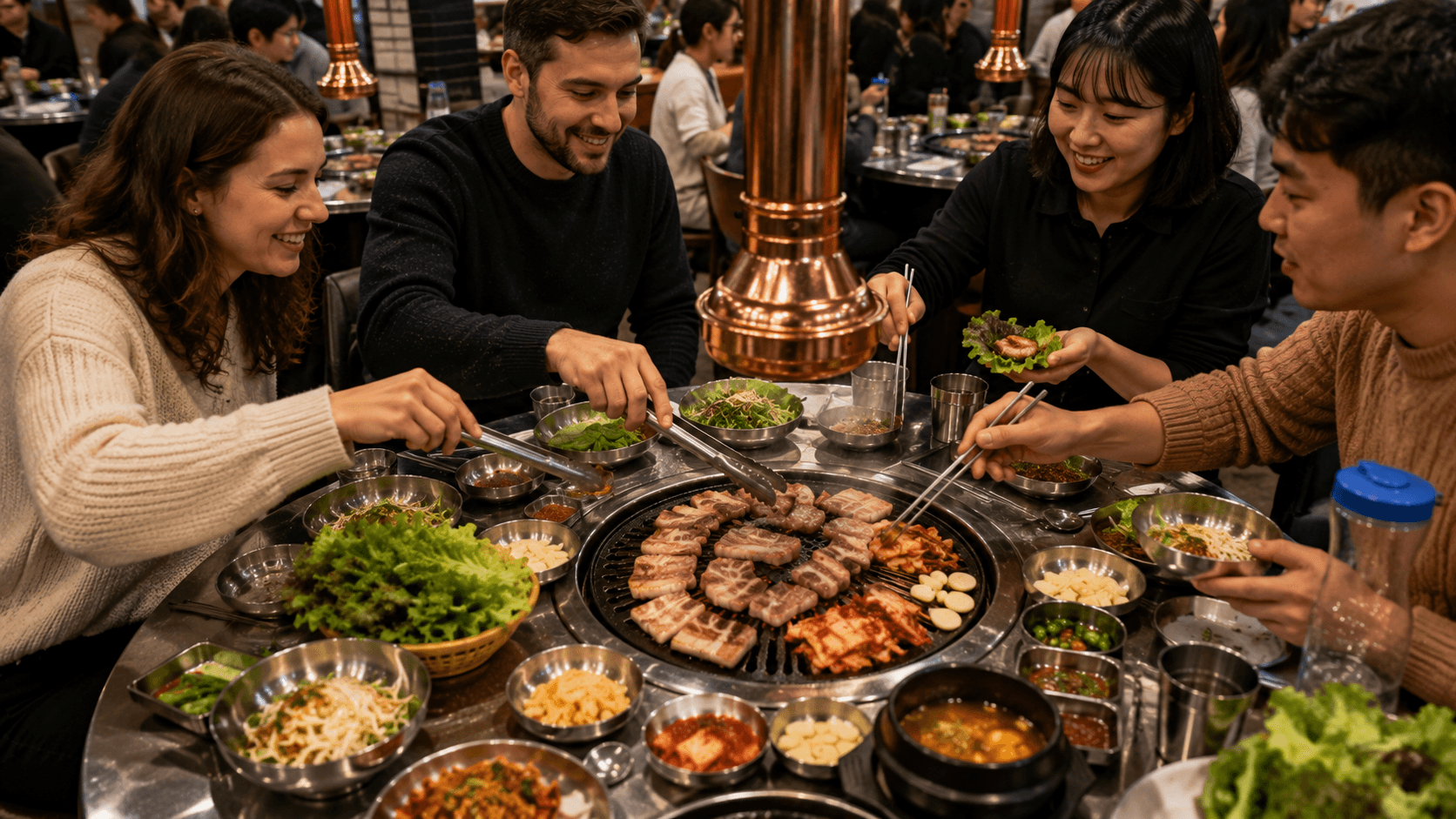
Solo travelers should know that some barbecue, hot-pot, and shared-dish restaurants require a minimum order for two people. Cafés, noodle shops, rice dishes, markets, department-store food halls, and many casual restaurants are easier for one person.
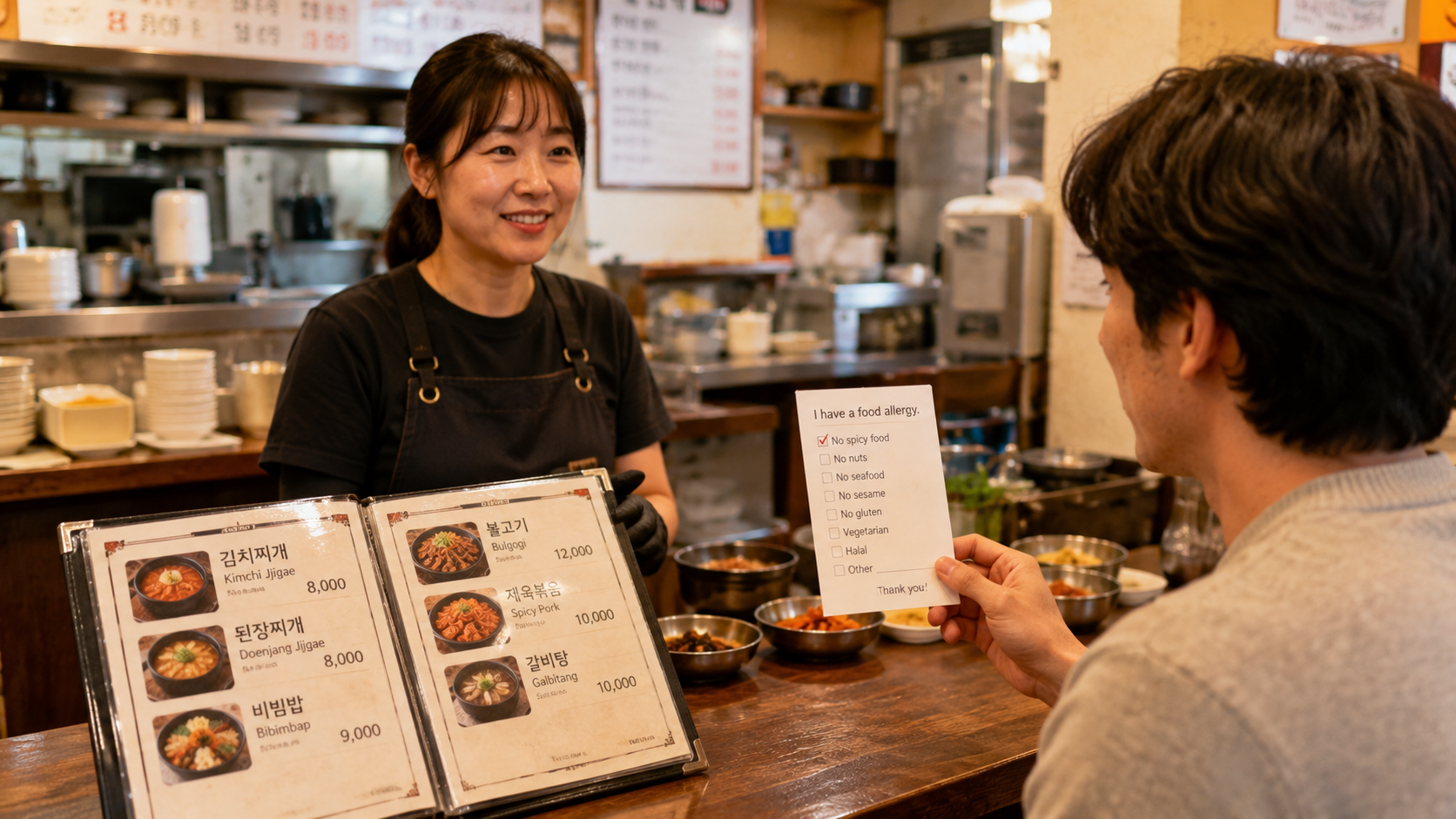
Travelers with allergies or strict dietary requirements should carry a clearly translated card stating the ingredient and the severity of the reaction. Ask about broths, sauces, garnishes, and shared cooking surfaces. Removing a visible ingredient does not necessarily remove fish, shellfish, meat, soy, sesame, or wheat from the dish.
Everyday etiquette that helps
Follow visible local cues rather than trying to memorize rigid rules.
- Queue at marked subway and bus boarding lines.
- Let passengers leave before entering.
- Keep calls and videos quiet on public transport.
- Avoid occupying priority seats when passengers who need them are present.
- Remove shoes when entering accommodation, restaurants, or rooms where the floor is raised and shoes are left at the entrance.
- Use two hands, or support one wrist with the other hand, when giving something to an older person or in a formal interaction.
- Sort waste according to the labels at your accommodation.
English ability varies. A polite greeting, annyeonghaseyo (안녕하세요), and thank you, gamsahamnida (감사합니다), are useful, but a translation app is more important than memorizing long phrases.
Safety and assistance
Korea's emergency numbers are:
- 112: Police
- 119: Fire and ambulance
- 1330: Korea Travel Helpline and tourist interpretation
- 1345: Immigration Contact Center
These details were verified on June 9, 2026 through the Korea Tourism Organization emergency guide and Korea Immigration Service.
If calling an emergency number without Korean, say "English please" or "Interpreter please", then provide your location. Save your hotel's Hangul address and nearest landmark. For lost property, ask the station, transport operator, hotel, or police and check the official LOST112 service.
Travel insurance should cover medical treatment, cancellation, luggage, and activities planned during the trip. Insurance conditions are financial contracts, so compare exclusions and claim requirements directly with the provider.
Common first-time mistakes
- Arriving without checking K-ETA, visa, or arrival-card rules for the correct passport.
- Using a paid imitation immigration website.
- Planning too many cities and losing days to transfers.
- Depending on one payment card or carrying no recharge cash.
- Booking accommodation based only on neighborhood name, without checking the station exit and walking route.
- Taking the wrong train because the destination is correct but the departure station is not.
- Assuming trains and airport transport run throughout the night.
- Boarding a bus without confirming its direction.
- Treating Jeju as a quick extension of a Seoul itinerary.
- Scheduling outdoor highlights without a rain, heat, or poor-weather alternative.
What to check before you go
One month before departure
- Confirm passport validity and entry requirements.
- Apply for a visa or K-ETA if required.
- Reserve intercity trains needed during busy periods.
- Review travel insurance and medication rules.
- Check whether your phone is unlocked.
Three days before arrival
- Submit the free e-Arrival Card if required.
- Check the weather and official safety alerts.
- Confirm your airport terminal and transport to the hotel.
- Save accommodation details in English and Hangul.
- Download offline copies of bookings and passport information.
On arrival
- Connect your phone before leaving the terminal.
- Withdraw or exchange a modest amount of KRW.
- Buy and load a Tmoney or EZL card.
- Verify the last service if arriving at night.
- Use only official transport counters, ranks, and ticket machines.
Your most useful next step is to check your passport in the official Visa Navigator, then build the itinerary around the number of full days available rather than the number of destinations on a wish list.