Halal food is available in South Korea, but finding it usually requires more planning than in Muslim-majority destinations. Seoul has the widest choice, particularly around Itaewon and Seoul Central Masjid. Options are more limited elsewhere, although Muslim communities and selected restaurants can be found in cities including Busan, Incheon, Daegu, Jeonju, Gwangju, and Jeju.
The most important point is that “Muslim-friendly,” “pork-free,” and “halal-certified” do not mean the same thing. Check the restaurant's classification, ask about ingredients, and confirm current information directly before making a special journey.
Information and official directories in this guide were checked on June 11, 2026. Restaurant certification, menus, opening hours, and reservation policies can change.
Quick answer
- Most reliable choice: A restaurant displaying valid certification from the Korea Muslim Federation (KMF) or another halal certification body you recognize.
- Easiest area in Seoul: Itaewon, especially around Seoul Central Masjid.
- Best official starting point: The Korea Tourism Organization's Muslim-friendly Travel portal.
- Do not assume: Vegetarian, seafood-based, pork-free, or alcohol-free food is automatically halal.
- Outside major cities: Identify restaurants and grocery shops before leaving, and carry a backup meal or certified packaged food.
- Before visiting: Confirm the branch, certification status, menu, opening hours, and whether halal dishes require advance reservations.
Understanding Korea's Muslim-friendly restaurant categories
The Korea Tourism Organization (KTO) uses four classifications for restaurants serving Muslim visitors. Understanding these categories is more useful than relying on a general “halal food” search.
| KTO category | What it means | What you should check |
|---|---|---|
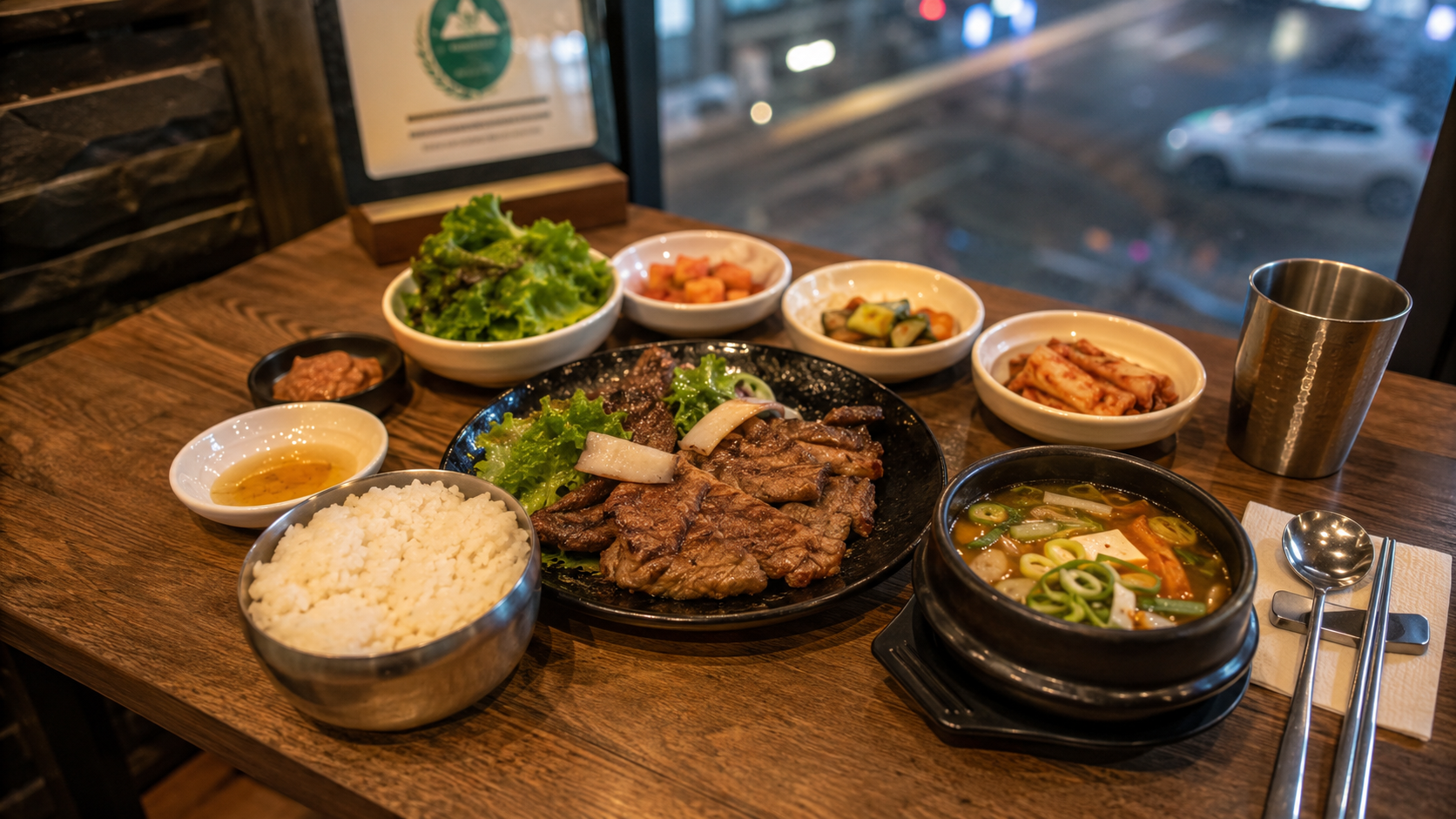
| Halal Certified | The restaurant is certified by an accredited halal certification agency, such as KMF. | Check that the certificate is current and applies to that location. |
| Self-certified | All food is halal, according to the Muslim restaurant owner. | Ask whether all meat, sauces, and processed ingredients are halal. |
| Muslim Friendly | Some halal dishes are available. Alcohol may be sold. | Identify the specific halal dishes and ask about preparation and shared equipment. |
| Pork Free | The restaurant does not use pork, but does not provide a halal menu. Alcohol may be sold. | Meat may not be halal, and broths or sauces may contain other ingredients you avoid. |
KTO also uses pictograms for details such as a Muslim owner or chef, halal menus, pork-free menus, alcohol-free premises, and halal meals requiring reservations. Its warning for hotel restaurants is particularly important: a hotel buffet classified as Muslim-friendly may still serve pork elsewhere in the buffet.
Treat these categories as planning information, not as substitutes for your own dietary standard. Travelers differ in whether they accept self-certification, kitchens that serve alcohol, shared cooking equipment, or seafood and vegetarian meals from non-halal kitchens.
How to verify a halal restaurant
1. Start with an official directory
Use the KTO Muslim-friendly Travel portal to understand the classification system and access its restaurant and tourist-map resources. Older downloadable guides may still appear online, so do not assume every listing remains current.
For KMF certification information, consult the Halal Advancement Institute of Korea, which operates in connection with the Korea Muslim Federation. Its website states that KMF certification is recognized by several overseas halal authorities.
2. Check the exact branch
Certification or halal procedures may apply to one branch rather than an entire restaurant chain. Compare the certificate's business name and address with the location you plan to visit.
A delivery-app listing with the same English restaurant name is not enough. Korean businesses sometimes have similar names, relocate, or operate multiple branches with different menus.
3. Contact the restaurant
Confirm the following shortly before your visit:
- Is the restaurant still halal-certified or fully halal?
- Is all meat halal, or only selected dishes?
- Is pork handled in the kitchen?
- Is alcohol used in marinades, sauces, or cooking?
- Are fryers, grills, utensils, and storage areas shared?
- Does the halal meal require an advance reservation?
- Are the current opening hours different on Fridays, public holidays, or during Ramadan?
Messaging may be easier than a telephone call if there is a language barrier. Keep the question short and specify the date, time, number of diners, and dietary requirement.
Where halal food is easiest to find
Seoul: start with Itaewon
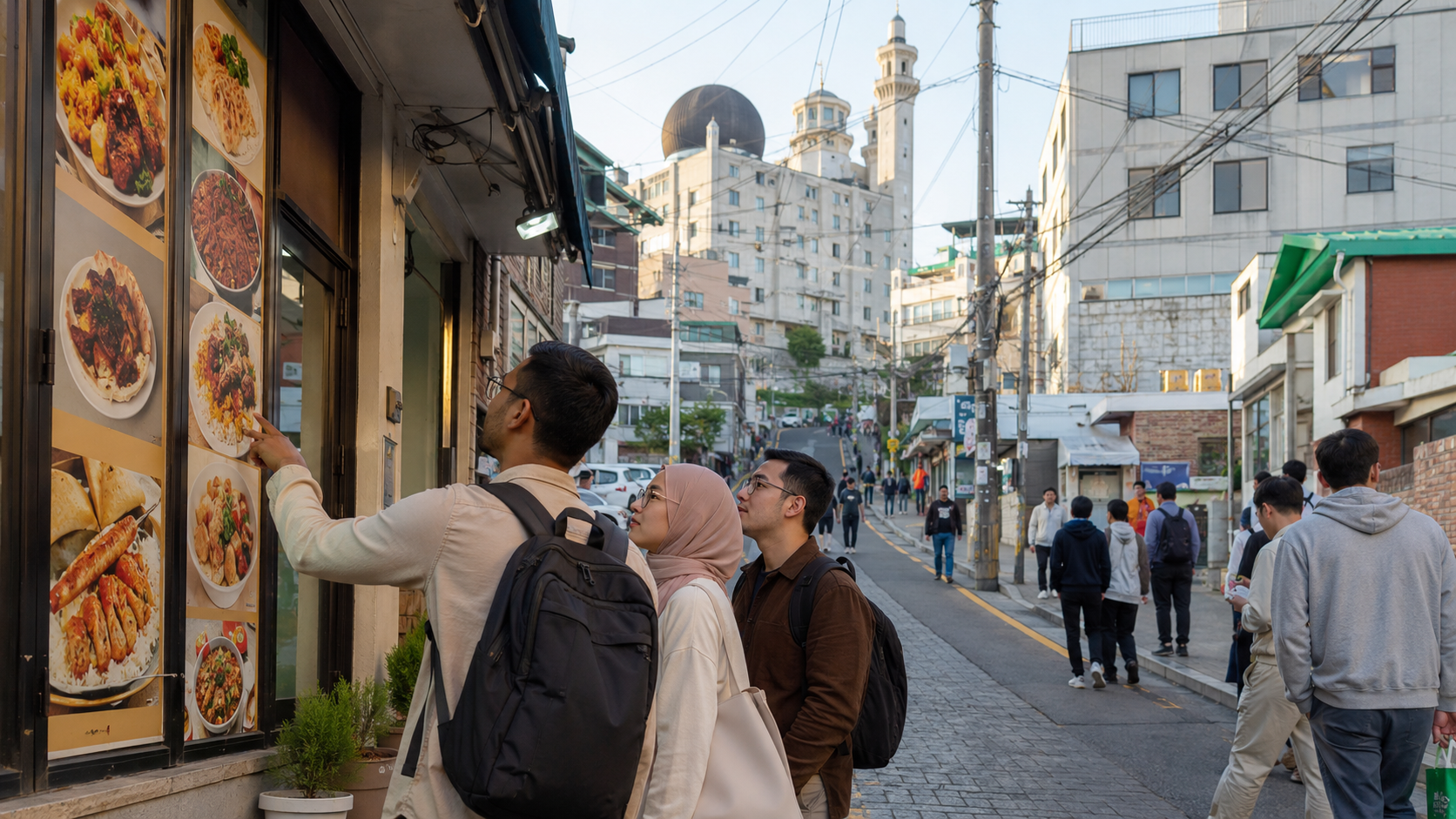
Itaewon in Yongsan-gu is the most practical base for travelers who want several halal dining and grocery options within one area. Seoul Central Masjid and the Korea Muslim Federation are located at 39 Usadan-ro 10-gil. The KMF's official directions lead from Itaewon Station on Seoul Subway Line 6.
The streets uphill from central Itaewon contain restaurants and shops serving Muslim communities from Korea, South Asia, Southeast Asia, Central Asia, Türkiye, and the Middle East. This variety is useful, but proximity to the mosque is not proof that every nearby restaurant is halal. Look for certification and ask directly.
When choosing accommodation, staying near Itaewon can reduce meal-planning time. Alternatively, save several verified restaurants on your Korean map app and group them with nearby sightseeing plans.
Busan, Jeju, and other cities
Halal options outside Seoul are more dispersed. A useful first step is to identify the nearest mosque or Islamic center, then ask the local community about currently operating restaurants and food shops.
The KMF's local Muslim community directory listed branches and centers in locations including Busan, Incheon, Daegu, Jeonju, Gwangju, Gyeongju, Ansan, Changwon, Gimhae, and Jeju when checked on June 11, 2026. This is a mosque directory, not a restaurant directory, but it can provide a practical local contact point.
Do not build a tight itinerary around an unconfirmed restaurant. In smaller cities, a listed business may close between lunch and dinner, require a group reservation, or stop serving a particular halal menu.
Korean dishes that require careful checking
A dish without visible pork is not necessarily halal. Meat stocks, seafood extracts, fermented seasonings, cooking alcohol, and processed ingredients are common in Korean kitchens.
Bibimbap
Bibimbap (비빔밥) is rice mixed with vegetables and sauce. Standard versions often include beef and egg. Requesting no meat does not confirm that every component or sauce meets your requirements. At an ordinary restaurant, ask about the gochujang sauce, side dishes, and preparation area.
Gimbap
Gimbap (김밥) is rice and fillings rolled in seaweed. Even “vegetable gimbap” may contain ham, egg, imitation crab, fish cake, or processed pickles. Watch the preparation if possible and list every ingredient you need removed.
Kimchi and side dishes
Kimchi commonly contains fish sauce, salted seafood, or other animal-derived flavorings. It may be acceptable to some Muslim diners but unsuitable for others. Side dishes called banchan (반찬) can also contain tiny pieces of meat, anchovy stock, or seafood seasoning that are not obvious from appearance.
Soups, stews, and noodles
Kimchi stew, soft-tofu stew, ramyeon, noodle soup, and rice-cake dishes may use pork, beef, anchovy, seafood, or mixed stock. Removing pieces of meat does not remove the broth in which the dish was cooked.
Tteokbokki (떡볶이), for example, looks like a simple rice-cake dish but frequently includes fish cake and may use anchovy-based stock. Instant noodles can contain meat-derived seasoning even when no meat is visible.
Barbecue and fried food
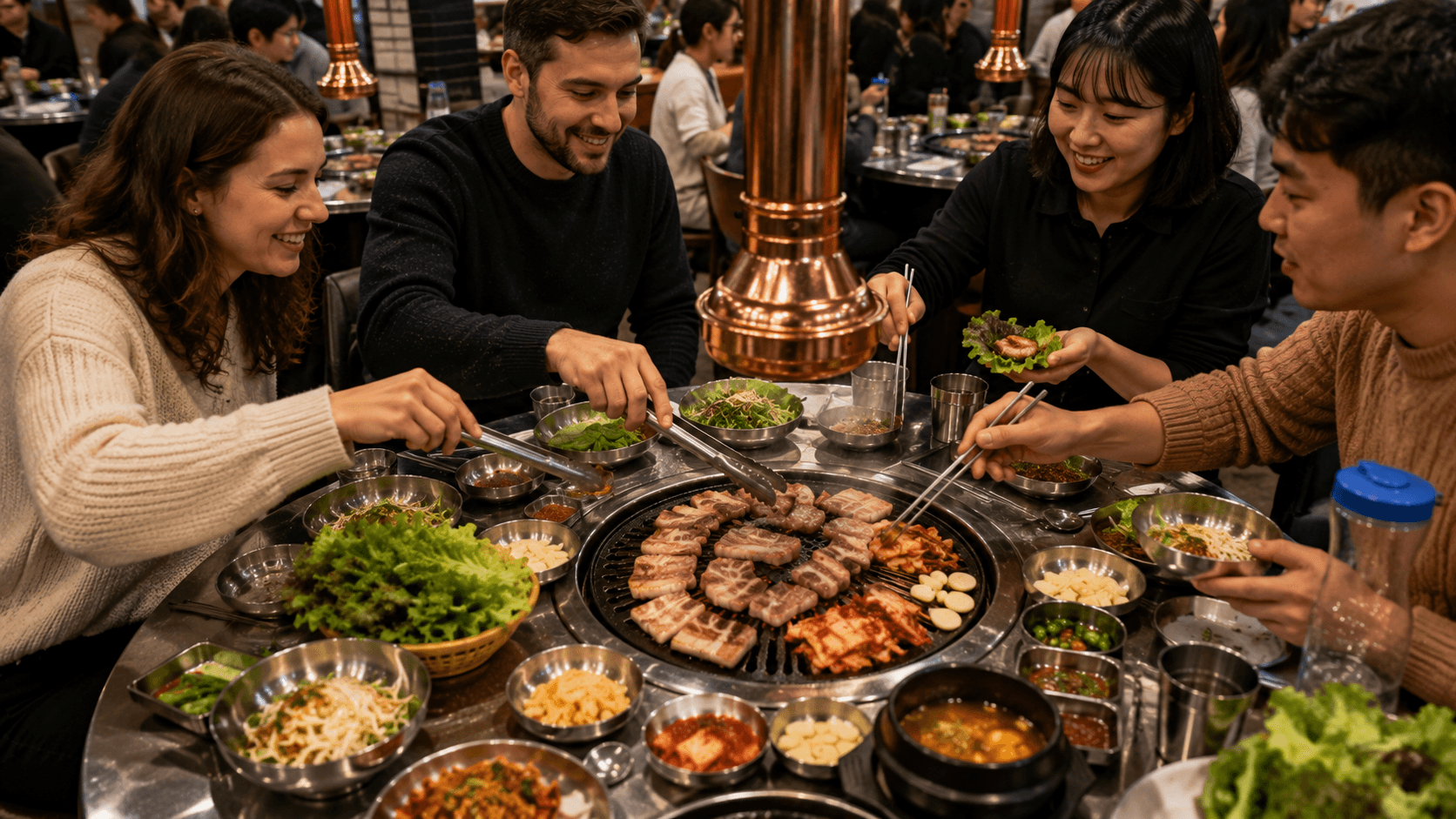
Korean barbecue restaurants may cook several meats on the same grill. Fried chicken, chips, and vegetable tempura may share oil with non-halal meat. Ask about shared fryers and grills if cross-contact affects your dietary practice.
Desserts and drinks
Check desserts for gelatin, emulsifiers, and alcohol-based flavoring. Some chocolates, cakes, ice creams, and traditional sweets may contain ingredients that are not clear from the English product name.
Alcohol is prominent in Korean dining culture, but bottled soft drinks, tea, and water are normally easy to order. At cafes, ask about flavor syrups or desserts individually rather than assuming the whole menu is suitable.
Useful Korean phrases
These phrases communicate specific restrictions more clearly than saying only “halal.” Show the Korean text to staff if pronunciation is difficult.
| English | Korean |
|---|---|
| Is this halal food? | 이 음식은 할랄인가요? |
| Is the meat halal-certified? | 고기는 할랄 인증을 받았나요? |
| Does this contain pork? | 돼지고기가 들어가나요? |
| Does the broth contain pork or meat? | 육수에 돼지고기나 고기가 들어가나요? |
| Is alcohol used in this dish? | 이 음식에 술이 들어가나요? |
| Please do not add pork or alcohol. | 돼지고기와 술을 넣지 말아 주세요. |
| Is the fryer shared with pork? | 돼지고기와 같은 튀김기를 사용하나요? |
| I need a fully halal meal. | 완전한 할랄 음식이 필요합니다. |
Staff may understand “halal” as simply “no pork.” Follow up with separate questions about meat certification, broth, alcohol, and shared equipment.
Buying halal food from supermarkets and convenience stores
Large supermarkets, international grocery shops, and online retailers may carry certified imported or Korean-made products. Look for a halal certification mark from an authority you recognize and check that it applies to the exact product, not merely the manufacturer.
Packaged-food labels in Korea usually place the ingredient list under 원재료명, meaning “ingredients.” Useful words to recognize include:
- 돼지고기: pork
- 돈육: pork meat
- 돼지기름 or 돈지: pork fat or lard
- 젤라틴: gelatin
- 쇠고기 or 소고기: beef
- 닭고기: chicken
- 알코올 or 주정: alcohol or food-grade ethanol
- 맛술: cooking wine
- 육수: stock or broth
An ingredient-translation app can help, but machine translation is not proof of halal status. Long seasoning blends may contain ingredients that are not fully explained in a short translated label.
For a day trip, practical backup foods include certified instant meals, sealed snacks, fruit, nuts, bread with verified ingredients, and canned fish that meets your dietary requirements. Check whether your accommodation provides a refrigerator, microwave, or shared kitchen before buying food that needs preparation.
Vegetarian food is not automatically halal
Vegetarian dining can be a useful fallback when halal meat is unavailable, but it does not resolve every concern. Korean vegetarian dishes may contain alcohol-based seasoning, and ordinary kitchens may use shared equipment.
KTO also notes in its guidance for vegetarian travelers that seemingly vegetable-based dishes can include meat or fish broth, eggs, ham, imitation crab, salted seafood, or fish sauce. Temple food generally excludes meat and seafood, but individual diners should still ask about alcohol, processed ingredients, and kitchen practices.
Delivery apps and takeaway orders
Delivery can be convenient for students and longer-term residents, but check the restaurant address before paying. Search results may combine similarly named businesses or branches.
Use the restaurant's official menu or contact details to confirm that the selected branch follows the halal practice you expect. Also check options and add-ons carefully: a halal main dish can be bundled with an unverified sauce, side dish, or processed meat topping.
For takeaway, ask staff to label separate meals when ordering for a mixed group. This reduces confusion once identical containers have been packed.
Ramadan and prayer planning
During Ramadan, confirm whether a restaurant offers iftar meals and whether reservations are required. Do not assume that ordinary opening hours will extend after sunset. Popular community restaurants may also become busy around iftar.
KTO maintains information about prayer rooms through its Muslim-friendly portal. KMF publishes prayer timetables and local mosque information, but travelers should use the timetable appropriate to their location and date.
What to check before you go
- Open the current KTO restaurant information rather than relying only on an old blog or saved screenshot.
- Confirm the restaurant's exact name, branch, address, and classification.
- Ask whether certification is current and visible at the restaurant.
- Check which dishes use halal meat.
- Ask about pork, broth, cooking alcohol, sauces, gelatin, and shared fryers or grills.
- Reserve in advance when the halal menu is prepared only on request.
- Confirm opening hours for your intended date, particularly on Fridays and public holidays.
- Save the Korean address in a Korean map app.
- Carry a backup meal for day trips, late arrivals, and smaller destinations.
- Decide in advance whether you accept self-certified, pork-free, vegetarian, or mixed-kitchen options.
FAQ
Can I find halal Korean barbecue?
Yes, selected restaurants serve Korean barbecue made with halal-certified meat. Verify the restaurant and branch, and ask whether the grill, tongs, scissors, marinades, and side dishes are separated from non-halal items.
Is seafood in Korea automatically halal?
Seafood itself may meet your dietary interpretation, but the finished dish can contain cooking alcohol, non-halal broth, meat seasoning, or shared-kitchen cross-contact. Ask about the complete recipe and preparation.
Are convenience-store meals halal?
Do not assume so. Most ordinary lunch boxes, gimbap, instant noodles, and processed snacks are not marketed as halal. Choose products carrying certification you recognize and inspect each package separately.
Is “pork-free” enough?
That depends on your personal standard, but KTO explicitly treats “Pork Free” as a separate and less restrictive category than “Halal Certified.” Pork-free restaurants may use non-halal meat and sell alcohol.
Where should I stay for easy halal food access in Seoul?
Itaewon is the most practical area because Seoul Central Masjid, KMF, international grocery shops, and numerous restaurants are concentrated nearby. Staying elsewhere is manageable if you save verified restaurants near your daily sightseeing routes.
Sources
- Korea Tourism Organization: Muslim-friendly Travel
- Halal Advancement Institute of Korea: KMF Halal Certification
- Korea Muslim Federation: Local Muslim Community Directory
- Korea Muslim Federation: Directions to Seoul Central Masjid
- Korea Muslim Federation: Prayer Times
- Korea Tourism Organization: Tips for Vegetarians
For your next step, choose restaurants from the current KTO resources, confirm each one directly, and save at least one backup food option near your accommodation before arriving in Korea.