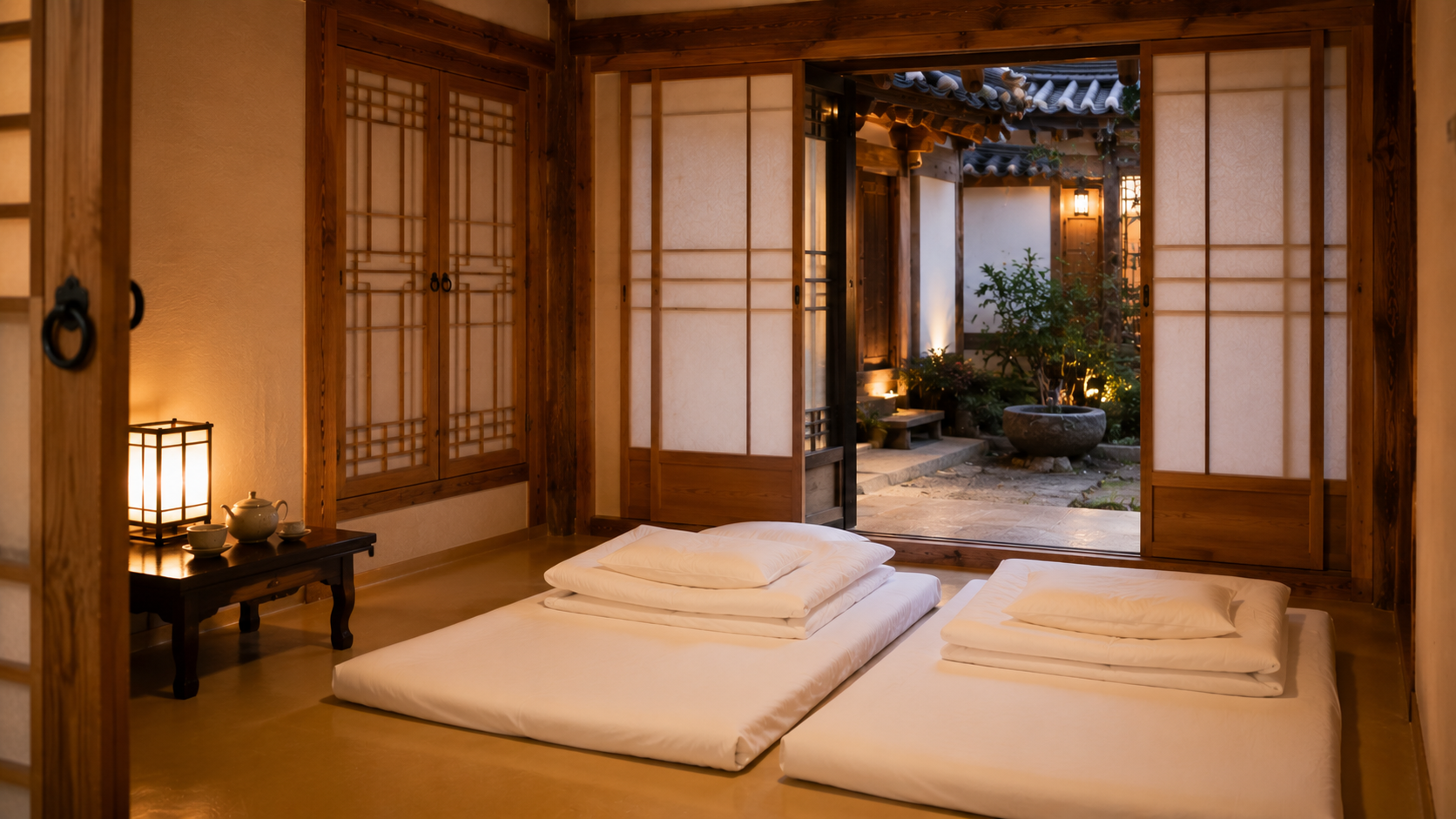
A hanok stay lets you sleep in a Korean traditional house, usually in a room with floor heating, wooden details, paper-covered doors, and a courtyard or garden. The experience can be memorable, but comfort levels vary widely: some properties are heritage homes with thin bedding and shared bathrooms, while others are renovated guesthouses with private bathrooms, air conditioning, and hotel-style beds. Check the room details carefully rather than assuming every hanok offers the same experience.
Information and official links in this guide were verified on June 11, 2026. Individual room rates, check-in times, breakfast service, and cancellation conditions vary by property and should be confirmed directly before payment.
At a glance
| Question | What to expect |
|---|---|
| Where do you sleep? | Traditionally on a floor mattress called a yo, although some rooms have Western-style beds. |
| Is the floor heated? | Many properties use ondol, Korea's floor-heating system. Heating availability and controls vary. |
| Are bathrooms private? | Sometimes. Older or budget properties may have shared bathrooms outside the room. |
| Is breakfast included? | Not automatically. It may be included, sold separately, or unavailable. |
| Are hanoks accessible? | Traditional thresholds, steps, narrow doors, gravel, and floor seating can create barriers. Confirm details directly. |
| Can you bring large luggage? | Usually, but steep lanes, steps, and limited room space may make large suitcases inconvenient. |
| How long should you stay? | One or two nights is enough for most first-time visitors. |
What is a hanok?
Hanok (한옥) is the Korean term for a traditional Korean house. There is no single standard layout. A hanok may be a centuries-old residence, a twentieth-century urban home, a recently reconstructed building, or a modern accommodation inspired by traditional architecture.
Common features include timber framing, tiled or thatched roofs, courtyards, raised wooden halls, deep roof eaves, and rooms designed around floor-level living. Traditional homes respond to the surrounding terrain and seasons rather than following one universal plan.
Seoul's official hanok portal explains how the compact urban hanoks of Bukchon were adapted to city life with standardized materials, glass doors, and smaller plots. In other words, even historically significant hanoks have evolved rather than remaining frozen in one architectural form. See the Seoul Metropolitan Government's introduction to Bukchon hanok.
A hanok-style hotel is therefore not necessarily an untouched historic building, and an old building is not necessarily a licensed guesthouse. Read how the operator describes the property and what facilities are actually included.
What sleeping in a hanok is really like
Floor bedding
The traditional arrangement is a folding mattress or padded quilt placed directly on the floor. This bedding is commonly called a yo (요). A duvet and pillow are laid on top and packed away during the day.
Floor bedding is usually firmer than a hotel mattress. Side sleepers, older travelers, pregnant guests, and anyone with back, hip, or knee problems should ask about mattress thickness. Some hosts can provide an additional pad, but this should be requested before arrival rather than assumed.
Getting up from the floor can also be difficult for guests with limited mobility. A room advertised as traditional may still contain a bed, so use listing photographs and written descriptions to confirm the arrangement.
Ondol floor heating
Ondol (온돌) refers to Korea's traditional floor-heating concept. Modern hanoks generally use hot-water pipes or another contemporary heating system beneath the floor rather than the historic smoke-channel method.
A heated floor can feel very warm, particularly beneath bedding. Ask whether guests can control the temperature inside the room. In winter, do not place temperature-sensitive items directly on a strongly heated floor, and keep luggage away from the warmest areas if it contains cosmetics, medicine, or electronics.
Heating does not guarantee good insulation. Paper-style doors, old window frames, and high ceilings may allow drafts. Conversely, summer rooms can become humid or warm. Confirm that air conditioning is installed if you are visiting during Korea's hot, humid summer.
Sound and privacy
Traditional construction was not designed for hotel-level soundproofing. Courtyard conversations, footsteps, sliding doors, plumbing, and noise from adjoining rooms may be audible. Private rooms can also open directly onto a shared courtyard.
Bring earplugs if you are a light sleeper. Couples and families should check whether the room has an internal lock, whether the bathroom requires crossing a public area, and whether other guests share the building.
How to choose the right hanok stay
1. Decide how traditional you want the experience to be
A highly traditional room may have floor bedding, low furniture, a small room, and a bathroom outside the sleeping area. A renovated premium property may preserve the courtyard and roofline while adding beds, private bathrooms, modern climate control, and sound insulation.
Neither option is inherently more authentic for every traveler. Choose according to your physical needs, budget, and tolerance for inconvenience.
2. Check the bathroom arrangement
Look for an explicit statement that the bathroom is private and ensuite. A private bathroom may still be across a courtyard rather than attached to the room.
Ask these questions when the listing is unclear:
- Is the toilet and shower used only by my room?
- Is the bathroom inside the room?
- Must I go outdoors to reach it?
- Is the shower separated from the toilet, or is it a wet-room layout?
- Are towels and toiletries provided?
- Is hot water continuously available?
Korean wet rooms often place the shower, sink, and toilet in one waterproof space. Shower sandals may be provided, but bringing lightweight waterproof slippers is useful.
3. Confirm the exact room, not just the property
Photographs on booking pages may combine several room types. Confirm the name of your booked room and check its specific bedding, occupancy, bathroom, window, heating, and air-conditioning details.
Room capacity can also be based on the number of floor bedding sets that fit into a compact space. A room accepting four guests may feel crowded once all four beds are laid out.
4. Read the cancellation and payment terms
Before paying, check the total price in KRW, taxes, breakfast charges, additional-person fees, cancellation deadline, and refund method. If a booking platform converts the amount into another currency, the displayed conversion may differ from the amount ultimately charged by your card provider.
For a direct reservation, ask whether the property accepts an international credit card. Some small guesthouses may request a Korean bank transfer, which is impractical for short-term overseas visitors. Do not send money until you have confirmed the operator, property address, reservation terms, and cancellation policy.
5. Check recent reviews for practical problems
Prioritize recent reviews that mention bathroom cleanliness, noise, mattress comfort, temperature control, luggage access, and host communication. A beautiful courtyard photograph says little about how the room functions overnight.
Treat subjective comments cautiously, but look for repeated reports of the same issue. Also note the reviewer's season: a room that is comfortable in October may have different heating, cooling, or humidity issues in January or August.
Where to book a hanok stay
Seoul
Seoul is convenient for a one-night introduction because hanok districts are close to palaces, museums, restaurants, and subway stations. Bukchon, Seochon, Ikseon-dong, and nearby Jongno contain traditional or hanok-inspired accommodation, but the atmosphere differs by street.
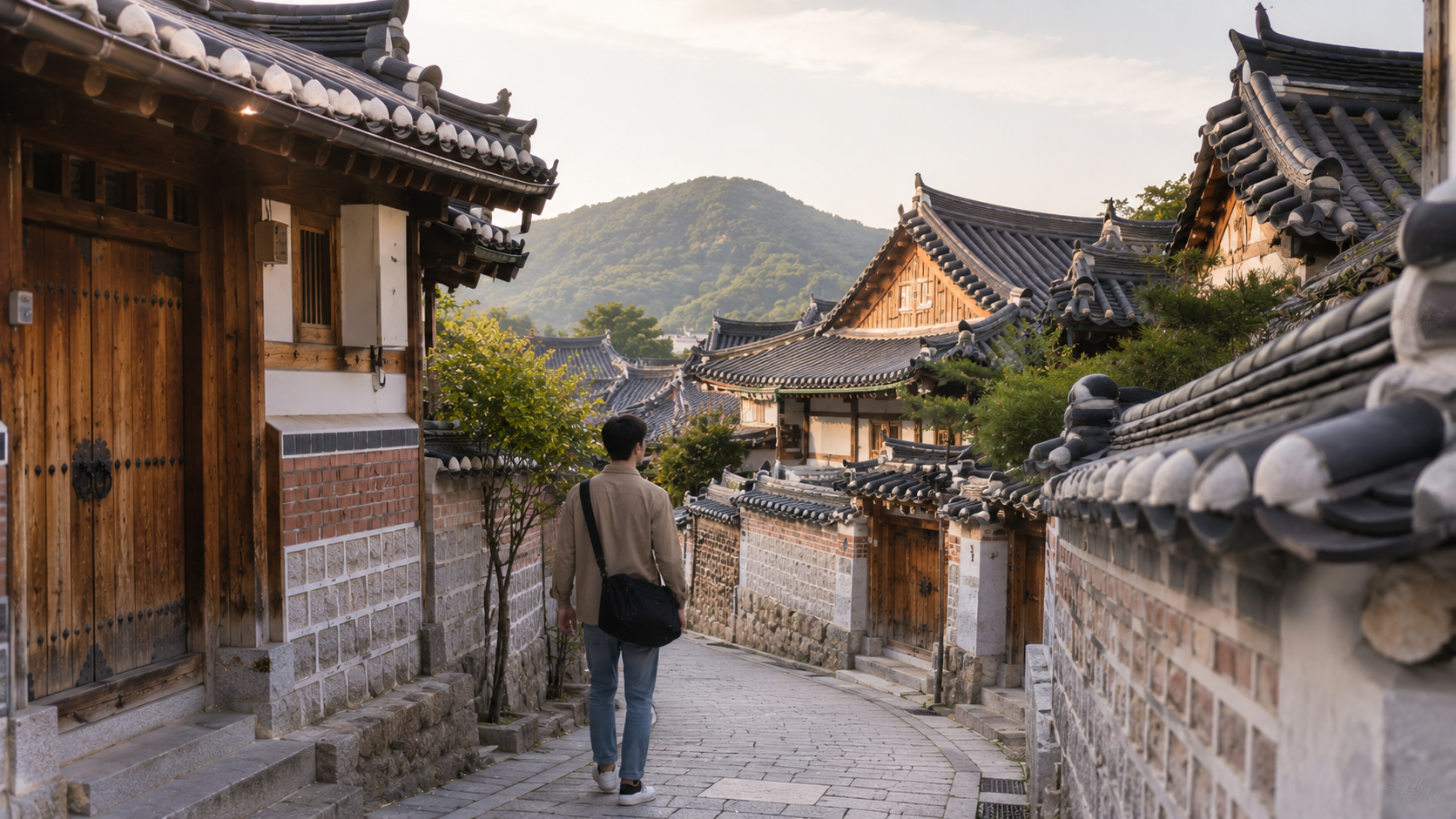
Bukchon Hanok Village is a living residential area, not an open-air museum. The official VISITKOREA page lists restricted visiting hours of 10:00 to 17:00 for the road along Bukchon-ro 11-gil and asks visitors to respect residents. This information was verified on June 11, 2026; check the official Bukchon Hanok Village listing again before visiting because local access rules can change.
If you stay in Bukchon, distinguish between rules for public sightseeing streets and access instructions for registered guests. Keep your booking confirmation available and follow the host's route, especially when arriving outside general visitor hours.
Jeonju
Jeonju is a practical choice for travelers who want a larger concentration of hanok accommodation and a full day of traditional architecture, food, crafts, and historic sites. Properties range from basic courtyard guesthouses to extensively renovated stays.
The central village can become busy during the day, so check whether your room faces a pedestrian street, commercial lane, or interior courtyard. Also confirm the distance from the nearest taxi drop-off point. Some lanes are unsuitable for cars, and dragging wheeled luggage over paving stones can be difficult.
Gyeongju
Gyeongju combines hanok-style accommodation with Silla-period historic sites, royal tombs, and traditional neighborhoods. Some stays are in the city center, while others are in quieter areas that require taxis, buses, or a car.
Do not assume that a property described as being in Gyeongju is within walking distance of the main attractions. Check the precise location and late-evening transportation options before booking.
Andong and historic villages
Andong is suitable for travelers interested in preserved village landscapes and Confucian cultural history. Hahoe and Yangdong were inscribed together on the UNESCO World Heritage List in 2010. UNESCO describes them as representative historic clan villages whose timber houses, study halls, academies, fields, rivers, and mountain settings reflect Joseon-period culture. Read the UNESCO World Heritage description of Hahoe and Yangdong.
Accommodation in or near a protected village may be simpler and less convenient than an urban guesthouse. Confirm admission arrangements, meal availability, transport, and whether guests may enter or leave after public visiting hours. Heritage status does not mean that every house accepts overnight guests.
Arrival, luggage, and check-in
Hanok guesthouses often have limited reception hours. The host may live on-site, meet guests by appointment, or send self-check-in instructions through a booking app. Confirm the check-in window and contact method at least one day before arrival.
Save the address in both English and Hangul. Korean map applications and taxi drivers may recognize the Korean property name more reliably than an English translation. Ask the host for the nearest vehicle-accessible point if the entrance is inside a pedestrian alley.
Pack lightly where possible. Traditional thresholds can be high, and courtyards may contain gravel, stepping stones, stairs, or uneven surfaces. A compact suitcase, backpack, or overnight bag is easier than several large wheeled cases. Ask whether luggage storage is available before check-in or after checkout; small properties may not have a secure storage room.
Remove your shoes at the designated entrance and leave them facing outward if space allows. Indoor slippers may be provided for common areas, while separate slippers are often used in bathrooms.
Etiquette during your stay
A hanok guesthouse may feel intimate because rooms share a courtyard and the host may live nearby. Basic consideration matters more than performing elaborate traditional etiquette.
- Keep voices low at night and early in the morning.
- Do not roll suitcases across wooden floors or raised thresholds.
- Ask before eating in the sleeping room; food may stain bedding, paper, or untreated wood.
- Do not smoke unless the property has an explicitly designated area.
- Keep paper doors away from water and handle sliding doors by their frames or handles.
- Do not enter closed rooms, private family areas, kitchens, or gardens without permission.
- Ask before photographing the host, other guests, residents, or private interiors.
- Follow instructions for sorting rubbish and returning used bedding.
Some hosts offer tea, breakfast, hanbok, craft activities, or cultural explanations. These are services, not automatic features of every stay. Check whether they require advance booking or an additional fee.
Accessibility and family considerations
Traditional architecture can be challenging for wheelchair users and anyone who has difficulty with steps or floor seating. A listing's general accessibility label may not describe the route from the street to the room.
Request photographs or measurements when necessary and confirm:
- Step-free access from the road to the entrance
- Door and bathroom width
- Threshold height
- Availability of a bed rather than floor bedding
- Grab bars and shower seating
- Distance to the bathroom at night
- Taxi access to the gate
- Space for a wheelchair, stroller, or mobility device
Families with young children should ask about courtyard ponds, stairs, open wooden verandas, fragile paper doors, and room locks. Floor bedding reduces the risk of falling from a bed, but heated floors may feel too warm for infants. Discuss temperature control with the host and follow current safe-sleep guidance from an appropriate medical authority.
Common booking mistakes
Assuming every hanok is historic
Some accommodations are modern buildings with traditional visual elements. If historical significance matters to you, ask when the building was constructed or restored and whether it has an official heritage designation.
Booking for appearance alone
Courtyard photographs can conceal shared bathrooms, thin mattresses, low ceilings, or rooms without exterior windows. Review the full facility list.
Arriving late without notice
A small guesthouse may not have a staffed desk. Late arrival can also disturb other guests and nearby residents. Obtain written confirmation if you need to arrive outside the standard check-in period.
Expecting hotel services
Daily housekeeping, elevators, luggage delivery, 24-hour reception, bathrobes, large towels, and multilingual staff are not universal. Confirm any service that is essential to your trip.
Planning too many nights
For a first stay, one night provides the experience without committing your entire trip to floor sleeping or limited facilities. Book longer only after checking comfort, transport, and meal options carefully.
What to check before you go
Use this checklist before finalizing the reservation:
- Exact property and room address in Hangul
- Floor mattress or Western-style bed
- Number and thickness of bedding sets
- Private, shared, indoor, or courtyard bathroom
- Heating and air-conditioning controls
- Check-in deadline and late-arrival procedure
- Breakfast availability and dietary limitations
- Total charge in KRW and additional-person fees
- Cancellation and refund terms
- International card acceptance
- Minimum-stay requirement
- Nearest taxi drop-off or public transport stop
- Luggage storage and large-bag access
- Wi-Fi availability
- Quiet hours and food rules
- Accessibility barriers
- Child policy and maximum occupancy
For tourism assistance while in Korea, VISITKOREA provides access to the 1330 Korea Travel Helpline through its official VISITKOREA website. Service channels and availability can change, so verify the current contact options on the site.
Your most useful next step is to shortlist two or three properties and send each host the same questions about bedding, bathrooms, temperature control, luggage access, and payment. The clearest reply is usually a better indicator of a smooth stay than the most polished photographs.