Choosing between a hotel and a guesthouse in South Korea usually comes down to privacy, service, location, and how much uncertainty you can tolerate. A hotel is generally the easier option for late arrivals, large luggage, business travel, or travelers who want a private bathroom and regular housekeeping. A guesthouse can suit solo travelers, students, and budget-conscious visitors who are comfortable with shared spaces and property-specific rules.
The names are not guarantees. A small hotel may have fewer services than a well-run guesthouse, while some guesthouses offer private rooms and bathrooms comparable to budget hotels. Always judge the actual room, facilities, and policies shown for your dates.
Information and official services in this guide were checked on June 11, 2026. Accommodation prices, reception hours, and booking conditions change frequently and must be confirmed with the property or booking platform.
Quick answer
| Choose a hotel if you prioritize | Choose a guesthouse if you prioritize |
|---|---|
| A private room and bathroom | A lower-priced bed or simple private room |
| Reception or automated late check-in | Shared kitchens and common rooms |
| Elevators and easier luggage handling | Meeting other travelers |
| Daily or scheduled housekeeping | A small-scale or residential atmosphere |
| Business facilities and predictable service | Hostel-style, homestay-style, or hanok accommodation |
| Clearer support when plans change | Staying in neighborhoods with few conventional hotels |
For a first visit, a hotel is the lower-risk choice if you arrive at night or have several bags. A guesthouse becomes more attractive when price and social interaction matter more than privacy or standardized service.
What does “guesthouse” mean in Korea?
In Korea, “guesthouse” is a broad commercial description rather than a promise of one particular room type. It may refer to:
- A backpacker hostel with dormitory beds
- A small property with basic private rooms
- A converted house with shared bathrooms
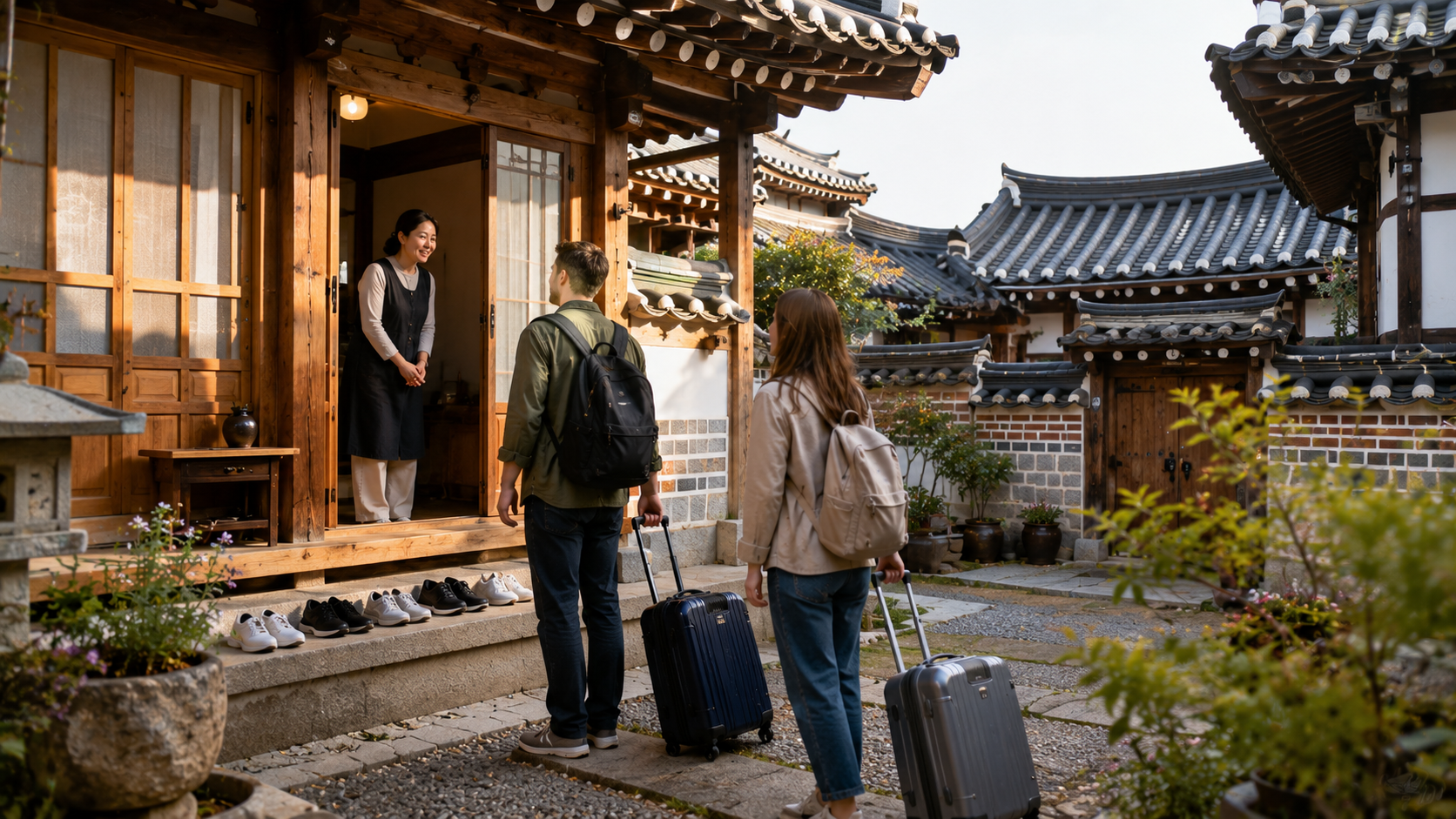
- A hanok, or traditional Korean house, offering floor bedding
- A property aimed primarily at international visitors
- A small accommodation with self-service or limited-hour reception
The Korean word minbak (민박) broadly refers to lodging in a private home or small residential-style property. You may encounter it in rural areas, on islands, or near beaches. Facilities and booking systems can differ considerably from urban guesthouses.
Do not assume that “guesthouse” automatically means a dormitory. Many offer private single, twin, double, or family rooms. Conversely, a private room does not necessarily include a private bathroom.
A hanok guesthouse also requires closer reading. Traditional rooms may use yo bedding, a padded sleeping mat placed on the floor, rather than a Western bed. Older buildings may have low doorways, thin walls, compact bathrooms, steep steps, or no elevator.
The main differences
Privacy and bathrooms
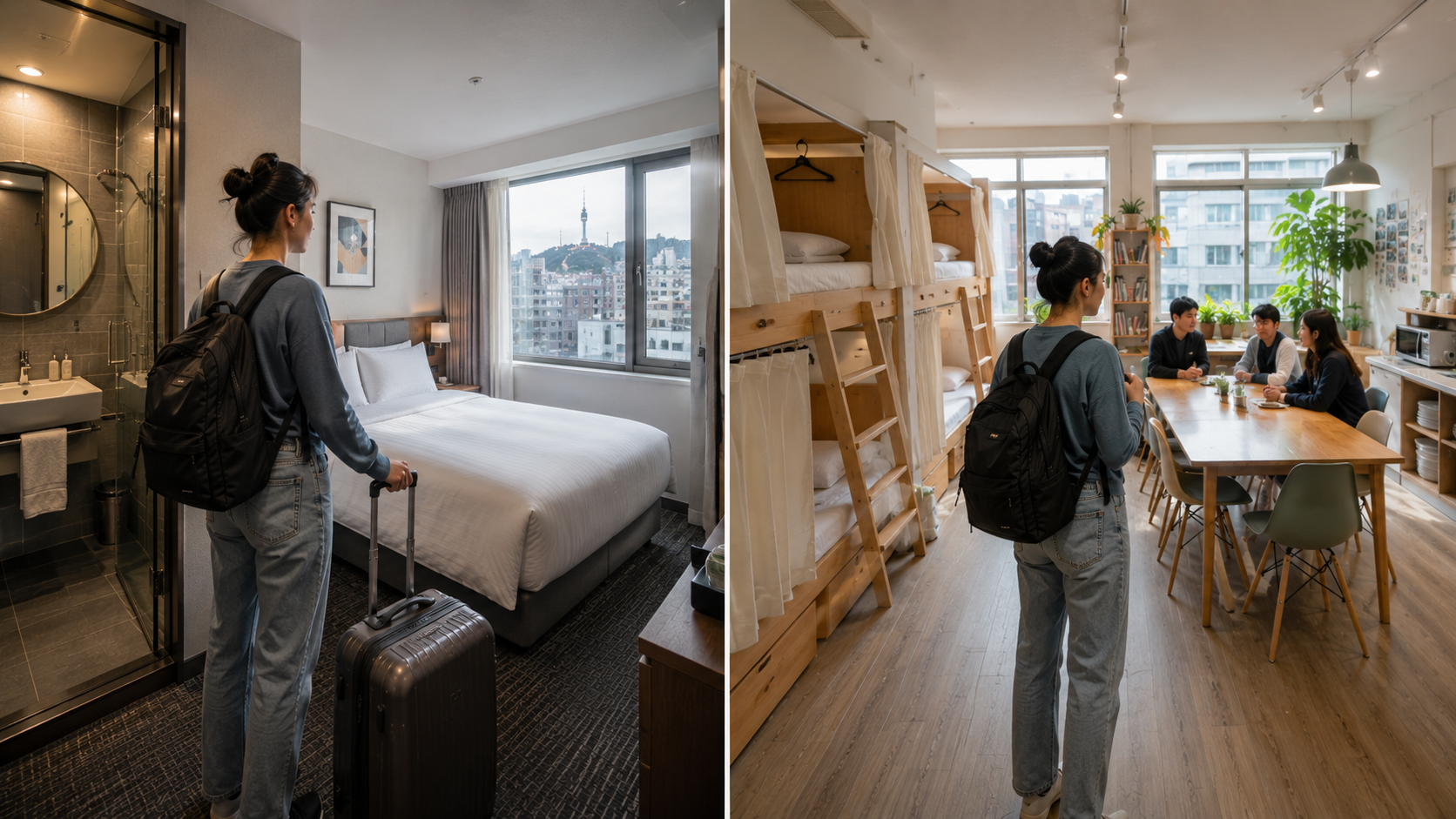
Hotels normally sell an entire private room, usually with an en-suite bathroom. Guesthouses may sell either a bed in a shared dormitory or a private room. Bathrooms may be private, shared with one other room, or shared by an entire floor.
Check the exact phrase attached to your selected room. “Private room” describes the sleeping space, not necessarily the bathroom. Look specifically for “private bathroom,” “en-suite bathroom,” or the equivalent confirmation in the amenities list.
Mixed and women-only dormitories are both common categories, but availability depends on the property. Confirm the room type before payment; changing it at check-in may be impossible when the property is full.
Service and reception
Hotels are more likely to have a staffed front desk, although small or budget hotels may use kiosks or limited reception hours. Guesthouses often have a short check-in window and may send door codes or self-check-in instructions through email or a booking-platform message.
This matters after an evening flight. Immigration, baggage collection, airport transport, and a missed train can push your arrival beyond the stated check-in time. A reservation does not automatically guarantee that someone will wait for you.
Before booking a late arrival, ask:
- What is the latest possible check-in time?
- Is self-check-in available?
- Where will the entry code or key instructions be sent?
- Does the entrance close or lock overnight?
- Is there a Korean telephone number for urgent help?
Make sure your phone can receive messages or access data in Korea. Take a screenshot of the address and entry instructions before leaving the airport.
Housekeeping, towels, and toiletries
Hotels commonly provide towels and basic bathroom products, with housekeeping offered daily or on a stated schedule. Environmental policies, room type, or length of stay may affect how often linen and amenities are replaced.
Guesthouse policies vary more. A towel may be small, limited to one per person, replaced only on request, or subject to a deposit. Toothbrushes, razors, sleepwear, and large bath towels should never be assumed. Bring essential toiletries or confirm the list supplied by the property.
In dormitories, bedding is normally assigned to one guest, but you may need to make the bed yourself. Some properties prohibit food in sleeping rooms or require guests to remove shoes at the entrance.
Shared spaces and noise
A guesthouse common room or kitchen can make a long stay easier and provide opportunities to meet other travelers. The tradeoff is less control over noise, lighting, temperature, and other guests' schedules.
Read recent reviews for specific patterns rather than general ratings. Repeated mentions of street noise, weak soundproofing, bathroom queues, uncomfortable mattresses, or late-night common-room activity are more useful than a single complaint.
Hotels generally offer more separation, but Korean city hotels can still have compact rooms and limited sound insulation. A high floor does not guarantee quiet if the building is near nightlife, a major road, or an elevated railway.
Luggage and accessibility
Hotels are usually better equipped for wheeled luggage, but this is not universal. Small properties may occupy upper floors of mixed-use buildings or have steps between the street and elevator.
Guesthouses in older neighborhoods may have no elevator, narrow staircases, or a reception area in a different building from the room. Hanok properties commonly include raised thresholds and uneven outdoor surfaces.
Ask the property directly when step-free access is essential. Useful questions include:
- Is there a step-free route from the street to the room?
- Does the elevator reach the room's floor?
- Are there stairs at the entrance or inside the property?
- Is the bathroom suitable for a wheelchair or shower chair?
- Can staff help with luggage, and during which hours?
Do not rely only on an “accessible” search filter. Confirm the features you individually require, preferably in writing.
Luggage storage
A conventional hotel is more likely to hold bags before check-in or after checkout. Guesthouses may also provide storage, but only while reception is open and sometimes in an unlocked common area.
Ask whether storage is available, supervised, and free. Never leave passports, cash, medication, laptops, or other valuables in a general luggage room unless secure lockers are available.
Which one costs less?
A dormitory bed is usually the least expensive option for one traveler. For two or more people, however, a private guesthouse room is not automatically cheaper than a budget hotel. The total can reverse once you account for bathroom type, breakfast, laundry, cancellation terms, and the distance from public transport.
There is no useful fixed nationwide price for either category. Rates change by city, neighborhood, weekday, season, event calendar, occupancy, and booking conditions. Prices shown in search results may also exclude optional services or differ between refundable and non-refundable plans.
For a fair comparison, search the same dates and number of guests, then compare the final KRW total. Check:
- Whether taxes and fees are included
- Whether the price is per bed or per room
- Whether breakfast is included
- Private versus shared bathroom
- Cancellation deadline and penalty
- Extra-person or bedding charges
- Laundry cost
- Luggage-storage charges
- Distance from the nearest useful subway or bus stop
A cheaper room that requires daily taxi rides or a long uphill walk may not offer better value.
Payment and deposits
International booking platforms commonly accept foreign cards, but direct payment policies vary. A property may require payment online, charge the card near arrival, or collect payment at check-in. Some small accommodations accept only particular cards or domestic transfer methods for direct reservations.
Confirm the payment currency and cancellation conditions before authorizing a booking. If the booking site offers currency conversion, compare it with your card issuer's rate and fees rather than assuming the displayed foreign-currency amount is preferable.
Guesthouses may request a key, towel, or locker deposit. The listing or property should explain how much is required, which payment methods are accepted, and when it is returned. Do not send money to a new account based solely on an unexpected message; verify the request through the booking platform or the property's published contact details.
Who should choose a hotel?
A hotel is generally more practical for:
- First-time visitors arriving late at night
- Families with young children
- Travelers carrying large suitcases
- Couples who want privacy
- Business travelers who need receipts, desks, or reliable support
- Travelers with mobility requirements
- Short stays where smooth check-in matters more than social space
- Anyone uncomfortable sharing a bathroom
An airport-area hotel can also reduce stress before an early departure, but verify the airport, terminal, and actual transport time. A property described as an “airport hotel” may still require a taxi or shuttle reservation.
Who should choose a guesthouse?
A guesthouse may work better for:
- Solo travelers who want to meet others
- Exchange students scouting neighborhoods before arranging longer-term housing
- Travelers who need a kitchen or washing machine
- Visitors willing to use dormitories to reduce costs
- People seeking a small hanok stay
- Travelers staying in residential or rural areas with limited hotel supply
- Guests who prefer a small property and can follow limited check-in hours
For a longer stay, verify whether the kitchen is genuinely usable. Some listings describe a microwave, refrigerator, and sink as a kitchen even when cooking is restricted.
Common booking mistakes
Booking the wrong bed or room
A low headline price may refer to one dormitory bed, not the whole room. Check the occupancy, bed type, gender designation, and bathroom arrangement before paying.
Assuming reception is open all night
“Hotel” does not always mean 24-hour reception, and “self-check-in” may require receiving a code before a deadline. Contact the property in advance when arriving late.
Ignoring the final approach
A property can be close to a subway station on a map but still involve a steep hill, pedestrian stairs, or an underpass without an elevator. Review the walking route with luggage in mind.
Confusing floor bedding with a mattress bed
A traditional room may provide bedding directly on a heated floor. Travelers with back, knee, or mobility concerns should ask about bed height and available alternatives.
Depending on old reviews
Management, renovation status, breakfast, and check-in systems can change. Prioritize recent reviews while also checking the property's current official description.
Booking separate reservations without telling the property
If you reserve consecutive nights through different platforms or room plans, the property may require you to check out, move rooms, or wait until the next check-in time. Contact it before arrival to ask whether the stays can be linked.
What to check before you go
Use this checklist after booking:
- Confirm the full Korean address and property name in Hangul
- Save the property's telephone number
- Check the final check-in time
- Ask about self-check-in for late arrival
- Confirm private or shared bathroom
- Check for an elevator and entrance steps
- Verify bed type and room occupancy
- Ask whether towels and toiletries are supplied
- Confirm luggage storage hours
- Read kitchen, laundry, curfew, and quiet-hour rules
- Review the cancellation deadline in Korean local time
- Save the reservation confirmation and entry instructions offline
- Tell the property when bringing children or requiring extra bedding
- Ask directly about accessibility requirements
If an accommodation problem cannot be resolved with the property or booking platform, the Korea Tourism Organization's 1330 Korea Travel Helpline and Complaint Center accepts travel inquiries and tourist complaints. As confirmed on June 11, 2026, the official page lists 1330 for calls within Korea and +82-2-1330 from overseas, along with online call and chat options. Availability by language and channel can change, so check the page when assistance is needed.
Frequently asked questions
Are Korean guesthouses safe for solo travelers?
Security depends on the individual property. Look for controlled entrance access, in-room or dormitory lockers, women-only room options where relevant, recent reviews, and clear staff contact information. Bring your own small padlock if the property does not specify the locker mechanism.
Can couples stay in a guesthouse?
Yes, when the property offers an appropriate private room. Dormitory rules may separate guests by gender, so a couple cannot assume they can share the same dormitory.
Do guesthouses accept children?
Some do, while others impose minimum-age rules or prohibit children in dormitories. Enter every child's age during the search and obtain written confirmation when the policy is unclear.
Is breakfast included?
Sometimes, but not reliably. “Breakfast” may mean a simple self-service selection rather than a prepared meal. Check the serving time, menu description, and whether it is included in your particular rate.
Can foreigners book accommodation without a Korean phone number?
International booking platforms and many hotel websites support overseas reservations, but direct-booking forms or self-check-in systems may request a local number. Contact the property before payment if the form rejects your number or if access instructions depend on Korean text messaging.
The practical decision
Book a hotel when you need privacy, luggage support, late-arrival flexibility, or a more predictable room setup. Book a guesthouse when a dormitory, shared kitchen, social environment, or small traditional property is part of what you want.
Before choosing either, compare the actual room rather than the category name. Your next step should be to search your exact dates, shortlist properties near the transport you will use, and send any unresolved questions to the accommodation before the free-cancellation deadline.