Opening a bank account in South Korea is usually straightforward once you have a Residence Card and documents showing why you need the account. The most reliable method is to visit a bank branch in person. Take more supporting paperwork than you think you will need, because document requirements and initial transaction limits can vary by bank, branch, visa status, and intended use.
Information in this guide was verified on June 10, 2026. Banking policies can change, so confirm the requirements with your chosen branch before visiting.
Quick answer
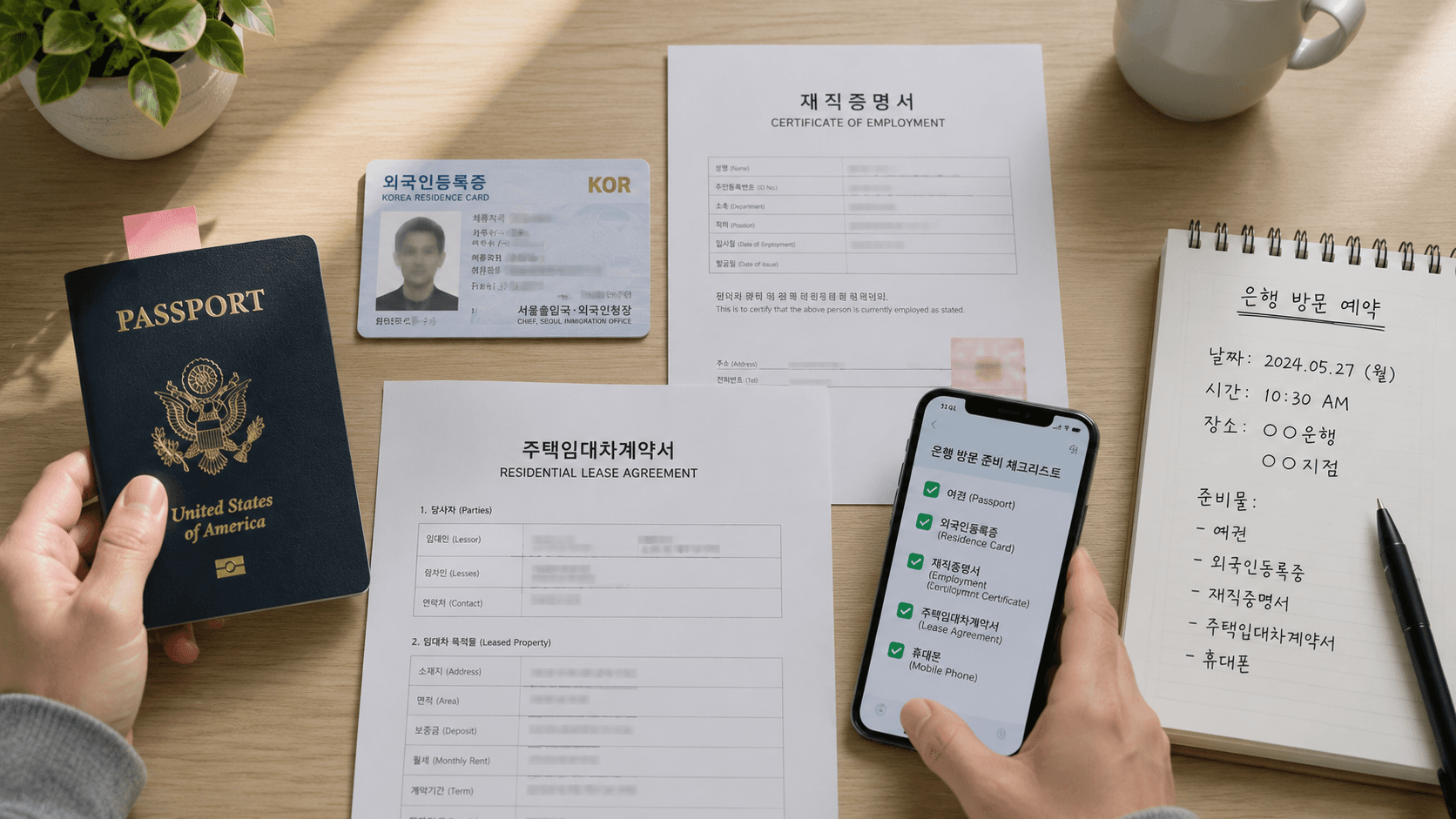
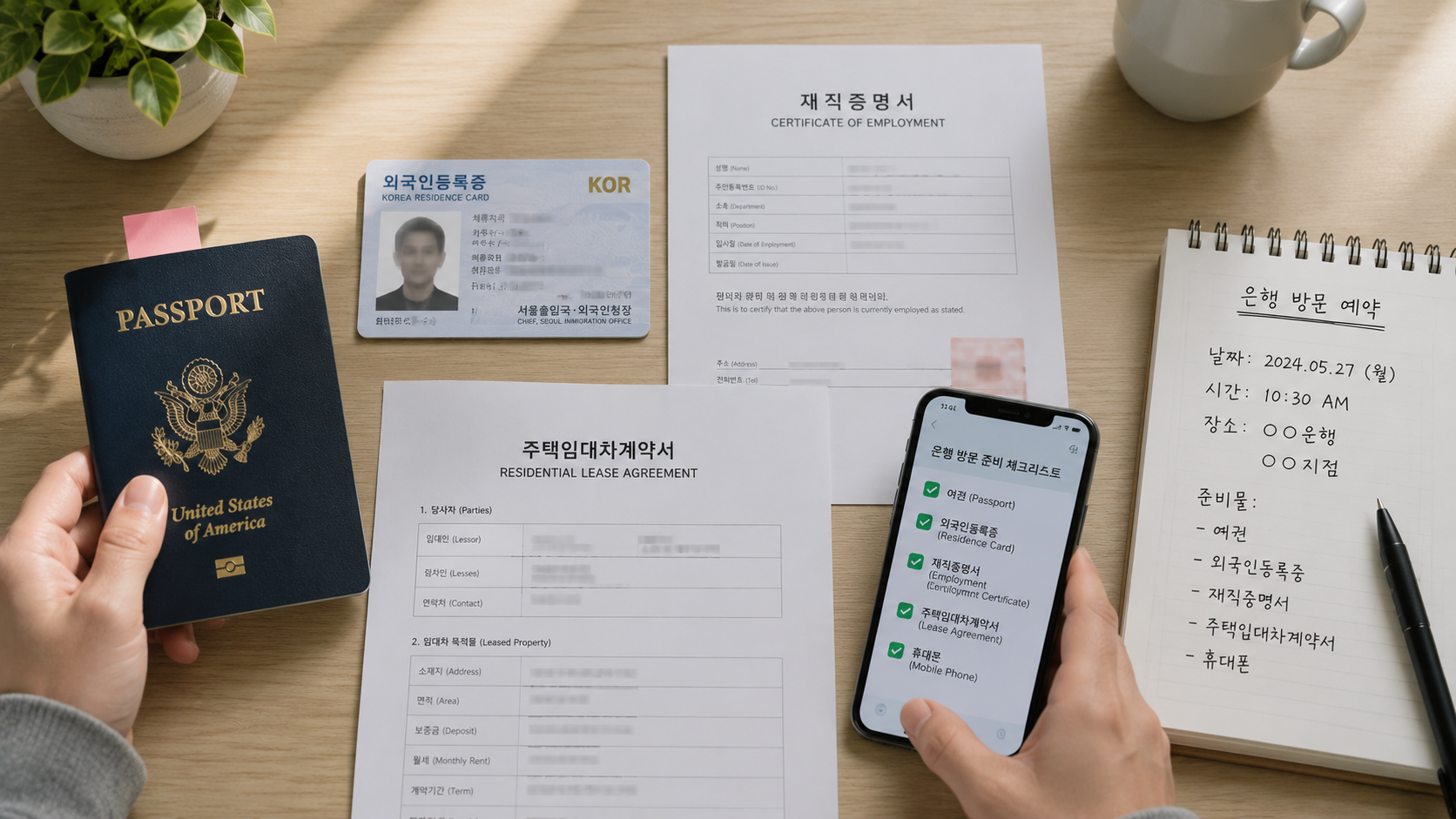
For the best chance of opening a fully usable account, bring:
- Your original passport
- Your Korean Residence Card, formerly commonly called an Alien Registration Card or ARC
- A Korean mobile phone number registered in your name
- Proof of your Korean address
- Evidence of the account's purpose, such as an employment contract, certificate of enrollment, scholarship document, or housing contract
- Your Korean tax identification information, if applicable
- Your foreign tax identification number and tax-residency details
At the branch, ask for a regular deposit account, a debit or check card, mobile banking, internet banking, and overseas remittance access if you need them. Do not assume that every service is included automatically.
The Korean government's Study in Korea banking guide lists identification, a signature or seal, and proof of the financial transaction's purpose as typical account-opening requirements. It also states that ordinary bank counters generally operate from 9:00 a.m. to 4:00 p.m. Requirements and hours should be reconfirmed with the individual branch.
Can foreigners open a Korean bank account?
Yes. Foreign residents, including employees, university students, language students, researchers, and eligible family members, can generally apply for an account.
Holding a visa does not guarantee approval. Korean banks must verify customers' identities and assess the purpose of new accounts under financial crime-prevention rules. A bank may request additional documents, open an account with restricted transaction limits, or decline an application if it cannot confirm the customer's identity or intended use.
Visitors without a Residence Card
A passport is listed as an acceptable form of identification in the government's general banking guidance, but passport-only account opening is not consistently available in practice. A branch may require a Residence Card, a Korean address, a local phone number, or evidence of a longer-term connection to Korea.
Short-term visitors should contact a specific branch before traveling there. Even when a passport-based account is available, mobile banking, identity verification, debit-card functions, and transfer limits may be restricted. Tourists who only need to pay for travel expenses will usually find an international card or travel-money product more practical than trying to open a Korean account.
Documents to prepare
Bank requirements are not completely standardized. Carry original documents rather than photographs or informal printouts.
| Document | Why the bank may request it |
|---|---|
| Passport | Confirms your legal name, nationality, and identity |
| Residence Card | Provides your Korean foreign resident number and residence status |
| Korean phone number | Used for bank contact and mobile identity verification |
| Proof of address | Confirms where you live in Korea |
| Proof of employment or study | Explains why you need the account |
| Tax-residency declaration | Required for international tax-compliance checks |
| Foreign tax identification number | May be required if you remain tax-resident elsewhere |
| Korean tax or business documents | May be needed for business income or self-employment |
Your name should be recorded consistently across your passport, Residence Card, mobile-phone subscription, and bank profile. Differences in spacing, name order, or omitted middle names can interfere with app registration and identity verification.
Evidence of the account's purpose
Banks commonly ask why you need the account. Appropriate supporting evidence depends on your situation.
Employees may bring:
- An employment contract
- A certificate of employment
- A letter requesting a payroll account
- A business card or employer contact details
Students may bring:
- A certificate of enrollment
- A student ID
- A university admission or scholarship letter
- Documents from the university's international office
Residents opening an account for daily expenses may bring:
- A Korean housing lease
- A dormitory confirmation
- A utility or management-fee bill
- An insurance, tuition, or regular-payment notice
These are practical examples, not a universal legal checklist. Ask the branch which documents it accepts for your particular purpose.
How to open the account step by step
1. Choose a convenient bank and branch
Major retail banks include KB Kookmin Bank, Hana Bank, Woori Bank, and Shinhan Bank. Choosing a branch near your workplace, university, or home makes later identity checks and document updates easier.
Service for non-Korean speakers differs between branches. A large branch in a university district, business center, or neighborhood with a substantial international population may be more familiar with foreign-resident applications. This is a practical consideration rather than a guarantee of English service.
Contact the branch and ask:
- Can this branch open an account for my visa or residence status?
- Which original documents are required?
- Is an appointment necessary?
- Is English-language assistance available?
- Can I receive a debit card immediately?
- Will the account have initial transfer or withdrawal restrictions?
- What documents are needed to remove those restrictions?
2. Visit during counter-service hours
The government guidance states that typical banking hours are 9:00 a.m. to 4:00 p.m. on business days, as verified on June 10, 2026. Individual branches, extended-hours branches, holidays, and temporary schedules may differ.
Arrive well before closing. Foreign-customer registration and tax-residency forms can take longer than a simple domestic transaction.
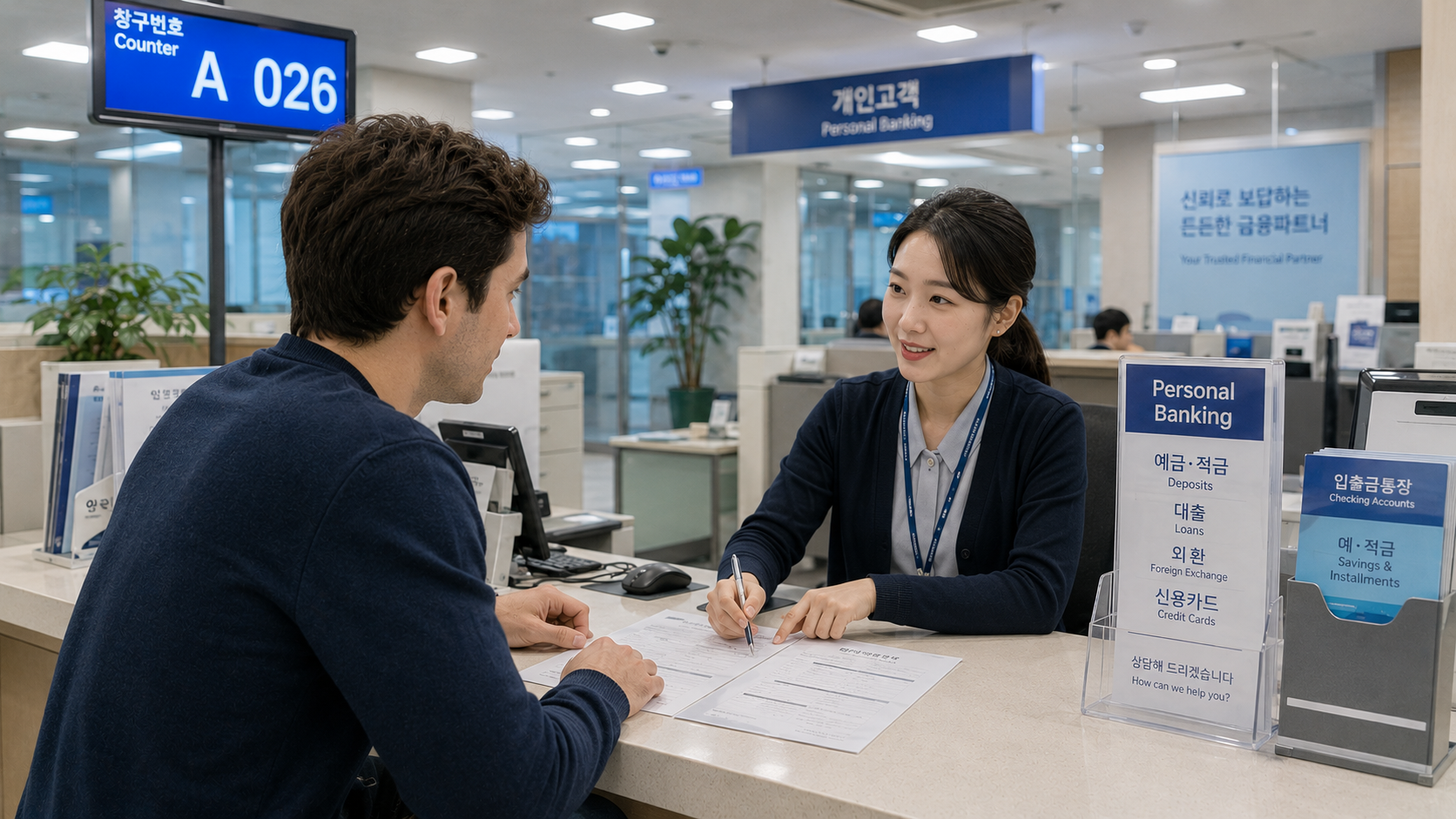
Take a queue ticket marked for deposits, new accounts, or general banking. Show the reception employee your documents and say that you want to open an account for salary, study, living expenses, or another accurate purpose.
3. Complete identity and tax checks
The employee will verify your identification and ask how you intend to use the account. You may also need to declare:
- Your country or countries of tax residence
- Your foreign tax identification number
- Whether you are a US citizen or otherwise subject to US tax reporting
- The expected source and volume of funds
- Whether you expect to receive money from overseas
Answer accurately. International tax-reporting forms are compliance documents, not optional marketing questionnaires. Ask the employee to explain any field you do not understand.
4. Confirm whether the account is restricted
A newly opened account may be classified as a limited account, commonly called a hando-jehan gyejwa (한도제한계좌). This is an anti-fraud measure that limits transfers or withdrawals until the bank has sufficient evidence of genuine financial activity.
There is no single transfer limit that readers should assume will apply everywhere. Limits can differ by bank, transaction channel, customer profile, and policy date. Ask the employee to write down the applicable limits for:
- ATM withdrawals
- ATM transfers
- Mobile and internet transfers
- Counter transactions
- Daily and per-transaction activity
Also ask exactly what will be accepted later to remove or raise the restriction. Examples may include documented salary deposits, tuition payments, regular utility payments, or additional employment records, but the bank decides what evidence is sufficient.
5. Apply for the services you need
Opening the deposit account does not necessarily activate every related service. Request each item explicitly:
- Debit or check card, called a chekeu kadeu (체크카드)
- Domestic ATM access
- Mobile banking
- Internet banking
- Transfer notifications
- An English-language app interface, if offered
- Overseas remittance services
- A foreign-currency account, if needed
A Korean check card is effectively a debit card: purchases are generally taken directly from the linked account. Ask whether the card supports online payments, transport payments, overseas purchases, and overseas ATM withdrawals. Features, fees, and eligibility vary by card.
6. Register the banking app before leaving
When possible, install and activate the official app while you are still at the branch. Foreign names and identity-verification records can cause registration problems that are easier to resolve in person.
Check that you can:
- Sign in successfully
- View your account
- Receive verification messages
- Make a small transfer
- Set or confirm your transfer limit
- Find the lost-card and fraud-reporting menu
Only install applications linked from the bank's official website or a verified app-store publisher. Never give another person your password, one-time password, security-card numbers, or remote access to your phone.
Choosing a bank
There is no objectively best bank for every foreign resident. Compare the services you will actually use.
| Feature | What to check |
|---|---|
| Branch access | Location, opening hours, appointment system, and language support |
| Mobile banking | Foreign-resident registration, English interface, and identity verification |
| Debit card | Online use, overseas use, transport function, and issuance time |
| Transfers | Initial limits and requirements for increasing them |
| Overseas remittance | Supported currencies, transfer fee, receiving-bank charges, and exchange-rate margin |
| Cash access | Nearby ATMs and after-hours fees |
| Salary or student services | Whether your employer or university has a partner branch |
A university or employer may recommend a particular bank because it has an on-campus branch or an established payroll process. That convenience can be more valuable than a small difference in fees.
Official bank websites include KB Kookmin Bank, Hana Bank, Woori Bank, and Shinhan Bank. Use the official branch locator or customer-service information to confirm current requirements.
Fees, minimum balances, and cards
Basic deposit accounts do not generally require the large opening deposits found in some countries. However, fees can apply to ATM use, transfers, certificates, overseas remittances, replacement cards, and transactions outside the bank's own network or normal service hours.
Fee waivers may depend on salary deposits, regular card use, account balance, age, student status, or digital statements. Ask for the current fee schedule before agreeing to optional products.
Do not confuse a debit card with a credit card. A credit-card application involves a separate assessment and may require proof of income, employment history, deposits, or other financial evidence. Opening a bank account does not guarantee credit-card approval.
Receiving salary and paying bills
Once the account is active, give your employer the bank name, account number, and account holder's name exactly as registered. A copy of the account page or bank-issued account confirmation may be requested.
Korean utility companies, mobile operators, insurers, and landlords may accept automatic account withdrawals. Before authorizing one, confirm:
- The payment date
- The amount or calculation method
- Whether insufficient funds create a penalty
- How to cancel the authorization
Keep enough money in the account before recurring payment dates. A failed automatic payment can interrupt phone, insurance, or utility services.
Sending money overseas
Overseas remittance rules depend on the amount, purpose, destination, source of funds, and your tax or residence status. The Study in Korea banking guidance notes that documentation and limits vary by transaction type and advises customers to check the rules before visiting a bank.
Before transferring, ask for the total estimated cost, including:
- The Korean bank's transfer fee
- The exchange rate and exchange-rate margin
- Intermediary bank charges
- The receiving bank's fee
- The estimated amount that will arrive
Large, frequent, or unusual transfers may require evidence such as salary statements, tax records, contracts, tuition invoices, or proof of the original source of funds. For definitive tax or foreign-exchange guidance, consult the bank and the relevant Korean authority rather than relying on informal advice.
Common problems and how to avoid them
The branch asks for documents that another branch did not mention
Branch-level checks can differ. Ask for a written list of missing documents and whether an alternative document is acceptable. You may try another branch, but you should not conceal a previous rejection or give inconsistent information.
Your banking app cannot verify your identity
Check whether your name, phone subscription, Residence Card, and bank account use exactly the same spelling and order. If they do not, contact the bank and mobile carrier rather than repeatedly attempting registration.
Your transfer limit is too low
Ask whether the account is a limited account and request the bank's current procedure for changing its status. Bring evidence of real account use, such as payroll records or regular payment documents. The bank may require a period of transaction history.
Your Residence Card or address changes
Update the bank promptly after renewing your card, changing your visa details, receiving a replacement passport, or moving. Outdated identity information can interrupt banking or remittance services.
Someone asks to borrow your account
Never sell, lend, or transfer control of your account, card, password, or verification device. Accounts used to receive or move money for another person can become connected to fraud or money-laundering investigations. The Financial Supervisory Service provides official financial-consumer and fraud-prevention information.
What to check before you go
- Confirm the branch handles new accounts for foreign residents.
- Ask for the exact document list for your visa and intended use.
- Check the branch's opening hours for your chosen date.
- Bring your original passport and Residence Card.
- Bring proof of address, work, study, or another genuine account purpose.
- Make sure your Korean phone number is registered in your own name.
- Prepare your foreign tax identification number.
- Check that your name is consistent across all documents.
- Ask about initial transfer and withdrawal limits.
- Request mobile banking and a debit card separately.
- Confirm all fees before applying for additional products.
FAQ
Can I open an account before receiving my Residence Card?
Possibly, but it is not guaranteed. Some branches may consider a passport and additional supporting documents, while others require a Residence Card. Services on a passport-based account may also be limited. Contact the specific branch first.
Do I need a Korean phone number?
A phone number may not be the only legal way to identify you at a counter, but a Korean number registered in your name is practically important for app activation, verification messages, online payments, and customer service.
Do I need a Korean personal seal?
The government guidance lists a seal or signature. Foreign customers are commonly able to use a signature, but confirm this with the branch. Sign consistently if the bank records your signature as the transaction method.
Can an exchange student open an account?
Usually, yes. Bring your passport, Residence Card, Korean phone number, proof of address, and a certificate of enrollment or university letter. Your university's international office may have instructions for a partner branch.
Will I receive a debit card on the same day?
It depends on the bank, branch, card type, and identity checks. Some basic cards may be issued at the branch, while others are delivered later. Ask how and where the card will be delivered and whether your name must be on the mailbox or building register.
Next step
Choose a branch near your university, workplace, or home and contact it with your visa type, Residence Card status, and reason for opening the account. Request the current document list in writing, then visit with the originals and apply for the account, debit card, and mobile banking together.
Sources
- Study in Korea: Living and Housing Information, including banking services, National Institute for International Education
- KB Kookmin Bank official website
- Hana Bank official website
- Woori Bank official website
- Shinhan Bank official website
- Financial Supervisory Service
Banking requirements, counter hours, fees, and transaction limits checked or reconfirmed through the linked official sources on June 10, 2026.