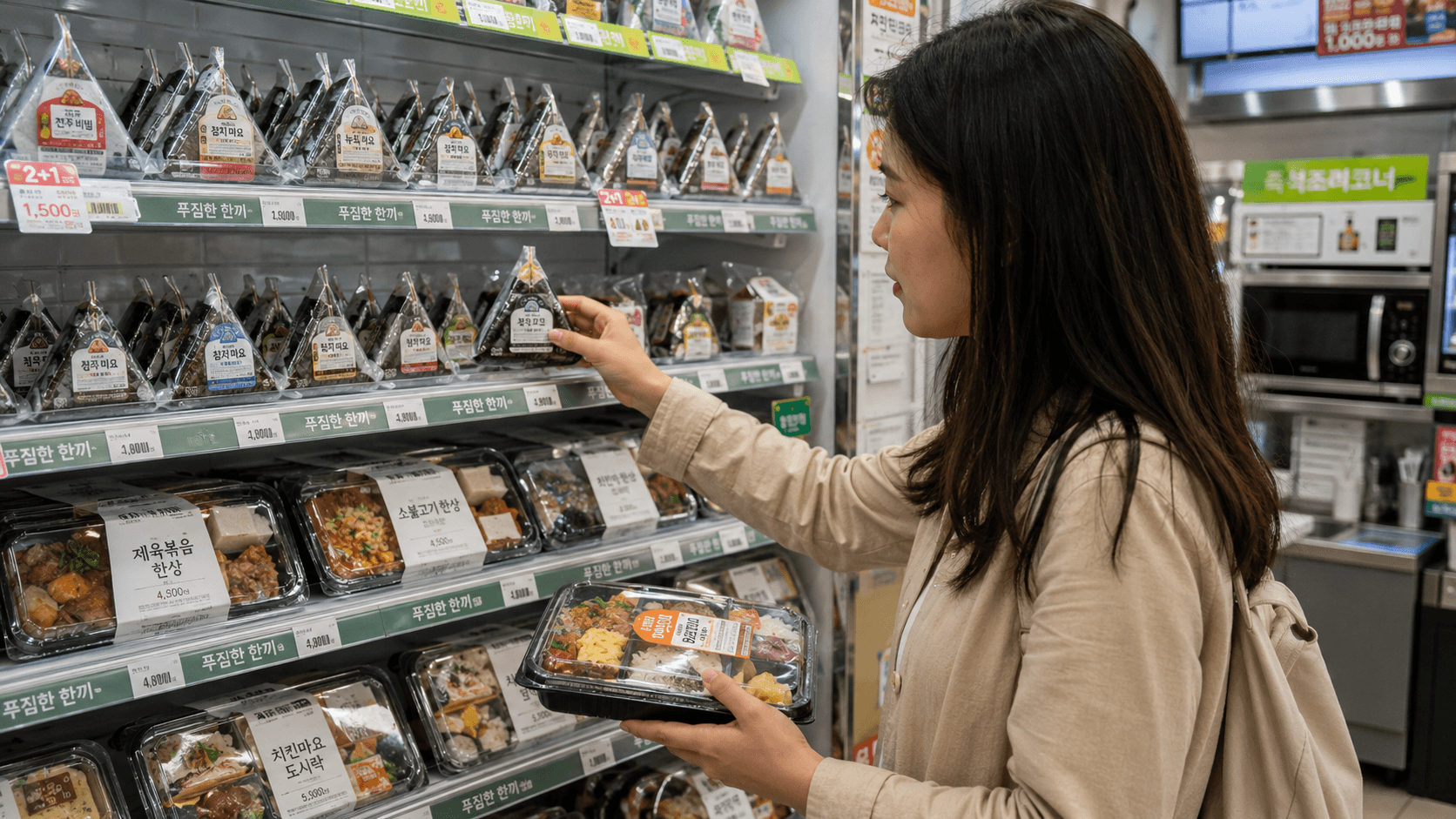
Korean convenience stores are useful places to buy an inexpensive breakfast, a late-night meal, snacks for a train journey, or food for a hotel room. CU, GS25, 7-Eleven, and Emart24 all sell prepared rice dishes, noodles, sandwiches, drinks, and chain-exclusive products, but selection and facilities differ by branch.
Quick answer
For a simple meal, choose one of these combinations:
- Light meal: triangular gimbap plus milk, soy milk, or bottled tea
- Full meal: dosirak lunch box plus water or a small side dish
- Hot snack: cup noodles plus a packaged egg or sausage
- No-microwave option: sandwich, regular gimbap, salad, yogurt, or fruit cup
- Breakfast: egg sandwich, banana, yogurt, and coffee
As verified on June 11, 2026, current prepared-food listings from 7-Eleven Korea and Emart24 show basic rice snacks from about KRW 1,800, sandwiches and burgers around KRW 2,800–4,200, and larger meals commonly around KRW 4,300–5,900. These are examples, not fixed nationwide prices. Products, promotions, and stock vary by store.
The main convenience store chains
The four names visitors are most likely to see are CU, GS25, 7-Eleven, and Emart24. You do not need to seek out a particular chain for basic food. All generally carry drinks, instant noodles, packaged rice dishes, sandwiches, and snacks.
Differences are most noticeable in private-label products, limited editions, and prepared meals. A branch near an office district may have a large lunch selection but sell out quickly, while a residential branch may carry more household goods and late-night snacks. Stores near universities often have larger instant-meal and low-cost snack sections.
Do not assume every branch is open 24 hours. For example, the Emart24 store finder includes a separate 24-hour filter, indicating that hours depend on the branch. This was checked on June 11, 2026. Search the branch on Naver Map, KakaoMap, or the chain's official store locator before making a special trip late at night.
Essential foods to recognize
Triangular gimbap: samgak gimbap
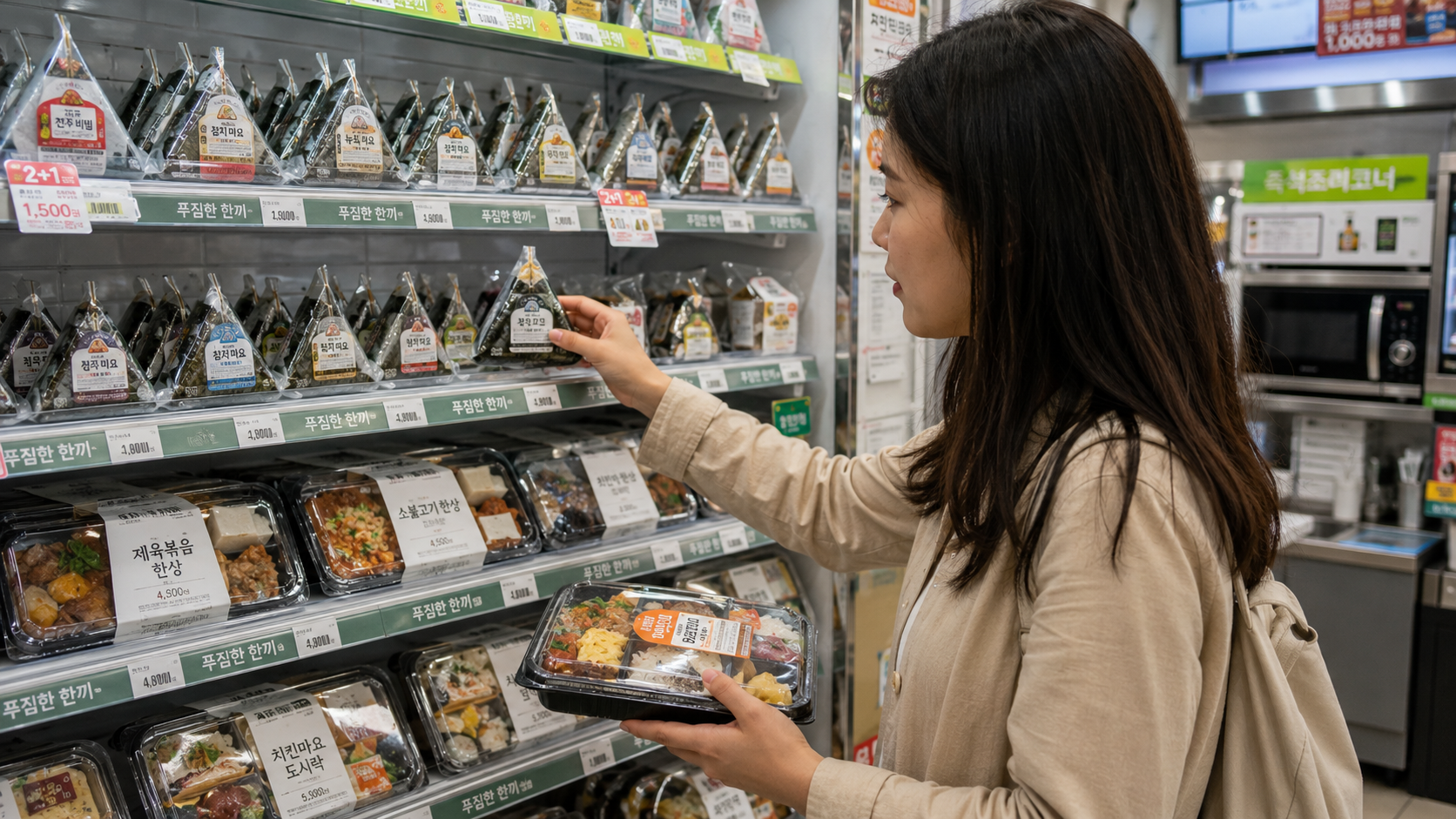
Samgak gimbap (삼각김밥) is a triangle of rice with a small amount of filling, wrapped in seaweed. Common fillings include tuna mayonnaise, kimchi, bulgogi, spicy pork, and chicken.
The numbered wrapper is designed to keep the seaweed separate from the rice until opening:
- Pull the center strip marked 1 from top to bottom.
- Slide off one side marked 2.
- Slide off the other side marked 3.
- Fold the seaweed around the rice.
Most varieties can be eaten cold. If the label includes microwave instructions, heating is optional unless the package specifically says otherwise. Avoid microwaving the product while it is still inside its seaweed wrapper unless the instructions permit it.
Gimbap rolls
Packaged gimbap (김밥) contains sliced rice rolls with vegetables and fillings such as egg, ham, tuna, or bulgogi. It is more substantial than triangular gimbap and is usually eaten cold or lightly warmed according to the package directions.
Gimbap has a short refrigerated shelf life. Check the date carefully, refrigerate it promptly after purchase, and do not leave it in a warm bag for several hours.
Dosirak lunch boxes
A dosirak (도시락) is a prepared lunch box containing rice and several side dishes. Typical components include meat, egg, kimchi, dumplings, sausages, or fried food.
These are usually designed for microwave heating. Look for a time printed beside a microwave symbol, often with separate instructions for different power levels. Before heating:
- Remove disposable cutlery, sauce packets, and seasoning sachets.
- Check whether the film should be removed, opened slightly, or left in place.
- Remove any item marked as unsuitable for microwaving.
- Follow the printed time instead of guessing.
The official Emart24 fresh-food page listed lunch boxes at KRW 5,900 and pasta dishes at KRW 4,300 when checked on June 11, 2026. The 7-Eleven page included a KRW 5,500 lunch box and several rice meals around KRW 4,900–5,000 on the same date. Shelf prices should always take priority over online examples.
Cup noodles and ramyeon
Korean instant noodles are labeled ramyeon (라면). Cup noodles are easiest for visitors because the cooking vessel is included.
Basic preparation is usually:
- Open the lid partway.
- Add the soup powder and other sachets as directed.
- Fill to the marked line with hot water.
- Close the lid and wait for the printed number of minutes.
Some products require microwave cooking after water is added. Others explicitly warn against microwaving the container. Follow the Korean diagrams even if you use a translation app for the text.
Larger stores may have dedicated ramyeon machines. Controls and suitable containers vary, so ask the cashier before placing an ordinary cup or packet into the machine.
Instant rice and refrigerated dishes
Microwavable rice, curry, soup, porridge, tteokbokki, dumplings, and meat dishes can be combined into a larger meal. Check whether the product includes rice; a curry pouch or soup container may be sold separately.
For tteokbokki (떡볶이), chewy rice cakes in sauce, read the preparation diagram carefully. Depending on the product, you may need to add water, drain water, mix in sauce, or microwave the opened container.
Sandwiches, burgers, and salads
Sandwiches and burgers are straightforward choices when you cannot read many Korean labels. Egg mayonnaise, ham and cheese, chicken, and bulgogi are common, but recipes change frequently.
As checked on June 11, 2026, official listings included sandwiches from KRW 3,000 at 7-Eleven and KRW 3,000–3,900 at Emart24. Emart24 burgers on the current page ranged from KRW 2,800 to KRW 4,200. Availability is branch-specific.
Salads may include a separate dressing packet under the lid. Some noodle salads contain wheat, buckwheat, egg, seafood, or nuts, so the appearance alone is not enough to identify allergens.
Drinks and desserts worth knowing
Pouch drinks and ice cups
Refrigerated pouches of coffee, tea, juice, and flavored drinks are often displayed near sealed cups of ice. The pouch and ice cup are normally separate products, so take both to the register.
After paying, open the ice cup, cut or tear the pouch, and pour the drink over the ice. Check the cup size: a large pouch may overflow a small cup.
Coffee
Stores may sell canned coffee, bottled coffee, pouch coffee, and machine-made coffee. For a coffee machine, pay first unless signage clearly instructs otherwise. The cashier may give you a cup, or the cup may be placed beside the machine.
Milk, yogurt, and traditional-style drinks
Common choices include flavored milk, drinking yogurt, soy milk, and sikhye (식혜), a sweet rice drink. Banana-flavored milk is widely recognized, but it is only one option among many.
Ice cream and desserts
Ice cream is usually kept in chest freezers away from the main refrigerated drinks. Convenience stores also carry packaged cakes, puddings, jellies, sweet rice cakes, and seasonal desserts. Limited-edition collaborations can disappear quickly and should not be treated as standard stock.
Understanding prices and promotions
The most important promotion labels are:
| Label | Meaning | What you must do |
|---|---|---|
| 1+1 | Buy one, receive one more | Take two qualifying items |
| 2+1 | Buy two, receive one more | Take three qualifying items |
| 증정 | A specified free gift | Check the shelf tag for the gift product |
| 할인 | Discount | Check the conditions and promotion dates |
The 7-Eleven monthly promotion page and Emart24 promotion listings showed active 1+1 and 2+1 categories when verified on June 11, 2026. Promotions often exclude some branches and end on a stated date.
The free product is not always added automatically if you bring only one item to the counter. Take the required quantity from the shelf. For a 2+1 deal, you normally pay for two and leave with three.
Check that the product name, size, and flavor match the promotion tag. Similar packaging placed beside the promoted item may not qualify. Ask the cashier Haengsa majayo? (행사 맞아요?), meaning roughly, “Is this included in the promotion?” if you are uncertain.
How to pay
Cash and payment cards are widely used at staffed convenience stores. International card acceptance can depend on the card network, issuer, terminal, and individual transaction, so carry another payment method rather than assuming every foreign card will work.
T-money transportation cards can also be used for purchases at participating merchants. Consult the official T-money English website for current card information. A transportation card must have enough stored balance, and acceptance should be confirmed at the register.
Mobile payment systems advertised at the counter may require a Korean account, Korean phone verification, or a locally issued card. Visitors should not rely on them as their only payment method.
Korean law requires stores to charge for many disposable shopping bags. Bring a reusable bag or be prepared to pay a small amount. The cashier may ask Bongtu piryo haseyo? (봉투 필요하세요?), meaning “Do you need a bag?”
Using the microwave and eating area
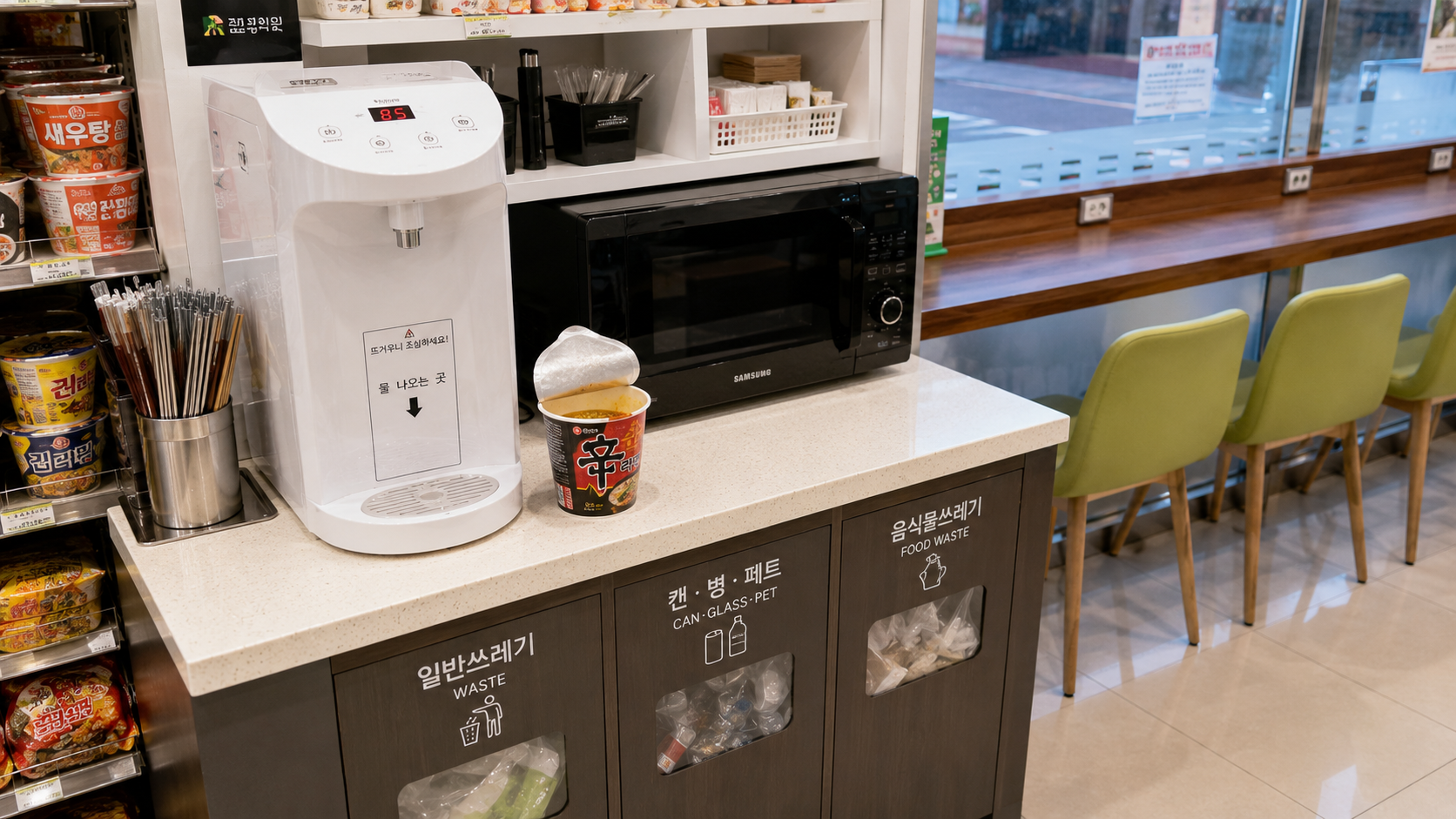
Microwaves, hot-water dispensers, and small eating counters are common, but not universal. They are normally intended for products purchased at that store.
A practical routine is:
- Pay before opening or heating anything.
- Ask where the microwave is if it is not visible.
- Remove non-microwave-safe packets and cutlery.
- Heat for the time printed on the package.
- Open hot containers carefully because steam can burn.
- Clean spills and sort waste using the labeled bins.
Seating may be unavailable, closed at certain hours, or reserved for customers. Alcohol consumption may also be restricted by the store or building. Do not assume that every convenience store operates as a dining space.
Food labels, dietary restrictions, and allergens
Korean packaged food usually presents ingredients and allergen information primarily in Korean. Translation apps can help, but automated translations should not be treated as a safety guarantee.
Useful terms include:
- 원재료명: ingredients
- 알레르기: allergy or allergen
- 우유: milk
- 계란 / 알류: egg or eggs
- 대두: soybean
- 밀: wheat
- 땅콩: peanut
- 메밀: buckwheat
- 새우: shrimp
- 돼지고기: pork
- 쇠고기: beef
- 닭고기: chicken
Vegetarian-looking gimbap, noodles, kimchi, and soup may contain meat stock, fish sauce, anchovy extract, egg, or seafood. Tuna mayonnaise and imitation crab are also common fillings. Korea does not use one universal convenience-store symbol that guarantees a product is vegan, halal, gluten-free, or suitable for a severe allergy.
For a serious food allergy or medically necessary diet, use a professionally translated allergy card and choose products whose complete ingredient information you can verify. Staff may be able to show you the label, but they cannot be expected to certify that a product is free from cross-contact.
Dates and storage
Look for 소비기한, the use-by date, followed by a date and sometimes a time. Fresh gimbap, sandwiches, salads, and lunch boxes can have particularly short limits.
Choose refrigerated food near the end of your shopping trip and place it in a refrigerator promptly. A hotel minibar may not be cold enough for safe food storage. When in doubt, buy a fresh item shortly before eating instead of keeping it overnight.
Do not buy a swollen package, broken seal, leaking container, or refrigerated product left on an ordinary shelf. Return a damaged item to the cashier before opening it.
Common mistakes to avoid
- Opening food before paying
- Taking only one item from a 1+1 promotion
- Assuming every branch has seating, hot water, or a microwave
- Heating sauce packets, metal-lined wrappers, or disposable cutlery
- Pouring boiling water into a container without checking its instructions
- Assuming a dish is vegetarian because no meat is visible
- Confusing the use-by date with the production date
- Leaving refrigerated gimbap or lunch boxes in luggage for hours
- Expecting a small neighborhood branch to stock a product seen online
- Throwing liquids and food waste into the wrong bin
What to check before you go
- Confirm the branch's opening hours on the day of your visit.
- Check whether your accommodation allows strongly scented food.
- Carry a card plus some KRW as a backup payment method.
- Bring a reusable bag and tissues or wet wipes.
- Save Korean dietary or allergy phrases on your phone.
- Inspect the shelf label for the current price and promotion period.
- Check the package date and heating instructions before paying.
- For a train or bus trip, choose food that is tidy, mild-smelling, and easy to eat.
A useful next step is to visit a medium-sized branch near your accommodation during the daytime, when staff assistance and prepared-food selection are more likely to be available. Start with triangular gimbap or a clearly labeled lunch box, then use the package diagrams to learn the self-service routine.
Sources
- CU official English website
- 7-Eleven Korea fresh-food listings
- 7-Eleven Korea monthly promotions
- Emart24 fresh-food listings
- Emart24 official website and store finder
- T-money official English website
Prices, promotions, product examples, and store-service information were verified on June 11, 2026.