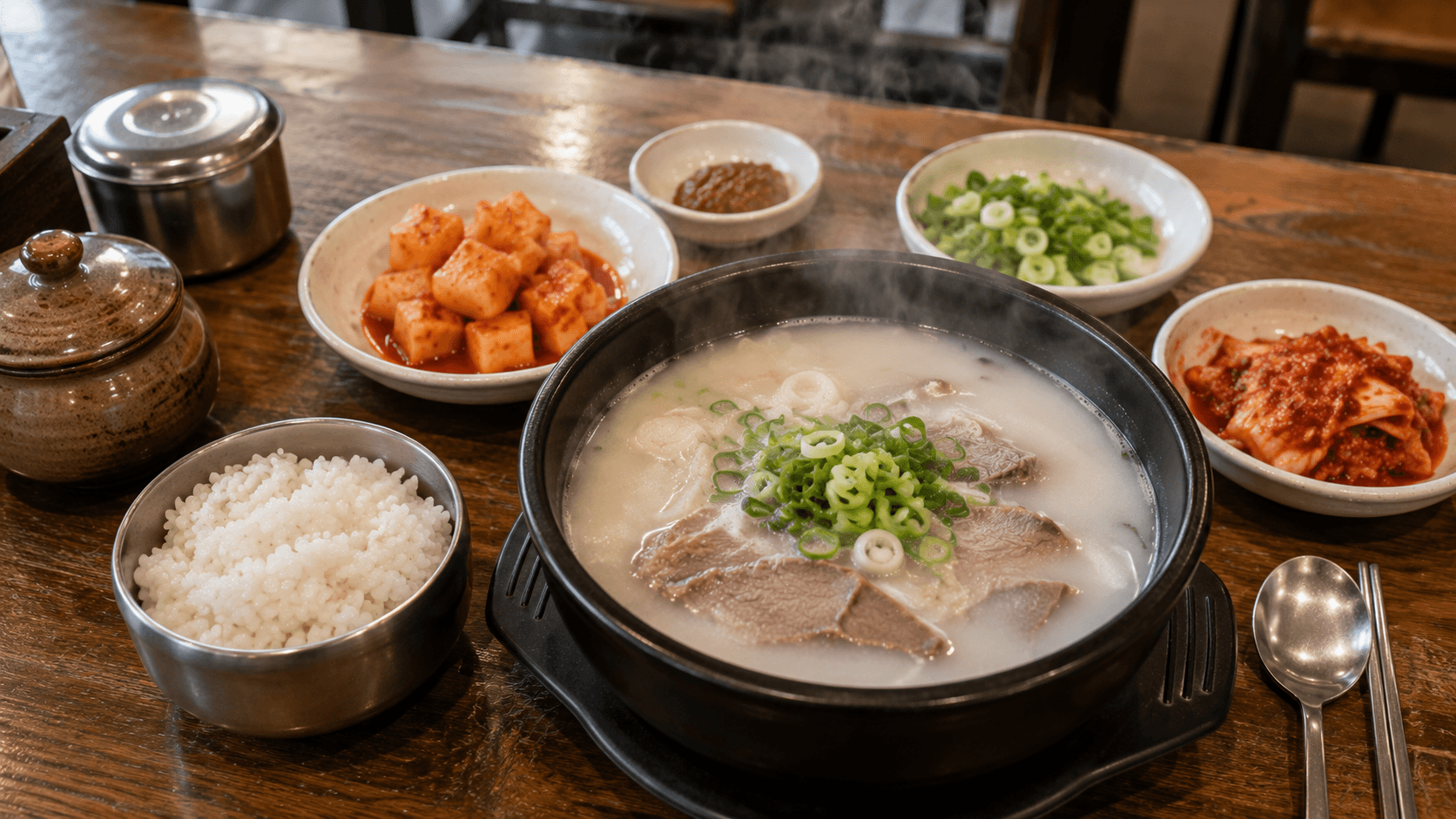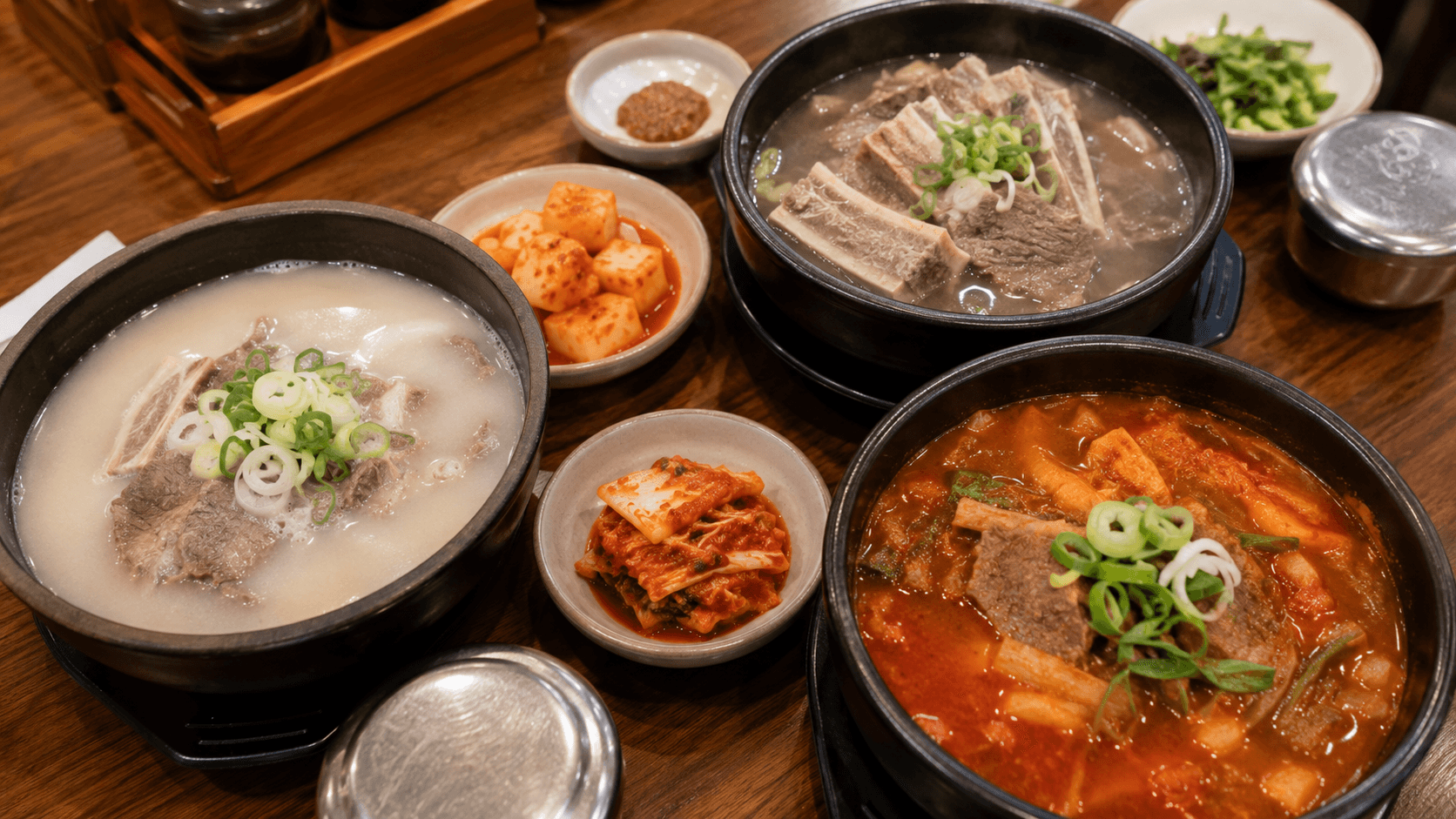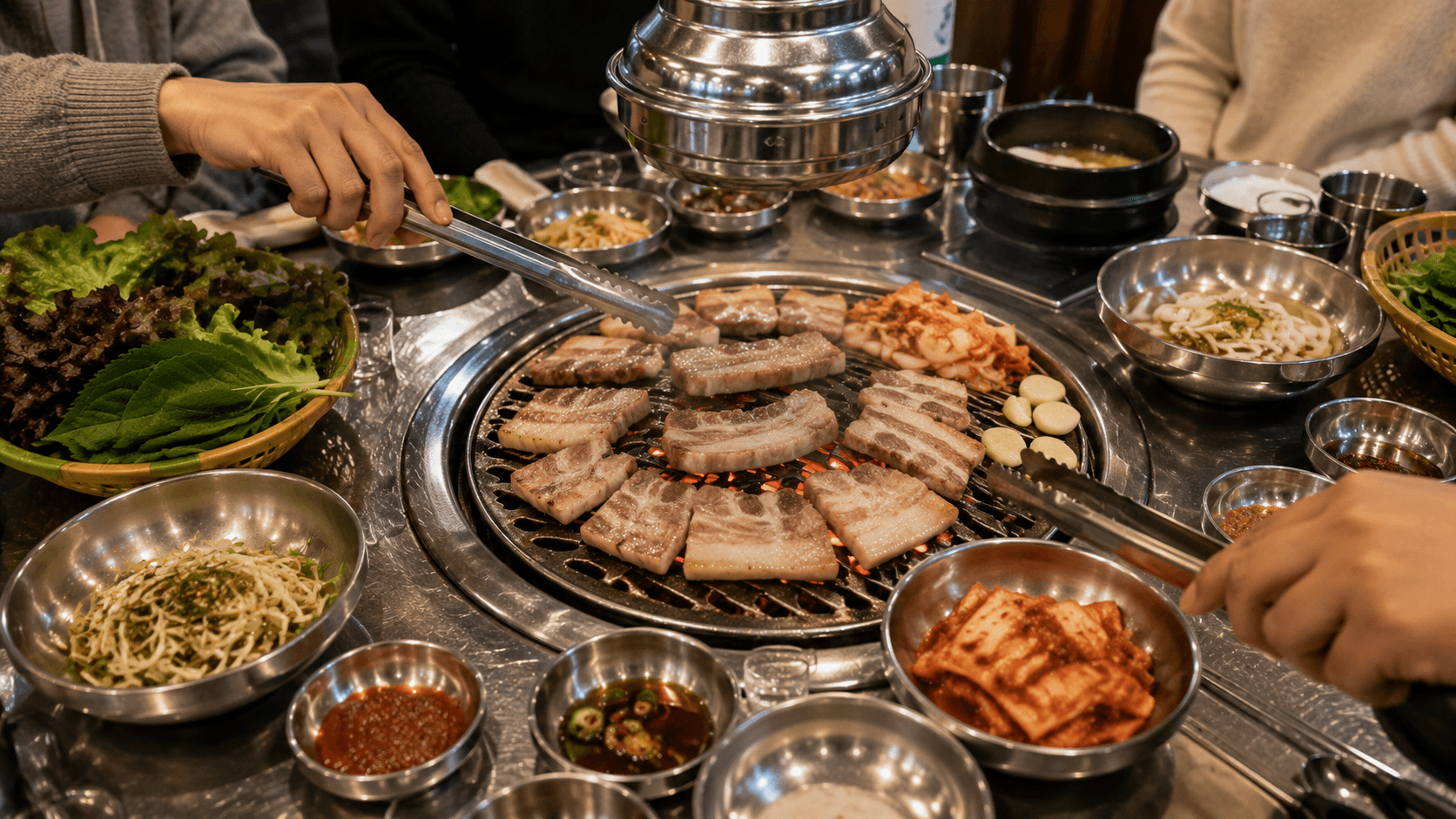
Korean barbecue is usually a shared meal built around meat cooked on a grill at your table. For a straightforward first order, choose one serving each of samgyeopsal (삼겹살, pork belly) and moksal (목살, pork shoulder), then add rice or a stew. Watch whether the staff take charge of the grill, keep utensils used for raw meat separate, and ask before assuming that side dishes or lettuce can be refilled free of charge.
Information and official links in this guide were checked on June 11, 2026. Individual restaurants set their own prices, serving sizes, minimum orders, reservation policies, and opening hours.
At a glance
| Question | Practical answer |
|---|---|
| What should beginners order? | Samgyeopsal and moksal are simple, usually unseasoned choices. Add galbi or bulgogi if you prefer a sweeter marinade. |
| Do I cook the meat myself? | Sometimes. At other restaurants, staff cook it for you. Follow their lead. |
| Is the menu price per person? | Often it is per serving of meat, with the weight shown in grams. Check carefully. |
| Are side dishes free? | Banchan are generally included, but refill policies vary. |
| Can one person eat alone? | Sometimes, but many barbecue restaurants are designed for groups and may require at least two meat servings. |
| Do I need a reservation? | Usually not at casual restaurants, although popular places can have long evening queues. |
| Is Korean BBQ always spicy? | No. Unmarinated pork and beef are not spicy, but sauces and side dishes may be. |
What Korean barbecue actually means
Korean barbecue is not one particular dish. It is a restaurant style in which pork, beef, chicken, duck, seafood, or vegetables are grilled at the table. The Korean term gogi-gui (고기구이) broadly means grilled meat.
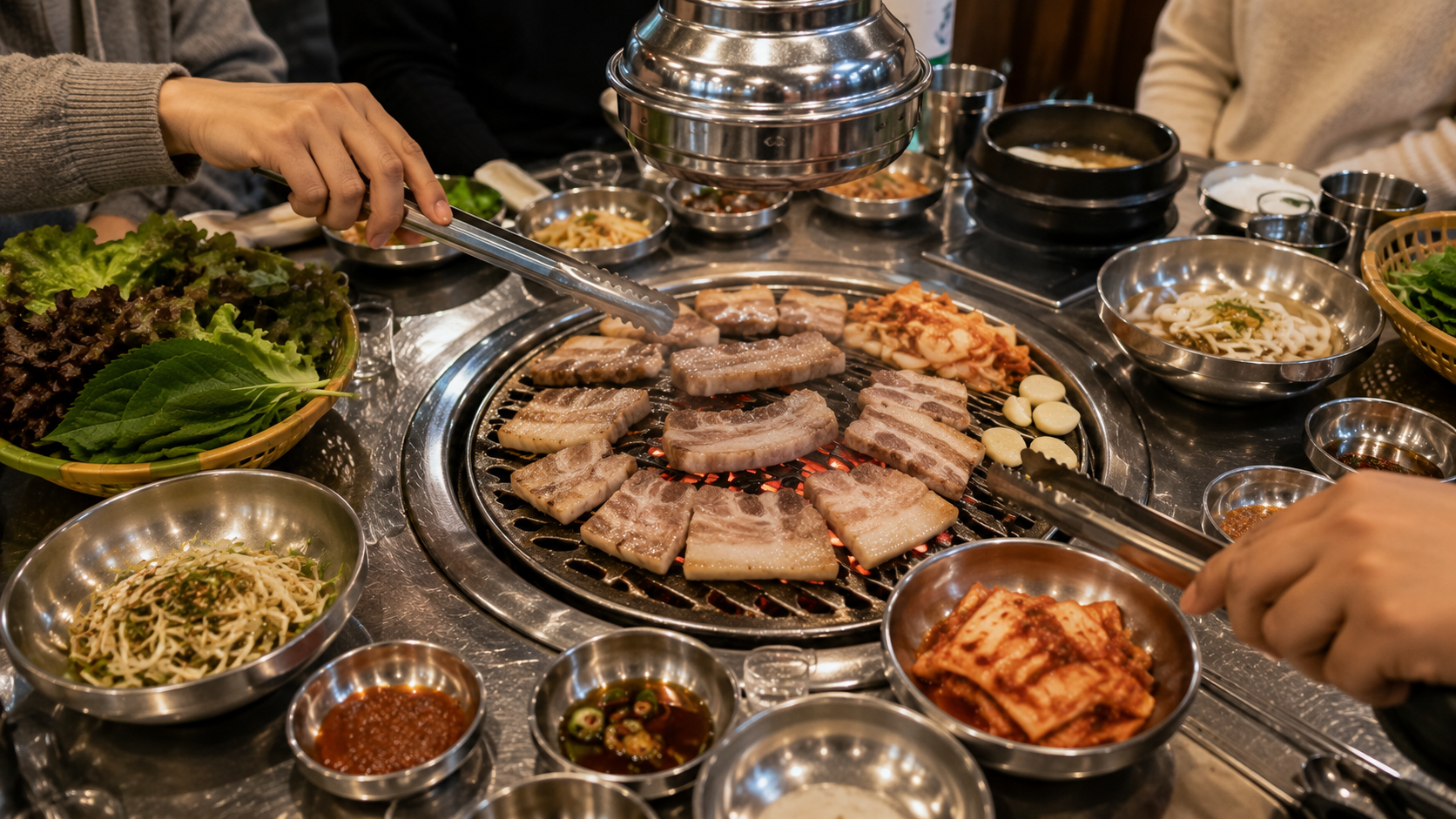
Your table will normally have a built-in grill or a portable burner. An exhaust hood may hang above it, or ventilation may be built around the edge of the grill. Restaurants use different grill plates depending on the meat, so do not move or replace the plate yourself.
The meat is accompanied by banchan (반찬), meaning small side dishes. Common examples include kimchi, seasoned bean sprouts, pickled radish, sliced onions, and salads. You may also receive lettuce or perilla leaves, dipping sauces, garlic, and green chili peppers.
The meal is communal: dishes sit in the middle, while each diner usually has an individual plate, chopsticks, spoon, and dipping sauce.
The main meats explained
Samgyeopsal: pork belly
Samgyeopsal (삼겹살) is thick-sliced pork belly, usually served without a marinade. It is rich and fatty, with crisp edges when properly grilled. This is the most recognizable beginner-friendly order, although diners who dislike fatty meat may prefer pork shoulder.
You may also see ogyeopsal (오겹살), pork belly with the skin attached, or daepae-samgyeopsal (대패삼겹살), very thin pork belly that cooks quickly.
Moksal: pork shoulder
Moksal (목살) is pork shoulder or collar. It is generally leaner and firmer than pork belly but still suitable for grilling. Ordering one serving of samgyeopsal and one of moksal gives two diners an easy comparison.
Dwaeji-galbi: marinated pork ribs
Dwaeji-galbi (돼지갈비) is pork rib meat in a sweet and savory marinade. The exact cut and amount of bone vary. Because sugar in the marinade can burn, staff may manage the grill more closely or change the grill plate during the meal.
Galbi: beef ribs
Galbi (갈비) means ribs and commonly refers to beef short ribs at beef restaurants. It can be marinated or unseasoned. Saeng-galbi (생갈비) usually indicates fresh, unmarinated ribs, while yangnyeom-galbi (양념갈비) means seasoned or marinated ribs.
Beef galbi usually costs substantially more than casual pork cuts. Check whether the listed portion contains bone and compare the weight rather than judging only by the plate size.
Bulgogi: thin marinated beef
Bulgogi (불고기) is thin beef in a sweet soy-based marinade. Depending on the restaurant, it may be cooked on a domed grill, in a shallow pan with broth, or in the kitchen. It is often mild, but ingredients vary.
Chadolbagi: thin beef brisket
Chadolbagi (차돌박이) is very thinly sliced, fatty beef brisket. It cooks in seconds. Remove it promptly once browned so that it does not become dry.
Hanwoo beef
Hanwoo (한우) is beef from Korean cattle. Restaurants may list a grade, cut, and place of origin. Hanwoo can be considerably more expensive than imported beef, so confirm the price and serving weight before ordering.
How to read the menu and estimate the bill
There is no reliable nationwide price for Korean barbecue. Prices depend on the city, neighborhood, meat origin, cut, grade, serving weight, and restaurant type. Current prices should therefore be checked on the restaurant's own menu on the day of your visit.
A meat listing commonly includes:
- The cut of meat
- Domestic or imported origin
- A weight such as 120 g, 150 g, or 180 g
- A price for that serving
- Sometimes a minimum initial order
Do not assume that one displayed price covers the table or an unlimited meal. If the menu lists samgyeopsal at a price beside 150 g, that normally means one 150 g order.
A useful budgeting calculation is:
meat price × number of servings + rice/noodles/stew + drinks
Rice, stew, noodles, steamed egg, and fried rice are frequently separate orders. Water and banchan are commonly included, but there are exceptions. Ask before requesting repeated refills of expensive-looking items such as steamed egg, cheese, seafood, or specialty salads.
Useful questions include:
Is this price for one serving?— 이 가격이 1인분이에요? (I gagyeogi irinbun-ieyo?)How many servings is the minimum order?— 최소 주문이 몇 인분이에요? (Choeso jumuni myeot irinbun-ieyo?)Is this refill free?— 이거 리필 무료예요? (Igeo ripil muryo-yeyo?)
How to order: a beginner's sequence
1. Check the minimum order
Many restaurants accept meat orders only from two servings, particularly for the first order. The servings do not always have to be identical, but policies vary. Solo diners should search for honbap (혼밥, eating alone) or 1인분 주문 가능, meaning one-serving orders are available.
2. Start with a manageable amount
For two adults, begin with two servings rather than ordering the entire meal at once. You can usually add more meat later. A practical first combination is one samgyeopsal and one moksal.
3. Add a carbohydrate or stew later
Common finishing dishes include:
- Doenjang-jjigae (된장찌개): soybean paste stew
- Kimchi-jjigae (김치찌개): kimchi stew
- Mul-naengmyeon (물냉면): cold noodles in chilled broth
- Bibim-naengmyeon (비빔냉면): spicy mixed cold noodles
- Bokkeumbap (볶음밥): fried rice, sometimes cooked on the grill
- Gonggibap (공깃밥): a bowl of steamed rice
Some restaurants allow fried rice only after a particular meat or stir-fried dish, so ask rather than placing rice directly on the grill.
4. Order drinks separately
Alcohol is optional. Common choices are soju, beer, and somaek, a mixture of soju and beer. Non-drinkers can simply request water or a soft drink. There is no obligation to participate in drinking rituals.
Who controls the grill?
The answer depends on the restaurant. Staff may cook every piece, start the meat and leave you to finish, or expect the table to cook everything.
Follow these cues:
- If a server immediately arranges the meat, leave it alone unless invited to help.
- If tongs and scissors are placed beside the grill and no server returns, your table may be expected to cook.
- If you are uncertain, ask
구워 주세요(guwo juseyo), meaningPlease grill it for us. - Do not press, cut, or repeatedly turn meat while a staff member is managing it.
- Let staff change a dirty or burnt grill plate. Ask
불판 바꿔 주세요(bulp판 bakkwo juseyo), meaningPlease change the grill plate.
The grill and exhaust equipment can become extremely hot. Keep phones, sleeves, bags, and children away from the cooking area.
Grilling safely
Korean barbecue puts raw and cooked food on the same table, so utensil separation matters. Use the designated tongs for raw meat and your personal chopsticks for food that is ready to eat. If the restaurant provides two pairs of tongs, keep track of which pair touched raw meat.
Cook pork and chicken completely. With thick pieces, check the center after cutting rather than judging only by the browned surface. If you are uncertain, ask the staff to inspect or finish the meat.
The Ministry of Food and Drug Safety's food safety system covers cooked food in restaurants as part of Korea's consumption-stage safety management. That regulation does not remove the need for care at a self-grill table: avoid cross-contamination, replace utensils that fall on the floor, and tell staff if the grill is malfunctioning.
If someone develops breathing difficulty, swelling, collapse, or another severe reaction, call 119 for emergency medical assistance.
How to make and eat a ssam
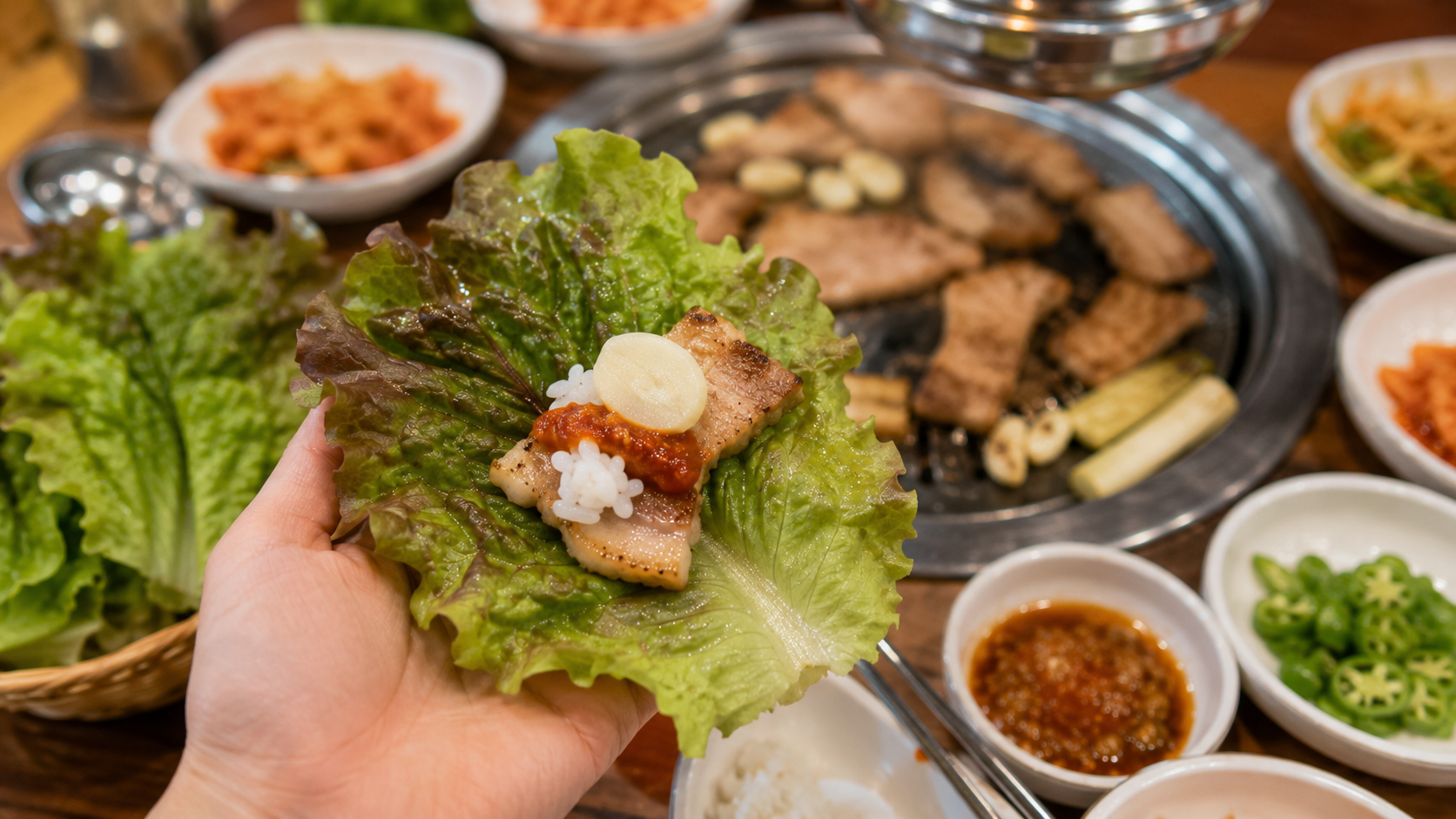
Ssam (쌈) means a wrap, usually made with lettuce or a perilla leaf.
- Place one leaf in your hand.
- Add one piece of cooked meat.
- Add a small amount of ssamjang (쌈장), the thick dipping paste.
- Add rice, garlic, kimchi, or another side only if you want it.
- Fold the leaf into a small parcel and eat it in one or two manageable bites.
There is no required formula. You can eat the meat without a wrap, dip it in sesame oil and salt, or combine it with a pickled radish slice. Avoid constructing an oversized wrap that is difficult to eat neatly.
Raw garlic and green chili can be intense. Try a small amount first. Perilla leaves have a distinctive herbal flavor and are not the same as sesame leaves, despite that common English menu translation.
Banchan and table etiquette
Banchan are intended to accompany the meal, not to function as separate appetizers that must be finished before the meat arrives. Share the central dishes and transfer food to your own plate when practical.
Refills of basic banchan are common but not guaranteed. Request only what the table is likely to eat. A polite request is 반찬 더 주세요 (banchan deo juseyo), meaning Please give us more side dishes.
Other useful habits include:
- Do not place personal chopsticks into shared dipping sauces.
- Do not put cooked meat back onto a plate that held raw meat.
- Use two hands when receiving or giving something to an older person or in a formal setting.
- Keep bags in a basket, under-seat compartment, or plastic cover if provided.
- Tell staff before moving hot cookware or adjusting a charcoal grill.
- Use the call button on the table when there is one; it is a normal way to request service.
Formal age-based etiquette is less important in a casual meal among friends. You do not need to imitate every drinking custom seen in television dramas.
Allergies, vegetarian diets, and religious requirements
Korean barbecue can be difficult for people with severe allergies or strict dietary restrictions. Marinades, ssamjang, kimchi, dressings, and stews may contain soy, wheat, sesame, seafood, shellfish, fish sauce, or other ingredients not obvious from appearance.
A shared grill also creates a high risk of cross-contact. Beef, pork, seafood, and vegetables may be cooked on the same surface or handled with the same utensils. Do not rely only on an icon, translated menu, or the assumption that an unseasoned item has no allergens.
Show staff a clearly translated allergy card before ordering and ask about sauces, marinades, broth, side dishes, and grill use. If the restaurant cannot confirm the ingredients or prevent cross-contact, choose another place. The Ministry of Food and Drug Safety is the relevant national authority for food safety and labeling information, but restaurant staff must confirm the ingredients used in that particular kitchen.
Vegetarian diners should not assume that kimchi, soup, or vegetable side dishes are meat-free. Fish sauce, anchovy broth, meat stock, and shared cooking surfaces are common concerns. A dedicated vegetarian restaurant is generally easier for strict diets than a meat-focused barbecue venue.
Muslim travelers should verify both the meat source and preparation method. Pork-free does not automatically mean halal, and a shared pork grill may be unacceptable for some diners. The VISITKOREA tourism portal maintains travel information, including resources for Muslim-friendly travel, but restaurant status and operating details should be reconfirmed directly.
Reservations, queues, payment, and accessibility
Casual neighborhood restaurants often accept walk-ins. Popular restaurants may use a paper waiting list, kiosk, Korean phone number, or local reservation platform. Ask your accommodation host or the 1330 Korea Travel Helpline for assistance when a queue system is available only in Korean. VISITKOREA provides free online calling and chat access to the 1330 helpline, although data charges may apply outside Wi-Fi.
International payment cards work at many restaurants, but acceptance cannot be guaranteed. Carry another payment method and check before ordering if payment is a concern.
Accessibility varies considerably. Older restaurants may have steps, narrow aisles, fixed stools, floor seating, or toilets outside the dining area. Table grills and hanging exhaust ducts can also restrict wheelchair positioning. Contact the restaurant directly to confirm step-free access, lift availability, seating clearance, and accessible toilets.
Opening hours shown on map applications may be inaccurate. Restaurants can close between lunch and dinner, stop taking orders before the posted closing time, or close when ingredients sell out. Verify the same day through the restaurant's official listing or by telephone.
Common beginner mistakes
- Ordering several expensive servings before understanding portion sizes
- Assuming every menu price is per person or covers unlimited meat
- Mixing utensils used for raw and cooked meat
- Interrupting staff while they are controlling the grill
- Letting thin brisket or sweet marinated meat burn
- Eating an unfamiliar green chili whole
- Assuming all banchan refills are free
- Expecting every restaurant to serve solo diners
- Assuming a vegetable dish is vegetarian or allergy-safe
- Wearing delicate clothing without expecting smoke or cooking smells
Many restaurants provide apron bibs, coat covers, or storage compartments. Ask for an apron with 앞치마 주세요 (apchima juseyo).
What to check before you go
- Confirm the restaurant's current opening hours and last-order time.
- Check whether reservations are accepted or required.
- Look for serving weights and an initial minimum order.
- Confirm that solo dining is allowed if you are alone.
- Review meat origin, cut, marinade, and price.
- Ask about allergens and shared grills before ordering.
- Confirm halal, vegetarian, or other dietary requirements directly.
- Check card acceptance if you do not have another payment method.
- Ask about step-free access and seating clearance when needed.
- Wear clothes that can tolerate some cooking smell.
FAQ
Do I have to wrap the meat in lettuce?
No. Ssam is one way to eat grilled meat, not a compulsory rule. You can eat it plain, with rice, or with a dipping sauce.
Should I tip at a Korean barbecue restaurant?
A conventional percentage-based restaurant tip is not expected in South Korea. Pay the amount shown on the bill unless the restaurant clearly lists a separate charge or policy.
Can I ask staff to cook everything?
Yes, you can ask, but service styles differ. Say 구워 주세요 (guwo juseyo). Staff may cook the meat fully, demonstrate the first batch, or tell you when to turn it.
Is Korean barbecue suitable for children?
Families do visit barbecue restaurants, but the exposed grill, hot metal, scissors, smoke, and crowded table require close supervision. Request a high chair in advance because availability is not guaranteed.
What is the easiest first order for two people?
Ask for one serving of samgyeopsal and one serving of moksal, subject to the restaurant's minimum order. Add rice or doenjang-jjigae, then order more only if needed.
Your next step is to choose a restaurant with a clearly photographed menu, check its current serving weights and minimum order, and save the Korean names 삼겹살 and 목살 on your phone before you arrive.