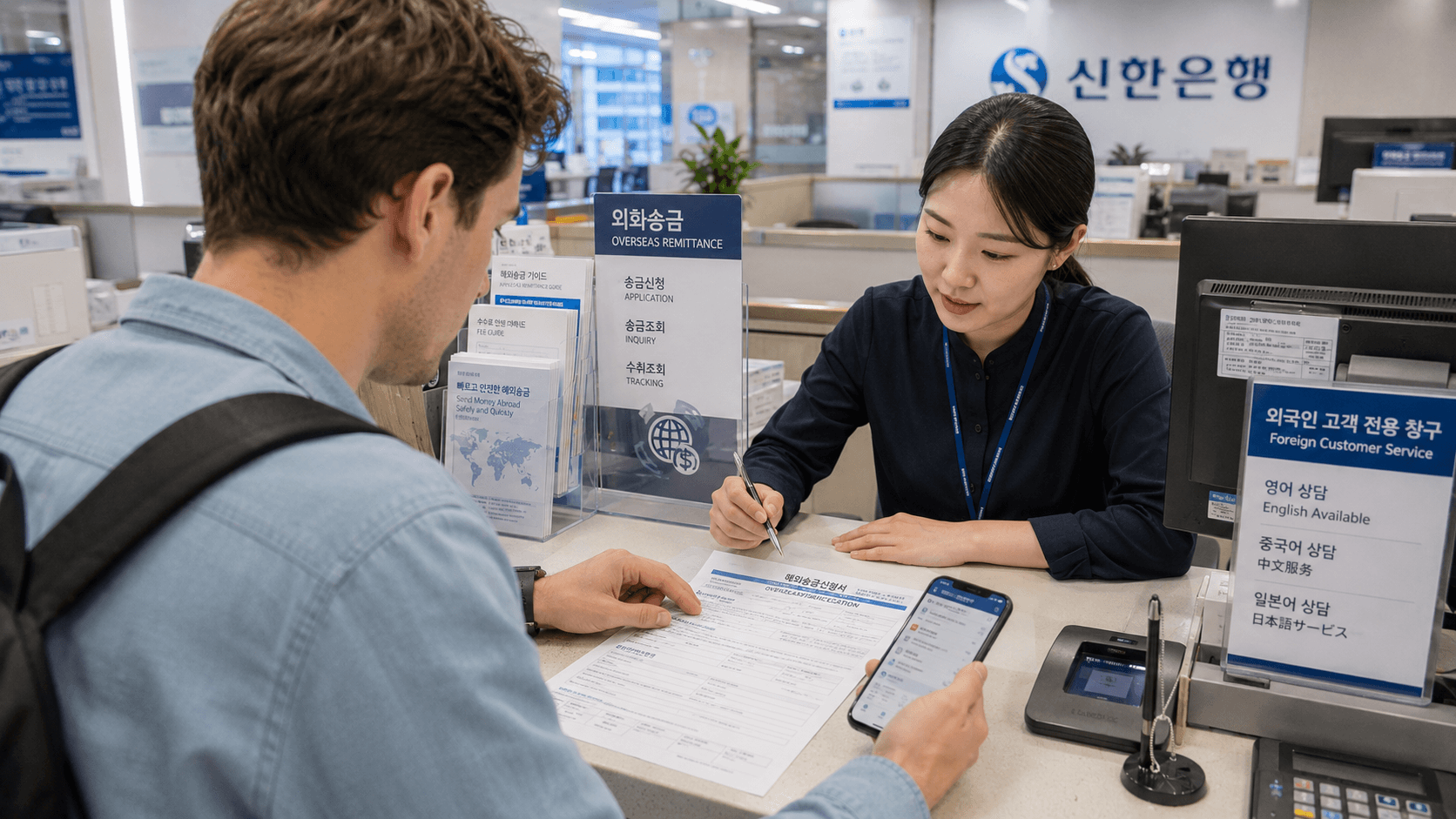
Sending money from South Korea usually requires a Korean bank account, verified identification and the recipient's exact banking details. You can use a conventional bank transfer or a licensed overseas-remittance provider. The cheapest option is not necessarily the one with the lowest advertised fee: compare the final amount the recipient will receive after exchange-rate margins and intermediary charges.
Rules, provider limits and fees may change. The regulatory and official information in this guide was checked on June 10, 2026. Confirm the transaction category, documentary requirements and final quote with your bank or provider before sending.
Quick answer
- Choose a Korean bank or licensed remittance service that supports the destination country and payout method.
- Prepare your passport or Residence Card, Korean phone number and Korean bank account.
- Obtain the recipient's legal name, account number and international bank codes.
- Select an accurate transfer purpose, such as living expenses, family support, tuition or transfer of salary.
- Compare the amount the recipient will receive, not only the service fee.
- Send a small test payment before transferring a large amount.
- Keep the receipt and any proof showing the source and purpose of the funds.
Your main options
International transfer through a Korean bank
Most Korean banks provide overseas transfers at branches, through internet banking or in their mobile apps. A bank transfer is generally the more practical route when:
- You are sending a large amount.
- The payment is for tuition, property, investment or another purpose requiring documents.
- You need a formal remittance certificate.
- Your destination or currency is not supported by a remittance app.
- You need assistance checking international account details.
Bank transfers normally travel through the SWIFT international banking network. One or more intermediary banks may handle the payment before it reaches the recipient's bank.
A practical processing estimate is one to five business days after the transfer is accepted, although compliance reviews, weekends, public holidays, intermediary banks and incorrect details can make it longer. This is not a guaranteed schedule; check the bank's quoted delivery estimate on the day you send.
Licensed overseas-remittance provider
Korea also has non-bank providers specializing in international transfers. Depending on the provider and country, the recipient may receive money in a bank account, mobile wallet or approved cash-pickup location.
These services can offer simpler pricing or faster delivery for routine personal payments. However, available countries, currencies, transaction ceilings, identity requirements and payout methods differ. Confirm that the company is authorized to provide the service in Korea and use its official website or app, not a link sent through an unsolicited message.
Examples of established services operating from Korea include SentBe and WireBarley. Their inclusion here is not a recommendation. Compare their current quote with at least one bank before deciding.
Carrying cash instead
Cash is usually less convenient and less secure than a traceable transfer. It also has customs requirements. According to the Korea Customs Service's foreign-currency declaration guide, travelers leaving Korea with more than the equivalent of USD 10,000 may need a customs declaration or confirmation from a foreign-exchange bank, depending on their status and the source and purpose of the money.
The Customs Service specifically states that a foreign resident leaving with earned income from Korea must obtain confirmation from the head of a foreign-exchange bank. These rules were verified on June 10, 2026. Ask the bank and Customs before departure rather than arriving at the airport with undeclared cash.
What information you need
Ask the recipient to copy the details directly from an official bank statement or banking app. Do not reconstruct an account number from memory.
For a bank deposit, you may need:
- Recipient's full legal name exactly as registered with the bank.
- Recipient's address and sometimes telephone number.
- Bank name and branch address.
- Account number or IBAN, where the country uses IBANs.
- SWIFT/BIC code.
- Country-specific routing code, such as an ABA routing number, sort code, BSB or IFSC.
- Transfer currency.
- Reason for payment.
- An intermediary or correspondent bank, if instructed by the recipient's bank.
For cash pickup or a mobile wallet, the provider may instead request the recipient's name, phone number, city and government-issued identification details.
A spelling difference can delay or return the payment. This is especially important when the recipient's name includes multiple family names, initials or a different order from the name shown on the account.
Documents commonly requested in Korea
Requirements depend on your nationality, Korean residency status, transfer purpose, amount, transaction history and source of funds. A bank or provider may request:
- Passport.
- Valid Residence Card, formerly commonly called an Alien Registration Card or ARC.
- Korean mobile number registered in your name.
- Korean bankbook, account details or debit card.
- Employment contract or certificate of employment.
- Payslips or a salary-deposit history.
- Korean income or tax documents.
- Tuition invoice or enrollment certificate.
- Rental, medical or commercial invoice.
- Documents showing how savings, sale proceeds or other funds were obtained.
Bring original documents to a branch when possible. A bank may reject a screenshot, an expired Residence Card or a document that does not clearly connect you to the funds.
Foreign residents transferring salary or savings should be prepared to demonstrate that the money was lawfully earned or brought into Korea. A bank may also ask about your expected transfer pattern as part of its customer-identification and anti-money-laundering checks.
Transfer limits and foreign-exchange rules
There is no single practical limit that applies to every person and every payment. The amount you can send without additional steps depends on factors including:
- Whether Korean regulations classify you as a resident or non-resident.
- Your nationality and immigration status.
- Whether the money is Korean-earned income or funds previously brought from overseas.
- The transfer purpose.
- Whether the transaction involves capital, securities, real estate, a loan or business activity.
- The provider's own per-transfer and annual limits.
- Whether supporting documents or a regulatory report are required.
Korea's transfers are governed by the Foreign Exchange Transactions Act, its Enforcement Decree and detailed regulations. The Ministry's English laws database listed an amended Enforcement Decree effective March 24, 2026 when checked on June 10, 2026.
Do not assume that an app's displayed ceiling is the complete legal answer. A provider limit is a product rule; regulatory reporting and documentary obligations may still apply. For a large transfer, investment, overseas property purchase, loan, inheritance or movement of business funds, consult a foreign-exchange desk before sending. This guide is not legal, tax or financial advice.
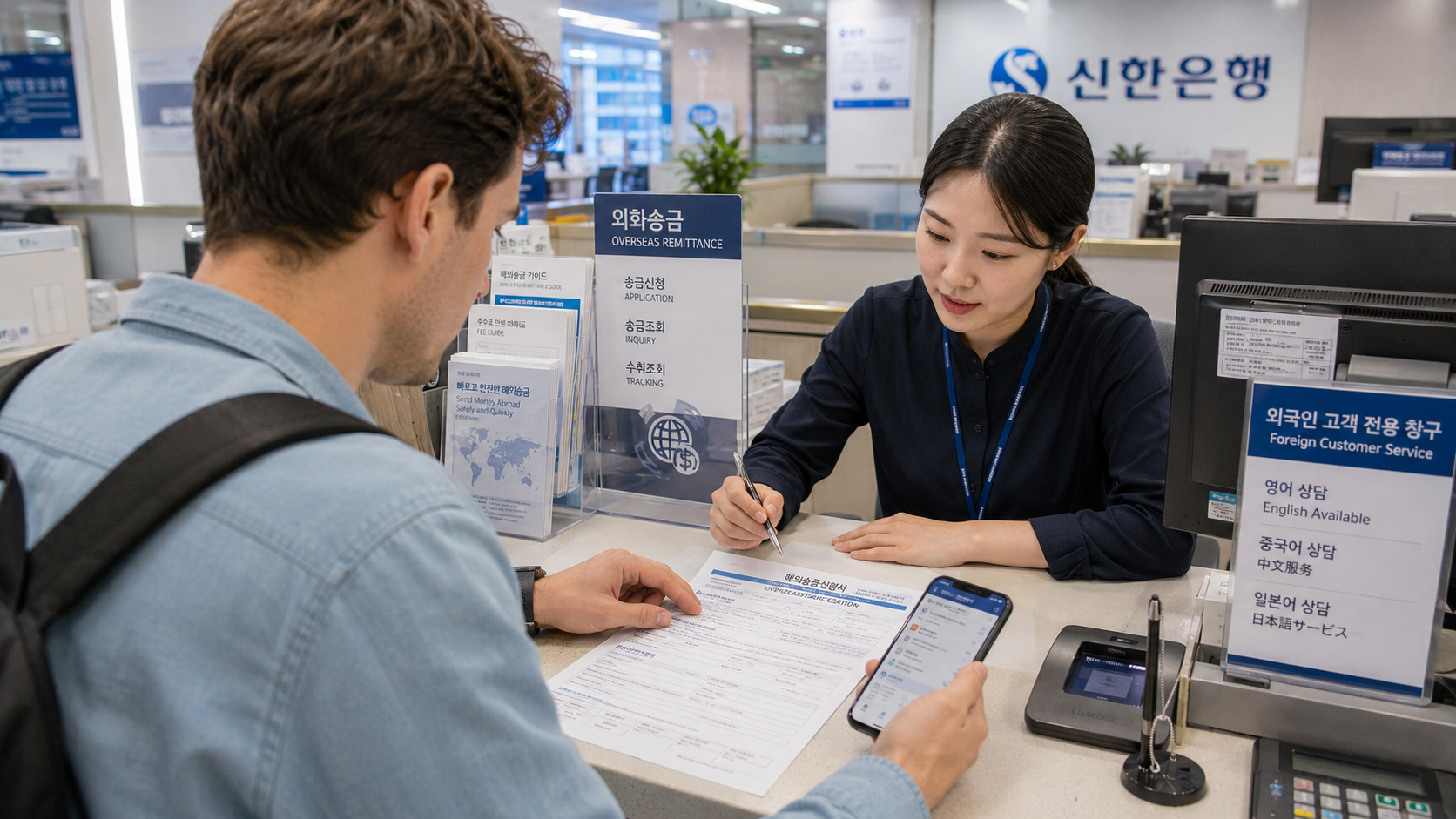
How to send money through a bank branch
1. Contact the branch first
Ask whether the branch handles foreign-exchange transactions and whether English-language assistance is available. Smaller branches may refer complex transfers to a larger location.
Explain your nationality, residency status, destination, approximate amount and purpose. Ask exactly which original documents to bring.
2. Request the complete cost
Ask for:
- The KRW amount that will leave your account.
- The exchange rate being applied.
- The Korean bank's transfer fee.
- Any cable or SWIFT charge.
- Possible intermediary-bank deductions.
- The expected amount and currency arriving in the recipient's account.
International wires may use one of three fee instructions:
- OUR: The sender agrees to pay applicable transfer charges, although exact treatment can still vary by banking chain.
- SHA: Sender and recipient share charges.
- BEN: Charges are deducted from the recipient's funds.
Ask which options are available for your destination. If the recipient must receive an exact amount, such as a tuition payment, confirm the beneficiary bank's requirements before sending.
3. Check every field
Verify the recipient's name, account or IBAN, SWIFT code, routing code and currency. Also check whether the destination account accepts the selected currency. A USD transfer to an account that only accepts local currency could be rejected or converted under the recipient bank's terms.
4. Keep the receipt
The receipt should include a reference number. For a SWIFT transfer, ask whether the bank can provide the payment reference or an MT103 transaction record if the recipient cannot locate the money.
How to use a remittance app
1. Complete identity verification
Install the official app and register using your legal name. Verification commonly requires a passport or Residence Card, a Korean phone number and a Korean bank account in the same name.
2. Add the recipient
Select the destination country and payout method, then enter the requested bank, wallet or cash-pickup information. The available fields vary by country.
3. Review the quote
Before confirming, record:
- KRW payment amount.
- Service fee.
- Exchange rate.
- Recipient amount.
- Estimated delivery time.
- Quote expiration time.
- Cancellation and refund conditions.
4. Fund the transfer correctly
Providers may assign a virtual Korean account or request payment from a verified account. Use an account in your own name unless the provider explicitly permits another method. A transfer funded by an unrelated person can trigger a review or refund.
5. Track the payment
Save the transaction number and send the recipient only the information required for collection. Never share your password, security card codes or one-time verification codes.
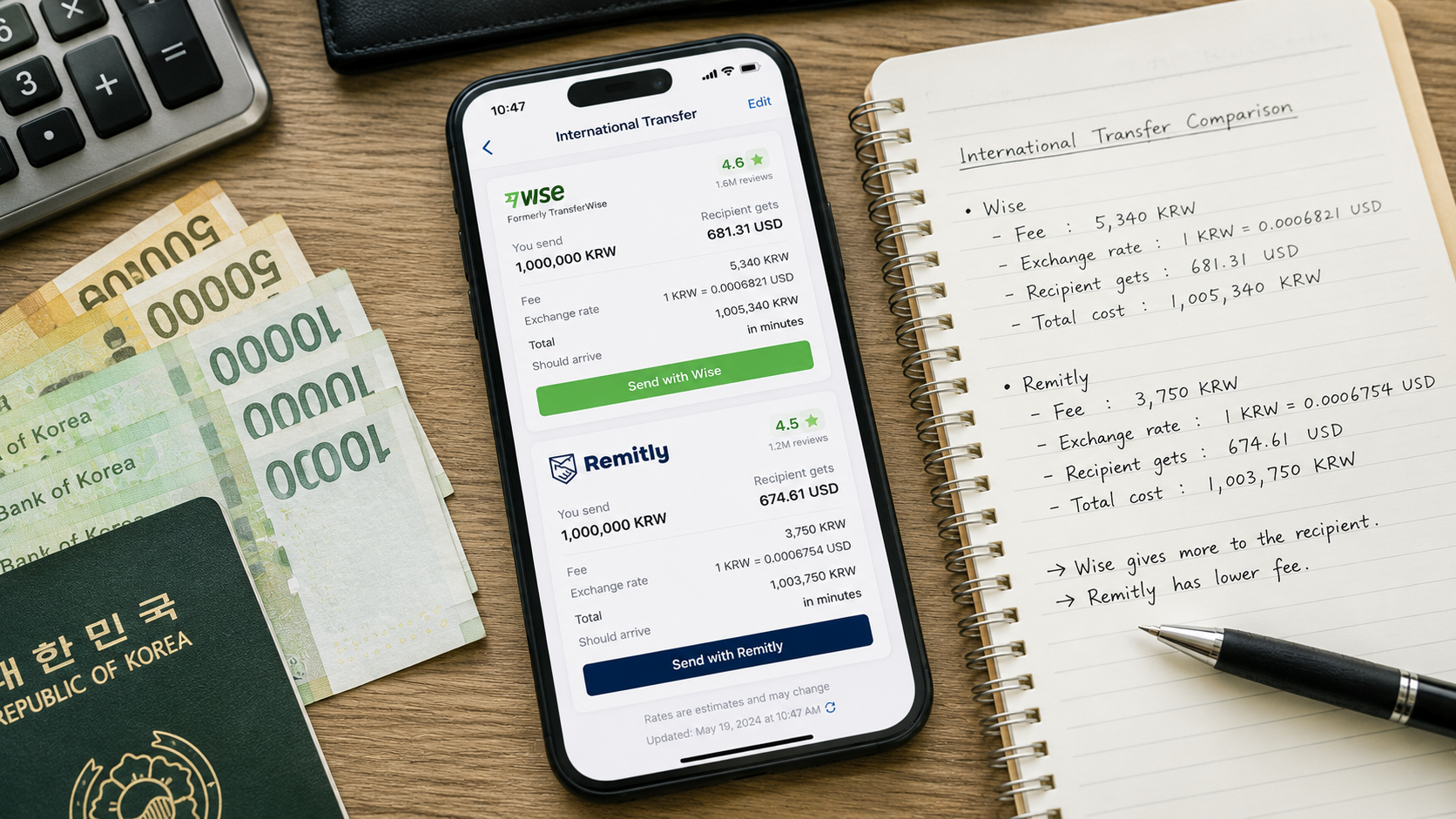
How to compare the real cost
Suppose Service A charges KRW 5,000 and Service B advertises no fee. Service B can still be more expensive if it uses a weaker exchange rate.
Compare providers at nearly the same time using the same KRW amount, destination currency and payout method. The most useful figure is:
Recipient amount after all disclosed charges
Also check whether the overseas bank may deduct an incoming-wire fee. Korean providers cannot always predict fees imposed later by intermediary or recipient banks.
Exchange rates can move while you compare. The Ministry of Finance and Economy's economic indicators provide a reference for market conditions, but the rate shown there is not a guaranteed consumer remittance rate. Your provider's final confirmation screen controls the transaction.
Common problems and how to avoid them
The transfer is pending
Identity checks, source-of-funds reviews and destination-bank screening can place a transfer on hold. Respond through the provider's official app or published contact channel. Do not send documents to a personal email address or messaging account unless its authenticity has been confirmed.
The recipient received less than expected
The difference may come from an exchange-rate margin, intermediary-bank charge, incoming-wire fee or a SHA/BEN fee instruction. Request an itemized explanation and the payment record.
The bank rejects your documents
Ask which specific fact remains unverified: identity, residence status, income source, payment purpose or recipient relationship. Obtain an official document addressing that point rather than repeatedly submitting the same material.
You entered the wrong account information
Contact the provider immediately. A transfer cannot always be reversed after payment or credit to the recipient. Recovery may require cooperation from several banks and may involve additional fees.
Someone asks you to forward money
Do not receive and resend funds for an employer, online acquaintance, romantic contact or supposed investment manager. You could be handling stolen or fraud-related money. Use only accounts and transfers connected to your own legitimate transactions.
Tax and reporting considerations
Sending money does not by itself explain whether the underlying funds have Korean or overseas tax consequences. Salary, business income, investment gains, gifts, inheritance and property proceeds can each be treated differently.
Keep employment records, payslips, contracts, tax certificates and transfer receipts. For Korean tax questions, use the National Tax Service's English resources and help desk or consult a qualified tax professional. For foreign-exchange reporting, ask your bank's foreign-exchange desk or the relevant Korean authority before making the transaction.
What to check before you send
- Is the bank or remittance provider legitimate and operating through its official channel?
- Does it support your destination, currency and required payout method?
- Is your passport or Residence Card valid?
- Does the name on your Korean account match your identification?
- Are the recipient's name and banking codes copied from an official source?
- Have you selected the true payment purpose?
- Do you have documents proving the source and purpose of the money?
- What exact amount will the recipient receive?
- Could an intermediary or recipient bank deduct another fee?
- Is there a deadline affected by weekends or holidays in either country?
- Have you saved the quote, receipt and reference number?
For a large or unusual payment, take this checklist and your documents to a bank's foreign-exchange desk before initiating the transfer. Getting the transaction classified correctly is more important than saving a small fee.
Sources
- Ministry of Finance and Economy: Laws in English
- Ministry of Finance and Economy: economic and foreign-exchange information
- Korea Customs Service: Declaration of Foreign Currency
- Financial Services Commission
- National Tax Service English website
- National Law Information Center: Foreign Exchange Transactions Act
- National Law Information Center: Foreign Exchange Transactions Regulations