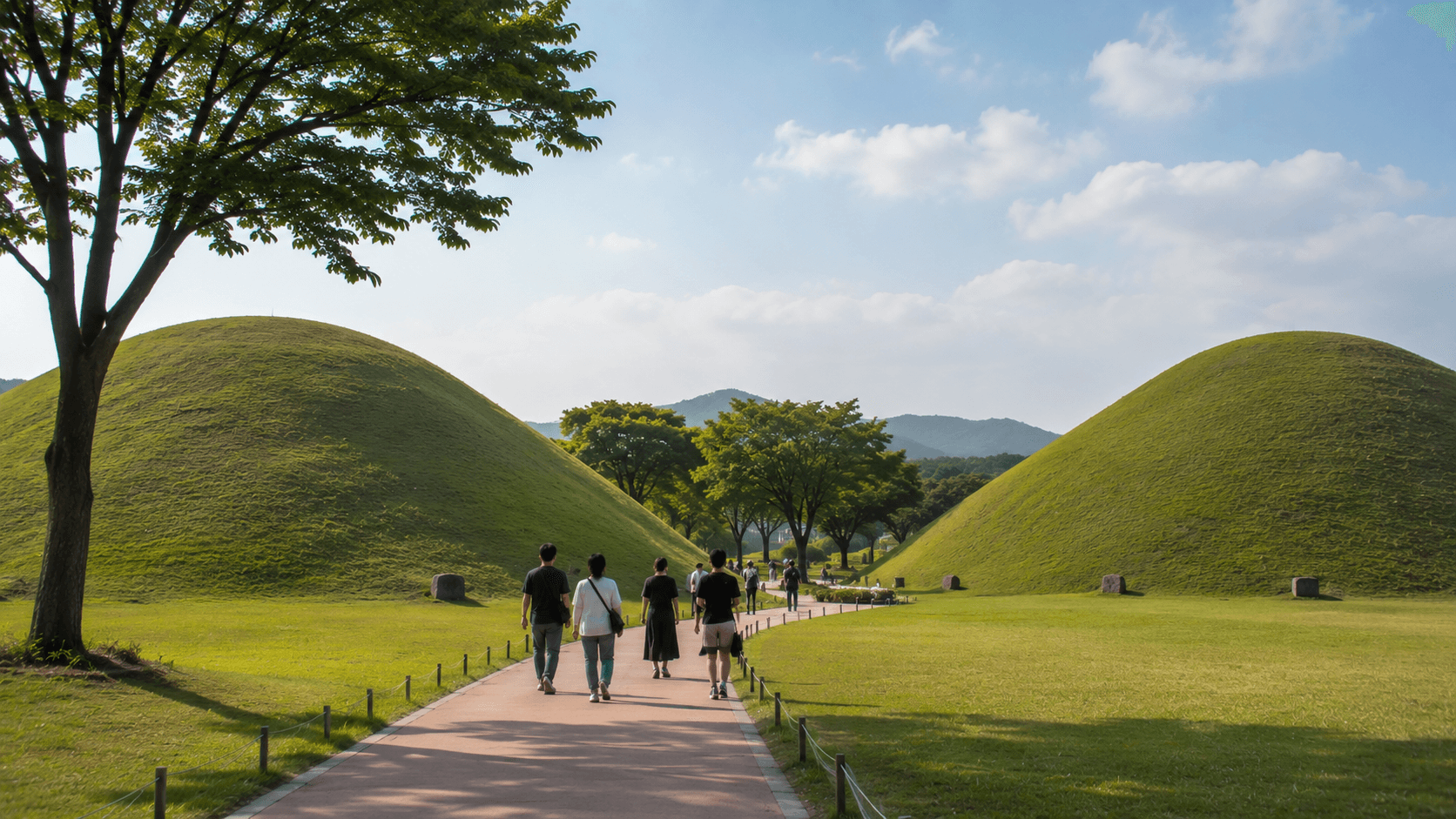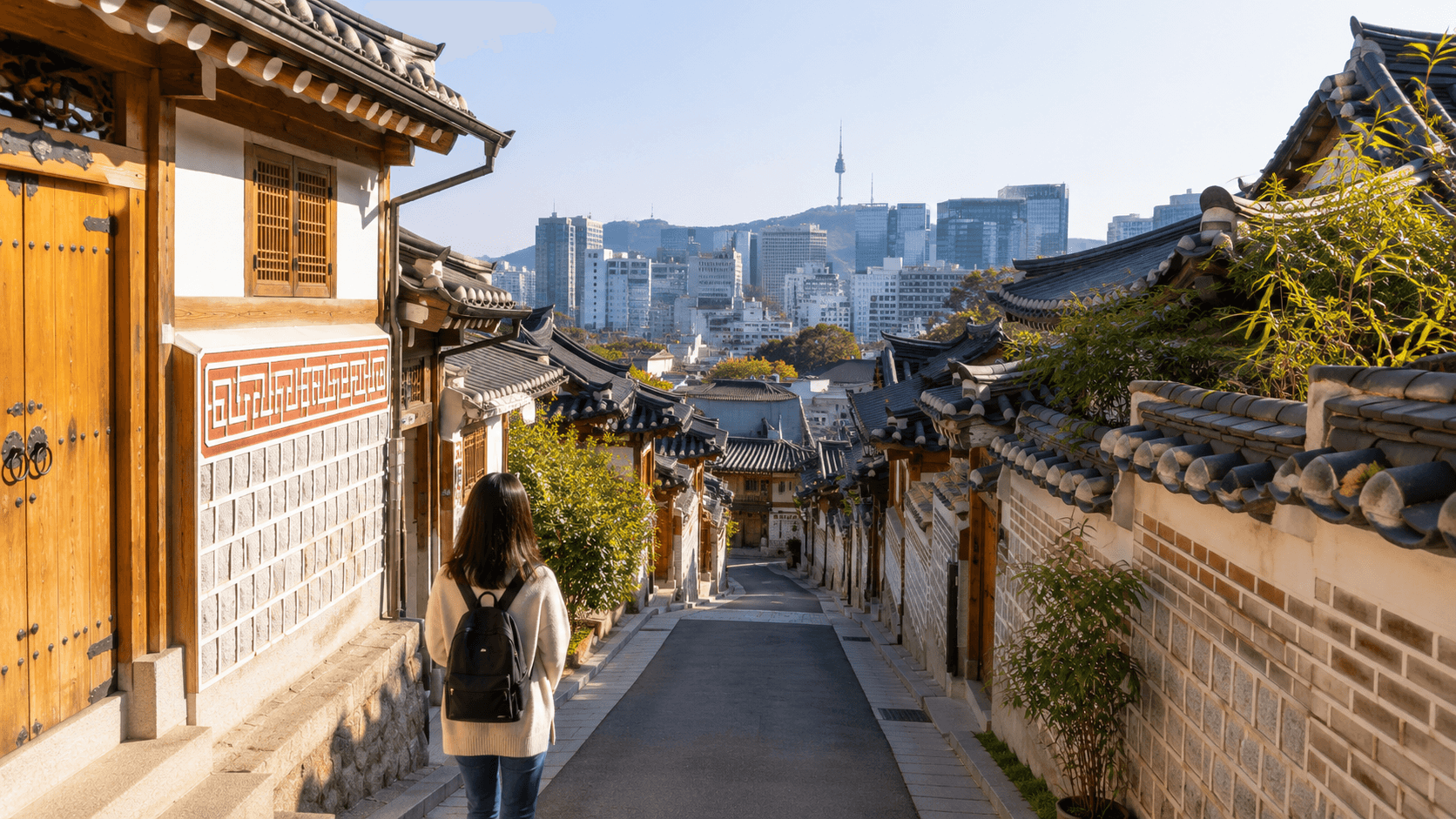
A first family trip to South Korea works well with four nights in Seoul and two nights in Busan. This seven-day route introduces Korean history, city life, markets, museums, and the coast without changing hotels every day. It is designed mainly for families with school-age children, but includes adjustments for toddlers and teenagers.
Fares, schedules, opening hours, and reservation information in this guide were checked on June 10, 2026. Reconfirm them on the linked official websites before traveling.
At a glance
| Day | Base | Main plan |
|---|---|---|
| 1 | Seoul | Arrival and an easy neighborhood walk |
| 2 | Seoul | Gyeongbokgung Palace, museums, and Insadong |
| 3 | Seoul | National Museum of Korea and the Han River |
| 4 | Seoul | Choose a child-focused Seoul day |
| 5 | Busan | KTX to Busan and Haeundae Beach |
| 6 | Busan | Coastal sights and Gwangalli |
| 7 | Busan or Seoul | Gamcheon, a market visit, and departure |
This schedule intentionally limits most days to two main areas. Seoul and Busan are large, and crossing either city can consume more time than the map suggests.
Before booking the itinerary
Choose accommodation for transport, not views alone
In Seoul, stay near a subway station with straightforward connections to central Seoul and Seoul Station. Jongno, Myeongdong, City Hall, and the Seoul Station area are practical for this route. Check the walking distance from the station exit rather than measuring from the station name: large stations can have long underground passages.
In Busan, Haeundae is convenient for the beach and eastern coastal attractions, while Seomyeon offers more central subway connections. Families using this exact itinerary will usually find Haeundae more relaxing, although journeys to Gamcheon and Busan Station will be longer.
Confirm whether the room legally accommodates every family member. Korean hotel rooms can be compact, and a room described as double may contain only one bed. Ask about cots, bed guards, laundry facilities, and breakfast charges for children before paying.
Plan the intercity journey early
KTX high-speed trains connect Seoul Station and Busan Station. Journey times and fares vary by service, so use the official KORAIL reservation website or KorailTalk app for the actual travel date. Reserve seats together rather than relying on buying adjacent seats at the station, particularly on Friday evenings, Sundays, public holidays, and school-vacation weekends.
KTX carriages have overhead racks and luggage spaces, but large suitcase storage is limited. Pack so that one adult can handle the luggage while the other supervises the children. Food may be carried aboard; buying a simple meal before boarding is often easier than searching after departure.
Check entry requirements separately
Visa and Korea Electronic Travel Authorization requirements depend on nationality, passport type, purpose, and travel date. Check the official Korea Visa Portal and K-ETA website for every traveler, including children. Do not rely on an airline blog or an older social-media post for immigration requirements.
Day 1: Arrive in Seoul and keep the evening simple
After a long flight, the goal is to reach the hotel, eat, and adjust to the time zone. Incheon International Airport lists trains, buses, and taxis in its official ground transportation guide. The best choice depends on your hotel rather than on which option is fastest in theory.
The airport railroad is useful for hotels near Seoul Station or an easy subway connection. An airport limousine bus may involve less walking when it stops near your accommodation. A taxi or reserved van can be practical for a larger family with several suitcases, but road travel becomes slower during congestion.
After checking in, take a short walk near the hotel. Good low-pressure options include Cheonggyecheon Stream, Gwanghwamun Square, or a nearby department-store food hall. Avoid scheduling a ticketed performance or distant observation deck on arrival day; immigration queues, baggage delivery, and traffic are unpredictable.
For dinner, look for dishes that can be shared and adjusted easily, such as mandu dumplings, gimbap rice rolls, grilled meat, noodle soup, or fried rice. Some restaurant dishes are spicy even when the English name does not indicate it. The useful phrase 안 맵게 해 주세요 means please make it not spicy, although not every prepared sauce can be changed.
Day 2: Gyeongbokgung, royal history, and Insadong
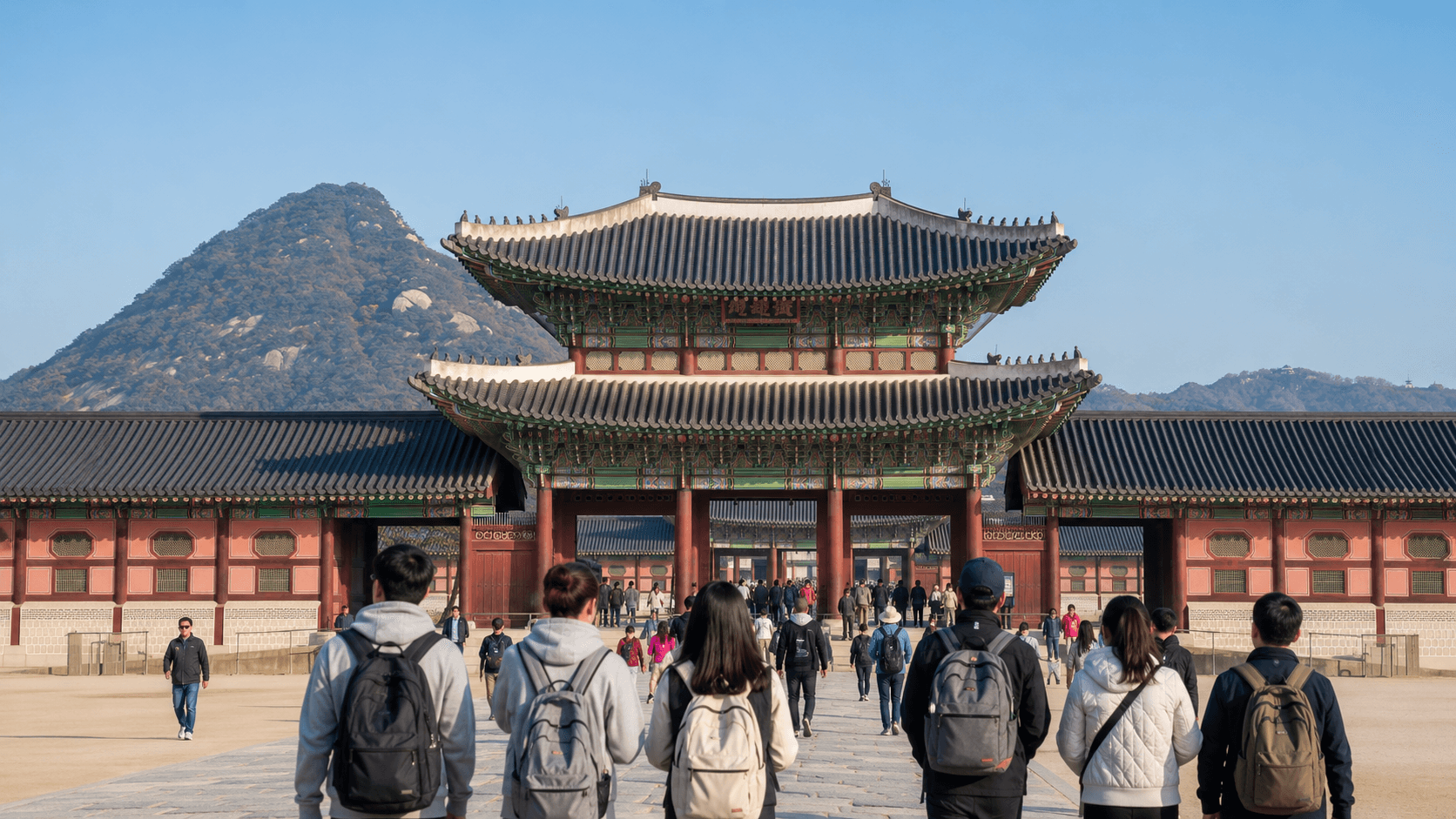
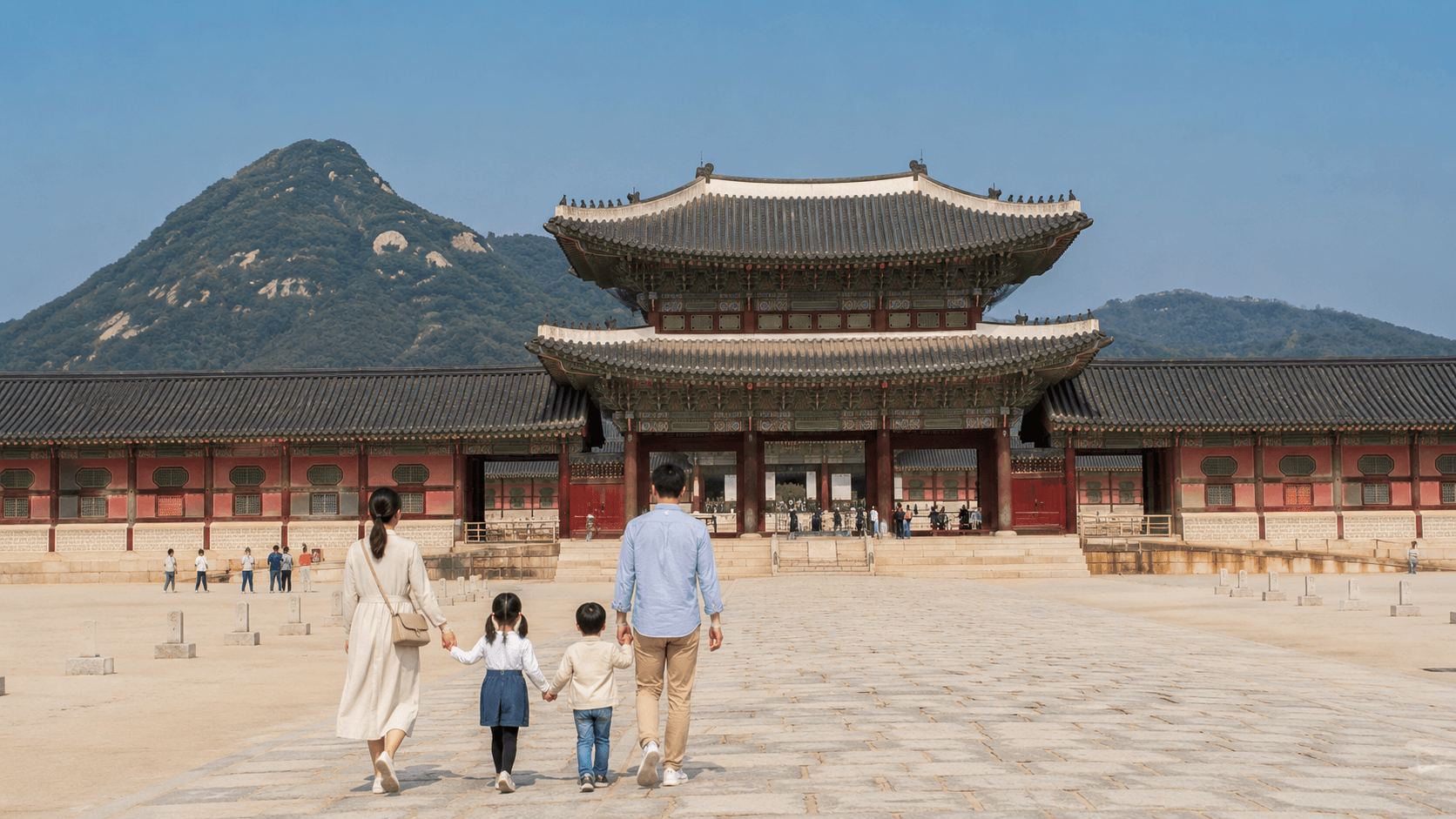
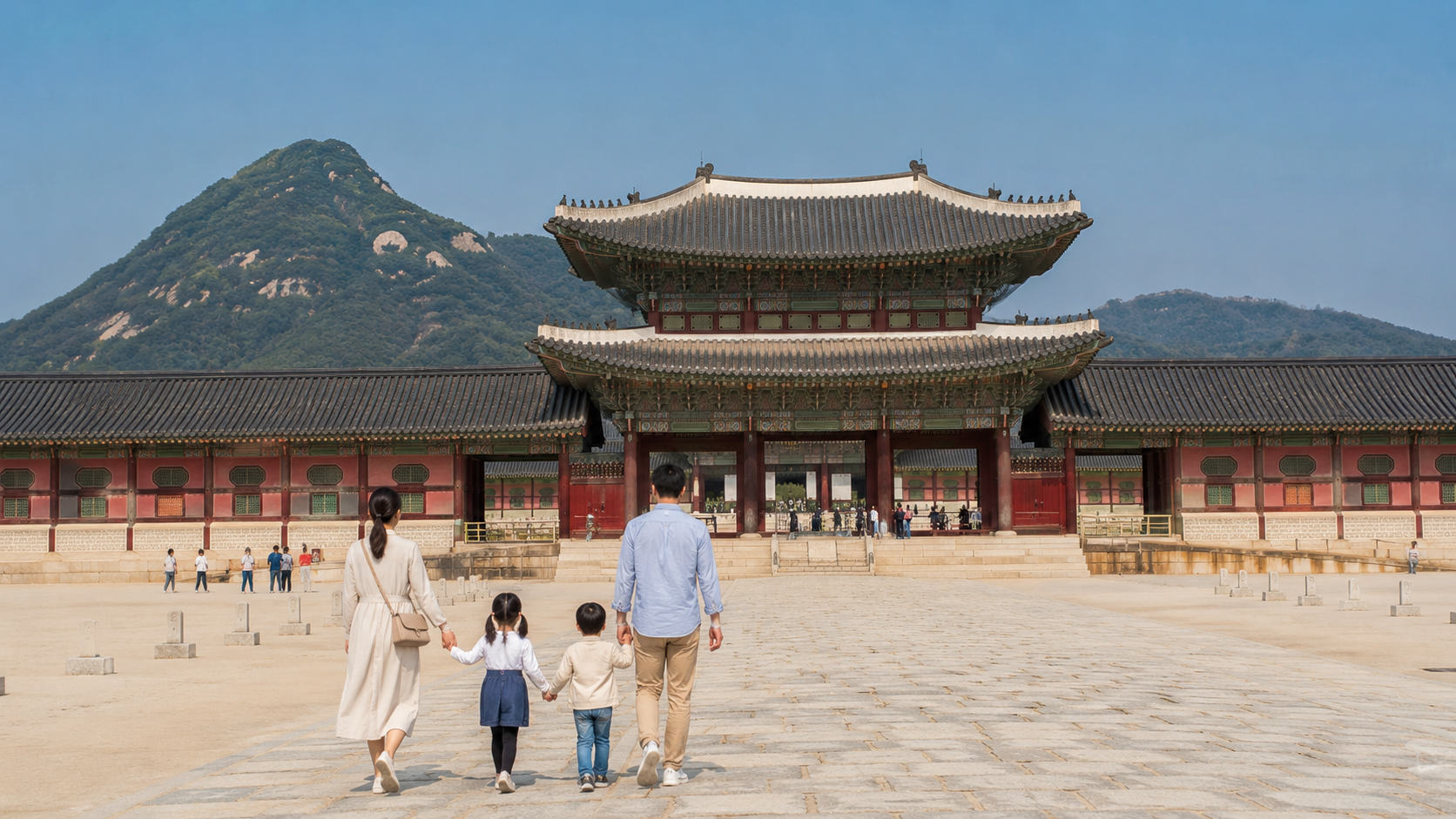
Start at Gyeongbokgung Palace (경복궁), the principal palace of the Joseon dynasty. Arriving near opening time gives children more room to explore and reduces exposure to midday heat in summer. Check the current schedule and closure information through the Korea Heritage Service palace website before visiting.
Allow 90 minutes to two hours rather than attempting to inspect every building. Focus on the main throne hall, palace courtyards, and the pond areas. Stone paving is uneven in places, so a stroller with larger wheels is easier than a lightweight model with small wheels.
Hanbok, traditional Korean clothing, can be rented from private shops around the palace. Treat this as an optional activity rather than a requirement. Compare the full rental period, hairstyle charges, locker availability, return deadline, and weather conditions before agreeing to a package.
After the palace, choose one nearby museum instead of forcing children through both:
- National Palace Museum of Korea: Better for royal objects, court culture, vehicles, and scientific instruments.
- National Folk Museum of Korea: Better for traditional homes, customs, and everyday life. Confirm its current location and visitor arrangements before travel because museum facilities and exhibitions can change.
Have lunch around Seochon or Insadong, then spend the afternoon browsing Insadong’s craft shops and pedestrian lanes. Ssamziegil, a spiral-shaped shopping complex, is easy to explore without committing to a long visit. Finish early if the children are tired; this day involves substantial standing and walking.
Day 3: National Museum of Korea and the Han River
Spend the morning at the National Museum of Korea in Yongsan. Its permanent galleries are free, while some special exhibitions charge admission. As verified on June 10, 2026, regular opening is 9:30 a.m. to 5:30 p.m. on Monday, Tuesday, Thursday, Friday, and Sunday, with extended opening until 9 p.m. on Wednesday and Saturday. Closure dates and holiday arrangements are listed on the museum’s official visitor information page.
Do not attempt the entire museum with children. Select one or two sections, such as prehistoric Korea, the Three Kingdoms, or ceramics. The museum provides free stroller and wheelchair loans, subject to availability. Its stated stroller weight limit was 15 kilograms when checked on June 10, 2026.
The Children’s Museum uses timed sessions and requires a reservation. The official museum page listed five daily sessions and 320 online-reservation places per session on the verification date. Reserve through the linked Children’s Museum information rather than assuming walk-in entry will be available.
After lunch, continue to a Han River park if the weather is comfortable. Yeouido Hangang Park is convenient for open space and river views, while Ichon Hangang Park is closer to the museum. A convenience-store picnic can be an enjoyable part of the day, but supervise children near bicycle paths and the river edge.
Use the museum as a full rainy-day plan if necessary. The building has restaurants, cafés, lockers, a lactation room, and indoor space for a slower schedule.
Day 4: Choose the right Seoul day for your children
Families have different limits, so choose one of these options rather than combining them.
Option A: Seoul Children’s Grand Park
This is the strongest choice for younger children who need outdoor space. The large park includes playgrounds and family facilities, with some attractions operating separately or charging fees. Check the Seoul Children’s Grand Park website for closures and facility notices.
Bring sun protection and expect more walking than the word park suggests. On hot or wet days, shorten the visit and combine it with a café or shopping center rather than crossing the city for another major attraction.
Option B: Lotte World area
Families wanting rides can spend the day at Lotte World in Jamsil. Admission products, ride restrictions, and operating hours change, so compare them on the official Lotte World website. Measure children before buying tickets if particular rides matter, and expect queues on weekends and holidays.
Families who do not want a full theme-park day can visit the nearby aquarium or walk around Seokchon Lake. These are separate activities with separate tickets.
Option C: Seoul Forest and Seongsu
This option suits older children and teenagers who prefer open space, cafés, shops, and contemporary neighborhoods. Begin at Seoul Forest, have lunch in Seongsu, and leave time for temporary shops or exhibitions. Pop-up stores may require advance registration and can have age or queue restrictions, so treat them as optional discoveries rather than the day’s main purpose.
Day 5: Take the KTX to Busan
Book a late-morning train if possible. This avoids moving luggage during the busiest commuter period while still leaving an afternoon in Busan. Arrive at Seoul Station at least 30 minutes before departure; the station is large, and families need time to locate the platform, buy food, and use the restroom.
KTX tickets show a train number, carriage, and seat. Trains normally stop for only a few minutes, so be ready near the correct platform section before boarding. Keep tickets or booking details accessible until the journey is complete.
After arriving at Busan Station, continue to the hotel and leave the luggage before sightseeing. If based in Haeundae, spend the late afternoon on Haeundae Beach and the adjoining promenade. Swimming access, safety controls, and beach facilities are seasonal. Check current notices through Visit Busan and follow lifeguard instructions.
Choose a seafood restaurant only if it suits the whole family. Busan also has noodles, pork-and-rice soup, dumplings, fried chicken, and ordinary Korean set meals. At seafood restaurants, confirm whether the displayed price is per person, per plate, or based on weight before ordering.
Day 6: Busan’s eastern coast and Gwangalli
Begin with Haedong Yonggungsa, a Buddhist temple built along Busan’s rocky coast. It is visually memorable but involves stairs, slopes, and crowded passages. A taxi from the Haeundae area is usually simpler for a family than making several public-transport transfers. Dress respectfully and keep voices low around worship areas.
Next, return toward Haeundae and choose one coastal activity. Haeundae Blueline Park operates the Beach Train and Sky Capsule along the former railway corridor. These are different products with different boarding points and ticket rules. Check routes, prices, operating times, and reservations on the official Haeundae Blueline Park website. Popular Sky Capsule times may sell out, so do not build the day around an unconfirmed ticket.
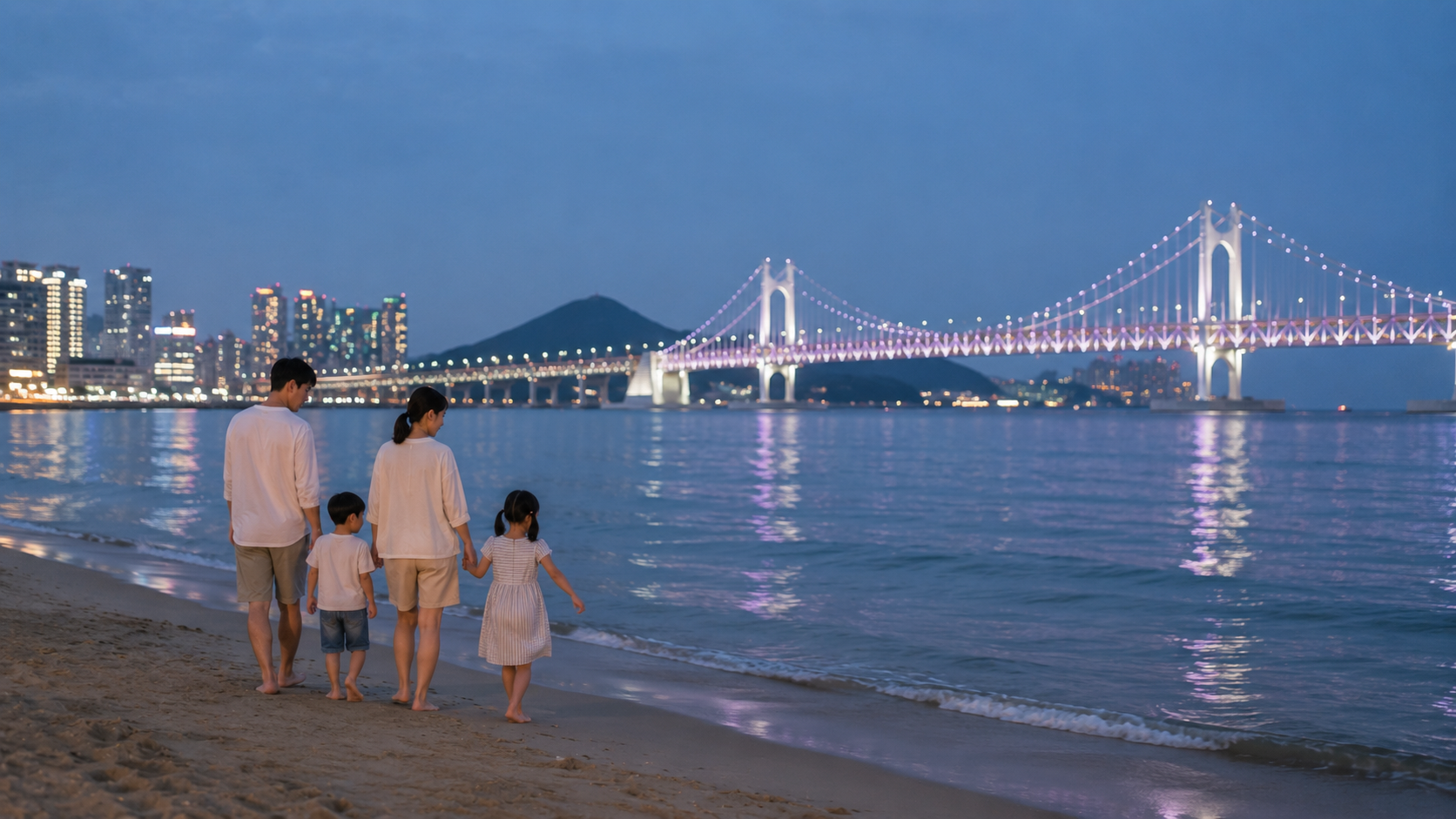
End at Gwangalli Beach for views of Gwangan Bridge. The beach is an open public area, but special performances and events can be changed or canceled because of weather, safety restrictions, or city scheduling. Check Visit Busan’s current notices instead of traveling solely for an event seen in an old video.
Day 7: Gamcheon, markets, and departure
Visit Gamcheon Culture Village early, before its steep lanes become crowded. This is a residential neighborhood as well as a visitor attraction. Keep noise down, do not photograph inside homes, and stay out of passages marked for residents. The hills and steps make a stroller inconvenient; a child carrier or shortened walking route is more realistic.
Continue to the Nampo area for lunch. Jagalchi Market is useful for seeing Busan’s seafood trade, but wet floors, working vehicles, tanks, and strong smells can be difficult for younger children. Keep the visit brief and consider nearby BIFF Square or a conventional restaurant if the market environment is uncomfortable.
Departure planning depends on the next flight:
- Flying from Gimhae International Airport: Leave a generous buffer for cross-city travel and airline check-in.
- Flying from Incheon the same day: A morning Busan sightseeing plan is risky. Return to Seoul the previous evening or book a separately protected domestic connection with ample time.
- Continuing elsewhere in Korea: Busan Station has KTX services toward Seoul and other rail connections, but always check the actual route because not every destination is served directly.
Getting around with children
Buy a separate rechargeable transportation card for each fare-paying traveler. Seoul’s official transport guide states that T-money and Cashbee cards can be purchased at convenience stores and subway stations. Tap when entering and leaving buses and subway gates so the system can calculate transfers correctly. Rules and child age categories should be reconfirmed through the Seoul Metropolitan Government transport guide.
Do not depend entirely on international map apps for walking and public-transport directions. Naver Map and KakaoMap generally provide more detailed local routing. Search destinations by Korean name when an English result is ambiguous.
Subway elevators exist at many stations, but the elevator route may require a different exit or a long detour. During rush hour, roughly 7:30–9:30 a.m. and 5:30–7:30 p.m. on weekdays, folding a stroller or taking a taxi may be more manageable.
Realistic family budget
Costs depend heavily on accommodation, child ages, and paid attractions. For planning rather than as quoted prices, a family of four might allow approximately:
| Item | Planning allowance |
|---|---|
| Simple breakfast | KRW 20,000–40,000 |
| Casual lunch | KRW 35,000–70,000 |
| Casual dinner | KRW 50,000–100,000 |
| Local transport per day | KRW 15,000–40,000 |
| Paid attractions | KRW 0–200,000+ |
These ranges are not official prices and were not presented as fixed rates on June 10, 2026. Theme parks, observation decks, special exhibitions, taxis, and premium coastal rides can raise the daily total substantially. KTX tickets and accommodation should be budgeted separately using live booking results.
Credit and debit cards are widely accepted, but carry some KRW cash for transportation-card loading, small markets, lockers, and businesses whose foreign-card terminals do not work. Do not assume that a mobile wallet issued abroad will function everywhere.
What to check before you go
- Confirm visa or K-ETA requirements for every passport holder.
- Reserve KTX seats together and verify the departure station.
- Check palace, museum, theme-park, and coastal-ride closure notices.
- Reserve the National Museum of Korea Children’s Museum if it is important to your family.
- Check height, age, and adult-accompaniment rules for rides.
- Confirm hotel occupancy limits, bed configuration, and luggage storage.
- Review weather alerts and air-quality conditions each morning.
- Carry prescription medicines in appropriate packaging and check import restrictions with the relevant Korean authority.
- Save the hotel name and address in Hangul for taxi drivers.
- Build an indoor alternative into every summer or monsoon-season day.
Frequently asked questions
Is seven days enough for Seoul and Busan with children?
Yes, if the family accepts that this is an introduction rather than a complete tour. Four nights in Seoul and two in Busan limit hotel changes while providing distinct city and coastal experiences. Families with toddlers may prefer spending the entire week in Seoul with one or two nearby day trips.
Should a family add Jeju or Gyeongju?
Not to this seven-day schedule. Adding Jeju requires flights and another hotel change. Gyeongju is easier to combine with Busan, but it deserves at least a full day. Extend the trip to nine or ten days before adding either destination.
Is Korea stroller-friendly?
Major museums, malls, airports, and newer transit facilities are generally manageable, but traditional sites, older neighborhoods, and coastal attractions may contain stairs, stone paving, or steep slopes. Bring a compact stroller plus a carrier if traveling with a small child.
What should families do in heavy rain?
Use the National Museum of Korea, a children’s museum reservation, an aquarium, a major shopping complex, or a theme park with indoor facilities. Avoid forcing an exposed palace or coastal schedule during thunderstorms or official weather warnings.
Sources
- Korea Tourism Organization: VISITKOREA
- Seoul Metropolitan Government public transportation guide
- Incheon International Airport transportation information
- KORAIL ticket reservations
- Korea Heritage Service royal palaces and tombs
- National Museum of Korea visitor information
- Visit Busan official travel guide
- Korea Visa Portal
Start by fixing the arrival airport, departure airport, and KTX travel date. Those three decisions determine the most practical hotel locations and whether the final Busan day is genuinely usable.