South Korea is straightforward to travel around once you have the correct entry documents, mobile data, payment options, and transport plan. The most important task is checking the rules for your specific passport: visa-free entry, K-ETA requirements, and arrival-card requirements are related but separate.
Entry, customs, and transport information in this guide was verified on June 9, 2026. Recheck official sources shortly before departure because requirements can change.
Quick answer
Before flying to Korea, confirm that you have:
- A valid passport and the correct visa or visa-free status
- A K-ETA if your nationality and circumstances require one
- A submitted e-Arrival Card if you are not exempt
- Your accommodation address and telephone number
- Travel insurance covering medical treatment and disruption
- At least two working payment cards plus some Korean won
- Mobile data through roaming, a SIM, or an eSIM
- A plan for traveling from the airport to your accommodation
- A transport card or a plan to buy one after arrival
- Clothing suitable for Korea's season and current forecast
- Copies of prescriptions and approval for controlled medication when required
1. Check your passport and entry permission
Passport validity
Travel with the same passport used for your visa, K-ETA, and airline booking. Check its expiration date, physical condition, and blank pages before paying for non-refundable travel arrangements.
Korean entry permission depends on nationality, purpose, and length of stay. Do not assume that another traveler's rules apply to you, even if you live in the same country. Use the official Korea Visa Portal and Visa Navigator to identify the relevant category, then confirm the result with the Korean embassy or consulate responsible for your place of residence.
Visa-free entry is normally for permitted short-term activities. It does not automatically authorize employment, study, or other activities requiring a specific status. Final admission and the permitted period of stay are determined by Korean immigration authorities.
Check whether you need a K-ETA
The Korea Electronic Travel Authorization, or K-ETA, applies to certain travelers who are eligible to enter without a visa. It is not a visa and does not guarantee admission.
As verified on June 9, 2026, the Korea Immigration Service K-ETA guidance states that a standard K-ETA costs KRW 10,000, is generally valid for three years or until the passport expires, and may take around 72 hours to process. Immigration recommends applying before travel rather than leaving it until departure.
A temporary K-ETA exemption for citizens of 22 countries and regions has been extended through December 31, 2026. Eligibility is passport-specific, so check the official K-ETA website rather than relying on an airline forum or an old travel article. Travelers aged 17 or younger and 65 or older are among the groups excluded from the K-ETA requirement under current guidance.
Use only the official website or official K-ETA app. Third-party sites may charge unnecessary service fees or imitate government pages.
Complete the e-Arrival Card if required
Foreign visitors generally need an arrival declaration unless they are exempt. Exempt groups include registered foreign residents and travelers holding a valid K-ETA.
If you need one, submit the free Korea e-Arrival Card within three days before arrival. You will need your passport details, flight or vessel information, purpose of entry, occupation, departure information, and Korean accommodation address and telephone number. The submitted declaration remains valid for 72 hours.
The Ministry of Justice has warned about imitation e-Arrival Card sites. The official service is free and does not request payment information.
Keep your first accommodation details accessible
Save the following both online and offline:
- Accommodation name in English
- Korean name, if available
- Full street address
- Telephone number
- Booking confirmation
- Directions or a map screenshot
Immigration forms may require this information, and it is also useful when taking a taxi. A neighborhood name alone, such as Hongdae or Gangnam, is not a sufficient destination.
2. Organize health, medication, and insurance
Buy travel insurance appropriate for your health, itinerary, and planned activities. Confirm coverage for emergency treatment, hospitalization, medical evacuation, trip interruption, lost baggage, and any hiking, skiing, diving, or vehicle rental you intend to do. Keep the insurer's assistance number and policy number offline.
Pack prescription medication in its original labeled packaging. Carry a copy of the prescription or a doctor's letter using generic drug names where possible. Some narcotic or psychotropic medicines require advance authorization in Korea, even when legally prescribed abroad. Confirm controlled-drug rules directly with Korea's Ministry of Food and Drug Safety or the Korean embassy; this guide is not medical or legal advice.
Put essential medication, glasses, contact-lens supplies, and one change of clothes in your cabin bag. Do not place medication needed during the journey only in checked luggage.
Save these emergency numbers:
- 112: Police
- 119: Fire and ambulance
- 1330: Korea Travel Helpline for travel information and interpretation assistance
The Korea Tourism Organization's emergency guidance confirms 112 and 119 as the principal emergency numbers. Hotel staff, station employees, police, or the 1330 helpline may help with communication in a non-life-threatening situation.
3. Prepare money and payment methods
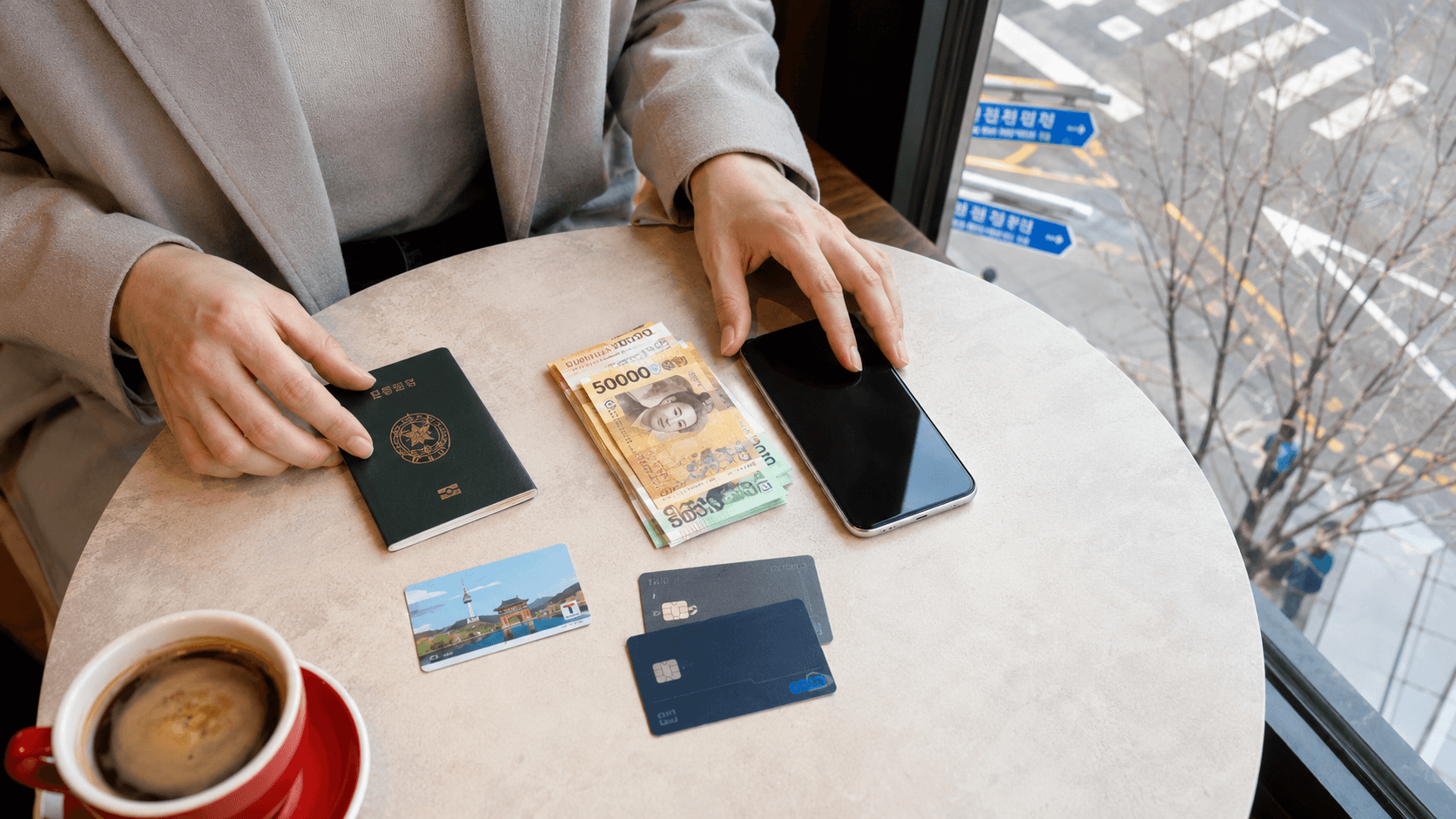
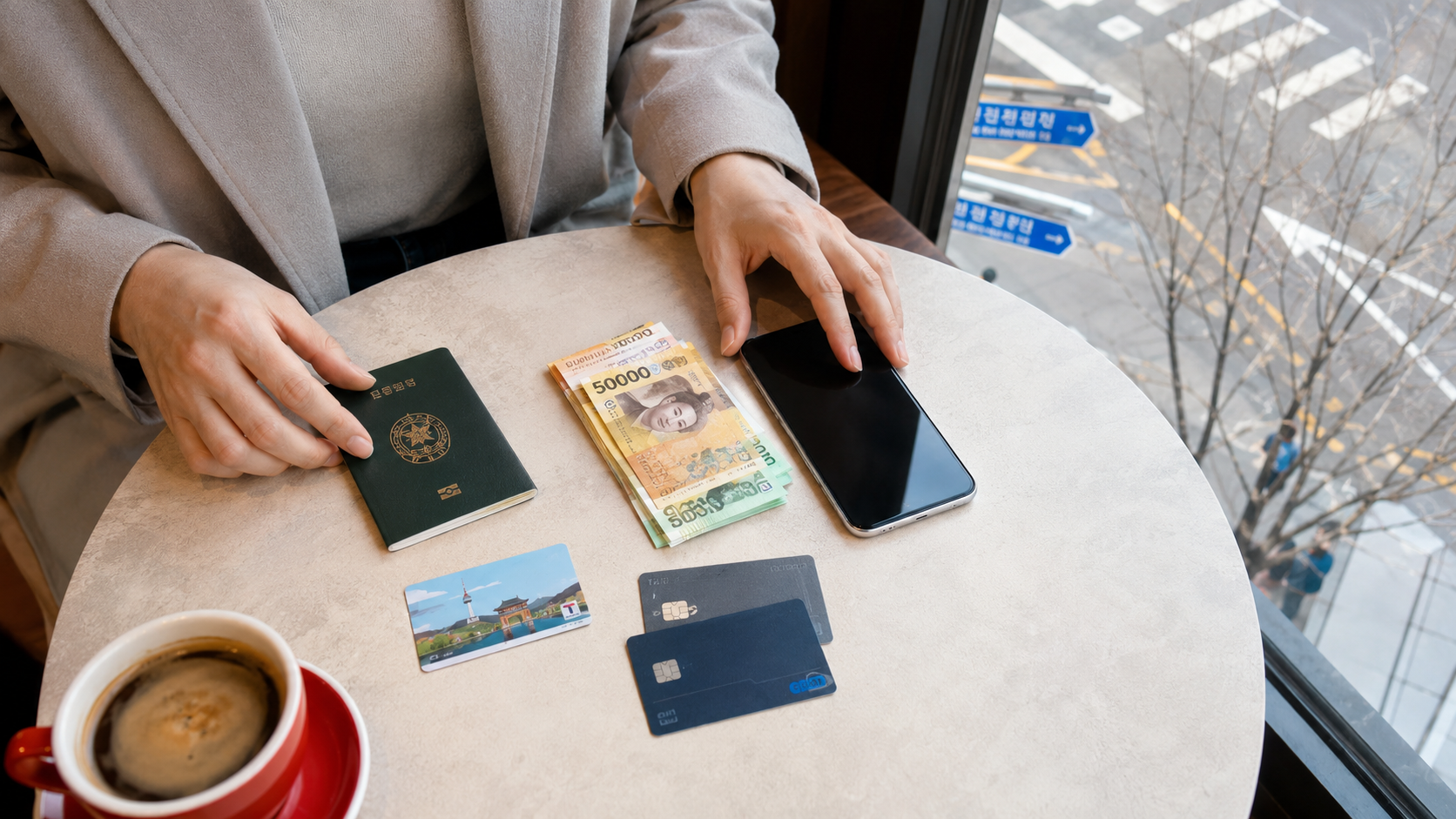
Korea's currency is the Korean won, written as KRW or with the symbol ₩. Card payments are common in cities, but a cash reserve remains useful for traditional markets, small businesses, transport-card reloading, lockers, and machines that reject foreign cards.
Bring:
- Two cards on different networks, stored separately
- A modest amount of Korean won for arrival expenses
- A bank card with a PIN you know
- Your bank's international contact details
- A backup way to access money
Tell your bank about the trip if it still uses travel notifications. Check foreign transaction and cash-withdrawal fees before departure. A card working at home or in another country is not a guarantee that every Korean terminal will accept it.
Do not carry your passport, all cards, and all cash in one wallet. Keep an emergency card and cash separately at your accommodation or in a secure second bag.
4. Arrange mobile data and useful apps
Reliable mobile data makes navigation, translation, reservations, and transport planning substantially easier. Choose among international roaming, a Korean SIM, an eSIM, or a portable Wi-Fi device. Compare data allowance, hotspot support, voice calls, activation requirements, and pickup or return arrangements.
Major Korean airports have carrier roaming counters offering SIM cards and portable Wi-Fi services, according to the Korea Tourism Organization's communications guide. Counter hours and prices vary, so check the provider's current details if your flight arrives late.
Install and test before departure:
- A Korean map and navigation app
- A translation app with an offline Korean language pack
- Your airline and accommodation apps
- Your insurer's app or emergency contact page
- Your eSIM or roaming provider's app
- A weather app
Korean addresses can appear differently in road-name and older lot-number formats. Save the Hangul version when provided, especially for smaller guesthouses, restaurants, and rural destinations.
5. Plan airport transportation
Confirm your arrival airport and terminal. Seoul-bound international passengers commonly arrive at Incheon International Airport, but some flights use Gimpo. Busan and Jeju have separate airports, and similarly named terminals can be far apart.
Before departure, write down:
- Airport and terminal
- Scheduled landing time
- Expected immigration and baggage time
- Accommodation check-in deadline
- Last practical train or bus
- Late-night taxi or hotel-transfer alternative
Do not plan around the scheduled landing time alone. Immigration queues, baggage delivery, customs, SIM pickup, and transport-card purchase can add substantial time.
For Incheon, compare the Airport Railroad, airport buses, taxis, and prearranged transport using the official Incheon International Airport transportation pages. Recheck fares, operating hours, boarding points, and last departures for your arrival date. Late-night services and routes can change.
6. Understand Korean transport cards
A rechargeable transport card such as Tmoney or EZL is the simplest general-purpose option for buses and urban rail. Cards are sold at convenience stores and transport locations, and they must have sufficient stored value before use.
The Korea Tourism Organization's transport-card guide notes that standard cards can be used on public transportation and at participating businesses. Purchase and reloading methods vary; carrying KRW cash avoids problems at machines or stores that do not accept an overseas card for reloading.
On buses, tap when boarding and again when leaving. On subways, tap at both entry and exit gates. Failure to tap correctly can affect transfer discounts or cause a fare adjustment.
Seoul also offers short-term Climate Card passes. As verified on June 9, 2026, the Seoul Metropolitan Government Climate Card page lists passes at KRW 5,000 for one day, KRW 8,000 for two days, KRW 10,000 for three days, KRW 15,000 for five days, and KRW 20,000 for seven days, plus KRW 3,000 for the physical card. Coverage is limited, and airport, regional, and privately operated routes may be excluded. Compare your itinerary before buying one.
7. Pack for Korea's season
Korea has four distinct seasons, with substantial differences in temperature, humidity, rain, and daylight. Check the forecast for every region on your itinerary, not only Seoul.
Spring: March to May
Pack layers because daytime and evening temperatures can differ. A light jacket, moisturizer, and any usual allergy supplies may be useful. Air-quality conditions can vary, so sensitive travelers may want a well-fitting mask.
Summer: June to August
Expect heat, humidity, and periods of heavy rain. Pack breathable clothing, sun protection, a compact umbrella, and shoes that can cope with wet streets. Indoor air conditioning can feel cool, so carry a light layer.
Autumn: September to November
Early autumn can remain warm, while late autumn may be cold, particularly at night or in mountain areas. Use layers and check conditions immediately before travel.
Winter: December to February
Bring an insulated coat, warm base layers, gloves, and footwear with suitable grip. Korea's indoor spaces are usually heated, making removable layers more practical than one extremely heavy outfit.
The Seoul Metropolitan Government climate overview describes the city's seasonal conditions, but mountain, coastal, southern, and island destinations may differ.
8. Check baggage, customs, and restricted items
Review your airline's current cabin and checked-baggage rules for every flight segment. Codeshare partners may use different limits. Confirm restrictions for batteries, power banks, liquids, sports equipment, and oversized luggage directly with the operating airline.
Korean customs rules apply to goods brought into the country, including purchases made abroad or at duty-free shops. As verified on June 9, 2026, the Korea Customs Service passenger guide lists the general personal-goods duty-free allowance as US$800, with separate limits for alcohol, tobacco, and perfume. The legal threshold is officially denominated in US dollars.
Declare goods when required. This includes items exceeding allowances and regulated or restricted products. Korea Customs provides an official mobile traveler declaration service in English.
Take particular care with:
- Meat and animal products
- Fresh fruit, vegetables, seeds, and plants
- Medication containing controlled substances
- Weapons and self-defense devices
- Large amounts of currency or valuable commercial goods
- Products made from protected wildlife
Animal and plant products may require quarantine inspection regardless of where they were purchased. When uncertain, declare the item and ask an officer. Do not bring fresh food simply because it is factory packed or permitted by your airline.
9. Bring the correct electrical adapter
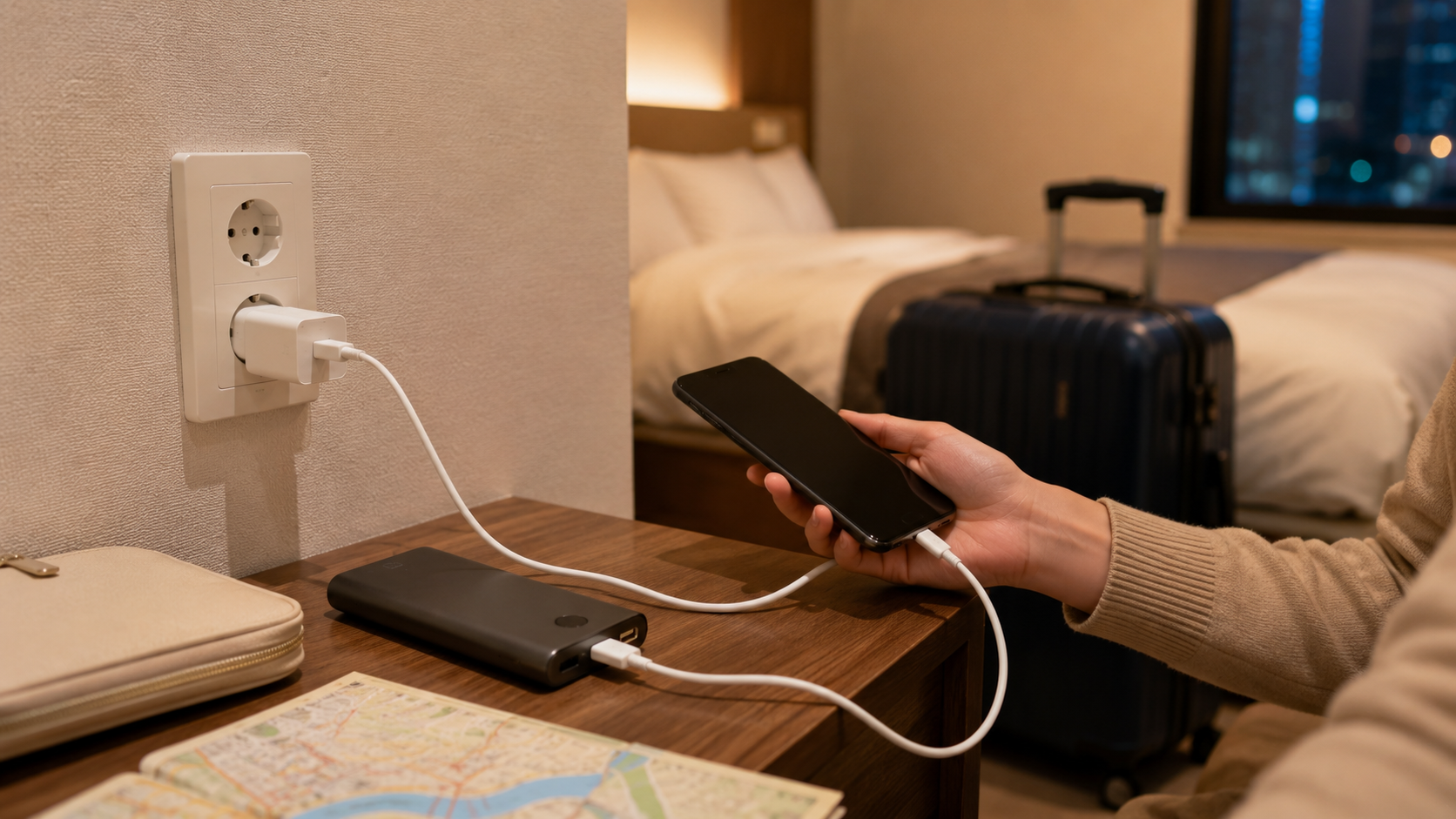
Korea uses 220 volts at 60 hertz with two-round-pin outlets. Check that each device is marked for 220V or an input range such as 100–240V. A plug adapter changes the plug shape; it does not convert voltage.
The Korea Tourism Organization electricity guide confirms the 220V, 60Hz standard. Pack a compact adapter and enough USB ports for your phone, power bank, camera, and other devices.
Keep power banks and spare lithium batteries in cabin baggage according to your airline's rules. Check permitted battery capacities before flying.
10. Prepare offline copies and emergency contacts
Store important documents in at least two places. A secure cloud copy is useful, but you should also retain information available without mobile service.
Save or print:
- Passport identification page
- Visa or K-ETA confirmation, when applicable
- e-Arrival Card submission details
- Flight and accommodation confirmations
- Insurance certificate and assistance number
- Prescription or medical letter
- Emergency contacts
- First accommodation address in English and Hangul
- Airport-to-hotel directions
Do not treat a photocopy as a substitute for carrying your original passport where identification is legally required. Keep the original secure and avoid handing it over as collateral for rentals.
What to check before you go
One month before departure
- Confirm passport validity and condition.
- Check your visa or visa-free eligibility.
- Determine whether K-ETA authorization is required.
- Buy suitable travel insurance.
- Resolve questions about controlled medication.
- Reserve popular trains, activities, or accommodation where necessary.
One week before departure
- Check the weather for each destination.
- Confirm baggage and battery rules with the operating airline.
- Arrange roaming, SIM, eSIM, or portable Wi-Fi.
- Verify airport transportation and late-night alternatives.
- Notify banks if required and prepare backup funds.
- Save addresses and essential documents offline.
Within three days before arrival
- Submit the e-Arrival Card if required.
- Recheck your flight terminal and accommodation check-in time.
- Review current entry notices from Korean immigration.
- Check for severe weather or transport disruption.
Before leaving for the airport
- Put your passport and entry documents in your cabin bag.
- Charge your phone and power bank.
- Confirm medication is accessible and correctly documented.
- Remove prohibited items from your luggage.
- Check that your first-night address and telephone number are available offline.
FAQ
Do I need both a K-ETA and an e-Arrival Card?
Usually not. Travelers holding a valid K-ETA are exempt from submitting an arrival card. If you are temporarily exempt from K-ETA, however, you may still need an e-Arrival Card. Use the navigator on the official e-Arrival Card site for your circumstances.
Can I rely only on credit cards?
It is unwise to carry no cash or backup payment method. Overseas cards may fail at particular terminals, and some transport-card reloading points or small businesses require KRW cash.
Should I buy a transport card before arriving?
It is not essential. Standard transport cards are widely sold after arrival. Buying in Korea also allows you to choose between a general stored-value card and a time-limited Seoul pass based on your actual itinerary.
Is a universal plug adapter enough?
Only if your devices support Korea's 220V supply. Check the input label on chargers and appliances. Devices limited to a lower voltage require a proper voltage converter, not merely a plug adapter.
Your next step
Start with the entry-document check because it depends on your passport and can affect whether you are allowed to board. After confirming your visa or visa-free status, check K-ETA eligibility and set a reminder to complete the e-Arrival Card within the three-day submission window if required.