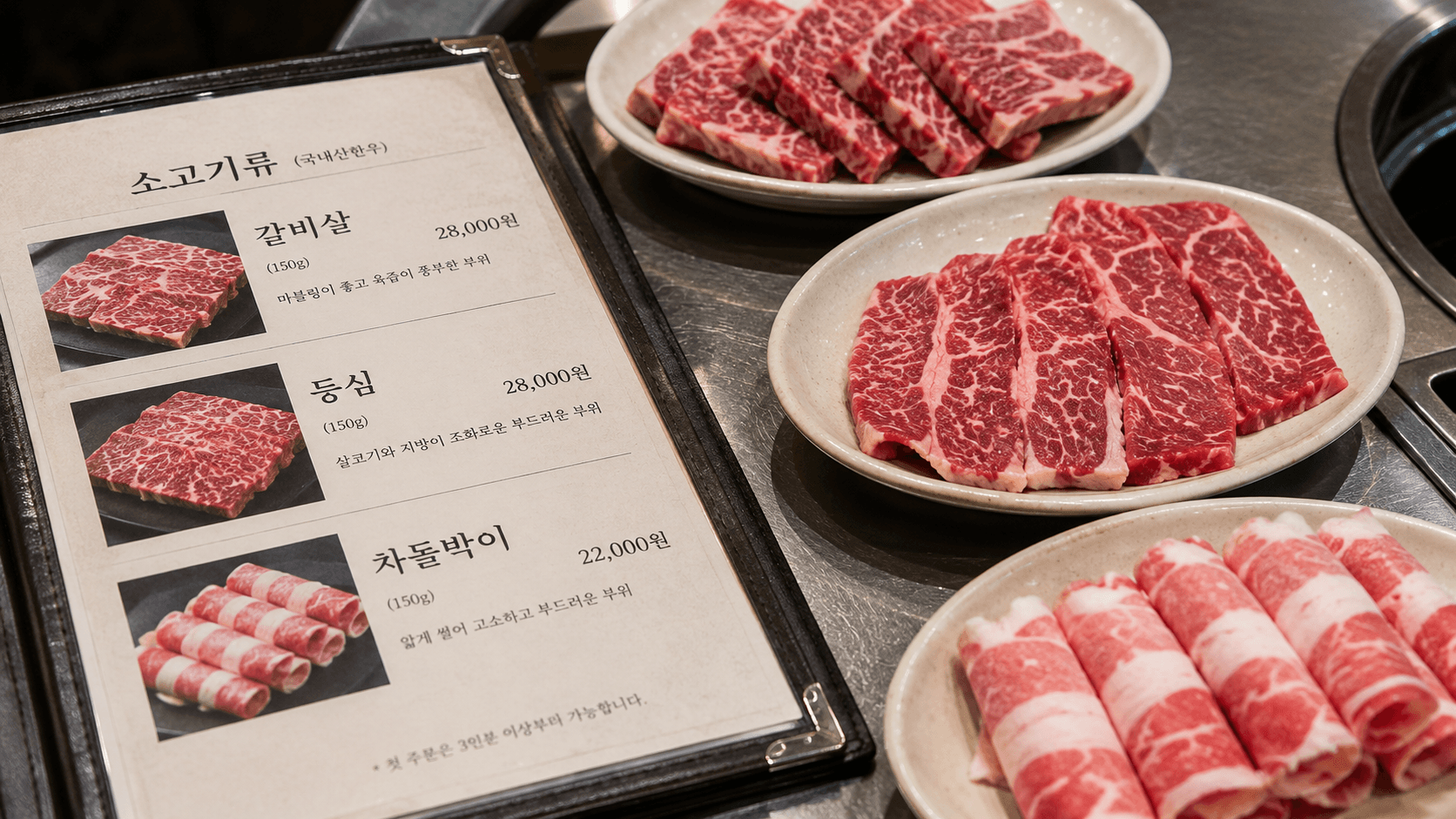
Korean barbecue menus can look complicated because they mix animal parts, cooking styles, marinades, and brand names. The easiest approach is to choose your meat first, then decide whether you want a rich or lean cut and whether you prefer it plain or marinated. For a first meal, samgyeopsal pork belly is the simplest classic; order moksal pork shoulder as a leaner contrast.
Quick answer
| Korean menu name | What it usually means | Fat level | Good for |
|---|---|---|---|
| 삼겹살 samgyeopsal | Pork belly | High | A classic first order |
| 오겹살 ogyeopsal | Skin-on pork belly | High | A firmer, chewier exterior |
| 목살 moksal | Pork neck or shoulder | Medium | A meatier alternative to belly |
| 항정살 hangjeongsal | Pork jowl or neck meat | High | Crisp edges and springy texture |
| 갈매기살 galmaegisal | Pork diaphragm meat | Low to medium | Lean, chewy pork |
| 갈비 galbi | Beef or pork ribs | Varies | Sweet marinated barbecue |
| 갈비살 galbisal | Boneless beef rib meat | Medium to high | Beef flavor without bones |
| 등심 deungsim | Beef loin or sirloin area | Medium | Tender, straightforward beef |
| 안심 ansim | Beef tenderloin | Low | Soft, mild beef |
| 채끝 chaekkeut | Beef strip loin | Medium | Tender meat with a firmer bite |
| 차돌박이 chadolbagi | Very thin beef brisket | High | Fast cooking and strong richness |
| 부채살 buchaesal | Beef top blade | Medium | Beefy flavor at a moderate price |
The English equivalents above are practical menu translations, not exact one-to-one butcher specifications. Korean and overseas cutting systems divide a carcass differently, and restaurants sometimes use familiar menu terms loosely.
First, understand the menu language
The word gogi (고기) means meat. Gui (구이) means something grilled or roasted, although restaurants often omit gui and list only the cut.
Several words tell you more about preparation than anatomy:
- Saeng (생): fresh or unseasoned, as in saeng-galbi.
- Yangnyeom (양념): seasoned or marinated.
- Sogeum (소금): salt; usually a simply salted preparation.
- Ganjang (간장): soy sauce, often indicating a savory-sweet marinade.
- Gochujang (고추장): fermented red chili paste.
- Daepae (대패): very thinly shaved, commonly used for pork belly.
- Sukseong (숙성): aged. The restaurant may use wet, dry, or another house aging method, so ask if the distinction matters to you.
The National Institute of Korean Language's Korean-English Learners' Dictionary is a useful official reference for checking unfamiliar Korean food words. Spellings vary in English: samgyeopsal may appear as samgyupsal, while galbi is sometimes written kalbi.
The main pork cuts
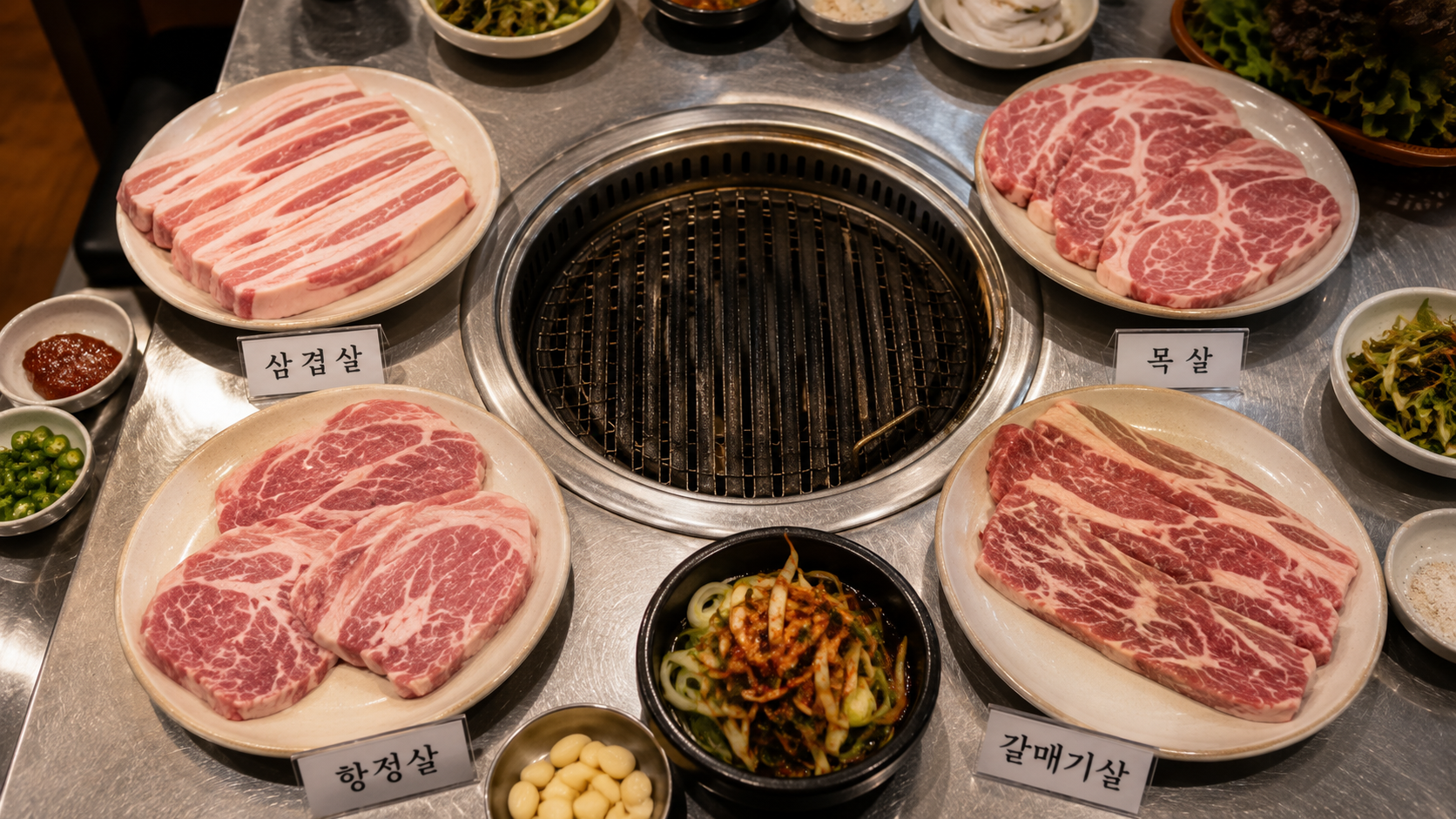
Samgyeopsal: pork belly
Samgyeopsal (삼겹살) is alternating layers of meat and fat from the belly. It normally arrives unseasoned in thick strips or slabs, which are grilled and then cut into smaller pieces with scissors.
Choose it if you want juicy meat, browned fat, and the most recognizable Korean barbecue experience. The fat also works well with sharp accompaniments such as kimchi, pickled radish, raw garlic, and pa muchim, a seasoned spring-onion salad.
Common variations include:
- Daepae-samgyeopsal (대패삼겹살): paper-thin belly that cooks in seconds.
- Naengdong-samgyeopsal (냉동삼겹살): frozen pork belly, often sliced thinly before serving.
- Kkotsamgyeopsal (꽃삼겹살): a presentation or trimming term suggesting an attractive cross-section; it is not one universal anatomical grade.
- Beoljip-samgyeopsal (벌집삼겹살): thick belly scored in a crosshatch pattern to expose more surface to the grill.
Ogyeopsal: skin-on pork belly
Ogyeopsal (오겹살) is generally belly with the skin layer retained. Compared with samgyeopsal, it can have a firmer, chewier edge. It is especially common at restaurants serving Jeju-style pork, although seeing ogyeopsal on a menu does not by itself prove that the pork came from Jeju.
Ask about origin separately if it matters: 국내산 means domestically produced, 수입산 means imported, and 제주산 indicates Jeju origin. Restaurants should display origin information, but an English menu may omit it.
Moksal: pork neck or shoulder
Moksal (목살), literally neck meat, is usually translated on menus as pork neck or pork shoulder. It has less obvious fat than belly but enough internal fat to remain juicy when cooked carefully.
This is a useful choice for diners who find samgyeopsal too rich. Thick moksal should rest briefly after grilling and should not be left over high heat until dry.
Hangjeongsal: pork jowl or neck meat
Hangjeongsal (항정살) comes from around the neck and jowl area. Fine streaks of fat give it a crisp, springy texture rather than the soft layers of pork belly. Portions often look smaller because relatively little of this cut comes from each animal.
It is rich despite its pale appearance. Order it as a second cut to share rather than assuming it is a lean option.
Galmaegisal: pork diaphragm meat
Galmaegisal (갈매기살) is associated with the diaphragm area. It is darker, leaner, and more muscular than belly, with a pronounced chew and pork flavor.
The name resembles galmaegi, the Korean word for seagull, but the cut has nothing to do with birds. Some restaurants marinate it lightly, so ask whether it is seasoned if you need to avoid sugar, soy, or garlic.
Dwaeji-galbi: pork ribs
Dwaeji-galbi (돼지갈비) means pork ribs, usually served in a soy-based or spicy marinade. Restaurant portions may include meat shaped or trimmed from nearby shoulder sections as well as rib meat. If you specifically want bone-in ribs, look at the menu photograph or ask, 뼈가 있어요? meaning, Does it have bones?
Marinated pork burns more easily than plain pork because the sauce can contain sugar. Cook it over a gentler part of the grill and turn it regularly.
The main beef cuts
Galbi and galbisal: ribs and boneless rib meat
Galbi (갈비) means ribs. At a beef restaurant, saeng-galbi is usually unseasoned beef rib, while yangnyeom-galbi is marinated. Galbisal (갈비살) refers to boneless meat taken from around the ribs.
Bone-in galbi may be filleted into a long strip attached to one bone. LA-galbi (LA갈비) is cut across the ribs, leaving several small bone sections in each strip. Watch for bone fragments when eating thin cross-cut ribs.
Galbi marinade is commonly sweet and savory, often using soy sauce, garlic, and sweeteners. Recipes vary, so travelers with allergies should ask the restaurant rather than relying on appearance.
Deungsim and kkotdeungsim: loin cuts
Deungsim (등심) covers the loin or sirloin region in Korean cutting terminology. It is normally tender enough for quick tabletop grilling and may have visible marbling.
Kkotdeungsim (꽃등심), literally flower loin, refers to a richly marbled, visually prized section often compared with ribeye. The word kkot suggests a flower-like marbling pattern; it is not a separate official quality grade.
Ansim: tenderloin
Ansim (안심) is tenderloin. It is soft, relatively lean, and mild compared with rib or skirt cuts. It suits diners who prioritize tenderness over strong beef flavor, but it can dry out if cut thin and cooked too long.
Chaekkeut: strip loin
Chaekkeut (채끝) is generally translated as strip loin. It balances tenderness with a more substantial bite than tenderloin. Restaurants may serve it as steak-like pieces rather than thin strips.
Chadolbagi: thin brisket
Chadolbagi (차돌박이) is very thinly sliced beef from the brisket area, with prominent seams of fat. It curls and browns almost immediately on a hot grill.
Do not leave it unattended while arranging side dishes. Place down a few slices at a time, turn them promptly, and eat them while the edges are crisp. Because it is thin and fatty, a plate can look larger than it feels as a meal.
Buchaesal: top blade
Buchaesal (부채살), named for its fan-like shape, corresponds broadly to top blade meat. It has a visible central line of connective tissue and a strong beef flavor. It can offer a useful middle ground between premium loin cuts and chewier offcuts.
Anchangsal and toshisal: prized diaphragm cuts
Anchangsal (안창살) and toshisal (토시살) come from around the diaphragm and internal skirt area. Both are dark, intensely flavored, and usually served in relatively small portions. English translations differ among menus because Korean and Western cutting systems do not align exactly.
These cuts are better choices for flavor than for buttery softness. Cook them quickly and avoid taking every piece to well-done unless necessary for your health or preference.
What Hanwoo and beef grades mean
Hanwoo (한우) identifies Korean native cattle; it is not the name of a cut. A menu can therefore offer Hanwoo deungsim, Hanwoo galbisal, or another Hanwoo cut. Imported beef may also be excellent, but it will usually cost less than highly graded Hanwoo at the same restaurant.
South Korea operates livestock grading and traceability systems through the Korea Institute for Animal Products Quality Evaluation. Beef quality grades commonly shown to consumers include 1++, 1+, 1, 2, and 3, with 1++ at the top of that scale. The grade applies to assessed carcass characteristics, not simply to tenderness, and it does not replace the cut name.
A high grade often means substantial marbling. That can be desirable, but diners who prefer cleaner, leaner beef may enjoy a lower-marbled cut more. Grade and cut should be considered together.
This grading-system information was verified on June 11, 2026. Check the official KAPE site for later changes.
How to order without over-ordering
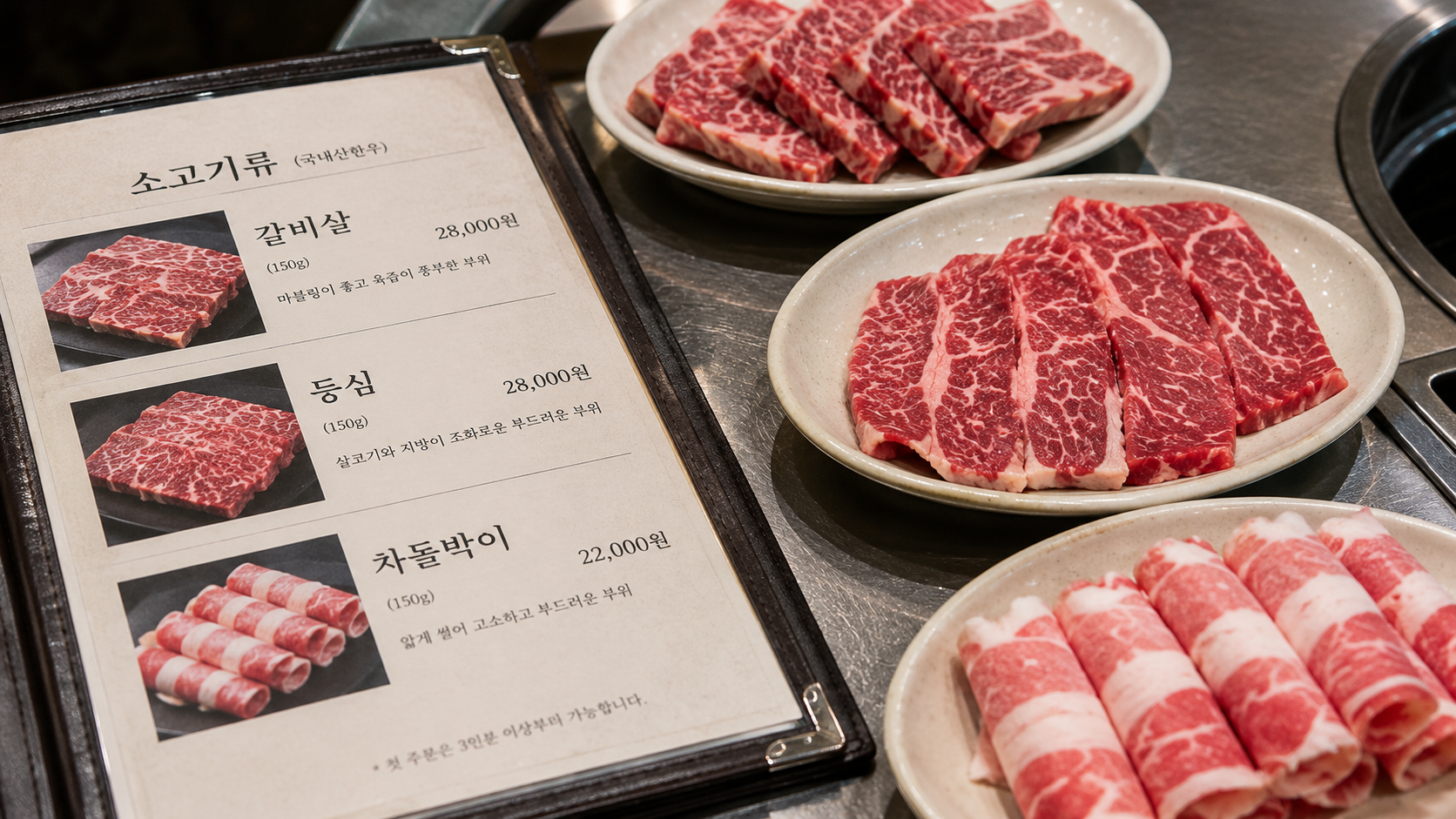
Most barbecue restaurants require an initial minimum order, often expressed as a number of servings rather than a minimum number of different cuts. The exact rule varies by restaurant. A menu might also show 1인분, meaning one serving, followed by a weight in grams.
Before ordering, check both the price and stated weight. Comparing only the price per plate is misleading because serving sizes differ. There is no reliable nationwide restaurant price for any cut, and prices vary sharply by city, origin, grade, portion size, and restaurant type.
A practical order for two people is:
- Confirm the restaurant's minimum order.
- Start with the minimum amount across one or two cuts.
- Add rice, stew, or noodles only after seeing the meat portion.
- Order another cut if needed; barbecue meat generally arrives quickly.
For pork, try samgyeopsal plus moksal. For beef, combine one marbled cut such as galbisal with a leaner cut such as ansim or buchaesal. Cook plain meat before strongly marinated meat so that sugar and sauce do not coat or scorch the grill early.
Cooking and eating at the table
Some restaurants expect customers to grill, while others have staff cook the meat. If an employee takes control of the tongs, let them handle it. This is common at restaurants serving thick pork or expensive beef.
When cooking yourself:
- Keep raw-meat tongs separate from personal chopsticks.
- Wait until thick pork is cooked through, with no visibly raw center.
- Cook thin chadolbagi only briefly.
- Move sugary marinades away from the hottest area.
- Ask for a grill change by saying bulpan jom bakkwo juseyo (불판 좀 바꿔 주세요) if burnt sauce builds up.
- Use scissors to divide large pieces after the exterior firms up.
Ssam (쌈) means a leaf wrap. Place one piece of meat in lettuce or a perilla leaf, add a small amount of ssamjang fermented dipping paste, and include garlic or pickles if desired. It is equally acceptable to eat the meat without a wrap.
Banchan side dishes are commonly included and may be refillable, but policies differ. Rice, steamed egg, stews, and noodles are frequently separate paid items. Never assume everything placed near the grill is complimentary; check the menu or ask.
Dietary and allergy considerations
Korean barbecue is difficult for strict vegetarians because meat may share grills, utensils, broths, and side-dish ingredients. Kimchi can contain fish sauce or salted seafood, while dipping sauces and marinades may contain soy, wheat, sesame, garlic, fruit, alcohol, or sweeteners.
Useful questions include:
- 양념 안 된 고기 있어요? Are there any unmarinated meats?
- 돼지고기 안 들어가요? Does this contain no pork?
- 알레르기가 있어요. I have an allergy.
- 같은 불판을 써요? Do you use the same grill?
For a serious allergy, show the ingredient in written Korean and obtain confirmation from staff. The national Food Safety Korea portal is the official food-safety information service, but an individual restaurant remains the necessary source for its recipe and cross-contact practices.
What to check before you go
- Specialization: Many restaurants focus on either pork or beef rather than both.
- Origin: Look for 국내산 for domestic meat, 수입산 for imported meat, and 한우 for Hanwoo.
- Serving weight: Find the grams listed beside 1인분.
- Minimum order: Solo diners should confirm whether one serving is accepted.
- Marinade: Ask if meat is plain when avoiding sugar, soy, wheat, or garlic.
- Reservations: Popular beef restaurants and group venues may require advance booking.
- Last order: Kitchen last-order time can be earlier than the posted closing time.
- Accessibility: Built-in grills, floor seating, narrow aisles, and smoke-extraction pipes can affect wheelchair access.
- Clothing: Smoke and cooking odors can linger. Use the chair compartment or plastic bag supplied for coats when available.
- Payment: Cards are widely used, but confirm payment options at small or traditional establishments.
Restaurant rules, portions, prices, and opening hours are business-specific and were not treated as nationwide facts in this guide. Confirm them directly with the restaurant on the day of your visit. For general visitor assistance, the official VISITKOREA website provides travel information and access to the 1330 Korea Travel Helpline.
Sources
- Korea Institute for Animal Products Quality Evaluation
- National Institute of Korean Language Korean-English Learners' Dictionary
- VISITKOREA official tourism portal
- Food Safety Korea official portal
Choose one familiar cut and one contrasting cut for your first meal. Samgyeopsal with moksal is the most straightforward pork comparison; galbisal with ansim provides a clear introduction to rich and lean Korean beef.