Korean seafood is much broader than raw fish. You can order grilled mackerel, spicy fish stew, soy-marinated crab, cold raw-fish soup, steamed shellfish, octopus, abalone, or a whole fish selected from a market tank. The main challenge for newcomers is understanding how the price is calculated and whether preparation, side dishes, or restaurant seating cost extra.
This guide explains the principal dishes, ordering systems, safety considerations, and Korean words that help at restaurants and fish markets. Market details and health guidance were checked on June 11, 2026.
Quick answer
- For an easy first meal: Try grilled fish, seafood pancake, clam soup, or spicy fish stew.
- For Korean-style raw fish: Look for hoe (회), usually pronounced roughly like hweh.
- At a fish market: Confirm the seafood price, preparation charge, restaurant seating charge, and stew cost before agreeing.
- For allergies: Do not assume a fish dish contains only fish. Broths, sauces, kimchi, pancakes, and side dishes may contain shellfish, anchovy stock, fish sauce, or fermented seafood.
- For health concerns: Choose fully cooked seafood. Raw and undercooked seafood always carries some risk.
- For payment: Ask whether cards are accepted before ordering at a small stall, and keep another payment method available.
Understanding Korean seafood menus
Hoe: Korean raw fish
Hoe (회) is a broad Korean term for sliced raw ingredients, although on a seafood menu it normally means raw fish. Korean-style fish restaurants often emphasize a firm, chewy texture. Common choices include:
| Korean | Common English name | General character |
|---|---|---|
| 광어, gwangeo | Flatfish or olive flounder | Mild, lean, and firm |
| 우럭, ureok | Rockfish | Firm white flesh |
| 도미, domi | Sea bream | Mild and slightly springy |
| 방어, bangeo | Yellowtail or amberjack | Richer and fattier |
| 참치, chamchi | Tuna | Served in cuts with different fat levels |
| 연어, yeoneo | Salmon | Soft and rich |
The English names used by restaurants are not always taxonomically precise. If the exact species or origin matters, ask to see the label rather than relying only on an English translation.
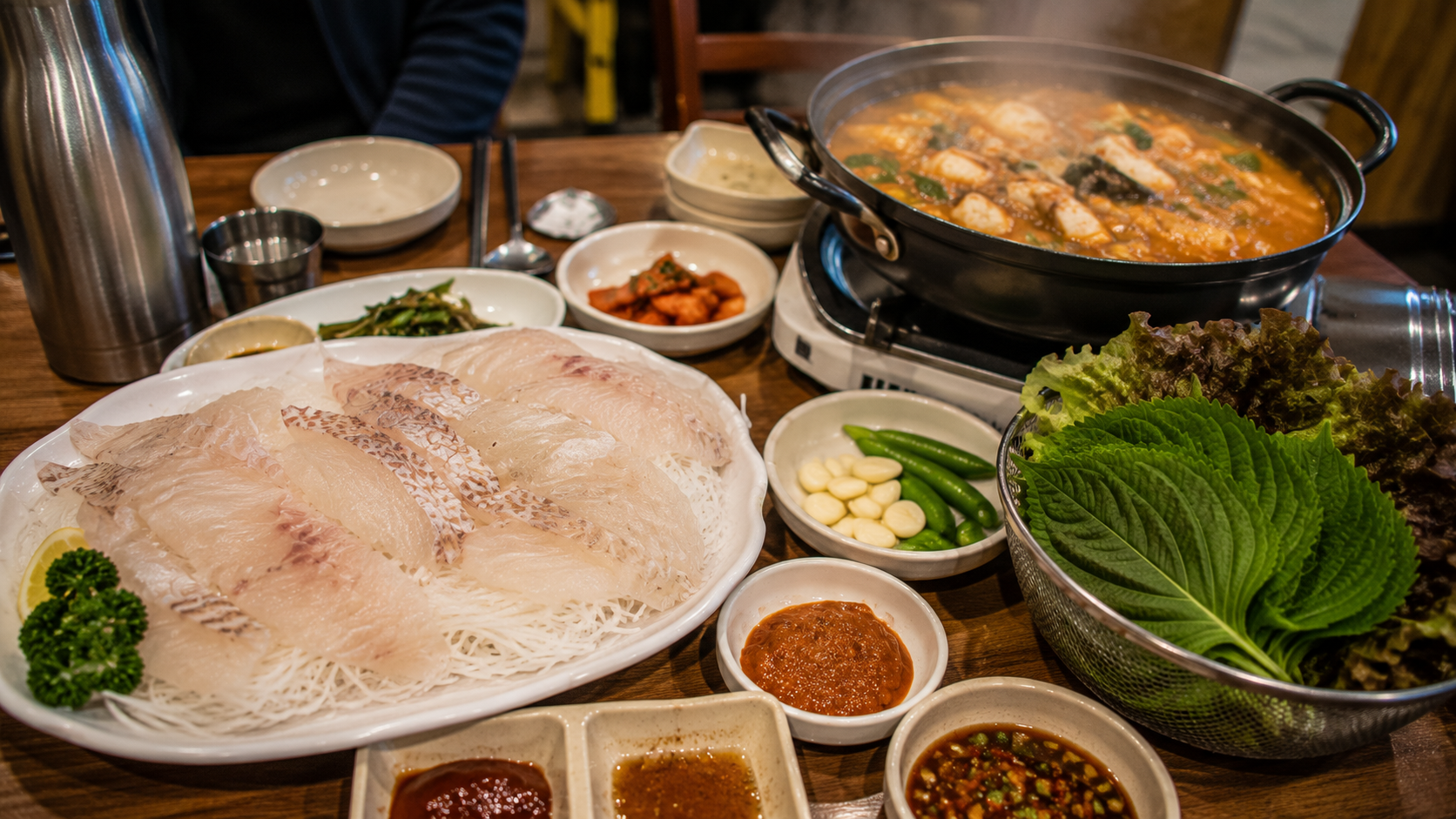
Hoe commonly arrives with lettuce, perilla leaves, sliced garlic, green chili, and dipping sauces. Chogochujang (초고추장) is a sweet, tart chili sauce; ssamjang (쌈장) is a thicker fermented soybean and chili paste. Soy sauce with wasabi may also be provided.
A common way to eat it is to place one slice in a leaf with a small amount of sauce and garlic. This is optional, not a rule. Start with an unwrapped piece if you want to taste the fish clearly.
Maeuntang after raw fish
After a whole fish has been filleted, a restaurant may offer maeuntang (매운탕), a spicy stew made with the remaining head and bones. It may be included, charged as an add-on, or require an additional cooking fee.
Ask before ordering:
- Maeuntang-eun poham-ieyo? (매운탕은 포함이에요?) Is the spicy stew included?
- Chuga biyong-i isseoyo? (추가 비용이 있어요?) Is there an additional charge?
Expect bones. This is not normally a boneless soup, so eat carefully.
Mulhoe: cold raw-fish soup
Mulhoe (물회) combines sliced raw fish or seafood, vegetables, and a cold, spicy-sour broth. It is especially associated with coastal dining and is refreshing in warm weather. The broth can contain gochujang, vinegar, sugar, garlic, and sometimes fruit or regional seasonings.
Mulhoe is usually spicy even when served cold. Ask for the sauce separately if you want more control, although a restaurant may already prepare the broth in batches.
Grilled fish
Saengseon-gui (생선구이) means grilled fish. It is one of the simplest choices for visitors who prefer fully cooked seafood. Common options include mackerel, hairtail, croaker, and Atka mackerel.
Grilled fish is often served bone-in, sometimes with the head attached. Use chopsticks to lift the flesh away from the central bones. Check carefully for fine pin bones before giving fish to a child.
Useful menu words include:
- Godeungeo-gui (고등어구이): grilled mackerel
- Galchi-gui (갈치구이): grilled hairtail
- Jogi-gui (조기구이): grilled croaker
- Imyeonsu-gui (임연수구이): grilled Atka mackerel
Shellfish and grilled clams
Jogae-gui (조개구이) is assorted shellfish grilled at the table. Depending on the restaurant, the order may include clams, scallops, mussels, oysters, or abalone. Cheese, butter, chili sauce, or chopped vegetables may be added.
Do not assume every shell will open at the same time. Follow the staff's instructions, use the provided tongs, and avoid mixing utensils used for raw shellfish with those used for eating.
Crab dishes
Ganjang gejang (간장게장) is raw crab marinated in a seasoned soy sauce. Yangnyeom gejang (양념게장) is generally coated in a sweet and spicy red sauce. Both are messy, strongly seasoned dishes commonly eaten with rice.
Check whether the crab is raw before ordering. The word marinated does not mean cooked. Shell fragments can also be sharp.
For a cooked alternative, look for kkotge-tang (꽃게탕), a spicy swimming-crab stew, or steamed crab. Large snow crab and king crab are frequently sold by weight, making them potentially expensive orders.
Octopus, squid, and unusual textures
- Nakji-bokkeum (낙지볶음): spicy stir-fried small octopus
- Ojingeo-bokkeum (오징어볶음): spicy stir-fried squid
- Muneo-sukhoe (문어숙회): blanched or cooked octopus slices
- Ojingeo-sundae (오징어순대): stuffed squid, especially associated with Sokcho
- Sannakji (산낙지): freshly cut raw small octopus whose pieces may continue moving
Sannakji requires particular care because pieces and suction cups can adhere inside the mouth or throat. It is not a sensible choice for children, anyone with swallowing difficulties, or anyone uncomfortable chewing very thoroughly. A cooked octopus dish provides a more approachable introduction.
Soups, stews, and shared dishes
Seafood frequently appears in bubbling communal pots:
- Haemul-tang (해물탕): spicy mixed-seafood stew
- Jogae-tang (조개탕): usually a clear clam soup
- Daegu-tang (대구탕): cod soup, which may be mild or spicy
- Agu-jjim (아구찜): braised monkfish with bean sprouts and a spicy sauce
- Haemul-pajeon (해물파전): seafood and green-onion pancake
Words such as tang, jjigae, or jjim do not guarantee a particular spice level. Ask An maepge haejuseyo (안 맵게 해주세요) for a non-spicy version, but understand that some sauces and broths are prepared in advance and cannot be changed completely.
 ## How ordering works at a Korean fish market
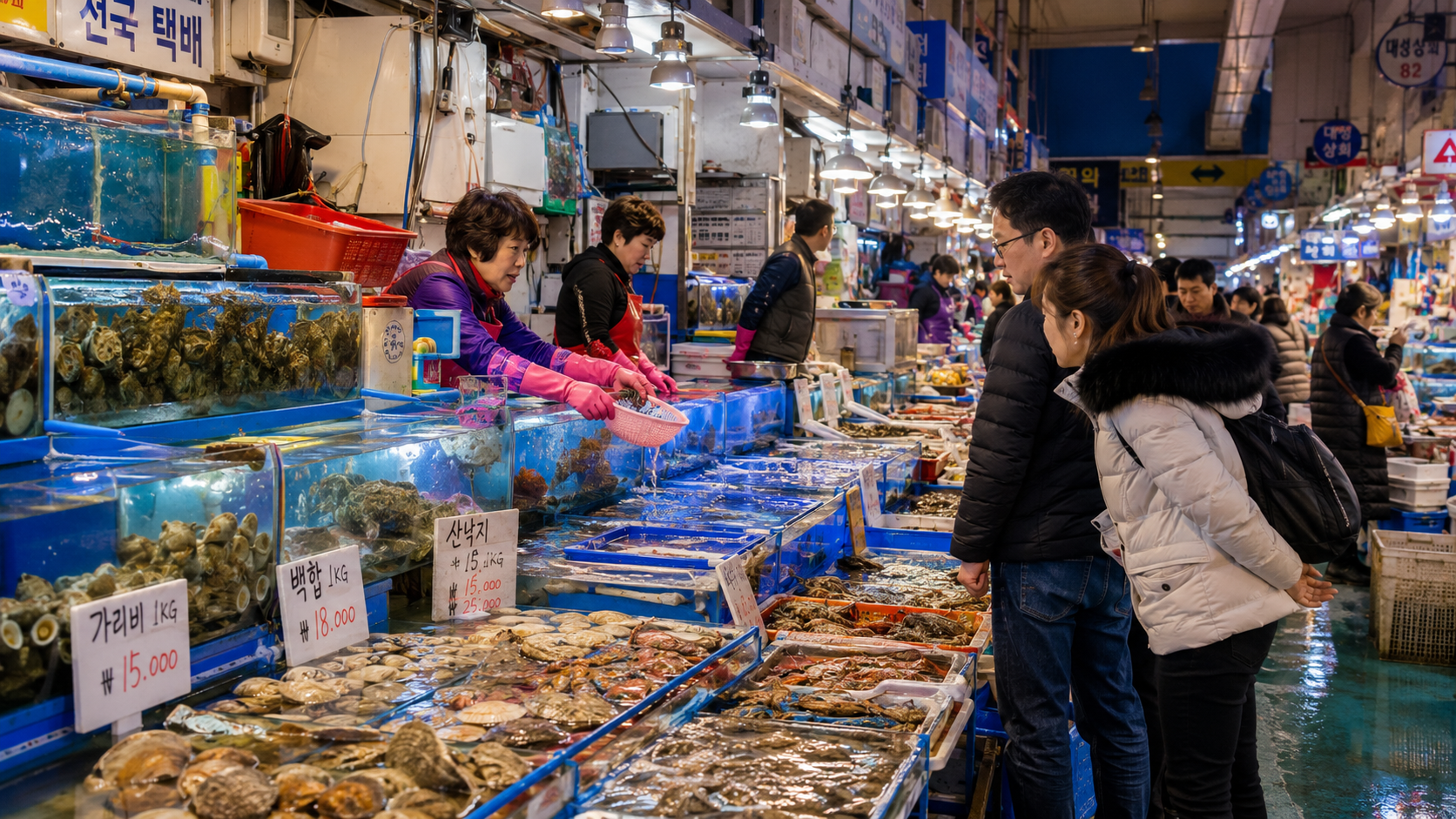
Large markets may separate purchasing from cooking. You select seafood from a ground-floor seller and then take it, or have it delivered, to an associated restaurant elsewhere in the building. The restaurant prepares and serves it for a separate fee.
Step-by-step market ordering
- Choose the seafood. Point to the tank or display and ask for the total price.
- Confirm the unit. Seafood may be priced per animal, per kilogram, by portion, or as a set.
- Ask whether the quoted amount is the total. A displayed figure may be a price per weight unit rather than the final charge.
- Choose the preparation. Options may include raw slicing, grilling, steaming, or soup.
- Confirm every additional fee. Ask about filleting, cooking, table setting, vegetables, and stew.
- Photograph or retain the order slip. This helps identify your purchase when it reaches the restaurant.
- Check the bill before paying. Ask for clarification immediately if the quantity or preparation differs from what you agreed.
Useful phrases:
- Igeo eolmayeyo? (이거 얼마예요?) How much is this?
- Il kilogram-e eolmayeyo? (1킬로그램에 얼마예요?) How much per kilogram?
- Jeonbu hapchyeoseo eolmayeyo? (전부 합쳐서 얼마예요?) How much is everything together?
- Sangcharim-bi isseoyo? (상차림비 있어요?) Is there a table-setting charge?
- Sonnjil-bi isseoyo? (손질비 있어요?) Is there a preparation charge?
- Yeongsujeung juseyo. (영수증 주세요.) Please give me a receipt.
There is no reliable nationwide price for a seafood-market meal. Species, weight, origin, catch, season, preparation, and restaurant fees all affect the bill. No fixed visitor price range could be responsibly confirmed on June 11, 2026, so obtain a written or calculator-displayed total before the seafood is prepared.
Major markets for visitors
Noryangjin Fisheries Wholesale Market, Seoul
Noryangjin is the most convenient large seafood market for many Seoul visitors. Its official market website provides market information and price data in Korean. Individual retail and restaurant schedules can differ, so verify the specific business rather than assuming the entire complex follows one set of hours.
Noryangjin works well for groups because a whole fish, crab, or shellfish set can be shared. Solo travelers should ask for a small prepared portion instead of buying a large live animal.
Jagalchi Market, Busan
Jagalchi is a major seafood destination near Nampo and Jagalchi stations. The Busan Infrastructure Corporation's official market page lists the address as 52 Jagalchihaean-ro, Jung-gu, Busan. Its facility guide states that the seafood market and raw-fish center close on the first, third, and fifth Tuesdays of the month. This closure information was verified on June 11, 2026; confirm it again before visiting because individual businesses and adjacent outdoor sections may operate differently.
The official access page lists Nampo Station Exit 2 and Jagalchi Station Exit 10. The surrounding neighborhood also contains independent seafood shops and restaurants, so decide whether you want the market-purchase experience or a simpler menu-priced meal.
Food safety and dietary concerns
Raw seafood
Raw seafood cannot be made risk-free simply by choosing an expensive restaurant. The US Centers for Disease Control and Prevention guidance on Vibrio, updated July 7, 2025 and checked June 11, 2026, advises against eating raw or undercooked seafood as the most effective preventive step. It identifies raw or undercooked shellfish, especially oysters, as a common source of infection.
People with liver disease, cancer, diabetes, HIV, immune suppression, reduced stomach acid, or recent stomach surgery may face greater risk of severe Vibrio infection. This is general health information, not individualized medical advice. Ask your doctor whether you should avoid raw seafood.
Seek prompt medical help if serious symptoms occur after eating raw seafood, particularly fever, chills, severe gastrointestinal illness, low blood pressure, or blistering skin lesions. Tell the clinician what you ate and when.
Allergies
Seafood restaurants can be difficult environments for people with severe fish or shellfish allergies because grills, cutting boards, fryers, broths, and utensils may be shared. Translation alone cannot guarantee the absence of cross-contact.
Useful statements include:
- Saewoo allergy-ga isseoyo. (새우 알레르기가 있어요.) I have a shrimp allergy.
- Jogaeryu allergy-ga isseoyo. (조개류 알레르기가 있어요.) I have a shellfish allergy.
- Saengseon allergy-ga isseoyo. (생선 알레르기가 있어요.) I have a fish allergy.
- Gachi jorihamyeon an dwaeyo. (같이 조리하면 안 돼요.) It must not be cooked together.
Show a written Korean allergy card specifying the exact ingredients and cross-contact risk. If staff cannot confirm the preparation method, choose another restaurant.
Vegetarian and halal considerations
A dish that appears vegetable-based may use anchovy broth, fish sauce, shrimp paste, oysters, or other seafood seasonings. Kimchi and soup stock are common examples. Ask specifically rather than using only the word vegetarian.
Seafood itself may fit some diners' halal practices, but alcohol can appear in marinades or sauces, and restaurants may prepare pork on shared equipment. Requirements vary, so confirm ingredients and preparation according to your own standard.
Common mistakes to avoid
- Ordering a whole crab without checking its weight and total price
- Assuming preparation and restaurant seating are included in a market quote
- Confusing hoe, raw fish, with hae, which appears in words related to the sea
- Expecting all seafood pancakes, soups, or stews to be mild
- Assuming marinated crab is cooked
- Giving bone-in grilled fish to a child without checking every bite
- Ordering more than the table can eat; market seafood portions can be large
- Taking perishable seafood on a long journey without proper cold storage
What to check before you go
- Confirm the market or restaurant's current opening hours and closing day.
- Check whether reservations are accepted or required for your group size.
- Ask whether seafood is sold by weight, by piece, or as a fixed set.
- Confirm table-setting, preparation, grilling, steaming, and stew charges.
- Carry a Korean translation of any allergy or medical restriction.
- Choose cooked seafood if you are pregnant, immunocompromised, medically vulnerable, or uncertain about raw seafood.
- Wear shoes with good grip; fish-market floors can be wet.
- Bring a compact bag for coats or belongings because seafood and grilling odors may linger.
- Plan to eat purchased raw seafood immediately rather than carrying it around while sightseeing.
FAQ
Is Korean hoe the same as sashimi?
Both involve sliced raw fish, but the dining context can differ. Korean hoe is commonly served with leaf wraps, garlic, chili, chogochujang, and ssamjang, and it may be followed by spicy fish-bone stew. Texture preferences and preparation styles also vary between restaurants.
Do I need to bargain at a fish market?
You can compare offers and ask for the total, but aggressive bargaining is unnecessary. Clear pricing matters more: confirm the species, weight, included items, and all preparation charges before agreeing.
Can one person eat at a seafood market?
Yes, but buying a whole fish or crab may be poor value for one diner. Look for a restaurant with menu-priced bowls, grilled-fish sets, hoe-deopbap, or small raw-fish portions.
What is an easy seafood dish for someone who dislikes raw fish?
Start with grilled mackerel, seafood pancake, clam soup, stir-fried squid, or fully cooked octopus. Ask about bones, spice, and shellfish ingredients when relevant.
Sources
- Noryangjin Fisheries Wholesale Market official website
- Jagalchi Market official website
- Jagalchi Market facility and closure information
- Jagalchi Market official access information
- Korean Ministry of Food and Drug Safety
- CDC guidance on preventing Vibrio infection
- CDC overview of Vibrio infection and higher-risk conditions
For your next step, choose either a fixed-menu seafood restaurant or a market meal. If visiting a market, save the four Korean pricing questions above on your phone and confirm the full cost before preparation begins.