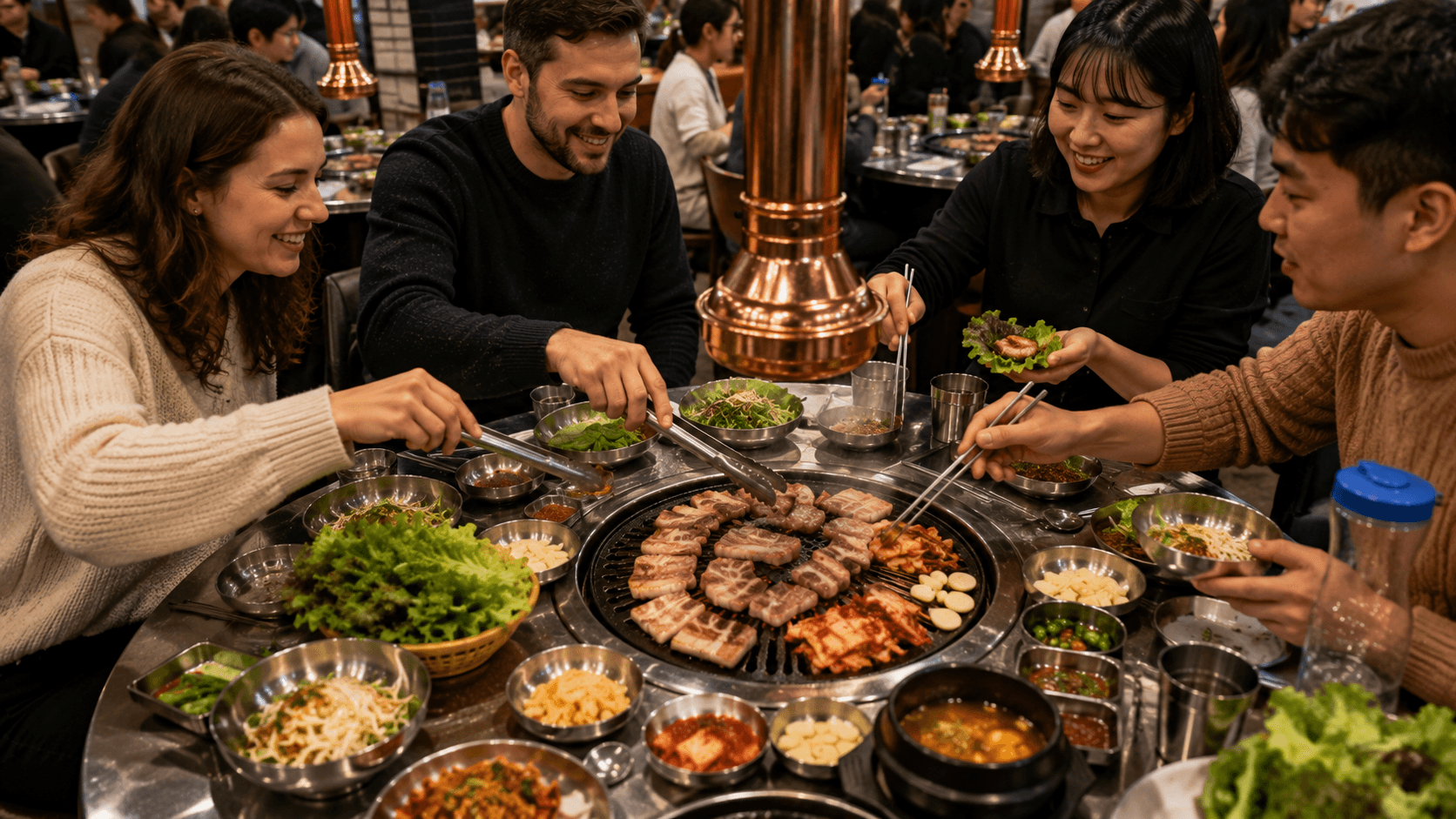
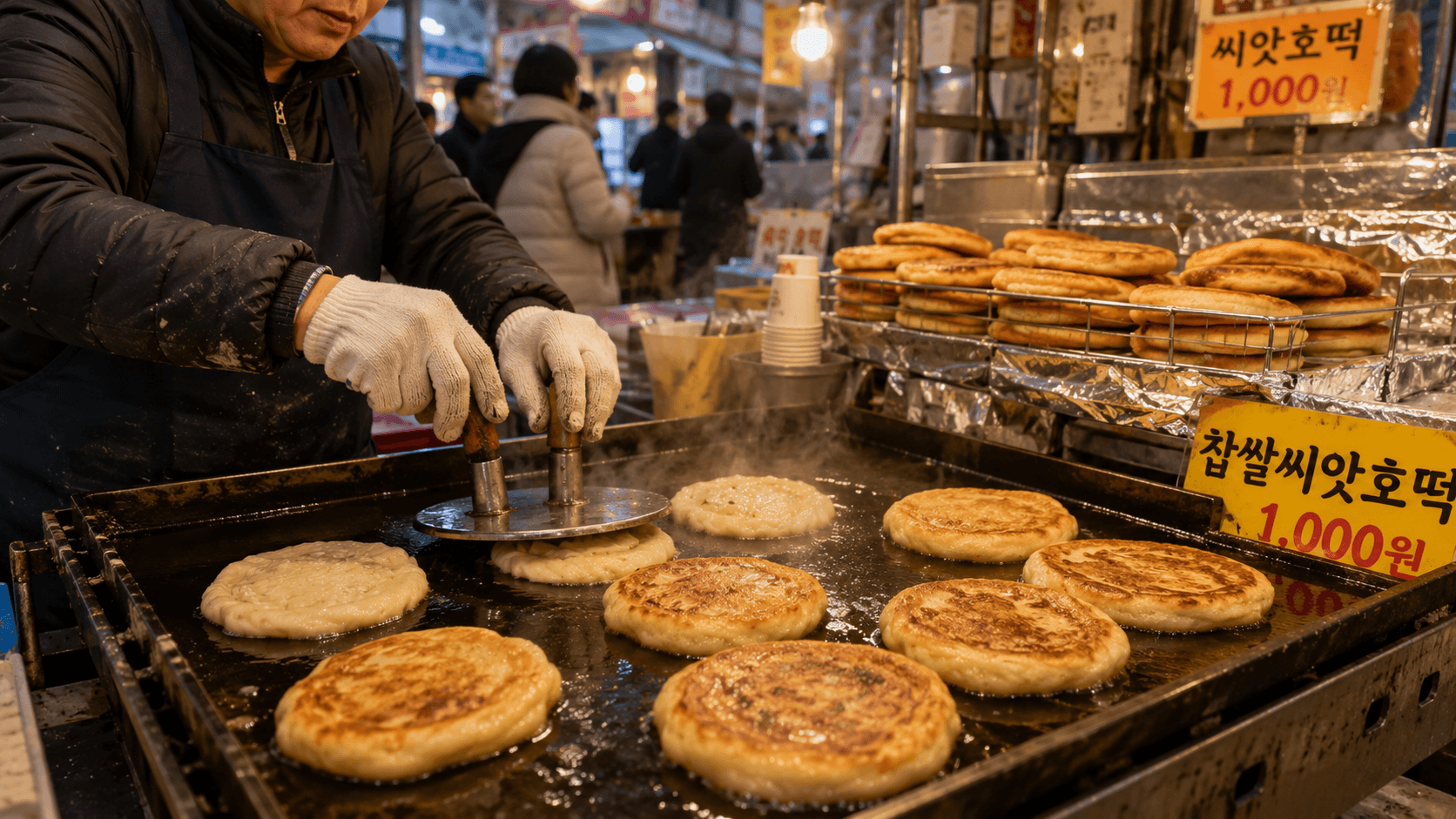
Vegan travel in South Korea is entirely possible, especially in Seoul, Busan, Jeju, and other major destinations. The main difficulty is not a lack of vegetables or tofu, but hidden animal ingredients: anchovy broth, fish sauce, salted shrimp, egg, and meat-based stock appear in dishes that may otherwise look plant-based.
The safest strategy is to identify dedicated vegan restaurants, save several backup options near your accommodation, and show restaurant staff a precise Korean explanation of what you do not eat. Information and service links in this guide were verified on June 11, 2026.
Quick answer
- Search for 비건 식당 (vegan restaurant) or 채식 식당 (vegetarian restaurant) on Korean map apps.
- Do not assume that vegetable bibimbap, kimchi, tofu stew, noodles, or temple-style food is automatically vegan.
- Specifically ask about fish sauce, salted seafood, anchovy broth, meat stock, egg, and dairy.
- Dedicated vegan restaurants are usually easier than modifying dishes at conventional Korean restaurants.
- Save a Korean dietary card on your phone and keep packaged food as an emergency meal.
- Confirm current hours directly with the restaurant. Map listings and older travel articles may be outdated.
Why apparently vegetarian Korean food may not be vegan
Korean meals commonly include rice, vegetables, mushrooms, seaweed, tofu, and fermented soybean products. However, Korean culinary categories do not always distinguish between vegan, vegetarian, and simply vegetable-heavy food.
A dish described as 채소 or 야채, both meaning vegetables, may still contain animal-derived broth or seasoning. Similarly, removing visible meat does not make a dish vegan if the sauce, soup base, or kimchi contains seafood.
Watch particularly closely for:
| Ingredient | Korean | Where it may appear |
|---|---|---|
| Fish sauce | 액젓 | Kimchi, seasoned vegetables, sauces |
| Salted seafood | 젓갈 | Kimchi and side dishes |
| Salted shrimp | 새우젓 | Kimchi, soups, stews, dipping sauces |
| Anchovy broth | 멸치 육수 | Noodle soup, stew, hot pot |
| Meat broth or stock | 고기 육수 | Soups, rice dishes, sauces |
| Egg | 계란 or 달걀 | Bibimbap, gimbap, noodles, pancakes |
| Milk | 우유 | Bread, drinks, desserts, sauces |
| Butter | 버터 | Bakery products, potatoes, restaurant cooking |
| Honey | 꿀 | Tea, snacks, sauces, desserts |
Kimchi deserves a separate check. Although its main ingredients are vegetables, conventional kimchi frequently includes aekjeot (액젓, fish sauce) or jeotgal (젓갈, salted seafood). Ask for 비건 김치 (vegan kimchi) rather than assuming that white or mild kimchi is seafood-free.
The most useful Korean phrases
The Korean word 비건 is a direct transliteration of “vegan” and is increasingly recognized. However, a detailed explanation is more reliable than using that word alone.
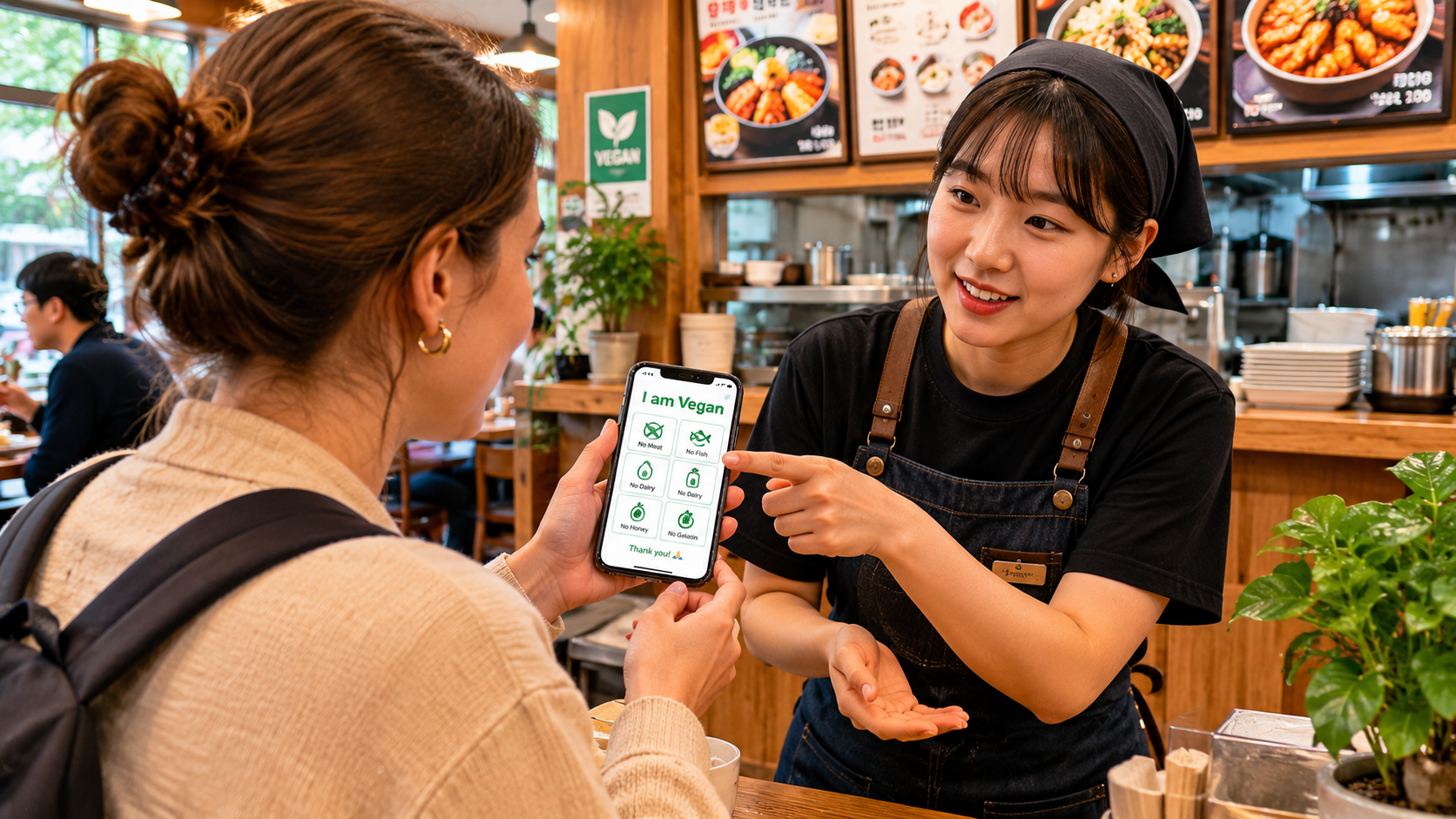
A clear dietary card
Show this text before ordering:
저는 비건입니다. 고기, 생선, 해산물, 계란, 우유, 버터, 치즈, 꿀을 먹지 않습니다. 멸치 육수, 고기 육수, 액젓, 젓갈, 새우젓도 먹지 않습니다.
I am vegan. I do not eat meat, fish, seafood, eggs, milk, butter, cheese, or honey. I also do not eat anchovy broth, meat broth, fish sauce, salted seafood, or salted shrimp.
For a shorter question, use:
- 이 음식은 비건인가요? — Is this dish vegan?
- 고기나 해산물이 들어가나요? — Does it contain meat or seafood?
- 멸치 육수가 들어가나요? — Does it contain anchovy broth?
- 액젓이나 젓갈이 들어가나요? — Does it contain fish sauce or salted seafood?
- 계란을 빼 주세요. — Please leave out the egg.
- 고기 없이 만들어 주세요. — Please make it without meat.
The last two requests do not cover hidden broth or seasoning. Use them only after confirming the base ingredients.
If you have a serious food allergy rather than a dietary preference, identify the allergen separately and carry appropriate medical information. A restaurant's verbal confirmation cannot guarantee the absence of cross-contact.
How to find vegan restaurants
1. Search in Korean as well as English
Korean map platforms generally contain more local listings and recent customer activity than international travel articles. Try these searches on Naver Map or KakaoMap:
- 비건 식당 — vegan restaurant
- 비건 음식 — vegan food
- 채식 식당 — vegetarian restaurant
- 사찰음식 — Korean temple food
- 비건 베이커리 — vegan bakery
- 비건 카페 — vegan café
Search around the neighborhood or subway station where you will actually be, not only across the entire city. Save at least two options because small restaurants may close between lunch and dinner, take irregular days off, or require reservations.
Community directories such as HappyCow's South Korea listings can help with discovery, but their classifications and hours are user-submitted. Cross-check the restaurant's current social media account, reservation page, or Korean map listing before making a special trip.
2. Check whether the whole restaurant is vegan
Labels such as “vegan-friendly,” “plant-based options,” and 채식 가능 (vegetarian option available) do not mean that every dish is vegan. Look for a statement that the restaurant is fully vegan, or confirm the exact dish and its broth, kimchi, sauce, and toppings.
Recent menu photos can be useful, but they do not replace confirmation. Menus, ingredients, and opening hours can change without appearing immediately on English-language pages.
3. Reserve special meals in advance
Temple-food restaurants, tasting menus, cooking classes, guesthouses, and rural accommodations may need advance notice. Send your full dietary restrictions when booking and ask for written confirmation.
For general tourism assistance, the Korea Tourism Organization's 1330 Travel Helpline provides travel information by telephone and online chat. As verified on June 11, 2026, the official page lists 1330 within Korea and +82-2-1330 from overseas, along with web-based call and chat options. Ask the helpline to confirm current access methods before relying on it for urgent assistance.
Korean dishes that can work with modification
The following dishes can be vegan, but their standard versions often are not. Dedicated vegan restaurants are the safest places to try them.
Bibimbap
Bibimbap (비빔밥) combines rice with vegetables and usually comes with egg; some versions also contain beef. Ask for both to be removed and confirm that the vegetables, sauce, and accompanying soup were not prepared with animal ingredients.
A useful request is:
계란과 고기를 빼고, 육수나 액젓 없이 만들어 주세요.
Please make it without egg or meat, and without meat broth or fish sauce.
Gimbap
Gimbap (김밥) is rice and fillings rolled in dried seaweed. Common fillings include egg, fish cake, ham, tuna, cheese, and imitation crab. A roll that looks vegetable-only may still contain egg or processed animal products.
Ask for 비건 김밥 specifically. At a conventional gimbap shop, extensive customization may be difficult because ingredients are prepared in advance.
Japchae
Japchae (잡채) consists of glass noodles and vegetables, but it may contain beef or be seasoned with a sauce or stock that is not vegan. Confirm the recipe rather than requesting only that visible beef be removed.
Tteokbokki
The rice cakes in tteokbokki (떡볶이) may be plant-based, but the sauce can contain anchovy stock, and the dish is commonly cooked with fish cake. Removing the fish cake after cooking does not remove the seafood ingredients from the sauce.
Tofu dishes
Plain tofu is vegan, but sundubu-jjigae (순두부찌개, soft tofu stew) commonly contains seafood, meat, egg, or anchovy-based stock. Dubu-jorim (두부조림, braised tofu) may contain fish sauce. Order these at a vegan restaurant or confirm every component.
Noodles
Cold or hot noodle dishes may use beef, chicken, anchovy, seafood, or fermented fish in their broth and sauces. Even kalguksu (knife-cut noodles) or janchi-guksu (banquet noodles) topped only with vegetables may have anchovy broth.
Vegetable pancakes
Jeon (전), including kimchi or vegetable pancakes, usually uses a flour batter that may contain egg. Kimchi pancakes may also contain non-vegan kimchi or seafood. Ask about both the batter and filling.
Temple food: promising, but confirm the program
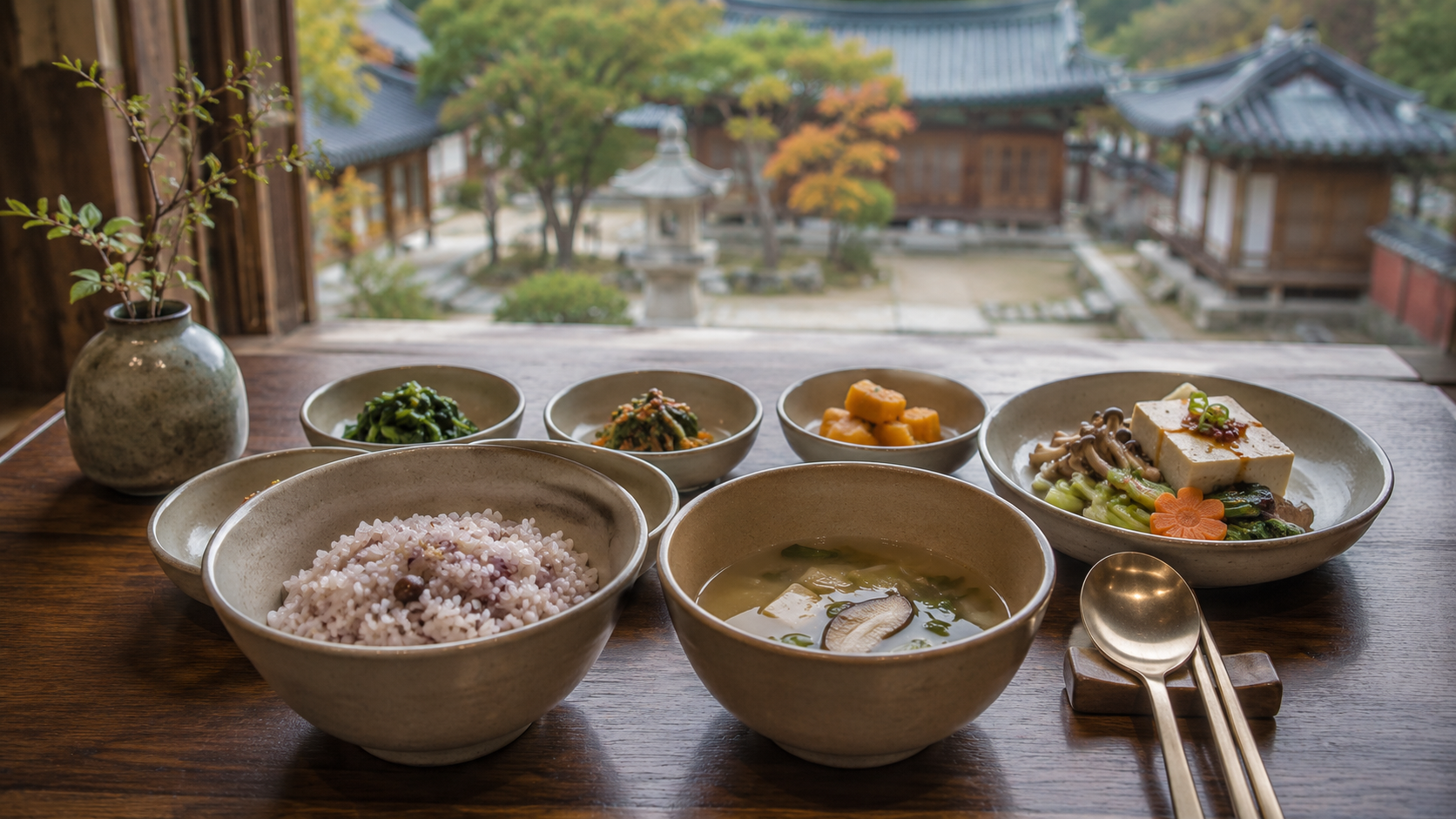
Korean Buddhist temple food, or sachal eumsik (사찰음식), is centered on plant ingredients and traditionally excludes meat and seafood. It is one of the most accessible ways to experience a complete Korean meal without conventional meat or fish broth.
However, “temple-style” on a commercial menu is not by itself a vegan certification. Confirm whether dairy, honey, processed ingredients, or nontraditional additions are used. Travelers who avoid all animal-derived products should also ask about honey.
The official Templestay reservation website lists participating temples and day, experience, and rest-oriented programs. Its current program search and reservation functions were verified on June 11, 2026. Meals and English support vary by temple and program, so contact the temple before booking and state your dietary requirements. Do not assume that a temple visit automatically includes a meal.
Temple meals may also avoid the five pungent vegetables traditionally restricted in Korean Buddhism, including garlic and several alliums. This gives the food a different flavor profile from ordinary restaurant versions of Korean dishes.
Convenience stores and supermarkets
Packaged food can provide a useful backup, but front-of-package photographs and English product names are not enough. Check the complete Korean ingredient list, including seasoning packets supplied with noodles or ready meals.
Useful words to recognize include:
- 원재료명 — ingredients
- 우유 — milk
- 버터 — butter
- 치즈 — cheese
- 유청 — whey
- 계란 / 달걀 — egg
- 돼지고기 — pork
- 쇠고기 / 소고기 — beef
- 닭고기 — chicken
- 멸치 — anchovy
- 새우 — shrimp
- 어류 — fish
- 꿀 — honey
A camera translation app can help, but machine translation may miss compound ingredients or text printed across packaging seams. When uncertain, choose a product with an independently recognizable vegan mark or contact the manufacturer. A “plant-based” product may still require an ingredient check if your definition excludes every animal-derived additive.
Simple backup foods may include plain fruit, nuts, rice, salad without dressing, plain soy milk, and packaged tofu. Availability and recipes vary by store and brand, so these are categories to inspect rather than guaranteed vegan products.
Eating outside major cities
Vegan travel generally requires more preparation in smaller towns, highway rest areas, islands, mountain regions, and places where only a few restaurants operate. A restaurant may be willing to prepare rice and plain vegetables, but its standard soup, kimchi, and side dishes may still contain seafood seasoning.
Before a rural day trip:
- Eat a substantial meal before departure.
- Save a suitable restaurant near the bus or train station.
- Check its current opening day and break time.
- Carry enough packaged food for one missed meal.
- Save the Korean dietary card offline.
- Ask your accommodation about kitchen access where relevant.
At traditional markets, ask the same ingredient questions you would in a restaurant. Vegetable appearance does not establish that a sauce, batter, or cooking broth is vegan. Shared fryers and grills are also common, which matters for travelers concerned about cross-contact.
Common mistakes
Assuming “no meat” excludes seafood
In casual conversation, 고기 (meat) may be interpreted as land-animal meat rather than fish or shellfish. Name meat, fish, seafood, eggs, and dairy separately.
Trusting the visible ingredients
Removing egg, fish cake, or beef at the table does not remove broth, fish sauce, or cooking residue. Ask how the dish is prepared before ordering.
Treating every side dish as vegetarian
Banchan (반찬), the small dishes served with a Korean meal, may contain anchovies, salted shrimp, fish sauce, meat, or egg. Check each item instead of assuming vegetable side dishes are safe.
Expecting extensive customization during busy periods
Some restaurants prepare soup bases, sauces, and mixed fillings in large batches. Staff may be unable to produce a vegan portion even if they understand the request. Accept a clear refusal and use your saved alternative.
Relying on one restaurant
Opening days and break times can change. Keep a second restaurant and a supermarket option near each important stop.
What to check before you go
- Save 비건 식당, 채식 식당, and 사찰음식 as search terms.
- Download Korean map and translation tools before leaving the airport.
- Store the full Korean dietary card as text and as a screenshot.
- Mark vegan restaurants near your accommodation and major sightseeing areas.
- Recheck opening hours on the day of your visit.
- Reserve temple meals, tasting menus, and cooking classes in advance.
- Ask accommodations whether breakfast can be prepared without egg, dairy, meat, seafood, broth, or fish sauce.
- Pack shelf-stable food for late arrivals and rural excursions.
- Contact your airline directly about special-meal availability and its ordering deadline; rules vary by airline and route.
- For severe allergies, carry medication and a professionally translated allergy card. Vegan labeling alone is not an allergy-control measure.
FAQ
Is kimchi vegan in Korea?
Not necessarily. Conventional kimchi often contains fish sauce, salted shrimp, or other salted seafood. Ask whether it is 비건 김치 and specifically check for 액젓, 젓갈, and 새우젓.
Is bibimbap vegan without meat?
Not automatically. It often contains egg, while the vegetables, sauce, soup, or kimchi served with it may contain animal ingredients. A dedicated vegan version is more reliable.
Is Korean temple food always vegan?
Traditional temple cuisine excludes meat and seafood and is strongly plant-centered. Nevertheless, confirm the exact restaurant or Templestay meal, especially if you avoid honey, dairy in modern products, or cross-contact.
Can I travel vegan outside Seoul?
Yes, but plan more carefully. Busan, Jeju, and other large cities have searchable vegan options, while smaller destinations may require advance calls, self-catering, or carrying a backup meal.
Should I use the word “vegetarian” or “vegan”?
Use 비건 and then list the excluded ingredients. 채식 can describe several forms of vegetarian eating and may not communicate that you exclude eggs, dairy, seafood seasoning, and meat broth.
Next step
Before finalizing your itinerary, search every overnight neighborhood for 비건 식당, save two current options, and send your Korean dietary card to any accommodation or activity provider supplying meals. That small amount of preparation will prevent most food-related problems after arrival.
Sources
- Korea Tourism Organization: 1330 Travel Helpline and Complaint Center
- Cultural Corps of Korean Buddhism: Official Templestay reservations
- Naver Map
- KakaoMap
- HappyCow South Korea directory — community-maintained; verify listings directly