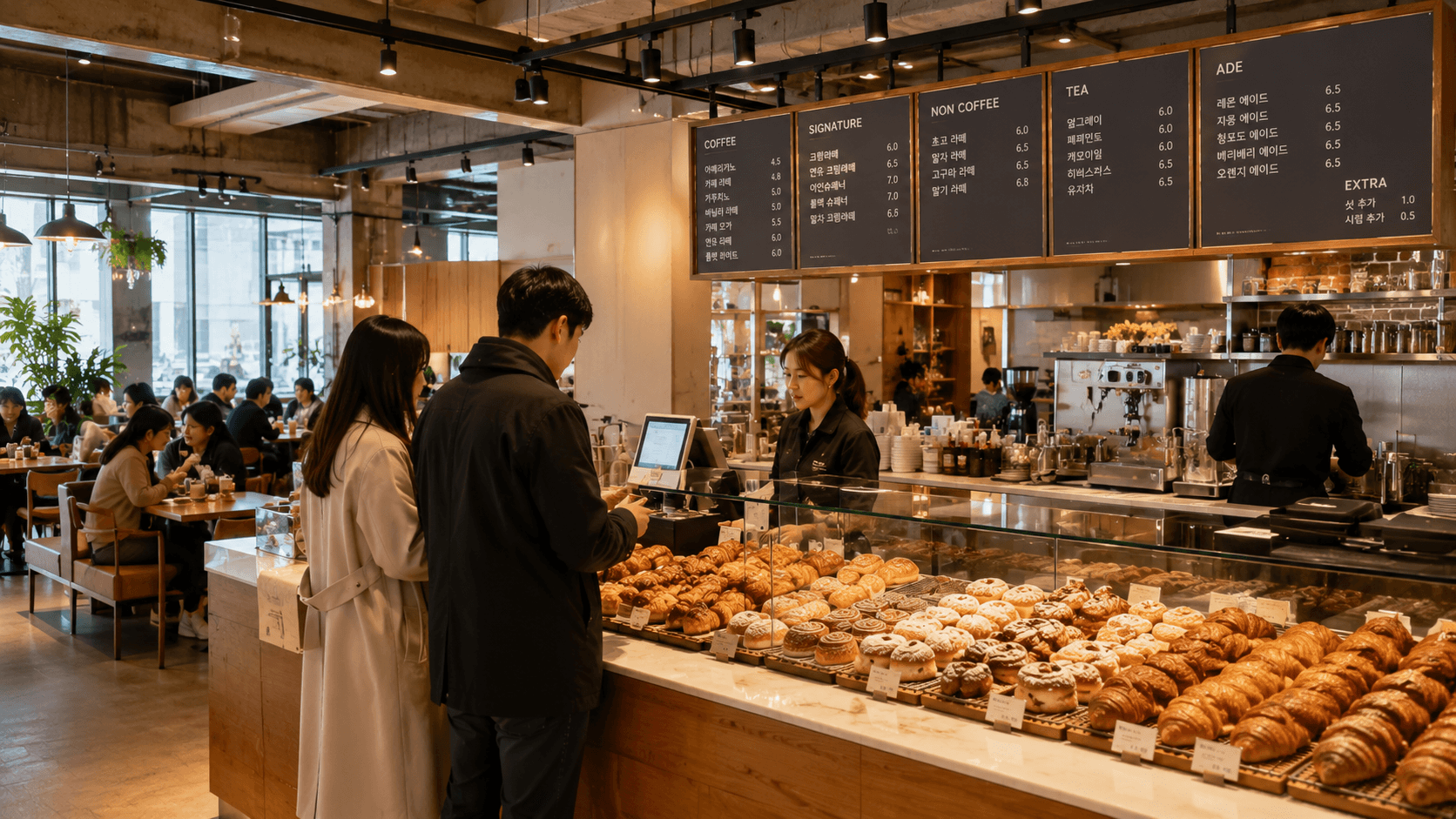
Korean cafes are not simply places to buy coffee. They serve as meeting rooms, study spaces, date locations, dessert destinations, and carefully designed attractions. Ordering is usually straightforward, but first-time visitors should understand counter service, one-drink-per-person policies, self-service stations, and the difference between a quick coffee chain and a cafe designed for a longer visit.
Price and service information in this guide was checked on June 11, 2026. Individual menus, opening hours, reservation systems, and seating rules can change without notice.
Quick answer
| Question | What to expect |
|---|---|
| Where do I order? | Usually at a counter or touchscreen kiosk before sitting down |
| Is table service common? | No, except at some traditional teahouses, hotel lounges, and specialty venues |
| How much should I budget? | Roughly ₩2,000–₩8,000 for a standard drink and ₩4,000–₩12,000 for many individual desserts; destination cafes can cost more |
| Can I pay by card? | Usually, but carry a physical card and some KRW as backup |
| Do I need to tip? | No |
| Can I work on a laptop? | Often, but check signs, available outlets, and busy-period restrictions |
| Can I stay for hours? | Sometimes, but buying one inexpensive drink does not guarantee unlimited use of a table |
| Are reservations needed? | Usually not, although popular cafes, afternoon-tea services, and themed venues may require them |
The price figures above are practical planning ranges rather than fixed national prices. They were reviewed against current Korean chain menu listings on June 11, 2026, including the official Starbucks Korea, Mega MGC Coffee, and Ediya Coffee menus. Prices vary by brand, branch, drink size, ingredients, and location.
Why cafes are a major part of daily life
In Korea, a cafe is often the default place to continue a conversation after lunch or dinner. The Korean expression for moving from a meal to coffee is sometimes shortened to 카페 가자, meaning let us go to a cafe. Students meet for group projects, coworkers hold informal discussions, and friends may choose a cafe primarily for its interior, view, or desserts.
This helps explain why one neighborhood can support several very different businesses: inexpensive takeaway chains, quiet roasteries, bakery cafes, converted houses, and large multi-floor venues. Seoul's city government has also documented the development of cafe streets, renovated-house cafes, book cafes, and hanok cafes in its overview of Seoul cafe culture.
Coffee is central, but it is not the whole culture. Tea, fruit ades, smoothies, seasonal drinks, shaved ice, bread, cakes, and elaborate plated desserts can be equally important.
The main types of Korean cafe
Budget coffee chains
Low-cost chains concentrate on fast service, large drinks, and takeaway orders. Seating may be limited or absent. These are useful when you want caffeine rather than an extended cafe visit.
Do not assume that a low advertised price applies to every variation. Iced drinks, larger sizes, decaffeinated coffee, extra espresso shots, alternative milk, or seasonal ingredients may cost more.
Full-size franchise cafes
Larger chains usually offer predictable menus, indoor seating, toilets, Wi-Fi, and some power outlets. They can be easier for newcomers because menu photographs and standardized ordering reduce the language barrier.
Facilities still vary by branch. A small station branch may have no toilet or seating, while a multi-floor branch may be suitable for a long conversation or laptop session.
Independent and specialty coffee shops
Independent cafes may emphasize beans, brewing method, architecture, music, or a small dessert selection. A specialty shop may offer hand-drip coffee, single-origin beans, or a choice of roast profiles.
These cafes are more likely to have limited seating or individual house rules. Some do not allow laptops on weekends, restrict stays during busy periods, or require each guest to order a drink.
Bakery and dessert cafes
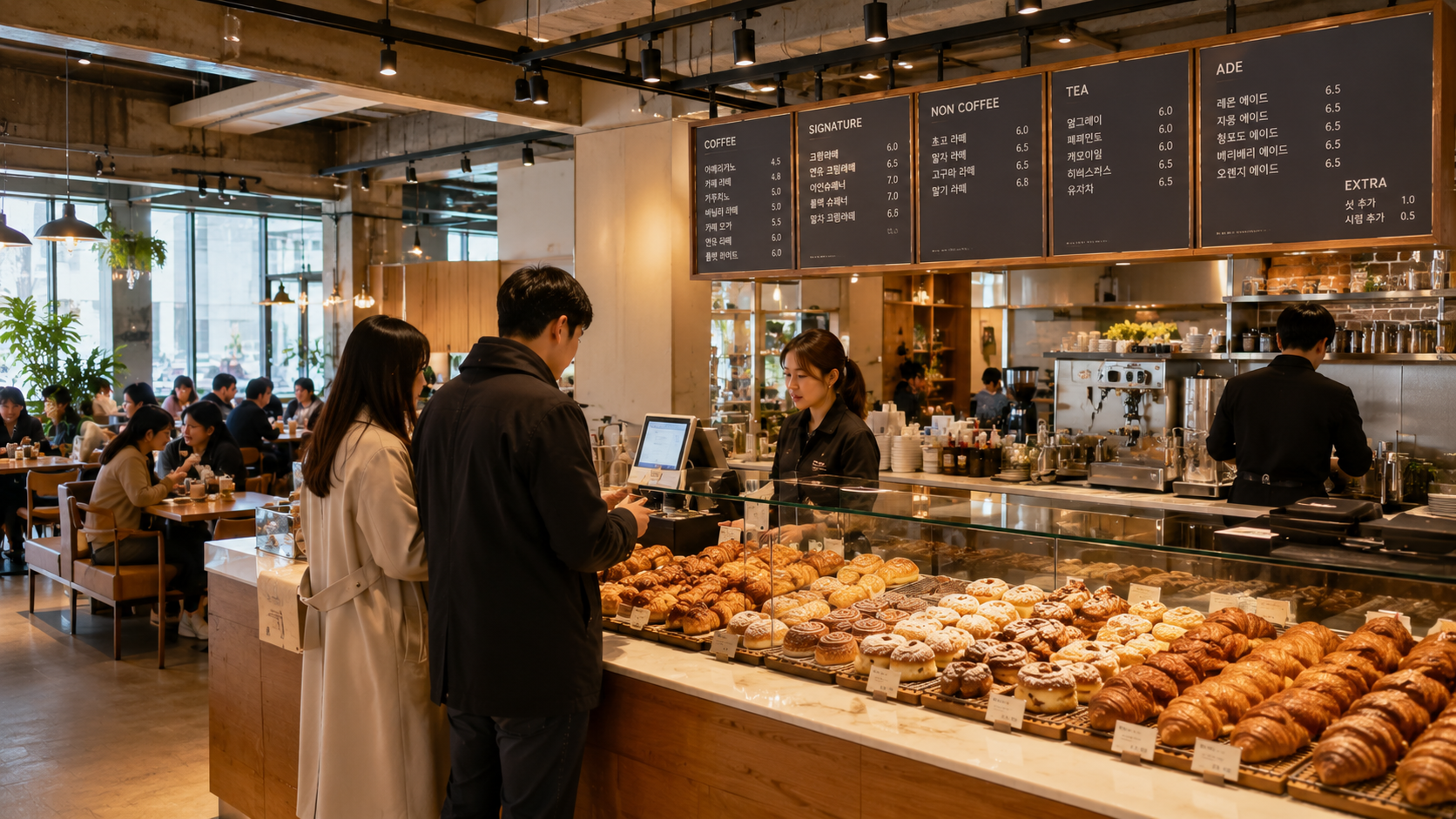
At bakery cafes, customers commonly take a tray, select bread or pastries, and pay for everything at the counter. Tongs and trays are normally provided near the display.
Popular desserts include roll cakes, financiers, salt bread, croissants, cheesecakes, and bingsu (빙수), a bowl of shaved ice with toppings. Bingsu is often large enough to share, but portion sizes vary.
Hanok cafes and traditional teahouses
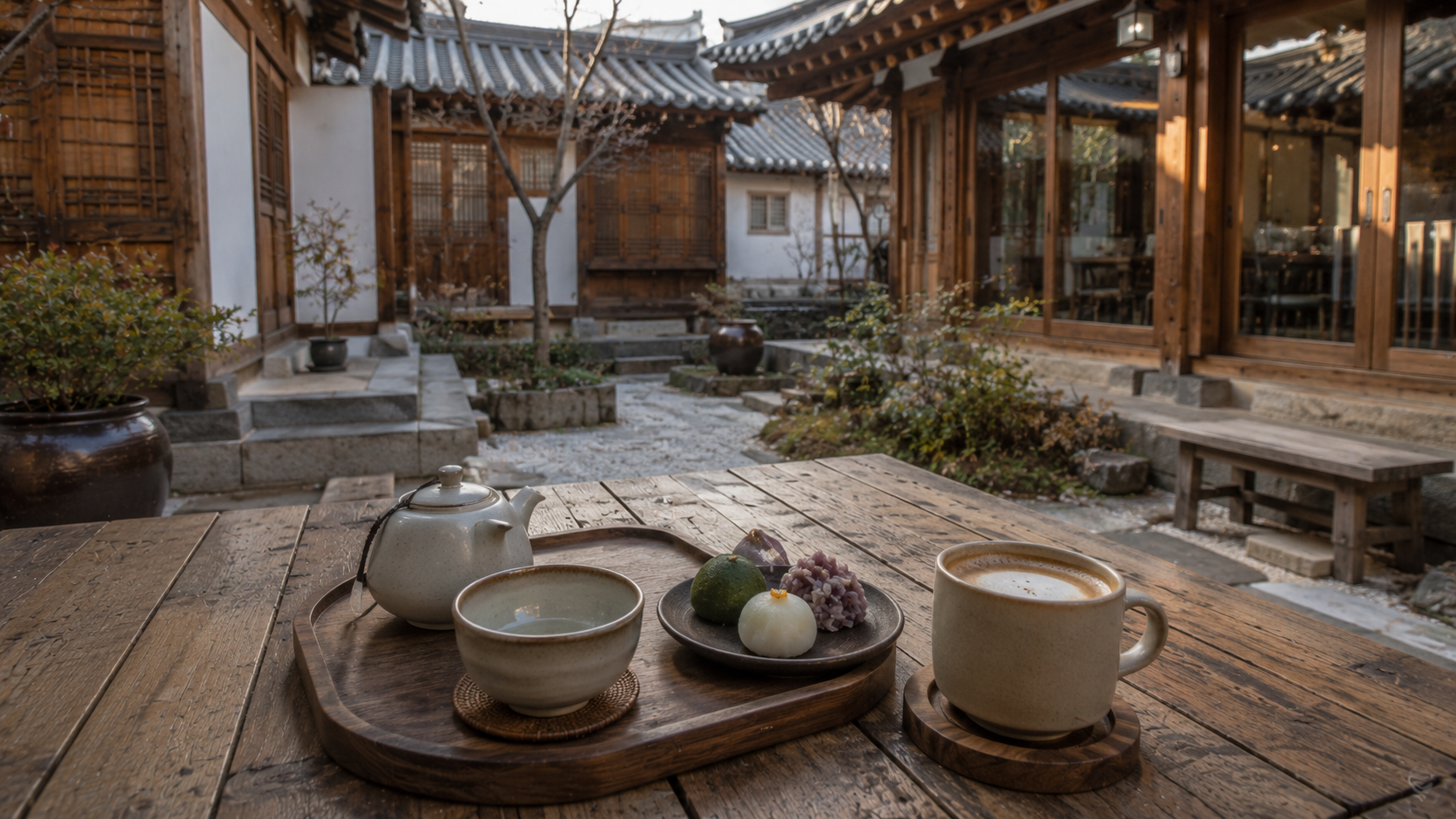
A hanok (한옥) is a traditional Korean building. Hanok cafes may have low thresholds, uneven floors, floor seating, courtyards, or limited climate control because of the building layout.
Menus can include coffee alongside jujube tea, ginger tea, omija berry drinks, rice cakes, and sweet red-bean desserts. Traditional presentation does not necessarily mean traditional preparation, so ask about ingredients if that matters to you.
Scenic and destination cafes
Large cafes outside dense city centers may be built around an ocean view, mountain setting, garden, rooftop, or unusual architecture. They can require a car, taxi, or long bus journey and may charge more than neighborhood cafes.
Check the last return bus, taxi availability, parking rules, and whether the view depends on daylight. A coastal cafe reached just before closing may offer little time to enjoy the location.
Dabang and retro cafes
Dabang (다방) is an older Korean term for a tearoom or coffeehouse. Some surviving dabang retain dim lighting, upholstered seats, old music, and traditional drinks such as ssanghwacha (쌍화차), a sweet herbal beverage.
Modern businesses also use retro dabang styling, so a vintage name does not prove that a cafe is historically old.
How to order step by step
1. Check whether you order first
In most cafes, order and pay at the counter before choosing a seat. At very busy independent cafes, staff may assign a table first. Look for a sign or follow the queue rather than immediately occupying the largest available table.
2. Choose dine-in or takeaway
Staff may ask:
- 매장에서 드세요? — Will you have it here?
- 포장이세요? — Is it takeaway?
Useful answers are:
- 먹고 갈게요 — I will have it here.
- 포장해 주세요 — Takeaway, please.
On a kiosk, look for 매장, meaning dine-in, and 포장, meaning takeaway.
3. Specify hot or iced
아이스 means iced. 따뜻한 means hot or warm. An Americano is 아메리카노.
A simple order is:
아이스 아메리카노 한 잔 주세요.
This means one iced Americano, please. Showing the menu photograph or pointing politely is acceptable when pronunciation is difficult.
4. Pay and keep the receipt or buzzer
You may receive a vibrating pager, a printed order number, or a verbal call using your drink name. Some cafes send an alert through their app, but counter orders normally remain available for visitors without a Korean account.
If using a touchscreen, an international card may occasionally fail even when the staffed terminal accepts it. Ask the counter for help rather than repeatedly attempting the same payment.
5. Collect the order
Pick up your drinks when the pager vibrates or your number appears. Straws, napkins, water, lids, and cutlery may be at a separate self-service station.
6. Return the tray
Most self-service cafes expect customers to take cups and trays to a return station. It may be labeled 반납대 or 퇴식구. Separate liquid, cups, and rubbish when labeled bins are provided.
Payment, tipping, and receipts
Card payment is normal at most urban cafes, including small purchases, but no payment method works everywhere. Carry a physical international card rather than relying entirely on a foreign mobile wallet. A small amount of KRW is a useful backup, particularly outside major commercial districts.
Korean transport cards should not be treated as universal cafe payment cards. Some businesses may accept a particular prepaid or mobile system, but acceptance is merchant-specific.
Tipping is not expected. Pay only the displayed total unless you are buying an additional product or service.
Ask for a receipt with 영수증 주세요 if you need one. At a kiosk, the receipt option may appear after payment.
Cafe etiquette that visitors should know
One drink per person
A sign reading 1인 1음료 means one drink per person. This is common at independent cafes, scenic venues, and places with limited seating. Cakes may or may not count toward the minimum, so check the wording.
Young children are sometimes excluded from the rule, but there is no universal age policy.
Do not bring outside food
Outside food and drinks are generally unwelcome unless the cafe explicitly permits them. This includes convenience-store drinks and food bought at a neighboring bakery.
Match your stay to the situation
There is no nationwide time limit for cafe seating. A long stay may be reasonable in a quiet chain cafe, but less considerate in a six-seat specialty shop with customers waiting.
During busy periods, use a table that matches your group size. Do not spread a laptop, coat, and shopping bags across several seats.
Keep calls and video audio quiet
Conversation is normal, but speakerphone calls and videos without headphones can disturb nearby customers. Cafes designed as quiet study spaces may enforce stricter rules.
Ask before commercial photography
Quick personal photographs are commonly tolerated, but tripods, lighting, repeated posing, product shoots, and photographing staff or other customers require permission. Some photogenic cafes display specific camera restrictions.
Studying and working in cafes
Cafe studying is common enough to have its own expression: 카공, shortened from cafe study. That does not mean every cafe welcomes an all-day workstation.
Before setting up, check for:
- Laptop-prohibition signs
- Weekend or peak-hour time limits
- Covered or unavailable power outlets
- Shared-table requirements
- Restrictions on video meetings
- Closing times for upper floors
A study cafe, or 스터디카페, is different from an ordinary coffee shop. It is generally a paid study facility with timed access, quiet desks, and sometimes unmanned entry. Registration or payment can require a Korean phone number, local card, or app.
For ordinary cafes, buy another item if you stay through several busy periods, and never leave valuables unattended while visiting the toilet.
Menu terms and dietary needs
Useful menu words include:
| Korean | Meaning |
|---|---|
| 디카페인 | Decaffeinated |
| 샷 추가 | Extra espresso shot |
| 시럽 빼 주세요 | Please leave out the syrup |
| 우유 | Milk |
| 두유 | Soy milk |
| 오트 | Oat |
| 견과류 | Nuts |
| 품절 | Sold out |
| 시즌 메뉴 | Seasonal menu |
Alternative milk and decaffeinated coffee are increasingly visible, but availability varies substantially. They may cost extra, and equipment can be shared with dairy or other ingredients.
If you have a serious allergy, do not rely only on an English menu, visual inspection, or a translation app. Ask staff to confirm ingredients and cross-contact risk. If clear information is unavailable, choose another item or business. Cafes with extensive bakery displays may handle milk, eggs, wheat, sesame, soy, peanuts, and tree nuts in the same preparation area.
Korean cafe drinks can also contain more sugar, cream, or caffeine than their names suggest. Ade, despite its English appearance, usually refers to a sweet carbonated fruit drink rather than plain juice.
Accessibility, children, and pets
Converted houses, rooftop cafes, basement shops, and hanok buildings may have stairs without lifts, narrow entrances, uneven surfaces, or toilets on another floor. Confirm step-free access and toilet availability before making a special journey. For Seoul, the city-backed Seoul Danurim accessible tourism service provides accessibility-focused travel information, although individual venue conditions should still be confirmed directly.
Parents may encounter 노키즈존, meaning no-kids zone, or an age restriction posted at the entrance. Other cafes welcome children but restrict access to rooftops, galleries, or fragile display areas.
반려동물 동반 means pets are allowed, but conditions can include carriers, leashes, designated floors, or size limits. Never assume that a dog-friendly terrace means animals may enter the indoor seating area.
Common mistakes
- Assuming every photogenic cafe has good public-transport access
- Trusting map opening hours without checking the cafe's latest official post
- Expecting a seat at a takeaway-focused budget chain
- Ordering first and then discovering that every table is occupied
- Taking a four-person table alone while smaller seats are available
- Confusing a study cafe with a normal coffee shop
- Assuming every dessert is vegetarian or free from alcohol, gelatin, or nuts
- Arriving near closing time without checking the last-order time
- Expecting every building to have a customer toilet
- Leaving a tray on the table in a clearly self-service cafe
What to check before you go
Use this checklist for a cafe that requires a special journey:
- Current opening day and hours
- Last-order time
- Temporary closure notices
- Dine-in, takeaway, or reservation rules
- One-drink-per-person requirement
- Waiting-list procedure and Korean phone-number requirement
- Nearest station or bus stop
- Last return service and taxi availability
- Parking fees or validation
- Step-free entrance and lift access
- Customer toilet availability
- Children or pet restrictions
- Rooftop closure during rain, wind, extreme heat, or cold
- Accepted payment methods
For tourism assistance, the Korea Tourism Organization provides the 1330 Korea Travel Helpline and online chat. Access options were confirmed on June 11, 2026. For a specific cafe, its official website or social-media account should take priority over an old blog post.
FAQ
Is it acceptable to visit a Korean cafe alone?
Yes. Solo customers are routine, especially at chains and cafes near offices or universities. Choose a smaller table when possible.
Do Korean cafes serve only coffee?
No. Tea, chocolate drinks, fruit ades, smoothies, juices, milk-based drinks, and seasonal beverages are common. Traditional teahouses may serve no espresso drinks at all.
Are cafes open late?
Some are, particularly in nightlife and university areas, but there is no reliable nationwide pattern. Independent shops may close earlier or stop taking orders before the listed closing time. Verify the specific branch on the day of your visit.
Can I reserve a table in English?
Walk-in service is more common than reservations. When booking is available, the system may use Naver, Catch Table, an official website, social media, or telephone. Some systems require a Korean mobile number. Contact the venue directly if the booking page is inaccessible.
Can I use the toilet without ordering?
Do not assume so. Toilets may require a receipt code, door key, or directions from staff, and some small cafes have no customer toilet. 화장실 어디예요? means where is the toilet?
What should I order for a recognizably Korean cafe experience?
There is no single required drink. Try a local seasonal ingredient, omija berry drink, jujube tea, black-sesame latte, injeolmi rice-cake dessert, or red-bean bingsu when available. Check sweetness and allergens before ordering.
Sources
- Korea Tourism Organization: VISITKOREA and 1330 travel assistance
- Seoul Metropolitan Government: Cafe Culture in Seoul
- Visit Seoul: Official Seoul Travel Guide
- Seoul Danurim Accessible Tourism Service
- Starbucks Korea official drink menu
- Mega MGC Coffee official menu
- Ediya Coffee official drink menu
Start by choosing the kind of experience you actually need: a quick takeaway coffee, a reliable place to sit, a specialist brew, or a destination worth planning part of the day around. Then verify that branch's latest hours and rules before setting out.