Korean convenience stores are useful for much more than snacks. You can assemble a quick meal, buy toiletries, reload a transport card, withdraw cash at some locations, send parcels, and sometimes sit down to eat. CU, GS25, 7-Eleven, and Emart24 are among the chains you will commonly see, but products, hours, seating, and services vary by branch.
Information and sample prices in this guide were verified on June 10, 2026. Always check the shelf label and branch signage because promotions and services change frequently.
At a glance
| Question | Practical answer |
|---|---|
| Are convenience stores open 24 hours? | Many are, but not every branch. Check the posted hours or a Korean map app. |
| Can I pay by card? | Cards are widely used, but overseas cards can occasionally fail. Carry some KRW as backup. |
| Can I reload a Tmoney card? | Yes, at participating stores. Official Tmoney instructions specify cash in Korean won for reloads. |
| Can staff heat my food? | Stores usually have customer microwaves, or staff may heat certain products. |
| Do stores have seating? | Some have indoor counters or outdoor tables; small branches may have none. |
| Can I use the restroom? | Do not assume so. Most small convenience stores do not provide a public restroom. |
| Are all services available everywhere? | No. ATMs, parcel machines, seating, charging, and transport-card services depend on the branch. |
Recognizing the main convenience-store chains
The major chains have similar core products but different private-label foods, promotions, and apps:
- CU (씨유): Purple-and-green signs. Its official website includes product listings, current promotions, and a store finder with service filters.
- GS25 (지에스이십오): Blue-and-white signs with red and green details.
- 7-Eleven (세븐일레븐): The familiar red, orange, and green logo. Its Korean website publishes current discounts and branch services.
- Emart24 (이마트24): Yellow-and-black signs.
There is no need to search for a particular chain unless you want an exclusive product or a specific service. For a basic meal, drink, or toiletry purchase, use whichever branch is convenient.
What you can buy
Ready-to-eat meals
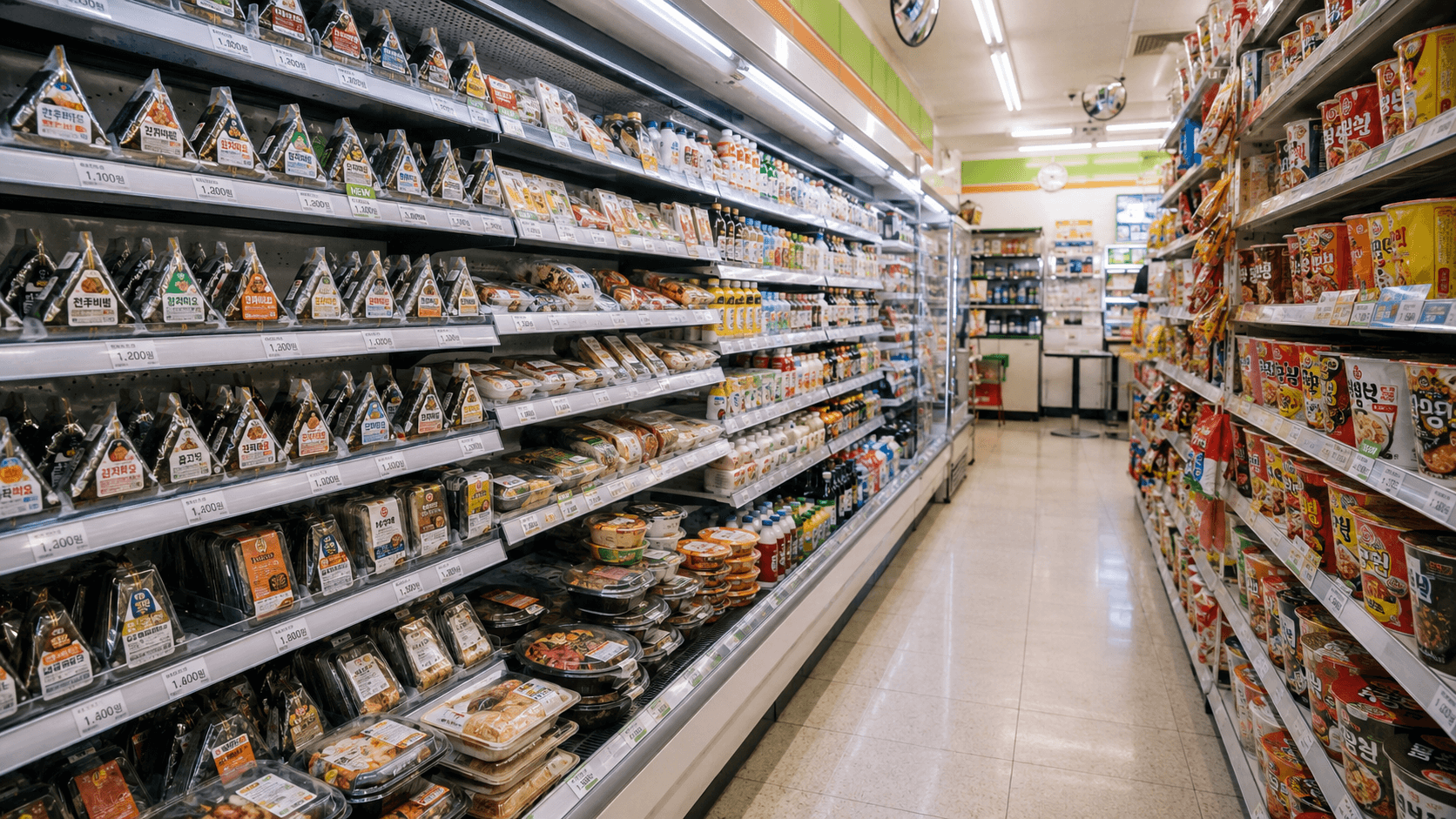
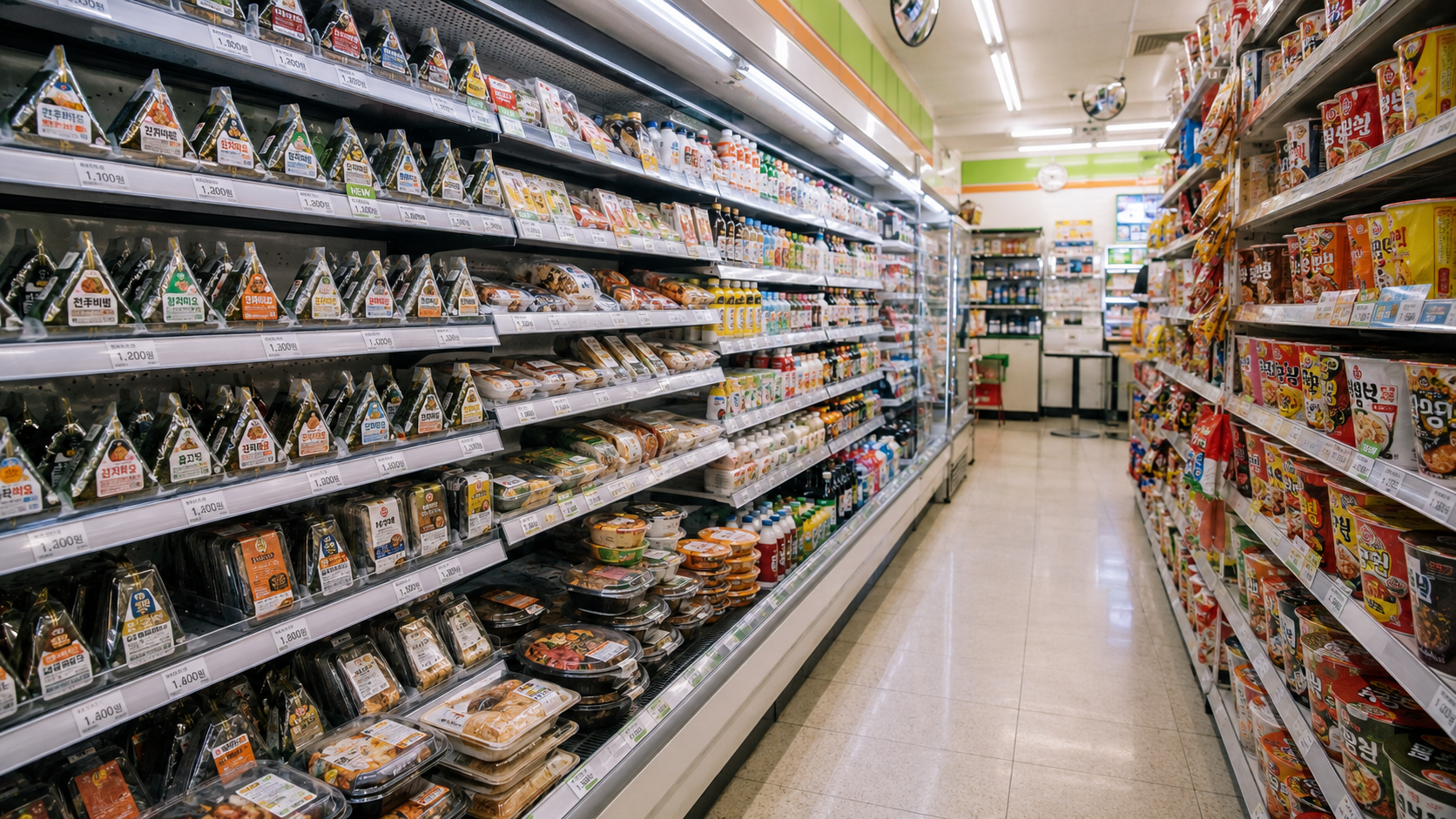
The refrigerated section commonly includes:
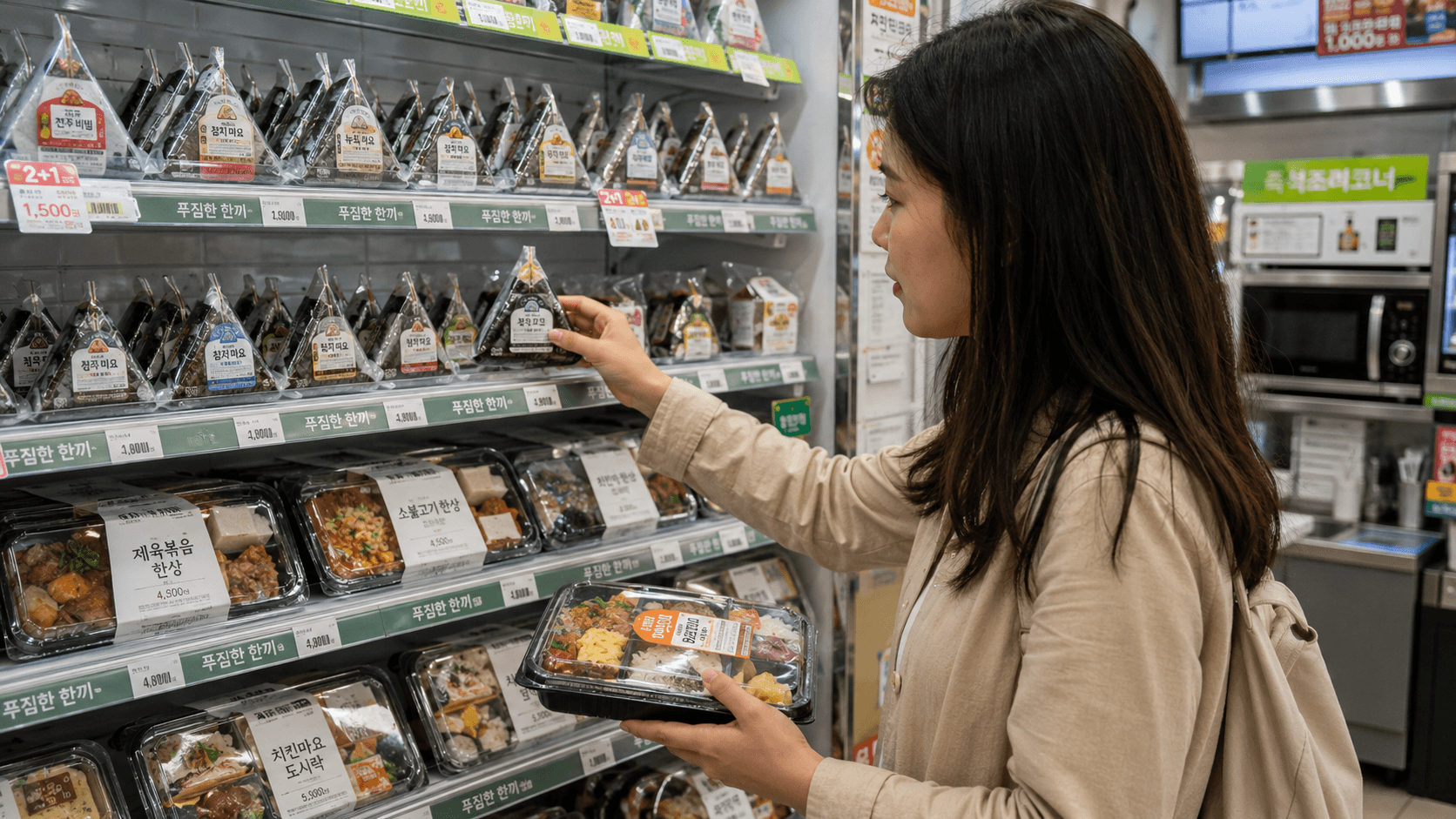
- Samgak gimbap (삼각김밥): Triangular rice parcels wrapped in seaweed
- Gimbap (김밥): Sliced or whole seaweed rice rolls
- Dosirak (도시락): Packaged lunch boxes with rice and side dishes
- Sandwiches, burgers, salads, pasta, and wraps
- Packaged eggs, fruit, yogurt, and protein drinks
Check whether a lunch box has a removable sauce packet, plastic lid, or sealed side dish before microwaving it. Heating instructions are normally printed in Korean on the packaging, often beside a microwave symbol and a time such as 1000W 1분 30초.
Fresh-food stock is usually better earlier in the day. Late at night, popular lunch boxes and gimbap may be sold out. Refrigerated rice products also have short sell-by periods, so check the printed date and time.
Cup noodles and hot snacks
Most stores sell cup noodles and provide hot-water dispensers. A typical setup is:
- Pay for the noodles first.
- Remove the lid partially and take out any seasoning packets.
- Add the packets as directed.
- Fill to the line inside the cup using the hot-water machine.
- Close the lid and wait for the printed cooking time.
Some branches also sell fried chicken, fish cakes, steamed buns, sausages, or other hot foods from a counter. Selection and service hours vary, especially overnight.
Drinks and coffee
Expect bottled water, soft drinks, juice, milk, energy drinks, canned coffee, beer, soju, and other alcoholic drinks. Many branches also sell machine coffee or cups of ice packaged for use with a separate pouch or bottle of coffee.
For an iced pouch drink, take both the ice cup and the drink pouch to the register. They are separate products and may be priced separately or sold as a promotional set.
Toiletries and emergency supplies
Convenience stores can help with small, urgent purchases such as:
- Toothbrushes, toothpaste, shampoo, and razors
- Menstrual products and tissues
- Umbrellas, masks, socks, and basic stationery
- Charging cables, batteries, and earphones
- Condoms and basic first-aid products
Selection is limited compared with a supermarket, pharmacy, or Daiso, and convenience-store pack sizes may cost more per unit.
Understanding prices and promotions
Prices are printed on shelf labels or product stickers. As a June 10, 2026 snapshot, CU's official website listed a cup noodle product at KRW 1,800, canned soda at KRW 1,700, and several 500-milliliter drinks at KRW 2,200–2,500. These are examples, not fixed market-wide prices; see the current CU product listings before relying on them.
What 1+1 and 2+1 mean
Promotions are one of the easiest ways to reduce the cost:
- 1+1: Buy one eligible item and receive a second one without an additional product charge.
- 2+1: Buy two eligible items and receive a third one without an additional product charge.
- 증정: A free gift or bonus product is included.
- 할인: The product is discounted.
The official 7-Eleven promotion guide confirms these common promotion types, while each chain publishes its own monthly offers.
Take the full promotional quantity to the register. Do not assume that the cashier will automatically add the free item. The offer may apply only to the exact flavor, size, or product group shown on the shelf label.
Chain apps may provide additional coupons or allow registered users to store a promotional item for later collection. However, account registration, identity verification, payment compatibility, and language support can make these features inconvenient for short-term visitors. Treat the shelf promotion as the simplest option.
How to pay
Cards and mobile payments
Domestic credit and debit cards are standard. International Visa or Mastercard cards often work at staffed registers, but acceptance cannot be guaranteed for every card, terminal, or self-checkout. A transaction may fail because of the card issuer's security controls rather than the store itself.
Practical payment routine:
- Present your items or scan them at the self-checkout.
- Say
카드요(kadeu-yo, “By card”) if needed. - Insert or tap the card when prompted.
- Keep some Korean won available in case the foreign card is declined.
Apple Pay and other overseas mobile wallets should not be treated as universally accepted. Look for the relevant payment logo at the terminal.
Cash
Cash remains accepted at staffed registers. Large notes can be inconvenient for a very small purchase, particularly early in a shift when the register has limited change.
Tmoney payments
Tmoney is primarily a prepaid transport card, but the official Tmoney retail-use list includes CU, GS25, 7-Eleven, and Emart24 among participating convenience-store brands. Individual-partner limitations may apply.
To pay from the card's stored balance, place it on the reader when the cashier requests payment. This is separate from reloading the transport balance.
Buying and reloading a Tmoney card
According to the official English Tmoney user guide, Tmoney cards are sold or reloaded at participating convenience stores, including CU, GS25, 7-Eleven, and Emart24.
To reload at a register:
- Hand the card to the cashier.
- State or show the amount you want to add.
- Pay the reload amount in cash in Korean won.
- Check the balance shown on the terminal or receipt.
Useful Korean:
티머니 충전해 주세요.(T-money chungjeonhae juseyo.) — Please reload my Tmoney card.만 원이요.(Man won-iyo.) — KRW 10,000, please.
As verified on June 10, 2026, Tmoney states that reloads can be made in KRW 1,000 units, from KRW 1,000 to KRW 90,000 per transaction, and that the card balance cannot exceed KRW 500,000. Visitors rarely need a large balance; adding KRW 10,000–30,000 at a time is a practical suggestion, not an official requirement.
Heating food and eating in the store
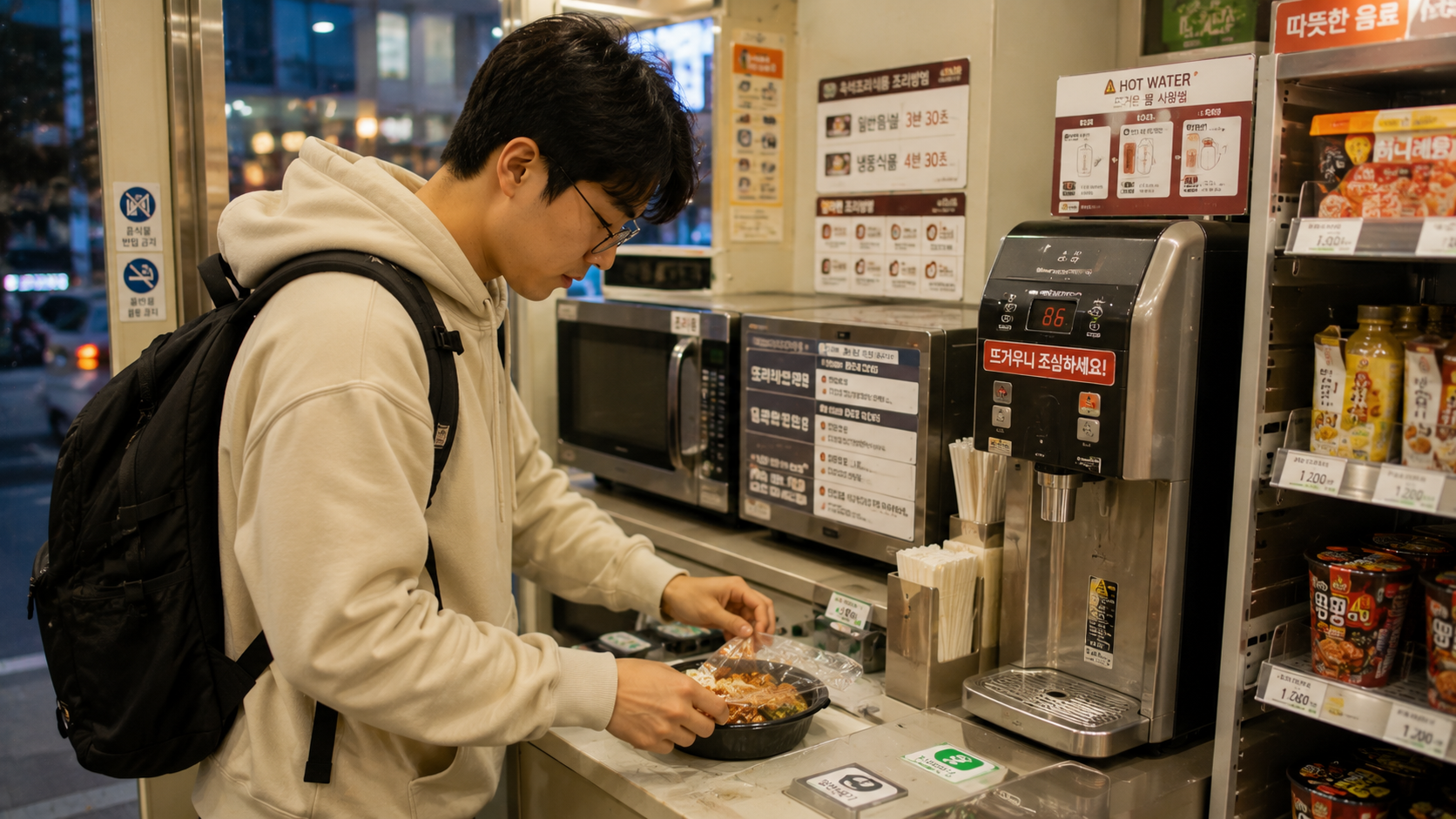
Pay before using the microwave, hot-water dispenser, or seating area. Stores normally place chopsticks, disposable spoons, napkins, and waste bins near the preparation counter, but layouts differ.
Microwave checklist
- Look for the microwave-safe symbol and heating time.
- Remove metal, foil, oxygen absorbers, and sauce packets unless the package says otherwise.
- Loosen or remove the lid as instructed.
- Use the time specified for the microwave's wattage.
- Ask staff if the instructions are unclear.
A simple request is 데워 주세요 (dewo juseyo, “Please heat it”). Staff may heat the item or point you toward the customer microwave.
Use store bins only for reasonable waste from products bought and consumed there. Separate liquids, general waste, cans, and bottles when labeled bins are provided.
ATMs, parcels, and other branch services
Convenience stores may provide ATMs, domestic parcel kiosks, bill payment, gift-card sales, delivery pickup, charging facilities, or copy and printing machines. These are not universal services.
For example, 7-Eleven's official service page lists ATMs, parcel delivery, public-bill collection, and gift certificates among its service categories. CU's store finder similarly lets users search by store type and available service.
Using an ATM
Before inserting a foreign card, check for an international network logo such as Visa, Plus, Mastercard, or Cirrus. The ATM operator and your bank may both charge fees, and the exchange rate may include additional costs. Cancel the transaction if the full fee is not displayed clearly enough for you to accept it.
Sending a parcel
Domestic convenience-store parcel systems usually require an address, recipient's Korean phone number, package measurements, and kiosk registration. English support varies. International shipping is less widely available and has separate documentation and prohibited-item rules.
For an important or time-sensitive shipment, verify the process directly with the chain or carrier rather than assuming any branch can accept it.
Alcohol, identification, and age checks
Convenience stores sell alcohol, but staff may request identification and must refuse prohibited sales. A passport or Korean residence card is more dependable than a photograph of an ID. Do not pressure staff to accept an unfamiliar document or an image on your phone.
Alcohol sale restrictions are a legal matter, and their application can depend on the buyer's birth year and current Korean rules. Anyone uncertain about eligibility should consult the relevant Korean authority rather than relying on informal age calculations.
Food allergies and dietary restrictions
Packaged foods generally have Korean ingredient and allergen labels. Front-of-package English words such as “chicken” or “vegetable” do not provide a complete ingredient list.
For a serious allergy:
- Use a translation tool to read the complete ingredient and allergen panel.
- Check sauces, seasoning packets, and garnishes separately.
- Do not assume vegetarian-looking gimbap is free of fish, meat stock, egg, or shellfish.
- Avoid the product if the label cannot be understood reliably.
Convenience-store staff may not have detailed ingredient or cross-contamination information. Their inability to confirm an ingredient should not be interpreted as confirmation that it is absent.
Useful Korean phrases
| Korean | Pronunciation | Meaning |
|---|---|---|
| 이거 주세요 | Igeo juseyo | This one, please. |
| 봉투 주세요 | Bongtu juseyo | A bag, please. |
| 봉투 필요 없어요 | Bongtu piryo eopseoyo | I don't need a bag. |
| 데워 주세요 | Dewo juseyo | Please heat it. |
| 젓가락 주세요 | Jeotgarak juseyo | Chopsticks, please. |
| 숟가락 주세요 | Sutgarak juseyo | A spoon, please. |
| 카드 돼요? | Kadeu dwaeyo? | Can I pay by card? |
| 현금으로 할게요 | Hyeongeumeuro halgeyo | I'll pay in cash. |
| 티머니 충전해 주세요 | T-money chungjeonhae juseyo | Please reload my Tmoney card. |
| 화장실 있어요? | Hwajangsil isseoyo? | Is there a restroom? |
Common mistakes to avoid
- Assuming every convenience store is open 24 hours
- Taking only one item in a 1+1 promotion
- Trying to reload Tmoney with a credit card
- Heating food before paying
- Microwaving foil, sealed lids, or sauce packets
- Expecting every branch to have seating, a restroom, an ATM, or parcel service
- Treating promotional shelf labels as permanent prices
- Relying on a foreign mobile wallet without a backup card or cash
- Leaving outside household or hotel waste in store bins
What to check before you go
For an ordinary snack stop, no preparation is needed. For a specific task, check the following:
- Late-night visit: Confirm the branch's current hours in Naver Map, Kakao Map, or the chain's official store finder.
- Tmoney reload: Bring cash in KRW.
- ATM withdrawal: Check international network logos and displayed fees.
- Parcel shipment: Confirm the branch has the correct kiosk and bring the recipient's Korean contact details.
- Meal stop: Look for seating before buying food you intend to eat immediately.
- Dietary restriction: Have a translation app ready and inspect the full label.
- Alcohol purchase: Carry an accepted physical photo ID.
- Promotion: Read the exact product, quantity, and date printed on the shelf tag.
Your most useful next step is to save the Korean phrases for heating food and reloading Tmoney. They cover two situations in which the cashier needs a clear instruction rather than a simple payment gesture.