Korean cosmetics are easy to find throughout South Korea, but the widest selection does not always mean the best purchase. Start at a multi-brand beauty store to compare products, then visit brand shops, department stores, or duty-free stores only when they offer a clear advantage. Check the final price, product size, shade, ingredients, use-by date, and tax-refund conditions before paying.
Tax-refund rules and thresholds in this guide were verified on June 11, 2026. Product prices, promotions, branch hours, and inventory change frequently and should be checked directly with the retailer.
At a glance
| Question | Practical answer |
|---|---|
| Where should a first-time shopper start? | A multi-brand health-and-beauty store, where products can be compared by category |
| Are cosmetics cheaper in Korea? | Sometimes, particularly during promotions or in value sets, but not every Korean product costs less than it does overseas |
| Can tourists receive a tax refund? | Yes, at participating stores if eligibility and purchase requirements are met |
| Do you need a passport? | Carry it when requesting an immediate tax refund or tax-refund receipt |
| Can you open tax-refund products? | Keep them new, unopened, and unused until departure if customs confirmation may be required |
| Should you buy sunscreen for use overseas? | Check whether the exact product complies with the rules and labeling requirements in your destination country |
Where to shop for Korean cosmetics
Multi-brand health-and-beauty stores
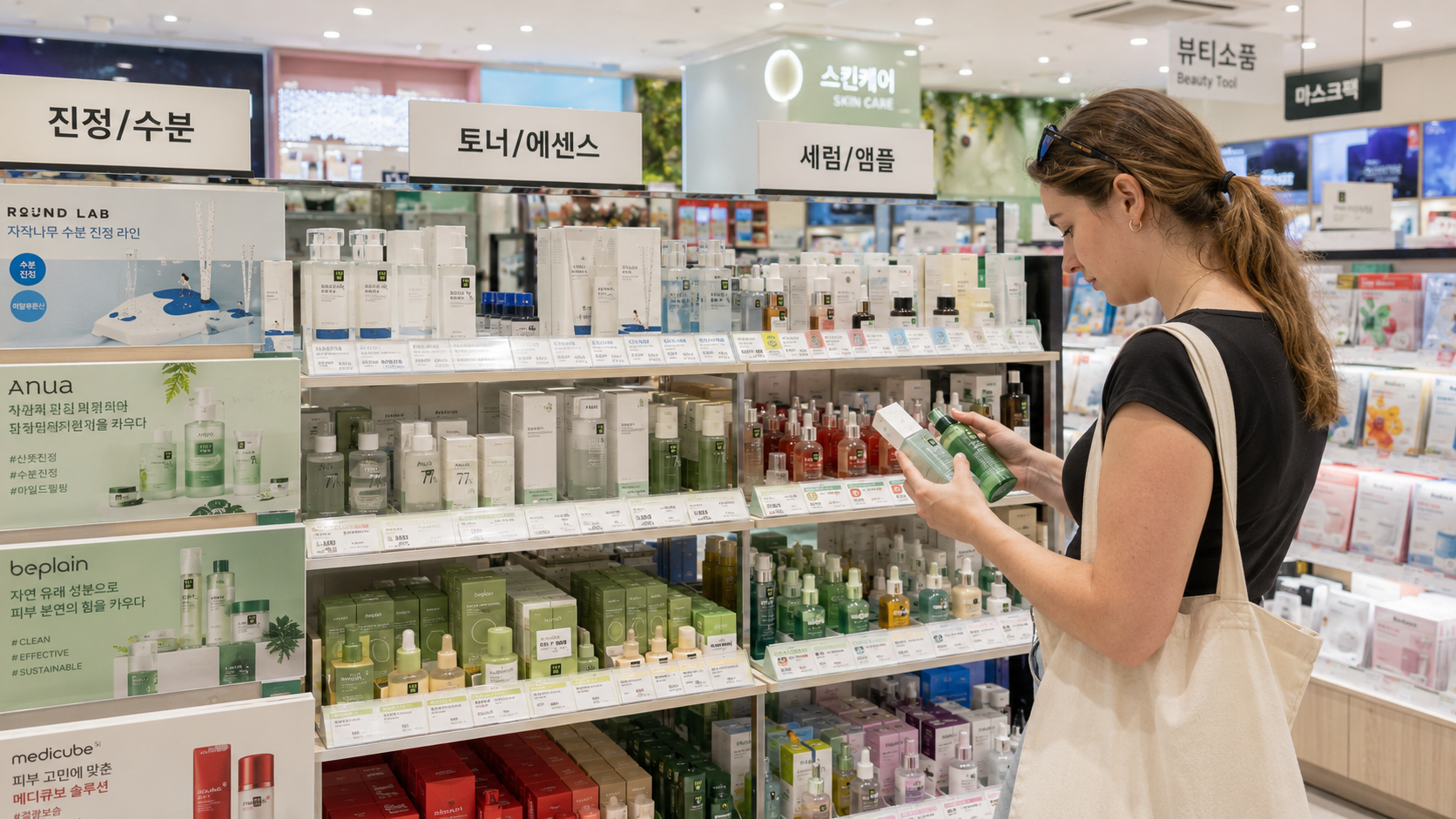
A multi-brand store is the most efficient starting point for newcomers. Olive Young is the most visible example, with skincare, makeup, hair products, beauty tools, and personal-care goods organized into categories. Branch size and stock vary, so a product available at a large tourist-area branch may be absent from a smaller neighborhood location.
These stores are useful for:
- Comparing similar cleansers, sunscreens, cushions, and lip products
- Finding several brands in one transaction
- Looking at current in-store rankings and promotional sets
- Buying practical travel items such as pimple patches, masks, and miniature products
Treat bestseller labels as sales information, not personalized skincare advice. A highly ranked product may still contain fragrance, exfoliating acids, retinoids, or other ingredients unsuitable for your skin.
Large branches in Myeongdong, Hongdae, Gangnam, and Seongsu generally attract international shoppers, while neighborhood branches may be quieter. This is a practical pattern rather than a guarantee of stock, service, or opening hours.
Brand-operated stores
A brand shop can be worthwhile when you already know what you want. It may carry a fuller shade range, brand-specific gift sets, or products missing from multi-brand retailers. However, Korea's retail market changes quickly, and a brand seen online may have few or no standalone branches.
Use the brand's official Korean website or social-media account to confirm that a location still operates. Map listings and old travel articles can remain online after a branch closes or relocates.
Department stores
Department stores are most useful for premium Korean cosmetics, luxury international brands, formal service, and staffed counters. They are also a reasonable choice when you want a receipt from an established retailer or need help matching a foundation shade.
Prices may be higher than at mass-market beauty stores, so compare the actual product volume and included gifts. A large gift set is not automatically good value if it contains products you will not use. Branch details can be checked through official operators such as Lotte Department Store rather than relying solely on third-party map entries.
Duty-free stores
Downtown and airport duty-free stores sell goods without certain Korean taxes included in the retail price. They are different from ordinary tax-refund stores, where you initially pay a tax-inclusive price and then claim a refund.
Duty-free shopping can make sense for premium sets or advance orders, but compare:
- The final KRW price after discounts
- Product size and number of units
- Collection location and deadline
- Airline baggage and liquid restrictions
- Customs allowances in your destination country
Do not assume the airport price is automatically the lowest. Downtown promotions or ordinary retail tax refunds may produce a better final price.
Pharmacies, supermarkets, and convenience stores
Pharmacies may carry dermatological skincare, dressings, and personal-care products, but a cosmetic product sold in a pharmacy is not necessarily a medicine. Ask a pharmacist if you need guidance about a medicinal product, and consult a qualified healthcare professional for persistent or serious skin problems.
Supermarkets and convenience stores can be useful for inexpensive masks, basic toiletries, and travel sizes. Selection is limited, and not every location participates in tourist tax refunds.
How to choose products without overbuying
1. Make a category list
Write down categories rather than viral product names: for example, gentle cleanser, fragrance-free moisturizer, brown eyeliner, or lightweight sunscreen. This makes it easier to compare alternatives when a specific product is sold out.
A short list also prevents duplication. Toner, essence, ampoule, and serum can overlap in purpose; you do not necessarily need one of each.
2. Compare unit size and set contents
Korean promotions commonly include twin packs, refills, miniatures, or attached bonus products. Compare the amount you are actually receiving rather than the apparent size of the box.
Check whether a promotional package contains:
- Two full-sized products
- One full-sized product plus a refill
- A full-sized product plus samples
- An older and newer version of the formula
- Shades or variants you did not intend to buy
The shelf label should show the final KRW selling price. Ask staff to confirm it if several promotional signs overlap.
3. Test color products carefully
Cushion foundation and base makeup often come in fewer shades than international shoppers expect. Shade numbers are not standardized across brands, and the same number can look different after drying.
Use a hygienic tester where available, apply a small amount near the jaw rather than only on the hand, and wait several minutes to check oxidation. Do not apply shared lip or eye testers directly to your face.
For refills, confirm compatibility with the exact compact model. A refill from the same brand may not fit every case.
4. Read the label
Useful Korean terms include:
| Korean | Meaning |
|---|---|
| 사용기한 | Use-by date |
| 제조번호 | Batch or lot number |
| 제조업자 | Manufacturer |
| 책임판매업자 | Responsible distributor or seller |
| 전성분 | Full ingredient list |
| 용량 | Volume or quantity |
| 본품 | Full-sized product |
| 리필 | Refill |
| 증정 | Complimentary item |
| 테스터 | Tester |
| 품절 | Sold out |
A date beside 사용기한 is the date by which the unopened product should be used under the stated storage conditions. Do not confuse it with a manufacturing date. If the label is unclear, ask staff before purchasing.
The Ministry of Food and Drug Safety is South Korea's official authority for cosmetics regulation and safety information. Packaging or advertising that promises to diagnose, treat, or cure a medical condition should be approached cautiously.
5. Check the exact formula
Products with similar English names may have different versions for Korea and overseas markets. Packaging, UV filters, color names, or ingredients can vary by country and reformulation date.
Photograph the front, back, ingredient list, and barcode of the exact item you intend to repurchase. This is more reliable than recording only the brand and product line.
Sensitive skin and ingredient precautions
Shopping staff can explain texture, finish, and product positioning, but they cannot diagnose skin conditions. For sensitive or allergy-prone skin:
- Read the complete ingredient list rather than relying on terms such as clean, mild, or natural
- Introduce one unfamiliar product at a time
- Patch-test according to professional medical guidance appropriate to your condition
- Avoid buying a large supply before knowing how your skin responds
- Stop using a product if it causes a concerning reaction and seek appropriate medical advice
Cosmetic claims and ingredient rules differ between countries. This is particularly relevant to sunscreens, products making functional claims, and devices. Before importing or reselling cosmetics, consult the customs and health authorities in the destination country. Personal luggage and commercial imports can be treated differently.
Tourist tax refunds
South Korea distinguishes duty-free shopping from tax-refund shopping. At a tax-refund store, the displayed price normally includes tax; eligible visitors may receive some tax back through an immediate refund or a later refund process.
According to the Korea Tourism Organization's tax-refund guide, as verified on June 11, 2026:
- The qualifying purchase is at least KRW 15,000
- Goods must be new, unopened, and unused
- Goods must leave Korea within three months of purchase
- Eligible non-Korean citizens must have stayed in Korea for less than six months
- An immediate refund transaction must be at least KRW 15,000 and less than KRW 1,000,000
- Immediate-refund purchases are limited to KRW 5,000,000 during the trip
Only participating retailers can issue the necessary refund documentation. Look for a tax-refund sign and ask before paying.
How to request the refund
- Present your passport at checkout.
- Ask whether the refund will be applied immediately or processed later.
- Keep the receipt and any separate refund document.
- Keep the purchased goods available and unopened in case customs asks to inspect them.
- At departure, complete customs validation and the refund procedure before checking the relevant baggage if inspection is required.
The Korea Customs Service states that customs may require the passport, sales certificate, and unopened purchased goods. Procedures vary by airport, refund operator, and transaction, so allow additional departure time.
A refund is not necessarily equal to the full tax shown in a simple calculation because processing arrangements may affect the final amount. Confirm the estimated refund before deciding that one shop is cheaper than another.
Payment and receipts
Major cosmetics retailers generally accept cards, but foreign cards can occasionally fail because of issuer controls or terminal compatibility. Carry a second payment method and a modest amount of KRW cash.
When the terminal offers dynamic currency conversion, compare carefully before selecting your home currency. Paying in KRW lets your card issuer perform the conversion, although the best option depends on your card's fees and exchange rate.
Keep receipts until you have checked every item. Before leaving the counter, confirm:
- The correct shade and product version
- The quantity charged
- Whether advertised gifts were included
- Whether the tax refund was processed
- Whether sealed items remain sealed
Return and exchange policies vary by retailer. Opened cosmetics are commonly difficult to return for hygiene reasons, so ask about the store's policy before paying if you are uncertain.
Packing cosmetics for your flight
Creams, gels, oils, balms, mists, liquid foundation, and many masks can be treated as liquids or gels during aviation security screening. Restrictions depend on the departure airport, transfer airport, airline, and destination.
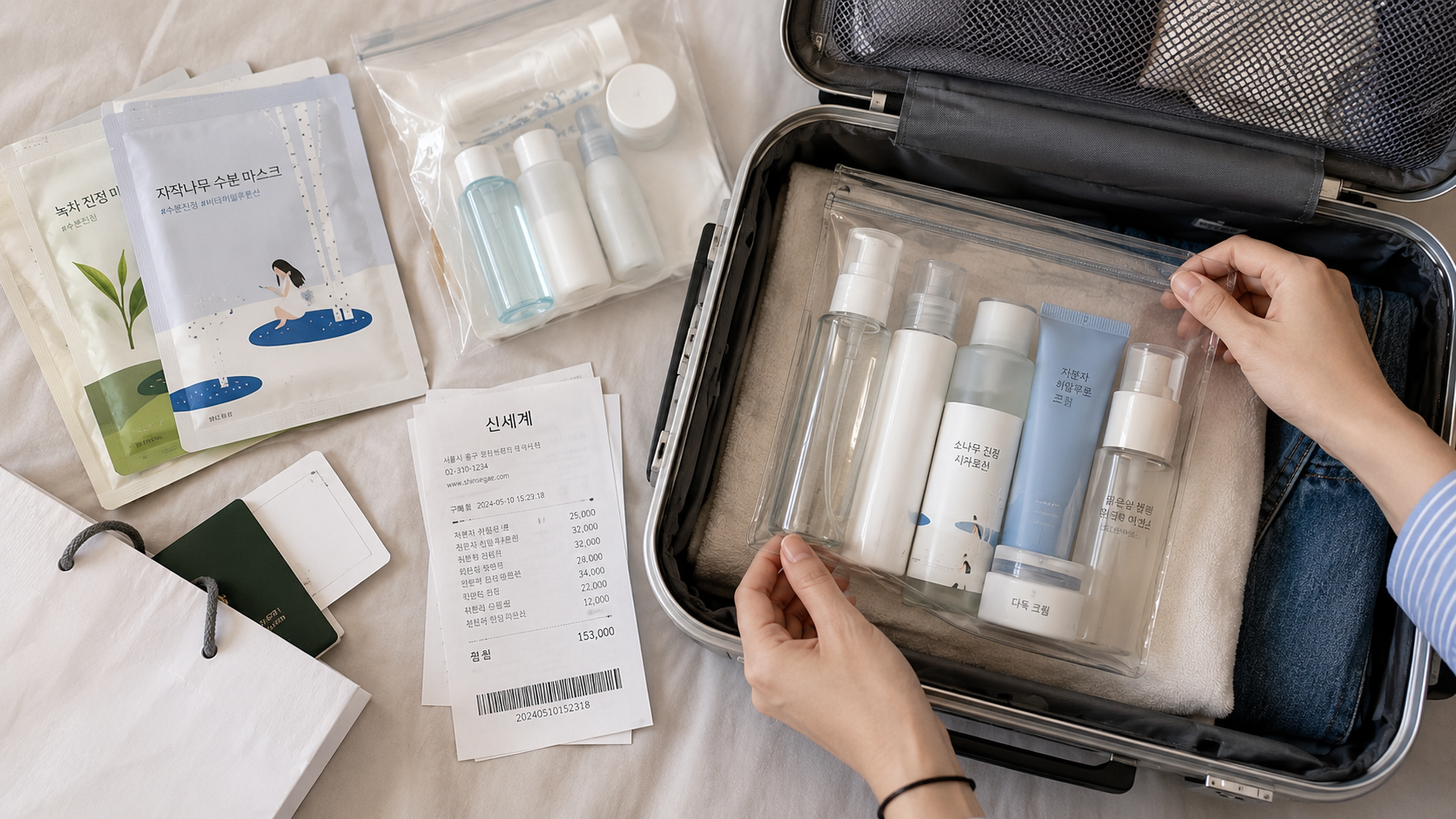
As a practical rule, place full-sized liquid cosmetics in checked baggage unless your airline and airports confirm that they are permitted in the cabin. Protect pumps with clips or tape, tighten caps, place liquids in sealable bags, and cushion glass containers.
Duty-free liquids may be sealed in a security bag, but opening the bag or transferring at another airport can affect whether they remain permitted. Confirm the full itinerary's rules before buying large liquids after security.
Do not pack every receipt inside checked baggage if you still need it for customs validation. Keep passports, refund documents, and purchase records together in your hand luggage.
Common mistakes to avoid
Buying only from social-media lists
Online trends move faster than product reformulations and store inventory. Use recommendations as a starting point, then check the exact formula, size, finish, and suitability for your needs.
Assuming every promotion is cheaper
A twin pack costs more upfront and may expire before you can use it. Calculate the price per item or per milliliter and consider how quickly you finish that category.
Opening tax-refund goods too early
Tax-refund goods may need to be presented unused and unopened. Keep them sealed until departure unless the refund documentation clearly indicates otherwise.
Leaving all shopping until the airport
Airport selection can be narrower, and your preferred shade or formula may be unavailable. Complete essential purchases in the city and treat airport shopping as a final comparison or collection point.
Buying too many active products
Using several new acids, retinoids, exfoliating pads, or brightening products at once can make it difficult to identify the cause of irritation. A smaller, deliberate selection is more practical than an entirely new routine.
What to check before you go
- Make a short list organized by product category
- Photograph products you already use, including ingredient labels
- Check allergies and ingredients you avoid
- Confirm your destination country's cosmetics and customs rules
- Leave luggage space and review your airline's weight allowance
- Carry your passport for tax-refund shopping
- Check current branch hours through the retailer's official channels
- Keep full-sized liquids and fragile containers in mind when packing
- Allow extra airport time if you need customs validation
Your most useful next step is to choose one large multi-brand store near your accommodation, compare products there, and postpone duplicate or expensive purchases until you have checked at least one alternative retailer.