South Korea does not require visitors to memorize a complicated rulebook. In most everyday situations, being observant, patient and considerate matters more than performing every custom perfectly. A small bow, polite language and careful treatment of shared spaces will take you a long way.
Etiquette also depends on context. Expectations at a family gathering, workplace dinner or Buddhist temple may be more formal than those in a café or among university students. Treat the practices below as useful defaults, not as rules followed identically by every Korean person.
At a glance
- Give a small nod or bow when greeting or thanking someone.
- Use two hands when giving or receiving something in a formal interaction.
- Remove your shoes when entering a home and wherever signs or raised flooring indicate.
- Wait briefly for the oldest or most senior person before starting a formal group meal.
- Keep calls and videos quiet on public transport.
- Do not occupy designated priority or pregnancy seats unless you need them.
- Ask before photographing individuals, ceremonies or private businesses.
- Follow posted rules at temples, palaces and memorial sites.
- A sincere apology is usually enough when you make a minor mistake.
Understanding respect and social hierarchy
Age and position can influence Korean speech and social behavior. Korean has several levels of formality, and people commonly use titles or relationship terms instead of first names. This does not mean every interaction is rigid. Friends may be very informal, while customer service staff generally use polite language regardless of age.
Visitors are not expected to understand the entire system. The practical approach is to begin politely and let the other person set the tone. Avoid assuming that someone wants to be addressed casually just because you have met several times.
Questions about age, occupation, education or marital status can appear earlier in a Korean conversation than some visitors expect. Age helps Korean speakers choose suitable language, although curiosity and conversational habits also play a part. You may answer generally or decline without confrontation: “I prefer not to say exactly” is acceptable.
Korean society is diverse and changing. Customs vary by generation, family, region and setting, so avoid treating one person's behavior as evidence of what all Koreans do.
Greetings, names and body language
Bowing and handshakes
A slight bow of the head and shoulders is an appropriate greeting in shops, hotels, restaurants and introductions. Deep ceremonial bows are unnecessary in normal tourist interactions.
Handshakes are also common, particularly in professional settings. In a formal exchange, you can shake with your right hand while lightly supporting your right wrist or forearm with your left. This is a respectful gesture rather than a requirement.
When giving or receiving a business card, gift, passport, payment card or other important object, use both hands when practical. With a heavy suitcase or shopping bag in one hand, nobody reasonably expects perfect form.
Using names
Do not automatically call a new acquaintance by their given name. Listen to how the person introduces themselves and how others address them. In English-speaking situations, using the full name or an offered English name is normally safe.
Common Korean family names include Kim, Lee and Park, but a shared surname does not imply that two people are closely related. Korean names are traditionally written family name first, as in Kim Min-ji, although individuals may reverse the order in international contexts.
Physical contact
Close friends may link arms or show casual physical affection, but touching a stranger is different. Avoid unsolicited hugs, backslapping or touching someone's head. A crowded subway may involve unavoidable contact; keep your belongings close and move without pushing where possible.
Shoes and entering indoor spaces
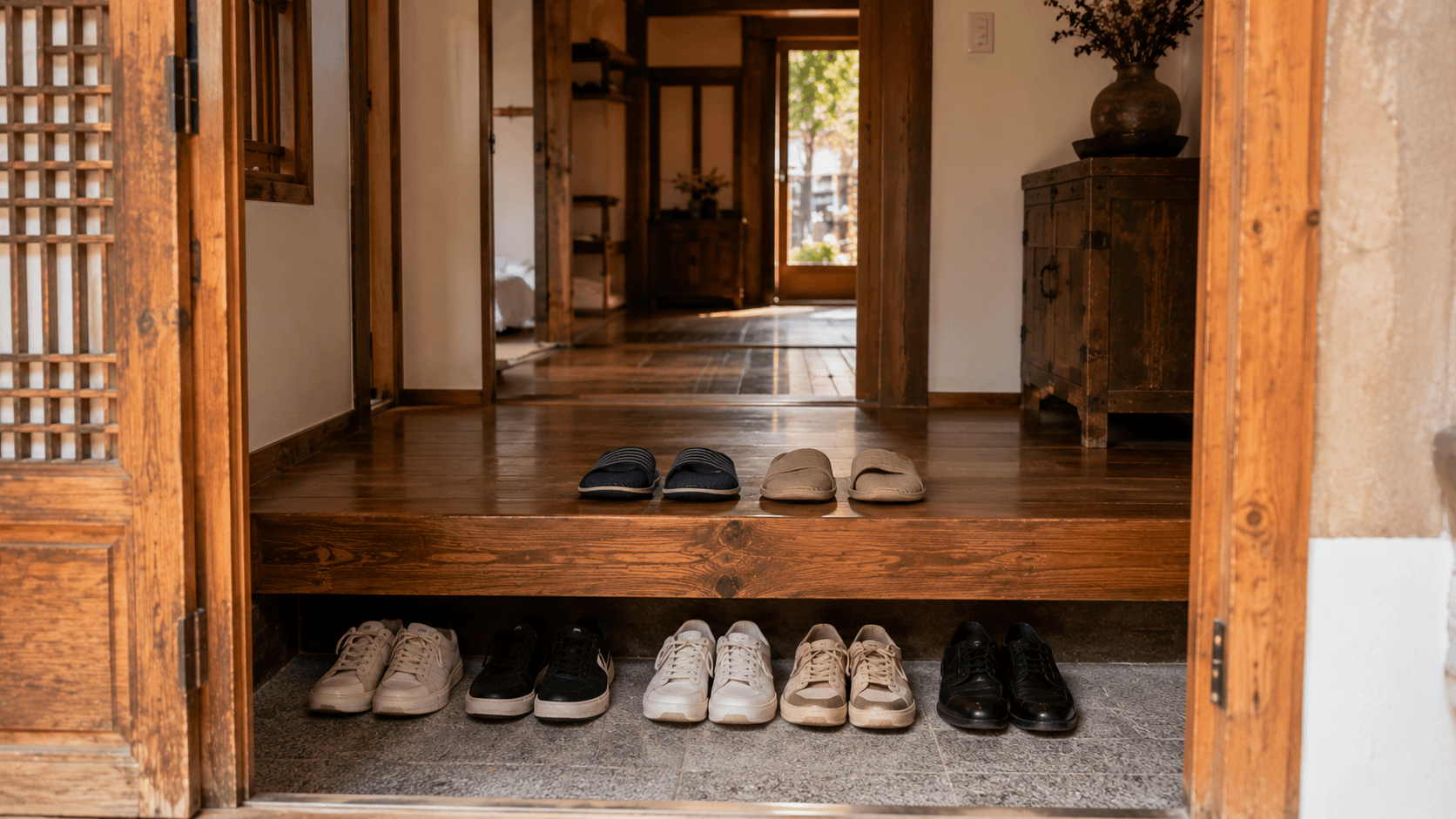
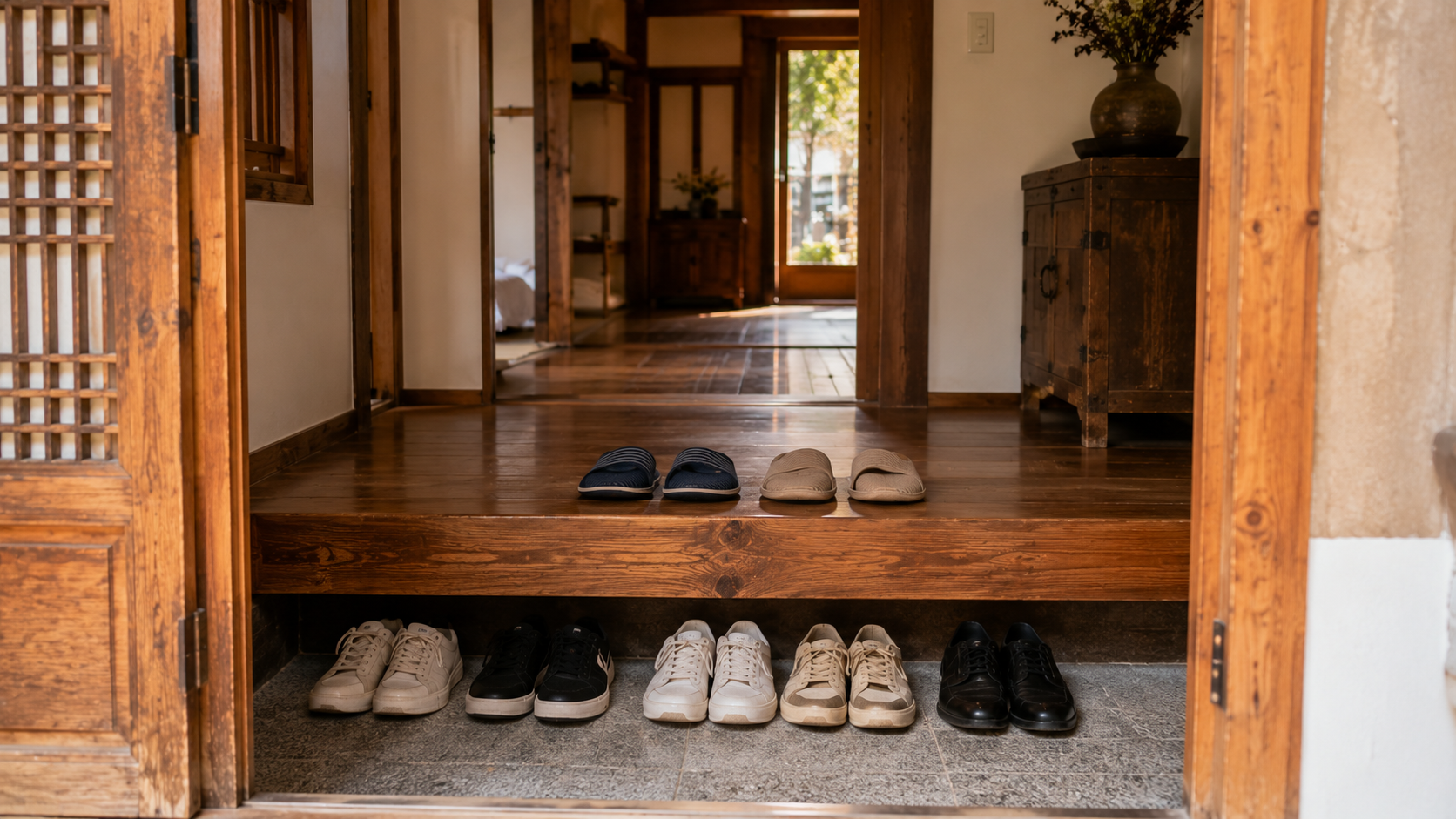
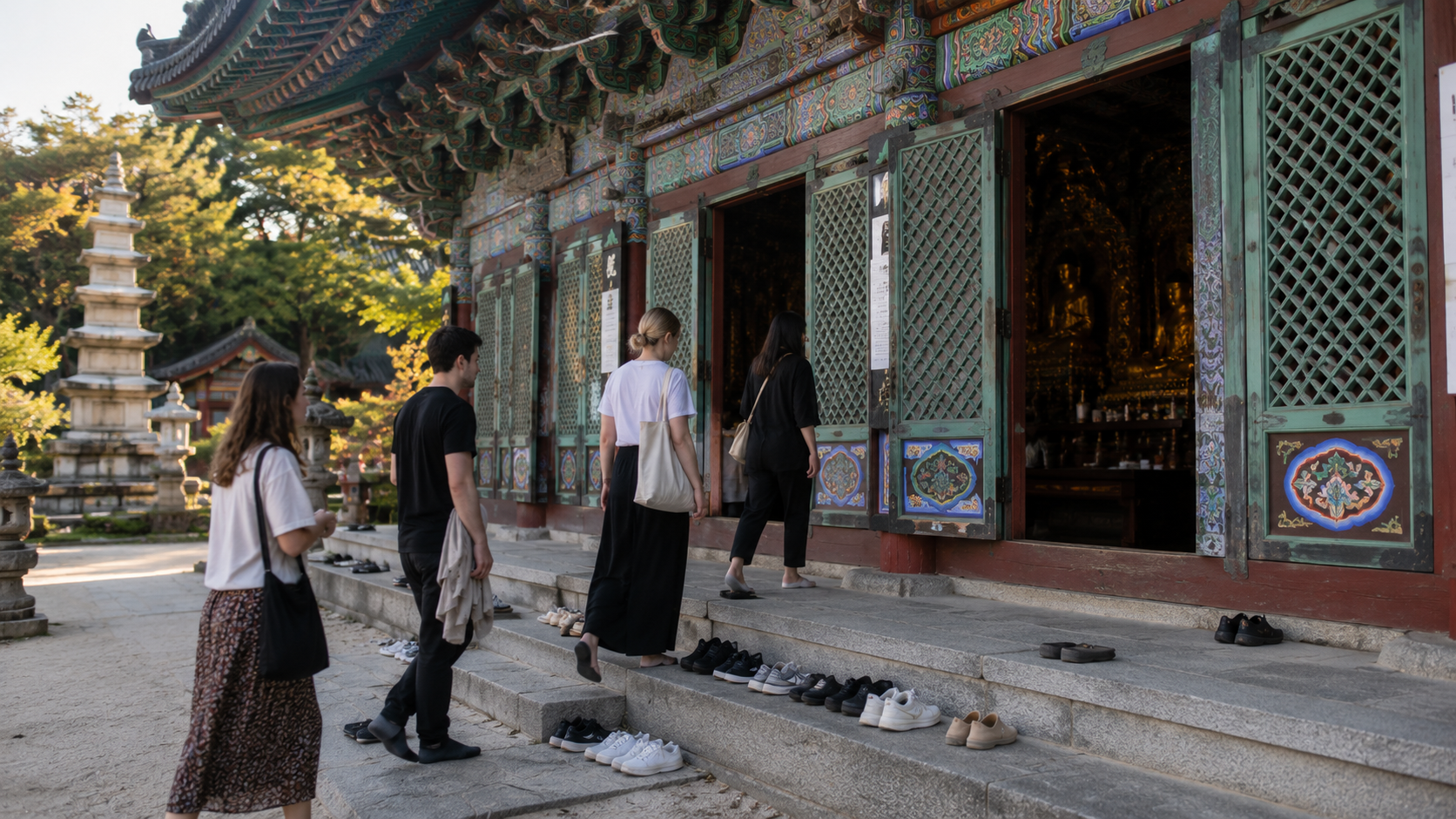
Shoes are normally removed inside Korean homes. You may also need to remove them in some traditional restaurants, guesthouses, temple buildings, clinics, studios and children's facilities.
Look for these signals:
- A step or raised floor immediately inside the entrance
- Rows of shoes, lockers or a shoe cabinet
- Indoor slippers supplied by the establishment
- A sign showing shoes crossed out
Do not step onto the clean raised floor in outdoor shoes, even briefly. Remove your shoes first, place them neatly and use slippers if provided. Bathroom slippers should remain in the bathroom.
Wear clean socks if you expect to visit a home, temple stay or floor-seating restaurant. Travelers who cannot remove footwear for medical or mobility reasons should explain this before entering; staff may offer shoe covers or another arrangement.
Dining without anxiety
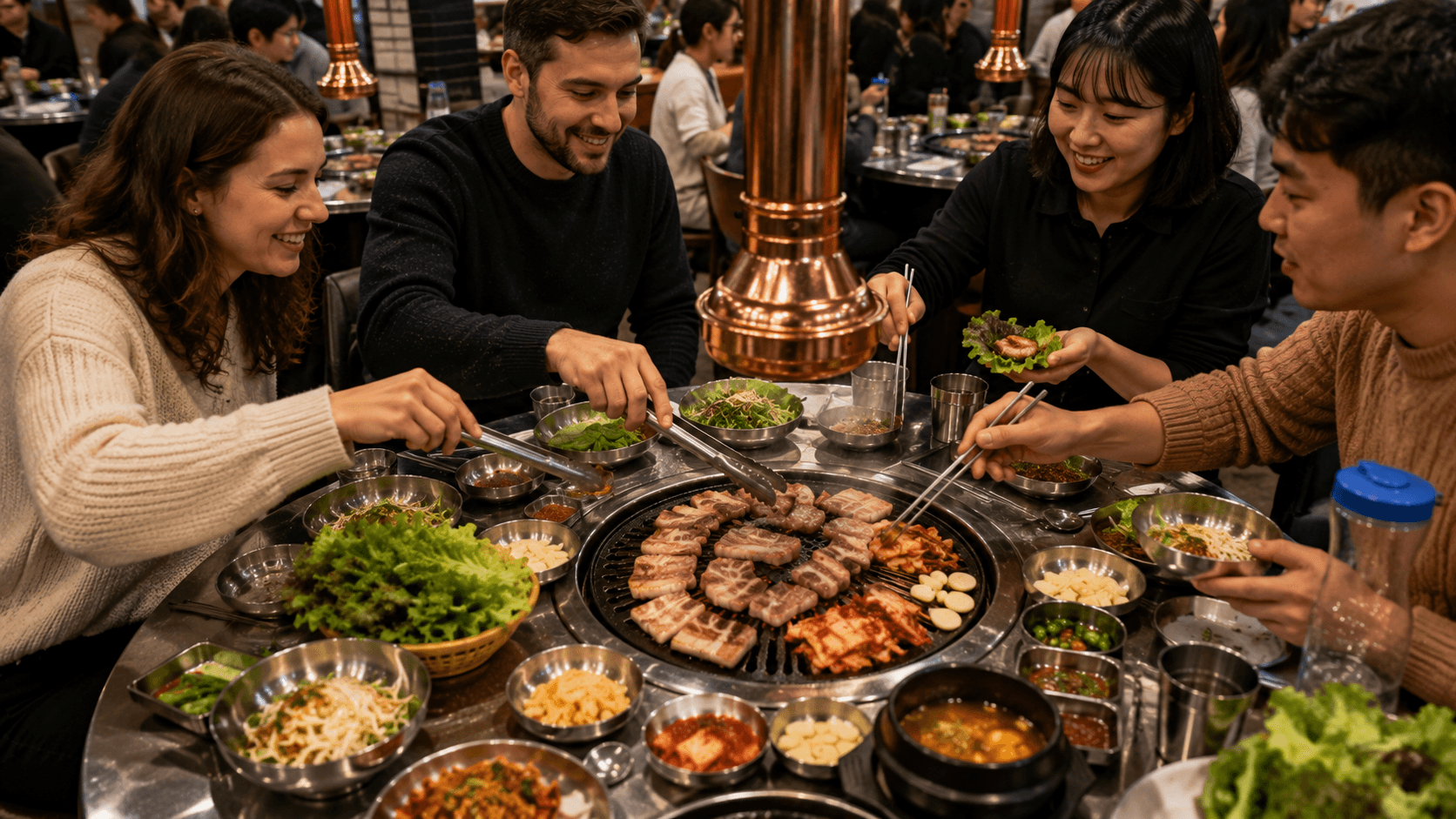
Korean meals often involve shared dishes called banchan (반찬), meaning small side dishes served with the main meal. Restaurants may also place grills, stews or serving plates in the center of the table.
Starting the meal
At a casual restaurant with friends, you can usually begin once everyone's food has arrived. At a formal meal or when dining with an older host, pause and follow their lead. A useful phrase before eating is “jal meokgetseumnida” (잘 먹겠습니다), roughly meaning “I will enjoy the meal.” It is appreciated but not required from visitors.
Rice and soup bowls generally stay on the table rather than being lifted to the mouth. A spoon is commonly used for rice and soup, while chopsticks are used for side dishes and solid food.
Never leave chopsticks standing vertically in a bowl of rice. This resembles a ritual food offering and is visually associated with memorial practices. Rest utensils beside the bowl or on an available holder instead.
Sharing food hygienically
Practices differ between households and restaurants. Shared dishes remain common, but serving tongs, scissors, ladles or extra chopsticks may be provided. Use them when available rather than placing utensils that have been in your mouth into communal food.
At Korean barbecue, one person may manage the grill, but this is not automatically the youngest person's job. Watch what the group is doing, and do not repeatedly turn or cut meat that someone else is already handling.
Banchan refills may be available at some restaurants, but they are not guaranteed for every dish. Ask staff rather than assuming. Take modest portions first to reduce food waste.
Paying and tipping
The person who invited the group may offer to pay, while friends may split the bill or alternate between dinner and coffee. Do not assume that age or gender determines who pays. Offer once and follow the host's response.
Tipping is not a routine expectation in ordinary Korean restaurants, cafés or taxis. Some hotels, tours and internationally oriented businesses may have their own service policies, so check the bill or booking terms. This practice was reviewed on June 11, 2026, but individual businesses can set different policies.
Drinking culture and personal choice
Alcohol may be offered at dinners, celebrations and social gatherings, but you do not have to drink. A clear “I don't drink” is sufficient. You can hold water or a soft drink during a toast.
In a formal group, people may pour drinks for one another. Hold your glass with two hands when an older person or host pours for you, and use two hands when pouring for them. Some younger Koreans turn slightly away from an older person when taking a drink, but visitors are unlikely to cause offense by not doing this.
Do not treat portrayals of heavy drinking in television dramas as a behavioral requirement. Pressuring someone to drink, taking advantage of intoxication or ignoring consent is unacceptable. Plan a safe route home and remain with companions who need assistance.
Public transport and shared spaces
Korean urban transport can be crowded and highly organized. Queue behind platform markings, allow passengers to exit first and move away from train doors after boarding. Keep backpacks and large luggage from blocking aisles or striking seated passengers.
Priority seating is marked for older adults, disabled passengers, pregnant passengers and adults accompanying infants or young children. Pregnancy seats are commonly pink. Leave these places available unless you need them; not every disability or pregnancy is visible.
Keep phone calls short and quiet. Use headphones for music, games and video, and prevent sound from leaking at high volume. Eating a full or strongly scented meal on a city bus or subway is inconsiderate, even where no specific prohibition is posted. Long-distance trains and intercity buses may have different expectations.
Stand clear of escalator entrances and follow local signs rather than relying on a universal rule about which side to occupy. Customs and safety campaigns can differ by operator.
Restaurants, shops and cafés
A loud call of “yeogiyo” (여기요), meaning approximately “over here,” can be used to get restaurant staff's attention. It is normal rather than inherently rude, although pressing a table call button is easier when one is available.
Self-service stations are common. Water, cutlery, side dishes or returned trays may be handled by customers, so check signs and observe nearby tables before waiting for staff.
In shops, place goods and payment items on the counter instead of handing over a pile awkwardly. Some employees may follow customers closely or remain nearby because attentive service is expected; this is not necessarily suspicion.
Cafés are popular places to study and meet, but a purchase does not make a table private indefinitely. Keep calls at a reasonable volume, especially in smaller cafés, and do not spread luggage across neighboring seats when the room is busy.
Visiting homes and accepting invitations
Arrive close to the agreed time and message your host if you will be late. Bring a modest gift when invited for a meal or overnight stay. Fruit, bakery items, tea or something from your home country can work well. Ask about allergies and avoid gifts that create an obligation to reciprocate extravagantly.
Remove your shoes, wait to be shown where to sit and offer to help with simple tasks. A host may initially refuse assistance out of politeness. One sincere offer is useful; repeatedly insisting can create more work.
Korean homes may use floor heating called ondol (온돌). Do not place heat-sensitive belongings directly on a very warm floor, and ask before changing heating controls.
Temples, palaces and heritage sites
Active Buddhist temples are places of worship, not merely photo locations. Dress in a way that permits comfortable, respectful movement, speak quietly near prayer halls and do not walk directly in front of someone who is bowing. Photography rules vary by building and ceremony, so check signs or ask first.
The official Templestay program introduces visitors to Korean Buddhist life through programs that may include meditation, ceremonies, communal work and temple meals. Schedules, prices, language support and participation rules differ by temple and program; verify them directly when booking.
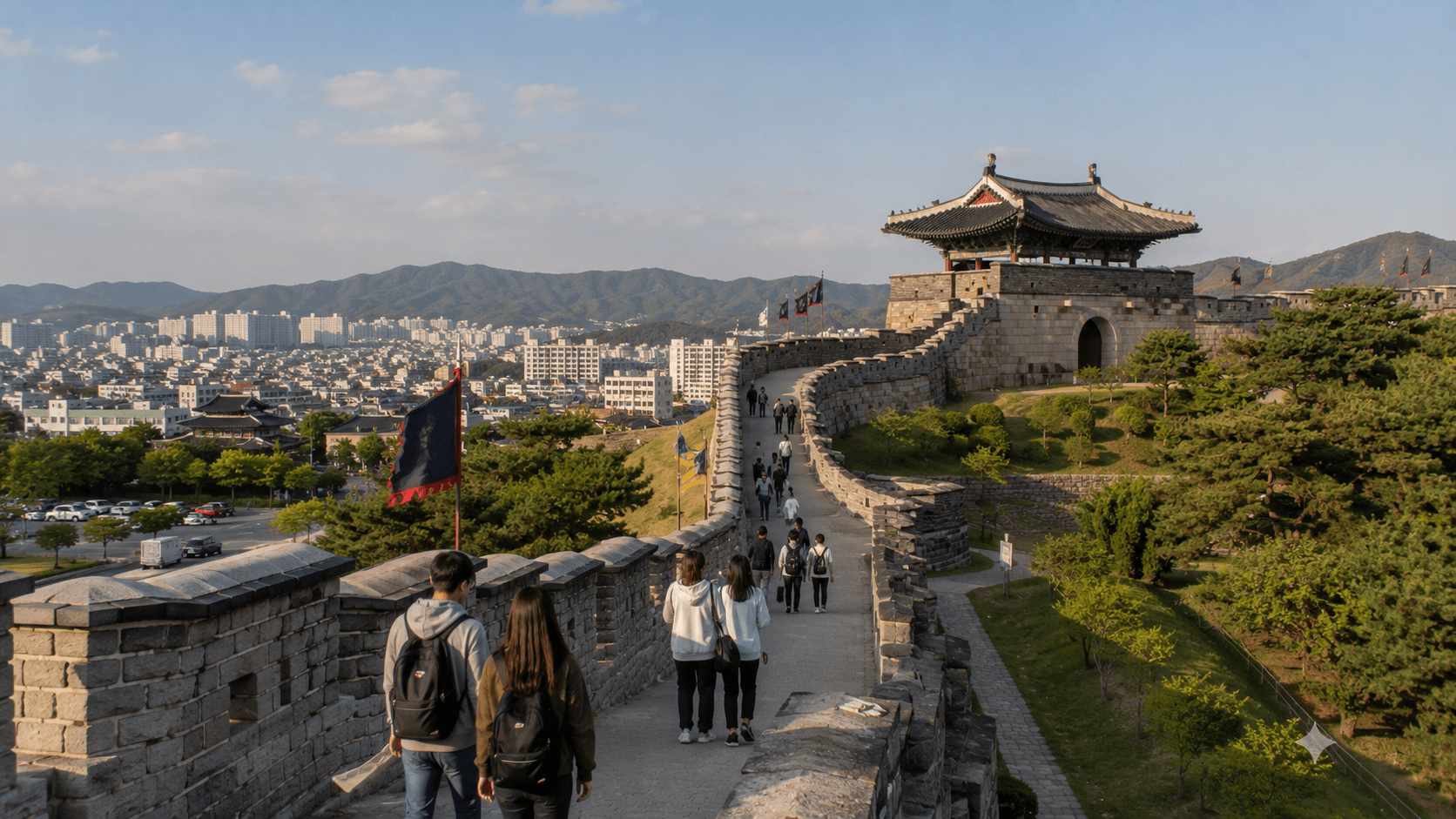
At royal palaces and historic villages, stay behind barriers and do not lean on painted structures, climb walls or handle artifacts. Wearing hanbok (한복), Korean traditional clothing, is welcomed at many tourism sites, but treat ceremonial clothing carefully and avoid costumes that mock historical or religious figures.
Memorials, cemeteries and sites connected to war or political violence deserve a more restrained tone than entertainment attractions. Read the site's guidance before staging photographs or filming commentary.
Photography, filming and privacy
A public location is not the same as permission to photograph every person in it. Ask before taking a close portrait, especially of children, worshippers, market vendors or people at work. Avoid blocking narrow streets or business entrances for a long photo session.
Museums, performances, shops and cafés may prohibit photography or commercial filming. A crossed-out camera symbol can apply to an entire room, not only one object. Flash, tripods, drones and large production equipment often have separate restrictions.
Do not publish an identifiable person in an embarrassing or sensitive situation without permission. When uncertain, frame the scene without faces or wait until the area clears.
Useful polite expressions
| Korean | Approximate pronunciation | Use |
|---|---|---|
| 안녕하세요 | annyeong-haseyo | Hello |
| 감사합니다 | gamsa-hamnida | Thank you |
| 죄송합니다 | joesong-hamnida | I am sorry |
| 실례합니다 | sillye-hamnida | Excuse me |
| 괜찮아요 | gwaenchanayo | It is okay / I am okay |
| 영어 가능하세요? | yeongeo ganeung-haseyo? | Is English possible? |
| 안 마셔요 | an masyeoyo | I do not drink |
Pronunciation does not need to be perfect. Speak calmly and combine the phrase with a nod, map, address or translation screen when necessary.
Common mistakes and how to recover
Most minor errors do not need a long explanation. Stop the action, say “joesong-hamnida,” and follow the person's direction.
Common avoidable mistakes include:
- Walking onto a raised indoor floor without removing shoes
- Blocking subway doors while checking a map
- Speaking loudly on public transport
- Photographing a person or ceremony without permission
- Treating every Korean acquaintance as an authority on national culture
- Assuming older customs are compulsory in every modern setting
- Comparing Korea dismissively with another country
- Expecting service staff to explain complex cultural questions during a busy period
If someone corrects you abruptly, focus first on the practical request. Tone does not always transfer cleanly between languages, and a short Korean instruction may sound sharper in English than intended.
What to check before you go
- Review the current rules on the official website of each palace, museum, temple or performance venue.
- Ask your host whether shoes will be removed and whether seating is on the floor.
- Mention dietary restrictions in advance; removing one visible ingredient may not remove broth, seasoning or cross-contact.
- Confirm whether a cultural program is conducted in English.
- Check photography, tripod and drone restrictions separately.
- Carry socks suitable for shoe-removal settings.
- Save your destination in Hangul for taxi drivers or local assistance.
- Use the VISITKOREA travel information portal to check official visitor guidance. As verified on June 11, 2026, the site also provides access to the 1330 Korea Travel Helpline through online call and chat options; data charges may apply.
A useful next step
Choose one cultural setting you are likely to encounter, such as a shared restaurant meal, a home visit or a Buddhist temple, and review the relevant section before arriving. Once there, follow posted instructions and the behavior of your host or guide rather than trying to perform every custom from memory.