Korean dining etiquette is generally forgiving, especially toward international visitors. The most useful rules are simple: let the oldest or most senior person begin first in a formal group, leave rice and soup bowls on the table, use the spoon for rice and soup, and never leave chopsticks standing upright in rice. Beyond that, observe your companions and follow the restaurant's setup.
Quick answer
| Situation | What to do |
|---|---|
| Eating with older people | Wait briefly for the oldest or most senior person to begin |
| Rice and soup | Keep the bowls on the table and use the spoon |
| Side dishes | Share them without searching through the dish |
| Chopsticks | Use them for solid food; never plant them upright in rice |
| Korean barbecue | Keep raw-meat tools separate and follow the group's lead |
| Receiving or pouring alcohol | Use two hands in formal situations or with older people |
| Declining alcohol | Refuse politely and clearly; you do not need to drink |
| Paying | Check whether payment is at the counter or table |
These are social conventions rather than laws. Expectations are usually more relaxed among friends and in casual restaurants than at a company dinner, formal family meal, or meal with much older people.
Understanding a Korean table setting
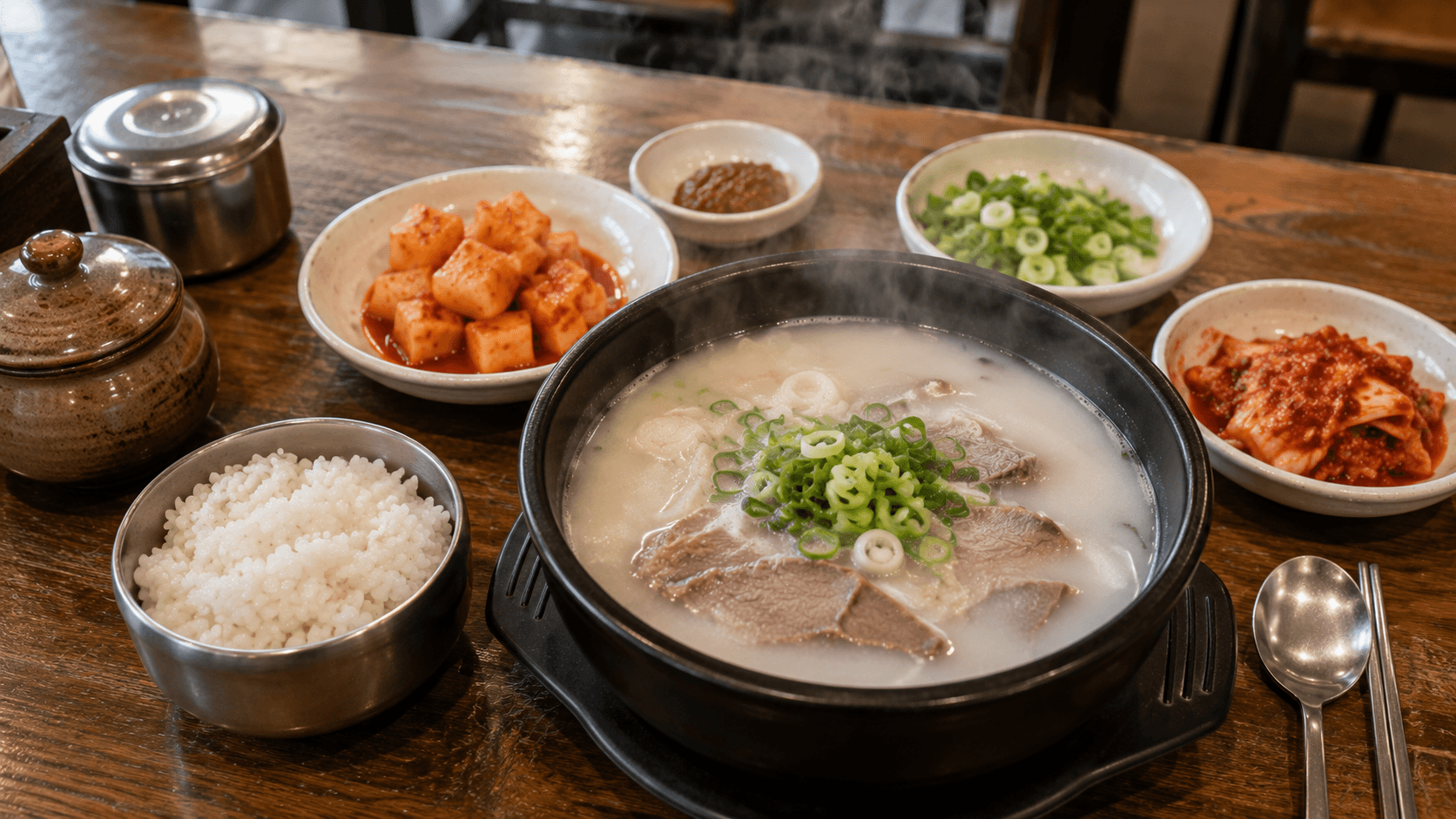
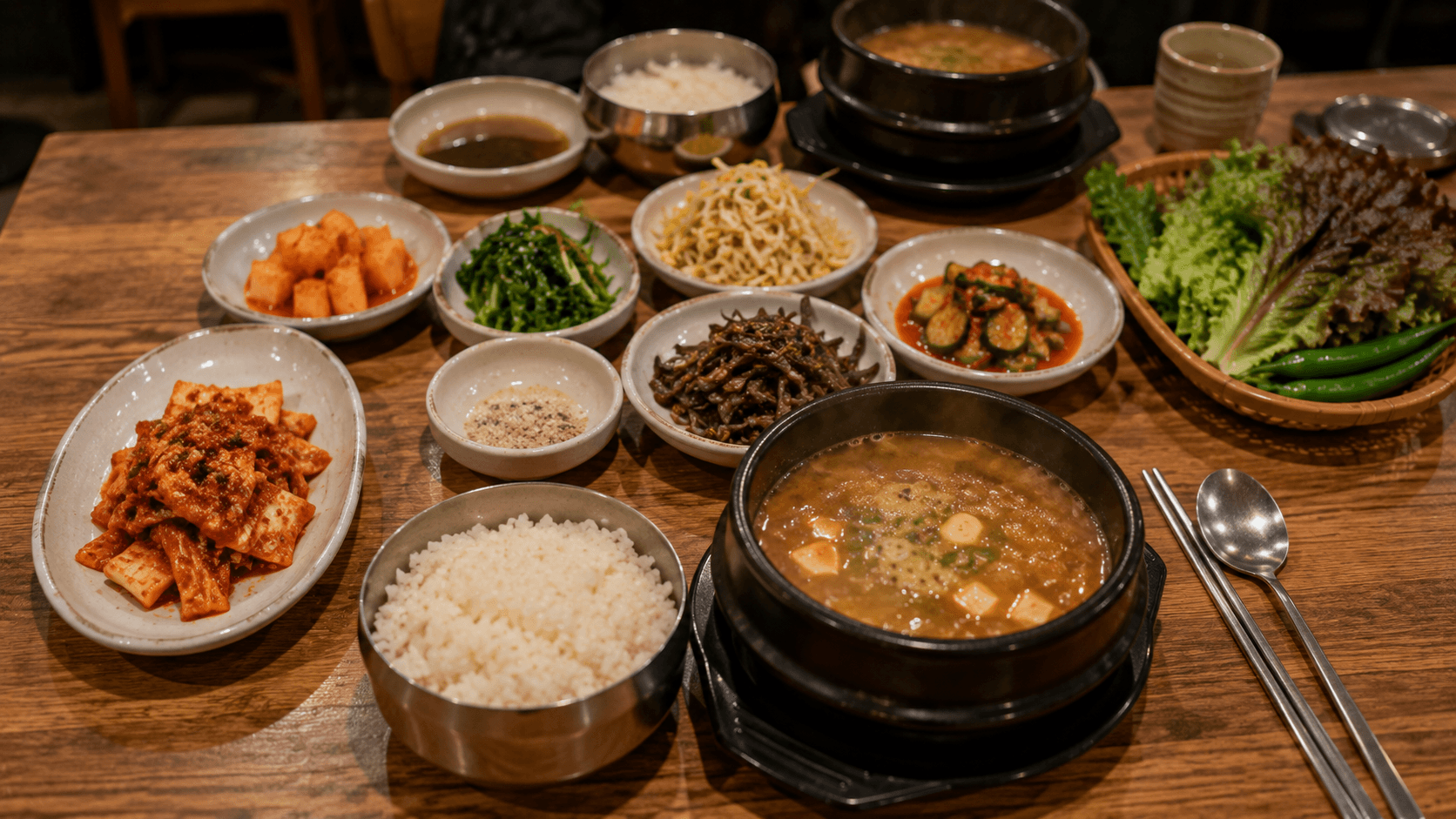
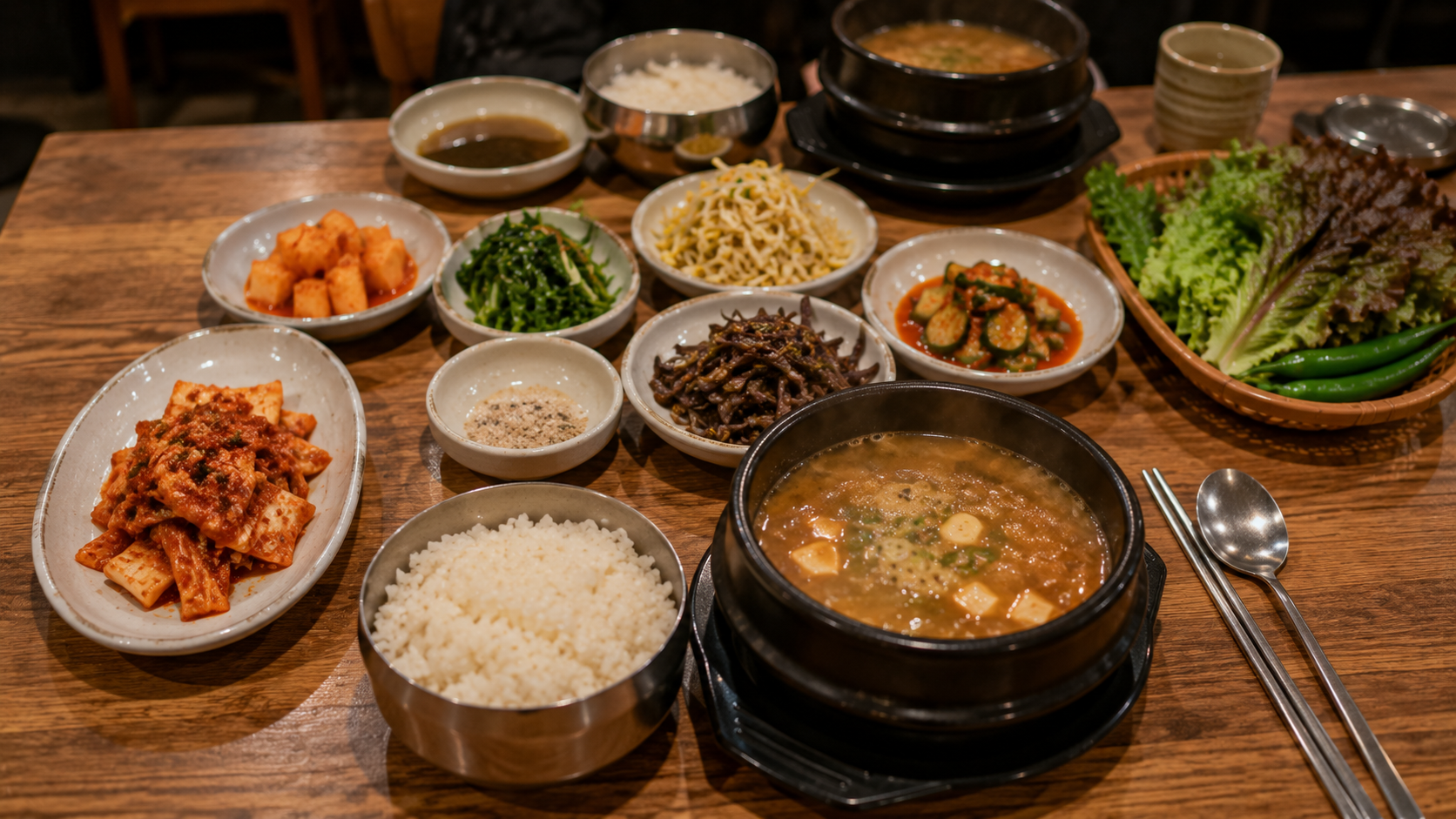
A Korean meal often arrives all at once rather than as separate Western-style courses. Your individual place may include rice, soup, a spoon, and chopsticks, while the middle of the table holds shared dishes.
Small shared side dishes are called banchan (반찬). They may include kimchi, seasoned vegetables, pickles, tofu, eggs, or small portions of fish. Soup, stew, grilled meat, and other main dishes may also be shared, depending on the restaurant.
Korean meals commonly use a spoon-and-chopstick set called sujeo (수저). The spoon is usually long-handled, while the chopsticks are often flat and made of metal. Metal chopsticks can feel slippery, so it is acceptable to eat slowly or ask whether a fork is available.
The communal character of Korean food extends beyond restaurant service. UNESCO's description of kimjang, the making and sharing of kimchi, emphasizes cooperation and sharing as important parts of Korean food culture.
The essential table manners
Wait for the senior diner in formal groups
At a meal involving older relatives, professors, managers, or hosts, wait until the oldest or most senior person begins eating. You do not need to make the pause conspicuous. Simply settle in, let the host organize the table, and follow the group's timing.
This convention may be ignored among close friends or at a hurried lunch. When uncertain, waiting a few seconds is the safer choice.
Keep rice and soup bowls on the table
Unlike in some neighboring dining cultures, Korean diners generally do not lift a rice or soup bowl to the mouth. Leave it on the table and lean forward slightly when necessary.
Use the spoon for rice, soup, porridge, and liquid from a stew. Use chopsticks for meat, vegetables, noodles, kimchi, and other solid items. Switching between the spoon and chopsticks is normal.
Avoid holding the spoon and chopsticks together in one hand while eating. Put one utensil down before using the other, particularly at a formal meal.
Never leave chopsticks standing in rice
Do not insert chopsticks vertically into a bowl of rice. The arrangement resembles ritual offerings associated with the deceased and is inappropriate at an ordinary meal.
Place chopsticks on a rest if one is provided. Otherwise, lay them neatly beside your spoon or on the table without pointing them at another person. Also avoid drumming, waving, or pointing with them.
Take food without searching through the dish
When taking food from a shared plate, choose an accessible piece instead of moving several pieces around to find a preferred one. Take a moderate amount and return for more later.
Use serving chopsticks, tongs, or a ladle when supplied. In casual meals, diners may use their own chopsticks for shared banchan, but practices differ. Following the utensils already being used at the table is more practical than imposing a universal rule.
Keep bowls and shared dishes where they are
Do not pull every shared dish toward your own place. If something is out of reach, ask for it or wait until it can be passed safely. Rotating a dish slightly for easier access is usually fine, but avoid reorganizing the entire table without asking.
Try not to reach across a hot grill or bubbling stew. Besides being awkward, this can be dangerous.
How to eat common Korean foods
Banchan
Banchan are accompaniments to the meal, not a tasting course that must be completed before the main dish arrives. Eat small amounts alongside rice, soup, or the main dish.
Some restaurants refill selected banchan without an extra charge, but this is not a universal entitlement. Ask before assuming. A useful phrase is "Banchan jom deo juseyo" (반찬 좀 더 주세요), meaning "Please give us a little more banchan."
Take only what the table is likely to eat. Avoid requesting several refills and leaving them untouched.
Shared stews and soups
A large stew such as kimchi-jjigae or budae-jjigae may be placed in the center. Use a serving ladle if provided and transfer a portion to your own bowl. In very casual groups, people may eat directly from the shared pot, but visitors who prefer separate portions can use an individual bowl.
Be careful with black stone bowls, metal pots, grills, and earthenware. They can remain dangerously hot long after reaching the table.
Korean barbecue
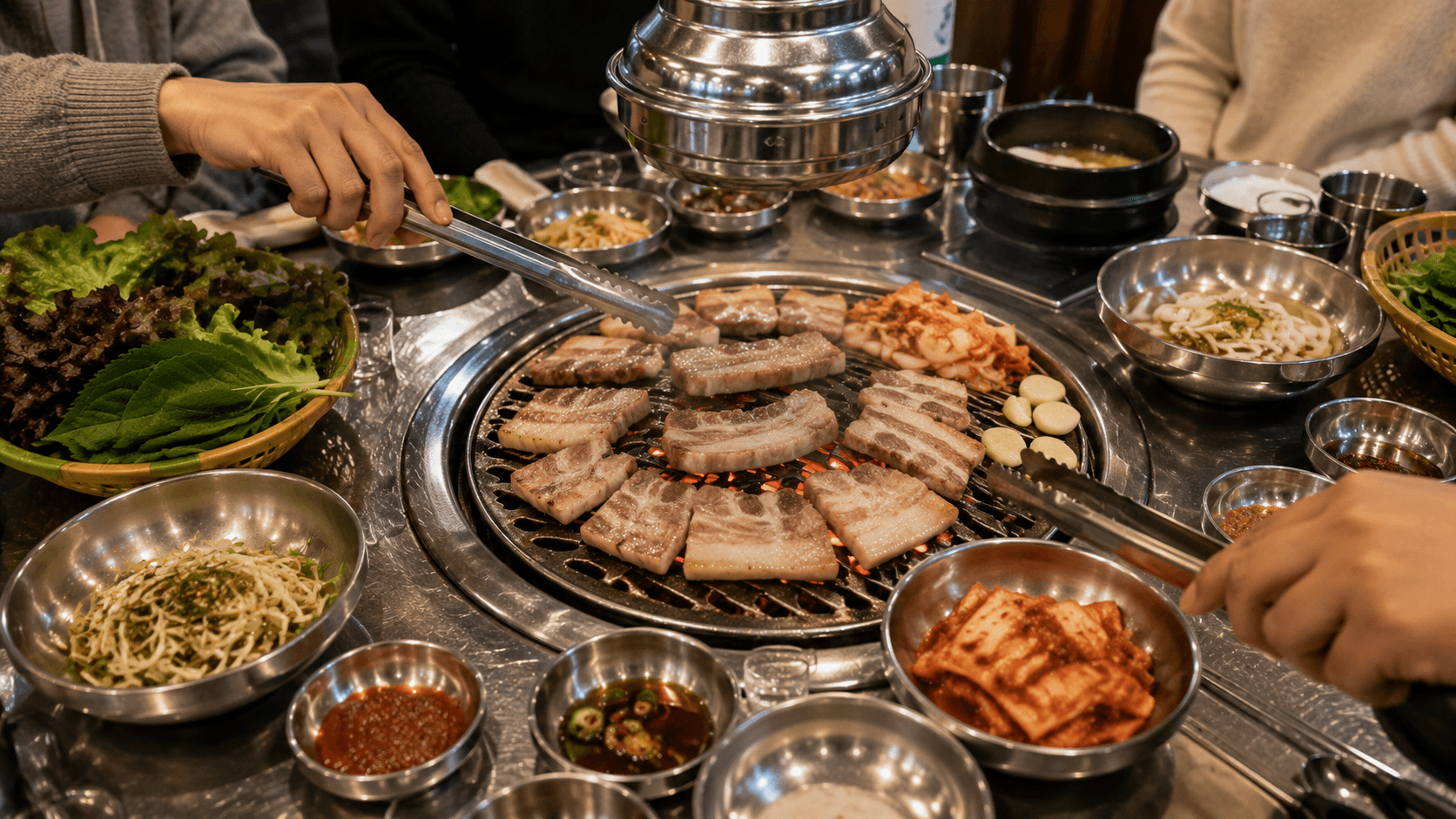
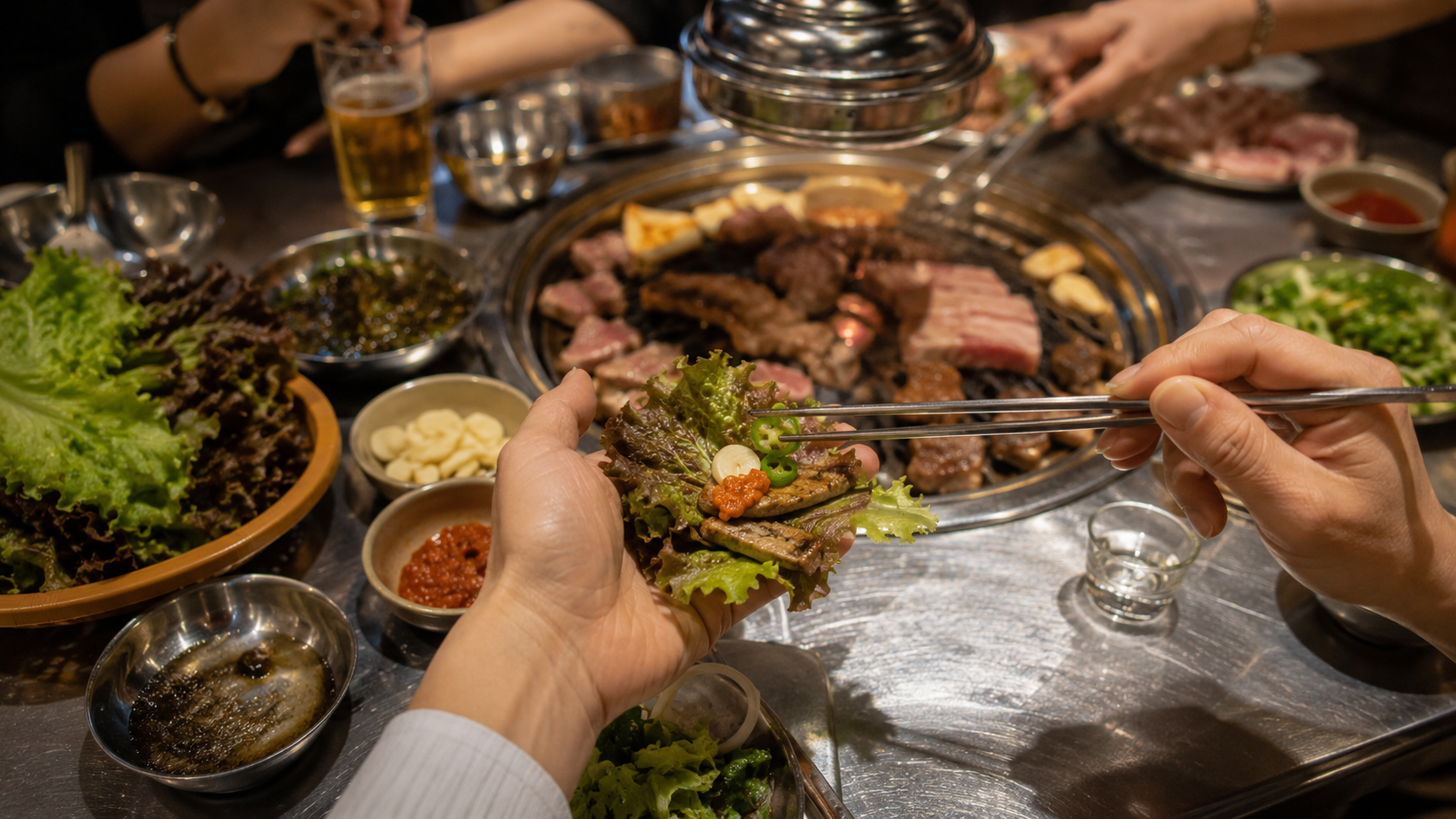
At barbecue restaurants, one person may manage the grill for the group. This is often whoever is nearest, whoever is most experienced, or a staff member. Do not immediately take control; see how the group or restaurant handles it.
Use the supplied tongs and scissors rather than personal chopsticks to handle meat. Keep tools that touched raw meat away from cooked food unless they have been replaced or cleaned. This is a food-safety precaution, not merely etiquette.
Once the meat is cooked, you can eat it directly or make a ssam (쌈), a leaf wrap. Place a manageable amount of meat, sauce, garlic, or other accompaniments in a lettuce or perilla leaf, fold it, and eat it in one bite if possible. An oversized wrap that falls apart is difficult to eat neatly.
Alcohol etiquette without pressure
Traditional drinking etiquette becomes more noticeable at formal dinners, work gatherings, and meals with older people. When an older or senior person pours for you, hold your glass with both hands or support your drinking hand with the other hand. Use two hands when pouring for them as well.
Some younger diners turn their head slightly away from a senior person while taking a drink. This remains recognizable as a respectful gesture, but it is not required in every modern or casual setting.
Do not assume that everyone drinks. It is acceptable to decline because of health, religion, medication, pregnancy, recovery, personal preference, or any other reason. You do not owe the table a detailed explanation.
Useful phrases include:
- Sulg-eul an masyeoyo (술을 안 마셔요): "I don't drink alcohol."
- Oneureun an masilgeyo (오늘은 안 마실게요): "I won't drink today."
- Gwaenchanseumnida (괜찮습니다): "No, thank you" or "I'm fine."
Say it clearly before someone fills your glass. Keeping water or a soft drink in front of you can also make your preference obvious. Pressuring someone to drink is not good hospitality, regardless of older customs.
Restaurant practices that surprise newcomers
Utensils may be in a table drawer
If no spoon, chopsticks, or napkins are visible, check for a shallow drawer beneath the tabletop. Some restaurants store utensils there. Other venues keep them in a container or at a self-service station.
Water and side dishes may be self-service
A sign reading self (셀프) usually indicates that customers should collect something themselves, such as water, cups, utensils, or banchan. Watch other diners or ask staff before waiting for table service.
Use the call button when provided
A tabletop button marked call (호출) or staff (직원) is meant to summon an employee. Press it once and wait. In restaurants without a button, raising a hand and saying "Yeogiyo" (여기요, "Excuse me, over here") is normal.
Payment location varies
Many casual restaurants expect customers to pay at a counter near the entrance, while other venues bring a card terminal or bill to the table. Look for a register as you leave or follow the host.
Tipping is generally not expected at ordinary Korean restaurants. However, premium hotels, international venues, or booking platforms may have their own service-charge or gratuity arrangements, so check the bill rather than treating this as an absolute rule.
Useful phrases at the table
| Korean | Approximate pronunciation | Meaning |
|---|---|---|
| 잘 먹겠습니다 | Jal meokgetseumnida | "I will enjoy the meal"; said before eating |
| 잘 먹었습니다 | Jal meogeotseumnida | "Thank you, I ate well"; said after eating |
| 감사합니다 | Gamsahamnida | Thank you |
| 여기요 | Yeogiyo | Excuse me / Over here |
| 물 좀 주세요 | Mul jom juseyo | Please give us some water |
| 앞접시 주세요 | Apjeopsi juseyo | Please give us small individual plates |
| 포크 있어요? | Pokeu isseoyo? | Do you have a fork? |
| 안 매운 음식 있어요? | An maeun eumsik isseoyo? | Do you have food that is not spicy? |
You are not required to say the pre-meal and post-meal expressions, but they are useful when eating in someone's home or when another person is hosting.
Dietary restrictions and allergies
Etiquette should never take priority over safety. If you have a serious allergy, do not rely only on a dish's appearance or an informal English description. Broths, sauces, kimchi, dumplings, pancakes, and side dishes may contain ingredients that are not visible.
Prepare a Korean-language allergy card naming the specific ingredient and stating whether cross-contact is dangerous. Show it before ordering. Shared grills, fryers, utensils, stockpots, and stew pots can make strict separation difficult, and a restaurant may be unable to accommodate the request safely.
Vegetarian and vegan diners should ask specifically about meat broth, anchovy stock, fish sauce, salted seafood, eggs, and cooking surfaces. Saying only "no meat" may not communicate every restriction.
Dining in a Korean home
Remove your shoes if the host does so or if there is a raised entry area. Wait to be shown where to sit, particularly if the meal uses a low table or includes older family members.
A small host gift is thoughtful but not mandatory. Fruit, bakery items, or another shareable item is usually easier than bringing a dish that competes with the prepared meal. Mention dietary restrictions well in advance rather than at the moment food is served.
Accepting a small first portion is polite when you can safely eat it, but you do not have to overeat. Compliment a specific dish, help pass plates when appropriate, and offer to assist with clearing the table. The host may refuse the offer.
Common mistakes to avoid
- Do not plant chopsticks upright in rice.
- Do not lift rice and soup bowls to your mouth.
- Do not search through shared dishes for preferred pieces.
- Do not handle raw barbecue meat with personal chopsticks.
- Do not reach across a hot grill or stew.
- Do not pressure anyone to drink alcohol.
- Do not assume every banchan refill is free or available.
- Do not blow your nose at the table if you can step away discreetly.
- Do not treat every traditional rule as mandatory in a casual modern restaurant.
What to check before you go
- Confirm whether the restaurant accepts reservations and whether the entire party must arrive before seating.
- Ask about minimum orders, especially at barbecue restaurants where meat may need to be ordered in two-serving quantities.
- Check whether seating is on chairs or the floor if mobility is a concern.
- Explain allergies or dietary restrictions before ordering.
- Carry the restaurant name and address in Korean.
- Check closing time and last-order time separately.
- Confirm whether a private room, high chair, wheelchair-accessible entrance, or accessible toilet is available when needed.
For real-time tourism help or interpretation, the Korea Tourism Organization operates the 1330 Korea Travel Helpline and chat service. The service page and contact details were verified on June 11, 2026; service channels can change, so check the official page before relying on them.
FAQ
Must I be able to use metal chopsticks?
No. Try them, but ask for a fork if necessary. Eating comfortably and without dropping hot food is more important than demonstrating perfect technique.
Should I finish every side dish?
You do not have to clean every shared plate. Take modest portions, request refills only when needed, and avoid ordering more than the group can reasonably eat.
Can I refuse food offered by an older person?
Yes, especially for allergies, dietary restrictions, or personal boundaries. Refuse politely and, when useful, give a short explanation. Safety takes precedence over ceremony.
Who should cook at Korean barbecue?
Follow the restaurant and group. Staff may cook, or one diner may take responsibility. If you are unsure, ask before moving the meat or changing the heat.
Is loud noodle slurping required?
No. You may encounter relaxed attitudes toward eating sounds, but deliberate slurping is not necessary. Eat in a way that is comfortable and considerate to others.
Your most useful next step is to save the phrases for requesting water, an individual plate, a fork, and non-spicy food. They solve more real restaurant problems than memorizing a long list of ceremonial rules.