Korean etiquette is less about memorizing rigid rules than showing awareness of other people. Speak politely, avoid disrupting shared spaces, follow the host's lead, and use both hands when giving or receiving something in a formal situation. Visitors are not expected to understand every custom, and a brief apology usually resolves an honest mistake.
The guidance below reflects common contemporary practice, not rules followed identically by every Korean person. Expectations vary by generation, setting, region, and relationship. Official visitor resources and service information were checked on June 11, 2026.
At a glance
| Situation | Practical response |
|---|---|
| Meeting someone | Give a small nod or bow and say annyeonghaseyo |
| Addressing a stranger | Use a title or neutral expression instead of guessing their first name |
| Giving or receiving something | Use two hands, especially with older people or in formal settings |
| Entering a home | Check whether shoes should come off; they usually do |
| Eating with others | Wait briefly for the oldest person or host to begin |
| Using chopsticks | Never leave them standing upright in rice |
| Riding public transport | Keep calls and conversations quiet and yield designated seats |
| Visiting a temple or memorial | Lower your voice and check photography signs |
| Making a mistake | Say joesonghamnida or mianhamnida, then correct it |
The basic principle: respect the situation
Korean social interaction can appear formal because age, professional position, and familiarity influence how people speak to one another. This does not mean every encounter requires ceremony. Friends in a café behave differently from employees meeting a senior executive, and a busy convenience-store transaction is not the same as visiting someone's family home.
When you are unsure, begin slightly more formally than you would with a close friend. A small bow, a polite tone, and a complete greeting are sufficient in most everyday situations. You can relax if the other person does.
Three habits cover a large part of Korean etiquette:
- Notice who is hosting or leading the interaction.
- Avoid creating inconvenience in a shared space.
- Use polite language until invited to speak casually.
Greetings, bows, and handshakes
How deeply should you bow?
A slight forward inclination of the head and upper body is the normal everyday greeting. Deep bows are associated with more formal ceremonies, major apologies, ancestral rites, and certain holiday traditions. Tourists do not need to imitate them during ordinary encounters.
A simple greeting is:
Annyeonghaseyo(안녕하세요): Hello, in polite everyday speech.Gamsahamnida(감사합니다): Thank you.Joesonghamnida(죄송합니다): I am sorry, or excuse me, in a formal and polite form.
Employees may bow more deeply because of workplace service conventions. You do not need to match the exact angle; acknowledge them with a small bow or verbal thanks.
Handshakes
Handshakes are common in business and international settings. In a formal introduction, support your right forearm or wrist lightly with your left hand, or use both hands around the other person's hand. This signals attentiveness rather than submission.
A visitor will not normally cause offence by using a standard one-handed handshake. The two-handed form is simply a useful choice when meeting an older person, host, professor, or senior colleague.
Names and titles
Do not assume that first-name use is automatically friendly. Korean names are commonly presented with the family name first, although some Koreans reverse the order in international settings. Ask how the person would like to be addressed if it is unclear.
In schools and workplaces, titles often replace names. Examples include seonsaengnim (선생님), meaning teacher or a respectful professional form of address, and role-based titles such as professor, manager, or director. English-speaking Koreans may instead invite you to use an English name or first name.
Avoid addressing an unfamiliar adult as ajumma or ajeossi. These terms broadly refer to a middle-aged woman or man, but they can sound overly familiar or imply an age the person does not identify with. Use jeogiyo (저기요), meaning roughly excuse me, to attract attention in a restaurant or shop.
Giving, receiving, and paying
Use both hands when giving or receiving a gift, business card, document, drink, or payment in a formal interaction. In casual transactions, one hand is common, particularly at busy shops. You may also see someone place the free hand beneath the wrist or forearm.
Take a business card long enough to read the name and position before putting it away. Avoid immediately folding it, writing on it, or pushing it into a back pocket during a formal meeting.
At shops and cafés, place a card or cash where the employee indicates. Many counters have a card reader facing the customer. Follow the screen or staff instructions rather than repeatedly handing the card back and forth.
Tipping is not a routine part of ordinary restaurant, café, taxi, or hotel transactions in Korea. Pay the stated amount unless a business explicitly offers a gratuity option or has a clearly explained service policy.
Shoes, homes, and floor-level spaces
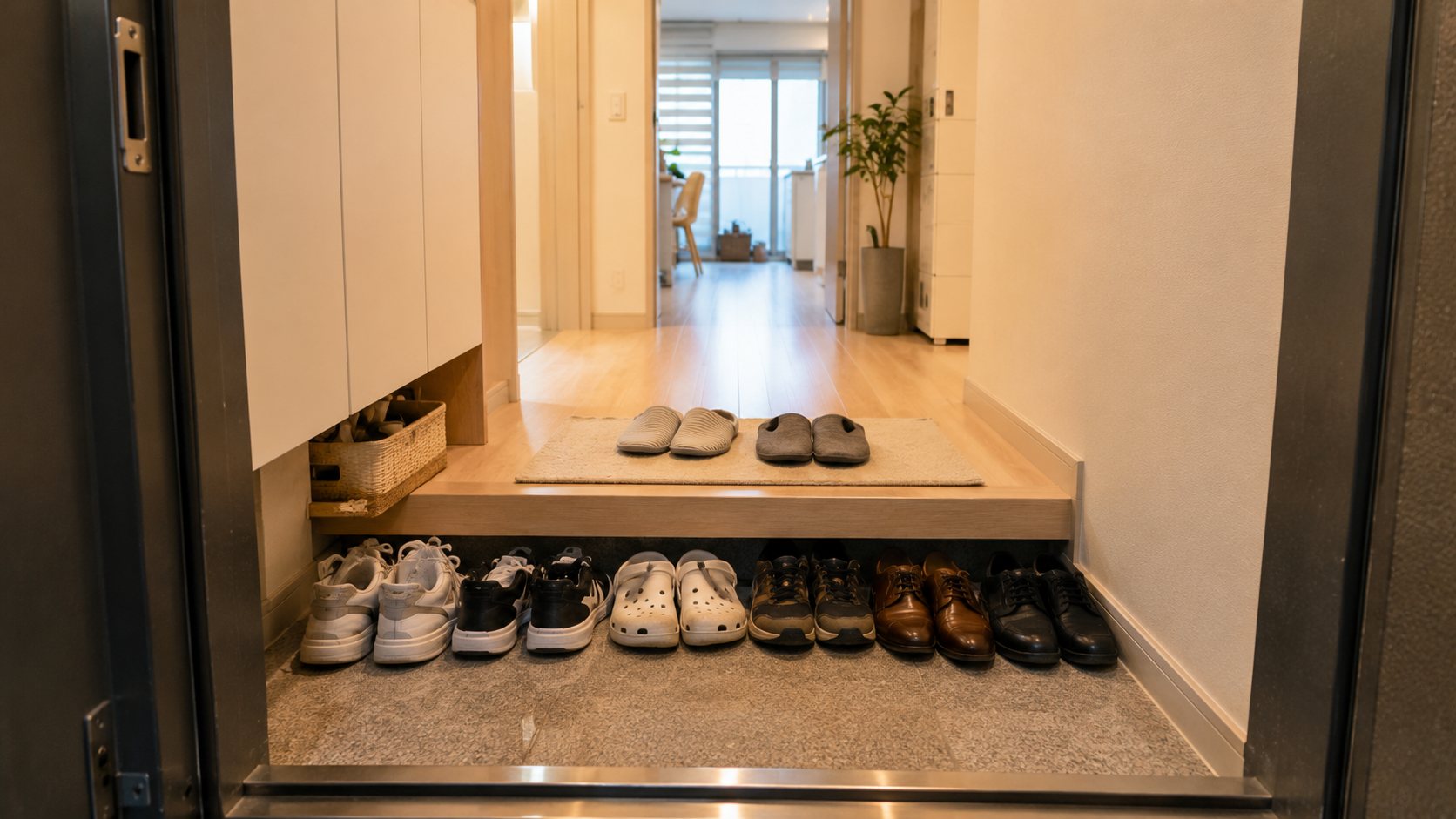
Shoes are normally removed inside Korean homes. They may also need to come off in guesthouses, traditional restaurants, temple buildings, fitting rooms, clinics, children's facilities, and other floor-seated spaces.
Look for these clues:
- A lowered entrance area filled with shoes
- A raised interior floor
- Slippers beside the doorway
- A sign containing
신발(shoes) or an image of footwear
Do not step onto the clean interior floor while still wearing outdoor shoes. Remove them in the entrance area, then step up. Arrange them neatly if practical.
Bathroom slippers, when provided, should remain in the bathroom. Accidentally walking through a home in bathroom slippers is a common visitor mistake. Return them and apologize; it is not a serious incident.
Never assume that shoes must be removed in every restaurant. Most modern restaurants use standard tables and chairs, and customers keep their shoes on. Follow the layout and the people ahead of you.
Korean dining etiquette
Restaurant etiquette is generally forgiving, especially in casual places. The most useful approach is to pause for a few seconds and observe how the table is organized.
Starting the meal
At a formal meal or when dining with an older host, wait for that person to begin. In a casual restaurant with friends, people may simply start when the food arrives. You can say jal meokgetseumnida (잘 먹겠습니다), literally indicating that you will eat well, before a meal provided by someone else.
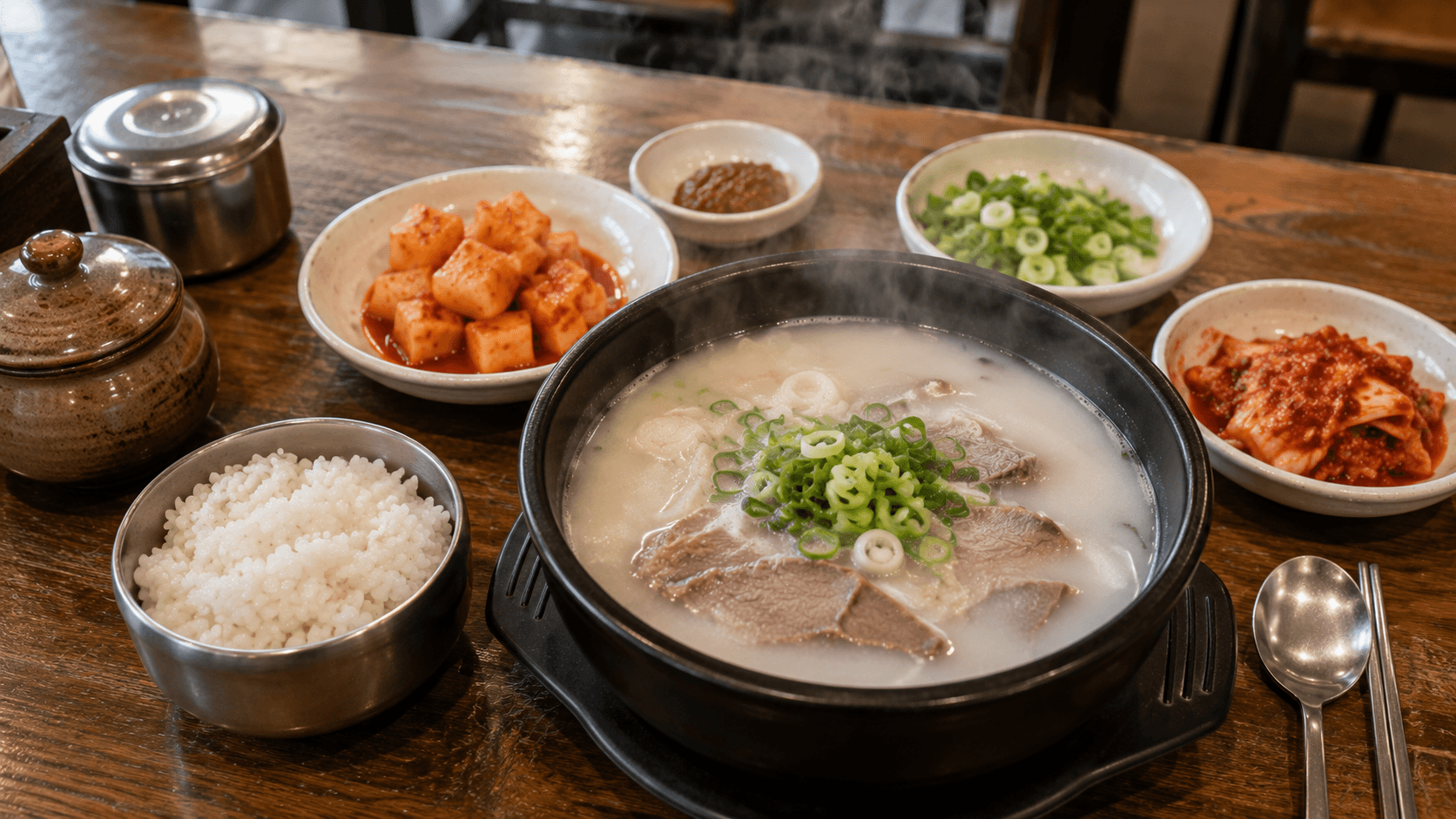
Meals often include banchan (반찬), small side dishes placed in the center. These are usually shared. Rice is generally served individually, while soup or stew may be individual or shared depending on the restaurant.
Use serving utensils when supplied. If no serving utensil is available, follow the table's practice or ask for one. Hygiene expectations have changed over time, so older descriptions of everyone eating directly from one communal pot should not be treated as a universal rule.
Spoon and chopsticks
Korean place settings normally include a spoon and chopsticks, sometimes called sujeo (수저) as a set. The spoon is convenient for rice, soup, and stew; chopsticks are used for side dishes, noodles, and solid food.
Important points:
- Do not leave chopsticks standing vertically in rice. The image is associated with food offered during rites for the deceased.
- Do not point at people or gesture dramatically with chopsticks.
- Put utensils down when you need both hands for another task.
- Avoid lifting rice or soup bowls to your mouth in a formal Korean meal.
- Ask for a fork if metal chopsticks are difficult to control. This is better than repeatedly dropping food.
You do not need to copy every detail of traditional table etiquette. Eating neatly and avoiding waste or disruption matter more than perfect technique.
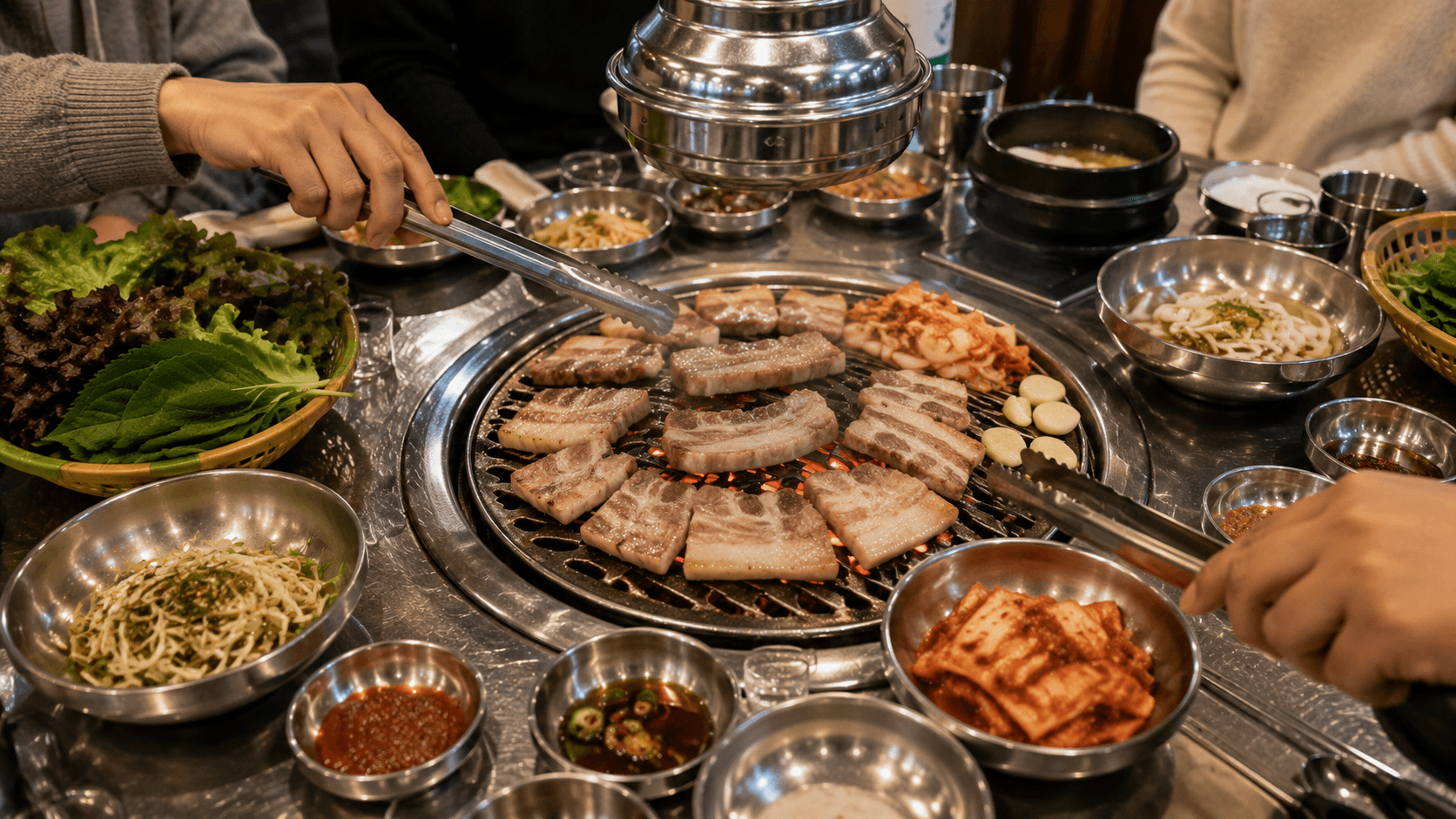
Grilling meat
At Korean barbecue, one person may take responsibility for the grill, but this is not an entitlement to control everyone's food. Check before moving another person's meat. Use the supplied tongs and scissors for raw or cooking meat rather than personal chopsticks.
Do not place cooked food back onto a dish that held raw meat. If the restaurant provides separate tools or plates, keep them separate.
Alcohol
Traditional etiquette often involves pouring drinks for other people and receiving a drink with two hands. Younger friends may handle this casually, while workplace dinners can be more formal.
You are not required to drink alcohol. A clear jeoneun sul an masyeoyo (저는 술 안 마셔요), meaning I do not drink alcohol, is appropriate. You can also accept a non-alcoholic drink for a toast. Health, religion, medication, and personal preference are all sufficient reasons; no detailed explanation is necessary.
Public transport and shared spaces
Korean subways and buses can be crowded, particularly during commuting hours. Good etiquette is primarily about movement, noise, and designated space.
Boarding and exiting
Let passengers leave before boarding. Stand to the side of train doors rather than directly in front of them. On buses, move inward when possible and prepare to exit before the stop without blocking the door too early.
Keep backpacks, suitcases, and shopping bags out of aisles. On a crowded train, take a bulky backpack off and hold it low. Do not lean luggage against a door that may open on the opposite side at the next station.
Priority seating
Priority seats are intended for passengers who need them, including older adults and people with disabilities. Separate pink seats are commonly designated for pregnant passengers. Do not assume that a person must visibly demonstrate a need before using priority seating.
Practices differ between cities and operators, but the cautious approach is to leave clearly designated seats available and offer an ordinary seat when someone nearby appears to need it more. Transport information and local notices can be checked through the relevant city or operator; for Seoul, start with the Seoul Metropolitan Government's transport information.
Noise and phone use
Keep calls brief and quiet on public transport. Earphone sound should not be audible to nearby passengers. Loud conversation is more noticeable inside a quiet carriage, even when the train itself is noisy.
Eating a full or strongly scented meal on a city bus or subway is inconsiderate. Drinking water or taking a small bite when necessary is a different matter, but avoid spills and remove all rubbish.
Follow current escalator and station safety signs. Do not rely on a blanket rule about standing on one side, because local safety campaigns and passenger behavior can differ.
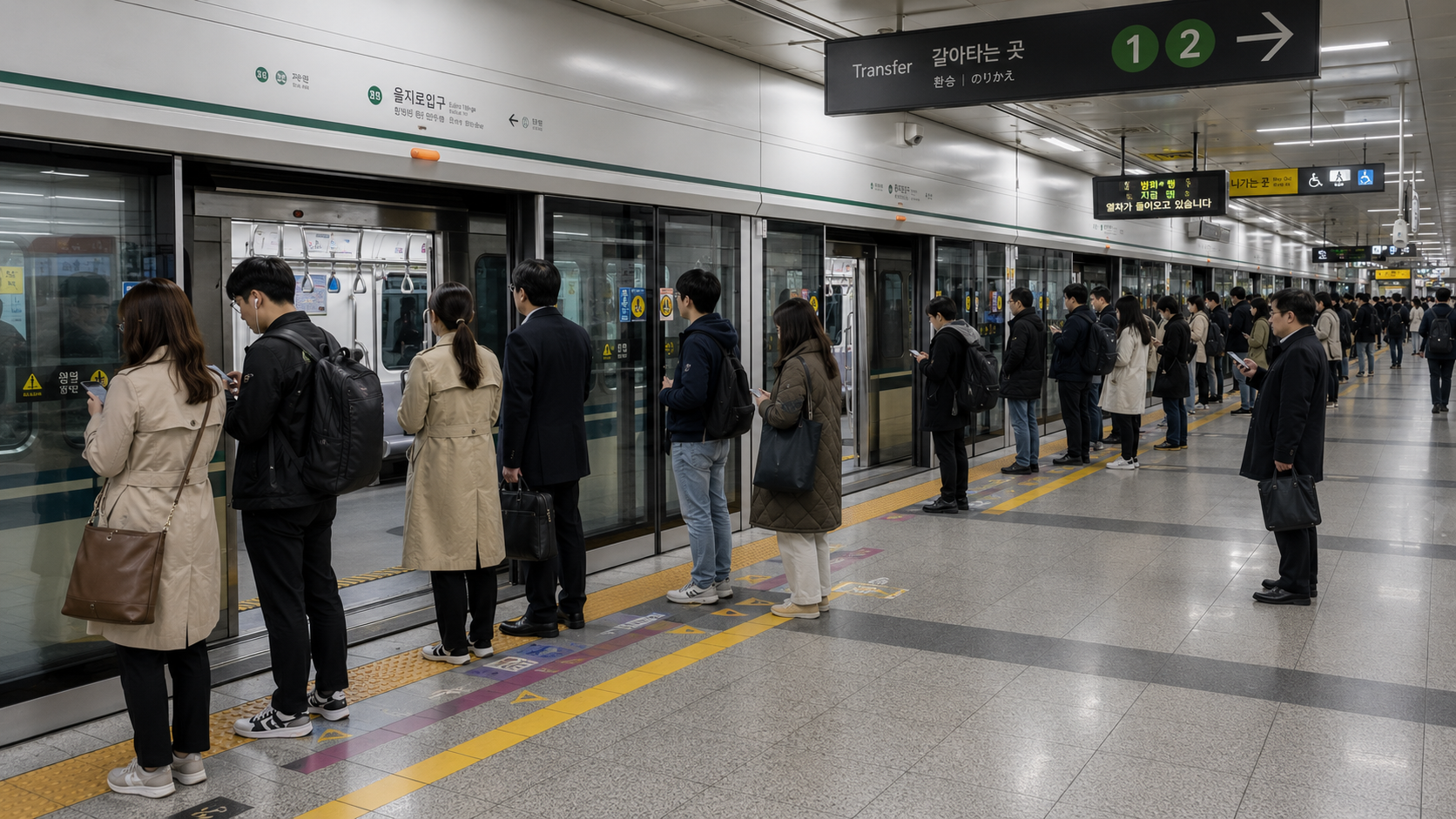
Queues, doors, and crowded streets
Queue where a line or floor marking exists. At cafés and food courts, the ordering line and collection area may be separate. Keep receipts or vibrating pagers until you receive the order.
In an unmarked crowd, order can appear less obvious. Do not respond by pushing. Watch who arrived before you and ask staff where to wait.
Holding a door for someone immediately behind you is considerate, but elaborate door-holding is not expected. On narrow pavements, avoid stopping suddenly in the center to check a map. Move to the side first, especially in areas such as Myeong-dong, Hongdae, Gangnam, or busy station corridors.
Photography and privacy
Ask before taking a close or identifiable photograph of a stranger. This is especially important for children, market vendors, worshippers, performers outside a public performance, and people in emotionally sensitive situations.
Museums, palaces, concerts, shops, cafés, and religious sites set their own photography rules. A venue may allow ordinary photography but prohibit flash, tripods, selfie sticks, drones, or commercial shoots. Check signs at the entrance and in individual exhibition rooms. The National Museum of Korea is a useful official starting point for current visitor information at that museum.
Do not photograph inside changing rooms, bathing areas, saunas, or other spaces where privacy is expected. At a jjimjilbang (찜질방), or Korean bathhouse and sauna complex, phones and cameras should remain out of bathing and changing areas.
Temples, palaces, and memorial places
A temple may be both a visitor attraction and an active place of worship. Keep your voice low around prayer halls, avoid walking directly in front of someone who is bowing, and do not touch statues, paintings, ritual instruments, or offerings.
Shoes must usually be removed before entering a temple hall. Dress requirements vary, but clothing that permits comfortable, modest movement is a sensible choice. Never assume that photography is allowed during a ceremony.
If you join an organized Templestay, follow the individual temple's schedule and instructions. Programs can include meditation, ceremonies, communal work, meals, and bowing, but activities differ by location. Confirm current requirements through the official Templestay website, checked June 11, 2026.
At royal palaces, memorial halls, cemeteries, and sites connected to war or national tragedy, avoid playful poses that could trivialize the setting. Read site-specific notices rather than treating every historical attraction as a photo backdrop.
Workplaces, universities, and language
Hierarchy remains visible in some Korean workplaces and universities, but organizational cultures differ considerably. Do not assume that every Korean office expects employees to socialize after work or obey the oldest person without question.
For a first meeting:
- Arrive on time or a few minutes early.
- Use the person's title until invited to do otherwise.
- Exchange business cards or documents with both hands.
- Allow senior participants or the meeting host to guide seating and introductions.
- Send a concise follow-up message when appropriate.
Korean has several speech levels. New learners should use polite endings rather than trying to reproduce highly formal or casual speech from television. -yo forms are suitable for many everyday conversations. Using informal speech, or banmal (반말), without agreement can sound disrespectful even when the vocabulary itself is friendly.
Visiting someone's home
Bring a modest gift when invited for a meal, particularly for a first visit. Fruit, bakery items, tea, or another shareable item is practical. Ask about allergies, dietary needs, children, or alcohol before choosing.
Once inside:
- Remove shoes where indicated.
- Wait to be shown where to sit.
- Ask before opening cupboards, using appliances, or entering private rooms.
- Offer to help clear the table, but accept the host's answer.
- Do not stay significantly later than the agreed time without checking.
Korean homes vary from multigenerational households to single-person studios. Avoid making assumptions about family roles, marriage, housing wealth, or why an adult lives with parents.
Personal questions and social boundaries
Questions about age, relationship status, education, or work may appear earlier in conversation than some visitors expect. Age can help speakers choose appropriate Korean language levels, but you are not obliged to disclose private information.
A polite redirection works well: I'd rather not say exactly, but we're around the same age, or I'm not married; how do you know the host?
Avoid treating questions as proof that all Koreans think alike. Some people ask them casually; others consider them intrusive. The same variation applies to physical contact, gift giving, drinking, and formality.
Common mistakes and how to recover
Most etiquette mistakes are minor. Correct the action without turning it into a long performance.
| Mistake | What to do |
|---|---|
| You entered wearing shoes | Step back, remove them, and apologize briefly |
| You sat in a designated seat | Move when you notice or when someone needs it |
| You used the wrong title | Thank the person for correcting you and use the right one |
| You began eating too soon | Pause and follow the table; no extended apology is needed |
| You cannot use metal chopsticks | Ask for a fork or spoon |
| You misunderstood a queue | Say joesonghamnida and move to the correct place |
| You took an unwanted photograph | Stop, apologize, and delete it if requested |
Being defensive usually creates more discomfort than the original error. A short apology followed by a clear correction is enough.
What to check before you go
- Review the specific venue's photography, clothing, food, and bag policies.
- Confirm whether shoes are removed at your accommodation or activity.
- Tell hosts about allergies and dietary restrictions in advance.
- Check accessibility directly with older buildings, traditional restaurants, and temples.
- Learn
annyeonghaseyo,gamsahamnida,joesonghamnida, andjeogiyo. - Keep your phone quiet in ceremonies, performances, classrooms, and shared transport.
- Follow posted rules when they differ from general cultural advice.
- For current destination guidance, use the Korea Tourism Organization's VisitKorea service.
Your most useful next step is to learn the four polite expressions above and then observe the first minute of each new situation. Signs, staff instructions, and the behavior of your host are more reliable than trying to apply one etiquette rule everywhere.
Sources
- VisitKorea, Korea Tourism Organization — official visitor information and travel support; checked June 11, 2026.
- Seoul Metropolitan Government transportation information — official city transport guidance; checked June 11, 2026.
- Official Korean Templestay website — temple programs and participating locations; checked June 11, 2026.
- National Museum of Korea — official museum and visitor information; checked June 11, 2026.
- Korea.net — official Republic of Korea portal for cultural and public information; checked June 11, 2026.