Korean dining etiquette is less about memorizing rigid rules than showing awareness of the group. Wait briefly before starting at a formal meal, handle shared food neatly, use your spoon and chopsticks appropriately, and follow the lead of your host. Everyday meals among friends are usually relaxed, while family gatherings, workplace dinners, and meals with older people may be more formal.
Quick answer
For most meals in Korea, remember these points:
- Wait for the oldest or most senior person to begin at a formal gathering.
- Use the spoon for rice, soup, and stew; use chopsticks for solid foods and side dishes.
- Leave rice and soup bowls on the table rather than lifting them to your mouth.
- Never leave chopsticks standing vertically in rice.
- Take modest amounts from shared dishes and avoid searching through them for a preferred piece.
- Use both hands, or support one arm with the other, when giving or receiving something in a formal setting.
- Ask before turning, cutting, or serving food that everyone shares.
- You may decline alcohol. Drinking is not required for good manners.
These are practical defaults, not laws. Age, relationship, setting, and the preferences of the people at the table matter more than perfect technique.
Understanding a Korean table
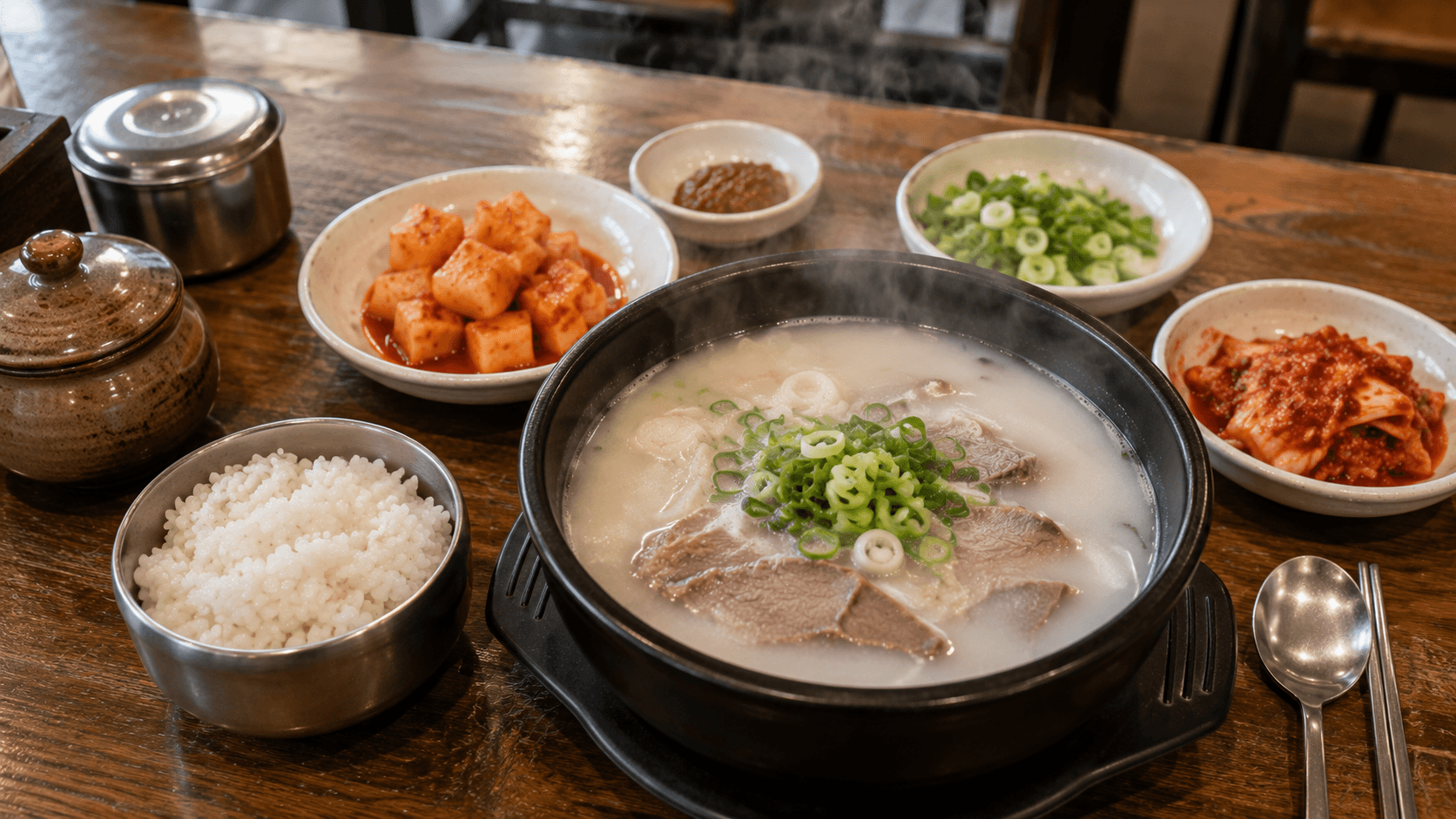
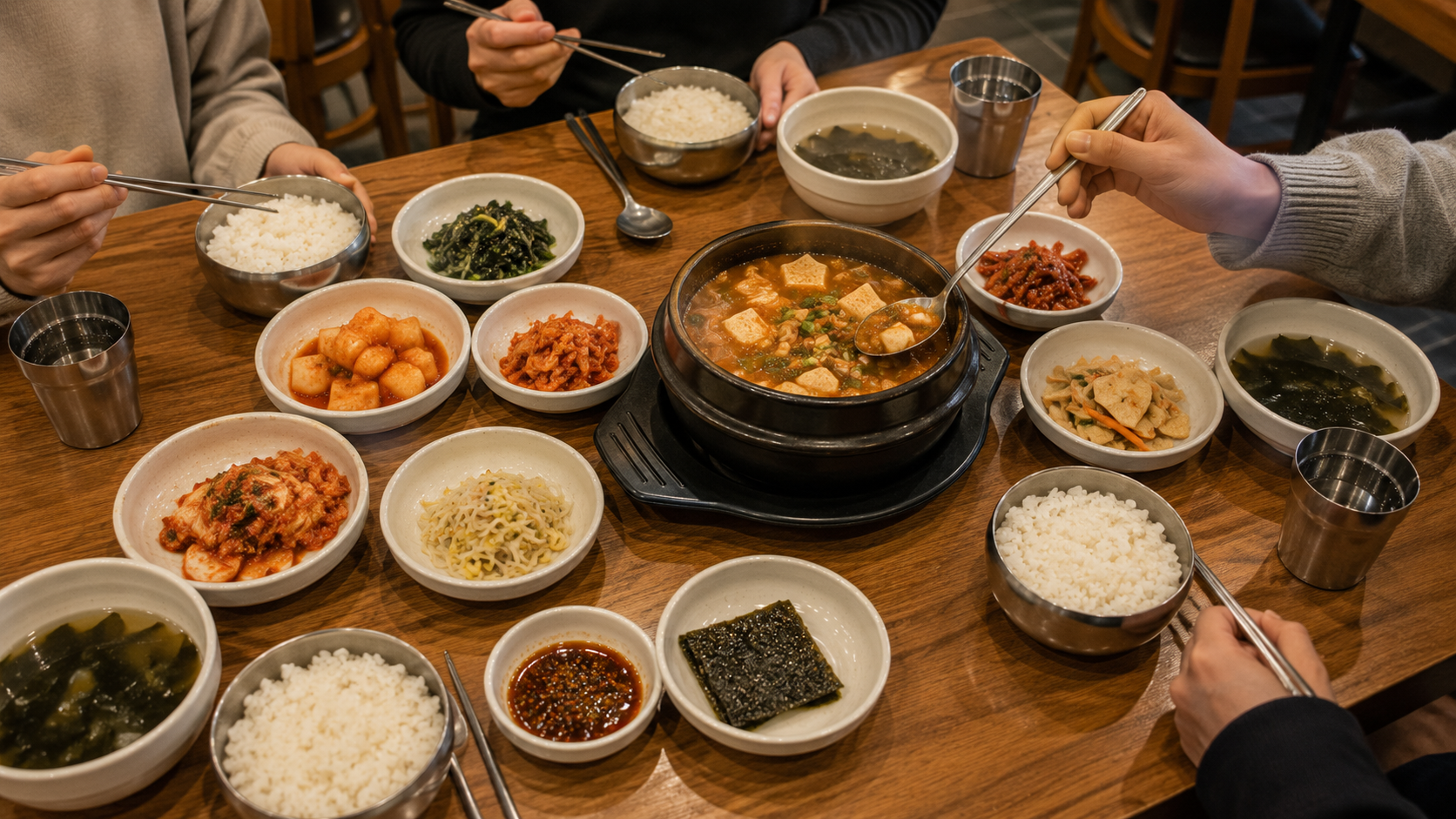
A typical Korean meal may include individual rice and soup alongside several shared dishes. Small side dishes are called banchan (반찬). Kimchi is one familiar example, but banchan can also include seasoned vegetables, tofu, eggs, dried fish, or braised foods.
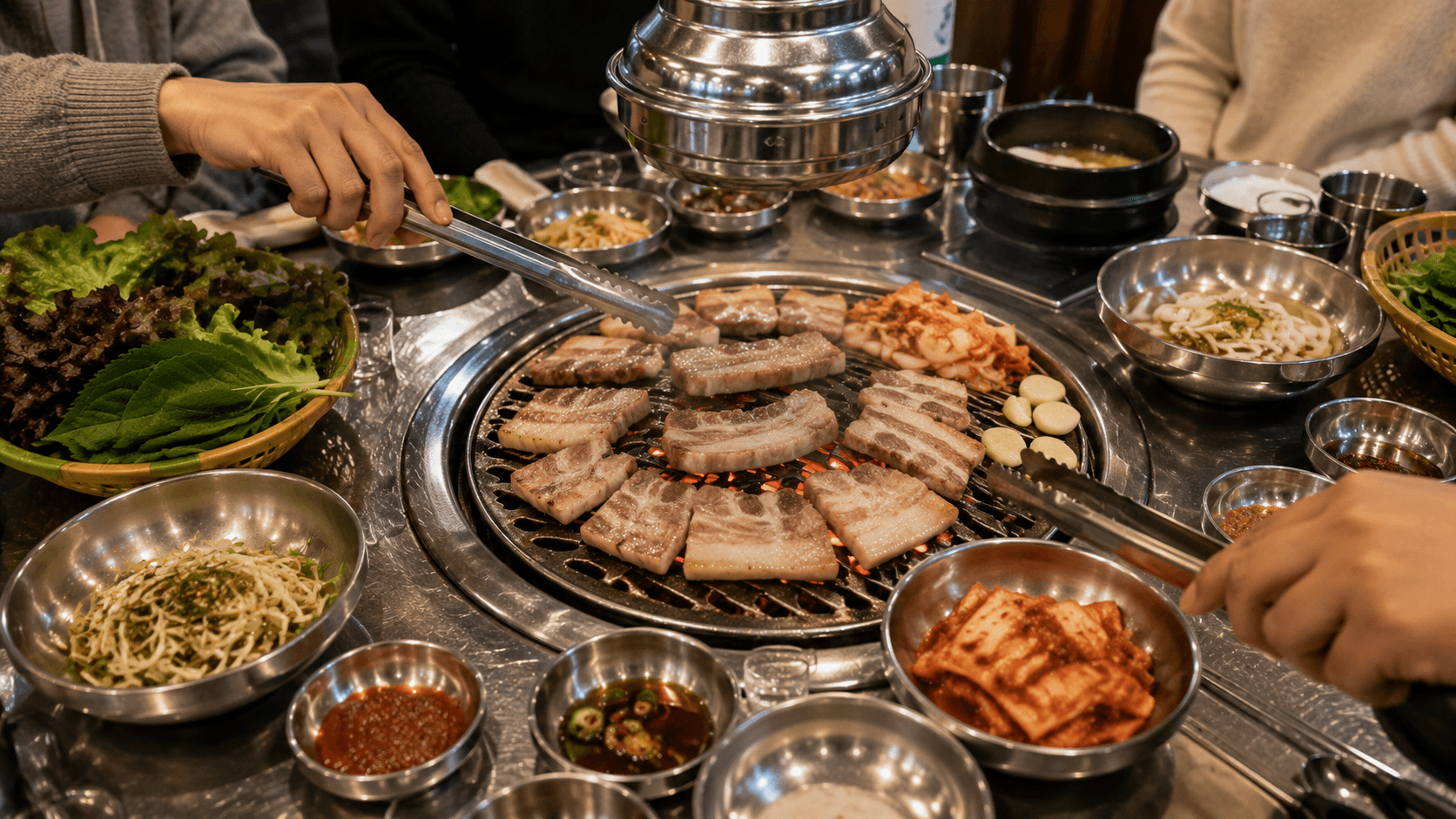
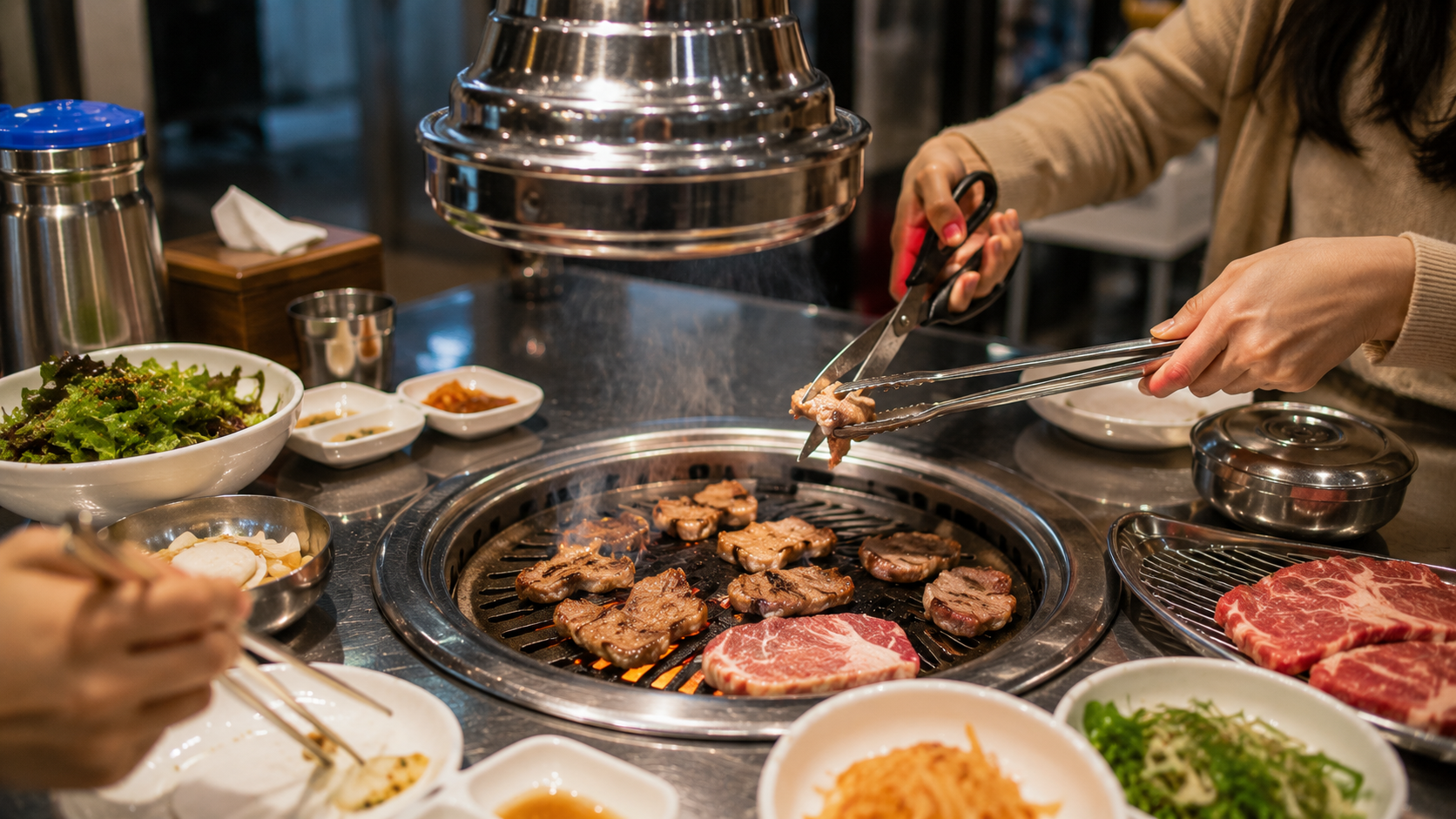
The main dish may also be shared. At a barbecue restaurant, diners cook meat on a grill in the center. At other restaurants, a table might share a pot of jjigae (찌개), meaning stew, or a large plate of stir-fried food.
This arrangement means that reaching toward the center of the table is normal. The important distinction is between food that belongs to you and food intended for everyone. Your rice bowl is usually individual; the plate of kimchi in the middle is usually communal.
The communal character of Korean food has deep cultural roots. UNESCO's description of kimjang, the making and sharing of kimchi, emphasizes cooperation and sharing within families and communities. At an ordinary restaurant, however, you do not need a cultural theory lesson before eating: simply watch how the dishes are being used.
When should you start eating?
At a formal family meal or workplace dinner, it is polite to let the oldest or highest-ranking person begin first. You do not need to stare at that person and wait for a ceremonial signal. A short pause and attention to the group are enough.
Among close friends, couples, classmates, or people of similar age, everyone may start as soon as the food arrives. Very hot dishes are also often eaten immediately. If you are uncertain, wait a few seconds and follow the host.
Before eating food prepared or purchased by someone else, Koreans may say jal meokgetseumnida (잘 먹겠습니다). It roughly communicates, “Thank you; I will enjoy the meal.” Afterward, jal meogeotseumnida (잘 먹었습니다) means, “Thank you; I ate well.” Visitors are not expected to pronounce these phrases perfectly, and a sincere English thank-you is acceptable.
How to use the spoon and chopsticks
A Korean utensil set is commonly called sujeo (수저), a term associated with the spoon and chopsticks used at a meal. The National Institute of Korean Language's Korean-English Learners' Dictionary is a useful official reference for checking Korean food and utensil terms.
Use the spoon for rice and liquids
A long-handled spoon is normally used for rice, soup, stew, porridge, and saucy food that is difficult to pick up. Chopsticks are used for meat, vegetables, noodles, kimchi, and other solid items.
This is a convention rather than a test. If a piece of food keeps slipping from metal chopsticks, use your spoon or ask for a fork. Most restaurants would rather help than watch a guest struggle.
Leave bowls on the table
Traditional Korean manners generally call for leaving rice and soup bowls on the table while eating. This differs from customs in some other East Asian countries, where lifting a rice bowl is common.
You can lean forward slightly and bring the spoon to your mouth. Large noodle bowls and informal dishes may be handled differently, so follow the people around you when the tableware does not resemble a standard rice-and-soup setting.
Do not hold both utensils at once
When using chopsticks, set down the spoon; when using the spoon, set down the chopsticks. Constantly holding one in each hand can look hurried, particularly during a formal meal.
Place utensils on a provided rest or neatly beside your bowl. Avoid dropping used ends directly onto the table if a rest is available.
Never plant chopsticks in rice
Do not leave chopsticks standing vertically in a bowl of rice. The arrangement resembles food presented during ancestral or memorial rites and can make people uncomfortable.
Also avoid pointing with chopsticks, tapping bowls, spearing food unnecessarily, or waving chopsticks while talking. If you need to gesture, put them down first.
Sharing banchan and main dishes
It is normal to eat directly from shared banchan with your own chopsticks in many everyday settings. Practices have become more hygiene-conscious, however, and a restaurant or host may provide serving utensils, tongs, a ladle, or small individual plates. Use them when available.
Take one manageable portion rather than moving food around or repeatedly searching for a preferred piece. If something is beyond comfortable reach, ask someone to pass or move it instead of leaning across the table.
For a communal soup or stew, use the ladle if one is provided. If individual bowls are available, transfer a portion before eating it. Some close groups may eat directly from the same pot, but a visitor should not assume that this is expected.
Do not return food to a shared plate after it has touched your mouth, bowl, or used utensils. If you cannot finish something, leave it on your own plate.
Korean barbecue etiquette
At gogi-jip (고깃집), or meat restaurants, one person often manages the grill. This may be the host, an enthusiastic diner, or a staff member. Before taking over, ask: “Would you like me to cook?”
Use the provided tongs for raw meat. Scissors are used to cut meat into smaller pieces directly on the grill. Once the meat is cooked, follow the restaurant's setup: some tables have separate utensils for cooked food, while others use the same tongs throughout service.
Avoid placing your personal chopsticks on raw meat. This is both a hygiene issue and a practical food-safety concern.
When meat is ready, take a reasonable share and check that others have food too. You may wrap meat in lettuce or perilla leaf with sauce, garlic, and other fillings. These wraps, called ssam (쌈), are usually eaten in one bite, but do not build one so large that eating it becomes difficult.
The grill surface may be changed during the meal. If it becomes heavily burnt or smoky, ask the staff rather than trying to remove it yourself.
Giving and receiving with two hands
Using two hands communicates respect when pouring a drink or passing something important to an older person, senior colleague, host, or new acquaintance. You can hold the object with both hands or use your right hand while your left hand lightly supports your wrist or forearm.
Among close friends, this formality is often relaxed. If everyone else is passing bowls casually with one hand, you do not need to turn the meal into a ceremony. Two hands remain a safe and polite default when you are unsure.
Alcohol etiquette without pressure
Traditional drinking etiquette is most visible at workplace dinners and meals involving different ages or ranks. A younger or junior diner may pour for a senior person using two hands. The recipient may also hold the glass with two hands. Some people turn their head slightly away from an older or senior person while taking a drink.
These practices are not universal, particularly among friends and younger groups. More importantly, etiquette does not require you to drink alcohol. You can say:
- “No alcohol for me, thank you.”
- “I don't drink, but I would be happy to toast with water.”
- Sul an masyeoyo (술 안 마셔요): “I don't drink alcohol.”
Keep your refusal calm and consistent. You do not owe the table a medical, religious, or personal explanation. If someone fills your glass anyway, you can leave it untouched and participate in the conversation.
Restaurant behavior that may surprise visitors
Calling the staff is normal
In casual Korean restaurants, staff may not repeatedly check the table. Use the call button if there is one. Otherwise, say jeogiyo (저기요), meaning “Excuse me,” clearly enough to be heard. This is normal restaurant behavior when spoken politely.
Water, utensils, tissues, or additional banchan may be at a self-service station. Look for self (셀프), a common sign indicating self-service. Do not assume every side dish can be refilled without charge; ask when the policy is unclear.
Shoes sometimes come off
Most restaurants use regular chairs and tables, but some traditional dining rooms have raised floors or floor seating. Remove your shoes when you see a shoe cabinet, a step up to the dining area, or other diners doing so. Wear socks in good condition and keep bare feet away from cushions and shared surfaces.
Payment is usually made at the counter
At many casual restaurants, diners pay near the entrance rather than waiting for a bill at the table. One person may pay for the group, with friends settling privately afterward. Separate checks are not guaranteed, so ask before paying if your group needs them.
Dietary restrictions and food allergies
Politeness should never override safety. Ask about ingredients before ordering, not after shared dishes arrive. Korean sauces, broths, kimchi, and side dishes may contain ingredients that are not visually obvious, including fish products, shellfish, soy, wheat, sesame, nuts, meat stock, or alcohol.
Do not rely only on a dish's English name. Carry a Korean-language allergy card naming the exact ingredient and explaining whether cross-contact is dangerous. Restaurant staff may understand the ingredient but may not be able to guarantee a separate preparation area.
For current destination information and traveler assistance, consult the Korea Tourism Organization's VISITKOREA travel portal and 1330 Korea Travel Helpline. The availability of its online call and chat options was verified on June 11, 2026.
Common mistakes to avoid
- Treating every custom as compulsory, even when the table is casual.
- Starting immediately at a formal meal without checking the host or senior diners.
- Lifting a standard rice bowl to the mouth.
- Leaving chopsticks upright in rice.
- Using personal chopsticks on raw barbecue meat.
- Searching through a shared dish for the most desirable piece.
- Taking the final portion without checking whether anyone else wants it.
- Reaching across another person's bowl or face.
- Assuming all banchan refills are free.
- Pressuring someone else to drink or accepting pressure to drink yourself.
- Pretending to understand ingredients when an allergy is involved.
What to check before you go
- Dining format: Is it a casual restaurant, formal dinner, workplace gathering, or meal in someone's home?
- Seating: Does the restaurant use chairs, floor seating, or a shoes-off room?
- Shared dishes: Are serving utensils or individual plates provided?
- Barbecue: Which utensils are intended for raw and cooked meat?
- Dietary needs: Can the restaurant confirm ingredients and cross-contact precautions?
- Payment: Will one person pay, or can the restaurant divide the bill?
- Accessibility: Traditional floor seating can be difficult for diners with limited mobility; request chair seating in advance.
- Last orders: Independently operated restaurants may stop accepting orders before the posted closing time, so confirm directly when arriving late.
FAQ
Is it rude to ask for a fork?
No. Asking politely for a fork is better than dropping food or becoming unable to eat. Some small restaurants may not have one, but staff will often help if they can.
Do I have to eat every banchan?
No. Try what interests you and leave unfamiliar dishes alone if necessary. Take small amounts first so that food is not wasted.
Should I finish all the food?
You do not need to force yourself to clear every shared plate. Finish the food you transfer to your own plate when practical, and avoid ordering far more than the group can eat.
Is slurping acceptable?
Some noodle noise is common in casual restaurants, but loud slurping is not required or universally appreciated. Eat naturally without deliberately making noise.
Who pays for a Korean meal?
The inviter, host, or most senior person may pay, particularly at a formal gathering, but this is not guaranteed. Among friends, people may split the total or take turns paying. Offer to contribute and follow the group's arrangement.
What should I bring to a meal at someone's home?
A modest, shareable gift such as fruit, dessert, or a non-alcoholic drink is appropriate unless the host tells you not to bring anything. Mention dietary restrictions before the day of the meal so the host has time to plan.
A useful next step
Before your first group meal, learn three expressions: jal meokgetseumnida before eating, jal meogeotseumnida afterward, and jeogiyo for politely calling restaurant staff. Then watch the table for a few seconds before acting. That combination is more useful than trying to perform every traditional rule perfectly.
Sources
Information and links checked on June 11, 2026.