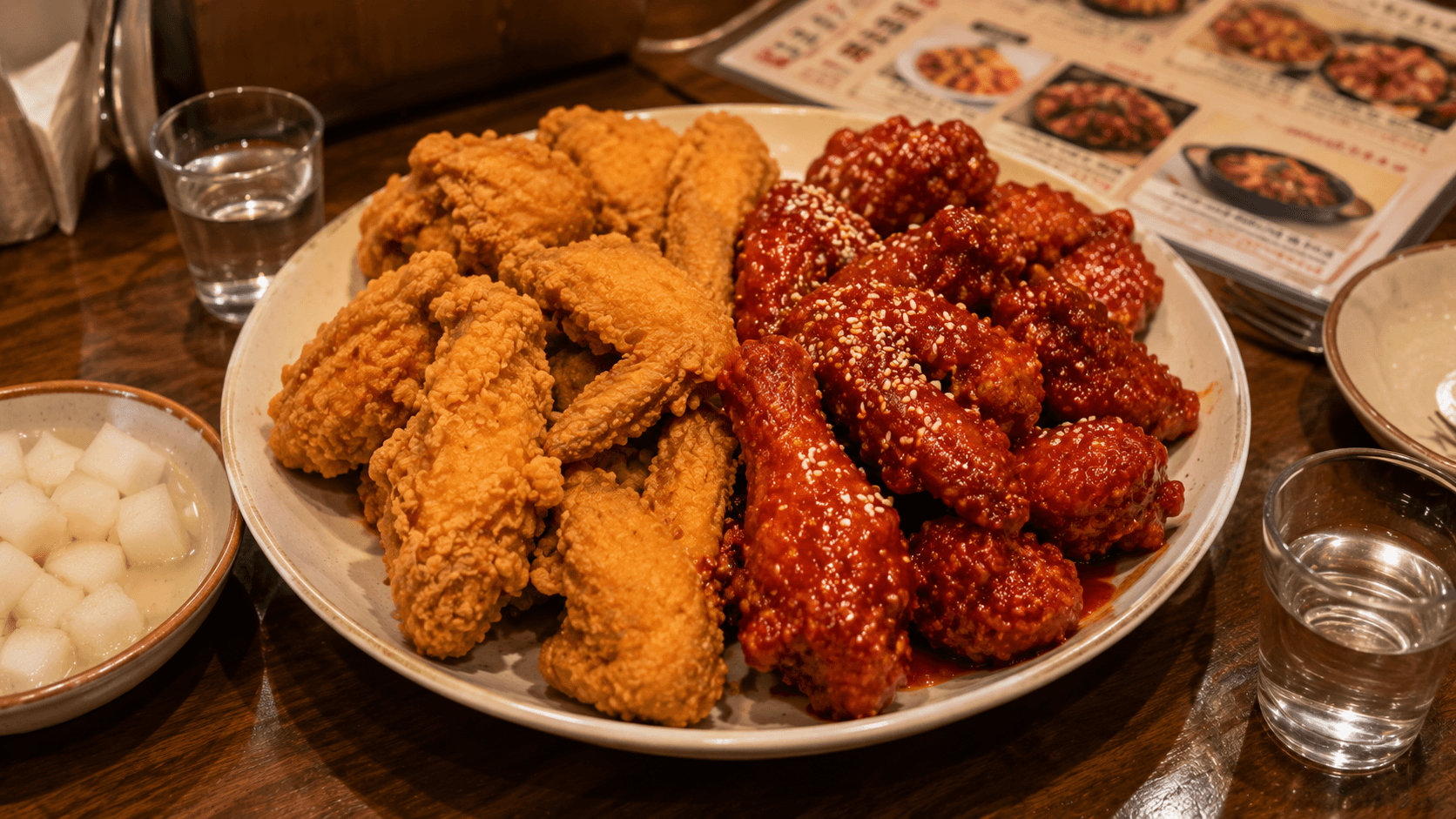
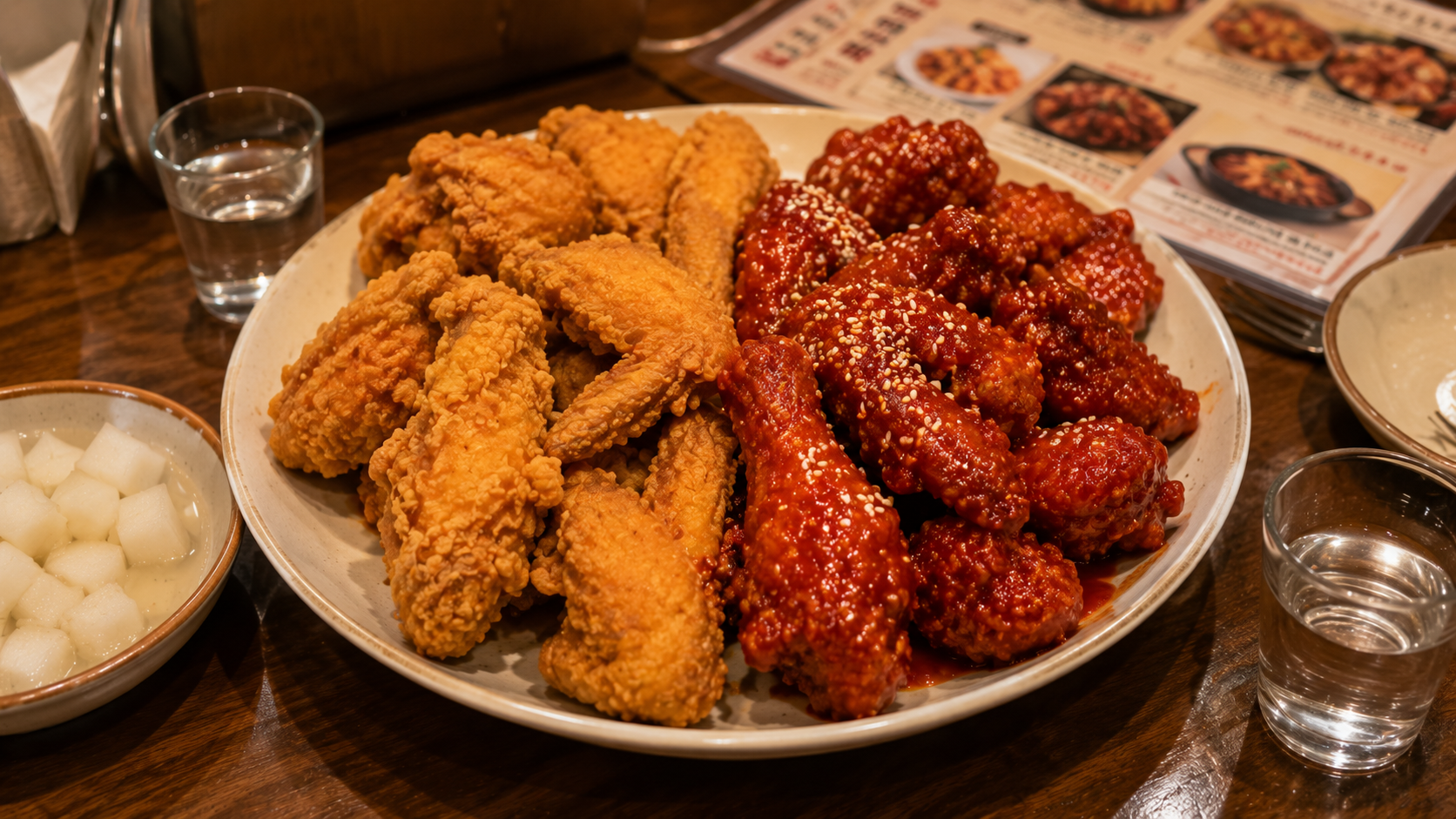
Korean fried chicken is usually ordered as a shareable box rather than as an individual meal. For a first order, choose banban chicken: half plain fried and half coated in yangnyeom sauce. One standard chicken generally suits two moderately hungry adults, although portion sizes vary considerably by restaurant.
At a glance
| Question | Practical answer |
|---|---|
| What should a first-time visitor order? | Banban: half fried, half yangnyeom |
| Bone-in or boneless? | Bone-in for varied pieces; boneless for easier sharing |
| How much for two people? | Start with one standard chicken and add a side only if needed |
| Typical budget | Roughly KRW 20,000-30,000 for a main chicken order, before drinks and delivery fees |
| Is yangnyeom very spicy? | Often sweet and mildly spicy, but heat levels vary |
| What is chimaek? | Chicken plus maekju, the Korean word for beer |
| Do you need a reservation? | Usually not at casual neighborhood shops |
| Can visitors order delivery? | Yes, but address entry, phone verification, payment, and coverage depend on the app |
Prices and service information in this guide were checked on June 11, 2026. Restaurant prices, opening hours, delivery areas, and payment acceptance can change, so confirm them with the specific branch before ordering.
What makes Korean fried chicken different?
The Korean word chikin (치킨) normally refers to fried or oven-cooked chicken sold by specialist shops. It does not simply mean any dish containing chicken.
A common feature is a relatively thin, crisp coating that can support sauce without immediately becoming heavy. Some restaurants fry the chicken twice, but this is not a universal rule. Recipes, batters, cooking oils, piece sizes, and frying methods differ between brands and independent shops.
Chicken is commonly sold as a whole bird cut into pieces, a box of wings and drumettes, boneless pieces, or a mixed set. Pickled white radish called chikin-mu (치킨무) is a standard accompaniment at many shops. It provides a sharp, cool contrast to fried food, although some branches now charge for extra containers.
Main styles and menu words
Fried chicken: huraideu
Huraideu chikin (후라이드 치킨) is plain fried chicken without a wet coating. It may still be seasoned, and some shops serve salt or dipping sauce alongside it.
Choose this if you prefer a crisp, less sweet order or want to compare the shop's basic frying quality. Plain chicken also travels better than heavily sauced chicken when delivery takes time.
Yangnyeom chicken
Yangnyeom chikin (양념치킨) is fried chicken coated in a seasoned sauce. The familiar version is glossy, sweet, tangy, garlicky, and mildly to moderately spicy. It may contain gochujang or other chili ingredients, but there is no standard recipe.
Do not assume that every red sauce has the same heat level. Ask whether it is spicy if you are sensitive to chili:
- An maewoyo? (안 매워요?) — Is it not spicy?
- Eolmana maewoyo? (얼마나 매워요?) — How spicy is it?
- Sosseu ttaro juseyo (소스 따로 주세요) — Please put the sauce on the side.
Soy-garlic chicken
Ganjang chikin (간장치킨) uses a soy-based sauce, often with garlic and sweetness. It is usually less chili-forward than red yangnyeom, but it is not necessarily mild, low in sodium, or suitable for someone with a soy allergy.
This is a useful second flavor for a group that wants something savory without ordering another red sauce.
Spicy chicken
Menus may use words such as spicy, hot, red, bul, or maeun (매운). Heat can range from gentle sweetness to a sauce built around hot Korean peppers. Brand names do not provide a reliable cross-restaurant heat scale.
Order a small size or request sauce on the side when trying an unfamiliar hot flavor. Dairy-based dips are not automatically included.
Honey and sweet flavors
Honey, corn, cheese-seasoned, and sweet-garlic options are common. These can be noticeably sweeter than visitors expect from a main course. Powdered cheese flavors may also contain milk ingredients.
Padak
Padak (파닭) is chicken served with thinly sliced green onion, usually with a mustard, soy, or sweet dressing. Pa means green onion and dak means chicken. It can feel lighter because of the fresh topping, but the dressing may contain mustard, soy, wheat, or sugar.
Old-style whole chicken
Yetnal tongdak (옛날통닭), meaning old-fashioned whole chicken, is generally fried as a whole bird or in a simpler market-style preparation. It often has a thinner, less elaborate coating than franchise chicken.
Traditional markets are good places to look for this style. Portions and packaging may be simpler, and English menus are less likely.
Bone-in, boneless, wings, or combo?
Bone-in chicken usually includes a mixture of legs, wings, breast, and other pieces. The irregular pieces are normal and are part of ordering a cut whole bird.
Boneless chicken is called sunsal (순살). Do not assume it consists only of breast meat. Depending on the restaurant, it may contain thigh meat, breast meat, tenderloin, or a mixture. The origin of the chicken can also vary by menu item.
Wing-focused menus may use these terms:
- Wing (윙): the flatter wing section
- Bong (봉): the drumette
- Dari (다리): leg or drumstick
- Combo (콤보): commonly a mixture of popular parts, but the exact contents depend on the brand
Read the item description rather than relying only on the product name.
The easiest first order: banban
Banban (반반) means half-and-half. A classic order combines half plain fried chicken and half yangnyeom chicken in one box.
You can say:
- Banban juseyo (반반 주세요) — Half-and-half, please.
- Huraideu ban, yangnyeom ban juseyo (후라이드 반, 양념 반 주세요) — Half fried and half yangnyeom, please.
Not every size or menu line permits two flavors. Some premium combinations cost more than a single-flavor order, so check the displayed total before paying.
How much does Korean fried chicken cost?
There is no national standard price. Cost changes by brand, branch, cut, sauce, location, and whether you order through a delivery platform.
As a current official-menu example, Kyochon's Korean menu listed recommended prices of KRW 19,000 for several whole-chicken flavors, KRW 21,000 for its whole plain fried chicken, and KRW 22,000-23,000 for several sauced, boneless, or combo products when checked on June 11, 2026. The company explicitly notes that actual prices may differ by branch.
For practical budgeting, allow approximately:
| Order | Suggested budget |
|---|---|
| Standard chicken for sharing | KRW 20,000-25,000 |
| Premium cut or larger combination | KRW 22,000-30,000 or more |
| Side dish | KRW 3,000-10,000 |
| Soft drink or beer | Check the branch menu |
| Delivery | Menu markup and fees may apply |
These are planning ranges, not fixed nationwide prices. Independent market vendors may be cheaper, while specialty restaurants and central entertainment districts may cost more.
How much should you order?
A standard chicken is commonly intended for sharing. For two adults, one chicken is a sensible starting point. Add fries, tteokbokki, or another side only if both diners are particularly hungry.
For three or four adults, consider two chickens or one larger chicken set plus sides. Ordering two flavors is usually more useful than ordering several similar side dishes.
For one person, look for:
- Single or solo sets
- Half chicken
- Six-piece wing packs
- Dakgangjeong cups at markets
- Lunch portions at pubs or casual restaurants
Large boxes create substantial leftovers, and sauced chicken loses crispness during storage.
Dining in, taking away, and paying
Dine-in
Most casual chicken shops do not require reservations, although popular branches can fill during weekend evenings, major football matches, and public events. Some branches primarily handle delivery and have little or no seating.
At the door, say meogeul geoyeyo (먹을 거예요), meaning you will eat there. Staff may direct you to a table and ask you to order through a tablet or QR code.
Takeaway
Takeaway is pojang (포장). Say pojanghae juseyo (포장해 주세요), meaning please pack it to go.
Ordering directly from the branch can avoid delivery fees and may produce crisper chicken. Ask for an estimated preparation time because chicken is often cooked after the order is placed.
Payment
Cards are widely used at established restaurants, but foreign-issued cards can occasionally fail at staffed or self-service terminals. Carry another card and some KRW as backup. Mobile payment options shown on a Korean terminal may require a locally supported account.
Always review the final amount for optional sides, extra sauce, drinks, delivery charges, and disposable-item fees.
Ordering delivery as a visitor
Korean delivery apps may require a Korean mobile number, address verification, account registration, or a locally accepted payment method. Requirements can change, and successful registration does not guarantee that every restaurant accepts the same payment options.
A practical sequence is:
- Copy your accommodation's Korean address from its booking page or ask reception for it.
- Include the building name, room number, and entrance instructions.
- Check whether the restaurant delivers directly before creating an app account.
- Confirm the delivery fee and estimated arrival time.
- Keep your phone available in case the rider cannot find the entrance.
- Meet the rider in the lobby if the property restricts access to guest floors.
Shuttle Delivery offered an English interface, delivery and pickup, and listed credit cards and PayPal among its payment methods when checked on June 11, 2026. Its official site listed service in selected communities in Seoul, Osan, Pyeongtaek, Daegu, and Busan, rather than nationwide coverage. Restaurant availability and operating times depend on the entered address.
Hotels and guesthouses do not all handle delivery in the same way. Ask the property where riders should leave food and whether lobby collection is required. Do not use an outdoor landmark as a delivery point unless the app and restaurant clearly support it.
Chimaek: chicken and beer
Chimaek (치맥) combines chi from chikin and maek from maekju (맥주), meaning beer. It describes the familiar pairing of fried chicken and beer, not a specific recipe or set menu.
Beer is optional. Soft drinks and sparkling water are normal alternatives, and there is no expectation that everyone at the table must drink alcohol. Bring identification if ordering alcohol because staff may request age verification.
Public drinking rules and enforcement can depend on the location. Do not assume that alcohol is permitted in every park, beach, stadium, riverside area, or event zone. Follow posted signs and local instructions, and remove all food packaging when you leave.
Allergies and dietary restrictions
Korean fried chicken is difficult to treat as allergen-free without direct confirmation. Batter, seasoning powders, marinades, sauces, frying oil, and shared preparation equipment can introduce multiple ingredients.
Potential concerns include:
- Wheat in flour, batter, soy sauce, or seasoning
- Soy in ganjang sauces and marinades
- Milk in cheese powder, creamy dips, or some batters
- Egg in batter, mayonnaise, or sauces
- Peanuts or tree nuts in specialty sauces
- Sesame in sauces, garnishes, or oil
- Mustard in padak dressing or dips
- Cross-contact in shared fryers and kitchens
Gluten-free, halal, vegetarian, and vegan claims should not be inferred from the menu name. Chicken described as plain may still be marinated or dusted with wheat-based ingredients. Halal meat certification also does not automatically mean that the complete restaurant operation, sauce, or fryer meets a diner's requirements.
For a serious allergy, ask the restaurant to confirm ingredients and cross-contact procedures. If staff cannot verify them clearly, choose another meal. The Ministry of Food and Drug Safety is South Korea's official national food-safety authority, but it cannot confirm the recipe used by an individual branch.
Common ordering mistakes
- Assuming yangnyeom always means extremely spicy: it often emphasizes sweetness, but recipes vary.
- Assuming boneless means breast meat: the cut depends on the product.
- Ordering one chicken per person: many standard boxes are designed for sharing.
- Forgetting delivery charges: app totals can exceed the in-store menu price.
- Using only a Romanized address: riders and restaurant staff generally work more easily with the Korean address.
- Expecting every branch of a chain to have identical prices, hours, seating, or stock.
- Treating powder-coated flavors as allergen-free because they have no wet sauce.
- Ordering too many sweet flavors: balance one sweet or spicy chicken with a plain or soy-based choice.
What to check before you go
- Confirm the branch's current opening time and final order time.
- Check whether the location has dine-in seating.
- Review recent branch information on Naver Map or KakaoMap, not just the chain's general website.
- Confirm the exact cut: whole bird, boneless, wings, legs, or combo.
- Ask whether banban is available for your chosen size.
- Check ingredients directly if you have allergies or dietary restrictions.
- Compare pickup and delivery totals.
- Save the Korean address of your accommodation before ordering delivery.
- Carry a backup payment method.
- Order earlier than usual during major televised matches or local festivals.
FAQ
Is Korean fried chicken always double-fried?
No. Double-frying is associated with some Korean fried chicken, but preparation methods vary. A restaurant may use a different frying schedule, batter, starch mixture, or oven-finishing process.
Is one chicken enough for two people?
Usually, one standard chicken is a reasonable starting order for two adults. Portion weights and piece counts vary, so check the menu description when available.
Can I order only drumsticks or wings?
Often, yes. Look for dari, stick, wing, bong, or combo menus. These products may cost more than a mixed whole bird.
Is Korean fried chicken halal?
Do not assume so. Ask for current certification and confirm the chicken, sauces, preparation area, and fryer according to your own requirements.
What should I order if I cannot eat spicy food?
Start with plain fried chicken or ask about a mild soy-garlic flavor. Request sauce separately when possible, but still confirm ingredients and chili use with the restaurant.
Where should a first-time visitor begin?
Find a well-reviewed branch near your accommodation and order one banban chicken: half plain fried and half yangnyeom. Choose pickup if it is nearby, add one container of pickled radish, and compare the two styles while they are still hot.