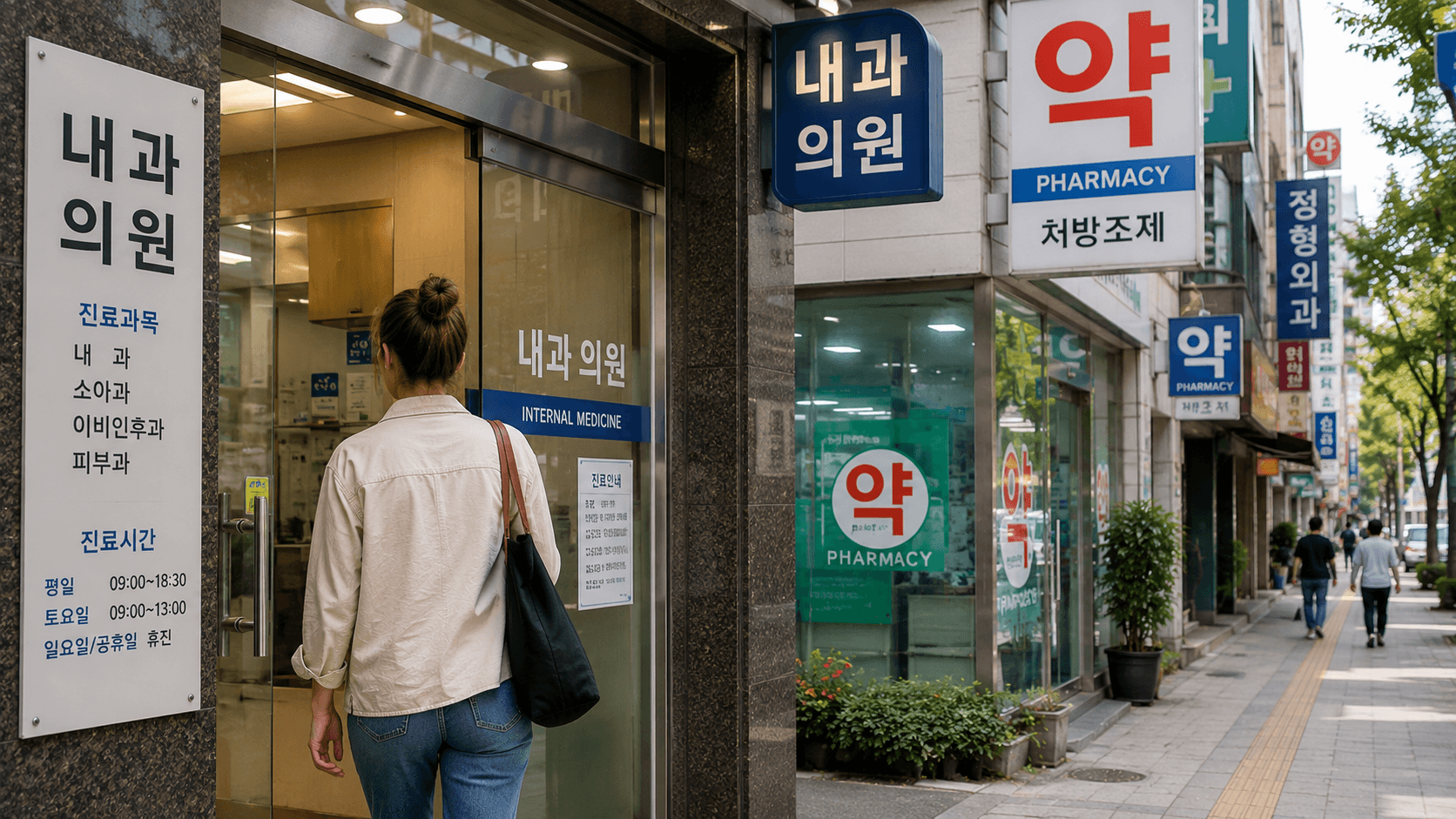
South Korea has an extensive network of neighborhood clinics, specialist practices, hospitals, pharmacies, and emergency departments. Visitors can receive treatment without Korean National Health Insurance, but they normally pay the full bill and seek reimbursement from travel or private insurance. Eligible foreign residents may be enrolled in National Health Insurance and receive the same covered benefits as Korean citizens.
Healthcare rules, charges, and operating hours can change. Insurance and emergency information in this guide was verified on June 10, 2026; confirm your individual status with the relevant official authority.
At a glance
| Situation | What to do |
|---|---|
| Minor illness or routine problem | Visit a local clinic marked 의원, ideally during weekday hours |
| Specialist problem | Search for a clinic in the relevant department and ask whether an appointment is required |
| Medicine | Take the doctor’s prescription to a pharmacy marked 약국 |
| Serious or life-threatening emergency | Call 119 for an ambulance |
| Unsure about National Health Insurance | Call NHIS at 1577-1000 or its English consultation number, 033-811-2000 |
| Need a facility with language support | Search the official Medical Korea hospital directories and confirm by telephone |
| Tourist needing general interpretation help | Contact the 1330 Korea Travel Helpline; do not use it instead of 119 in an emergency |
How the Korean healthcare system is organized
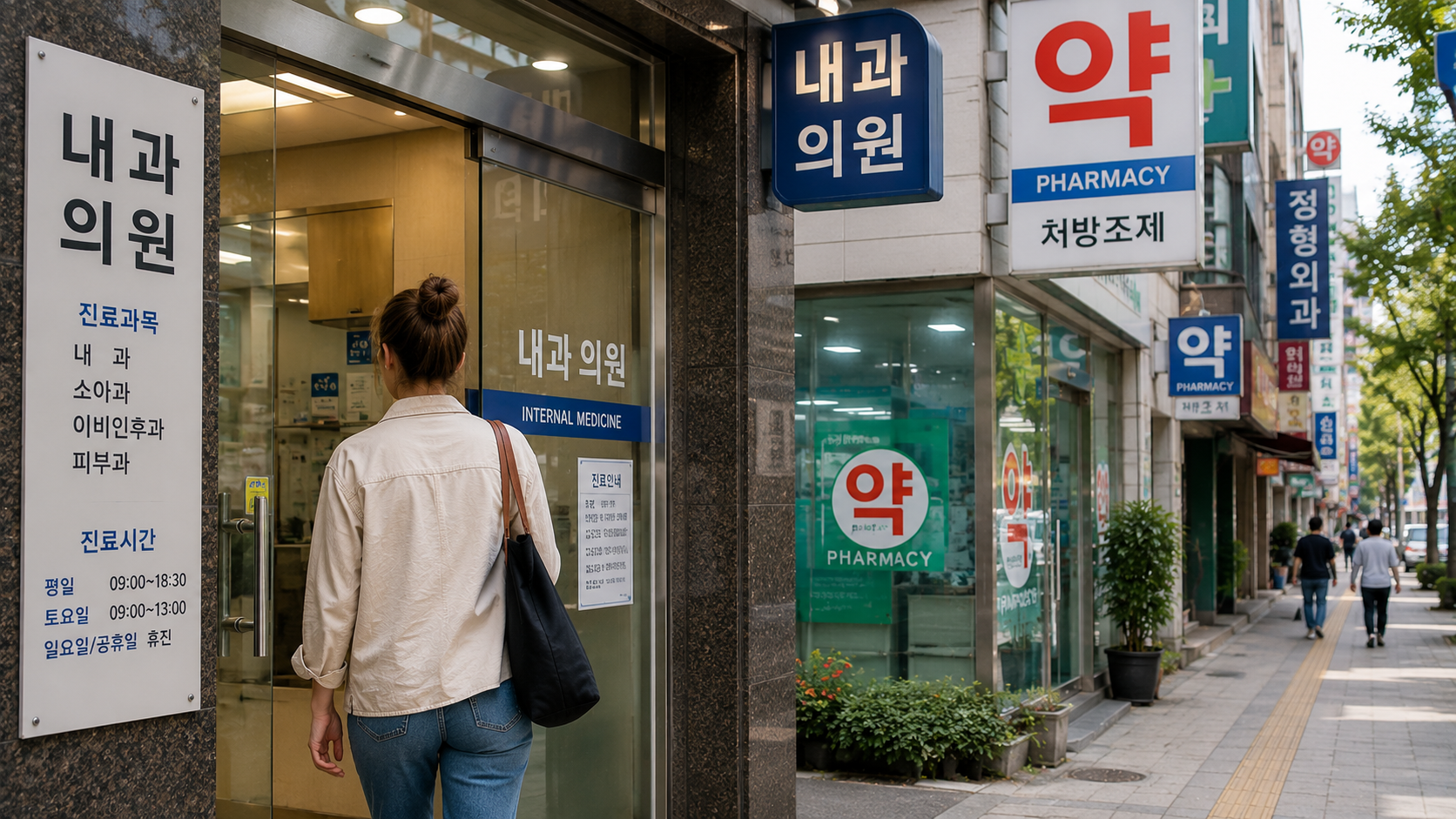
Most patients begin at a neighborhood clinic, called an uiwon (의원). These clinics usually concentrate on one department, such as internal medicine, dermatology, orthopedics, pediatrics, ophthalmology, or ear, nose, and throat care. They are generally the most practical starting point for a non-emergency illness.
Larger facilities include hospitals (byeongwon, 병원), general hospitals (jonghap byeongwon, 종합병원), and tertiary general hospitals (sanggeup jonghap byeongwon, 상급종합병원). University hospitals and major medical centers handle complex treatment, surgery, severe illness, and referrals from smaller providers.
The Health Insurance Review and Assessment Service, known as HIRA, reviews National Health Insurance claims and assesses healthcare services. The National Health Insurance Service, or NHIS, administers insurance eligibility, contributions, and benefits.
Where should you go first?
Use a local clinic for problems such as:
- Cold or flu symptoms
- Mild stomach problems
- Skin conditions
- Ear or throat pain
- Minor sprains or joint pain
- Routine prescriptions
- Follow-up care that does not require a major hospital
Consider a general or tertiary hospital when you have a referral, need complex diagnostic work, require surgery or inpatient care, or have a serious condition that cannot be managed locally. Large hospitals may require an appointment, referral document, or advance registration with an international clinic.
Going directly to a major hospital can mean a higher bill, a longer wait, and more complicated registration. Under NHIS, outpatient co-payment rates also vary by facility level. The NHIS benefits guide lists higher standard co-payment percentages for larger institutions than for clinics, although the amount actually charged depends on the service and whether it is covered.
National Health Insurance for foreign residents
South Korea’s public system is called National Health Insurance, commonly shortened to NHI or NHIS. Your eligibility and enrollment date depend on your residence status, employment, visa category, and other circumstances.
Employees
Foreign nationals working at an insured workplace are generally enrolled as employee-insured members. According to the NHIS guidance for foreigners, the employee and employer each pay 50% of the employee’s health insurance contribution, normally through payroll deductions.
Do not assume that employment automatically means the paperwork has been completed. Check your payslip and ask your employer when coverage began, particularly after changing jobs or visa status.
Other long-term residents
As a general rule, eligible registered foreign residents who are not insured through an employer become subject to mandatory self-employed enrollment after staying in Korea for more than six months. Different timing or treatment can apply to particular visa categories and personal circumstances.
The NHIS English webpage contains some legacy implementation dates alongside current guidance. For that reason, confirm your exact enrollment date directly with NHIS rather than relying only on a general online summary.
Students and exchange students
University students should ask both their university’s international office and NHIS about their status. A university insurance plan, private student policy, and Korean National Health Insurance are not necessarily interchangeable. Confirm:
- Whether you are enrolled in NHIS
- The date coverage starts
- How contributions are billed
- Whether a university policy remains active
- Which services each policy excludes
Tourists and short-term visitors
Tourists are not normally enrolled in Korean National Health Insurance simply because they enter the country. Clinics and hospitals can still treat foreign visitors, but the patient usually pays the provider directly.
Travel insurance is therefore important. Check whether your policy requires you to contact an assistance center before non-emergency hospital treatment and whether it covers pre-existing conditions, outpatient care, prescriptions, medical evacuation, and sports-related injuries.
What NHIS covers
The NHIS insurance benefits page identifies covered healthcare benefits such as diagnosis, testing, treatment, surgery, rehabilitation, hospitalization, and certain health screenings. Foreign members receive the same NHI coverage framework as Korean citizens, according to the agency’s foreign-resident guidance.
NHIS does not make every service free. Patients pay co-payments, and some treatments, medicines, room upgrades, certificates, and optional services may be wholly or partly non-covered. Ask the provider to distinguish between:
- Covered care: 급여 (geubyeo)
- Non-covered care: 비급여 (bigeubyeo)
Before an expensive test or procedure, ask for an estimate showing both categories.
Getting help from NHIS
As verified on June 10, 2026, the NHIS English website lists:
- General call center: 1577-1000
- English consultation: 033-811-2000
NHIS also operates centers for foreign residents. Locations and the residential areas handled by each center can change, so check the official page before visiting.
How to visit a clinic
1. Find the correct department
Useful department names include:
| English | Korean |
|---|---|
| Internal medicine | 내과 |
| Family medicine | 가정의학과 |
| Pediatrics | 소아청소년과 |
| Dermatology | 피부과 |
| Orthopedics | 정형외과 |
| Ear, nose, and throat | 이비인후과 |
| Ophthalmology | 안과 |
| Obstetrics and gynecology | 산부인과 |
| Psychiatry | 정신건강의학과 |
| Dentistry | 치과 |
For symptoms that do not clearly belong to one specialty, internal medicine or family medicine is usually a practical starting point.
2. Check hours and language support
Clinic hours vary, and reception may close before the displayed end of consultation. Lunch breaks are common. Telephone the clinic on the same day to confirm:
- Opening and reception hours
- Lunch break
- Whether walk-ins are accepted
- Whether a doctor or staff member can communicate in your language
- Whether interpretation must be booked
- What identification and insurance documents are required
The official Medical Korea registered-hospital directory can be filtered by region and facility type. Its separate accredited-hospital directory includes language filters. Directory inclusion does not guarantee that an interpreter is immediately available, so call first.
3. Bring the right information
Take:
- Passport or Residence Card, if issued
- NHIS eligibility information or insurance card details
- Travel or private insurance certificate
- List of medicines, active ingredients, and dosages
- Allergy and chronic-condition information
- Previous test results or referral letters
- A payment card and another payment method if possible
Medicine brand names differ between countries. Listing the active ingredient is more useful than showing only a foreign brand name.
4. Register and ask about charges
At reception, you may be asked to complete a short registration form and describe your main symptom. Before non-urgent tests or treatment, ask:
- Is this covered by NHIS?
- Is any part non-covered?
- What is the estimated patient payment?
- Will I receive an itemized receipt?
- Can you issue documents in English?
International clinics at major hospitals may have separate fees or billing procedures. Confirm these when booking.
5. Pay and collect documents
Patients commonly pay after the consultation. Keep the itemized bill, receipt, prescription, medical certificate, and any test results needed for insurance reimbursement.
Ask for documents before leaving. Returning later for an English certificate, imaging copy, or detailed statement may involve another fee and processing time.
Pharmacies and prescriptions
A pharmacy is marked 약국 (yakguk). In the usual outpatient process, the clinic gives you a prescription and you take it to a pharmacy, often located in the same building or nearby.
The pharmacy dispenses the medicine and charges separately from the clinic. Under NHIS, covered pharmacy costs generally involve a patient co-payment; uninsured visitors pay the applicable price themselves.
Pharmacists may package tablets into small dated or timed sachets. Check the instructions before leaving, especially:
- How many times a day to take each dose
- Whether to take it before or after food
- Whether the medicine causes drowsiness
- Whether it conflicts with alcohol, pregnancy, allergies, or current medication
- How it should be stored
Do not assume a medicine sold over the counter in your home country is available without a prescription in Korea. Likewise, foreign prescriptions may not automatically be dispensable. A Korean doctor may need to assess you and issue a local prescription.
If bringing medication into Korea, retain the original packaging and prescription documentation. Controlled or narcotic medicines can be subject to special permission. Check directly with the Ministry of Food and Drug Safety and Korea Customs before traveling; do not rely solely on airline or online-forum advice.
Costs and payment
There is no reliable single price for a clinic visit. The total depends on insurance status, facility level, consultation type, tests, imaging, treatment, prescription, and whether each item is covered.
As verified on June 10, 2026, NHIS publishes standard co-payment structures but not a universal final price for every visit. Its benefits page lists a standard 30% outpatient co-payment for clinics and 30% for covered pharmacy expenses, with higher percentages at larger hospitals. Exceptions and separate rules apply, so treat these figures as a framework rather than a quotation.
Uninsured patients should request an estimate. For planned procedures, ask for a written breakdown including consultations, anesthesia, implants or materials, hospital rooms, medicines, follow-up care, and certificates.
Korean credit and debit cards are widely used at medical facilities, but acceptance of a particular foreign card is not guaranteed. Carry an alternative payment method. Direct billing to overseas insurers is not universal; many patients pay first and claim later.
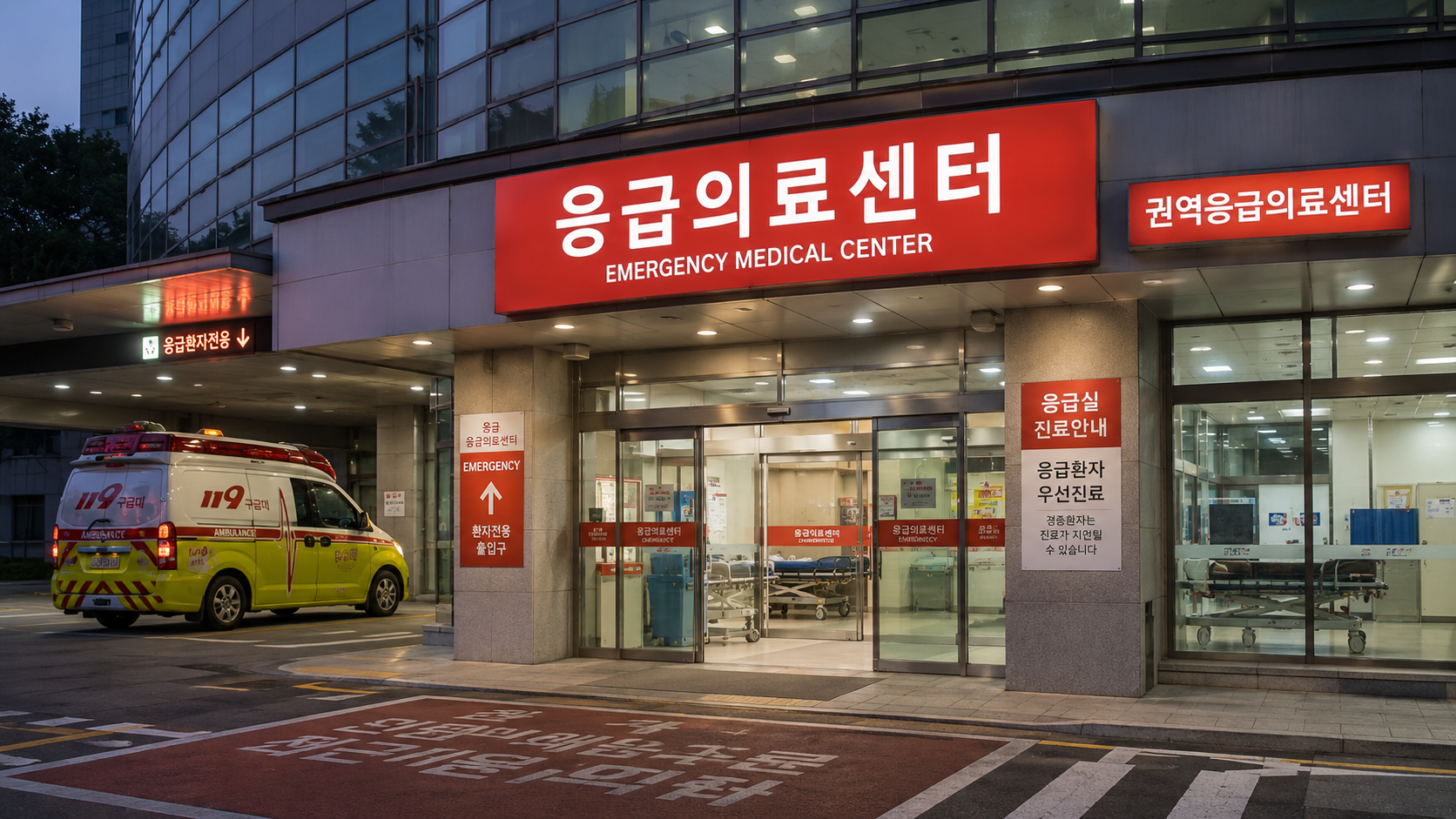
Emergencies and urgent care
Call 119 for an ambulance or a life-threatening medical emergency. The National Fire Agency operates Korea’s public emergency medical response system. Give the dispatcher:
- Your location or a nearby landmark
- Your telephone number
- What happened
- The patient’s age and condition
- Whether the patient is conscious and breathing
If you cannot pronounce the address, show it to a nearby Korean speaker or read the Korean address from a map app. Stay on the line and follow the dispatcher’s instructions.
Go directly to emergency care for warning signs such as severe breathing difficulty, major trauma, loss of consciousness, symptoms of stroke, uncontrolled bleeding, or severe chest pain. This is general safety information, not a diagnosis.
Emergency departments prioritize patients by medical urgency, not arrival order. A long wait is possible for a condition assessed as non-critical. Ambulance transport also does not guarantee immediate treatment at the first hospital considered; the emergency team may need to locate a facility able to accept the patient.
For general tourist information or interpretation support, the Korea Tourism Organization operates the 1330 Korea Travel Helpline. As verified on June 10, 2026, it can be reached by dialing 1330 within Korea and also offers online call and chat options. In a medical emergency, call 119 first.
Language and accessibility
English ability varies considerably. Large hospitals may have international healthcare centers, while a small clinic may have no dedicated interpreter.
Practical preparation helps:
- Write symptoms and their duration in simple sentences.
- Save your address and emergency contact in Korean.
- Keep translated allergy and medication information on your phone.
- Ask whether professional interpretation is available for consent discussions or complex treatment.
- Do not rely only on machine translation for surgery, medication risks, or legally significant consent forms.
Accessibility also varies between older clinics and modern hospitals. If you use a wheelchair, need step-free access, or require another accommodation, call before traveling and confirm the route from the entrance to the department.
Common mistakes to avoid
- Going to a major university hospital for a minor illness without checking referral or appointment requirements
- Assuming every doctor speaks English
- Arriving shortly before closing or during lunch break
- Forgetting your passport, Residence Card, or insurance details
- Agreeing to non-urgent tests without asking whether they are non-covered
- Leaving without an itemized bill needed for reimbursement
- Assuming travel insurance will pay the hospital directly
- Bringing controlled medication without checking Korean rules
- Using 1330 instead of 119 during a genuine emergency
What to check before you go
Before traveling to Korea
- Buy travel insurance appropriate for your health and planned activities.
- Record your insurer’s emergency-assistance number.
- Prepare a medication and allergy list using generic ingredient names.
- Check import requirements for controlled medication.
- Save 119 and the Korean address of your accommodation.
Before a clinic appointment
- Confirm hours, lunch break, appointments, and language support.
- Ask what identification is required.
- Bring insurance documents and relevant medical records.
- Prepare a short symptom timeline.
- Ask whether the clinic can issue English documents.
Before a test, procedure, or admission
- Request an estimated cost.
- Identify covered and non-covered items.
- Confirm interpreter arrangements.
- Ask about deposits and payment deadlines.
- Check what follow-up care and medicines are included.
FAQ
Can a tourist see a doctor in South Korea?
Yes. Tourists can use clinics and hospitals, but they generally pay without NHIS coverage and then apply to their travel insurer for reimbursement, subject to their policy.
Do I need an appointment for a Korean clinic?
Many neighborhood clinics accept walk-ins, but this is not universal. Specialist clinics, international centers, and major hospitals are more likely to require appointments. Call first.
Can I go straight to a university hospital?
It may be possible, but referral requirements, higher co-payments, appointment rules, and department restrictions can apply. For non-emergency care, contact the hospital before going.
Is healthcare free under Korean National Health Insurance?
No. NHIS members normally pay co-payments, and non-covered services may be charged in full. Ask for a cost estimate when treatment is not routine.
How do I confirm whether I am insured?
Contact NHIS rather than relying only on your employer, university, or visa assumptions. As verified on June 10, 2026, NHIS lists 1577-1000 as its general call center and 033-811-2000 for English consultation.
Sources
- National Health Insurance Service: Guidance for Foreigners
- National Health Insurance Service: Insurance Benefits
- National Health Insurance Service: Centers for Foreign Residents
- Health Insurance Review and Assessment Service
- National Fire Agency: Public Emergency Medical Services
- Medical Korea: Registered Hospitals
- Medical Korea: Accredited Hospitals and Interpretation Filters
- Korea Tourism Organization: 1330 Travel Helpline
Your most useful next step as a resident is to call NHIS and confirm your enrollment date, contribution status, and registered address. Visitors should save their insurer’s assistance number and 119 before beginning their trip.