A Korean jjimjilbang (찜질방) combines a public bathhouse with clothed, shared relaxation areas. The bathing section is usually separated by gender and requires full nudity, while the communal sauna rooms, lounges, and restaurants are generally mixed-gender spaces where everyone wears the facility’s T-shirt and shorts.
The system is manageable once you understand the sequence: pay, remove your shoes, store your belongings, wash thoroughly, use the baths, put on the provided clothes, and enter the communal area.
At a glance
| Question | Practical answer |
|---|---|
| Do I need a reservation? | Usually not for ordinary admission, but treatments and premium facilities may require one. |
| Is nudity required? | Yes in the gender-separated bathing area. Swimwear and underwear are normally not worn there. |
| Are the sauna rooms mixed-gender? | Usually yes. Wear the provided shirt and shorts. |
| Are towels provided? | Usually, but size and quantity vary. |
| Can I stay overnight? | Only if the facility specifically permits it. Do not assume that every late-opening sauna allows sleeping. |
| Can I pay by card? | Korean cards are widely accepted, but foreign-card acceptance and cashless policies vary. Carry another payment option. |
| How long should I allow? | Two to four hours is comfortable for a first visit. |
| Do staff speak English? | Sometimes at large tourist-oriented facilities, but not reliably at neighborhood bathhouses. |
Operating hours, admission prices, re-entry rules, child policies, and overnight access are set by each business. They were not nationally standardized when checked on June 11, 2026, so verify these details directly with the facility on the day of your visit.
What is a jjimjilbang?
The word jjimjilbang roughly refers to a heated room or sauna room. In everyday use, however, it usually means an entire Korean bathing and relaxation complex.
A typical facility has two main zones:
- A gender-separated wet area with showers, hot and cold baths, and sometimes steam rooms or dry saunas
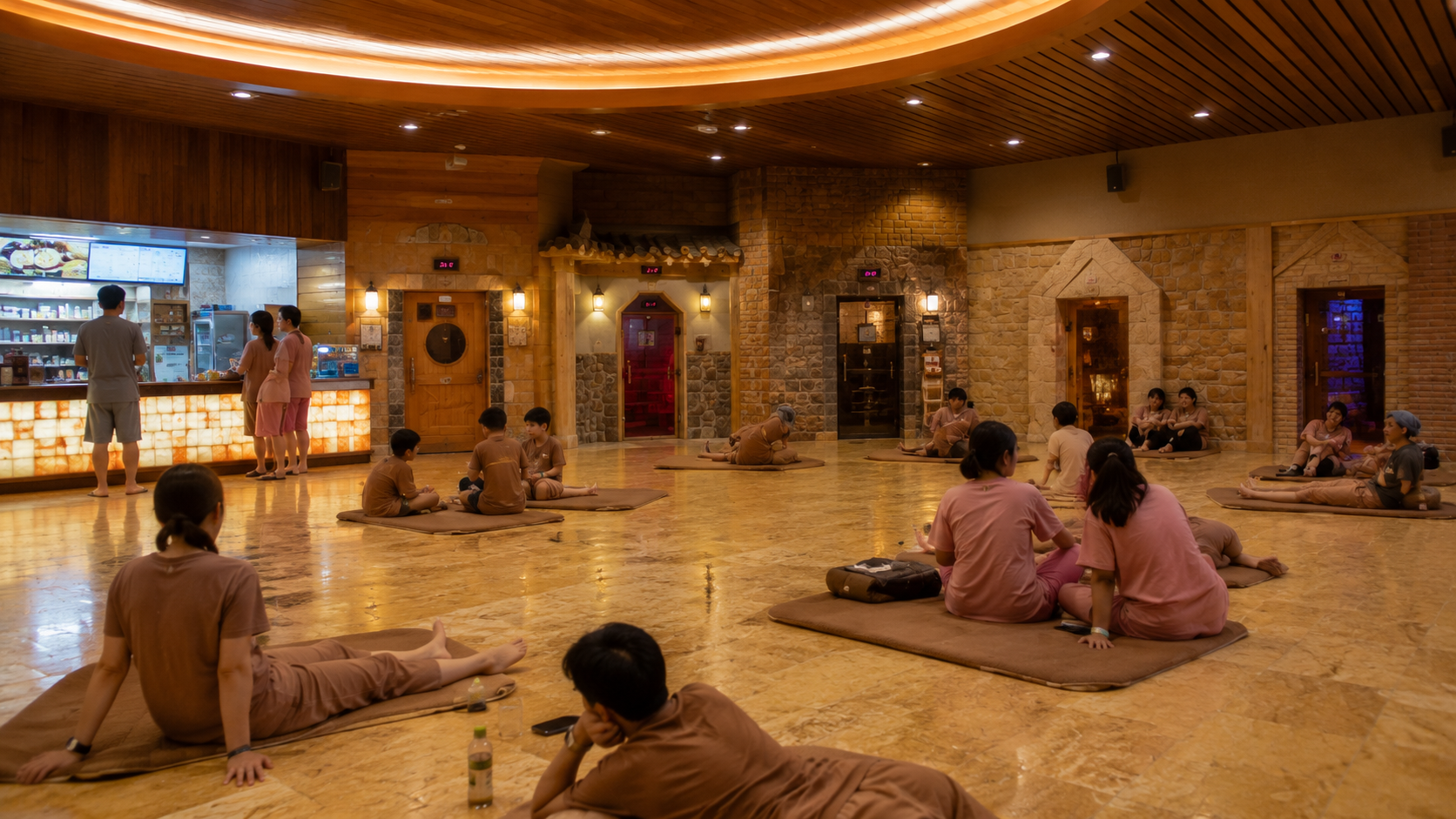
- A clothed communal area with heated rooms, cooling rooms, floor lounges, television, food, massage chairs, or sleeping spaces
Facilities differ considerably. A small neighborhood establishment may mainly be a bathhouse, while a large suburban or resort complex can include restaurants, children’s areas, outdoor pools, entertainment, and spa treatments.
A mogyoktang (목욕탕) is primarily a public bathhouse. It may have hot baths and a sauna but no substantial mixed-gender lounge. Check photographs and facility descriptions rather than assuming that every place labeled sauna offers the full jjimjilbang experience.
Before choosing a facility
Search the Korean name of the business in Naver Map or KakaoMap, as local listings and recent Korean reviews may be more complete than international map results. Useful Korean search terms include:
- 찜질방: jjimjilbang
- 사우나: sauna
- 목욕탕: public bathhouse
- 이용요금: admission fee
- 영업시간: operating hours
- 주차: parking
- 수면실: sleeping room
- 외국인: foreign visitor
Confirm the following before traveling across town:
- Current operating hours: Some older guides still describe jjimjilbangs as universally open 24 hours. That is no longer a safe assumption.
- Last admission: The doors may close to new customers before the facility itself closes.
- Bath and sauna access: Some businesses sell separate wet-area and full jjimjil-spa tickets.
- Overnight policy: Late opening does not automatically mean sleeping is allowed.
- Luggage storage: Shoe and clothing lockers may not fit a large suitcase.
- Tattoo policy: Rules are set by individual operators and may not appear online.
- Child and family rules: Ask about age restrictions for entering an opposite-gender bath, children’s admission, and supervision requirements.
- Maintenance closures: Bathhouses may close regularly for cleaning or maintenance.
The Korea Tourism Organization’s 1330 Korea Travel Helpline provides travel information and multilingual interpretation by telephone and online chat. As verified on June 11, 2026, the listed numbers were 1330 within Korea and +82-2-1330 from overseas.
What to bring
Most visitors need very little:
- A payment card plus some cash as a backup
- Basic toiletries if you prefer your own products
- A hair tie for long hair
- Clean underwear for afterward
- A small waterproof pouch if you need glasses or essential items nearby
- A sealable bag for wet personal items
- Your facility name and address written in Korean
Large jjimjilbangs normally provide lounge clothes and small towels. Shampoo, conditioner, soap, toothbrushes, razors, exfoliating mitts, and larger towels may be supplied, sold, or unavailable depending on the business.
Do not bring valuables unless necessary. Locker security is generally straightforward, but a jjimjilbang is still a public space. Keep your locker key or electronic wristband attached to you, and do not leave your phone unattended while sleeping or charging.
Step-by-step: entering a jjimjilbang
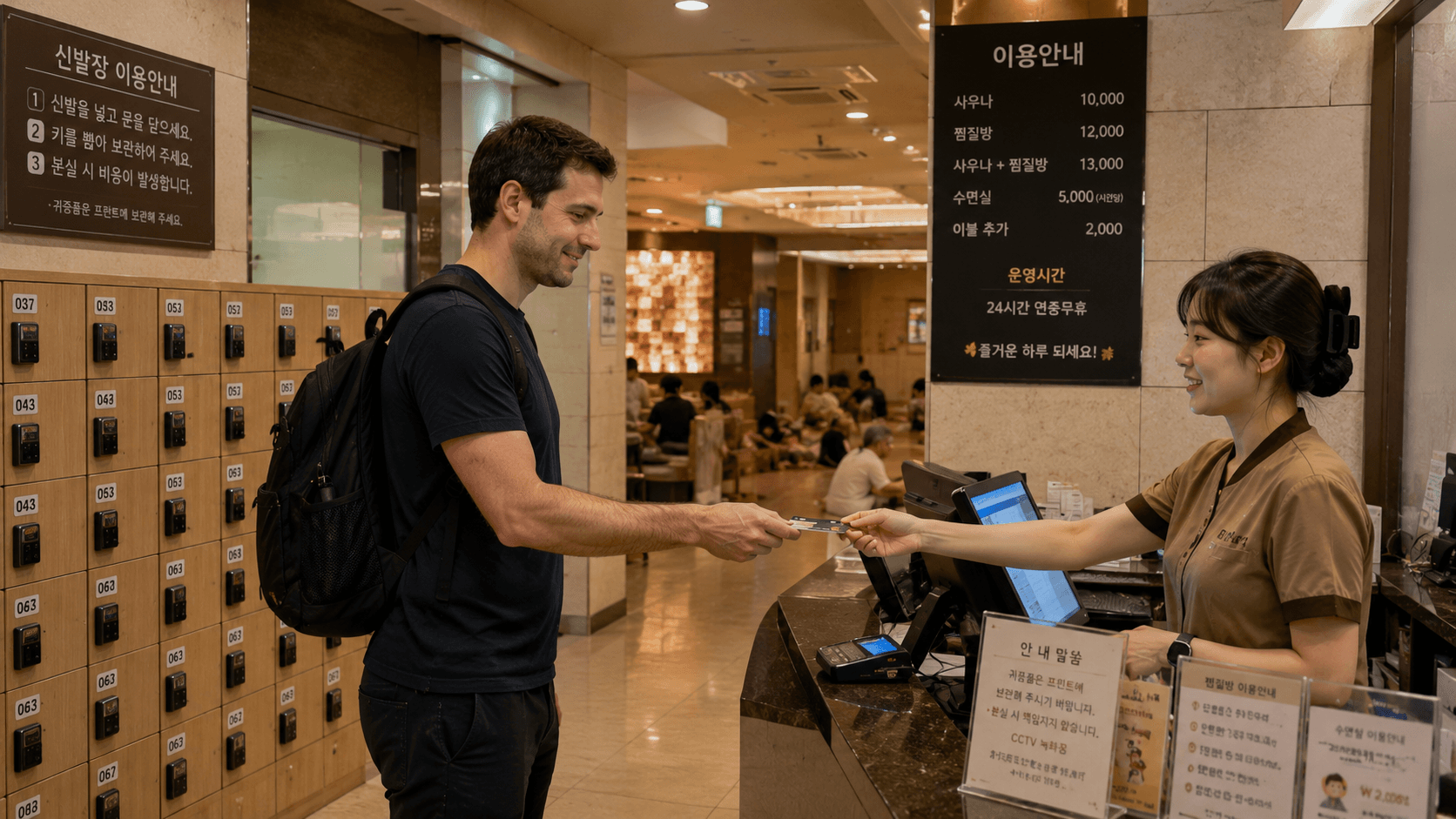
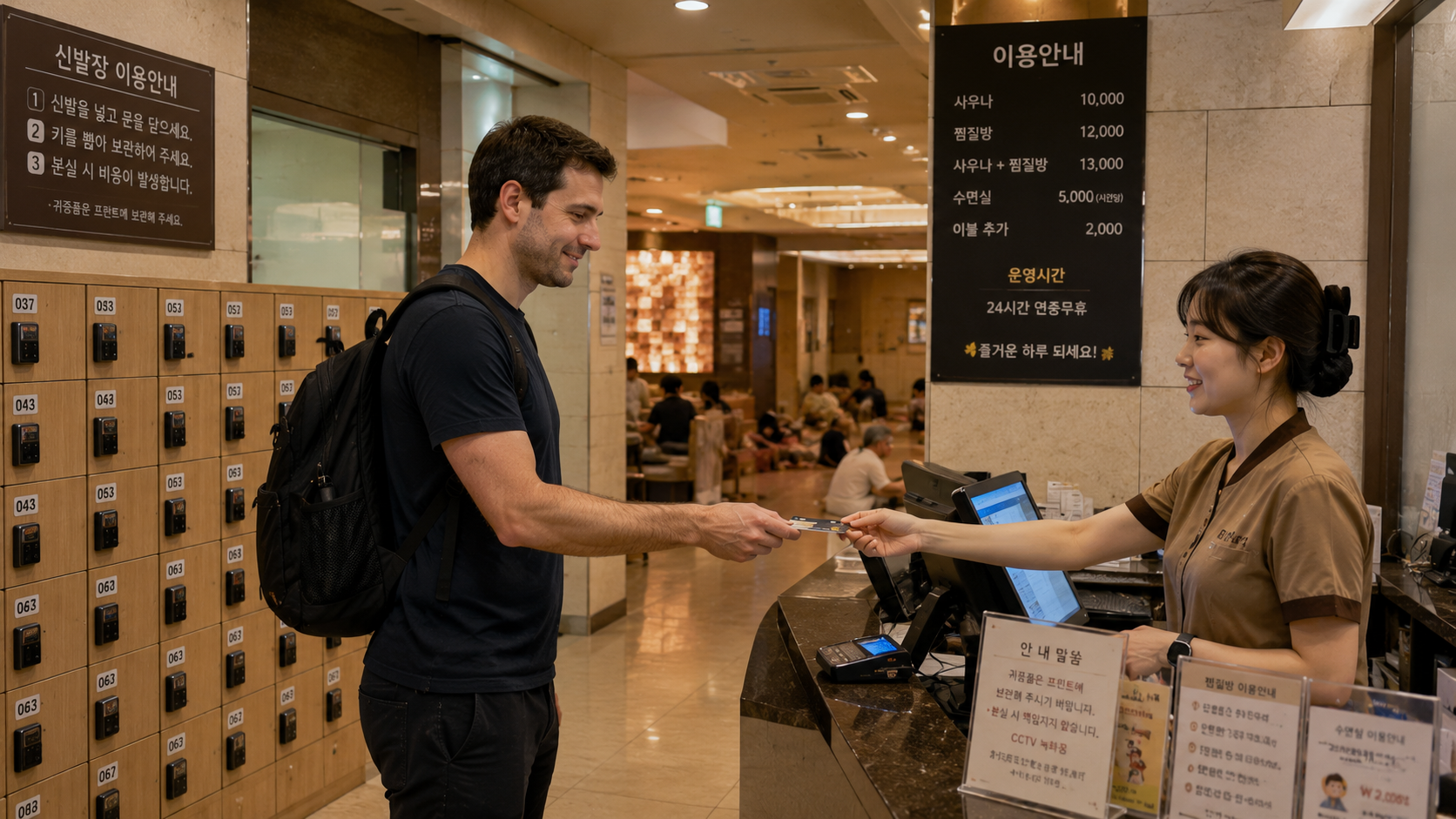
1. Pay at reception
Tell the receptionist how many adults and children are entering. Clarify whether you want bath-only admission or access to the jjimjil area if more than one ticket is offered.
You will generally receive a locker key or electronic wristband, lounge clothes, and one or more small towels. The wristband may also record food and service purchases for payment when you leave. Ask before using it if the billing process is unclear.
Admission fees vary too widely by location and facility type for a useful nationwide price to be stated. Check the operator’s official site or current local listing. Prices and reservation conditions should be treated as verified only for the date shown by that operator.
2. Remove your shoes
The shoe lockers are normally near the entrance. Take off your shoes before stepping onto the raised indoor floor, place them in the numbered locker, and lock it.
At some establishments, you hand the shoe-locker key to the changing-room desk and receive another key. At others, one wristband operates everything.
3. Enter the correct changing room
Follow the signs for 남탕 or 남자, meaning the men’s bath, and 여탕 or 여자, meaning the women’s bath. Staff may point you toward the correct entrance.
Gender arrangements are usually binary and based on the facility’s operating policy. Transgender, nonbinary, and intersex visitors should contact the business privately before visiting rather than relying on general assumptions. Ask what changing and bathing options are available and decide whether the answer meets your privacy and safety needs.
4. Store all clothing and belongings
Find the locker matching your key number. Remove all clothing before entering the wet area. The small towel is carried with you; lounge clothes remain in the locker until you finish bathing.
Phones and cameras should stay stored. Photography in changing rooms and bathing areas is inappropriate and may violate privacy laws or facility rules.
5. Wash before entering a bath
This is the essential rule. Sit or stand at an open shower station and wash your body thoroughly with soap. Rinse away all soap before entering a shared pool.
Keep the small towel out of the bathwater. You can place it beside the pool or fold it on your head. Tie up long hair so it does not trail in the water.
6. Use the baths at your own pace
Baths may include warm, hot, cold, herbal, bubbling, or open-air pools. Temperatures are often displayed near the water, although signs may be in Korean.
Enter slowly and avoid treating heat endurance as a challenge. Move to a cooler area if you feel dizzy, nauseated, unusually tired, short of breath, or light-headed. Drink water and seek staff assistance if symptoms continue.
People who are pregnant or who have cardiovascular, blood-pressure, respiratory, skin, or other medical concerns should ask a qualified medical professional whether hot baths and saunas are appropriate. This guide is not medical advice.
7. Dry off before returning to the locker area
Use the small towel to remove excess water before walking back into the dry changing area. This reduces slippery floors and is basic courtesy.
Put on the provided T-shirt and shorts if you plan to enter the communal jjimjil area.
8. Enter the communal sauna area
The shared area may contain rooms heated with stone, salt, clay, charcoal, or other materials. Temperatures should be posted outside each room. Start with a moderate room and take cooling breaks.
You can sit or lie on a mat, but avoid blocking the doorway or taking more floor space than necessary when the room is busy. Conversation is acceptable in many facilities, though voices should stay low in sleeping and quiet areas.
Food and additional services
Common jjimjilbang foods include baked eggs, noodles, seaweed soup, dumplings, and sikhye (식혜), a sweet chilled rice drink. Menus and availability vary.
You may pay immediately or scan your wristband and settle the total when leaving. Check the amount before confirming, especially when ordering through a Korean-language kiosk.
Body scrubbing, called seshin (세신) or sometimes ttaemiri (때밀이), is usually offered inside the gender-separated bath area. It is a vigorous exfoliation performed on a dedicated table after you have soaked. It is normally charged separately.
Do not assume that massage, scrubbing, barbering, or beauty treatments are included in admission. Ask about the price, waiting time, payment method, and whether a reservation is required before beginning.
Etiquette that matters
Follow these basic rules and you are unlikely to cause problems:
- Wash completely before entering any shared bath.
- Do not wear a swimsuit in the ordinary bathing area unless the facility specifically requires one.
- Keep towels, soap, and hair out of the bathwater.
- Do not stare at other bathers.
- Never take photographs or video in wet areas, changing rooms, or sleeping spaces.
- Keep your voice and phone audio low.
- Do not reserve loungers or floor space with unattended belongings.
- Shower again after a body scrub before returning to a bath.
- Follow posted rules even when they differ from what you have read elsewhere.
The towel folded into a lamb-head shape, called yangmeori (양머리), is optional. It is a playful custom rather than required etiquette.
Tattoos and body piercings
Korea does not have one universal visitor-facing tattoo rule for all jjimjilbangs. Some establishments admit tattooed guests without difficulty, while others restrict large or visible tattoos under their house rules.
Contact the venue before arriving if you have prominent tattoos. Ask whether covering them with waterproof patches is acceptable. Do not assume that policies reported in an old review still apply.
Remove jewelry that may become painfully hot, catch on furniture, or be lost. Fresh tattoos, open wounds, and recently pierced skin should not be exposed to communal baths without appropriate medical guidance.
Visiting with children
Family members can spend time together in the clothed communal area, but the wet baths are separated by gender. Rules governing young children entering with an opposite-gender parent can depend on current regulations and facility policy.
Because this is a regulated and potentially changing issue, confirm the applicable age limit directly with the operator. The official Korean Law Information Center is the authoritative source for national legislation, but individual facilities may impose stricter access rules.
Children require close supervision around hot water, cold pools, slippery floors, and heated rooms. Check whether the business has child admission limits or designated family facilities.
Can you sleep overnight?
Some jjimjilbangs have sleeping rooms or allow guests to rest in a general lounge. Others close overnight or prohibit sleeping even if they operate late.
A jjimjilbang is not equivalent to a hotel. Expect floor mats, shared rooms, snoring, lights, announcements, and limited privacy. There may be no reserved bed, secure luggage room, shower products, charging socket, or guaranteed quiet space.
Before relying on one after a late flight or missed train, confirm:
- Overnight admission is currently permitted
- The latest check-in time
- Whether an overnight surcharge applies
- When baths close for cleaning
- Whether large luggage is accepted
- Whether sleeping rooms are gender-separated
- When you must leave the next morning
Book licensed accommodation when you need dependable sleep, private storage, or an address suitable for formal travel or immigration records.
Accessibility and sensory considerations
Accessibility varies sharply, especially in older neighborhood buildings. Possible barriers include entrance stairs, narrow lockers, wet floors, low seating, raised bath edges, and floor-level resting areas.
Contact the facility to ask about elevators, wheelchair access, accessible showers, support rails, private changing spaces, and whether an assistant may enter. Do not rely only on an elevator icon in a map listing; it may refer to the building rather than the bathing facilities.
Saunas can also involve strong heat, echoes, bright lighting, crowds, television noise, and food smells. Visit during a quieter weekday period and choose a smaller facility if sensory load is a concern.
Common first-time mistakes
Going directly into the bath
Always wash first, even if you showered at home.
Wearing lounge clothes into the wet area
The provided shirt and shorts belong in the communal zone, not the baths.
Assuming everything is included
Food, massage chairs, scrubs, treatments, extra towels, and overnight stays may cost more.
Losing the locker wristband
Keep it attached. Replacement charges may apply, and the key controls access to your belongings.
Staying in extreme heat too long
Use shorter sessions and cooling breaks. Leave immediately if you feel unwell.
Arriving with a suitcase
Confirm storage first. A station locker or hotel baggage service may be more practical.
What to check before you go
Use this final checklist on the day of your visit:
- Current opening hours and last admission
- Admission fee and what the ticket includes
- Card, cash, and foreign-payment acceptance
- Reservation requirement for treatments
- Tattoo policy
- Child and family access rules
- Overnight and sleeping-room policy
- Luggage size limits
- Maintenance or bath-cleaning times
- Accessibility requirements
- Route home after late-night public transport ends
For a first visit, choose a well-reviewed facility with recent photographs, arrive at least three hours before closing, and ask reception to explain the locker system before entering. That removes most of the uncertainty while leaving enough time to bathe, try one or two heated rooms, eat, and change without rushing.
Sources
- VISITKOREA: 1330 Korea Travel Helpline and Complaint Center
- Korea Tourism Organization’s official VISITKOREA portal
- Korean Law Information Center
Time-sensitive service information in this guide was checked on June 11, 2026. Always confirm the chosen jjimjilbang’s current prices, hours, admission rules, and facilities directly before departure.