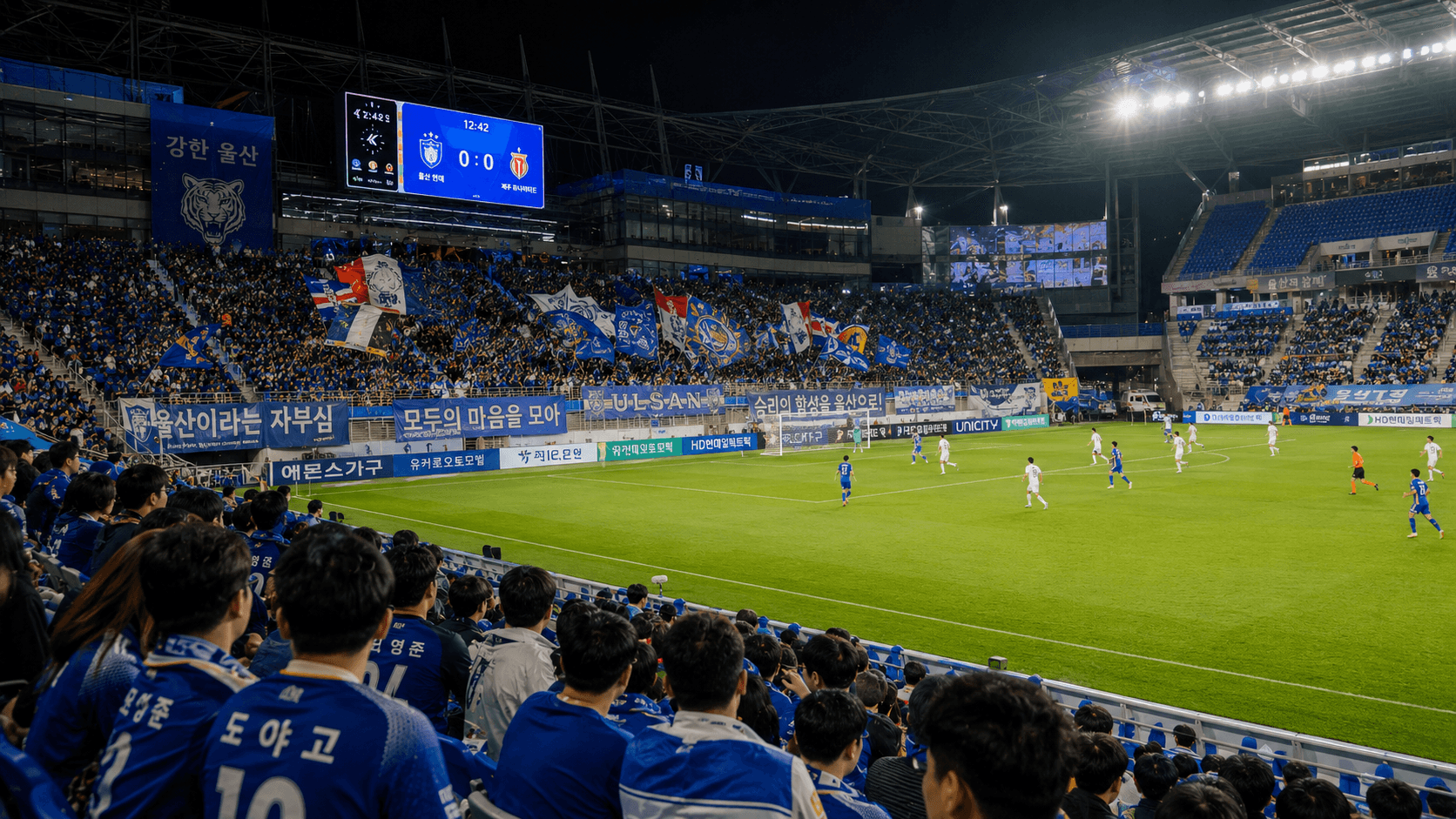
Watching a soccer match in South Korea is usually straightforward once you know which organization sells the tickets. For a professional club match, begin with the K League schedule and then follow the home club’s ticket instructions. For a South Korea national-team match, use the Korea Football Association’s PLAY KFA platform. Ticket prices, sale dates, stadium rules and kickoff times vary by match, so confirm every detail shortly before you go.
At a glance
| Question | Practical answer |
|---|---|
| Where do I find K League fixtures? | Check the official K League schedule. |
| Where do I buy K League tickets? | Through the home club’s designated ticketing platform or stadium box office. |
| Where are national-team tickets sold? | Usually through PLAY KFA. |
| Can I buy on match day? | Often, but availability is not guaranteed. Popular fixtures may sell out in advance. |
| How early should I arrive? | About 60 minutes early for an ordinary league match and 90 minutes or more for a major fixture. |
| Is English service guaranteed? | No. The K League website has an English option, but club and ticketing pages may remain primarily in Korean. |
| Can I take food inside? | Policies differ by stadium and match. Check the home club’s notice before bringing outside food or drinks. |
Ticketing routes and schedule sources in this guide were verified on June 11, 2026. Prices and individual match rules must be checked again because clubs publish them separately.
Choose the type of match
K League club soccer
The K League is South Korea’s professional men’s soccer competition. Its two professional divisions are K League 1 and K League 2. Clubs are based around the country, including Seoul, Incheon, Suwon, Daejeon, Jeonju, Pohang, Ulsan, Busan, Gwangju and Jeju.
Use the official K League website to check K League 1 and K League 2 fixtures, results, tables and club links. Select EN if the site opens in Korean. The schedule should be your starting point, but the home club’s announcement is the final practical reference for ticket sales, gate opening and stadium changes.
A league match is generally the easiest option for a first-time visitor. Tickets for routine fixtures are often available closer to kickoff, and the atmosphere can still be lively without the extreme demand associated with national-team games or major rivalries.
South Korea national-team matches
The Korea Football Association, commonly called the KFA, manages South Korea’s national teams. Its official site publishes fixtures for the men’s, women’s and youth teams through the KFA match schedule.
The KFA directs supporters to PLAY KFA for ticket sales. PLAY KFA requires an account for its purchasing and account-management functions. Ticket notices normally specify the sale time, seating map, prices, purchase limits and collection or mobile-ticket procedure.
National-team matches held in Korea can attract heavy demand, especially men’s senior internationals in the Seoul metropolitan area. Do not assume tickets will remain available at the stadium.
Korea Cup and other competitions
The Korea Cup is the national knockout competition and can bring professional and lower-division clubs together. The KFA lists the competition among its domestic tournaments on the official KFA website.
Women’s, semi-professional, university and youth matches are also held around the country. These can be inexpensive and accessible, but English-language ticket information may be limited. Check the organizing association and participating clubs rather than relying only on general event listings.
How to find a suitable match
- Open the official K League or KFA schedule.
- Confirm that the team listed first or marked as home is playing at the stadium you intend to visit.
- Check the exact stadium name. Some clubs use more than one venue during a season.
- Open the home club’s official website or social-media notice.
- Confirm the kickoff date, time and ticket-sale schedule.
- Check your return transport before paying, particularly for an evening match outside central Seoul.
All published times should be treated as Korea Standard Time. Fixtures can change because of weather, broadcasting, cup participation or stadium availability. Recheck the match page on the morning of the game.
How to buy K League tickets
K League tickets are controlled by the home club rather than sold through one universal English-language checkout. A club may use an external reservation service, its own website or both. The official K League homepage provides links to current clubs, but the purchasing process may continue in Korean.
Online booking steps
- Find the match on the K League schedule.
- Open the home club’s official page.
- Look for 티켓 or 예매, meaning ticket or advance reservation.
- Read the match notice before entering the booking page.
- Choose the correct date and opponent.
- Select a stand and individual seat if a seating map appears.
- Complete payment and save the confirmation screen.
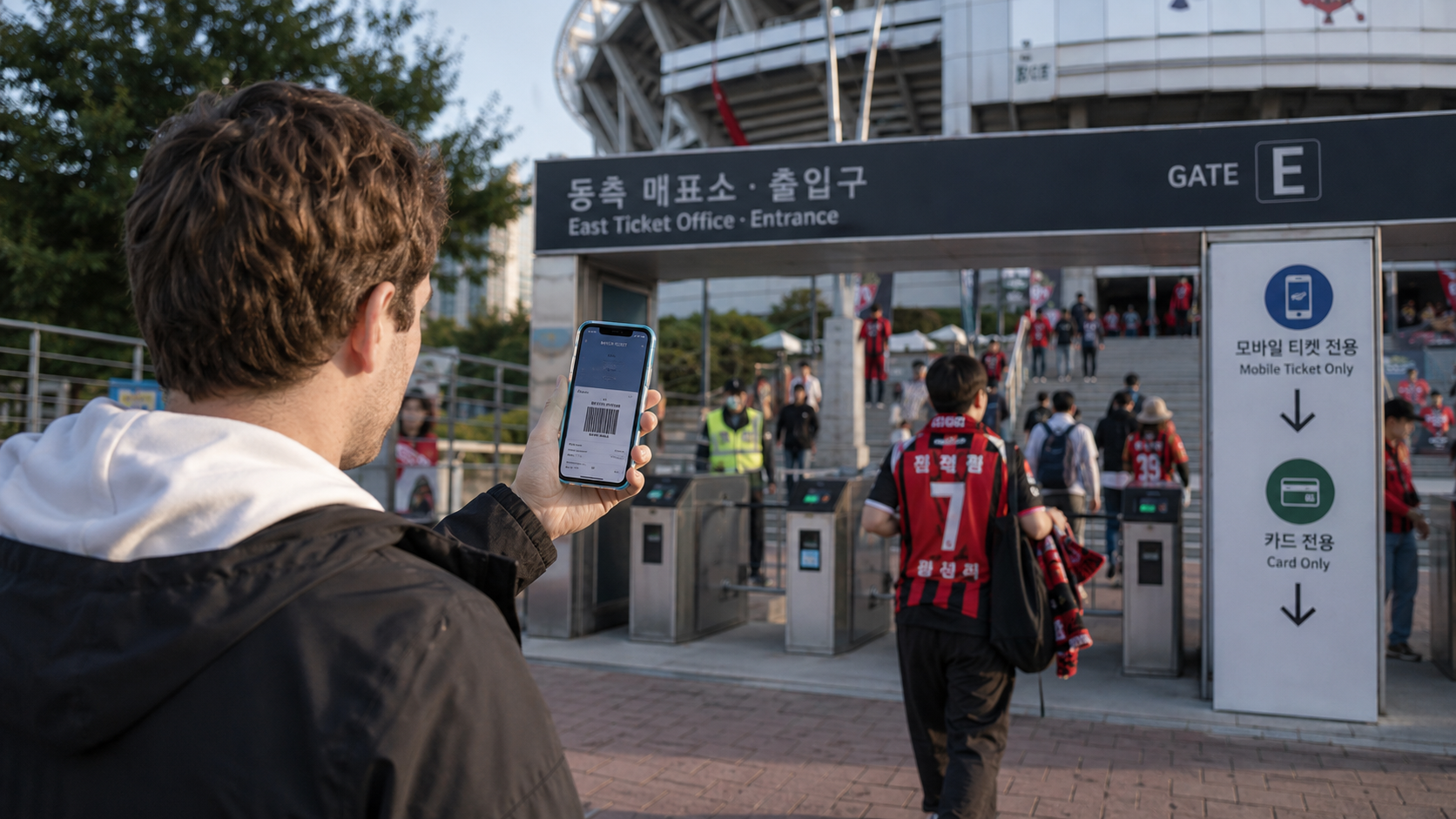
- Check whether entry uses a mobile barcode, printed ticket or box-office collection.
Account registration, identity verification and payment acceptance differ among platforms. A foreign-issued card may not work on every Korean booking site. This is a platform-specific limitation, not a universal K League rule.
If online payment fails, check whether the club advertises match-day sales. Arrive early and take your passport or another photo ID in case the ticket desk needs to confirm a reservation. Do not buy from an unofficial reseller unless the organizer expressly permits ticket transfer or resale.
Buying at the stadium
Match-day box offices are usually marked 매표소, meaning ticket office. The sales window and accepted payment methods are determined by the club.
At the counter, show the match listing or team names on your phone if spoken communication is difficult. You can also use these phrases:
- 표 한 장 주세요: One ticket, please.
- 두 장 주세요: Two tickets, please.
- 홈석: Home section.
- 원정석: Away section.
- 카드 돼요?: Can I pay by card?
A stadium may have separate windows for advance-ticket collection and new purchases. Join the line matching your ticket status.
How to buy national-team tickets
Use PLAY KFA, the KFA’s official ticket platform. As verified on June 11, 2026, PLAY KFA contains a dedicated ticket area and account functions, while the KFA website links directly to the service.
For a high-demand match:
- Create or update your account before ticket sales begin.
- Read the KFA ticket notice in full.
- Note the opening time in Korea Standard Time.
- Sign in before sales open.
- Decide on a price category in advance using the published seating map.
- Keep the payment confirmation and ticket instructions accessible offline.
Do not infer the ticket price from an earlier international. The KFA announces prices, limits and sales conditions separately for each event.
Choosing the right seat
Stadium terminology is not completely standardized, but these descriptions will help you interpret most seating maps.
| Area | What to expect |
|---|---|
| Home supporters’ end | Standing, chanting, flags and drums may be common. Best for active participation. |
| Away section | Reserved for visiting supporters. Do not wear prominent home-team colors here. |
| Sideline or main stand | A clearer tactical view and generally calmer atmosphere. Usually costs more than seats behind the goal. |
| Corner section | A compromise between price, atmosphere and field view. |
| Premium or table seating | May include wider seats, tables or hospitality benefits; inclusions vary by club. |
| Accessible seating | Availability and companion-seat rules must be confirmed with the club before purchase. |
For a first match, a sideline or corner seat is the simplest choice. Avoid the central supporters’ block if you do not want to stand, sing or have flags temporarily obstruct your view.
Getting to the stadium
Public transport is normally more practical than driving. Parking can be restricted, nearby roads become congested, and cars may leave slowly after the final whistle.
Use Naver Map or KakaoMap for local route planning because Korean place data and bus stops are often more complete than on international mapping services. Search the stadium’s Korean name when possible. Confirm that the destination is the actual match venue rather than a training ground or similarly named sports complex.
For subway-accessible stadiums
Check the correct station exit before leaving the train. Large stadium complexes may be several minutes from one exit and much farther from another. Follow supporters wearing team colors, but verify the gate shown on your ticket because entrances can be distributed around the venue.
For regional stadiums
Some grounds require a local bus or taxi from the nearest intercity rail or bus terminal. Check the last bus and train before kickoff. A match ending around 9 p.m. may leave little time for a long transfer back to Seoul.
Keep the stadium’s Korean name and address on your phone for taxi drivers. Build extra time into trips involving KTX or SRT high-speed trains, since a close match, added time and post-match crowds can delay your exit.
When to arrive
For an ordinary K League fixture, arriving about 60 minutes before kickoff is a practical suggestion rather than an official requirement. It allows time to locate the ticket office, pass security, find your gate and buy refreshments.
Arrive 90 minutes or more in advance for:
- A national-team match
- A derby or major rivalry
- A final or promotion playoff
- A match with a large giveaway or fan event
- Your first visit to an unfamiliar stadium
- A game requiring box-office ticket collection
Gate-opening times vary. Check the club or organizer’s match-day notice rather than assuming the stadium opens at a standard time.
Food, drinks and bags
Stadium concessions commonly sell Korean snacks, meals and drinks, but selection and cashless-payment policies differ. Smaller grounds may have limited food service, so eat before arrival if the club has not published concession information.
Bag checks and prohibited-item lists are also venue-specific. Fireworks, flares, weapons and objects that could endanger spectators should never be brought to a match. Rules for outside drinks, cans, glass, large banners, professional cameras, umbrellas and oversized luggage can differ.
There is no reliable nationwide bag-size rule covering every Korean soccer venue. Check the organizer’s current notice. If no clear English guidance is available, travel with a small bag and avoid rigid containers or bulky luggage. Major subway stations may have lockers, but availability is not guaranteed on busy days.
Match-day atmosphere and etiquette
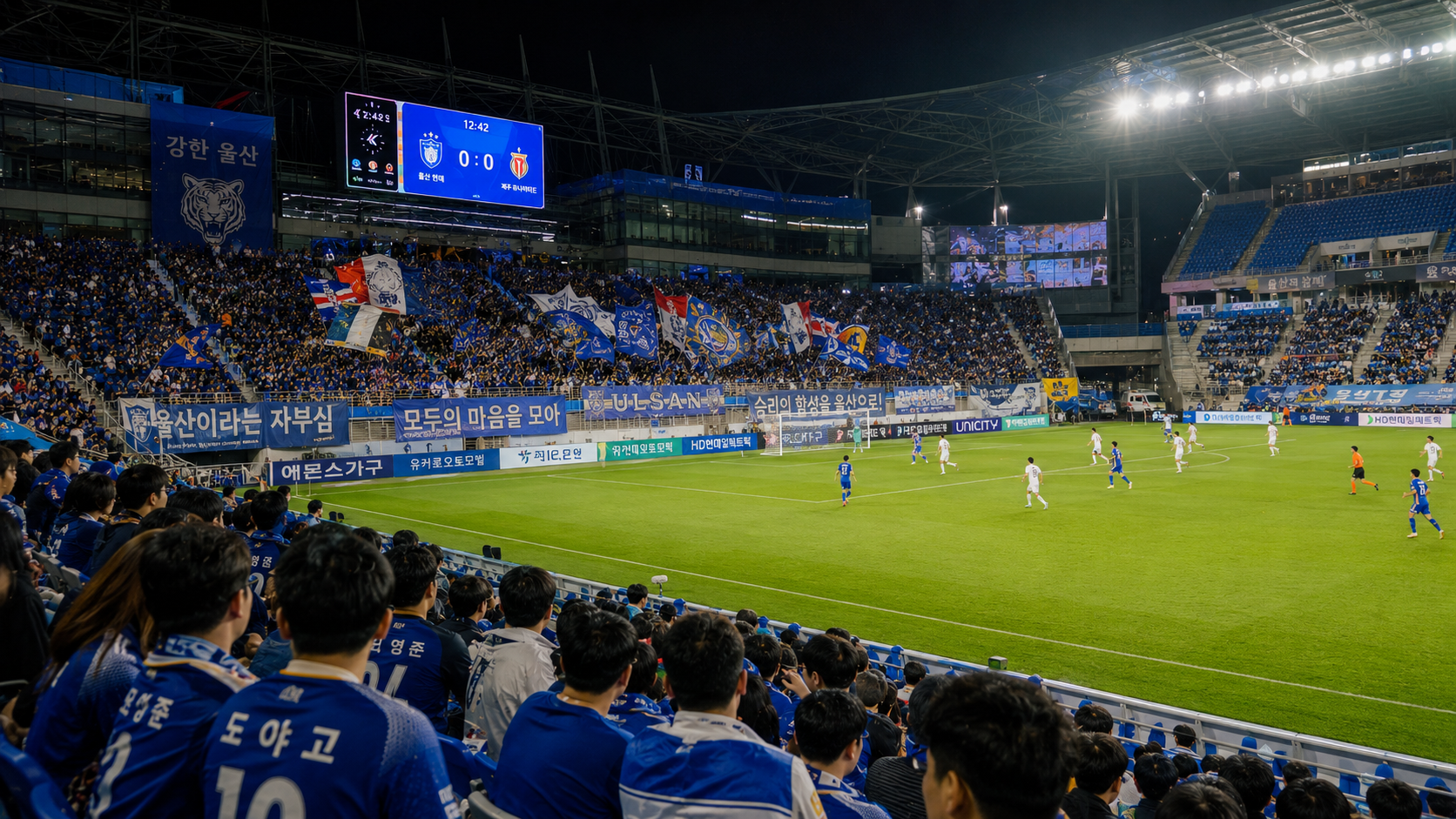
Korean supporters use organized chants, drums and large flags, particularly behind the goals. Joining simple clapping patterns is welcome, but participation is optional outside the active supporters’ area.
Follow these basic rules:
- Sit in the section printed on your ticket.
- Keep aisles and emergency routes clear.
- Do not enter an away section in home-team clothing, or vice versa.
- Expect some supporters to stand in chanting sections.
- Do not throw cups, food or other objects.
- Ask before taking close-up photographs of individual spectators.
- Follow staff instructions during banners, pyrotechnic incidents or severe weather.
Soccer is normally called 축구 (chukgu) in Korean. The English word “football” may be understood, but “soccer” or chukgu is less ambiguous in casual conversation.
Weather and seasonal preparation
Korean stadiums are not uniformly enclosed or climate-controlled. Even covered stands may provide little protection from wind or angled rain.
In summer, bring sun protection and check heat or heavy-rain notices. During the monsoon period, use a compact raincoat if umbrellas are restricted or would obstruct other spectators. In early spring and late autumn, evening temperatures can feel much colder after sunset, especially in open bowl stadiums.
Matches may continue in rain, but severe weather can cause delays or postponements. Check the home club’s official channels before leaving your accommodation.
Accessibility and attending with children
Accessibility arrangements are managed by individual clubs and venues. Contact the home club before purchasing if you need wheelchair seating, step-free access, a companion seat, accessible parking or assistance from a transport stop. Do not assume that every ticket category can be exchanged for an accessible position at the gate.
For children, check the match notice for age-based ticket rules. Some clubs offer reduced prices or family sections, but the eligibility age, required proof and ticket inventory vary. Young children may benefit from ear protection near drums and loud supporters’ sections.
Common mistakes to avoid
Booking the wrong venue
A club’s home city does not guarantee that every home fixture uses its usual stadium. Confirm the venue on the individual match listing.
Waiting for match-day sales
This can work for a routine league game, but it is risky for national-team fixtures, finals, derbies and small stadiums.
Choosing the away end accidentally
Look for 원정석, meaning away section. Access may be controlled separately, and home merchandise may not be permitted there.
Relying on a foreign card at the last minute
Korean ticketing platforms can require local account or payment processes. Try online booking early enough to use the box office as a backup when match-day sales are available.
Ignoring the journey home
The final whistle is not the end of your travel time. Allow for stoppage time, slow stadium exits and crowded platforms. Check the last realistic connection, not merely the last scheduled train.
What to check before you go
- Fixture date and kickoff time rechecked on match day
- Exact stadium and Korean address saved
- Ticket barcode, collection code or confirmation available
- Correct home or away section selected
- Photo ID packed if the booking notice requires it
- Gate-opening and ticket-office times checked
- Bag and prohibited-item rules reviewed
- Weather forecast checked
- Return subway, bus or train planned
- Portable battery charged
- Club notice checked for postponement or venue changes
Frequently asked questions
How much does a Korean soccer ticket cost?
There is no single nationwide price. Clubs set their own categories, and the KFA publishes separate prices for each national-team match. Check the official match page after sales are announced. Prices were therefore not generalized in this guide.
Can tourists buy tickets without a Korean phone number?
It depends on the ticketing platform and its current registration process. Some online systems may present identity, phone-verification or payment barriers to short-term visitors. Where advertised, stadium sales are the most practical fallback, but they do not guarantee availability.
Are K League matches suitable for someone who does not speak Korean?
Yes. The main challenges are ticketing and finding the correct gate, not watching the match itself. Save screenshots of your booking, stadium name and seat information, and arrive early enough to ask staff for help.
Can I wear a European club shirt?
A neutral foreign club shirt is unlikely to cause confusion, but plain clothing is simpler. Never wear the home team’s colors in a designated away section or the visiting team’s colors in a restricted home supporters’ section.
Where should I start?
Open the official K League schedule, choose a home match that fits your itinerary, and follow the listed home club’s ticket announcement. For a national-team match in Korea, monitor the KFA schedule and prepare a PLAY KFA account before sales begin.