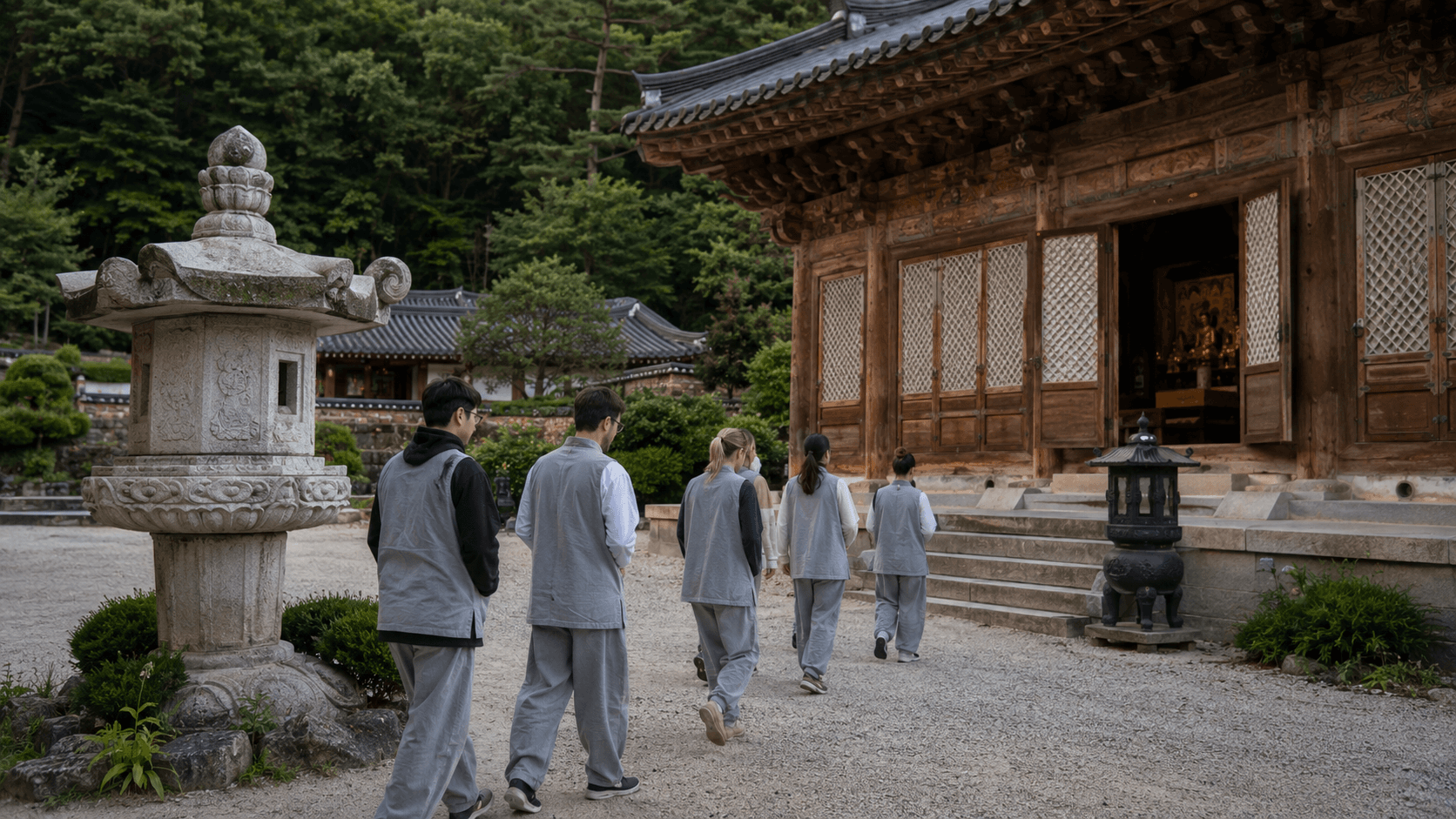
A Korean temple stay lets you spend several hours or one or more nights at a Buddhist temple while learning about monastic routines and Korean Buddhist culture. You do not need to be Buddhist, speak Korean, or participate in every religious practice. However, facilities, language support, prices, schedules, and participation rules differ substantially by temple, so read the individual program page before booking.
Information in this guide was verified on June 11, 2026. Program availability, fees, transport details, and cancellation rules can change.
At a glance
| Question | Practical answer |
|---|---|
| Do I need to be Buddhist? | No. Temple stays are cultural programs open to participants from different backgrounds. |
| Can I join alone? | Usually yes. The official FAQ states that rooms are managed by the temple and that program staff are present, although room arrangements vary. |
| How long is a stay? | Programs include short day visits, structured overnight experiences, and less structured rest stays. |
| Is English available? | At selected programs. Use the foreigner-specialized temple filter and confirm the actual language of instruction. |
| What do I sleep on? | Often Korean-style floor bedding in a simple shared or private room, depending on the temple. Check the room description. |
| Are meals included? | They commonly form part of an overnight schedule, but confirm the number of meals on the program page. |
| Is participation compulsory? | The official guidance says activities are voluntary. Tell staff if health, mobility, or religious considerations prevent you from joining. |
| How much does it cost? | There is no single national price. Each temple sets fees by program, date, age, room, and length of stay. Check the live booking page. |
What is a Korean temple stay?
Templestay is a cultural program coordinated by the Cultural Corps of Korean Buddhism. It developed into a nationwide program after Korean temples welcomed international visitors around the 2002 FIFA World Cup. The official Templestay introduction describes it as an opportunity to experience Buddhist culture and the daily life of practitioners in a working temple.
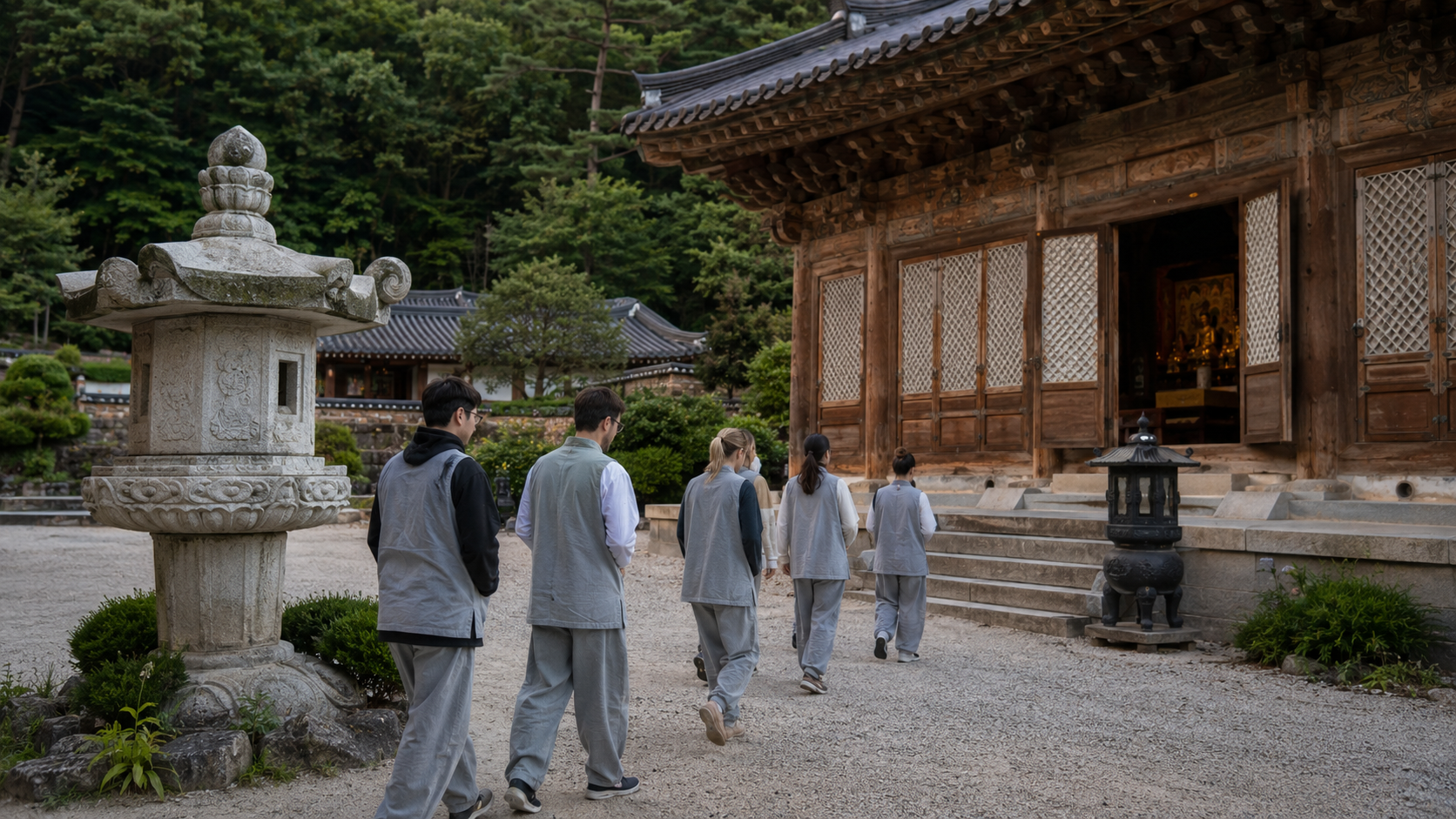
This is not the same as checking into a themed hotel. A temple remains a religious community. Bells may sound before dawn, residents may be meditating or conducting ceremonies, meals follow temple routines, and quiet is expected at night.
The official program directory includes temples in Seoul, Busan, Jeju, Gangwon Province, and most other regions. Some are urban and easily reached by subway or bus; others are mountain temples requiring an intercity bus, local bus, taxi, or uphill walk. The official temple directory should be your starting point.
Choose the right program type
The official system divides stays into three main formats.
One-day program
A one-day program, or dangilhyeong (당일형), is suitable when you want an introduction without sleeping at the temple. It may include a temple tour, meditation, tea, copying a sutra, or making a lotus lantern or prayer beads.
Official guidance says these sessions commonly last at least two hours and may begin in the morning or early afternoon. The exact meeting time is set by the temple.
Choose this format if you have limited time, are uncomfortable with floor sleeping, cannot manage an early-morning schedule, or want to test the experience before booking overnight.
Experience-oriented stay
An experience-oriented program, or cheheomhyeong (체험형), follows a structured schedule. Activities may include evening and dawn ceremonies, Seon meditation, 108 prostrations, communal work, tea with a monastic, and a formal temple meal.
A typical one-night program described in the official FAQ starts with check-in at approximately 2-3 p.m. and finishes around noon or 1 p.m. the following day. Dawn worship may begin at approximately 4 a.m. This is a general model, not a guaranteed schedule; verify the timetable on your selected listing.
This format provides the clearest introduction to temple life but allows less personal free time.
Rest-oriented stay
A rest-oriented program, or hyusikhyeong (휴식형), gives you more unstructured time. Meals, orientation, and basic temple etiquette may still be scheduled, while much of the day is left for walking, reading, meditation, or rest.
Do not assume that rest-oriented means hotel-style freedom. Arrival deadlines, meal times, quiet hours, restricted areas, and rules concerning alcohol and smoking still apply.
How to find and book a temple stay
Step 1: Search the official directory
Use the official Templestay reservation page. As verified on June 11, 2026, it provides filters for region, temple, program type, participant numbers, and temples specializing in international visitors.
The English-domain website was still displaying substantial Korean-language interface text during verification. Browser translation can help with navigation, but confirm important details directly with the temple if the translated wording is unclear.
Step 2: Check the actual program, not only the temple
A temple may operate several programs with different schedules and eligibility rules. Confirm:
- Program date and check-in deadline
- Day program, structured experience, or rest stay
- Number of nights and included meals
- Language used for orientation and activities
- Adult, child, or family participation rules
- Room-sharing arrangements
- Bathroom and shower arrangements
- Required fitness or walking ability
- Price and available payment method
- Cancellation and refund conditions
- Directions from the nearest station or bus stop
The directory offers a foreigner-specialized filter, but this should not be interpreted as a guarantee that every session has a fluent English-speaking guide. Ask whether the specific date will be conducted in English.
Step 3: Confirm your reservation status
Do not travel to the temple based only on a submitted request. Check that you have received a completed reservation or payment confirmation. Save the temple's telephone number, address in Hangul, and check-in instructions.
For rural stays, ask whether advance payment is required and whether any remaining amount must be paid by card, bank transfer, or cash. Payment arrangements are not uniform across all temples.
Step 4: Recheck transport
Map the entire trip before departure, including the last local bus or taxi segment. Mountain temples can be far from the stop that shares their name, and local bus intervals may be long.
Arrive early. A late arrival can disrupt orientation, room allocation, and the evening meal. If a delay is unavoidable, telephone the temple rather than relying on email.
Prices, refunds, and what is included
There is no universal temple-stay fare. The amount depends on the temple, program, duration, participant age, room arrangement, and special event. Live prices should be verified on the individual reservation page on the day you book.
Do not assume that the fee includes transport, towels, toiletries, activity materials, or a private room. Overnight programs often include accommodation, scheduled activities, and specified meals, but inclusions must be checked program by program.
Cancellation deadlines and refund percentages may also vary. Read the displayed refund terms before paying and contact the temple promptly if your plans change. During holiday periods, seasonal retreats, and limited-capacity English programs, changing to another date may be difficult.
What happens during an overnight stay?
A structured program often follows this general sequence:
- Arrival, registration, and room assignment
- Change into the provided temple-stay clothing, when supplied
- Temple tour and etiquette orientation
- Evening meal, known as gongyang (공양)
- Evening ceremony or meditation
- Quiet time and early lights-out
- Dawn ceremony
- Breakfast and a morning activity
- Tea conversation, meditation, walking, or communal work
- Check-out around midday
Schedules can change because of weather, temple ceremonies, staffing, or the season. Treat the listing as the current plan rather than an unchangeable itinerary.
Common activities explained
Seon meditation, called chamseon (참선), is the Korean Buddhist tradition of seated meditation. Staff normally explain posture, but you should mention knee, hip, or back problems before starting.
Yebul (예불) is a Buddhist ceremony held in a Dharma hall, commonly in the evening and before dawn. Visitors may observe quietly if they do not wish to bow or chant.
The 108 prostrations, or baekpalbae (108배), involve repeatedly lowering the body to the floor and standing again. The official FAQ says activities are voluntary. Skip or modify this practice if it is unsuitable for your health.
Chadam (차담) is a conversation over tea with a monk or nun. It may be an opportunity to ask about Buddhist practice, temple history, or monastic life, but it is not guaranteed in every program.
Baru gongyang (발우공양) is a formal meal using nested bowls and a prescribed eating procedure. Some stays instead serve less formal cafeteria-style temple meals.
Rooms, bathrooms, and comfort
Expect simple accommodation. Korean floor heating may be used, with a padded mat and bedding placed directly on the floor. Furniture can be minimal, and walls may transmit sound easily.
Private rooms are not guaranteed. Participants may share with others, and some temples separate accommodation by gender. Couples should not assume that they will sleep in the same room. Ask before booking if room allocation is important.
Bathrooms may be private, shared within the accommodation building, or located separately. Accessibility varies greatly because historic mountain temples can have stone steps, steep paths, thresholds, and buildings without lifts. Contact the temple directly before booking if you use a wheelchair, need step-free access, cannot sit on the floor, or require an accessible bathroom.
Meals and dietary requirements
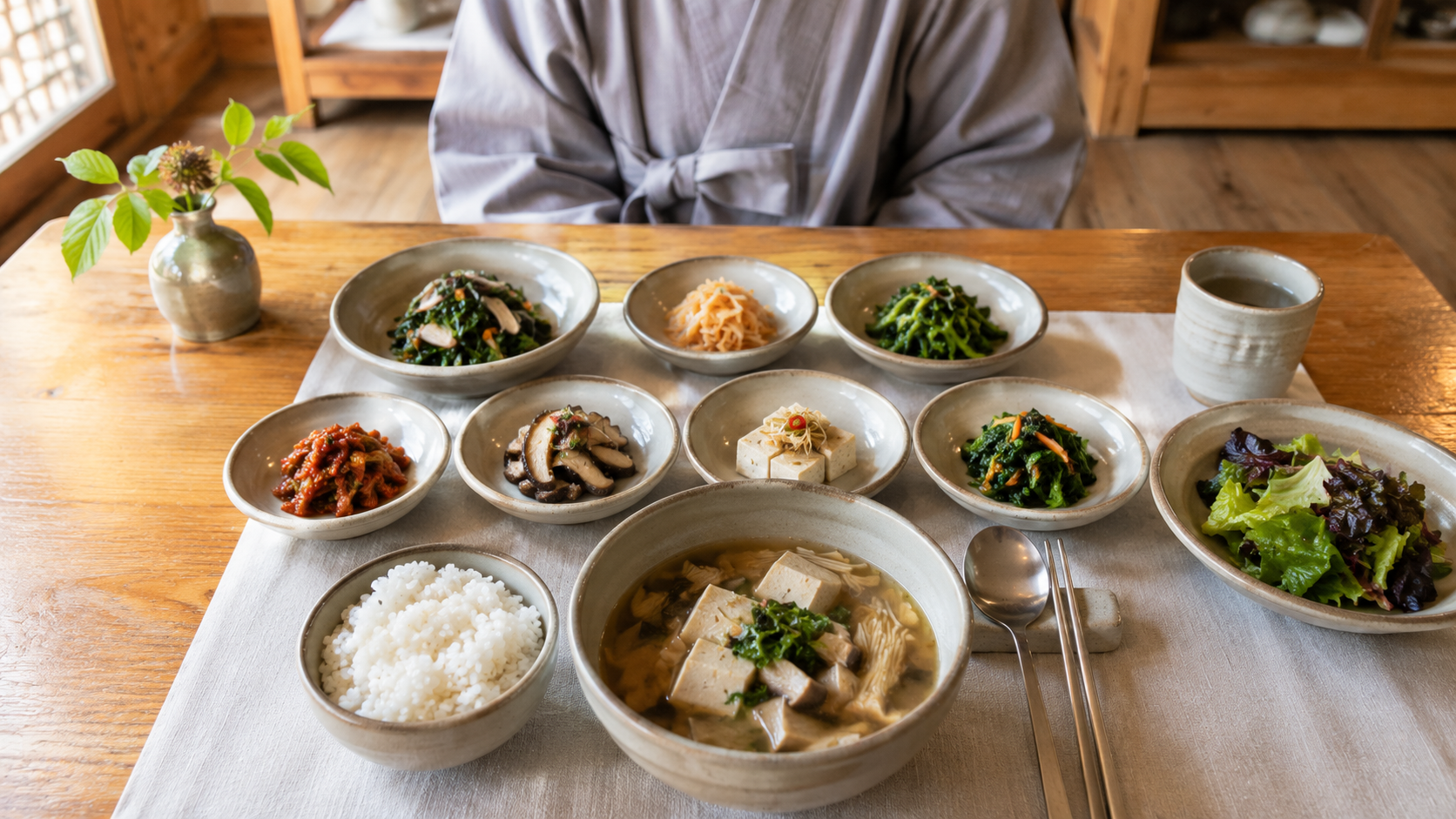
Meals are generally simple temple food built around rice, soup, vegetables, tofu, mushrooms, and seasoned side dishes. Portions, serving styles, and ingredients vary.
Do not treat temple food as automatically safe for every vegetarian, vegan, halal, kosher, or allergy-related diet. Soy, sesame, wheat, nuts, and fermented products may be used, and kitchens may not be able to prevent cross-contact. Contact the temple before paying if you have a serious allergy or strict dietary requirement. Bring permitted emergency medication and do not expect an unconfirmed special meal on arrival.
Food waste is strongly discouraged. Take a small first portion and return for more only if the serving system permits it.
What to pack
The official preparation guidance recommends bringing personal toiletries, a towel, spare clothing, and warm layers. It notes that supplied items differ by temple and that mountain mornings and evenings can be cold outside midsummer.
A practical packing list includes:
- Toothbrush and personal toiletries
- Towel, unless explicitly provided
- Sleepwear and underwear
- Warm layer, even in spring or autumn
- Comfortable socks
- Easy-to-remove shoes
- Rain protection
- Refillable water bottle
- Prescription and emergency medication
- Small flashlight for dark paths before dawn
- Earplugs, used discreetly and never during instructions
- Portable battery, as outlets may be limited
Temple-stay vests and trousers are commonly supplied, but sizing and availability vary. Wear modest, loose clothing as a backup. Avoid short shorts, low-cut tops, and clothing with offensive text or imagery.
Essential temple etiquette
The official rules prohibit disruptive noise, alcohol, and smoking. Participants should also avoid conspicuous public displays of affection.
Follow these basic practices:
- Speak quietly, particularly near residential and prayer areas.
- Remove your shoes where instructed and arrange them neatly.
- Do not enter buildings or monastic quarters marked as restricted.
- Ask permission before photographing monastics, ceremonies, or other participants.
- Silence your phone during orientation, meals, meditation, and ceremonies.
- Do not sit directly in front of an altar with your feet pointing toward it.
- Use the side doors of a Dharma hall when instructed; the central doorway may be reserved.
- Avoid walking in front of someone who is bowing or praying.
- Follow staff instructions even if another temple used different rules.
A common greeting is hapjang (합장), placing the palms together at chest level and making a small bow. Visitors are not expected to know every ritual in advance. Quietly watch the instructor and ask when uncertain.
Can non-Buddhists participate?
Yes. The program is designed as a cultural experience as well as an introduction to Buddhist practice. According to the official FAQ, participation in activities is voluntary. If prostrations, chanting, or other practices conflict with your beliefs, you may sit quietly or explain the situation to the staff.
Voluntary participation does not mean ignoring the schedule without notice. Tell the coordinator if you need to miss an activity so staff do not search for you or delay the group.
Children, solo travelers, and groups
The official FAQ states that children can generally participate with a parent or another adult, but each temple sets its own rules. Check minimum ages, family-room arrangements, and whether the schedule is realistic for your child. A 4 a.m. ceremony and long periods of silence may be difficult for younger children.
Solo travelers can book many programs, subject to availability. You may be assigned a shared room, so confirm privacy and gender arrangements before payment.
Groups should use the official group-inquiry option or contact the temple well in advance. Do not make separate individual reservations and assume that everyone will be placed together.
Common mistakes to avoid
Choosing only by photographs
A beautiful mountain setting does not guarantee convenient transport, English instruction, private bathrooms, or a relaxed schedule. Read the full listing.
Booking a rest stay while expecting guided activities
Rest-oriented programs may contain only a few organized sessions. Choose an experience-oriented stay if instruction is your priority.
Underestimating the dawn schedule
Going to bed late and then attempting a 4 a.m. ceremony can make the entire stay exhausting. Keep the evening before arrival light and avoid planning a demanding activity immediately after check-out.
Assuming temple meals solve every dietary issue
Temple cuisine may fit some plant-based diets, but allergies and strict religious diets require direct confirmation.
Arriving after the final local bus
Rural transport may be infrequent. Check the last connection and keep enough KRW for a taxi where one is available.
What to check before you go
Reconfirm these points two or three days before departure:
- Reservation and payment are complete
- Exact check-in time and meeting point
- Program language
- Room-sharing and bathroom arrangements
- Included meals and dietary confirmation
- Required toiletries and towel
- Weather and appropriate layers
- Route from the nearest transport stop
- Final bus or train connection
- Accessibility or health accommodations
- Cancellation contact and temple telephone number
Save the temple's Korean name and address as a screenshot. This is useful when showing the destination to a bus driver or taxi driver in an area where English is limited.
Frequently asked questions
Can I leave early?
Possibly, but tell the coordinator in advance. Gates, transport, and check-out procedures may make an unplanned pre-dawn departure impractical.
Is Wi-Fi available?
It depends on the temple and accommodation building. Treat connectivity as a convenience rather than a guaranteed service.
Can I drink coffee or bring snacks?
Rules vary. Food may be restricted in bedrooms, and eating outside scheduled meals can conflict with temple practice. Ask before bringing or consuming snacks.
Will I meet a monk or nun?
You will be staying in an active Buddhist community, but a personal conversation with a monastic is not guaranteed unless tea conversation or a Dharma talk appears in the schedule.
Should I tip?
Tipping is not a standard requirement. Pay the listed program fee. Use an official donation box only if you independently wish to make a donation.
Next step
Open the official program search, filter by region and program type, and shortlist two options. Compare language, transport, schedule, room type, and cancellation conditions before choosing the temple.