Korean university areas are useful places to experience city life beyond major sightseeing districts. They usually combine inexpensive restaurants, cafés, coin karaoke rooms, small performance venues and shops aimed at students. Hongdae offers the biggest entertainment scene, Sinchon and Ewha are better for an easy daytime walk, and Daehak-ro is the strongest choice for theater. Busan’s university districts provide a less tourist-oriented alternative.
Transport connections and official visitor information in this guide were checked on June 11, 2026. Individual businesses, campus access rules and performance schedules can change, so confirm them shortly before visiting.
At a glance
| Area | City | Go for | Nearest rail station |
|---|---|---|---|
| Hongdae | Seoul | Street culture, nightlife and independent shops | Hongik Univ. Station |
| Sinchon and Ewha | Seoul | Campus architecture, cafés and budget meals | Sinchon or Ewha Womans Univ. Station |
| Daehak-ro and Hyehwa | Seoul | Small theaters and an older university atmosphere | Hyehwa Station |
| Konkuk University | Seoul | Busy evening streets and straightforward transport | Konkuk Univ. Station |
| Hoegi and Kyung Hee University | Seoul | Local student dining and a scenic campus approach | Hoegi Station |
| Seoul National University area | Seoul | A large campus and student-oriented residential streets | Seoul Nat’l Univ. Station or Gwanaksan Station |
| Kyungsung–Pukyong | Busan | Food, nightlife and access toward the coast | Kyungsung Univ.–Pukyong Nat’l Univ. Station |
| Pusan National University | Busan | A compact neighborhood with a local student crowd | Pusan Nat’l Univ. Station |
Understanding Korean university districts
University names are commonly shortened in Korean. Hongdae (홍대), for example, comes from Hongik Daehakgyo, meaning Hongik University. Konkuk University’s area is called Geondae (건대), while Ewha Womans University is often shortened to Idae (이대). Learning these short forms helps when reading maps, signs and restaurant listings.
The commercial district and the campus are not always in the same place. A subway station bearing a university’s name may sit some distance from the main gate. The streets immediately around an exit can also feel completely different from those behind the campus, so search for both the station and the university gate in your map app.
There is usually no admission charge to walk through outdoor campus areas, but a university is not a public tourist attraction. Access can be restricted during examinations, festivals, security incidents or construction. Libraries, classrooms, dormitories, laboratories and some museums may require identification or advance registration. Check the university’s official website before making the campus itself the main purpose of your visit.
1. Hongdae: the largest and busiest choice
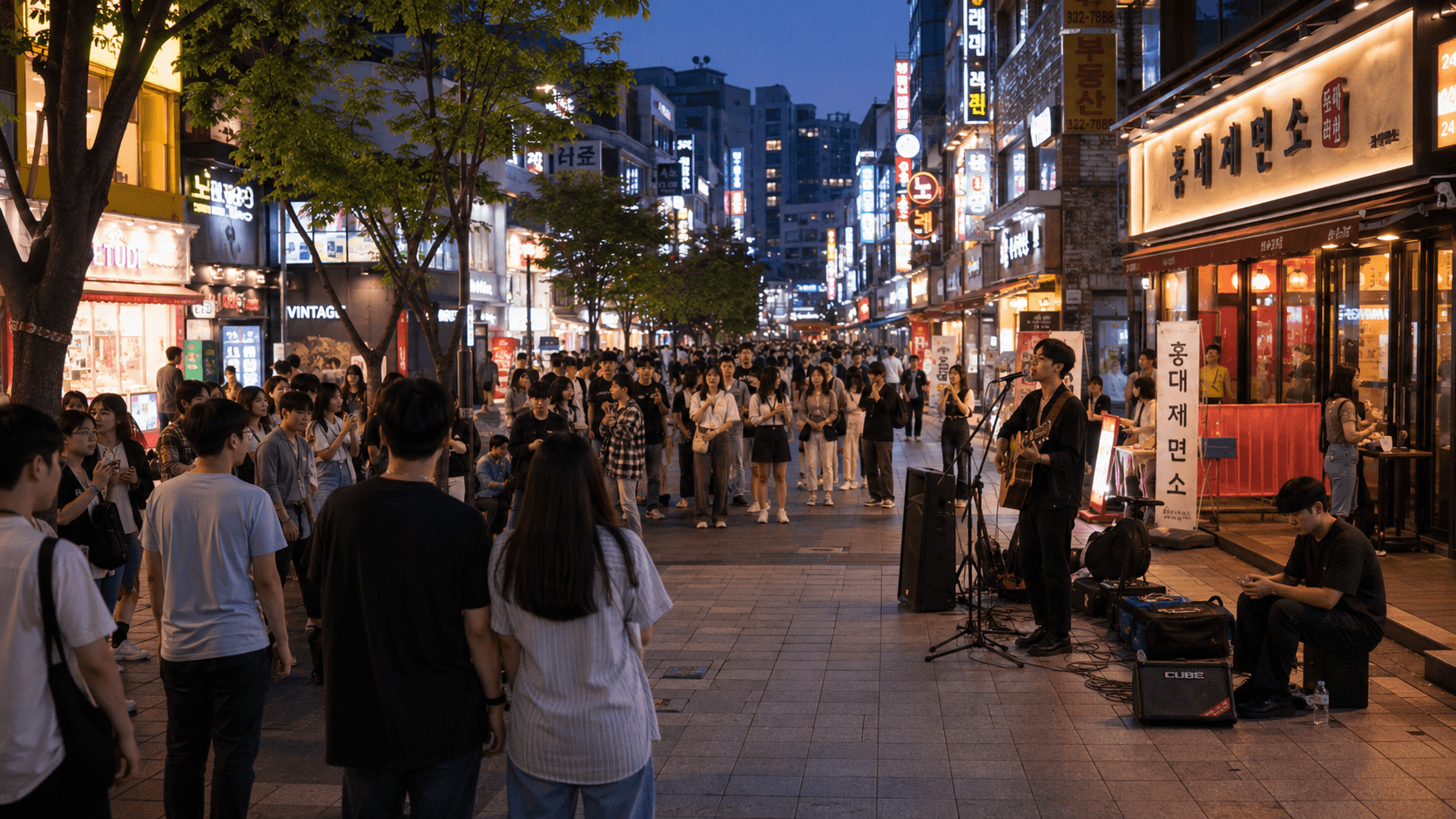
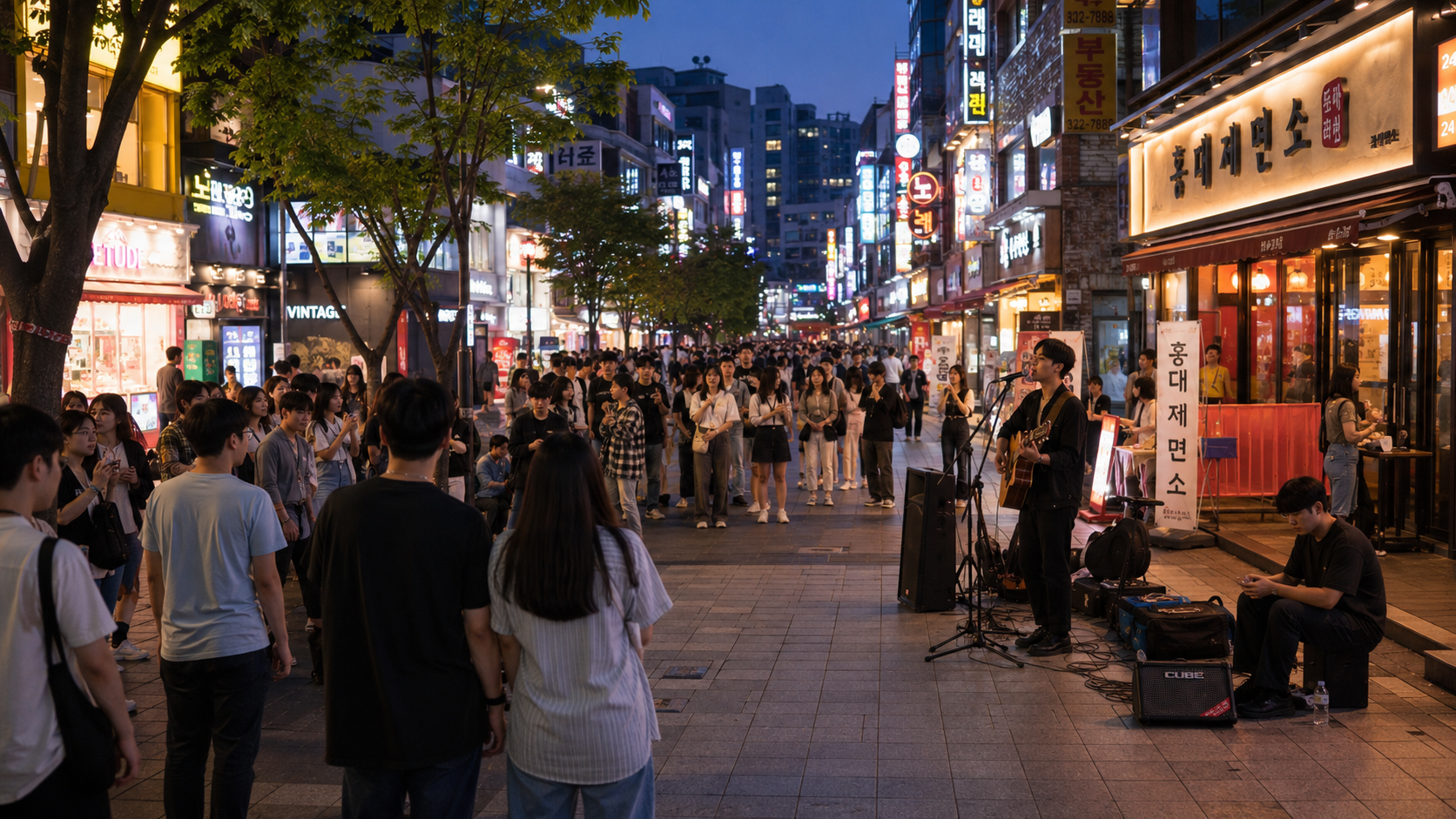
Hongdae (홍대) is the commercial and entertainment district around Hongik University. It is a practical first choice for visitors who want shops, street activity, music venues and late-night food in one area. Hongik Univ. Station is served by Seoul Subway Line 2, the Gyeongui–Jungang Line and AREX, making the neighborhood convenient from both central Seoul and Incheon International Airport. Confirm routes through the official Seoul Metro service and AREX.
The station area is much larger than the university frontage. The streets near Exit 9 are among the busiest, while Yeonnam-dong and Gyeongui Line Forest Park offer a calmer café-and-walking route north of the station. Toward Sangsu and Hapjeong, the district becomes more dispersed, with smaller bars, restaurants and performance spaces.
Hongdae is no longer primarily a student neighborhood: it receives large numbers of tourists and weekend visitors. Prices and crowd levels vary considerably between the main pedestrian streets and quieter side roads. For a more manageable visit, arrive in the late afternoon, walk toward Hongik University’s main gate, and continue south toward Sangsu or Hapjeong rather than remaining around one station exit.
Useful for: nightlife, fashion browsing, busking and groups with different interests.
Watch for: dense weekend crowds, loud streets and venues with age or identification checks. Carry your physical passport if you plan to enter an age-restricted venue; a photograph of it may not be accepted.
2. Sinchon and Ewha: an easy university-area walk
Sinchon (신촌) sits among Yonsei University, Ewha Womans University and Sogang University. Its restaurants, cafés and entertainment businesses serve students, hospital visitors and office workers. It is generally easier to navigate than central Hongdae, although the main streets become busy in the evening.
A useful route starts at Sinchon Station on Line 2, follows the main street toward Yonsei University, and then continues east toward Ewha Womans University. Yonsei’s Sinchon campus combines landscaped grounds with historic-looking stone buildings, while Ewha is known for the dramatic sunken Ewha Campus Complex. Use the Yonsei University website and Ewha campus information to check maps and current visitor notices.
The streets near Ewha Womans Univ. Station are often called Idae. They contain cosmetics shops, casual restaurants, clothing stores and businesses aimed at students. The retail mix has changed over time, so do not rely on an old blog’s list of specific stores.
Allow about half a day if you want to include both campuses, lunch and café time. The route involves slopes, especially around the university grounds. Travelers with limited mobility should check entrances carefully and avoid assuming that the shortest map route is step-free.
Useful for: architecture, daytime walking, first-time visitors and exchange students scouting the area.
Watch for: Sinchon Station on Line 2 and Sinchon Station on the Gyeongui–Jungang Line are separate stations. Confirm the line before arranging a meeting.
3. Daehak-ro and Hyehwa: university culture with theater
Daehak-ro (대학로), literally University Street, is centered on Hyehwa Station and Marronnier Park. The area is associated with small theaters, plays, musicals and performing arts rather than clubs. Sungkyunkwan University is uphill to the north, while Seoul National University’s medical campus and hospital are nearby.
This is the most suitable university district for travelers who prefer an evening performance to nightlife. Many productions are in Korean, but physical theater, dance and some musicals may still be accessible to visitors with limited Korean. Check the production’s official ticket page for language information, running time, age limits and same-day ticket rules. Do not assume that every venue has English service.
For a balanced visit, walk through Marronnier Park, explore the theater streets, eat before the main evening performance period and then continue toward Ihwa-dong or the outer wall near Naksan Park. The latter route becomes steep and includes stairs.
Hyehwa also works well with nearby historical attractions. Changgyeonggung Palace is within the wider district, although its admission hours and closed days should be confirmed separately through the Royal Palaces and Tombs Center.
Useful for: theater, date-night itineraries and visitors combining modern culture with central Seoul.
Watch for: similarly named venues. Save the Korean theater name and full address rather than relying only on an English translation.
4. Konkuk University: compact, busy and convenient
The area around Konkuk University is usually called Geondae. Konkuk Univ. Station connects Lines 2 and 7, and the university, large shopping facilities and restaurant streets are grouped within a relatively compact area.
The atmosphere changes after classes and work finish. Restaurants fill quickly, neon signs become more prominent and groups move between barbecue restaurants, pubs, arcades and coin karaoke rooms. This makes Geondae a convenient alternative for travelers who want an active evening without navigating an area as extensive as Hongdae.
The streets north and west of the station contain much of the student-oriented dining, while the larger retail complexes lie on the opposite side. Nearby Common Ground is recognizable by its blue container-style buildings, but tenants, events and operating hours can change. Verify a specific shop or event directly before traveling for it.
Useful for: casual evening food, mixed-age groups and visitors staying in eastern Seoul.
Watch for: restaurants designed for two or more diners. Barbecue and shared dishes may have minimum-order requirements even when the menu lists a per-person price.
5. Hoegi and Kyung Hee University: a more local atmosphere
Hoegi (회기) serves Kyung Hee University, Hankuk University of Foreign Studies and the University of Seoul. Compared with Hongdae or Geondae, its commercial streets generally feel more residential and closely tied to everyday student life.
Kyung Hee University’s Seoul campus is the visual highlight. The approach rises gradually from the surrounding restaurant streets toward formal campus buildings and landscaped grounds. Check the university’s official campus map and directions before visiting, particularly if you are looking for a specific building.
The neighborhood is a good place to look for affordable Korean meals, including stews, noodles, fried rice and set menus. English menus are not guaranteed. A translation app with camera recognition is useful, but check whether the displayed price applies to one serving and whether a minimum of two servings is required.
Useful for: repeat visitors, quieter meals and prospective exchange students.
Watch for: the uphill approach and narrower pavements. Hoegi Station can also be crowded during commuter periods.
6. Seoul National University and the Gwanak area
Seoul National University’s main Gwanak campus is extensive and set against Gwanaksan Mountain. It is better for visitors interested in a major Korean campus, academic facilities or a planned campus tour than for travelers seeking a compact nightlife district. The official SNU website provides campus maps and tour information.
A common mistake is assuming Seoul Nat’l Univ. Station on Line 2 is beside the campus. It is in the surrounding commercial district, and most visitors continue by bus or taxi. Gwanaksan Station on the Sillim Line serves another side of the campus, but the most convenient stop depends on your destination within the university. Check the exact building before choosing a route.
The Line 2 station area, often called Sharosu-gil after the university’s gate symbol and the Korean word for street, has cafés, restaurants and bars. It is more useful for food than sightseeing. The campus itself includes long distances, slopes and roads with bus traffic, so allow more time than a map’s straight-line distance suggests.
Useful for: prospective students, campus tours and visitors combining the university with Gwanaksan.
Watch for: treating a mountain walk as an extension of a casual campus visit. Use a marked hiking route, carry water and check weather and daylight conditions separately.
7. Kyungsung University and Pukyong National University in Busan
The Kyungsung–Pukyong area, often shortened to Gyeongdae in local conversation, is one of Busan’s major student entertainment districts. Kyungsung Univ.–Pukyong Nat’l Univ. Station is on Busan Metro Line 2, with direct rail connections toward Seomyeon, Gwangan and Haeundae. Route maps, timetables and accessibility information are available from the Busan Transportation Corporation.
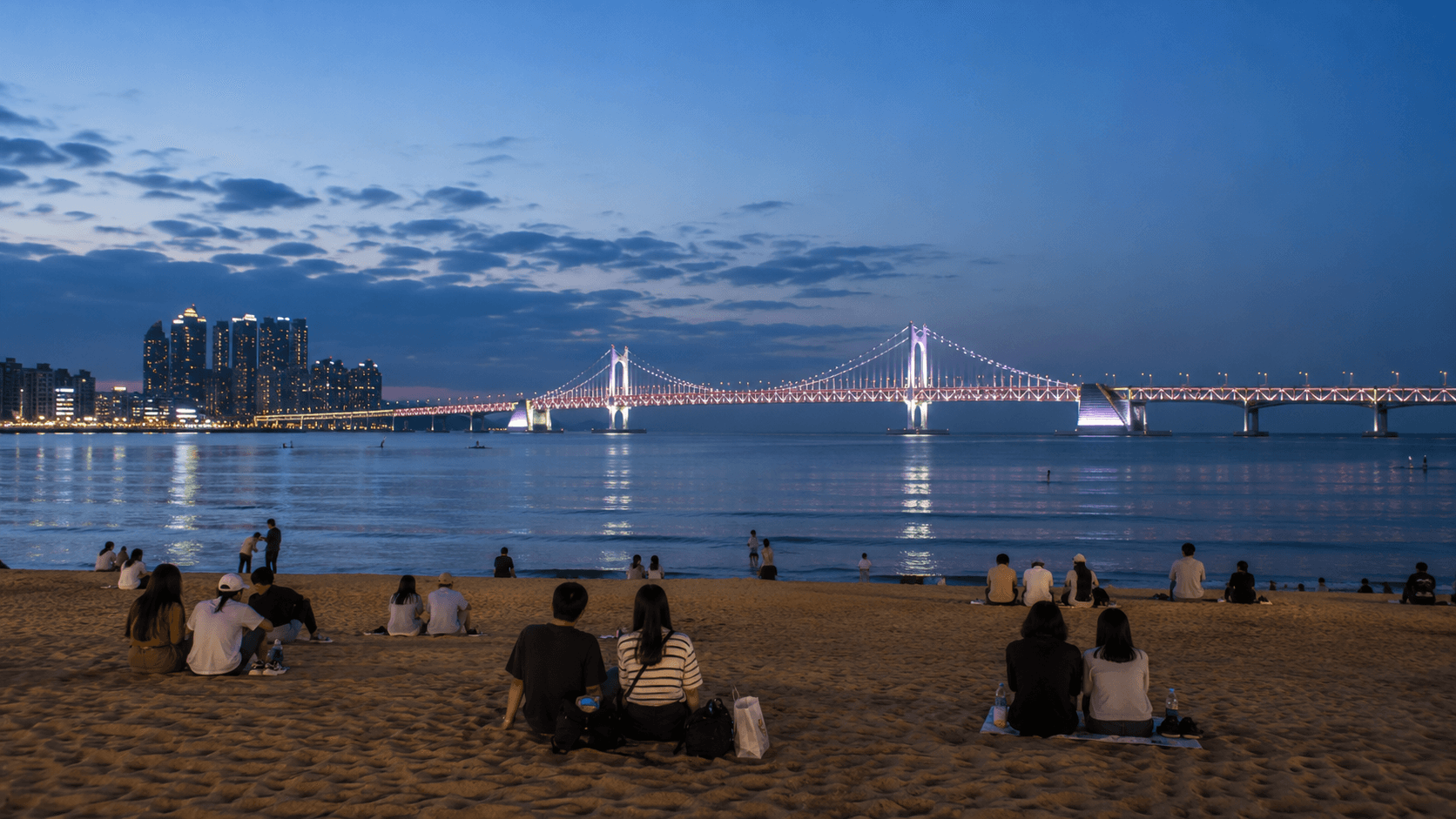
The streets near the station contain restaurants, cafés, pubs, karaoke rooms and entertainment businesses. It works particularly well as an evening stop after Gwangalli because both areas are on Line 2, though travelers should check the final train for their exact destination on the day of travel.
This district sees international students but is not organized primarily for foreign tourists. Menus and ordering systems may therefore offer less English than in central tourist areas. Card payment is widespread in established businesses, but carrying a small amount of KRW is sensible for older shops or temporary stalls.
Useful for: Busan nightlife, budget meals and travelers who want a less tourist-centered evening.
8. Pusan National University: northern Busan’s student center
Pusan National University retains the spelling Pusan in its official English name, although the city is now romanized as Busan. Its main Busan campus is near Pusan Nat’l Univ. Station on Metro Line 1. Do not confuse this with Pusan Nat’l Univ. Yangsan Campus Station on Line 2, which is in Yangsan.
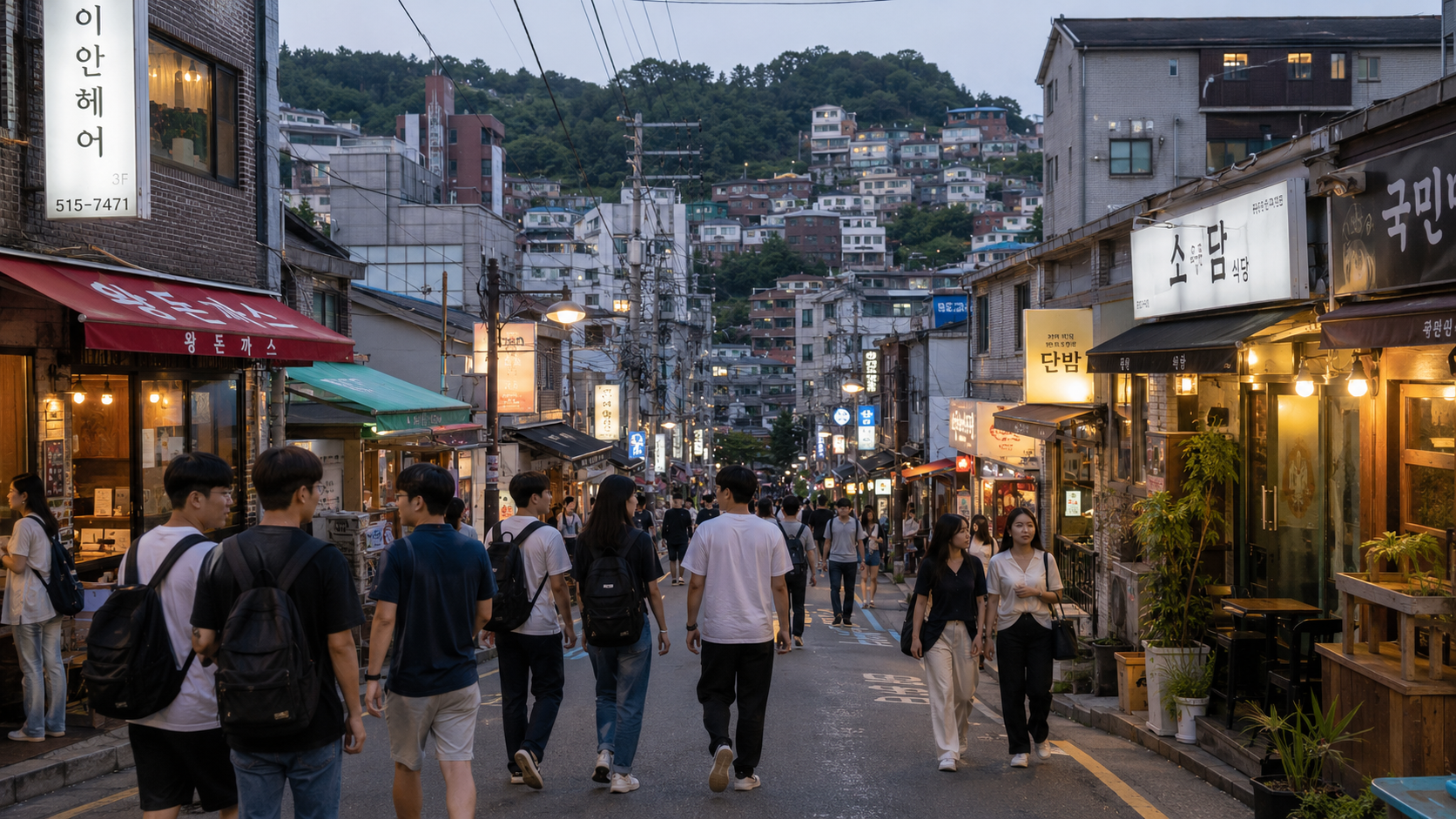
The commercial streets between the station and campus offer cafés, restaurants, bars and daily services for students. The neighborhood is compact enough for an unstructured walk and tends to receive fewer short-term international tourists than Seomyeon, Haeundae or Gwangalli.
The campus rises toward the mountain, so expect slopes. The area can be paired with Oncheonjang or other northern Busan stops, but it is less convenient as a quick addition to a tightly scheduled coastal itinerary.
Useful for: longer Busan stays, exchange students and visitors seeking an everyday university neighborhood.
Practical costs and payment
University areas can be economical, but location alone does not guarantee low prices. Compare menus displayed outside and check whether prices are per person, per portion or for a shared dish. Restaurants near campus back gates and residential streets are often more student-oriented than businesses beside major station exits.
Most permanent restaurants, cafés and shops accept Korean-issued cards, and many accept international Visa or Mastercard products. Acceptance is not universal, particularly with unattended kiosks, foreign-issued debit cards and small vendors. Keep some KRW and install a Korea-compatible map and translation app before going out.
Reservations are usually unnecessary for ordinary cafés and casual restaurants. They may be needed for popular restaurants, performances, workshops and large groups. Some Korean booking platforms require a local telephone number or payment method; contact the venue directly when the reservation process does not accept foreign details.
Campus etiquette
- Treat classrooms, libraries, dormitories and laboratories as restricted unless signs clearly permit entry.
- Do not photograph identifiable students at close range without permission.
- Keep noise low around teaching buildings and study spaces.
- Follow temporary barriers, security instructions and festival access controls.
- Ask before organizing commercial photography, interviews or large group activities.
- Use public cafés and restaurants rather than student-only dining facilities unless visitors are explicitly accepted.
What to check before you go
- Confirm the correct campus: several universities operate campuses in different cities.
- Save the university name, station and destination in Hangul.
- Check the final train and any service notices through the relevant transport operator.
- Look for current campus-entry, museum or tour information on the university website.
- Check whether a performance requires advance booking or Korean-language ability.
- Wear comfortable shoes; campuses commonly include hills, stairs and long internal roads.
- Avoid examination periods if your main goal is a lively student atmosphere.
- Expect major festivals to bring security controls, crowds and restricted building access.
Which area should you choose?
Choose Hongdae for the widest range of entertainment, Sinchon and Ewha for a walk combining several universities, or Daehak-ro for theater. Geondae is convenient for a straightforward evening out, while Hoegi offers a quieter student atmosphere. In Busan, Kyungsung–Pukyong is the easiest option to combine with major visitor districts, and Pusan National University is better for a slower, more local outing.
Start by marking one station and one campus gate in your map app. Build the visit around a short walking route rather than attempting to cover an entire university district at once.