Renting an apartment in South Korea is manageable once you understand the deposit system and the documents used to protect tenants. The most important rule is not to transfer a large deposit until you have confirmed the legal owner, checked the property register, understood every contract clause, and investigated deposit-return insurance.
Information on reporting requirements and tenant procedures was verified on June 10, 2026. Rental prices, guarantee eligibility, local brokerage limits, and administrative rules can change, so confirm them for your address before signing.
Quick answer
Most newcomers choose wolse (월세), meaning a refundable deposit plus monthly rent. Jeonse (전세) requires a much larger deposit and usually little or no monthly rent, but it exposes the tenant to greater deposit-return risk.
A typical rental process is:
- Set a budget that includes the deposit, rent, management fee, utilities, and brokerage fee.
- Visit properties through a licensed real estate office.
- Check the owner and debts recorded against the property.
- Confirm whether deposit-return insurance is available.
- Negotiate and sign a written Korean rental contract.
- Pay the balance and receive the keys.
- Report your new address and obtain the protections available through an official date stamp and lease reporting procedures.
Do not treat a listing, verbal promise, chat message, or English summary as a substitute for the signed Korean contract.
Understanding Korean rental types
Wolse: deposit plus monthly rent
With wolse, the tenant pays a deposit, called bojeunggeum (보증금), and monthly rent. The deposit is supposed to be returned at the end of the tenancy after unpaid rent, utilities, or documented damage has been deducted.
Listings commonly display two numbers, such as 1000/80. When the unit is KRW 10,000, this normally means a KRW 10 million deposit and KRW 800,000 monthly rent. Never assume the unit: ask the agent to write the full amounts in KRW.
Some landlords will accept a larger deposit in exchange for lower monthly rent. This conversion is negotiable, so compare the total cost rather than looking only at the advertised rent.
Jeonse: a large lump-sum deposit
With jeonse, the tenant provides a large deposit and ordinarily pays no monthly rent. The landlord must return the deposit when the lease ends. The Seoul Metropolitan Government's housing guide describes the basic difference between jeonse and monthly-rent contracts.
Jeonse is not automatically cheaper or safer. The landlord may have mortgages or other debts, and the property's sale value may be insufficient to repay every creditor and tenant. A tenant considering jeonse should obtain professional help, examine the property register, compare the deposit with a conservative market valuation, and check guarantee eligibility before signing.
Ban-jeonse and short-term housing
Ban-jeonse (반전세) combines a relatively large deposit with monthly rent. Short-term furnished studios may require a smaller deposit but charge higher rent, include restrictive cancellation terms, or operate under accommodation-style agreements.
Confirm whether the address can be used for foreign-resident address reporting. This matters for immigration administration and may affect tenant protections. A landlord's claim that address registration is “not possible” is a warning to investigate the building and contract more carefully.
Decide what you can actually afford
Prepare for more than the advertised deposit and rent:
| Cost | What to confirm |
|---|---|
| Deposit | Payment schedule, return date, and permitted deductions |
| Monthly rent | Due date, payment account, late-payment terms, and VAT if relevant |
| Management fee | Included services and recent monthly statements |
| Utilities | Electricity, gas, water, internet, heating, and waste charges |
| Brokerage fee | Written calculation and whether VAT is added |
| Moving costs | Moving company, cleaning, furniture, and appliance installation |
| Parking | Availability, registration rules, and monthly charge |
The management fee, or gwanlibi (관리비), can significantly change the real monthly cost. Ask for recent statements for both summer and winter, particularly in buildings with central heating or air conditioning.
Finding an apartment
Online platforms are useful for comparing neighborhoods, but listings can be outdated or designed mainly to attract inquiries. Confirm that a property is still available before traveling to view it.
A local licensed real estate office is called a budongsan (부동산) or gongin junggaesa samuso (공인중개사사무소). In Seoul, the city's real estate information portal provides property information and tools for checking registered brokerage offices.
Tell the agent your requirements in writing:
- Maximum deposit, rent, and management fee
- Preferred move-in date and lease length
- Need for address reporting
- Furnished or unfurnished
- Elevator and accessibility requirements
- Parking, pets, or bicycle storage
- Maximum walking time to public transportation
- Appliances that must be included
An English-speaking agent can help communication, but the agent still participates in the transaction and is not your independent lawyer or financial adviser.
Inspect the home properly
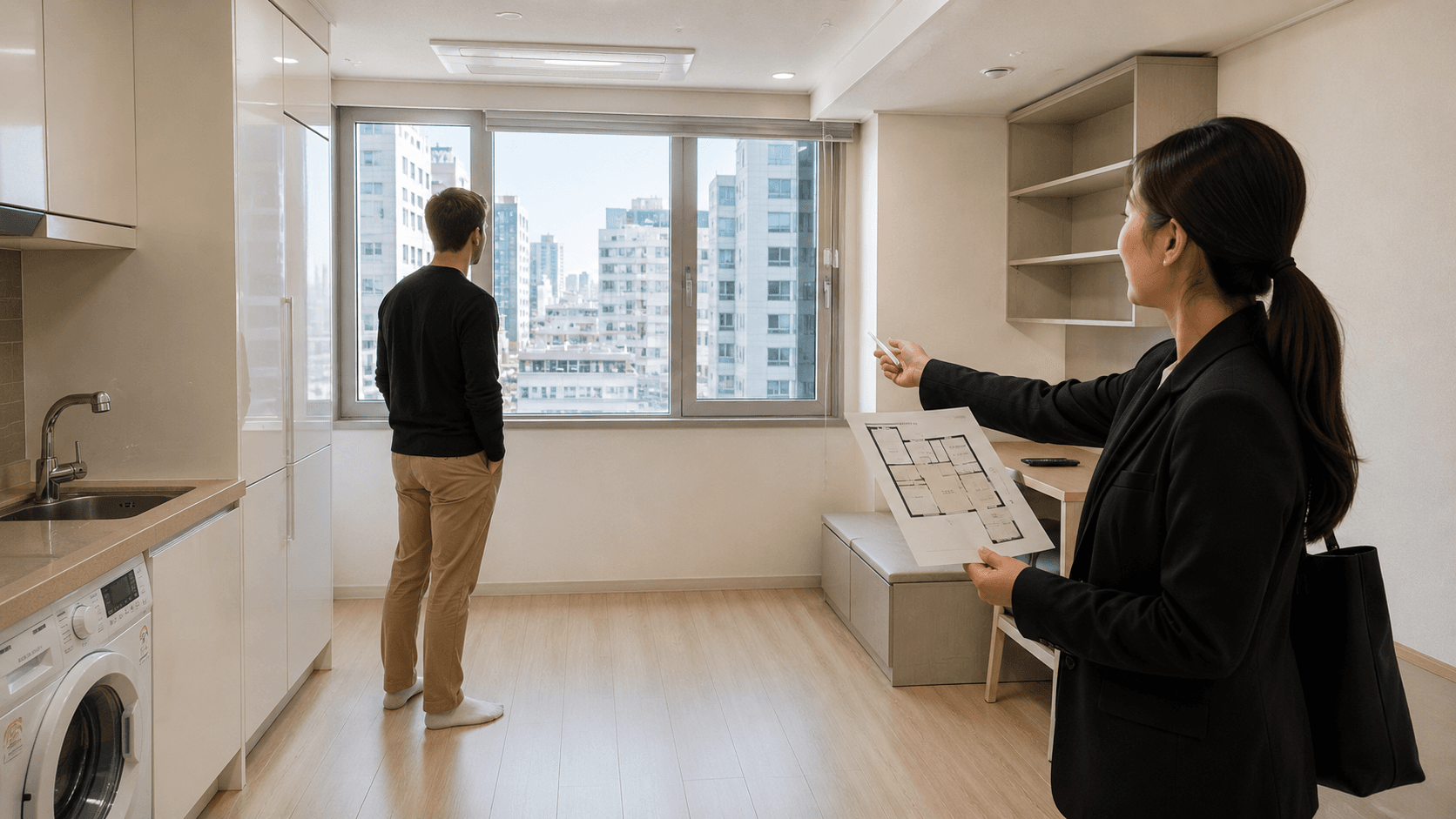
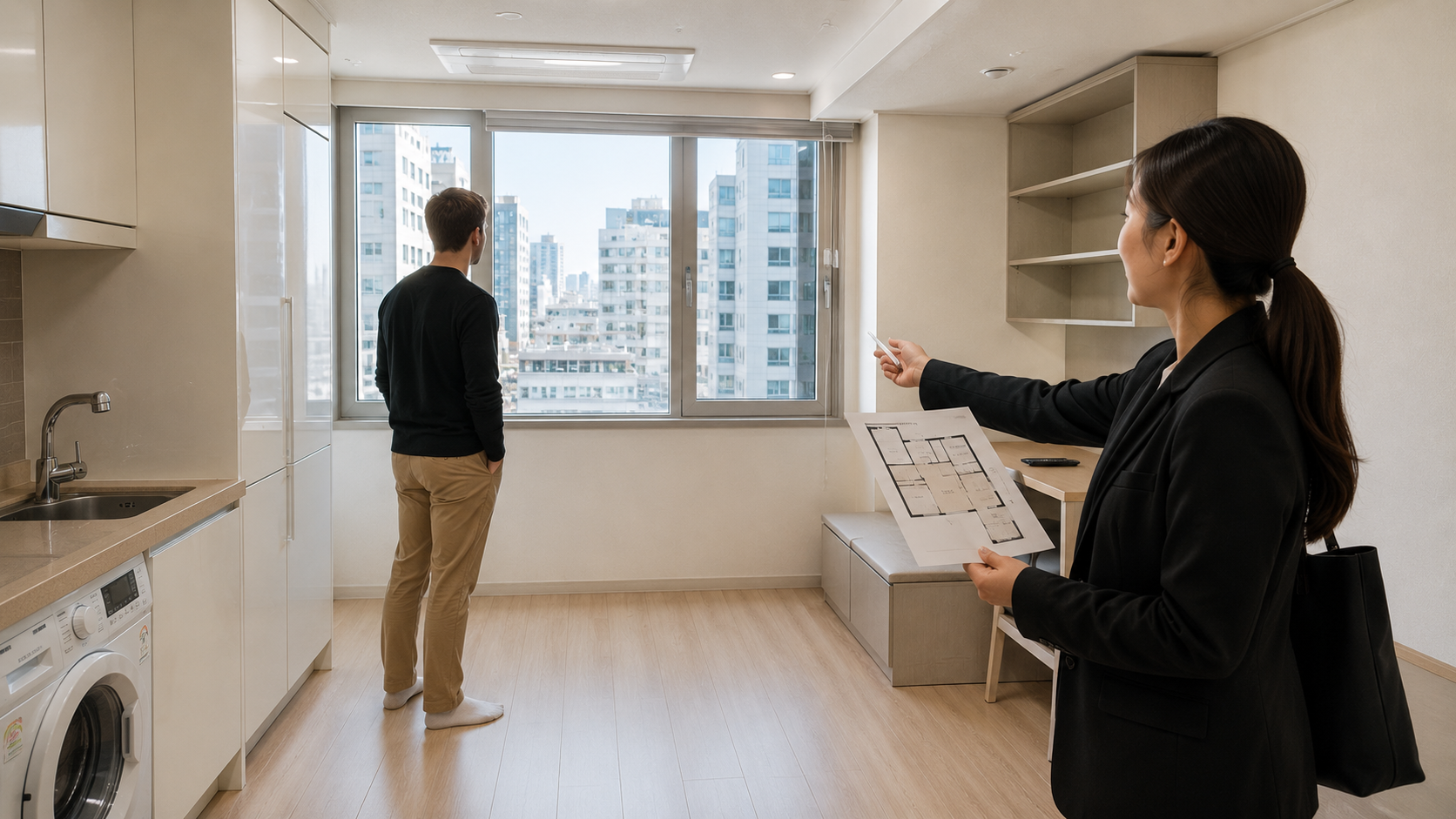
Visit in daylight when possible. A quick evening viewing can hide noise, moisture, poor ventilation, or limited sunlight.
Inside the unit
Check:
- Water pressure, hot water, drains, and signs of leakage
- Mold, condensation, wallpaper stains, and musty smells
- Window locks, door lock, intercom, and fire-safety equipment
- Heating and air-conditioning controls
- Electrical outlets and appliance condition
- Mobile reception and internet options
- Storage space and furniture included in the lease
- Noise from neighbors, roads, railways, restaurants, or construction
For a semi-basement unit, known as banjiha (반지하), investigate drainage, flood exposure, ventilation, emergency exits, and security particularly carefully.
Around the building
Check the route to public transportation at the time you would normally commute. Also look at waste-disposal facilities, parcel delivery arrangements, parking access, elevators, entrance security, late-night lighting, and nearby commercial noise.
Photograph existing damage during the inspection and again when moving in. Attach a condition list to the contract or send a dated record through a traceable communication channel.
Check the property before paying
1. Confirm the legal owner
Compare the landlord's identification with the owner shown on the property's current registry record. If a representative signs, request identification and legally adequate proof of authority. Do not send money to an unrelated account merely because an agent or messenger requests it.
2. Obtain a current registry record
The official real estate register is available through the Supreme Court Internet Registry Office. It can show ownership, mortgages, seizures, provisional registrations, and other registered rights.
A registry check is not a one-time task. Review it before signing and obtain a fresh record immediately before paying the final balance, because new rights may have been registered in the meantime.
3. Compare the deposit with the property's value and debts
A low advertised price does not make a lease safe. Consider the deposit, registered mortgages, other tenants' deposits, tax-related risks, and a conservative estimate of what the property could produce in a forced sale.
Apartment transaction information can be researched through the Ministry of Land, Infrastructure and Transport's real estate transaction system. Unusual buildings, subdivided houses, villas, and officetels may be harder to value than standardized apartment units.
4. Investigate deposit-return insurance
The Korea Housing and Urban Guarantee Corporation, commonly called HUG, operates jeonse deposit-return guarantee products. Eligibility depends on the property, deposit, valuation, ownership, debt position, contract, and application timing. Check the current conditions directly through HUG before signing; do not rely on a landlord's or agent's assurance that approval is automatic.
Other authorized guarantee providers may offer relevant products. Compare coverage, exclusions, deadlines, required documents, and what happens if the landlord fails to return the deposit.
Signing the rental contract
Korean residential leases commonly use a standard-form contract. Request time to read it and obtain an accurate translation or independent review if you cannot confidently understand the Korean text.
The contract should clearly identify:
- The exact property and portion being rented
- Landlord and tenant
- Deposit, rent, management fee, and payment dates
- Contract payment and final-balance payment
- Lease start and end dates
- Included furniture, appliances, parking, and storage
- Repair responsibilities
- Conditions for early termination
- Deposit-return timing and account details
- Special agreements added to the standard terms
Useful special clauses may require the landlord to avoid creating new mortgages or other rights before the tenant receives possession and completes protective procedures. Another clause may address cancellation and repayment if the property proves ineligible for an agreed deposit guarantee. The wording and enforceability should be reviewed by a qualified Korean professional.
A contract payment is often made when signing and credited toward the deposit. Cancellation consequences can be substantial. Do not pay a “holding deposit” unless the property, price, parties, refund conditions, and purpose of the payment are documented.
Brokerage fees
Brokerage remuneration is subject to legal and local limits and varies by transaction value and property type. The actual fee must be negotiated within the applicable ceiling. Ask the broker for:
- The transaction value used in the calculation
- The applicable maximum rate
- The agreed fee in KRW
- Whether VAT is charged separately
- A receipt and the brokerage office's business details
For current local limits, consult the relevant city or provincial government and the licensed brokerage office. Do not assume that a percentage quoted for Seoul applies everywhere or to every type of building.
Protecting your deposit after moving in
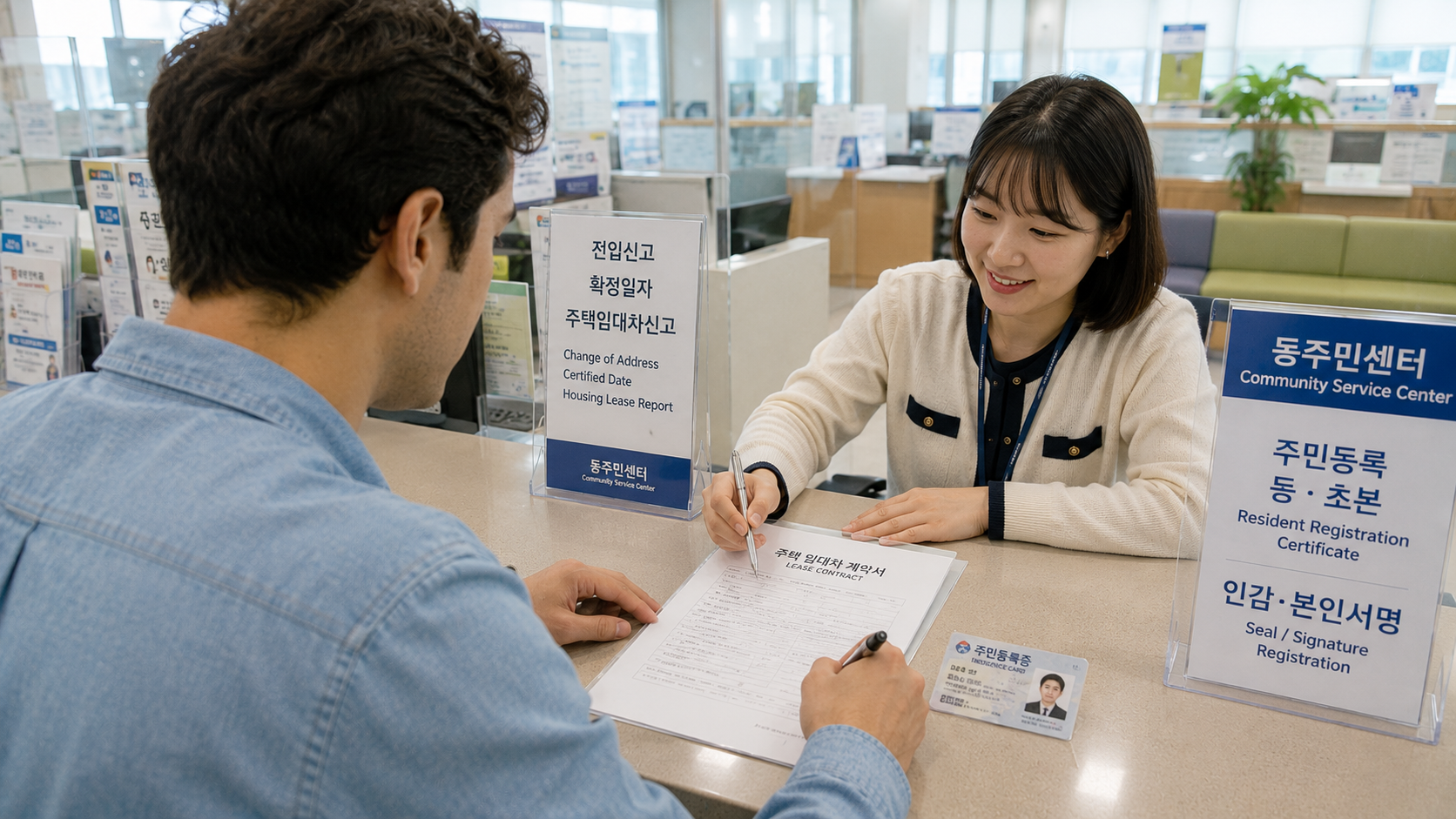
Under Korea's housing-lease framework, possession of the home and the appropriate residence or address registration are central to establishing rights against third parties. An official fixed date, called hwakjeong ilja (확정일자), can also be important for priority in repayment.
Foreign residents should ask the local eup, myeon, or dong community service center which procedures and documents apply to their immigration status. Bring your signed lease, passport, Residence Card if issued, and any other requested documents. Address-change obligations are also administered through immigration channels; check the current procedure and deadline on Hi Korea or call Immigration Contact Center 1345.
Certain residential leases must be reported through the national housing lease reporting system within 30 days of signing, although coverage depends on location, deposit, and rent. A properly submitted report may also provide a fixed date. Requirements and penalties have changed since the system was introduced, so verify your contract on the official Real Estate Transaction Management System or at the local community service center. This reporting information was checked on June 10, 2026.
Keep copies of the signed contract, registry records, transfer receipts, guarantee documents, condition photographs, repair messages, and official filings. Pay by bank transfer when possible so the amount, recipient, and date are recorded.
Repairs, rent, and communication
Report defects promptly in writing and keep photographs. The party responsible for a repair can depend on the cause, seriousness, contract, and applicable law. Routine consumables and tenant-caused damage are different from structural problems or failure of essential installed systems.
Do not deduct repair expenses from rent without written agreement or professional advice. Keep rental payments current and use the account stated in the contract unless a legitimate change is documented and verified.
Korea's Housing Lease Protection Act includes rules on lease duration, renewal requests, and limits on certain rent or deposit increases, with exceptions and procedural requirements. For a dispute or a proposed early termination, consult the current statute through the National Law Information Center and obtain qualified advice rather than relying on an informal translation.
Ending the lease and recovering the deposit
Check the notice provisions months before the end date. Do not assume the lease ends automatically without consequences: renewal, implied continuation, and termination rules may depend on when notice is given.
Before leaving:
- Give notice in a form that creates evidence of delivery.
- Agree on an inspection date and document the property's condition.
- Settle rent, management fees, and utilities.
- Confirm the exact deposit repayment date and account.
- Coordinate key return with deposit repayment.
- Preserve your legal position if the deposit has not been returned.
Do not casually complete an address change, surrender possession, or hand over every key before obtaining advice when a deposit remains unpaid. Those actions can affect practical or legal protections. Contact a housing counseling service or Korean lawyer promptly if repayment appears uncertain.
Common mistakes to avoid
- Choosing a home from photographs without inspecting it
- Assuming every officetel legally permits residential use or address reporting
- Paying before confirming ownership and the recipient's bank account
- Checking the register only once
- Accepting verbal promises that are absent from the contract
- Ignoring management fees and winter heating costs
- Assuming a large jeonse deposit is guaranteed by the government
- Signing a Korean contract without understanding special clauses
- Missing lease-reporting, fixed-date, guarantee, or address-change deadlines
- Moving out before dealing with an unpaid deposit
What to check before you go
Before a viewing, bring identification, a list of requirements, and a way to record measurements and defects. Before signing, obtain the latest registry record, confirm the owner, calculate the total monthly cost, investigate guarantee eligibility, and read every clause.
Before moving in, recheck the registry, transfer money only to a verified recipient, receive the keys, photograph the condition, and collect all signed documents. Immediately afterward, confirm the lease-reporting, fixed-date, and foreign-resident address procedures that apply to you.
Your next practical step is to set separate maximum figures for the deposit, monthly rent, and total monthly housing cost. Give those figures to at least two licensed local agents, then compare actual properties and registry records rather than relying on listing prices alone.
Sources
- Seoul Metropolitan Government housing guide
- Ministry of Land, Infrastructure and Transport Real Estate Transaction Management System
- Supreme Court Internet Registry Office
- Korea Housing and Urban Guarantee Corporation
- Hi Korea immigration services
- National Law Information Center
- Seoul Real Estate Information Portal