Seoul is too large to cover efficiently by moving between distant landmarks all day. For a first visit, spend four full days exploring one or two neighboring areas at a time: historic Jongno, central Seoul and Dongdaemun, Yongsan and Hongdae, then Gangnam and Seongsu. This route balances major sights with enough time for meals, rest, and unplanned stops.
Operational details and prices in this guide were verified on June 9, 2026. Exhibition schedules, palace programs, and business hours can change, so check the linked official pages shortly before visiting.
At a glance
| Day | Main area | Highlights |
|---|---|---|
| 1 | Jongno | Gyeongbokgung Palace, Bukchon, Insadong, Ikseon-dong |
| 2 | Central Seoul | Cheonggyecheon, Gwangjang Market, DDP, Namsan |
| 3 | Yongsan and Mapo | National Museum of Korea, Han River, Hongdae |
| 4 | Gangnam and Seongsu | Bongeunsa, COEX, Seoul Forest, Seongsu |
Allow at least four full days, excluding your arrival and departure days. If you have only three days, remove Day 4 or choose either Gangnam or Seongsu rather than attempting both.
Before starting: transport and navigation
Choose a transport card
A rechargeable Tmoney card is the simplest option if you want to pay for individual subway and bus journeys. Standard cards generally cost KRW 3,000-5,000 before adding travel credit and are sold at convenience stores and subway information centers. See the Korea Tourism Organization transport-card guide for current purchase and use information.
Visitors making several journeys each day can compare this with Seoul's Climate Card. As verified on June 9, 2026, short-term passes cost KRW 5,000 for one day, KRW 8,000 for two days, KRW 10,000 for three days, KRW 15,000 for five days, or KRW 20,000 for seven days. A physical card costs an additional KRW 3,000. These passes cover eligible Seoul subway lines and Seoul-licensed buses, but not the Sinbundang Line, airport buses, or every route outside Seoul. Check the official Climate Card coverage and purchase instructions before deciding.
International credit and debit cards are accepted at designated new ticket machines on Seoul Metro Lines 1-8 for short-term Climate Cards and single-journey tickets. Seoul announced an average service fee of approximately 3.7% for international-card transactions. This payment option was introduced on March 17, 2026.
Use a Korea-compatible map
Google Maps can help with place names, but its walking and driving directions may be limited in South Korea. Install Naver Map or KakaoMap and download Korean place names when possible. Subway stations are numbered, which makes them easier to identify even if pronunciation is unfamiliar.
Always tag your transport card when entering and leaving the subway. On buses, tag once when boarding and again before getting off, especially when transferring.
Day 1: Palaces, hanok streets, and old Seoul
Morning: Gyeongbokgung Palace
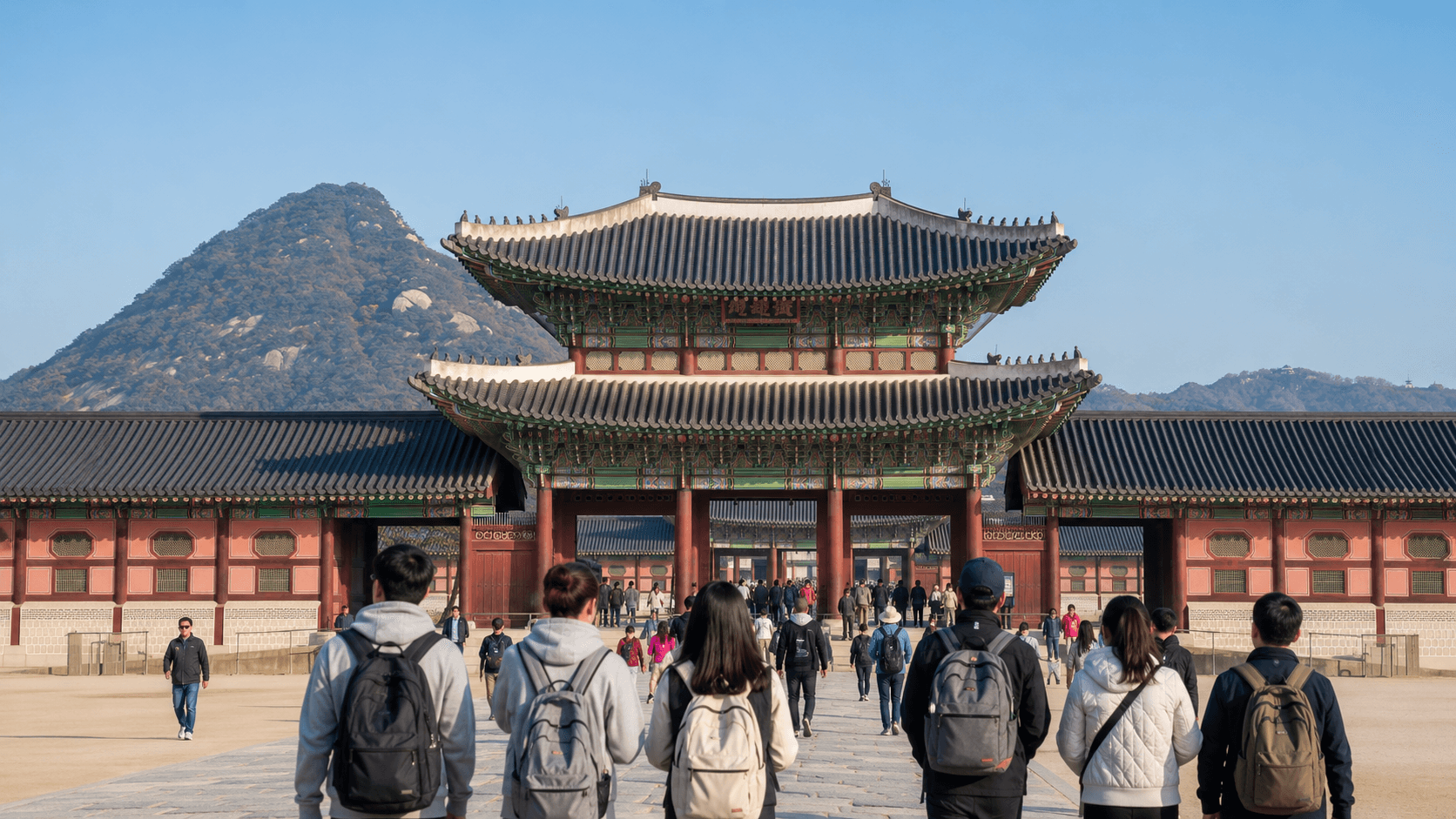
Start around 9:00 at Gyeongbokgung Palace, the principal royal palace of the Joseon dynasty. Arriving near opening time gives you space to see the main ceremonial courtyard before large tour groups arrive.
As verified on June 9, 2026, regular opening hours are:
- January-February and November-December: 09:00-17:00
- March-May and September-October: 09:00-18:00
- June-August: 09:00-18:30
- Last admission is one hour before closing.
- The palace normally closes on Tuesdays.
If Tuesday is a public holiday, the closure may move to the next non-holiday weekday. Confirm the date through the Royal Palaces and Tombs Center visitor-hours page. General adult admission is KRW 3,000.
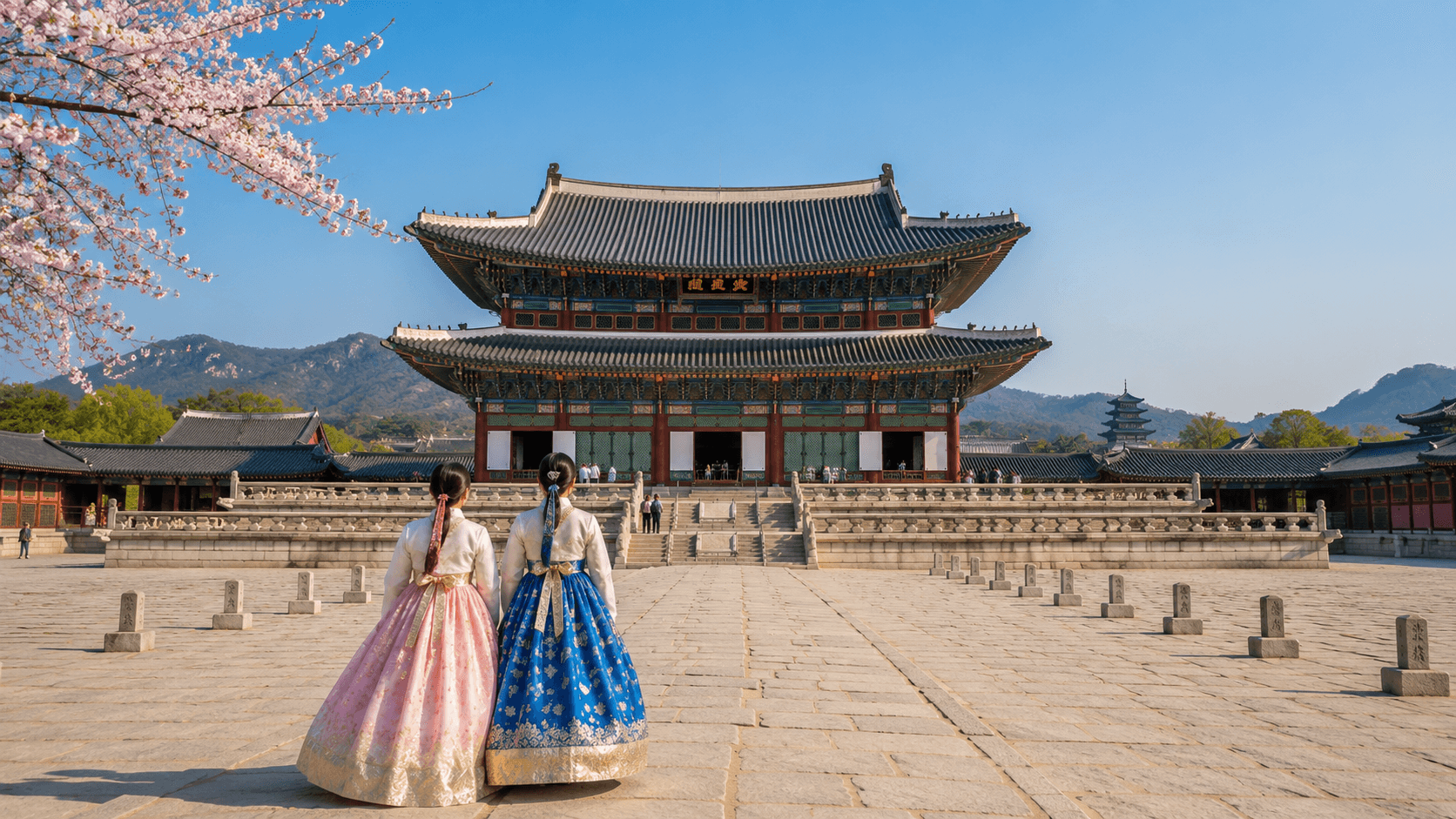
Allow 90 minutes to two hours. The site is extensive, with stone paths and limited shade, so comfortable shoes matter more than formal clothing. Renting hanbok, Korean traditional clothing, is optional. Do not build your schedule around it unless dressing up and taking photographs are priorities, as fitting and returns can add considerable time.
If the palace is closed, visit Changdeokgung Palace instead, but check whether you need a separate timed reservation for its rear garden.
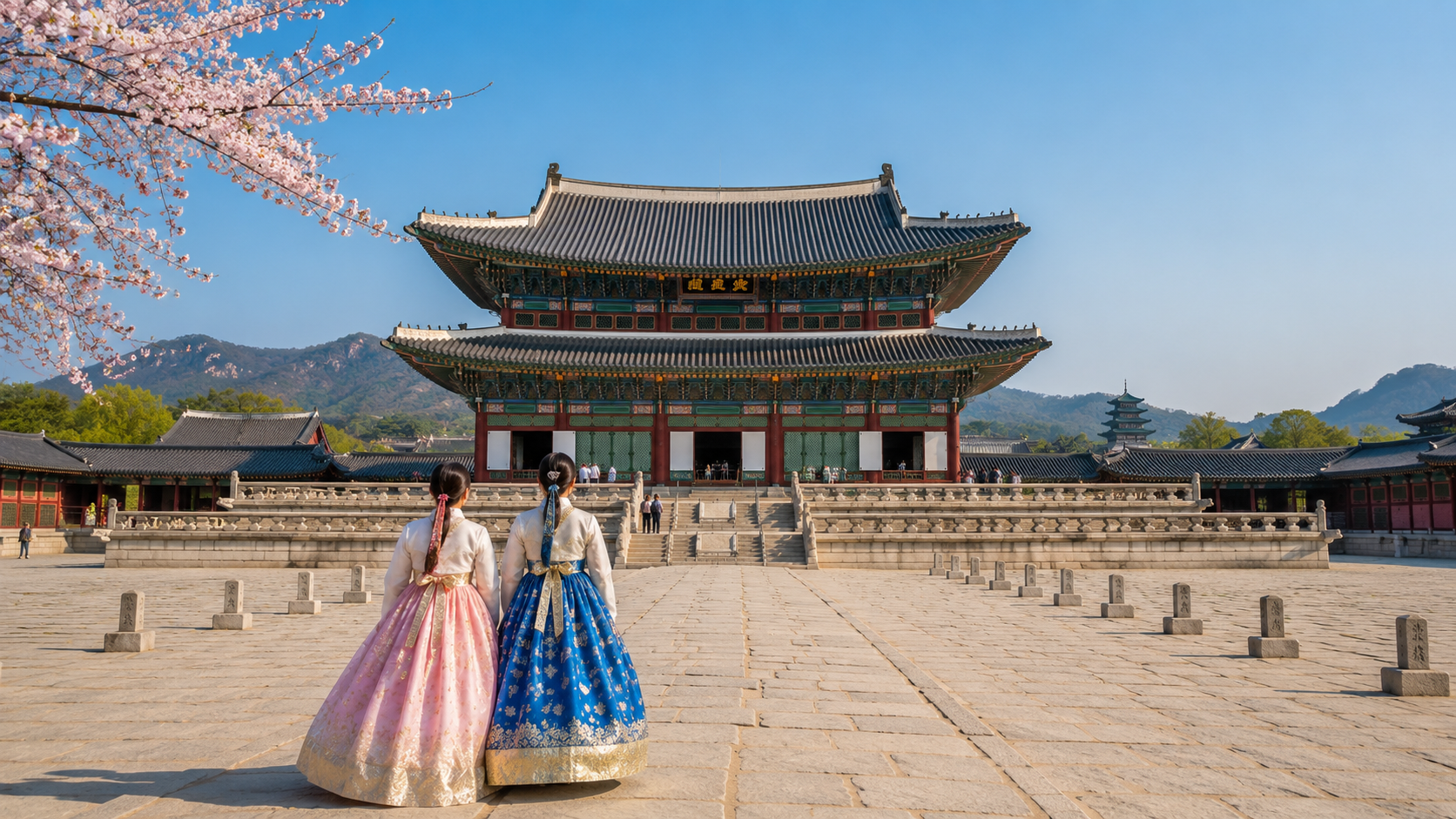 the traditional palace courtyard and Geunjeongjeon Hall, with one or two visitors wearing colorful hanbok walking
naturally in the foreground. Wide-angle composition, symmetrical palace architecture, soft morning sunlight, blue sky,
authentic Korean details, calm atmosphere, natural colors. No text, logos, watermark, or decorative border. Landscape
orientation, 16:9 aspect ratio, high detail.
the traditional palace courtyard and Geunjeongjeon Hall, with one or two visitors wearing colorful hanbok walking
naturally in the foreground. Wide-angle composition, symmetrical palace architecture, soft morning sunlight, blue sky,
authentic Korean details, calm atmosphere, natural colors. No text, logos, watermark, or decorative border. Landscape
orientation, 16:9 aspect ratio, high detail.
Lunch: Seochon or Tongin Market area
Leave through the western side for Seochon, an older neighborhood with small restaurants and cafes. Choose a restaurant displaying prices clearly rather than waiting for a specific viral venue. At busy restaurants, solo diners may be asked to order a minimum of two portions for shared dishes such as barbecue or hot pot; noodle, rice, dumpling, and soup restaurants are usually simpler for one person.
Afternoon: Bukchon and Insadong
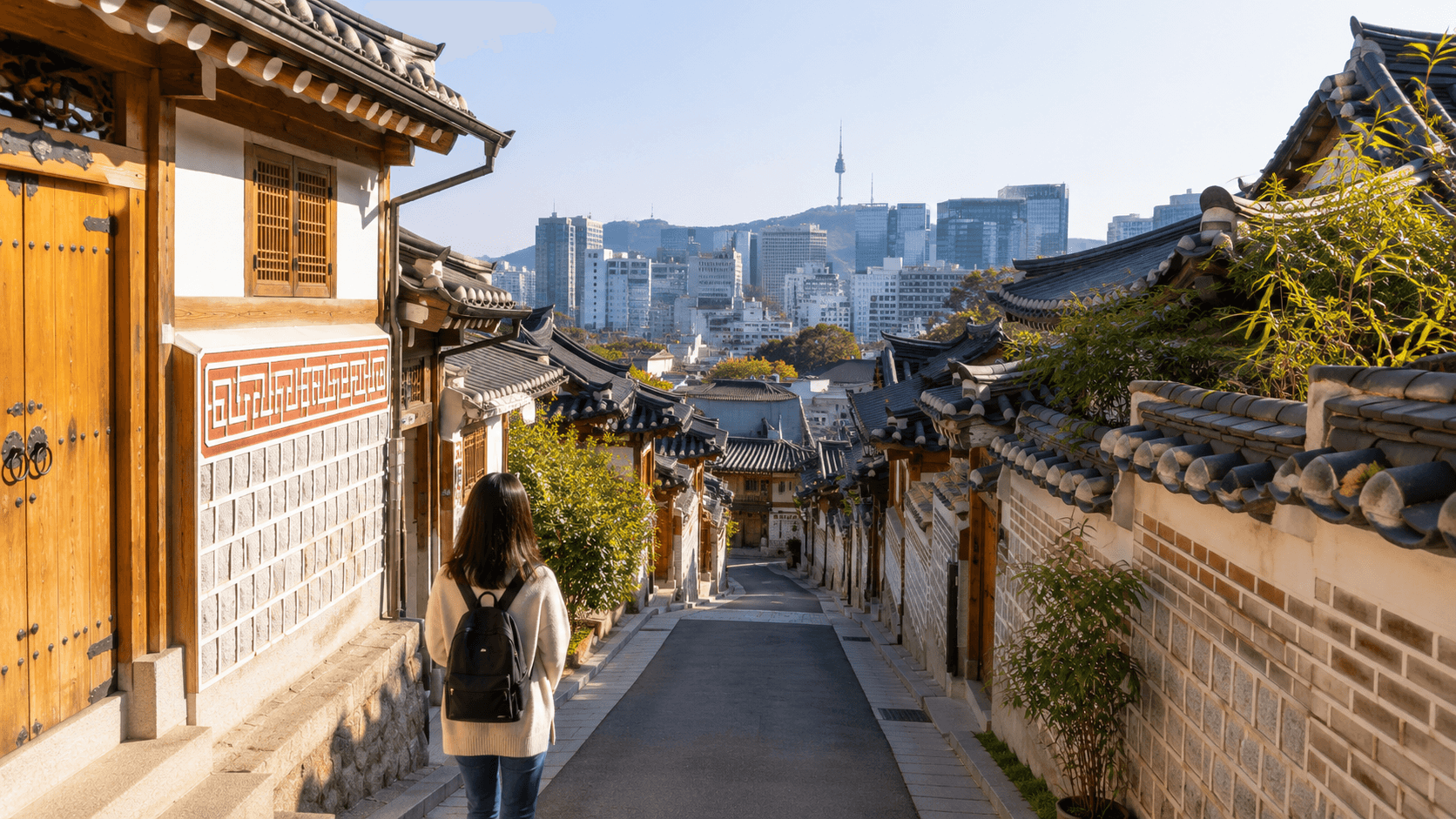
Continue to Bukchon Hanok Village, where traditional houses called hanok remain mixed with residences, workshops, guesthouses, and cafes. Bukchon is a living neighborhood, not an outdoor museum.
Tourist access in Bukchon's designated red zone is restricted from 17:00 until 10:00 the following morning. Visit only during permitted hours, follow posted signs, keep voices low, and do not photograph through residential doors or windows. The Seoul Metropolitan Government's Bukchon notice explains the controlled area and visiting rules.
Walk south toward Insadong for crafts, tea shops, galleries, and souvenir shopping. Then continue to Ikseon-dong, a compact area of converted hanok buildings. Its narrow lanes become congested in the late afternoon; treat it as a place for a short walk or early dinner rather than a major half-day attraction.
Day 2: Markets, urban design, and a city view
Morning: Cheonggyecheon and Gwangjang Market
Begin with a walk beside Cheonggyecheon Stream. Enter around Jonggak or Euljiro and walk east toward Gwangjang Market. The stream path is below street level, but stairs and street crossings mean you should use the upper road when step-free access is important.
Reach Gwangjang Market before the main lunch rush. Foods commonly associated with the market include bindaetteok, a mung-bean pancake, mayak gimbap, small seaweed rice rolls, dumplings, noodles, and yukhoe, seasoned raw beef. Check the displayed price before ordering and bring a payment card plus some cash. Individual vendors keep different hours, so there is no single reliable opening time for every stall.
Order selectively. Trying two or three small dishes is more practical than buying a full portion at every popular counter. Raw meat may not suit pregnant travelers, young children, or anyone with a weakened immune system.
Afternoon: Dongdaemun Design Plaza
Walk or take the subway to Dongdaemun Design Plaza, usually abbreviated to DDP. The building and outdoor spaces are worthwhile even without a ticketed exhibition. Interior hours and admission vary by gallery and event, so check the official DDP website linked by Seoul Metropolitan Government before going.
Allow one to two hours, depending on the current program. Dongdaemun History & Culture Park Station serves Lines 2, 4, and 5, making this an easy point from which to return to your accommodation for a break.
Evening: Namsan and N Seoul Tower
For a broad city view, go to Namsan in the late afternoon. You can walk uphill, use a bus, or take the separately operated cable car from the Myeong-dong side. The climb is manageable for active visitors but includes sustained slopes and steps.
The outdoor tower plaza provides views without an observatory ticket. As verified on June 9, 2026, the paid observatory operates from 10:00 to 22:30 on weekdays and until 23:00 on weekends and public holidays, with final admission 30 minutes before closing. Weather or operating conditions can alter these hours; check the official N Seoul Tower visitor page.
Sunset is popular, so allow extra time for transport and queues. On hazy or rainy days, postpone the tower rather than paying for a limited view. Myeong-dong is a convenient dinner stop after descending.
Day 3: Korean history, the Han River, and Hongdae
Morning: National Museum of Korea
Spend the morning at the National Museum of Korea in Yongsan. It is a strong introduction to Korean history and material culture, especially if palace architecture and historical references felt unfamiliar on Day 1.
Permanent galleries are free. As verified on June 9, 2026, the museum opens from 09:30 to 17:30 on Monday, Tuesday, Thursday, Friday, and Sunday. On Wednesday and Saturday it remains open until 21:00. Last admission is 30 minutes before closing, and paid special exhibitions have separate ticketing. Check the museum's official visitor-information page for closure dates and current exhibitions.
The museum is too large to see completely in one morning. Choose two or three sections and allow about three hours. Free wheelchairs, strollers, coat storage, and lockers are available, according to the museum's visitor information.
Afternoon: Choose a Han River stop
From Yongsan, choose one river area rather than trying to cover several parks:
- Ichon Hangang Park: Convenient from the museum and suitable for a quiet riverside walk.
- Yeouido Hangang Park: Larger lawns and easy access to Yeouido's commercial district.
- Mangwon Hangang Park: Convenient to combine with Mangwon Market and western Seoul.
The river can feel considerably colder and windier than nearby streets. In summer, carry water and avoid the least shaded part of the afternoon. In winter, shorten the stop and use the extra time at the museum.
Evening: Hongdae and Yeonnam-dong
Continue to Hongik University Station for Hongdae's shops, restaurants, live venues, and busy pedestrian streets. For a calmer evening, walk north toward Yeonnam-dong and the Gyeongui Line Forest Park.
Hongdae is an entertainment district rather than one specific attraction. Check age rules, cover charges, last entry, and identification requirements directly with any club or ticketed venue. Carry your original passport when a venue requires official identification, but keep it secure.
Day 4: Gangnam, Bongeunsa, and Seongsu
Morning: Bongeunsa and COEX
Begin at Bongeunsa, a Buddhist temple opposite the COEX complex. It offers a useful contrast with the commercial district around it. Dress and behave as you would at an active religious site: speak quietly, do not obstruct worshippers, and check before photographing ceremonies.
Cross to COEX for shops, restaurants, exhibitions, and Starfield Library. The library is inside a shopping complex and is free to enter, but it is also a functioning public space rather than a staged photography set. Event schedules and individual store hours vary.
Gangnam's distances are deceptive. Attractions that appear close on a map may require long underground walks, so use the correct station exit and allow extra time if carrying luggage or using a wheelchair.
Afternoon and evening: Seoul Forest and Seongsu
Take the subway or a taxi north to Seoul Forest, then walk toward Seongsu's cafe and retail streets. The district contains converted industrial buildings, independent shops, temporary pop-ups, and brand spaces, but openings change frequently. Treat specific social-media recommendations as leads, not guaranteed destinations.
In 2026, the Seoul International Garden Show is running in and around Seoul Forest and Seongsu through October 27, according to the Seoul Metropolitan Government's event announcement. Travelers visiting after that date should not assume installations or programs remain available.
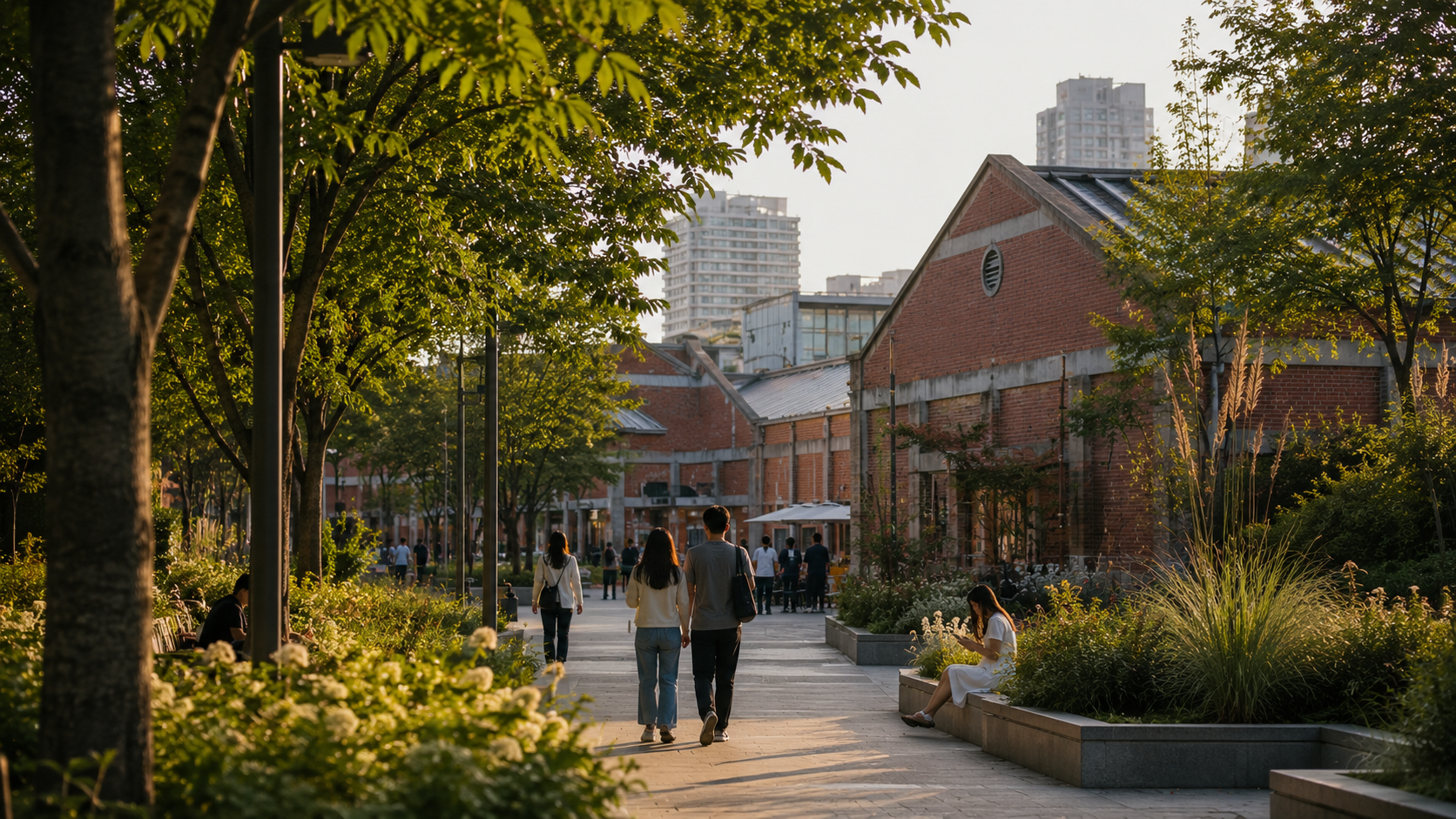 tree-lined walking path leading toward renovated red-brick industrial buildings, with a few visitors walking or
relaxing naturally. Wide landscape composition, greenery in the foreground, modern urban details in the background,
warm golden-hour light, relaxed contemporary Seoul atmosphere, natural colors. No text, logos, watermark, or
decorative border. Landscape orientation, 16:9 aspect ratio, high detail.
tree-lined walking path leading toward renovated red-brick industrial buildings, with a few visitors walking or
relaxing naturally. Wide landscape composition, greenery in the foreground, modern urban details in the background,
warm golden-hour light, relaxed contemporary Seoul atmosphere, natural colors. No text, logos, watermark, or
decorative border. Landscape orientation, 16:9 aspect ratio, high detail.
Finish with dinner in Seongsu or return to your accommodation before the subway becomes crowded. Pop-up stores may require Korean-language reservations or local phone verification, so do not make them essential parts of the day unless you have confirmed entry requirements.
Where to stay for this itinerary
For a first visit, prioritize a direct subway connection over a fashionable neighborhood name.
- Jongno or Euljiro: Convenient for palaces, markets, and central sights.
- Myeong-dong: Practical for airport transport, shopping, and multiple subway lines, though busy at night.
- Hongdae: Useful for nightlife and the AREX airport railway, but farther from eastern and southern Seoul.
- Seoul Station: Strong transport connections, though the immediate area is less atmospheric than Jongno or Hongdae.
Check the walking route from the station to the property, not just the stated distance. Hills, underpasses, large intersections, and station corridors can make a nominal five-minute walk much longer with luggage.
Realistic budget notes
Admission is not the largest expense on this itinerary. Gyeongbokgung costs KRW 3,000, the National Museum's permanent galleries are free, and neighborhoods such as Bukchon, Insadong, Hongdae, and Seongsu do not charge general admission. Your main variable costs will be accommodation, food, shopping, taxis, ticketed exhibitions, and the N Seoul Tower observatory or cable car.
Convenience stores and casual restaurants make it possible to keep food costs moderate, but do not assume every market is cheaper than a restaurant. Always check posted menus. Foreign cards are widely accepted in Seoul, but carry some KRW cash for market stalls, older ticket machines, and small businesses.
Common planning mistakes
- Scheduling Gyeongbokgung on a Tuesday without checking holiday adjustments.
- Entering Bukchon's restricted residential zone outside permitted hours.
- Crossing Seoul repeatedly instead of grouping nearby districts.
- Expecting every restaurant to accept solo diners for shared dishes.
- Building a day around a temporary Seongsu pop-up without confirming reservations.
- Underestimating station corridors, stairs, hills, heat, or winter wind.
- Treating airport transfers as part of a full sightseeing day after a long flight.
What to check before you go
- Confirm palace closure days and any special night-opening reservations.
- Check Bukchon signs and restricted-zone boundaries.
- Review weather, air-quality, and heavy-rain alerts.
- Compare a Tmoney card with the Climate Card based on your actual routes.
- Check the last train for any late evening outside your accommodation area.
- Confirm observatory visibility before paying for a city view.
- Check museum and DDP exhibition schedules.
- Save hotel and destination names in both English and Korean.
- Keep a small amount of KRW cash and a backup payment card.
- For emergencies, call police at 112 or fire and ambulance services at 119.
The Korea Tourism Organization announced on January 20, 2026 that its 1330 Travel Helpline call and chat services were temporarily unavailable until further notice. Check the latest official 1330 service notice rather than relying on older guidebooks that list it as continuously available.
If you have an extra day
Choose one focused addition:
- Changdeokgung and Jongmyo: Best for more history, subject to closure and guided-entry rules.
- Bukhansan National Park: Best for hiking, weather permitting; this requires proper footwear and a separate day.
- Jamsil: Combine Seokchon Lake with the Lotte World Tower area.
- A slower neighborhood day: Spend more time in Mangwon, Yeonnam-dong, Seochon, or Seongsu instead of adding another major landmark.
Your next step is to place the four day routes on your preferred map app, mark your accommodation, and move Day 1 away from Tuesday if necessary. That single adjustment prevents the most common first-time itinerary problem.
Sources
- Royal Palaces and Tombs Center opening hours
- Seoul Metropolitan Government Climate Card guide
- Seoul Metropolitan Government Bukchon visitor restrictions
- National Museum of Korea visitor information
- Official N Seoul Tower operating hours
- Seoul Metropolitan Government DDP information
- Korea Tourism Organization transport-card guide