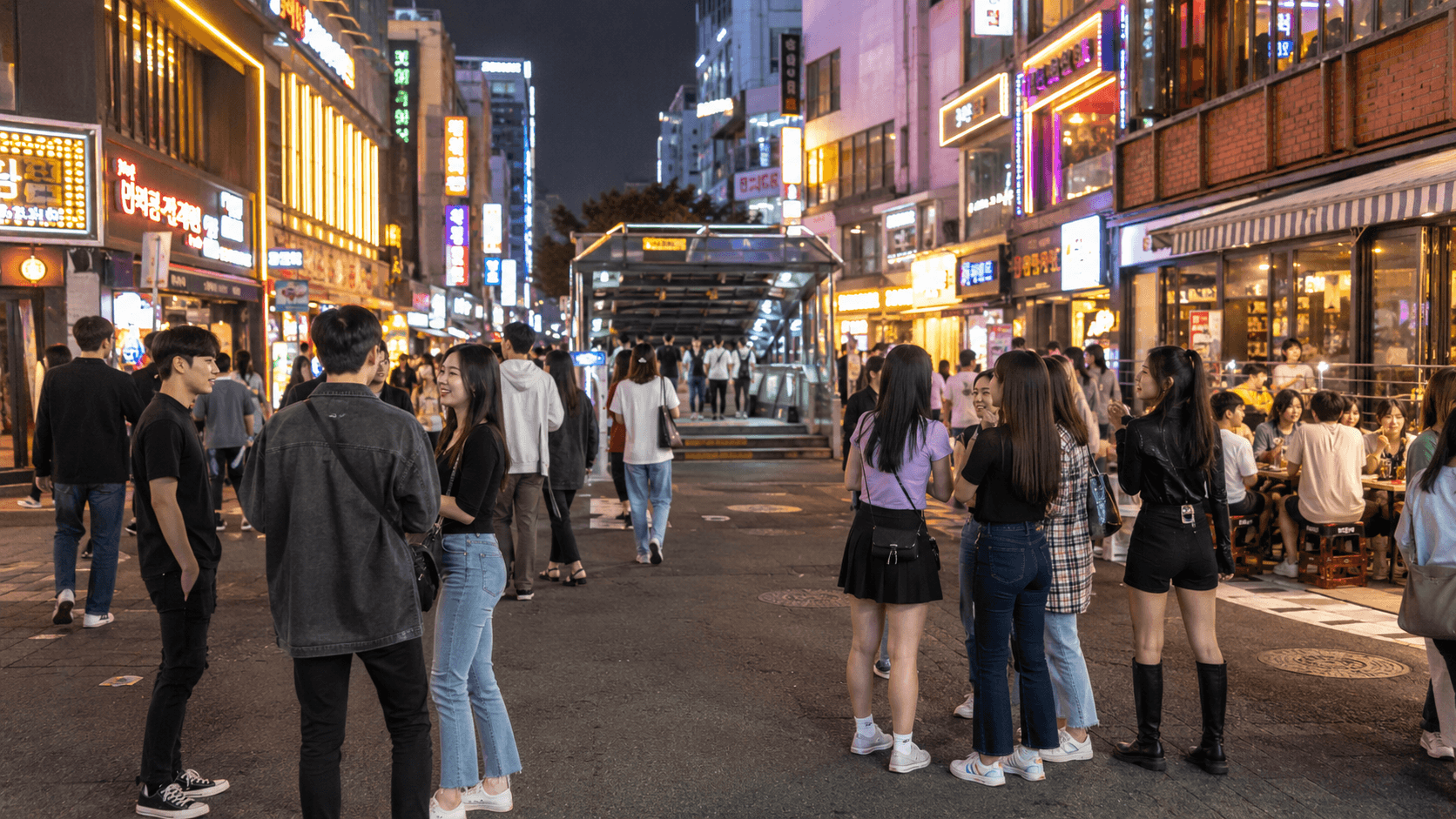
Seoul nightlife is spread across several districts rather than concentrated in one central strip. Hongdae suits energetic, youth-oriented nights; Itaewon offers an international mix; Euljiro and Jongno are better for Korean-style pubs and food; and Gangnam has larger, more polished venues. Choose one area for the night, especially if you plan to stay out after the subway stops running.
Information on transport fares, legal age rules and public services in this guide was verified on June 9, 2026. Individual venues change their hours, admission policies and prices frequently, so check directly before visiting.
At a glance
| Area | Best for | Nearest useful stations | General atmosphere |
|---|---|---|---|
| Hongdae | Clubs, live music, busking, casual bars | Hongik University, Sangsu, Hapjeong | Young, busy and informal |
| Itaewon | International restaurants, bars and clubs | Itaewon, Noksapyeong | Diverse and visitor-friendly |
| Euljiro | Small bars, beer alleys and retro interiors | Euljiro 3-ga, Euljiro 4-ga | Industrial, compact and atmospheric |
| Jongno 3-ga and Ikseon-dong | Pojangmacha, Korean food and bar-hopping | Jongno 3-ga | Lively, local and food-focused |
| Gangnam | Large bars, clubs and group gatherings | Gangnam, Sinnonhyeon | Polished, crowded and relatively expensive |
| Apgujeong and Cheongdam | Lounges, cocktails and fashionable venues | Apgujeong Rodeo, Cheongdam | Dressier and higher-budget |
Choosing the right nightlife district
Hongdae: clubs, performances and casual energy
Hongdae, named after nearby Hongik University, is one of the easiest nightlife districts for first-time visitors. The area combines dance clubs, live venues, coin karaoke rooms, restaurants, late-night cafés and street performances. The Korea Tourism Organization's Hongdae guide specifically identifies its busking culture and Club Street.
The busiest streets are around Hongik University Station and the pedestrian areas closer to Hongik-ro. For smaller bars and a slightly calmer evening, continue toward Sangsu or Hapjeong. Friday and Saturday nights can become extremely congested, particularly near station exits and major club entrances.
Hongdae generally suits travelers who want multiple options without reservations. However, individual clubs may impose age, dress or identification rules. Admission is never guaranteed simply because you meet the legal drinking-age requirement.
Itaewon: international food and mixed nightlife
Itaewon has bars, clubs and restaurants serving customers from a wide range of backgrounds. The official Itaewon Special Tourist Zone information describes it as a major multicultural entertainment district.
The main nightlife area is near Itaewon Station, including the streets behind the Hamilton Hotel. Noksapyeong and Gyeongnidan-gil offer more restaurants and smaller bars, although the neighborhood is hilly. Itaewon remains a practical choice when your group has different food preferences or limited Korean-language ability.
The district includes narrow lanes and steep streets. Avoid entering an alley that already looks uncomfortably crowded, and follow temporary barriers, one-way pedestrian instructions or police directions. Seoul operates crowd-detection and response systems in high-density districts, as explained in the city's crowd safety overview, but visitors should still make independent decisions about whether an area feels safe to enter.
Euljiro: Korean pub culture in an industrial district
Euljiro combines printing shops, workshops and older commercial buildings with small bars and restaurants. Some venues occupy upper floors or unmarked buildings, so entrances may be less obvious than in Hongdae or Gangnam.
A straightforward starting point is Euljiro Nogari Alley, near Euljiro 3-ga Station. Nogari (노가리) is dried young pollack, commonly served as a beer snack. According to the official Nogari Alley listing, business hours and holidays vary by establishment and parking is unavailable.
Choose Euljiro for conversation, food and smaller venues rather than a large-club experience. Check the building number carefully and use a Korean map application because a venue may be several floors above street level.
Jongno 3-ga and Ikseon-dong: food first, drinks second
Jongno 3-ga is useful for travelers who want a Korean-style evening built around shared food. The area has restaurants, bars and outdoor-style pojangmacha (포장마차), meaning covered food stalls or casual tented pubs. Typical dishes include noodles, omelets, grilled seafood and dried-fish snacks.
The lanes around Ikseon-dong contain converted hanok buildings, restaurants and bars, while streets closer to Jongno 3-ga Station have a rougher, more informal late-night character. Seating can be tight, menus may be Korean-only and some stalls may not accept reservations.
Outdoor stalls and streetside seating are affected by weather, local enforcement and redevelopment. Treat online photographs as examples rather than proof that a particular stall will be operating.
Gangnam, Apgujeong and Cheongdam: larger and dressier venues
The streets around Gangnam Station and Sinnonhyeon contain restaurants, pubs, karaoke rooms and clubs. The official Gangnam destination page notes that the area around Gangnam Station exits 10 and 11 is particularly busy in the evening.
Gangnam is convenient for groups staying south of the Hangang River, but crossing Seoul from Hongdae or Itaewon late at night can mean a long taxi ride. Apgujeong Rodeo and Cheongdam generally have more lounges, cocktail bars and dress-conscious venues. Reservations and table bookings are more relevant here than in casual Hongdae bars.
Do not assume that every club admits foreign visitors, solo customers or people of every adult age. Door policies can be selective and may change by event. Confirm with the venue before making a long journey.
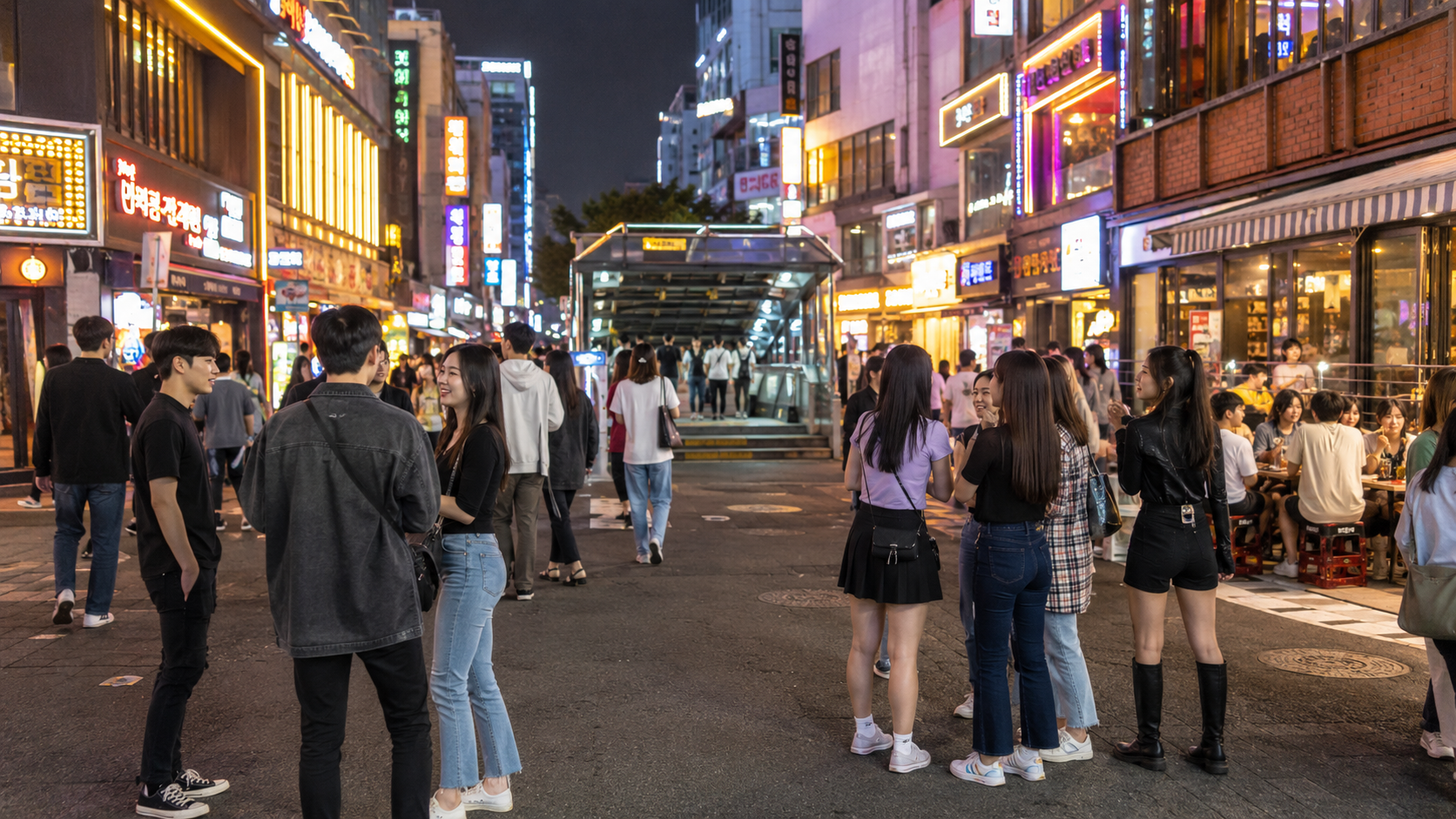
What a typical night in Seoul looks like
A Korean night out often moves through several rounds, called cha (차). The first round may be dinner with beer or soju. A second stop could be a pub or cocktail bar, followed by noraebang (노래방), a private-room karaoke venue. Some groups finish with late-night soup, noodles or barbecue.
You do not need to follow this pattern or drink alcohol. Karaoke rooms, cafés, night walks, cinemas and late meals are all normal alternatives. Seoul also has substantial alcohol-free nightlife, although dedicated non-alcoholic bar options are less predictable and should be checked individually.
At Korean restaurants and traditional pubs, groups commonly share dishes. Some venues require each table to order food, while others may apply a minimum order or one-drink-per-person policy. Ask before sitting down if the rule is unclear.
Legal age and identification
Under Korea's current Youth Protection Act, people are generally treated as juveniles until the year in which they turn 19; the exception begins on January 1 of that calendar year. This year-based rule differs from systems based strictly on a person's birthday.
This is general information, not legal advice. Venues can apply stricter admission rules, and staff may decline entry if they cannot verify your age. Carry an original passport or another identification document the venue explicitly accepts. A photograph of a passport may not be accepted.
Never leave your passport as collateral. Keep it in a closed internal pocket or secure bag, and take only the cards and cash needed for the evening.
Budgeting for a night out
There is no reliable citywide price for drinks or club admission. Prices vary considerably by district, event, venue and whether table service is involved.
The following are planning estimates, not official or guaranteed prices:
| Type of night | Suggested budget per person |
|---|---|
| Dinner and one casual bar | ₩30,000–₩60,000 |
| Dinner, several drinks and karaoke | ₩50,000–₩100,000 |
| Club night with admission and taxi | ₩70,000–₩150,000+ |
| Lounge or table-service evening | ₩150,000 and above |
Ask to see the menu before ordering. Imported alcohol, cocktails, bottle service and table packages can raise the total quickly. Confirm whether quoted club prices include admission, a drink, a table or only a reservation deposit.
International credit cards work at many established businesses, but payment acceptance can vary. Carry some KRW for small stalls, lockers, transport-card top-ups or a backup payment method. Check the total on the card terminal before approving it.
Reservations and door policies
Casual pubs usually operate on a walk-in basis, while popular restaurants, live performances, cocktail bars and higher-end clubs may require reservations. Korean booking platforms sometimes require a local phone number or Korean payment method.
Before visiting a specific venue, confirm:
- The date and opening hours, including the final admission time
- Whether a ticket or reservation is required
- Accepted identification
- Age, dress and group-size restrictions
- Cover charges, minimum orders or table deposits
- Whether large bags or coats must be stored
- Accessibility, including lifts and accessible toilets
A listing marked open until 4 a.m. does not necessarily mean customers can enter at 3:30 a.m. Kitchens, ticket desks and admission lines may close earlier.
Getting home after midnight
Subway
As verified on June 9, 2026, the adult Seoul subway base fare is ₩1,550 with a transport card or ₩1,650 for a single-ride ticket, effective since June 28, 2025. Longer trips cost more. See the Seoul Metropolitan Government subway fare page for the official fare structure.
Last-train times vary by line, station, direction, day and operator. Do not rely on a general statement that the subway closes at midnight. Check the exact final connection before entering your first venue, particularly when a transfer is required.
Night buses
Seoul's late-night buses use route numbers beginning with N and are often called Owl Buses. A 2026 city notice confirmed that 14 night routes normally operate from 11 p.m. to 6 a.m. daily. The adult Owl Bus fare listed by Seoul is ₩2,500, but routes and fares can change; verify them through the official Seoul bus information before travel.
Night buses may involve a walk from the entertainment district and longer waiting times than daytime services. Tap your transport card when boarding and again when leaving.
Taxis
Standard Seoul sedan taxis charge a daytime base fare of ₩4,800 for the first 1.6 km. Late-night surcharges apply from 10 p.m. to 4 a.m.: 20% from 10–11 p.m., 40% from 11 p.m.–2 a.m. and 20% from 2–4 a.m. These rates were verified on June 9, 2026 through the city's official taxi fare guide.
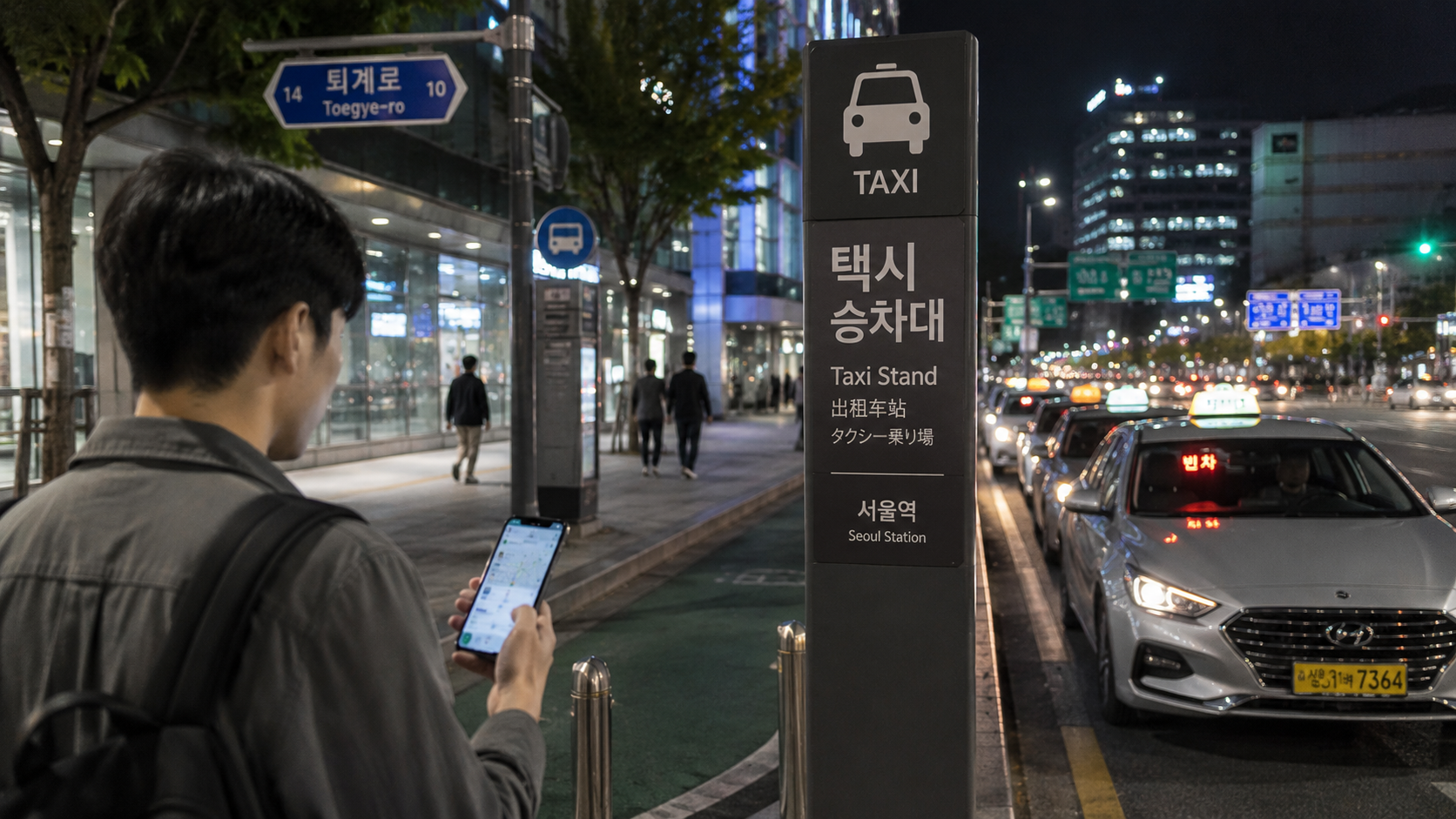
Use an established taxi-hailing app or a marked taxi stand. Enter the destination before requesting the car and compare the vehicle plate with the app. Standard taxis should use the meter unless you selected a separately approved fixed or app-based fare.
Have your accommodation's name, full address and phone number saved in Korean. Drivers may recognize the nearest major landmark or subway station more easily than an English hotel name.
Safety and etiquette
Seoul is navigable late at night, but normal urban precautions still apply.
- Stay with your group in crowded districts and agree on a meeting point in case mobile service fails.
- Do not accept unattended drinks, and keep your own drink in sight.
- Leave immediately if staff or strangers pressure you to buy bottles, join a private room or use an unfamiliar payment method.
- Avoid steep, narrow or packed alleys when pedestrian movement has slowed.
- Respect residential streets by keeping voices down outside venues.
- Ask before smoking. Rules and designated areas vary, and smoking near entrances may disturb nearby businesses or residents.
- Photograph or record performers only when permitted.
- Do not attempt to carry an unconscious friend home without help. Call emergency services if the person cannot be awakened, is breathing abnormally or may be injured.
For police assistance, call 112. For fire or medical emergencies, call 119. The Korea Tourism Organization lists these numbers and the multilingual 1330 Korea Travel Hotline on its official emergency information page.
Nightlife without clubs or alcohol
A late evening in Seoul does not have to involve bars. Practical alternatives include:
- Private-room karaoke with soft drinks and snacks
- Late-night Korean barbecue or soup restaurants
- Evening walks along the Hangang River in well-lit, active areas
- Night photography around Dongdaemun Design Plaza or central Seoul
- Cinemas with late screenings
- Board-game cafés and PC rooms
- A scheduled night-view attraction
One official option is SEOULDAL, a tethered balloon in Yeouido Park. As verified on June 9, 2026, its standard schedule is Tuesday–Sunday, noon–10 p.m., with the last flight at 9:30 p.m.; an adult ticket costs ₩25,000. Operations depend on wind and weather, so check the official SEOULDAL information on the day. Passengers under the influence of alcohol cannot board.
What to check before you go
- Choose one primary district and save two or three backup venues nearby.
- Verify current hours, event tickets and admission policies directly.
- Carry accepted identification and keep it secure.
- Charge your phone and carry a small power bank.
- Save your accommodation address in Korean.
- Check the exact last subway connection before drinking.
- Load enough money onto your transport card for a night bus.
- Estimate the late-night taxi fare and surcharge in advance.
- Wear shoes suitable for stairs, hills and long walks.
- Monitor crowd conditions during festivals, Halloween and major performances.
- Save 112, 119 and the 1330 Korea Travel Hotline.
Your most useful next step is to select the district that matches your preferred pace, then confirm that night's venue schedule and your return route before leaving your accommodation.
Sources
- Seoul Metropolitan Government subway fares and system information
- Seoul Metropolitan Government bus fares and usage guide
- Seoul Metropolitan Government taxi fare guide
- Korea Tourism Organization emergency information
- National Law Information Center: Youth Protection Act
- Korea Tourism Organization Hongdae guide
- Korea Tourism Organization Itaewon guide
- Seoul Metropolitan Government crowd safety information