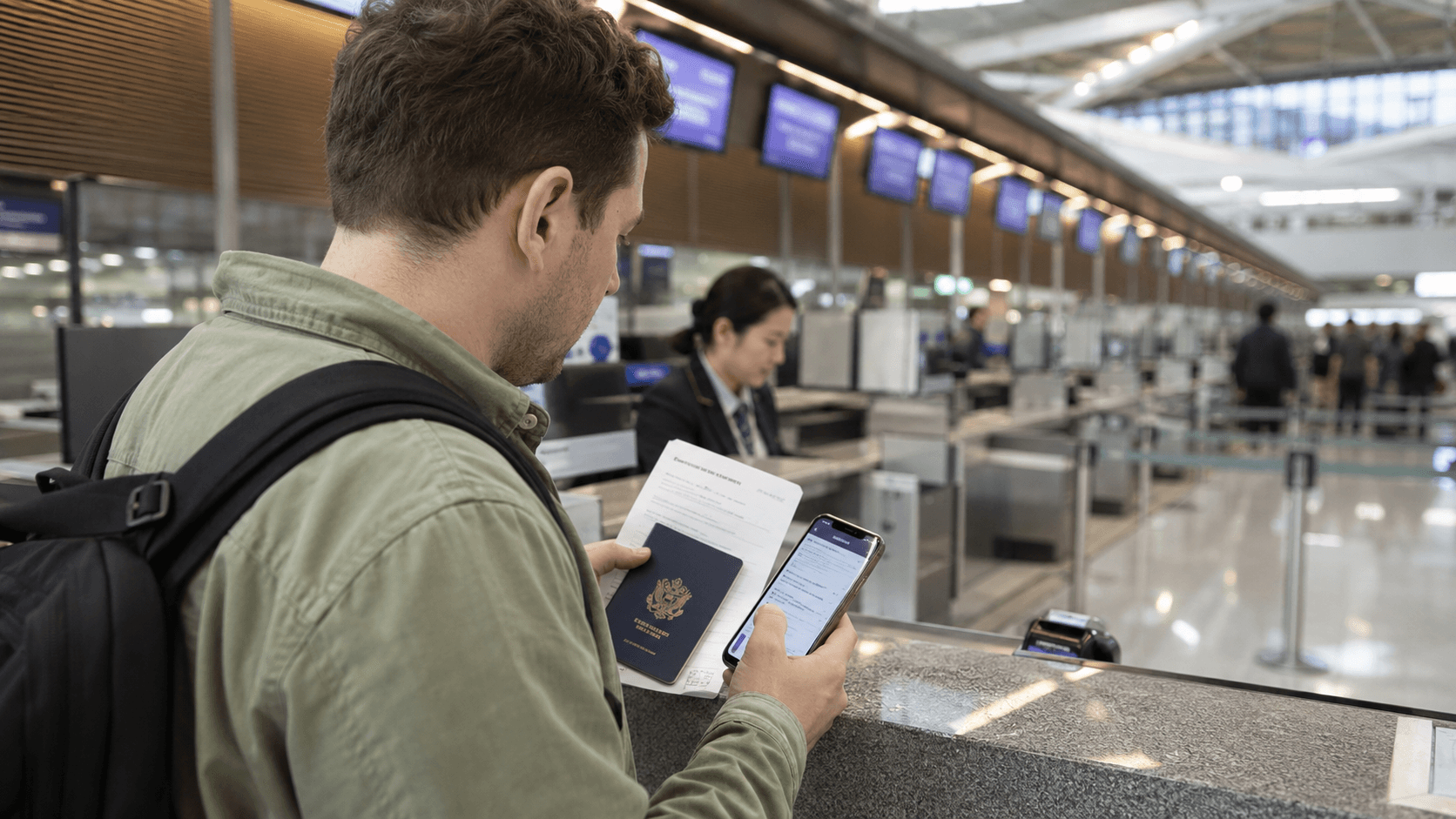
South Korea’s entry requirements depend on your passport, reason for travel and intended length of stay. Before booking, confirm whether you can enter visa-free, need a Korea Electronic Travel Authorization (K-ETA), or must obtain a visa. Most foreign visitors who do not hold K-ETA approval or a Korean Residence Card must also submit a free e-Arrival Card.
Information in this guide was verified on June 9, 2026. Immigration and health rules can change, so check the official services again shortly before departure.
Quick answer
For a typical short tourist visit, prepare:
- A passport valid for your trip
- Proof that you qualify for visa-free entry, or the correct Korean visa
- K-ETA approval if your nationality requires it
- A free e-Arrival Card if you are not exempt
- Your accommodation address and contact details in Korea
- A return or onward itinerary and evidence that you can support your stay, if requested
- Any required Q-CODE health declaration based on your recent travel history
- Customs and quarantine declarations for restricted or declarable items
A visa or K-ETA does not guarantee admission. The final decision is made by a Korea Immigration Service officer at the port of entry.
Step 1: Check whether you need a visa
Do not rely on a general list found on a travel blog. Visa-free eligibility and permitted stay periods depend on the passport you will use, not where you live or where your flight begins.
Use the official Korea Visa Portal Visa Navigator and enter your nationality, purpose of entry and intended length of stay. You can also confirm the result with the Korean embassy or consulate responsible for your place of residence.
There are three common possibilities:
| Your situation | What you normally need |
|---|---|
| Your passport qualifies for visa-free entry | Passport plus K-ETA if required, or an e-Arrival Card if K-ETA-exempt |
| Your nationality or travel purpose requires a visa | Passport, valid Korean visa and usually an e-Arrival Card |
| You already hold a valid Korean Residence Card | Passport and Residence Card; an arrival card is generally not required |
Visa-free entry is intended for permitted short-term activities such as tourism, visiting relatives, attending meetings or certain unpaid business activities. It does not automatically allow employment, paid performances, long-term study or other income-producing work.
If you plan to work, study, teach, undertake an internship, join a working-holiday program or remain in Korea long term, identify the correct visa before departure. Entering as a tourist and trying to change status later may not be permitted.
How long can you stay without a visa?
The permitted period varies by nationality. It may be 30, 60, 90 or more days under Korea’s visa-waiver and visa-free arrangements. For example, not every visa-exempt traveler receives the same 90-day period.
Check your nationality in the Visa Navigator rather than assuming that a friend’s permitted stay applies to you. The period granted at immigration is the period that controls your stay.
Step 2: Check your K-ETA status
K-ETA is Korea’s electronic travel authorization for eligible travelers entering without a visa. It is not a visa and is not used by travelers who are entering with a Korean visa.
As verified on June 9, 2026, nationals of 25 countries and regions are temporarily exempt from K-ETA through December 31, 2026, Korea Standard Time:
- Asia: Hong Kong, Japan, Macao, Singapore and Taiwan
- Americas: Canada, Guam and the United States
- Europe: Austria, Belgium, Denmark, Finland, France, Germany, Italy, Liechtenstein, the Netherlands, Norway, Poland, Spain, Sweden, Switzerland and the United Kingdom
- Oceania: Australia and New Zealand
The Ministry of Justice advises travelers to verify exemption status through the official K-ETA website, where an exemption message should appear after the relevant nationality is selected. The exemption currently ends on December 31, 2026 unless the Korean government extends or changes it.
Travelers from other visa-free countries may still need K-ETA approval. Some categories, including eligible travelers aged 17 or younger or 65 or older, are excluded from the K-ETA requirement, but should confirm their status through the official service.
Applying for K-ETA
If required, apply only through the official K-ETA website or official mobile application.
As verified on June 9, 2026:
- Fee: KRW 10,000, plus a separate online payment charge
- Normal assessment time: within 72 hours, although it can take longer
- Expedited processing: not available
- Validity: generally three years, or until the passport expires if sooner
- Use: multiple entries during the validity period
Apply well before your flight or ferry. A required K-ETA must be approved before boarding. If your passport is reissued, you must obtain a new K-ETA even if the previous authorization has not expired.
Update your travel information online if your purpose, Korean address, contact details, arrival date or accompanying-person information changes.
Travelers covered by the temporary exemption may apply voluntarily and pay the fee. The main practical benefit is exemption from submitting an arrival card. For a single trip, completing the free e-Arrival Card is usually the simpler option.
Step 3: Complete the e-Arrival Card if required
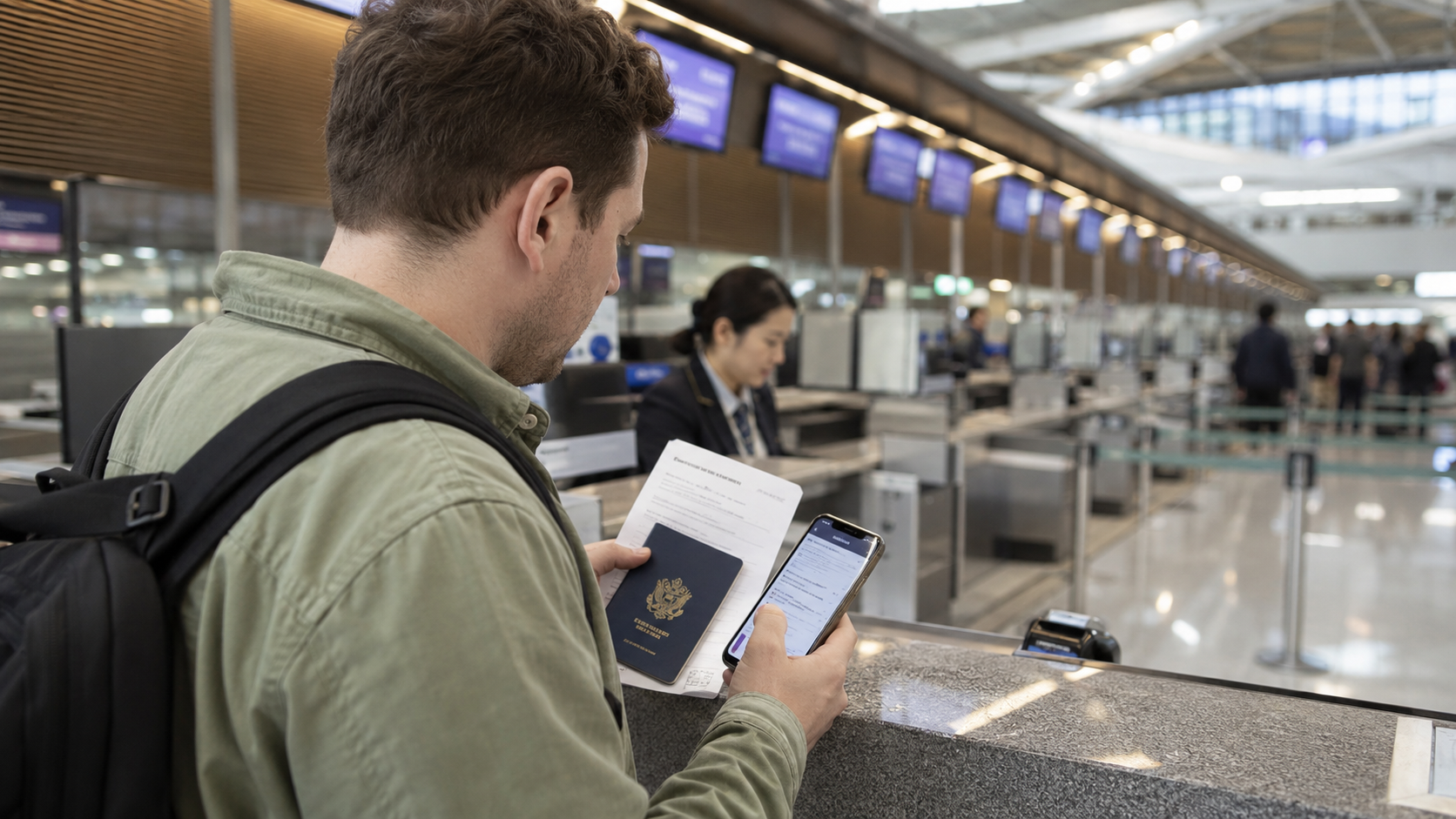
The e-Arrival Card is Korea’s online immigration entry declaration. It is separate from K-ETA and does not provide travel authorization.
In principle, foreign nationals entering Korea must submit an arrival declaration. According to the official e-Arrival Card eligibility guide, common groups that need to submit include:
- Travelers entering with an individual Korean visa
- Travelers whose nationality is temporarily exempt from K-ETA
- Visa-free travelers who are otherwise exempt from applying for K-ETA
Common exemptions include:
- Holders of valid K-ETA approval
- Holders of a valid Korean Residence Card, Permanent Resident Card or Overseas Korean Resident Card
- Certain group-visa holders
- Qualifying airline crew and other specifically listed categories
Submit the form through the official Korea e-Arrival Card website. It is available starting three days before arrival, calculated in Korea Standard Time, and is free.
You will need:
- A valid passport
- A working email address
- Arrival date and flight or vessel number
- Your address and contact details in Korea
- Your purpose of entry
- Your occupation
- Departure details, if available
The submission expires 72 hours after it is filed. If you do not enter Korea during that period, submit a new form. You can edit most travel and accommodation information before immigration inspection.
You normally do not need to print the confirmation, but keeping a screenshot or the issue number is sensible in case an airline employee or immigration officer asks about it.
Since May 6, 2026, the submission process has included an email verification-code step. Use an inbox you can access while traveling.
Avoid paid or imitation arrival-card sites
The Ministry of Justice warned again in March 2026 that fraudulent websites were impersonating the e-Arrival Card service. The official address ends in e-arrivalcard.go.kr, and the service does not request payment information. Close any website that charges a submission fee.
Passport and supporting documents
Your passport must be valid when you enter Korea. Requirements can also be affected by your visa, transit country and airline, so check all three before departure. If your passport is close to expiry, renewing it before an international trip is the lowest-risk option.
Carry or save offline copies of:
- Your return or onward booking
- Your first accommodation address and telephone number
- Your full itinerary or invitation details, where relevant
- Evidence of sufficient funds for the visit, if requested
- Your visa grant information or K-ETA approval
- Documents supporting your stated purpose of travel
Immigration officers may ask where you are staying, how long you will remain and what you plan to do. Give direct answers consistent with your visa or visa-free status.
Dual nationals and Korean citizens
A person who holds Korean nationality is generally expected to undergo Korean immigration procedures using a Korean passport. This can apply even when the traveler also holds another country’s passport.
Questions involving dual nationality, military-service obligations or loss of Korean nationality can be legally complex. Contact a Korean embassy or the Korea Immigration Contact Center rather than relying on general travel advice.
Health and Q-CODE requirements
Korea does not require every arriving traveler to complete Q-CODE. Current requirements are based on recent presence in designated quarantine areas and, in some cases, symptoms.
According to the Korea Disease Control and Prevention Agency Q-CODE guidance, Q-CODE applies to:
- Travelers who departed from, stayed in or transited through a strict quarantine inspection area
- Travelers who visited a designated quarantine inspection area and have symptoms such as fever or cough
The designated areas can change quarterly. Check the KDCA guidance shortly before travel, including any country where you had a transit stop.
When applicable, Q-CODE can be completed from seven days before arrival. It collects itinerary, stay, quarantine and health information and generates a QR code for presentation or scanning at quarantine inspection.
If you develop fever, cough, rash, severe diarrhea or another significant infectious-disease symptom during travel, report it honestly to the quarantine officer. Health screening requirements are separate from visa and immigration permission.
Customs, food and medication
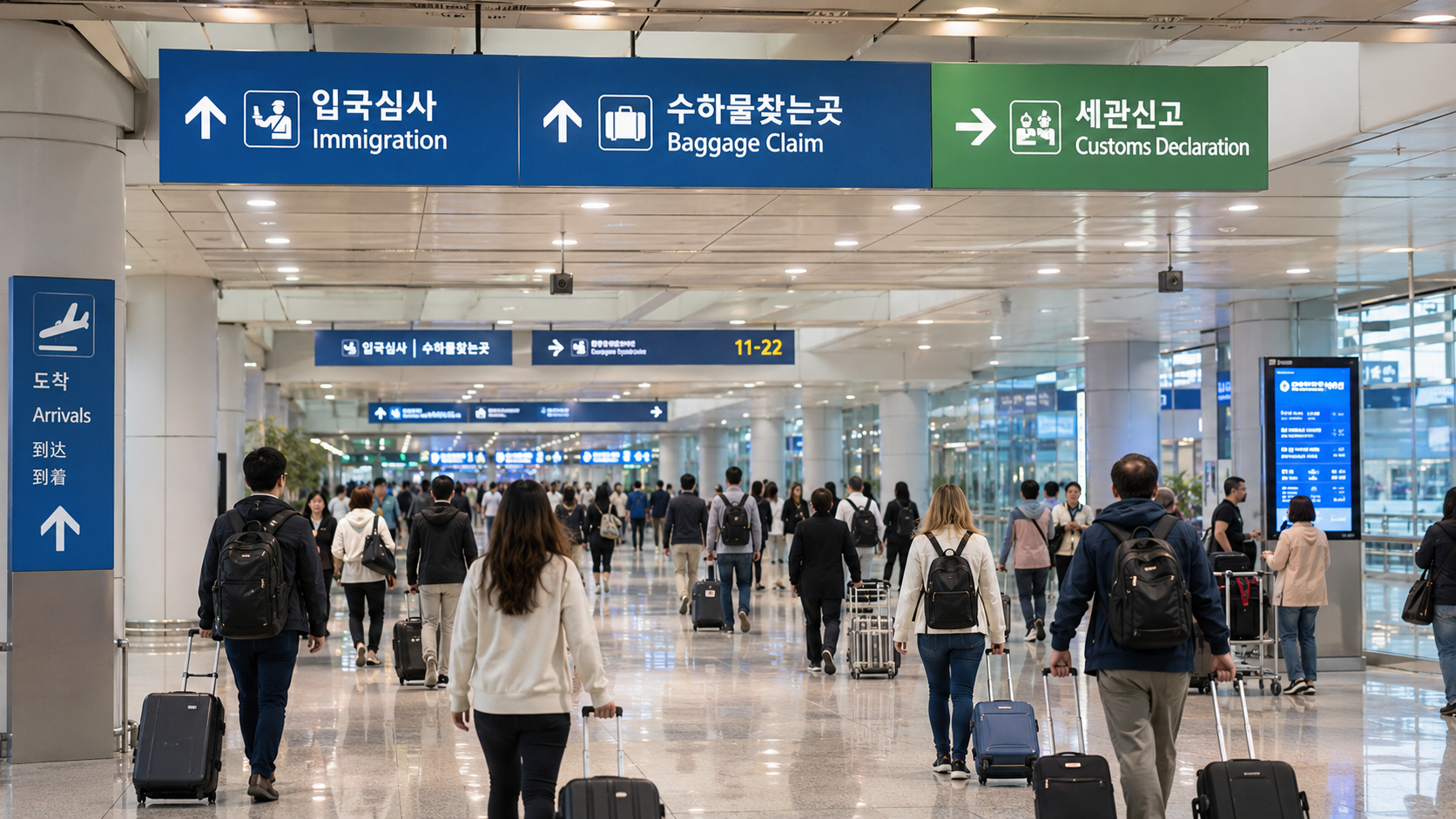
Immigration admission and customs clearance are separate processes. Even travelers with nothing to declare must follow the airport’s customs route and instructions.
According to the Korea Customs Service passenger guide, verified on June 9, 2026, the general duty-free allowance for goods is US$800 in taxable value. Separate allowances include up to two liters of alcohol with a total value no higher than US$400, 200 cigarettes and 100 milliliters of perfume. Age restrictions apply to alcohol and tobacco allowances.
Declare items such as:
- Goods exceeding duty-free allowances
- Commercial goods or samples
- Cash or other means of payment exceeding US$10,000
- Meat, animal products, fruit, vegetables, plants, seeds and other agricultural products
- Firearms, weapons or related components
- Controlled medicines or drugs that may be misused
- Wildlife products covered by CITES restrictions
Food that appears harmless, including meat snacks, fresh fruit or homemade products, may require declaration or quarantine inspection. When uncertain, declare it.
For prescription medication, keep it in its original packaging and carry a copy of the prescription or a doctor’s letter. Rules for narcotics and psychotropic medicines are stricter; confirm permission with Korea’s Ministry of Food and Drug Safety before travel.
What happens at immigration?
Follow signs for foreign-passport immigration after quarantine procedures, if any. Have your passport ready and remove hats, masks or glasses if instructed for facial identification.
The officer may:
- Scan your passport and check your visa, K-ETA or visa-free eligibility.
- Review your arrival declaration and travel details.
- Take fingerprints and a facial image where required.
- Ask about your accommodation, departure date or reason for visiting.
- Grant a period of stay or refer you for additional inspection.
Additional questioning does not automatically mean entry will be refused. Keep your supporting documents accessible and answer accurately.
Do not assume you received a physical entry stamp. Check your admitted period through any entry record or documentation provided, and do not remain beyond the authorized date.
Common mistakes to avoid
- Applying for K-ETA when your trip actually requires a work, study or long-term visa
- Assuming every visa-free nationality receives 90 days
- Using a third-party K-ETA or e-Arrival Card website
- Submitting the e-Arrival Card too early, causing it to expire before arrival
- Entering a hotel name without its full Korean address or telephone number
- Forgetting that a new passport invalidates the K-ETA linked to the old passport
- Failing to update changed travel information
- Packing meat, fruit, plants or controlled medicine without checking declaration rules
- Assuming visa or K-ETA approval guarantees entry
What to check before you go
Two to four weeks before departure
- Confirm visa-free eligibility and permitted stay through the Visa Navigator.
- Apply for the correct visa if your purpose is not covered by visa-free entry.
- Apply for K-ETA if required; do not wait for the 72-hour minimum.
- Check passport validity and any transit-country requirements.
- Confirm medication and agricultural-product restrictions.
Within seven days of arrival
- Check current KDCA quarantine-area designations.
- Complete Q-CODE if your itinerary or symptoms make it necessary.
- Save your accommodation’s full address and telephone number.
Within three days of arrival
- Submit the free e-Arrival Card if required.
- Verify that your passport number, arrival date and flight number are correct.
- Save the confirmation issue number or screenshot offline.
Before boarding
- Carry your passport, visa or K-ETA details and onward itinerary.
- Check for last-minute notices from your airline and Korean authorities.
- Make sure your stated travel purpose matches the permission under which you are entering.
FAQ
Do US, Canadian, British or Australian tourists need K-ETA in 2026?
These nationalities are among those temporarily exempt through December 31, 2026, as verified on June 9, 2026. Eligible travelers normally need to submit the free e-Arrival Card instead unless they already hold valid K-ETA approval or qualify for another exemption.
Is the e-Arrival Card a visa?
No. It is an immigration declaration. It does not replace a visa or required K-ETA approval.
Can I complete the arrival form at the airport?
The official online form can be submitted during the three-day window before arrival. Completing it before departure is more practical because you will need internet access, email verification and your Korean accommodation details.
Do children need entry documents?
Yes. Each child needs a valid passport and must independently meet Korea’s visa or visa-free rules. Children aged 17 or younger are generally excluded from K-ETA, but may still need an e-Arrival Card. Airlines or border authorities may request consent or relationship documents when a minor travels alone or with only one parent, so check with the airline and relevant authorities.
Who can answer a case-specific immigration question?
Contact the Korea Immigration Service, your nearest Korean embassy or the Immigration Contact Center. From overseas, the listed numbers are +82-2-1345 and +82-2-6908-1345 to 1346.
Your practical next step is to open the official Visa Navigator with the exact passport you will use, confirm your permitted stay and purpose, and then check the K-ETA website for an exemption or application requirement.
Sources
- Korea Visa Portal and Visa Navigator
- Official K-ETA application guide
- Ministry of Foreign Affairs notice on the K-ETA exemption through December 31, 2026
- Official Korea e-Arrival Card service
- Official e-Arrival Card eligibility guide
- Korea Disease Control and Prevention Agency Q-CODE guidance
- Korea Customs Service passenger clearance guide
- Korea Immigration Service English website