Living in Korea is often convenient, but that convenience depends on being properly connected to local systems. A Korean phone number, residence card, bank account, registered address, and correctly formatted name can affect everything from online shopping to hospital registration. Housing deposits are unusually important, rubbish rules are local, and apparently simple tasks may require several linked forms of identification.
The details below were checked against official sources on June 10, 2026. Immigration, insurance, banking, and housing requirements can change, so confirm rules that apply to your visa and municipality.
At a glance
| What surprises newcomers | What to do |
|---|---|
| Online services may require Korean identity verification | Keep your name identical across your residence card, phone contract, and bank records |
| Rent can involve a substantial deposit | Verify the property and owner before transferring money |
| Moving has administrative consequences | Update immigration, banking, insurance, employer, and utility records promptly |
| Rubbish bags and collection rules vary by district | Ask your building manager or district office before disposing of waste |
| Management fees can materially increase housing costs | Request previous bills before signing a lease |
| Disaster alerts may arrive only in Korean | Install the multilingual Emergency Ready app |
| English service varies even within the same organization | Save official foreign-language helplines and allow time for in-person visits |
1. Your local identity is an interconnected system
A residence card is more than proof of immigration status. Its foreign resident number and registered name are used across banking, mobile communications, insurance, employment, and online identity checks.
Small inconsistencies can cause large problems. A mobile carrier might record your name with spaces while your bank removes them, or a website might expect your surname and given names in a different order. The result can be a failed verification screen even when every number is correct.
When opening accounts or signing contracts:
- Use the exact Romanized name printed on your residence card.
- Ask staff to show you how the name appears in their system.
- Avoid casually adding or removing spaces, hyphens, or middle names.
- Keep your Korean phone number registered in your own name.
- Update connected services after replacing a residence card or changing your legal name.
Do not assume that a passport alone will unlock every local service. Some functions remain limited until your residence registration, phone contract, and bank records are active and aligned.
Hi Korea, the official immigration portal, provides online applications, appointment reservations, card-validity checks, office information, and immigration guidance. Its multilingual Immigration Contact Center is available by calling 1345 without an area code within Korea. These contact details were verified on June 10, 2026.
2. Moving is an administrative event, not just a change of apartment
Your immigration record contains a registered place of stay. After moving, you may need to report the new address and update other organizations separately. The reporting method, deadline, and required evidence can depend on your status and circumstances.
Because late reporting may have consequences, confirm the current procedure through Hi Korea's immigration and stay guide or call 1345 before or immediately after moving. Do not rely only on a landlord, university, employer, or estate agent to handle it.
Prepare documents such as your residence card, passport, signed lease, and proof that you occupy the new address. Ask whether the report can be completed online, at immigration, or through the local administrative office responsible for your address.
Also update your:
- Employer or university
- Bank and card companies
- Mobile carrier and internet provider
- National Health Insurance Service
- Electricity, gas, and building-management accounts
- Delivery apps and frequently used shopping sites
Keep a scanned copy of the final lease and proof of every address update.
3. Housing costs more than the advertised monthly rent
Korean rental listings usually emphasize the deposit and monthly rent, but these are not the whole cost.
Wolse (월세) means monthly rent with a deposit. Jeonse (전세) generally involves a much larger lump-sum deposit and little or no monthly rent. The Seoul Metropolitan Government's housing guide explains these basic structures and notes that deposits are normally returned at the end of a lease, less applicable unpaid charges or other deductions.
A listing may also exclude gwanribi (관리비), the building-management fee. Depending on the property, this can cover common-area cleaning, security, lifts, internet, water, shared electricity, or other services. Gas, private electricity use, parking, and heating may still be separate.
Before signing, request:
- A written list of what the management fee includes.
- Recent summer and winter utility bills for the unit.
- The exact payment date and permitted payment method.
- Rules for early termination and finding a replacement tenant.
- An inventory of furniture and appliances.
- Written confirmation of who repairs the boiler, air conditioner, plumbing, and supplied appliances.
Take timestamped photographs and video when you move in. Record scratches, mould, damaged wallpaper, blocked drains, faulty appliances, and meter readings. Send the record to the landlord or agent in writing instead of keeping it only on your phone.
4. A large deposit should never be treated casually
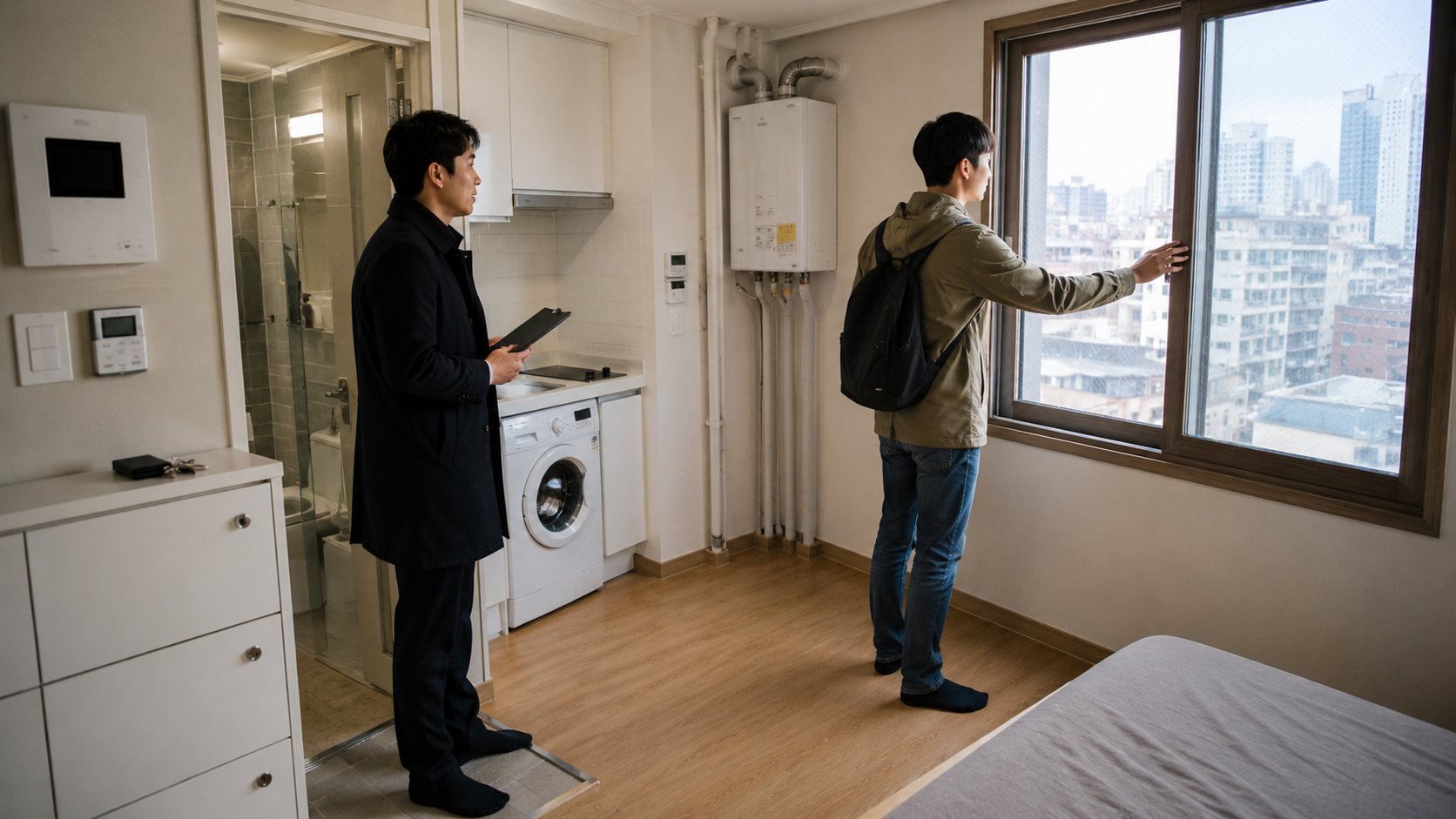
Paying a large housing deposit simply because the estate agent appears professional is risky. Confirm the identity of the owner, the property's official records, existing claims against the property, the legal status of the building, and the protections available for your lease before transferring substantial funds.
Use a licensed real-estate office and obtain receipts. Make sure the account receiving the deposit belongs to the appropriate party; if it does not, demand a documented legal explanation before paying. Never accept verbal assurances as a substitute for checking documents.
Ask an independent Korean-speaking adviser, university housing office, relocation specialist, or public counseling service to review the contract if you do not understand it. This is especially important for jeonse and other high-deposit arrangements.
Housing law and deposit protection are legal matters. For current official guidance, contact your local government housing service or the relevant national authority rather than relying on social-media posts. Seoul residents can also contact the city's 120 Dasan Call Center; availability of foreign-language assistance can vary by time and service.
5. Your apartment may behave differently in each season
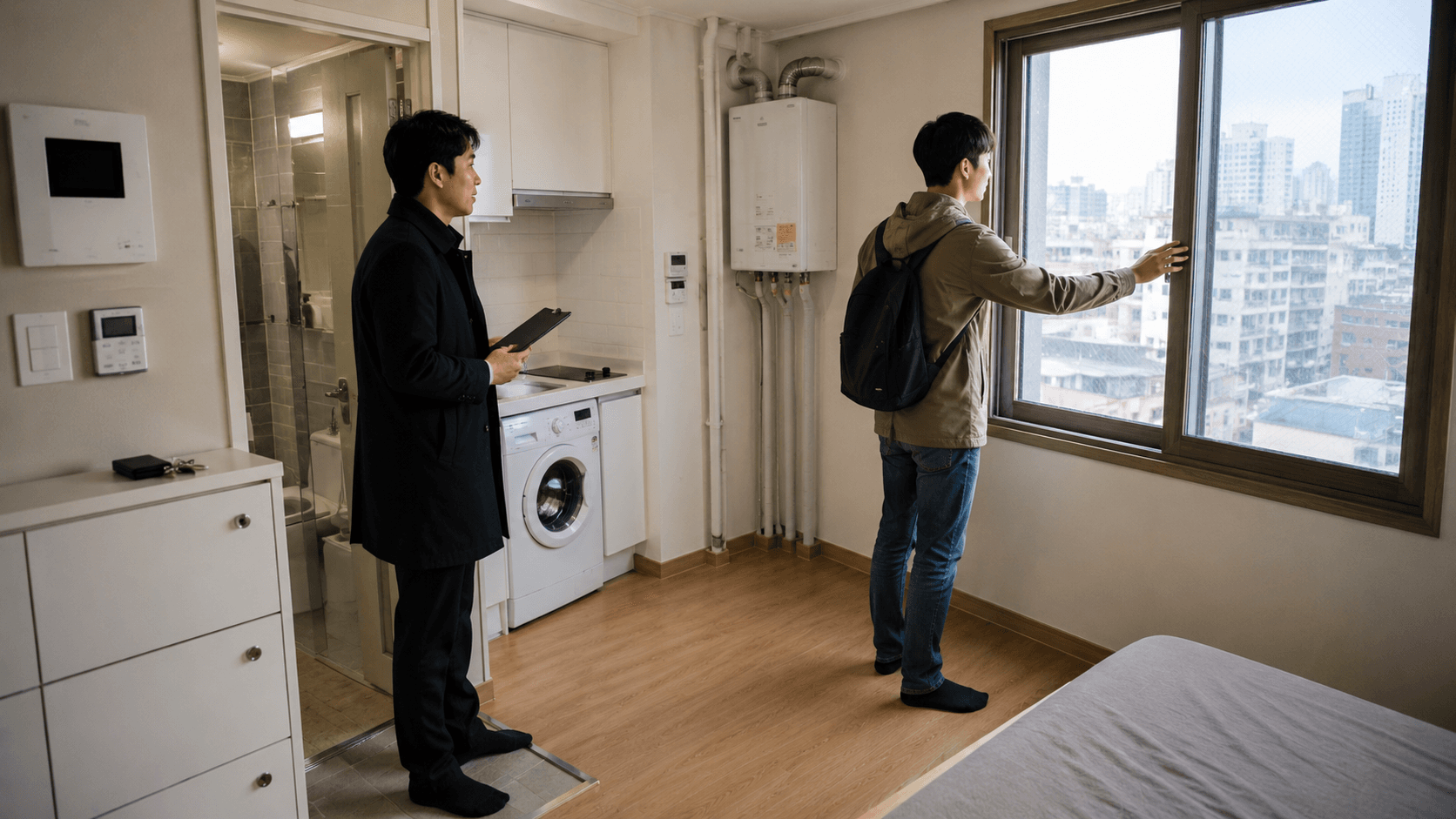
Korean homes commonly use ondol (온돌) floor heating, usually controlled through a wall-mounted boiler panel. The controls may separately manage room heating and hot water, and translation apps do not always interpret the labels accurately.
Ask for a demonstration before the weather turns cold. Photograph the panel, model number, and boiler service label. Learn how to recognize normal boiler sounds and where the water and gas shutoff valves are located.
Summer creates a different problem. High humidity can cause condensation and mould, particularly in basement or semi-basement rooms, poorly ventilated bathrooms, exterior walls, and spaces behind large furniture.
Practical precautions include:
- Check window frames, wallpaper edges, wardrobes, and the area beneath the sink before signing.
- Leave space between furniture and cold exterior walls.
- Use ventilation and a dehumidifier when necessary.
- Run the bathroom fan after showering.
- Report leaks or recurring dampness in writing.
- Do not cover serious mould with new wallpaper without investigating the moisture source.
These are practical housing precautions, not a substitute for professional building or medical advice.
6. Rubbish disposal is local and closely organized
You generally cannot place all household waste in any plastic bag. Ordinary rubbish commonly requires municipality-approved volume-based bags, while recyclables, food waste, clothing, and oversized items follow separate procedures.
The exact bag design, collection point, permitted disposal time, and recycling categories vary by municipality and sometimes by building. Bags bought in one district may not be accepted in another.
On your first day, ask your landlord, building manager, dormitory office, or district office:
- Where ordinary rubbish goes
- Which official bags to buy and where to buy them
- How food waste is collected
- How to dispose of glass, cans, plastic, vinyl, paper, and polystyrene
- Whether labels must be removed or containers washed
- How to register and pay for furniture or appliance disposal
- Which days and times collection is allowed
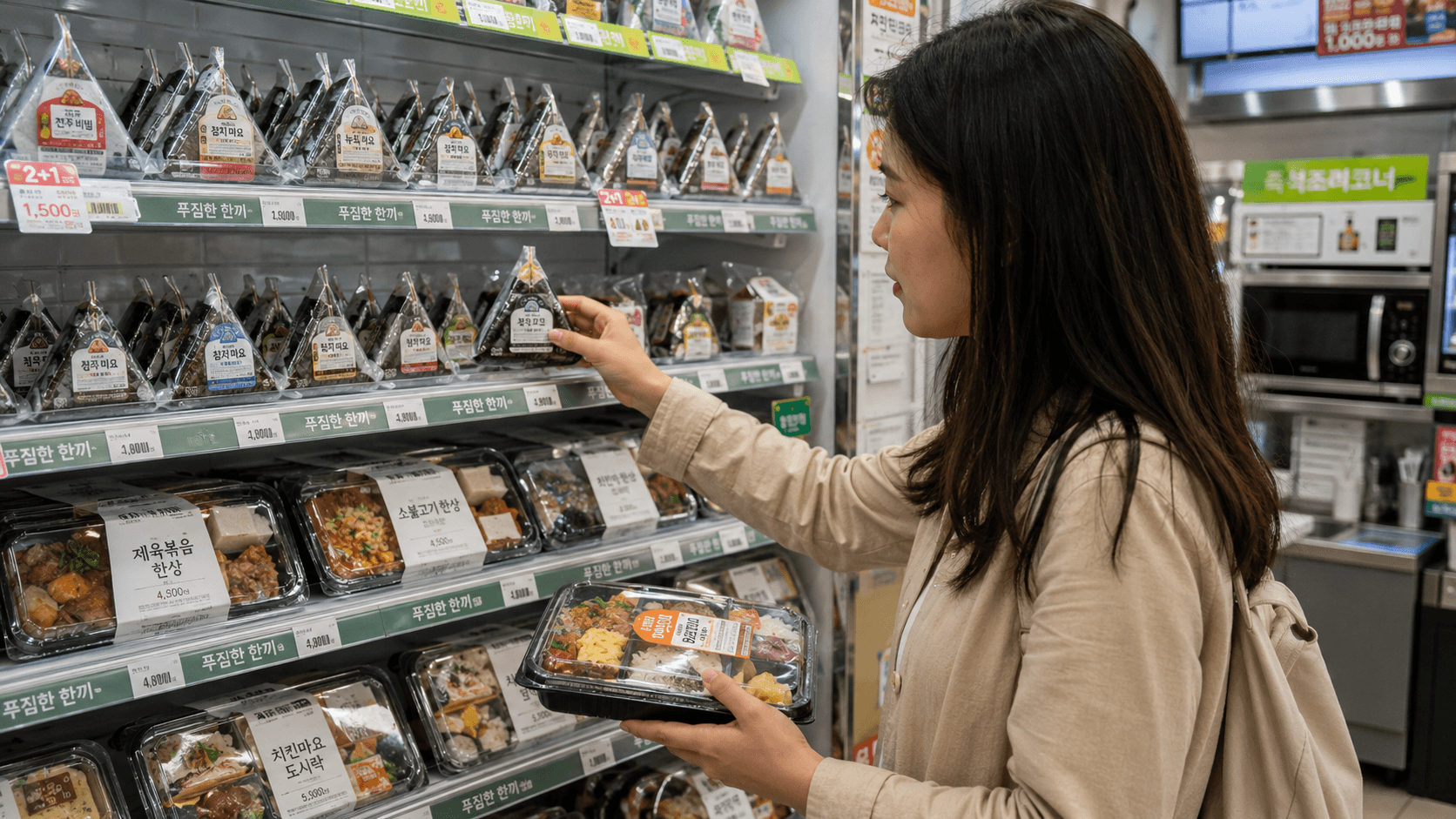
Convenience stores and supermarkets often sell official rubbish bags, but you may need to request them at the counter. Show staff a photograph of the required bag if language is a problem.
Do not leave a mattress, chair, suitcase, or appliance beside the bins without checking the bulky-waste procedure. Many municipalities require advance registration and a paid disposal label or confirmation number.
7. Banking access does not mean every feature works immediately
Banks apply their own document and risk-review requirements. A branch may request a passport, residence card, Korean phone number, proof of address, employment or enrollment documents, and evidence explaining the account's purpose. Requirements can differ by bank, branch, visa status, and requested service.
New accounts may initially have transfer or withdrawal limits. Internet banking, overseas remittance, debit cards, and authentication tools can require separate activation. Ask specifically about each feature instead of assuming it is included.
The Seoul Metropolitan Government's banking guide lists common documents but also notes that institutions may impose different requirements. Because banking procedures are time-sensitive, confirm them directly with the chosen bank; this guidance was checked on June 10, 2026.
Bring originals, not just phone photographs. Schedule extra time, and avoid visiting shortly before you need to pay a deposit or receive a salary.
8. Healthcare is accessible, but insurance and language require planning
Foreign employees at covered workplaces are generally enrolled through their employer, while other foreign residents may be subject to different eligibility and enrollment rules. Exemptions can exist in limited circumstances. The National Health Insurance Service guidance for foreign residents should be checked for your status.
The NHIS English consultation number listed on its official site was 033-811-2000 as verified on June 10, 2026. Rules, contributions, and eligibility can change, so ask NHIS directly rather than treating a colleague's situation as precedent.
For routine care, search for the appropriate clinic type rather than automatically going to a large hospital. Bring your residence card or passport, a list of medications and allergies, and your insurance information. International clinics can be useful, but English availability varies by doctor and shift.
For emergencies, call:
- 119 for fire, rescue, or emergency medical assistance
- 112 for police
- 1345 for immigration information, not emergencies
Save your address in both English and Korean, including the building name and unit number. A Korean address is often more useful to dispatchers, taxi drivers, and delivery workers.
9. Official alerts can be confusing until you set up translation
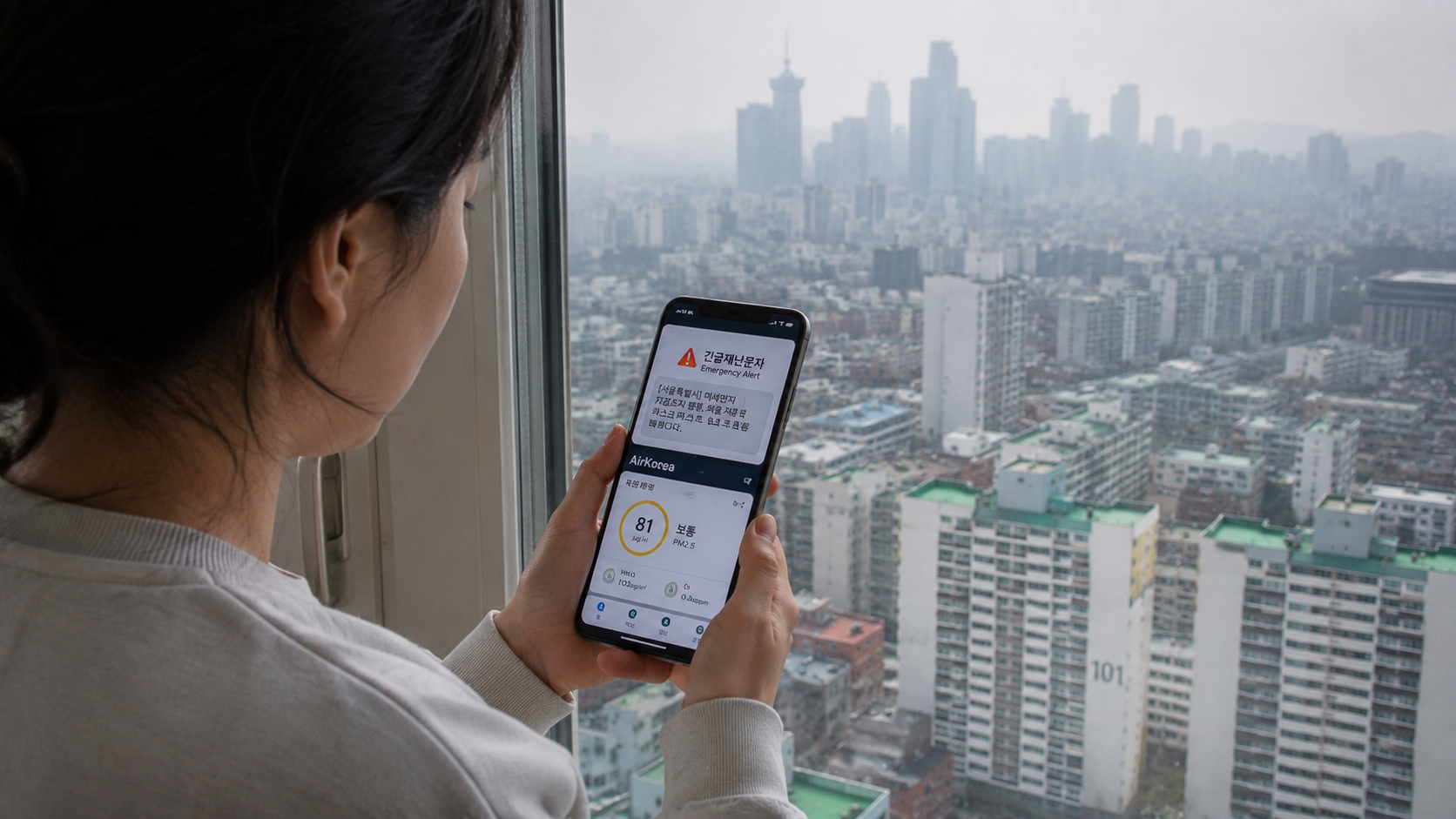
Phones in Korea may receive emergency alerts concerning weather, air quality, missing persons, civil defense, fires, or local hazards. The message can be difficult to understand quickly if it arrives only in Korean.
The official Emergency Ready app guide states that the app offers English, Chinese, and Japanese support along with disaster alerts, safety information, shelter locations, and emergency-facility information. This service information was verified on June 10, 2026.
For pollution data, AirKorea provides government-supported real-time air-quality information and a comprehensive air-quality index. Check local readings before prolonged outdoor exercise, particularly if you have a respiratory or cardiovascular condition. Follow medical advice appropriate to your health.
10. Navigation and addresses require local habits
Korean addresses may appear in road-name and older lot-number formats. Building names, underground exits, apartment complexes, and entrances matter because the pin may not lead to the correct door.
Keep your home, workplace, and university addresses saved in Hangul. Use a Korean navigation service such as Naver Map or KakaoMap alongside any international mapping app, especially for bus stops, subway exits, walking routes, and small businesses.
When meeting someone, share the subway exit number or a clear landmark, not only the station name. Large stations can have exits separated by several blocks, while apartment complexes may contain many buildings with similar numbers.
For taxis or deliveries, show the Korean address and a nearby landmark. Add the building number, floor, unit, and door-entry instructions where appropriate, but avoid sharing access codes publicly.
11. Convenience is often conditional on Korean-language setup
Delivery, reservations, ticketing, second-hand marketplaces, and loyalty programs can be extremely convenient once your account passes local verification. Before that, they may reject foreign cards, overseas phone numbers, nonstandard names, or residence-card details.
Treat the first month as setup time. Prioritize systems in this order:
- Residence registration and address records
- Korean mobile number in your own name
- Bank account and debit card
- Mobile and internet banking
- Health-insurance confirmation
- Navigation, translation, emergency, and transport apps
- Shopping, delivery, and reservation accounts
A translation app is useful, but save screenshots and ask staff to write down important Korean terms. For contracts, immigration, healthcare, or financial matters, machine translation should not be your only check.
12. Workplace expectations do not replace your legal rights
Communication style and hierarchy vary widely between Korean workplaces. Do not assume that every company expects late-night dinners, unpaid overtime, or constant availability. Equally, do not assume that an informal promise from a manager overrides your written contract.
Keep copies of your employment contract, payslips, working-time records, leave requests, and important messages. If wages, dismissal, statutory allowances, or working conditions become disputed, seek official guidance rather than relying solely on coworkers.
The Ministry of Employment and Labor explains how labor-related petitions can be submitted through the government e-People system. Immigration permission to perform particular work is a separate issue; confirm it with Hi Korea or 1345 before accepting freelance work, changing employers, or adding a second job.
What to check before you go
- Confirm your visa conditions through Hi Korea or the Korean embassy or consulate responsible for your application.
- Prepare original identity, education, employment, and housing documents that your visa or institution requires.
- Check whether documents need apostilles, notarization, or certified translations.
- Arrange temporary accommodation so you are not pressured into signing a lease immediately.
- Budget for a deposit, management fees, utilities, brokerage costs, furnishings, and initial banking delays.
- Save 112, 119, and 1345 in your phone.
- Install Korean navigation, translation, AirKorea, and Emergency Ready services.
- Keep digital and physical copies of your passport, visa documents, lease, and insurance records.
- Ask your landlord about rubbish, heating, mould, deliveries, parking, and building-entry rules before moving in.
Your most useful next step is to create a personal setup checklist based on your visa, city, employer or university, and housing type. Start with immigration registration and a correctly registered phone number; most of Korea's everyday convenience becomes easier once those foundations are in place.
Sources
- Hi Korea official immigration portal
- National Health Insurance Service guidance for foreigners
- Seoul Metropolitan Government housing guide
- Seoul Metropolitan Government banking guide
- Seoul Metropolitan Government Emergency Ready app guide
- AirKorea official air-quality service
- Ministry of Employment and Labor petition guidance