A hanok stay lets you sleep in a traditional Korean house, usually around a courtyard and beneath a tiled or thatched roof. The experience can range from a simple family-run guesthouse with floor bedding to a luxury hotel combining hanok architecture with Western beds, private bathrooms, restaurants, and concierge service.
The important point is that “hanok hotel” is not one standardized accommodation category. Check the room itself, not just photographs of the exterior. Confirm the bed type, bathroom arrangement, soundproofing, luggage access, meals, and cancellation terms before booking.
Information and links in this guide were verified on June 11, 2026. Room prices, property policies, and transport arrangements can change, so confirm them directly before your trip.
At a glance
| Question | Practical answer |
|---|---|
| What is a hanok? | A traditional Korean house, typically built around timber frames, tiled or thatched roofs, courtyards, and floor-level living spaces. |
| Do you sleep on the floor? | Often, but not always. Some rooms use Korean floor bedding, while modern and luxury properties may have Western beds. |
| Are bathrooms private? | Many renovated properties have private bathrooms, but older guesthouses may use shared facilities. |
| Is floor heating available? | Usually. Modern hanok accommodation commonly uses heated floors inspired by ondol (온돌), Korea’s traditional floor-heating system. |
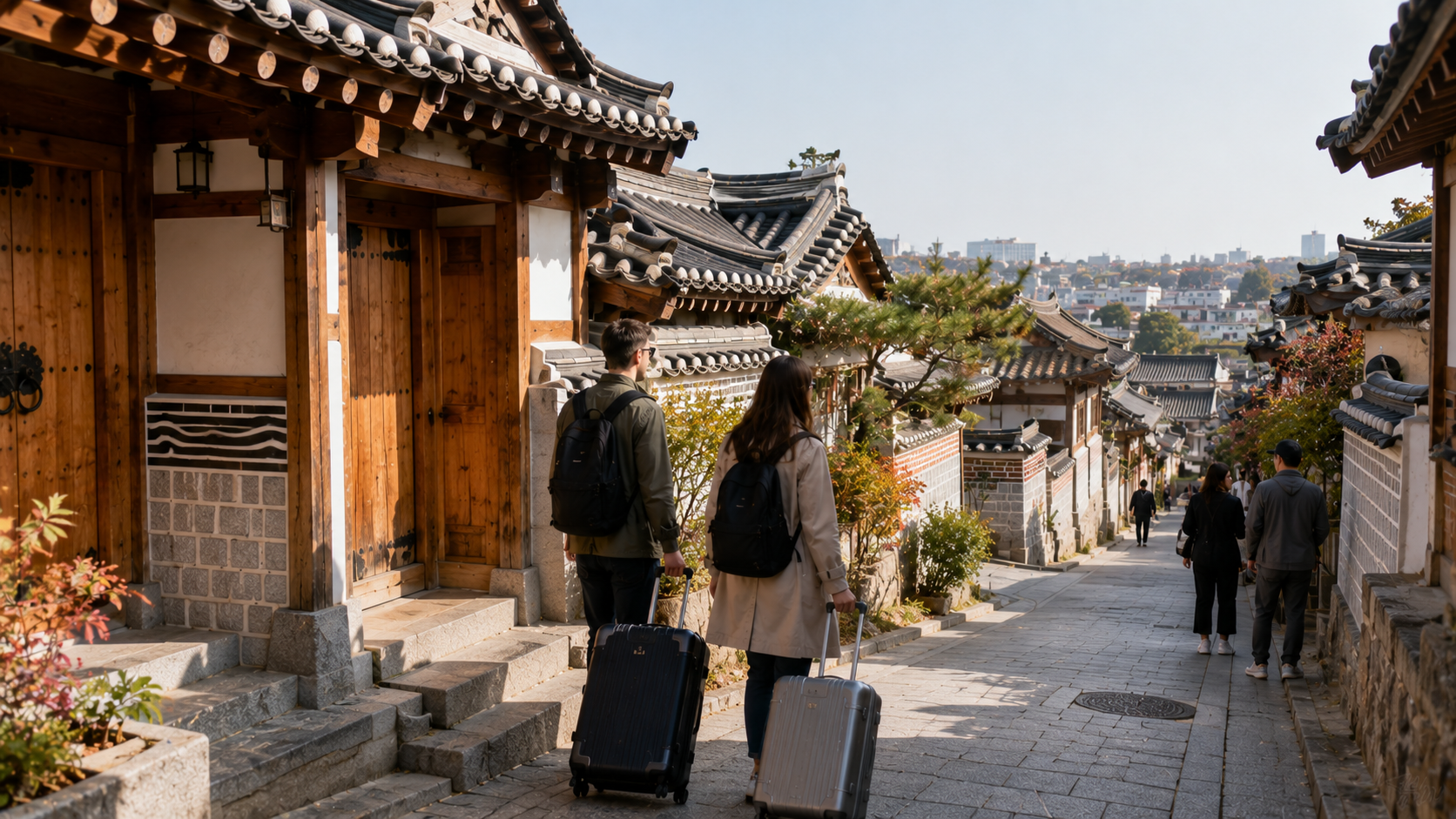
| Is a hanok suitable for large luggage? | Sometimes, but narrow lanes, steps, low thresholds, and limited storage can make large suitcases inconvenient. |
| Where are the main areas? | Seoul, Jeonju, Andong, Gyeongju, and several smaller historic villages. |
| How long should you stay? | One or two nights is enough for most first-time visitors. |
What staying in a hanok is actually like
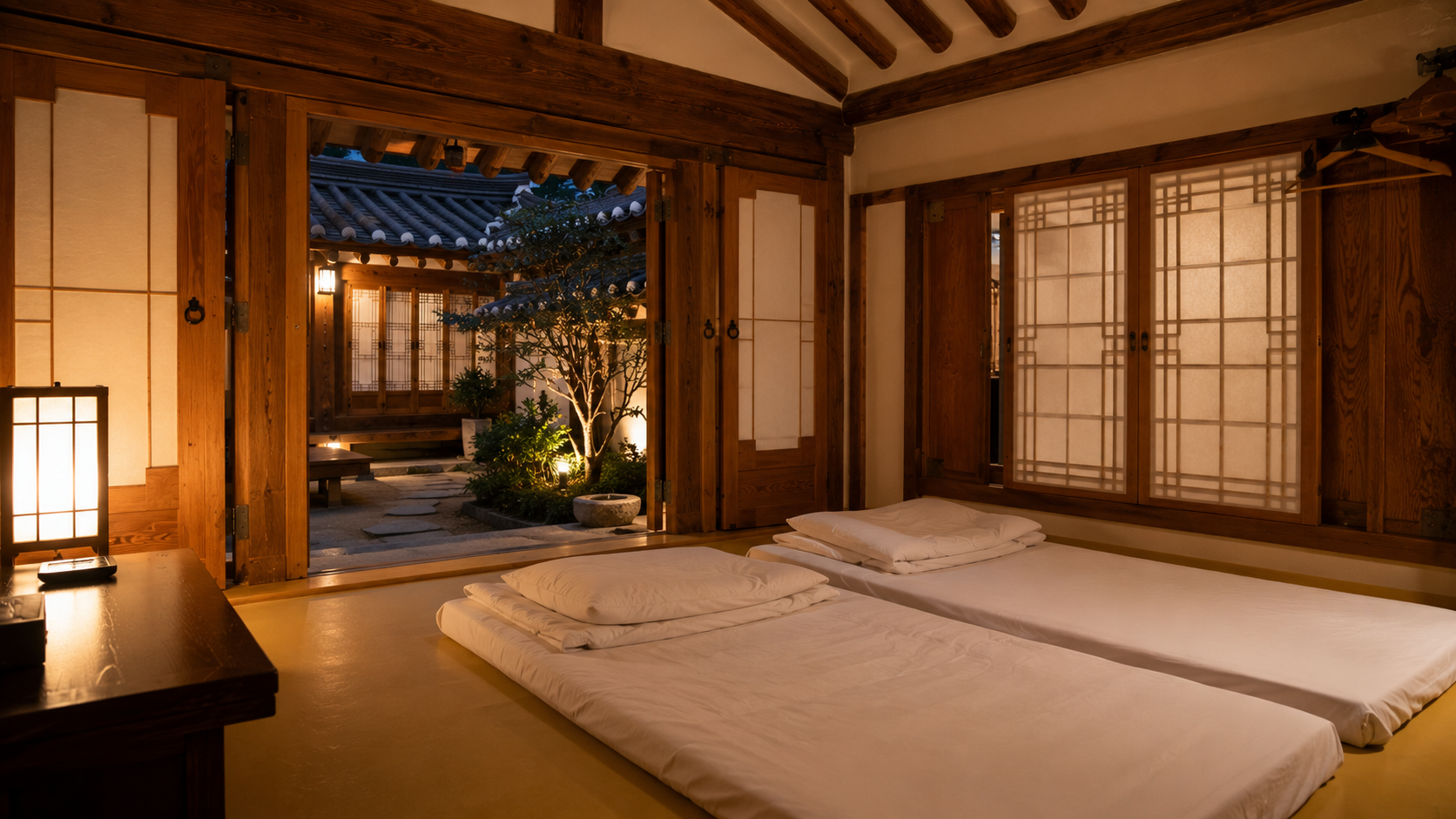
Traditional rooms are arranged for floor-level living. Guests normally remove their shoes at the entrance and may sit, eat, and sleep close to the heated floor. A room described as ondol usually provides a mattress pad or quilt called a yo (요), bedding, and pillows that are laid out at night and folded away during the day.
Floor bedding can be comfortable when the mattress is thick and the floor temperature is well controlled. However, it may not suit travelers with knee, hip, or back problems. Ask for the mattress thickness and whether additional bedding is available. Do not assume that a “traditional room” contains a raised bed.
Wooden doors, paper-covered panels, compact courtyards, and interconnected buildings create atmosphere, but they also affect privacy. Older structures may transmit conversations, footsteps, doors, and courtyard noise more easily than modern hotels. Quiet hours matter, especially in small properties where several rooms face the same courtyard.
Renovated hanok can contain air conditioning, Wi-Fi, refrigerators, modern plumbing, and ensuite bathrooms without changing the exterior appearance. Others deliberately retain simple facilities. The booking page should be treated as a room specification, not merely inspiration.
The main types of hanok accommodation
Family-run hanok guesthouses
These are generally small properties with only a few rooms. The owner may live on the premises, manage check-in personally, and serve a simple breakfast. English support varies, and reception may not operate continuously.
This type works well for travelers who value the building and neighborhood over hotel services. It is less suitable if you need a staffed front desk, late-night arrival, extensive luggage storage, or guaranteed English assistance.
Heritage houses and village stays
Some stays operate in historic residences or protected village settings. These can provide the strongest sense of place, but preservation requirements may limit structural alterations. Bathrooms might be in an annex, entrances may have high thresholds, and vehicle access can be restricted.
The surrounding community may still be residential. Guests should keep voices low, avoid photographing private interiors without permission, and follow restrictions on food, smoking, and open flames.
Modern hanok hotels
Modern hanok hotels use traditional architectural forms while providing facilities closer to those of a conventional hotel. Rooms may include Western beds, larger private bathrooms, climate control, restaurants, room service, and accessible public areas.
They are usually the easiest choice for travelers who want hanok design without floor sleeping or shared facilities. Nevertheless, confirm whether your particular room is in a traditional-style building and whether it has a bed or floor bedding.
Private-house rentals
A whole-house rental provides greater privacy and may include a kitchen or private courtyard. It can be practical for families and groups, but services are often limited. Check occupancy rules carefully: traditional rooms may be compact even when the listing permits several guests.
Also confirm whether the property is legally registered accommodation, how check-in works, and whether the host can assist if heating or door-lock problems arise.
Where to book a hanok stay
Seoul: convenient but usually compact
Seoul is the easiest option when a hanok night must fit into a broader city itinerary. Bukchon, Seochon, and neighborhoods around Anguk and Jongno place guests near royal palaces, museums, restaurants, and subway stations.
Bukchon Hanok Village contains residences as well as guesthouses and cultural businesses. It is not an open-air museum. The Korea Tourism Organization lists visitor hours of 10:00-17:00 for the controlled section along Bukchon-ro 11-gil, verified on June 11, 2026. Registered overnight guests should still follow instructions from their accommodation and respect neighborhood quiet rules.
Seoul hanok rooms tend to be smaller than rural properties, and taxis may not reach the front door on narrow lanes. Ask for a walking route from the nearest road or subway exit. The official Seoul Hanok Portal provides background on the city’s hanok neighborhoods.
Choose Seoul when convenience is the priority and one atmospheric night is enough. It is also a practical option for travelers who do not want to reorganize an intercity itinerary around a rural stay.
Jeonju: the widest choice for first-time visitors
Jeonju Hanok Village is one of the most straightforward places to compare multiple hanok guesthouses in a walkable area. Accommodation ranges from simple floor-sleeping rooms to renovated houses with ensuite bathrooms and family rooms.
The central location makes it easy to combine a stay with Gyeonggijeon Shrine, Jeondong Cathedral, craft workshops, markets, and Jeonju’s food scene. The tradeoff is activity: central lanes can be busy during the day, particularly on weekends and holidays.
For a quieter night, compare properties on the edge of the village rather than only those beside the main shopping streets. Use the Jeonju City tourism website to check current visitor information and local attractions, then confirm accommodation details directly with the property.
Jeonju is the strongest all-round choice for travelers seeking variety, easy sightseeing, and a destination where staying in a hanok is part of the normal visitor experience.
Andong: heritage and rural atmosphere
Andong is appropriate for travelers more interested in historic landscapes and Confucian culture than nightlife or shopping. Hahoe Village is one of the two communities included in UNESCO’s Historic Villages of Korea: Hahoe and Yangdong World Heritage property.
Accommodation in and around the Andong area may involve restored houses, rural surroundings, and limited evening dining. Check the exact map location carefully. A property using “Andong” or “Hahoe” in its English name may not be within convenient walking distance of the main village entrance or central Andong.
Ask whether dinner must be reserved, when the last practical check-in is, and whether the host offers pickup from a bus stop or station. Travelers arriving without a car should plan the final local connection before confirming a nonrefundable room.
Gyeongju: a cultural stop with mixed accommodation styles
Gyeongju combines Silla-era archaeological sites with traditional and hanok-inspired accommodation. Some properties are restored houses; others are new buildings using tiled roofs, courtyards, and timber details.
This distinction is not necessarily a measure of quality. A newly built hanok-style hotel may provide better insulation, accessibility, and bathrooms, while an older house may offer greater historical character. Decide which matters more to you.
Check the distance from the historic center, Hwangnidan-gil, Daereungwon, and your arrival station. Gyeongju’s attractions are spread out, so an attractive rural property can add considerable taxi time.
Smaller villages: rewarding but transport-dependent
Hanok and traditional-house stays also appear in places such as Asan’s Oeam Folk Village and other rural heritage communities. These stays can be quieter and more personal, but English booking information and public transport may be limited.
Before choosing one, verify the full Korean address, check-in window, meal options, taxi availability, and the host’s preferred communication method. Save the property name and address in Hangul for taxi drivers.
How much does a hanok stay cost?
There is no reliable nationwide standard rate. Prices depend on location, building type, room size, bathroom arrangement, meals, season, and whether guests reserve one room or an entire house. Luxury hanok hotels and private compounds can cost several times more than a small guesthouse room.
Because live rates change by date and platform, no fixed price range is presented here. When comparing prices, check what the total includes:
- VAT and service charges
- Breakfast or dinner
- Maximum occupancy and extra-person fees
- Additional bedding
- Private or shared bathroom
- Entire-house use or one room in a shared compound
- Parking
- Cultural activities
- Cancellation and date-change conditions
A low headline rate may be for two guests even when the room allows four. Conversely, an entire-house rate may look expensive until divided among a group.
How to choose the right room
1. Decide between a bed and floor bedding
Search the room description for “Western bed,” “bedroom,” “ondol room,” or “Korean-style futon.” Photographs can be misleading because bedding may be stored during the day.
Ask directly: “Does this room have a raised bed, or does every guest sleep on bedding placed on the floor?”
2. Confirm the bathroom arrangement
Look for “private bathroom,” “ensuite bathroom,” or “bathroom inside the room.” “Private bathroom” could still mean a bathroom outside the sleeping room but reserved for your use.
Ask whether towels and toiletries are provided and whether the shower is separated from the toilet. Compact Korean bathrooms often use a wet-room layout in which the shower shares the same floor area.
3. Check climate control in both seasons
Ondol heating can make the floor very warm in winter. Ask whether guests can adjust the temperature themselves. In summer, confirm that the sleeping room has its own air-conditioning unit rather than relying only on natural ventilation.
4. Examine access and mobility
Traditional entrances may include steps, raised thresholds, uneven stone paths, and low doorways. Floor seating and bedding also require repeated kneeling or standing without furniture support.
Travelers with limited mobility should request exact photographs and measurements. “Ground floor” does not automatically mean step-free. Confirm the route from the street, bathroom layout, bed height, and availability of chairs.
5. Review luggage arrangements
Ask whether a taxi can stop at the entrance and whether luggage can be stored before check-in or after checkout. A compact hanok room can feel crowded with multiple large suitcases. Keeping one night’s necessities in a smaller bag may be easier.
Booking and check-in checklist
Contact the property before paying if any essential detail is absent from the listing. Use short, specific questions that are easy to translate.
- Is the bathroom private and inside the room?
- Does the room have a raised bed or floor bedding?
- Can the heating and air conditioning be controlled in the room?
- Is breakfast included? Can allergies or dietary restrictions be accommodated?
- What is the latest check-in time?
- Can a taxi reach the entrance?
- Is luggage storage available?
- Are children accepted, and is there a minimum age?
- Are there quiet hours or a curfew?
- Is the room lockable from both inside and outside?
- Which payment methods are accepted on arrival?
- What happens if transport delays the arrival?
Keep the reservation confirmation, Korean address, telephone number, and check-in instructions offline. Small guesthouses may contact guests through a Korean messaging app or an international booking platform rather than email.
Hanok etiquette
Remove outdoor shoes before stepping onto the interior floor. Properties usually provide a designated entrance area, called a hyeongwan (현관), or a wooden threshold where shoes should remain.
Do not drag wheeled luggage across paper flooring, wooden platforms, or sleeping mats. Ask where cases should be placed. Keep food and strongly colored drinks away from bedding unless the host says otherwise.
Courtyards amplify sound. Speak quietly at night, close gates gently, and use headphones rather than playing audio through speakers. Smoking is normally restricted because timber, paper, bedding, and dry landscaping create a serious fire risk. Follow the property’s designated smoking policy.
Never light candles, incense, or portable cooking equipment without explicit permission. Historic houses may also prohibit attaching decorations, moving furniture, or opening architectural panels.
Common mistakes to avoid
- Booking from exterior photographs without reading the room specifications
- Assuming every hanok is an old or protected building
- Expecting hotel-style reception at a small family guesthouse
- Arriving after the stated check-in period without contacting the host
- Assuming an ensuite bathroom includes a bathtub or separate shower stall
- Bringing several large suitcases into a compact floor room
- Underestimating the physical difficulty of floor sleeping
- Choosing a rural property without checking the final bus or taxi connection
- Treating a residential hanok neighborhood as a themed attraction
What to check before you go
Reconfirm the following three to seven days before arrival:
- The exact check-in window and contact method.
- Your room’s bed and bathroom configuration.
- The route from the station or bus terminal.
- Whether taxis can reach the entrance.
- Meal reservations and nearby evening dining.
- Weather conditions and appropriate sleepwear.
- Current cancellation rules and any balance payable at the property.
For urgent tourism assistance in Korea, the Korea Tourism Organization operates the 1330 Korea Travel Helpline, with phone and online contact options. Availability and supported channels should be checked on the official page before relying on the service.
FAQ
Is one night in a hanok enough?
Yes for most first-time visitors. One night provides the architectural and floor-sleeping experience without committing a large part of the trip. Book two nights when the property is itself a retreat, meals or activities are included, or the destination requires a long journey.
Can I stay in a hanok with children?
Often, but policies vary. Courtyard ponds, stone steps, paper doors, low furniture, and thin walls require supervision. Confirm age restrictions, child fees, bedding, and whether other guests share the compound.
Are hanok stays suitable in winter?
They can be particularly comfortable because of heated floors, but temperature control differs by property. Corridors, bathrooms, and detached buildings may feel colder than the sleeping room. Bring sleepwear that can be layered.
Do hanok hotels accept foreign credit cards?
Larger hotels and international platforms generally do, while small guesthouses may have limited payment systems. Confirm the accepted card network, deposit method, and whether any balance must be paid in KRW at check-in.
Is breakfast always Korean?
No. It may be a Korean set meal, porridge, toast, a light self-service meal, or not offered at all. Breakfast hours can be fixed, and small kitchens may not accommodate every dietary request. Confirm before arrival rather than assuming substitutions will be available.
Sources
- Korea Tourism Organization: Bukchon Hanok Village
- Seoul Metropolitan Government: Seoul Hanok Portal
- Jeonju City Tourism
- UNESCO World Heritage Centre: Historic Villages of Korea, Hahoe and Yangdong
- Korea Tourism Organization: 1330 Korea Travel Helpline
Your next step is to choose the destination first, then compare individual rooms using the bed, bathroom, access, and check-in checklist above. The quality of a hanok stay depends less on the word “hanok” in the property name than on whether its actual facilities match your needs.